

Listening Masterclass: How to Understand Native Speakers in Another Language
Struggling with listening? Discover realistic tips, challenge prompts, and the best tools for improving your listening skills as a self-guided language learner

Raise your hand if listening in another language makes you feel like someone hit “fast forward” on real life. No shame in that. For most of us, understanding native speakers at full speed is the Mount Everest of language skills.
But good news: nobody expects you to make it to the summit on day one. Not me, not other learners, not even the slightly-grumpy waiter in Türkiye (Turkey). Let’s break it down together.
Even Bad Listeners Aren’t Hopeless
I'll let you in on a secret: My listening skills aren't really world famous. I have a tendency to guess ahead in conversations and get excited, cut in, intterupt and so on (similar to ADHD symptoms). Hey, it keeps life interesting!
But as with all weaknesses, it's good to work on them a little. I’ve collected a treasure chest of tips that make listening less intimidating – for me and for you.
The Truth About Listening in Other Languages
The difficulty of listening to native speakers talk at their unadjusted speed is HUGELY underrated, it is much much harder than most people think.
Words are not pronounced the way you learnt them. Real native speakers will skip and shorten words, let them run into each other, and link sounds that are invisible on paper.
Your brain can’t process things at full speed because it’s still learning all the sounds and meanings, let alone combining all that with non verbal clues and composing a reply.
You will, I repeat WILL, miss things. Especially before B1. That’s not failure, that’s normal.

Listening from Day 1 is Easy
Here’s a mind-boggling thought: Listening is the one skill you can start from day one. No vocab, no grammar, just pure sound. It’s connected to comfort, confidence, and even better pronunciation down the road.
So my advice really is this: Listen from day 1.
In fact, make that day 1 about learning your new alphabet and copying the sounds you're hearing. Omniglot, for example, has some excellent alphabet resources.
🇩🇪 Want to learn German and improve your listening skills? Get the German Accent & Pronunciation Masterclass to master the full range of German letters, umlauts & special rules.
5–10 Minute Listening Activities for Language Learners
You asked for bite-sized, practical activities – here’s my snack box!
Listen to something every day, but especially content for learners or truly “simple” media. Reality TV works (the dumber, the better), so does kids’ news. Context is your friend and subtitles are welcome.
Try note-taking, even in your native language. Jot down key ideas, repeat and summarize what you hear – don’t obsess over unknown words. I love pen & paper (here’s my language journal guide).
Use transcripts! Many podcasts and videos provide them, and you can easily create your own using AI tools. Read along, or try writing your own version, then compare (trains your ear AND your spelling).
For more AI-powered Listening tips, check out AI Shortcuts for Listening Practice by AI Language Club.Dive into music. It’s fun, memorable, and repetitive. Lyricstraining and Clozemaster both let you play with gaps and missing words in songs, which is an efficient way to squeeze in extra listening practice.
Pick a short audio clip and listen three times in a row. Each time, see if you catch a new word or phrase. (If bored, try speeding it up – your brain can handle more than you think!)
Try This Today: Make a running playlist or queue on your favourite app and add one song/podcast episode in your target language. Listen when you walk, drive, or wash up. If you’re a Spotify user, here is how to learn languages with Spotify.
Use a Vast range of sources
Your target language has many sub-sets of language groups, and in real life situations you may never know which one you are going to encounter. So especially when you work on listening skills, it's important to cast the net wide. Take turns listening to the news, rap songs, local dialects and whatever you can get hold of. To get you started, note that many news services do a simplified language version of their own news casts, for example DW in German, RFI in French or Sveriges Radio for Swedish.
Active Listening (But Not the Overwhelming Kind)
Want to get proactive? Active listening is all about catching the message, not every single word. Trust yourself to guess from the context. If a speaker goes too quickly, don’t panic!
Ask them to repeat, slow down, or point at what they mean. The first few interactions will probably be awkward and a little funny. Stick with it – things get less painful FAST. It’s fun to try, ask them to slow down, try again, point at things, say the words you know.
Mini-Dare: Strike up a short conversation (even just a greeting) in your target language this week. If you blank out or only get 20%, that still counts!
You’ve got this.
Is it really a problem to be daydreaming during your listening sessions?
There are different levels of listening.
What you don’t want to do is set yourself up for failure or disappointment, so before you switch that input on it’s worth focusing on whether you are here
for pleasure
to get the gist
to study
If you’re too tired for study, don’t worry about that aspect and set your expectations differently.
Paying lots of attention, extracting 100% of meaning and nuance, listening in detail
Podcasts often require attention and demand a lot of attention
When you’re listening for study, you will want a transcript!
Listening for the gist, being happy understanding most
TV can be a good practice element for this, where there’s a narrative to follow - films too. Decide if you want scripted or spontaneous dialogue.
Subtitles are absolutely ok, and there are strategies for weaning yourself off them
Understanding very little, “immersion listening” at an early point
I always remember Ron Gullekson’s quote about making himself uncomfortable as early as possible
This is great for exposure, but beware - if it’s just a wall of sound, you’re not doing much good. You need to be able to distinguish where a word starts and ends.
Listening for Training — How To Go About It
Know your target language’s pronunciation rules
Determine what your audio is about, make sure you have some structures and vocab ready to go
Listen without reading, just see what you can get, make your notes, stop and start, vary the speeds
Repeat
Enlist the help of a transcript if available - ideally you do want that transcript there but you can also transcribe the text yourself or summarize it to read it back to a tutor
Discuss with a tutor, get them to ask you questions…or if you’ve got no one on hand, read a translation of the text
Find great tutors at Preply or italki.
Where can you go to find good listening material?
During selection of materials, consider:
Level right for you?
Language register (formal/informal) right for you?
Topic interesting?
Affordable and accessible for you?
What do you need to understand, what do you want to understand?
Remember: “A polyglot cannot survive on audio alone”. Combining with text, visual and even speaking is very crucial for a balanced approach.
Want a deeper dive?
Check out my podcast episodes on this topic for more “real talk” about what works (and what definitely doesn’t).
Q&A: How Can You Train Your Listening Skills?
Can Helpful Notes Cut Your Reaction Time in Conversations?
And, while you’re here, join the Fluent Language newsletter so you don’t miss the next batch of encouragement and practical language wisdom.
How to Speak More Fluently by Building Good Conversation Habits
Ever hit a wall in conversation when trying to speak another language? Discover the different ways that you can handle that wall. Knowing how to handle a conversation breaker means knowing how to keep things flowing, and it’s the only way for you to approach fluency.
No matter if you are new to language learning or you're a certified multilingualist, I bet you know the conversational wall. It's that feeling where you just don’t know how to say something. It could be a missing word, and sometimes you can’t find words for what you’re even trying to say.
The wall creates that awkward moment with your conversation partner, where you just stall the whole thing. You’re running on empty, grasping around for words, and in fact you’re feeling like an idiot. How frustrating it is for an articulate adult to fail when it comes to saying stupid basic things like “I don’t like boiled potatoes” or whatever. How far you have to go!

In today’s blog article, I want to introduce you to the different ways that you can handle that wall. Knowing how to handle a conversation breaker means knowing how to keep things flowing, and it’s the only way for you to approach fluency.
What You Have Tried Before to Get Fluent in a Language
The following three options might all feel pretty familiar and perhaps even helpful to you if you run into one of those walls. But are they really the best way of dealing with the problem?
You’ve Hit More Language Books
Many people who are new to language learning feel like their only way of dealing with the wall is to give up trying to have the conversation and return to the books. The logic is that if you don’t know how to say everything, you obviously haven’t studied enough yet. But in reality, this is a sign that your learning mindset needs a breath of fresh air.
A student once told me “I’ve always been used to excelling at the things I put my mind to. Law exams, university grades, that all didn’t feel so hard to me. So why can’t I ace this language!?”. As his language coach, it’s my duty to remind him of several trap doors that he’s opening up with that kind of thinking.
Firstly, believing that first time mastery is the only way to be a good language learner is a way of closing a door to true growth in your own mind. And moreover, it’s important to recognise that language learning is not only graded by what you remember and express correctly. Creativity, flexibility and conversational confidence play a huge part in fluency and form part of the learning experience.
The key is to understand that you’re not failing when you run into a wall. You are actually succeeding at discovering your skills. Keep on exploring.
You’ve Tried to Change the Topic
Changing the topic may help you save face, hide that panic and manoeuvre your conversation back onto safer ground. Overall, it’s a pretty solid option and one you can try if you are feeling particularly embarrassed. Remember that everyone loves to talk about themselves, so your sneaky way back from the conversation wall is to put the focus back on the person you are talking to. With a little bit of luck, they may even say exactly what you were thinking - and they’ll show you how to express it in your target language.
If this is a good option, why isn’t it the best one? The answer is simple. How many times are you going to change topic before you realize you still haven’t said what you need to say?
You’ve Tried to Look Up Words in Google Translate
The part of you that considers herself a solid and obedient learner will want to do this. The part of you that wants to demonstrate that you are truly accomplished will want to do this. The easy way out of not knowing something is to look it up. Of course! And yet I urge you to consider the negative effects of looking up words every single time.
First of all, your smartphone battery isn’t going to last forever. Secondly, it’s not actually all that polite to keep your conversation partner waiting while you whip out a phone and start googling for an answer. They’re right there! They might just be dying to help you. And thirdly, you’re training your brain to know where to look, but not to remember anything that you are learning. Neither your brain nor your mind will thank you for relying on a lazier way of thinking.
So with all those kind-of-okay options ruled out, what could be the way a truly fluent learner approaches the conversation wall? From my observations in lessons and in my own language learning experiences, it comes down to a few significant shifts in attitude. Remember that Growth Mindset I’m so very fond of? Here is where you use it. Here is where you show your head who’s boss!
Here's How to Be More Fluent in Conversation
Step 1: Walk through the Awkwardness

If you’re a perfectionist or someone who holds themselves to high standards you’re not going to like this option at all. A way through? You mean I’m telling you that you should admit when you don’t know something and sit there all awkwardly looking like an idiot? Yes. That is exactly what I am telling you to do. There are so many learning benefits from finding your way through that awkwardness. First of all, you’ll quickly realise that missing a word in foreign language conversation is a pretty common thing.
My friend Lindsay recently told me about British nursery rhyme We’re Going on a Bear Hunt. In the story, the brave bear hunters encounter all kinds of obstacles. Mud, snowstorms, rivers, everything is in the way. There’s no way under it. There’s no way over it. So they decide to go the only way that they can: through it!
When you are facing your own linguistic obstacles, remember that you can’t go over or under. You’ve got to get through it. That awkward moment when you feel restricted and stupid because you don’t know how to say what’s on your mind? That’s normal. Just notice it’s happening, take a breath and continue to Step 2.
Ideal Step 2: Accept the Challenge
The idea of accepting a challenge sounds like this is a big thing, but I assure you that this is an attitude shift that will become your best new habit within a matter of hours. So you don’t know a word. So someone’s looking at you and waiting for you to say something and you don’t know how. So WHAT! What can you do next? How are you going to go from awkward to outspoken?
Ideal Step 3: Describe What You Want to Say
Okay, here is where you flex your real fluency muscles. A confident foreign language speaker is not intimidated by gaps in her vocabulary. Instead, she will embrace the learning opportunity and look for a way around the gap. The first step to take is to prepare a set of useful fillers in your target language. These filler lines should become as comfortable to you as hello and thank you. You will need them for ever and ever - trust me, I’m so fluent in English and words still fail me on a regular basis.
Good filler expressions include the following:
“I don’t know how to say, but I mean a thing that…"
“Help me out here…how do you say…?"
“You know, it is a little like…"
The key component in a good filler line is that they all allow you to describe the thing you are trying to express. No matter if it’s a noun, verb or expression you are searching for, the key to fluency is in opening yourself up to learning the word from your conversation partner.
It’s absolutely essential to remember that these moments of hitting the wall are where you really show your skills in language learning. Not because you are measured by how many times you encounter the wall, but by how many times you get through it, over it or under it. This is the way that you will have confident conversations in weeks, not years.
So are you ready to start having truly fluent conversations?
Thanks for reading this article on Fluent, the Language Learning Blog. Please share this post on Twitter, Insta, or Facebook using the Share buttons. If you are feeling stuck right now, why not subscribe to Fluent.

How to Fluently Switch From One Language To Another Language
Imagine you're on a train in Belgium. A woman on the train is speaking French on the phone when the ticket conductor comes in. She asks him a question in fluent Flemish. No one bats an eyelid.
Switching effortlessly between languages is a dream for many language learners. But how do you achieve it? Is it a realistic goal? In this article, read and hear my best tips for switching languages.
Imagine you're on a train in Belgium. A woman on the train is speaking French on the phone when the ticket conductor comes in. She asks him a question in fluent Flemish. No one bats an eyelid.
Or a guy at a party is chatting to his friends in Spanish, and suddenly an American friend comes in and he enthusiastically greets her in fluent English.

We've all seen it on TV or even in real life, but have you ever wondered how these super-quick switches between languages work?
Alessia, 17 from Verona has! She sent me this question to answer on the Fluent Show this week.
How to switch quickly from a language to another? Is it just a question of practice?
In answer to Alessia's question, I dove into a bunch of studies and came up with my best tips for anyone who wants to step up their switching.
Looking Into Switching Between Languages
Speedy switches like those I described above are a hallmark of bilingual people. Linguistically, doing this is is called “code switching”. It is very common and has been studied for decades.
Bilinguals do it naturally, for example in environments where there is more than one dominant language or native language. It happens all over the world and millions of people are able to speak bilingually.
Here are three ways you may experience code switching:
Switching a word might look like this: “Dw i’n teimlo yn rili rili wedi blino.“ (I am feeling really, really tired.)
Switching a phrase could be something like this: “Oui, ils offrent des part-time jobs dans leur société." (Yes, they offer part-time jobs at their company.)
Switching between languages after a few sentences, or even saying half a sentence in one and another half in the other.
When you switch into another word, phrase, or sentence, the switch is absolute and your brain is able to do this very quickly.
This has attracted the attention of phsychologists and neurologists too, studying and trying to measure what happens in our brain during such a switch.
Studies show: There are “neurocognitive costs”, for example slower response times. Your brain has to activate the second language (L2) and suppress your dominant main language (L1), and that means it has to concentrate and work hard.
The research also shows that these costs are lower when switching into L2 than when switching into L1. The brain patterns change as your expertise in L2 changes. It also changes depending on whether you’re able to predict that the switch is coming, and whether you’re switching individual words or full phrases.
To get started reading about all the fascinating research, check out the links at the bottom of this article.
How Can You Get Better at Language Switching?
As a learner, your goal might be to use your target language just as easily as you use your first language. But being able to switch like a bilingual person is NOT a good goal for your early language learning stages.
Use it as a vision goal, your inspiration and motivation source. But be honest with yourself and clear about the fact that it’s not going to happen in just a few months.
There’s a huge element of practice involved in switching languages quickly. Sorry, no one likes to hear that there isn’t a secret shortcut!
4 Ways To Practice For Switching
Tip 1: Practice phrases not words so that you build good muscle memory and you can ’think faster’ in your target language.
Tip 2: Listen to input in lots of languages and find bilingual materials too so you can process the language more quickly, for example parallel texts or bilingual podcasts.
Tip 3: Stick to one subject area and one type of conversation at first so you can direct your studies towards the goal of code switching
Here are my 3 Steps for Learning Topical Vocabulary
Tip 4: Practice in comfortable environments.
For example you could create an exercise with a trusted tutor that involves switching.
Or set up a language exchange. This involves switching by offering your skills to someone else and it's usually free. Often, exchanges switch languages after about half an hour, but to spice it up you could switch every 5 minutes.
The ‘price’ of Code Switching As a Bilingual
I’m bilingual in German and English, but make no mistake, my language quality suffers unless I practice.
Here are some of the annoying things that happen.
- My vocabulary in German becomes heavily influenced by my thinking in English and English sometimes shows through. I will use words that I know as dictionary translations of what I want to say in English, but they don’t feel casual enough for how I want to speak in German.
- My German isn’t up to date and I might mix in a word I used as a teenager or an expression that feels a bit 90s.
- English words that I say without thinking, like “actually”, find their way into my German sentences and just bubble up.
- My dialect is heavily reduced and I produce the German language as Hochdeutsch, which is not how I would speak in my home environment.
In other words, I speak an odd “international German”. I was recently called out for having an “englischen Akzent” by a former schoolmate who had not seen me for over a decade. That’s fairly embarrassing.
Episode Links
Study Shows How Bilinguals Switch Between Languages – Association for Psychological Science
Multidisciplinary Approaches to Code Switching - Google Books
Going in and out of languages: Article by François Grosjean and Joanne L. Miller, 1994
The Language Habit Toolkit — The All-in-One System For Meeting Your Goals in Language Learning
Conclusion: Language Shows Who You Are
It’s impossible not to be a product of your environment when it comes to how you speak.
To stay more active in German, I’m subscribing to a German magazine and watching more YouTube so that I hear German on a regular basis. But without living there, I lose a part of my authenticity in German.
Have you ever practiced switching from one language of another? Do you think there's a price to being bilingual?
Leave a comment below to share your thoughts!
What Is Fluency, What Is Mastery...And How Do You Get There?
This week on the Fluent Show, Lindsay and I went deep into what fluency is, adding in a few other words that often feel awkward to use. It's a great conversation, and will provide you with a new sense of clarity and inspiration, so you can confidently go out there and do what you need to do: learn languages and feel great about it!
If there is one question that haunts language learners, it must be this one:
"How many languages do you speak fluently?"
Often asked innocently by people who are interested, it can strike terror in your mind. Will they test you on your languages? Are you allowed to say you're fluent if you still make mistakes?

Oof! Those are heavy questions, and none of them are difficult to answer. Even for those of us who have studied for decades, the question of fluency still causes confusion.
This week on the Fluent Show, Lindsay and I went deep on those questions.
It's a great conversation, and will provide you with a new sense of clarity and inspiration, so you can confidently go out there and do what you need to do: learn languages and feel great about it!
Press play now, and don't forget to leave us a comment below to share what you thought of the show.
Podcast Notes
Our warm-up discussion revolved around the labels we see in our space, and whether they apply to you.
If You Travel And Work On A Laptop, Are You a Digital Nomad?
A digital nomad is a person who travels and works online, right? But for some reason, the term can feel icky to us. In this week's episode, we discussed how some words walk that line between being descriptive and defining.
When being a digital nomad (or "polyglot", y'know..?) becomes a label that you like to put on yourself, it's worth taking a second to consider who that YOU really is underneath. After all, at some point everyone might want to stop travelling and settle up with a nice cat, just two target languages instead of 12, and a garden and a veg patch. And that is super cool, because that's you.
If you thought that this discussion of who YOU are was deep, wait until you hear what we moved on to!
How Will You Get Fluent? How Can You Achieve Mastery?
I have received several messages from listeners recently, asking the Fluent Show to weigh in on how we can achieve goals such as fluency and mastery. And interestingly, each one of them asked another question:
"How do I know when I have achieved it?"
What Is Fluency In A Language?
Our first question came from Evan, and he wondered when one can consider oneself fluent in a language. In the question, Evan considered quite a range of definitions from "making no mistakes" to "dreaming in your target language".
Our discussion starts off with this fluency mindmap I drew:
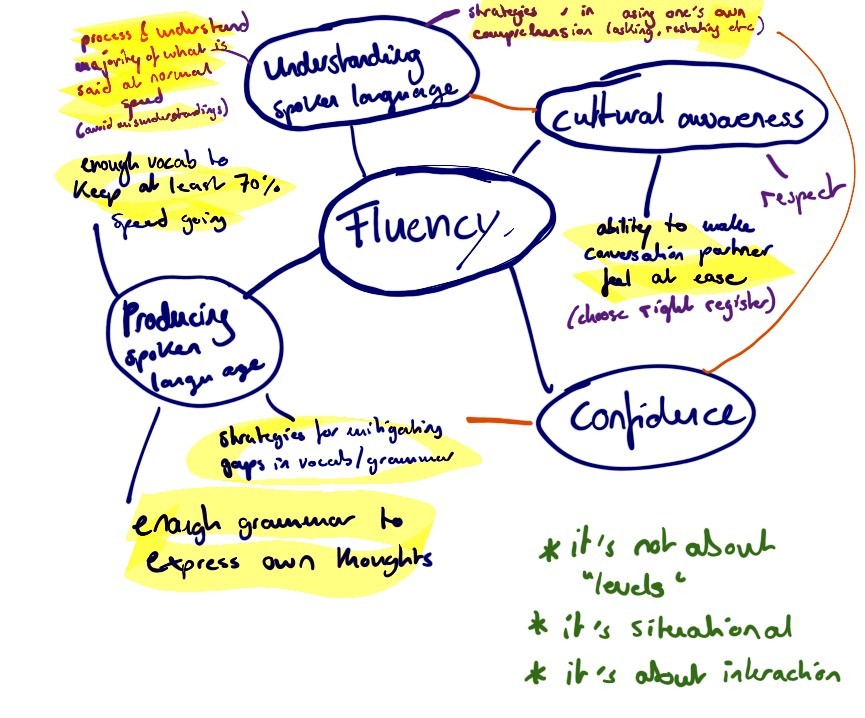
Bet you love my handwriting. Here's more about our take on fluency..
- "Fluency" implies speed and ease when using a language, which comes out most strongly when you're interacting with someone in person
- Usually interacting with someone in person means speaking
- The concept includes intercultural awareness that helps you put your conversation partner at ease and how to interact in a way that is appropriate for their style
- It implies confidence, meaning you have strategies to keep a conversation going
Fluency In A Language Is A Moving Target
Ultimately, your own definition of what fluency means to you is personal and unique. We believe that there are different points of fluency. These can relate to your goals and the purpose of your language learning. They can relate to what you are aiming for next, or what you're finding around you right now.
Just as life is forever changing, you may constantly evaluate your requirements for being "fluent".
What Is Mastery Of A Language?
Moving on from the fuzzy concept of fluency, we turned our minds to "Mastery" and how it is different from the former.
Madeline wrote in and asked:
What counts as mastery? Does every native speaker even possess it?
Our Thoughts on Mastery
This one was even trickier to nail down, believe it or not!
- Mastery is a point of pride and confidence for many, something we actively aim for and
- The word implies comfortable command, being able to use a skill (i.e. a language) with ease
- Mastery includes understanding beyond the literal meaning of the words in a target language
- But it can also imply superiority, like being the best out of everyone who uses that target language. Which isn't quite right in this context.
- For me, mastery is about more than just conversation and personal interaction. It encompasses the four core skills: listening, speaking, reading and writing
Our Conclusion
Both fluency and mastery are wonderful concepts to consider, but as Lindsay says, she is happy to not be fluent or masterful in every language. There is so much to discover and learn, and we can take a lot of joy out of appreciating the way that's ahead of us.
Yes, you can always get better. But there's no point in stressing about whether you are a fluent master - walk your own path, keep moving forward, and allow yourself to feel fluent on your own terms.
What language fluency looks like
On my adventures around Pinterest, I recently came across this image which is filled with thoughts of "language fluency". It addresses a question every learner asks him- or herself lots of times - What exactly IS fluency? So many of you quote fluency as the ultimate learning ambition, so have you defined what it means to you?

Giant beret is not a symbol of fluency
A word about SMART goals
If you have taken on challenges in the past, you may have come across this very corporate acronym before. SMART stands for specific - measurable - achievable - relevant - time constrained. Generally speaking, this is considered to be the best possible way that you can formulate a goal. "Fluency" therefore needs to be made measurable, and it's really important that you try and spell out to yourself what exactly it means to be fluent.
For example, a vague and not very effective goal would be "I want to be able to have a conversation with a French person soon."
Now compare that to this goal, which can be considered worthwhile and functional: "I want to be able to have general small talk about the weather and travel methods (specific and achievable ) with my French aunt (relevant ) when I go and see them in a month (time constrained )." And even with that, the question of how you measure it is not too clearly answered. Measuring fluency is up to you. Like a self-fulfilling prophecy, fluency happens when you believe it's happening.
Checklist - what makes you fluent?
In the image shown above, you can see a few good indicators that you could take as measurements of fluency. For me, these are the most important ones:

- You are able to communicate without hesitation and without long gaps, and feel confident to compensate for words you don't know
- You are secure enough in your understanding of grammar and word order that you can produce sentences without wondering where the words go or what tense the sentence is supposed to be in
- You feel that you connect, share information and understand your partner's responses in a conversation
- You find that using your language brings you a sense of achievement and confidence, which increases your core skills
If you are a language learner or educator, what would you add to this list? Or would you take something out?
Remember it's attitude and skill combined
Finally, there are two parts to becoming that fluent speaker you dream of being. It's in your attitude, trying and going for it without worries of whether your verb endings are spot on or not. But there is also an aspect of practice and expertise, so don't think that with the right attitude you could completely neglect the study part. Once you get both of those up to the right level, you will just know that it's working. Until then....invisible progress.



Struggling with listening? Discover realistic tips, challenge prompts, and the best tools for improving your listening skills as a self-guided language learner