

How to Speak More Fluently by Building Good Conversation Habits
Ever hit a wall in conversation when trying to speak another language? Discover the different ways that you can handle that wall. Knowing how to handle a conversation breaker means knowing how to keep things flowing, and it’s the only way for you to approach fluency.
No matter if you are new to language learning or you're a certified multilingualist, I bet you know the conversational wall. It's that feeling where you just don’t know how to say something. It could be a missing word, and sometimes you can’t find words for what you’re even trying to say.
The wall creates that awkward moment with your conversation partner, where you just stall the whole thing. You’re running on empty, grasping around for words, and in fact you’re feeling like an idiot. How frustrating it is for an articulate adult to fail when it comes to saying stupid basic things like “I don’t like boiled potatoes” or whatever. How far you have to go!

In today’s blog article, I want to introduce you to the different ways that you can handle that wall. Knowing how to handle a conversation breaker means knowing how to keep things flowing, and it’s the only way for you to approach fluency.
What You Have Tried Before to Get Fluent in a Language
The following three options might all feel pretty familiar and perhaps even helpful to you if you run into one of those walls. But are they really the best way of dealing with the problem?
You’ve Hit More Language Books
Many people who are new to language learning feel like their only way of dealing with the wall is to give up trying to have the conversation and return to the books. The logic is that if you don’t know how to say everything, you obviously haven’t studied enough yet. But in reality, this is a sign that your learning mindset needs a breath of fresh air.
A student once told me “I’ve always been used to excelling at the things I put my mind to. Law exams, university grades, that all didn’t feel so hard to me. So why can’t I ace this language!?”. As his language coach, it’s my duty to remind him of several trap doors that he’s opening up with that kind of thinking.
Firstly, believing that first time mastery is the only way to be a good language learner is a way of closing a door to true growth in your own mind. And moreover, it’s important to recognise that language learning is not only graded by what you remember and express correctly. Creativity, flexibility and conversational confidence play a huge part in fluency and form part of the learning experience.
The key is to understand that you’re not failing when you run into a wall. You are actually succeeding at discovering your skills. Keep on exploring.
You’ve Tried to Change the Topic
Changing the topic may help you save face, hide that panic and manoeuvre your conversation back onto safer ground. Overall, it’s a pretty solid option and one you can try if you are feeling particularly embarrassed. Remember that everyone loves to talk about themselves, so your sneaky way back from the conversation wall is to put the focus back on the person you are talking to. With a little bit of luck, they may even say exactly what you were thinking - and they’ll show you how to express it in your target language.
If this is a good option, why isn’t it the best one? The answer is simple. How many times are you going to change topic before you realize you still haven’t said what you need to say?
You’ve Tried to Look Up Words in Google Translate
The part of you that considers herself a solid and obedient learner will want to do this. The part of you that wants to demonstrate that you are truly accomplished will want to do this. The easy way out of not knowing something is to look it up. Of course! And yet I urge you to consider the negative effects of looking up words every single time.
First of all, your smartphone battery isn’t going to last forever. Secondly, it’s not actually all that polite to keep your conversation partner waiting while you whip out a phone and start googling for an answer. They’re right there! They might just be dying to help you. And thirdly, you’re training your brain to know where to look, but not to remember anything that you are learning. Neither your brain nor your mind will thank you for relying on a lazier way of thinking.
So with all those kind-of-okay options ruled out, what could be the way a truly fluent learner approaches the conversation wall? From my observations in lessons and in my own language learning experiences, it comes down to a few significant shifts in attitude. Remember that Growth Mindset I’m so very fond of? Here is where you use it. Here is where you show your head who’s boss!
Here's How to Be More Fluent in Conversation
Step 1: Walk through the Awkwardness

If you’re a perfectionist or someone who holds themselves to high standards you’re not going to like this option at all. A way through? You mean I’m telling you that you should admit when you don’t know something and sit there all awkwardly looking like an idiot? Yes. That is exactly what I am telling you to do. There are so many learning benefits from finding your way through that awkwardness. First of all, you’ll quickly realise that missing a word in foreign language conversation is a pretty common thing.
My friend Lindsay recently told me about British nursery rhyme We’re Going on a Bear Hunt. In the story, the brave bear hunters encounter all kinds of obstacles. Mud, snowstorms, rivers, everything is in the way. There’s no way under it. There’s no way over it. So they decide to go the only way that they can: through it!
When you are facing your own linguistic obstacles, remember that you can’t go over or under. You’ve got to get through it. That awkward moment when you feel restricted and stupid because you don’t know how to say what’s on your mind? That’s normal. Just notice it’s happening, take a breath and continue to Step 2.
Ideal Step 2: Accept the Challenge
The idea of accepting a challenge sounds like this is a big thing, but I assure you that this is an attitude shift that will become your best new habit within a matter of hours. So you don’t know a word. So someone’s looking at you and waiting for you to say something and you don’t know how. So WHAT! What can you do next? How are you going to go from awkward to outspoken?
Ideal Step 3: Describe What You Want to Say
Okay, here is where you flex your real fluency muscles. A confident foreign language speaker is not intimidated by gaps in her vocabulary. Instead, she will embrace the learning opportunity and look for a way around the gap. The first step to take is to prepare a set of useful fillers in your target language. These filler lines should become as comfortable to you as hello and thank you. You will need them for ever and ever - trust me, I’m so fluent in English and words still fail me on a regular basis.
Good filler expressions include the following:
“I don’t know how to say, but I mean a thing that…"
“Help me out here…how do you say…?"
“You know, it is a little like…"
The key component in a good filler line is that they all allow you to describe the thing you are trying to express. No matter if it’s a noun, verb or expression you are searching for, the key to fluency is in opening yourself up to learning the word from your conversation partner.
It’s absolutely essential to remember that these moments of hitting the wall are where you really show your skills in language learning. Not because you are measured by how many times you encounter the wall, but by how many times you get through it, over it or under it. This is the way that you will have confident conversations in weeks, not years.
So are you ready to start having truly fluent conversations?
Thanks for reading this article on Fluent, the Language Learning Blog. Please share this post on Twitter, Insta, or Facebook using the Share buttons. If you are feeling stuck right now, why not subscribe to Fluent.

What a 60 Minute Yoga Class Taught Me About Language Learning
Did you know that I used to try to be absolutely perfect in English? That even today it bothers me a tiny bit when people tell me they can hear my German accent?
I remember that I used to be the best in my class in English. Then I changed schools and better people came along. I was the best IELTS taker my university had ever seen at IELTS 9.0. Then I went out to the pub and understood no one. One thing I learnt in that progress is that trying to be flawless is like guaranteeing yourself a failure. Turns out perfectionism doesn't work if you want to learn a language. We don't have to be the best to be good.
In the haze of ambitious new year's goals, let's have a look at how to achieve everything you want without pressure and perfectionism.

Perfectionism By Another Name
You are probably already aware that "perfectionism is bad". There are many who warn about its dangers. It makes logical sense to start before you're ready and keep practicing until you achieve fluency, but in reality I've seen many learners who never seem to be ready. A former German student of mine had this habit of pausing in the middle of the sentence because he forgot a word. He'd switch to English very quickly, exclaiming that he's tired and today just isn't the right day. He asked for grammar exercises instead, trying to rule out any language learning flaws before he even started.
The "I have to be perfect" feeling is sneaky. It doesn't hide in a labelled box inside your mind and heart. Perfectionism works hard to keep its hold on you. Funnily enough, the feeling loves it most when you are trying to speak in your target language. This is when perfectionism has a good day. Here are statements to look out for. Ever had a thought like this?
- "I need to be ready before I can speak"
(and what exactly is ready?)
- "I just want to make sure I get this right"
(what if there is no right?)
- "Is this how a native speaker would say it?"
(native speakers aren't perfect)
- "Am I making enough progress?"
(if you are learning, the answer is yes)
- "Am I good enough?!"
(yes)
Perfectionism is Bad Because..
It paralyzes you, because your high ambition will stop you from trying before you are "ready". It's never worse than when the task is to speak. The fear of what others may think of you, the instant vulnerability of being on the spot, and the stress of thinking so fast are good nutrition for perfectionism. This is why you may prefer to keep quiet or spend another few days preparing. And before you know it, a year of study has passed and you've spoken to nobody.
It frustrates you and kills your will to try again. Last week, I was chatting to a girl at a friend's party and mentioned that I'm a Welsh learner. She exclaimed "wyt ti'n dysgu cymraeg?!" and revealed that Welsh is her native language. Oh my! I had to speak! After a few sentences of conversation she complimented me on my skills (which is ridiculous since half the conversation was "how do I say .... in Welsh?"). Then came the fatal moment. I said something, and she replied "that's not how we would say it in Wales", then explained to me how the locals shorten words in slang. And of course I felt embarrassed! Of course I was gutted to have been so uncool and use stilted uncomfortable Welsh.
The frustration of that moment must not stop me from learning more and trying again. I'll have to keep speaking in textbook Welsh for now. I have to stay on my own path, and the same goes for you if you're learning another language. Never let yourself feel frustrated enough to stop, just because you made a mistake once before.
Remember that being bad at your target language is good, because you'll get better. But when you stop, that's the single way you will fail at learning a language.
The Yoga Analogy
In yoga, there is a philosophy that freedom in the practice means freeing yourself from the desire to achieve perfect poses at all times. It's about letting go of your ego and of having to be right all the time. You work with recognizing your own body and its capabilities. You accept good days and bad days, and you thank yourself for doing what you can. Your prize is not a perfect yoga pose, but a better relationship with your body.
In language learning, that wonderful freedom is waiting for you too. I have received feedback about my failings time and time again, and have had to remind myself that language is a living and evolving tool, never used in the perfect way. Now at age 32, I guess my way through Welsh conversations and feel excited when mistakes are corrected. I work on my mindset much more than my "conversation prep", and trust that everything others correct will be the best and most useful vocabulary I could possibly acquire.
Something magical happens when we put aside those high standards and just surrender. Surrender to mistakes as and when they happen. Surrender to looking like a non-expert. Surrender to trusting the process and letting yourself learn.
With allowing your mind to simply engage and progress at its own speed, you get to discover how capable you really are. The question of being "good enough?" becomes irrelevant as you discover that you are truly the best that you can be. And verb endings, imperfect accents, all those things that trip you up in speaking your target language become things that you learn as you go along.
Mistakes are visitors you bump into on your journey. They are added training bonuses that show you where to focus. They're what keeps you in the game when you risk complacency. I wish we would reframe the way we think about mistakes in language learning and accept that they are boosters, power-ups, encouragers - whatever you want to call them, mistakes are that perfection you're looking for.
3 Practical Tips for Being Perfectly Non-Perfectionist
1) Start Before You're Ready, But Start Easy
So you've studied Polish for 3 weeks and not talked yet? Come on now. Just get yourself to the Polish shop, to a community class, or to italki, or on HelloTalk and quit having excuses.
Language learning is not about being the best or the most impressive person out there. Your interest in another language is enough validation, so go with the journey and take it super-easy at the start. It is NOT embarrassing to aim for saying one sentence correctly before you say another. Remember that yoga pose: You want to ease into it, not muscle into it.
2) Prep 5 Stock Phrases
Stock sentences are useful phrases that you can always say to buy yourself a little time, to enter or exit a conversation. They're useful things like "What does _ mean" and "How do I say _", along with asking the other person to slow down and be patient. Stock phrases also contain polite formulas like please and thank you, and maybe "Do you want a drink?". When I say prep, what I mean is you should have these stock phrases down so well that you could recite them at 3 in the morning if I shake you out of your sleep.
These stock sentences are your safety blanket, the lines you know you've got right no matter what. The reason I recommend you learn no more than 5 is that studying stock phrases isn't the point of learning a language.
You need enough to help you manage, but not so much that it stops your creativity. Remember - this is all about embracing restrictions so that you
3) Keep A Log
Instead of remembering the times that you made a mistake and "looked like an idiot", make sure you make a note of every correction that you get. Focus on what you're learning and how the other person is helping you improve. Even if you post a pronunciation video on YouTube and get "Your Russian Sucks!", so what! Ask the commenter what exactly you did wrong and upload another one. Remember that Yoga pose, where you are building your strength and easing into it.
Love Yoga? Love Languages?
If you enjoyed this blog article, check out my regular newsletter and please leave me a comment letting me know what your own perspective on mistakes and perfection in language learning is.
Podcast Episode 28: What You Are is What You Say (Language and Identity)
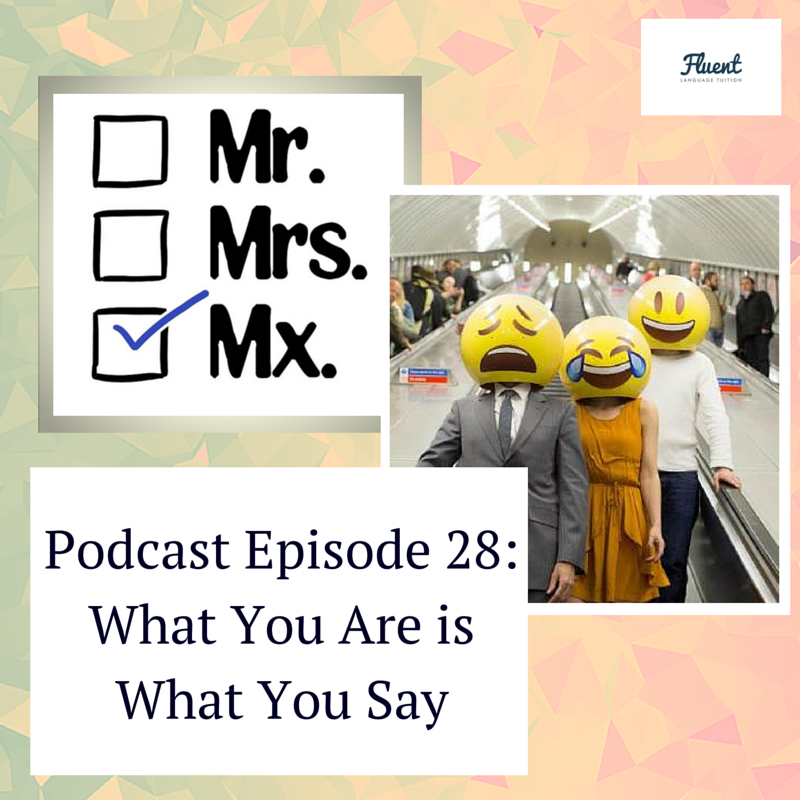
Welcome to Episode 28, a fun collection of language learning news. Lindsay and I shared our progress in Japanese and Welsh, read out wonderful listener feedback, and moved on to 3 big news items.
This episode is brought to you with support from HelloTalk, the world's largest language exchange app.
What's it like when your language changes to express who you are?
The episode features an interview with J from Compassionate Language Learner who identifies as gender-neutral and has some fabulous things to say about the topic.

- Swedish introduces "hen" pronoun
- Oxford Dictionary introduces "Mx" as a new honorific
- Fluent's Quick Guide to Language Blogging for Beginners
See The World in a New Way with Emoji
An emoji is ‘word of the year’, but is it even a word? Is this good? * Emoji word of the year
African Languages Aren’t English
The East African Council has just switched its lead language from English to Kiswahili.
Tips of the Week
Lindsay’s tip is using the Interlinear books method of learning a language.
Only two tips in this episode: 1) Make weekly commitment meet-ups such as going to exercise classes with a language buddy 2) Discover Binaural songs and Interlinear Books
And Even More Interesting Links!
- List of Placeholder Expressions by Language
- Extremely Loud and Incredibly Close
- The Knife of Never Letting Go by Patrick Ness
- HelloTalk - use code FLUENTLANGUAGE for 3 months of free pro membership
Double-click to edit...
How to Eliminate Your Self-Doubt and Get Speaking
Today I have another awesome guest post for you. Do you remember the podcast with Jade Joddle, where we talked about introversion and extroversion in language learning? I feel like Jade would love today's guest poster. This is all about how to get out of your own head and be that extrovert you HAVE to be when you want to speak another language. For me as a pretty extroverted person, that fear is weaker than for most people I see. I literally just go up to people and speak terrible Russian/Spanish/Italian. Honestly, I'm embarrassing!
Guest writer Kevin Morehouse is a language coach on a journey to make the world a more multilingual place. Raised as a monolingual English speaker in the United States, Kevin is all too familiar with the struggles of the language learner looking to go beyond English and make the leap from monoglot to polyglot. On his blog Language Hero, Kevin gives actionable tips on mindset, method, and goal-setting that can help intrepid learners escape the language learning labyrinth. You can read more of his work at Language Hero or connect with him on Twitter @Kevin_Morehouse
So let's beat that voice in your head!

Speaking.
It’s the bane of many a language learner. The idea of going up to someone and trying to communicate in a non-native language can be excessively intimidating for some. Every new opportunity to do so unleashes an unrelenting barrage of questions straight from your unconscious:
- What if I blank out and don't know a word?
- What if I say something wrong, or unintentionally offensive?
- What if they laugh at me?
- What if they can't understand me?
This is self-doubt in its purest form. By unwittingly asking yourself what would happen in the worst-case scenario, you're psyching yourself out from the possibility of success. By answering these questions, you're painting a picture of the worst-possible scenario.
And sadly, if you paint a bleak enough picture, you'll likely never go up to that person and start speaking, no matter how much experience you have.
And if you want to live out your dream of speaking a language confidently, that just won't do.
The problem isn't you, or your "talent" or how much experience you have. The problem here is that you're letting your self-doubt run your mental imagery, and thereby run the show.
We need to take back our mental imagery. Instead of imagining the worst-possible scenario before it happens, we need to change our angle of approach.
We need to go back…wards.
A New Angle on Visualization
Comedian Kyle Cease is no stranger to the paralyzing effect of negative thoughts and visualizations, known to many as performance anxiety.
In order to combat the excess worry that he would feel before going on stage, the comedian found a unique way to reapproach his mental imagery and, in his own words "get out of his own head."
The technique is called Kylegling (kuh-lay-gull-ing), and is best described by Kyle himself in this short video:
The Technique, Step by Step
- Notice when you are anxious about the outcome of an event
- Instead of thinking about how it will go, imagine yourself in the not-too-far future and begin to imagine how it went.
- Mentally construct the best possible outcome you can think of, and load your thoughts with positive emotions. Do this until you start to physically “feel” happier, more positive, and more confident in the present moment.
- Once you've built up the outcome in your mind, ask yourself "How did I do it?" and retrace your steps mentally all the way back to the present time.
- Use the new information and positive energy gained from this visualization to “get in the zone” and live out the situation as close to your vision as possible.
An Example in Action
You overhear a Spanish speaker walk into your job.
You've been studying Spanish, so you know you need to go over to them and say something.
Instead of psyching yourself with questions of Can I do this? or Will she judge me? you stop, imagine yourself in the future (post-conversation) and think about how well it went.
You imagine yourself going up to her, introducing yourself simply and succinctly, with a smile and a nod.
She smiles back, widely, pleased to have an opportunity to share her language with someone as enthusiastic as yourself.
If you're an experienced learner, you chat back and forth for a bit, maybe exchanging a few laughs, all the while forging a connection. If you're just beginning, you use what Spanish you know, and then, if necessary and/or possible, you explain politely in English why you're so eager to learn Spanish, and how you're going about doing it.
She compliments you on your language skills and your enthusiasm, give you a few friendly tips, and you say your farewells, happy to have met one another.
You come back to reality: You still haven't spoken any Spanish yet, but now you've got an encouraging and positive view of how everything will go.
Then, with the confidence gained from the exercise, you sally forth and start the conversation for real this time, using your mental script to “get in the zone” and guide you through successfully.
Final Thoughts
Even if the situation doesn't go exactly as you mentally planned it, the outcome is likely to be much more successful than it would have been had you kept your focus on the possibility of failure, embarrassment, or rejection.
I’ve used this technique many times to clear my thoughts and offset the pressure that often comes with a new opportunity to test my language skills. It’s worked well for me, and I’m positive you’ll benefit from it as well.
If you’re having trouble getting up the courage to speak, use this method to take control of your inner thoughts and back your way into success.
So, readers:
What do you think?
Have you ever used this or other visualization techniques to get in the zone when learning your using a language?
Please let me know in the comment section below!
Double-click to edit...



Struggling with listening? Discover realistic tips, challenge prompts, and the best tools for improving your listening skills as a self-guided language learner