

How to Get The Perfect Accent
Learning a language is a long journey, and even after many years of dedication it can still feel like you're far from arriving.
One of the milestones we hope to hit along the way is to start creating a 'perfect accent' in another language, so we can fit in well. But how is that done? Read more to find out my tips for improving your accent in any language, step by step.

Learning a language is a long journey, and even after many years of dedication it can still feel like you're far from arriving.
One of the milestones we hope to hit along the way is to start creating a 'perfect accent' in another language, so we can fit in well. But how is that done? Hear all about it on this episode of the Fluent Show.
After I shared my own story of learning English to a very high level on an episode of the Fluent Show’s episode 96, listener William sent me a very interesting question.
It’s about a classic problem when you’re learning a language: how do you sound good? How can you fit in with your accent?
Here's what he wrote in his question:
I'm learning English (and French) in Canada, I'm very happy with my progress so far. I'm a self-touch learner and I spend most of my time for listening and reading. For about 2 years learning from scratch, now I'm able to read books I love and listen to any audio source without much struggles. But still, I feel the "isolation" since I have not have a great intonation and accent yet. As you said that it could have affects on learner's self-confidence. So I hope you could share some thoughts on the topic in a future episode, how you do it and what is the right mindset to acquire the native accent.
William is so smart because he recognised the core feeling that’s the problem here. It’s not about being understood anymore or about having access to conversations, now it’s about blending in and feeling at ease, personally. I have a lot of empathy for that desire, because even after 15 years in the UK I still can’t seem to blend in like a local. And every now and then it bothers me, because it directs the conversation to me, or something about me, or something I don’t want to focus on at that moment. So even after all this time...people still pick up that I’m from somewhere else, and there are certain sounds that I will “Germanize”, especially when I’m very tired.
Tips For Improving Your Accent
Working on your accent in another language is best reserved for those levels where you are communicating comfortably. It's not the same as studying the pronunciation rules of a language, which comes at the start and will help you understand words and rhythm. The accent you want to acquire is all about blending in with the people you hear and speak to on a regular basis, so that you can feel like you belong with that group.
There are specific exercises and accent work activities that you can do, and most of them are focused on listening intently and echoing what you here.
Here are four principles that will help you as you work on improving your accent:
Listen & echo. Fine-tuning your accent starts with hearing many details of the accent you want to acquire, so listen intently and identify specific sounds that you want to get.
Tinker. Focus on individual expressions instead of trying to fix it all at once. It can sound inauthentic when you try to create a full "accent profile" for yourself, so instead think of it like tiny iterations of your existing language.
Harmonize. Continue to listen to others even while you are producing language, and try to monitor your speech as you talk.
Look and feel. Consider mouth shapes, learn the IPA if you wish, but most importantly observe and feel where in the mouth different expressions are formed. When you echo what you hear, think about how it feels in your mouth.
Finally, you can also find a language coach who specialises in accent work and who will help you improve through recorded speech, individual feedback and specialised challenges.
Online Courses For Getting a Great Accent
My recommendation for German learners is my Accent & Pronunciation Masterclass Course. This course is designed for foreign natives who want to sound authentic and understand German words with ease. The course is great because it
- Works with mouth shapes
- Focuses on sounds and how they’re formed
- Provides consistent rules that help you make sense of German
- Considers you as an English speaker - knows what you tend to get wrong
Check out the German Pronunciation & Accent Masterclass
For English learners, these two courses from Elena Mutonono will be a great resource and cover the essential topics you need to know about, like connected speech.
And in French, I have a wonderful recommendation from my muse française, Géraldine Lepere, who has a great Vocabulary and Pronunciation Program.
3 Mindset Tips for Accent Work
Finally, I've got a few important notes regarding the mindset to adopt when you are working on improving your foreign accent.
There is no such thing as perfect when it comes to learning a foreign language or working on a foreign accent. Some people do work on improving how good they sound and how well they fit in. But bear in mind that striving for perfection would be like aiming for a moving target - impossible to hit and impossible to maintain!
Consider these three mindset tips to ensure that you're working on your accent without expecting unreasonable things from yourself:
Don’t compare up, i.e. don't compare yourself to better speakers than yourself. Everyone's voice and accent are absolutely unique.
Don’t obsess over fixing everything at once - instead remember that the trick is to tinker and iterate your improvements.
Pay attention to how other people say things. If you do hear something that sounds great in your target language, echo it and use it for yourself. There's no 'stealing' in accents.
Do You Feel Great About Accent?
Have you tried to lose your foreign accent in a target language? How did it go? Share your story in the comments, and don't forget you can send podcast feedback to kerstin@fluentlanguage.co.uk or follow the show on Twitter.
If you have a second, leave us a podcast review on iTunes or in the Podcasts app!
What Is Fluency, What Is Mastery...And How Do You Get There?
This week on the Fluent Show, Lindsay and I went deep into what fluency is, adding in a few other words that often feel awkward to use. It's a great conversation, and will provide you with a new sense of clarity and inspiration, so you can confidently go out there and do what you need to do: learn languages and feel great about it!
If there is one question that haunts language learners, it must be this one:
"How many languages do you speak fluently?"
Often asked innocently by people who are interested, it can strike terror in your mind. Will they test you on your languages? Are you allowed to say you're fluent if you still make mistakes?

Oof! Those are heavy questions, and none of them are difficult to answer. Even for those of us who have studied for decades, the question of fluency still causes confusion.
This week on the Fluent Show, Lindsay and I went deep on those questions.
It's a great conversation, and will provide you with a new sense of clarity and inspiration, so you can confidently go out there and do what you need to do: learn languages and feel great about it!
Press play now, and don't forget to leave us a comment below to share what you thought of the show.
Podcast Notes
Our warm-up discussion revolved around the labels we see in our space, and whether they apply to you.
If You Travel And Work On A Laptop, Are You a Digital Nomad?
A digital nomad is a person who travels and works online, right? But for some reason, the term can feel icky to us. In this week's episode, we discussed how some words walk that line between being descriptive and defining.
When being a digital nomad (or "polyglot", y'know..?) becomes a label that you like to put on yourself, it's worth taking a second to consider who that YOU really is underneath. After all, at some point everyone might want to stop travelling and settle up with a nice cat, just two target languages instead of 12, and a garden and a veg patch. And that is super cool, because that's you.
If you thought that this discussion of who YOU are was deep, wait until you hear what we moved on to!
How Will You Get Fluent? How Can You Achieve Mastery?
I have received several messages from listeners recently, asking the Fluent Show to weigh in on how we can achieve goals such as fluency and mastery. And interestingly, each one of them asked another question:
"How do I know when I have achieved it?"
What Is Fluency In A Language?
Our first question came from Evan, and he wondered when one can consider oneself fluent in a language. In the question, Evan considered quite a range of definitions from "making no mistakes" to "dreaming in your target language".
Our discussion starts off with this fluency mindmap I drew:
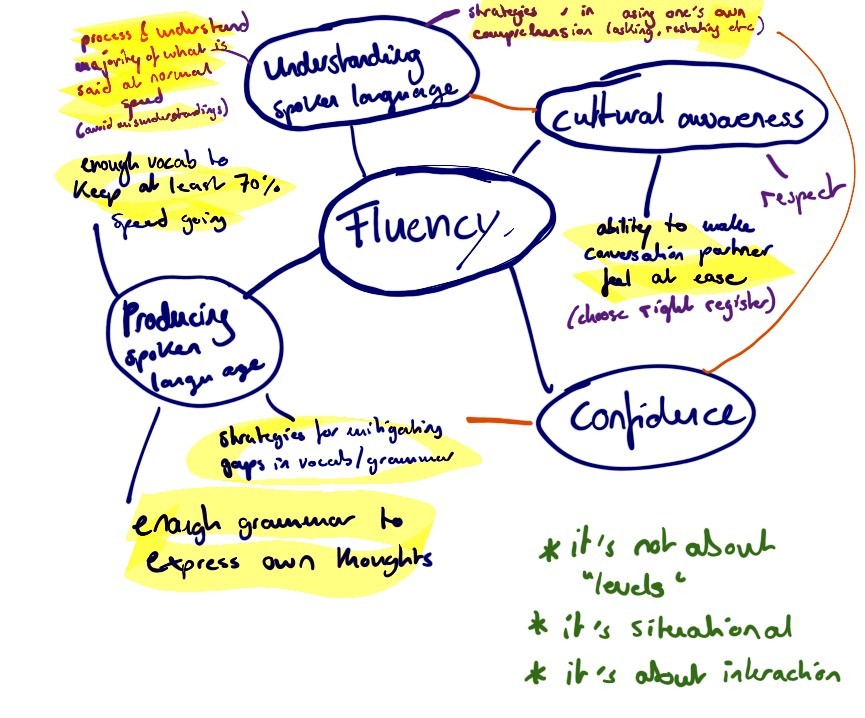
Bet you love my handwriting. Here's more about our take on fluency..
- "Fluency" implies speed and ease when using a language, which comes out most strongly when you're interacting with someone in person
- Usually interacting with someone in person means speaking
- The concept includes intercultural awareness that helps you put your conversation partner at ease and how to interact in a way that is appropriate for their style
- It implies confidence, meaning you have strategies to keep a conversation going
Fluency In A Language Is A Moving Target
Ultimately, your own definition of what fluency means to you is personal and unique. We believe that there are different points of fluency. These can relate to your goals and the purpose of your language learning. They can relate to what you are aiming for next, or what you're finding around you right now.
Just as life is forever changing, you may constantly evaluate your requirements for being "fluent".
What Is Mastery Of A Language?
Moving on from the fuzzy concept of fluency, we turned our minds to "Mastery" and how it is different from the former.
Madeline wrote in and asked:
What counts as mastery? Does every native speaker even possess it?
Our Thoughts on Mastery
This one was even trickier to nail down, believe it or not!
- Mastery is a point of pride and confidence for many, something we actively aim for and
- The word implies comfortable command, being able to use a skill (i.e. a language) with ease
- Mastery includes understanding beyond the literal meaning of the words in a target language
- But it can also imply superiority, like being the best out of everyone who uses that target language. Which isn't quite right in this context.
- For me, mastery is about more than just conversation and personal interaction. It encompasses the four core skills: listening, speaking, reading and writing
Our Conclusion
Both fluency and mastery are wonderful concepts to consider, but as Lindsay says, she is happy to not be fluent or masterful in every language. There is so much to discover and learn, and we can take a lot of joy out of appreciating the way that's ahead of us.
Yes, you can always get better. But there's no point in stressing about whether you are a fluent master - walk your own path, keep moving forward, and allow yourself to feel fluent on your own terms.
Mastery and Advanced Level Language Learning
When you reach the higher language levels, it's not enough to just study. How does it feel to reach a level where you are looking for ways to go beyond fluency? How can you move towards mastery?
There's no Lindsay in this episode (don't worry, she'll be back very soon!), so I found myself two experts who know what they are talking about:
- Tristan Foy, an American polyglot who's currently my advanced German student
and
- Gareth Popkins from How To Get Fluent
The episode is full of tips and strategies for reaching the very advanced levels and getting better even after years of study.
It's Not About Fast Progress

Thanks to Ellen Jovin for letting me show you this picture.
Of course you want to start off feeling like you are making fast progress, but at the advanced levels you're no longer looking for that. Approaching and chasing "mastery" means that the time you spend studying a language isn't relevant anymore. In other words, a truly advanced learner has long stopped counting the time they spent.
Advanced Level Means Finding "More" In The Language
Once you get to a point where having a conversation in your target language is no longer just a crazy dream, it's absolutely essential to find something more to connect to. Call it culture, call it personal connections, whatever it might be.
At the advanced level, you're guaranteed to have found what Tristan calls "the language speaking to your soul" - grammar and vocabulary becomes secondary.
"Learning a language is a bit like hugging a cactus - you can never get entirely comfortable"
(Tristan Foy)

It Takes Work To Progress

It's entirely possible to plateau at an intermediate level even after you have moved to a country. If you've got enough language to chat to people and fill in forms, that doesn't mean you're approaching "Mastery" yet but it does mean you're okay. So in order to improve ever more, you need to put in the work, set new goals and engage in every single one of listening, reading, speaking and writing, vocabulary, and grammar.
Turns out that you're never ever done - Gareth for example has just passed the C1 German exam and he says he has endless scope for improvement.
Enjoy the journey, stop for a breather whenever you feel like it and keep going.
Fluency - No One Cares!
Tristan sums this up with a wonderful sentence: Don't worry about getting fluent. Worry about getting better.
Everyone is always looking for a label, it could be "fluent" or "C1" or "conversational". But at the end of the day, you're never really done and get closer and more comfortable.
You Need Humility
Having areas of weakness in your language is not a sign that you are weak overall, but it's a valuable hint.
Gareth highlights that your potential for making errors gets bigger as you improve, so you'll need to keep aware that it will get ever more difficult to find and revise the most advanced grammar points. He recommends you work with textbooks, grammar exercises and advanced tutors.
Links and Resources Mentioned In This Episode
- How to Get Fluent, Gareth's blog - highly recommended
- Ellen Jovin, a highly recommended blog here too
- > Wade's Russian Grammar
- > Hammer's German Grammar
Gareth's summary of the Polyglot Gathering, in which he explains what "The Need Principle" is:
Learning another language is a long, hard process, requiring a lot of dedication (..) After all, as an adult trying to learn a new language it’s all about “overcoming human nature”. You need, erm, “need”: you’re either surrounded by the language, you know somebody who speaks it, you have an unusual interest in the country or culture or the language will benefit you at work
Thanks for our good friends at Flashsticks for their ongoing support of the Creative Language Learning Podcast. They have a free app, awesome vocab post-its, and more.



Struggling with listening? Discover realistic tips, challenge prompts, and the best tools for improving your listening skills as a self-guided language learner