Listening Masterclass: How to Understand Native Speakers in Another Language
Struggling with listening? Discover realistic tips, challenge prompts, and the best tools for improving your listening skills as a self-guided language learner

Raise your hand if listening in another language makes you feel like someone hit “fast forward” on real life. No shame in that. For most of us, understanding native speakers at full speed is the Mount Everest of language skills.
But good news: nobody expects you to make it to the summit on day one. Not me, not other learners, not even the slightly-grumpy waiter in Türkiye (Turkey). Let’s break it down together.
Even Bad Listeners Aren’t Hopeless
I'll let you in on a secret: My listening skills aren't really world famous. I have a tendency to guess ahead in conversations and get excited, cut in, intterupt and so on (similar to ADHD symptoms). Hey, it keeps life interesting!
But as with all weaknesses, it's good to work on them a little. I’ve collected a treasure chest of tips that make listening less intimidating – for me and for you.
The Truth About Listening in Other Languages
The difficulty of listening to native speakers talk at their unadjusted speed is HUGELY underrated, it is much much harder than most people think.
Words are not pronounced the way you learnt them. Real native speakers will skip and shorten words, let them run into each other, and link sounds that are invisible on paper.
Your brain can’t process things at full speed because it’s still learning all the sounds and meanings, let alone combining all that with non verbal clues and composing a reply.
You will, I repeat WILL, miss things. Especially before B1. That’s not failure, that’s normal.

Listening from Day 1 is Easy
Here’s a mind-boggling thought: Listening is the one skill you can start from day one. No vocab, no grammar, just pure sound. It’s connected to comfort, confidence, and even better pronunciation down the road.
So my advice really is this: Listen from day 1.
In fact, make that day 1 about learning your new alphabet and copying the sounds you're hearing. Omniglot, for example, has some excellent alphabet resources.
🇩🇪 Want to learn German and improve your listening skills? Get the German Accent & Pronunciation Masterclass to master the full range of German letters, umlauts & special rules.
5–10 Minute Listening Activities for Language Learners
You asked for bite-sized, practical activities – here’s my snack box!
Listen to something every day, but especially content for learners or truly “simple” media. Reality TV works (the dumber, the better), so does kids’ news. Context is your friend and subtitles are welcome.
Try note-taking, even in your native language. Jot down key ideas, repeat and summarize what you hear – don’t obsess over unknown words. I love pen & paper (here’s my language journal guide).
Use transcripts! Many podcasts and videos provide them, and you can easily create your own using AI tools. Read along, or try writing your own version, then compare (trains your ear AND your spelling).
For more AI-powered Listening tips, check out AI Shortcuts for Listening Practice by AI Language Club.Dive into music. It’s fun, memorable, and repetitive. Lyricstraining and Clozemaster both let you play with gaps and missing words in songs, which is an efficient way to squeeze in extra listening practice.
Pick a short audio clip and listen three times in a row. Each time, see if you catch a new word or phrase. (If bored, try speeding it up – your brain can handle more than you think!)
Try This Today: Make a running playlist or queue on your favourite app and add one song/podcast episode in your target language. Listen when you walk, drive, or wash up. If you’re a Spotify user, here is how to learn languages with Spotify.
Use a Vast range of sources
Your target language has many sub-sets of language groups, and in real life situations you may never know which one you are going to encounter. So especially when you work on listening skills, it's important to cast the net wide. Take turns listening to the news, rap songs, local dialects and whatever you can get hold of. To get you started, note that many news services do a simplified language version of their own news casts, for example DW in German, RFI in French or Sveriges Radio for Swedish.
Active Listening (But Not the Overwhelming Kind)
Want to get proactive? Active listening is all about catching the message, not every single word. Trust yourself to guess from the context. If a speaker goes too quickly, don’t panic!
Ask them to repeat, slow down, or point at what they mean. The first few interactions will probably be awkward and a little funny. Stick with it – things get less painful FAST. It’s fun to try, ask them to slow down, try again, point at things, say the words you know.
Mini-Dare: Strike up a short conversation (even just a greeting) in your target language this week. If you blank out or only get 20%, that still counts!
You’ve got this.
Is it really a problem to be daydreaming during your listening sessions?
There are different levels of listening.
What you don’t want to do is set yourself up for failure or disappointment, so before you switch that input on it’s worth focusing on whether you are here
for pleasure
to get the gist
to study
If you’re too tired for study, don’t worry about that aspect and set your expectations differently.
Paying lots of attention, extracting 100% of meaning and nuance, listening in detail
Podcasts often require attention and demand a lot of attention
When you’re listening for study, you will want a transcript!
Listening for the gist, being happy understanding most
TV can be a good practice element for this, where there’s a narrative to follow - films too. Decide if you want scripted or spontaneous dialogue.
Subtitles are absolutely ok, and there are strategies for weaning yourself off them
Understanding very little, “immersion listening” at an early point
I always remember Ron Gullekson’s quote about making himself uncomfortable as early as possible
This is great for exposure, but beware - if it’s just a wall of sound, you’re not doing much good. You need to be able to distinguish where a word starts and ends.
Listening for Training — How To Go About It
Know your target language’s pronunciation rules
Determine what your audio is about, make sure you have some structures and vocab ready to go
Listen without reading, just see what you can get, make your notes, stop and start, vary the speeds
Repeat
Enlist the help of a transcript if available - ideally you do want that transcript there but you can also transcribe the text yourself or summarize it to read it back to a tutor
Discuss with a tutor, get them to ask you questions…or if you’ve got no one on hand, read a translation of the text
Find great tutors at Preply or italki.
Where can you go to find good listening material?
During selection of materials, consider:
Level right for you?
Language register (formal/informal) right for you?
Topic interesting?
Affordable and accessible for you?
What do you need to understand, what do you want to understand?
Remember: “A polyglot cannot survive on audio alone”. Combining with text, visual and even speaking is very crucial for a balanced approach.
Want a deeper dive?
Check out my podcast episodes on this topic for more “real talk” about what works (and what definitely doesn’t).
Q&A: How Can You Train Your Listening Skills?
Can Helpful Notes Cut Your Reaction Time in Conversations?
And, while you’re here, join the Fluent Language newsletter so you don’t miss the next batch of encouragement and practical language wisdom.

How Much Will You Pay for a Helpful Language Tutor?
A language tutor can teach you the ins and outs of your target language, and help you achieve your learning goals faster and easier. But the pricing confuses many students. Some tutors cost $50+ per hour, others are available for less money? What’s the difference? Read on to learn more about different backgrounds, levels, and prices.
A language tutor can teach you the ins and outs of your target language, and help you achieve your learning goals faster and easier. But how much should you pay for a language tutor? There are different online teaching platforms where you can choose from a wide range of tutors with different backgrounds, levels, and prices.
For example, on italki*, one of the most popular online language learning platforms, you can find tutors who charge as low as $5 per hour or as high as $50 per hour. You can even find great language exchanges for free!.
So what’s the difference? Read this article to discover which options will be right for you.
Do I need a language tutor?
Experienced language learners agree on one thing: Learning a language with a tutor is a true game changer.

Need Support On Your Language Learning Journey?
Don’t miss out on the Fluent Language newsletter! Sign up today and get weekly language learning advice from me.
It’s impossible to progress as much if you don’t start speaking your language at some point. And for an early stage learner, picking a tutor means working with someone who can help you bridge the gaps with ease.
Language tutor or language exchange?
I would recommend all learners to try at least one tutor, and to be clear about what you’d like from your lessons. A great tutor will ask you about your goals and tailor their service to you.
I wouldn’t recommend tackling a language exchange before you have learnt at least the essential structures and phrases of your target language (use this checklist to help you work out what to study).
Starting an exchange too early might leave you feeling frustrated, and there is a risk that you and your partner rely on the stronger language exclusively.
You do not get top quality at bottom prices
For the purpose of this article, I want to assume that you have made up your mind and you are looking for a tutor.
Now here is the part I want to talk to you about. I disagree with many other articles are telling you. Let's talk about price. Most other articles include a sentence that goes a little like this:
"Language lessons online are very cheap, you can get them for just $5 an hour."
US$5 an hour? That’s less than you pay for a drink at Starbucks. Now I know that wages and currencies vary around the world and I’m not stupid, so please don’t come commenting with the “$5 is lots of money in xyz!” argument. Your online teacher's costs are not just measured in time-per-hour. They also have a family to support, an internet connection and webcam to buy, personal development to cover. These are all part of the job, and that’s the case even if they live in the cheapest country in the world.
Self-employed language teachers will price themselves as low as they can because they really love working with you. But when they are taking on 50 students a week because the price per lesson is very low, they become mediocre teachers. If you are able to approach the exchange with a mindset that considers both payment and benefits, you will not be ripped off.
Read on to find out how to find exactly the right partner for your needs and your budget.
How To Find A Price That Works For You
In order to help you select the right language learning partnership, it is helpful to approach sites like italki* with a clear image of what you are truly looking for.
It's a good idea look beyond italki, because many of the greatest and most experienced teachers I know have their own blogs and websites. You can also try other platforms such as LanguaTalk.*
Option Number 1: The Freebie
Look for a language exchange partner and simply swap time helping them practice your native language for time practicing your target language.
Pros:
- You don’t even have to look online because many foreign students or residents in your town might be looking for language exchanges too.
- Sharing the language learning experience is very motivating and you’ll see the partner’s success just as much as yours.
Cons:
- There is a learning curve and this exchange may be frustrating at first. You have to be comfortable setting boundaries and working with rules, otherwise you become someone else’s free teacher.
- Your partner will speak the language but may not be able to explain it
- You give as much as you get, so prepare to work hard
Got a partner whose language you want to learn? Get our tips about learning a language from your partner.
And if you’re the one who wants to help your partner learn your language, here’s what I’ve learnt from having an English speaker partner (spoiler: I didn’t become his tutor!).
Option Number 2: The Super Bargain
Look for lessons under $10/hour and take advantage of the low living costs in other countries. Bear in mind these types of prices are below minimum wage in most countries, and probably this includes yours.
Pros:
- Maybe you will find a great tutor for peanuts
Cons:
- This is a trial and error technique, it often takes longer to find someone you click with, whose expectations match yours, and who is familiar with students from your cultural background
- The cheaper language teachers tend to be those supporting themselves temporarily, so you don’t get ongoing support as most cheap teachers decide to move on to another job within a few months
- This isn’t really a con from my perspective, but hopefully the tutor will soon raise their rates!
My personal verdict on this option? It’s better than nothing, but the worst of both worlds.
Option Number 3: The Professional
Hire an experienced language tutor for a minimum of $20/hour. Look for someone who is showing their expertise and commitment by having their own website, blogging about their work and knowledge and giving you a clear idea of what lessons will be like.
I’m biased, and here are my Pros:
- You’ll get a free consultation from most experienced language teachers and they will clearly tell you which goals you are working towards, and keep you committed
- The lessons tend to be tailored, long-term and built for you
- You’re doing a great thing because this is the way to support an experienced professional
- Professional teachers strive towards working full-time for you, so they can offer a flexible schedule and will fit the lesson times around you
For more details on how you can find that tutor that's worth your time, here is a list of questions you should ask them.
Cons? Well, we'd all love to get more free things in life.
A Tip for Ethical Teachers
For language teachers who are reading this article and excited about stepping up their business, here’s some important advice:
- Be serious and trustworthy: I would not charge a student until I know for sure that I connect with them. I don't take on each one, only students that understand my style. I don't want people to spend money on me unless I feel like I really understand what they need.
- Commit to your business: If you don’t want to be seen as some kind of fly-by-night operation, you have to show your worth to your potential student. Be worth their investment, be around and be reliable. You can’t do this without a brand and website, but it’s not as difficult as you may think.
For more information, have a look at the “Teach Languages” section here on Fluent, and in particular you should investigate the Live Lessons Course. This step-by-step course is written for language teachers who are excited to start standing out as one of the best out there.

Frequently Asked Questions
How Many Sessions With My Tutor Should I Have per Month?
There is no right or wrong answer to this question. The more sessions you have with your tutor, the more you can benefit from your tutor’s expertise and feedback.
Deciding on the number of tutoring sessions will depend on your personal situation and preferences. Here are some questions to help with your decision:
• What is your language learning goal?
• How many hours do you dedicate to learning your target language?
• How frequently do you have difficulties and need your language tutor's help?
For more detailed questions. Check my blog post 9 questions to ask your language tutor. And if you want deeper guidance to help you answer the questions above and find the right language strategy for yourself, I recommend checking out the Language Habit System or talking to a language learning coach.
Should I Hire A Native Speaker As My Language Tutor?
You don't actually need a native speaker to practice with. This is so important to understand. You just need someone who's good enough or a little better than you. Sometimes it even helps not to have the native speaker, because a non-native speaker has learnt your target language too and can explain grammar and other problems more easily.
You can check my blog post where I dive into why having a native speaker as your tutor might not be necessary.
Are Tutor Lessons A Good Way To Learn A Language?
Yes, they should be part of your system along with helpful resources and input, self-motivation is important so you don't become too reliant on one thing, learn how to build your routine here.
Language Exchange Tips for Fun and Effective Conversations
The most rewarding way of practicing your language is by connecting with people on a 1-to-1 basis. It takes commitment to make any language exchange successful.
Discover the best tips for a fun and effective exchange with the Fluent Show, featuring Kerstin Cable, Lindsay Williams, and language exchange expert Jonathan Huggins, who runs several community challenges and groups for language learners.

Everyone and their dog knows that language learning is easier, faster, and more fun when you have found a great language partner. It makes it so much fun when you can easily practice your vocabulary with someone you really want to speak to.
In this article, I'm going to tell you the best tips from our Fluent Show episode with Lindsay Williams and Jonathan Huggins, who runs several community challenges and groups for language learners.
Listen to the episode here:
Ready to level up your language learning game with my very best tips?
Then make sure you join the Fluent Language newsletter right here! Subscribe now, and every week, I'll send you handpicked language learning tips right in your inbox.
How to Find The Perfect Language Exchange
The most rewarding way of practicing your language is by connecting with people on a 1-to-1 basis. It takes commitment to make any language exchange successful.
Approach Exchanges With The Right Mindset
No matter who you are speaking to in your target language, remember that a little consideration can go a long way. It is easy to add an exchange partner to your checklist right next to "app" and "coursebook", but harder to remember that they're a person with a life to live too.
Start by generously giving something, and consider how you can help the other learners instead of simply seeing them as a resource. It's important to respect your partner's life so you can build up a relationship that keeps on giving.
To make sure you’re ready for the new words you’ll learn in an exchange, review these great guidelines for improving your vocab memory.
Before you start a language exchange:
It's important to feel like you're going to both give and get something out of your language exchange.
Who would be a great exchange partner for you?
Consider whether you will benefit most from finding a native speaker, a teacher, a good explainer, or simply a buddy who can help you progress.
Think also about where you’d like them to be located, because online exchanges are much easier when your timezones are convenient for each other.
Look for people who you have something in common with. Find out if you'll be on your partner's wavelength by checking out their profile, hobbies, location, and more.
Is it best to practice with my partner?
It can be amazing to learn languages with your partner, but…not always! In my own relationship of German/English speaker, we never really made it work. Read my story and get 5 Ways to Inspire Your Partner to Learn Your Language.
Where to find the best language exchange partners?
For detailed tips on finding great people locally and online, make sure you check out this blog article on the best places to find great exchange partners.
You can also look for people on these apps.
Tandem | Find Conversation Exchange Partners
— here is a detailed review of TandemHelloTalk - Language Exchange App
— here is a detailed review of HelloTalk
Language Exchange — Jonathan's Facebook group for anyone who wants to practice with native speakers.
Before starting a conversation or following someone, it's important to check their bios on social media. It helps gauge their interests and motivations. Sharing a brief summary of your background, interests, and goals can also increase the chances of a satisfying exchange.
Tools and technology needed for a language exchange

Most language exchanges online require fast internet, a good webcam, a microphone, and video conferencing software.
Click here to read about our recommended online teaching tools, which you can use for exchanges too!
Don’t forget, you might even find a local exchange partner to meet in a café. Then you only need a phone to send a message and organise the meeting!
Don’t just start with “hello”
Send more than just a "hello", and try asking questions and connecting based on something you saw in your potential partner's profile. For example, if they are a Frencg learner and they talk about a place they love to travel to, you can say: “Hey, I saw that you’re learning French and you’ve travelled to La Rochelle. I love it there! Have you ever eaten at Le Petit Marinier?".
Consider your expectations. Being someone's language learning partner is a commitment to be taken seriously, and it is your partner's decision whether they will be ready to join you.
Agree on how your exchange is going to work:
When will you practice which language?
Who's going to arrange the timeslots?
Will you send recordings, chat, focus on specific language points like grammar topics or vocab?
What will you talk about each week?
Finally, consider what level you are at in your target language and how this will impact the kinds of things that you can say and understand.

Once Your Language Exchange is Underway
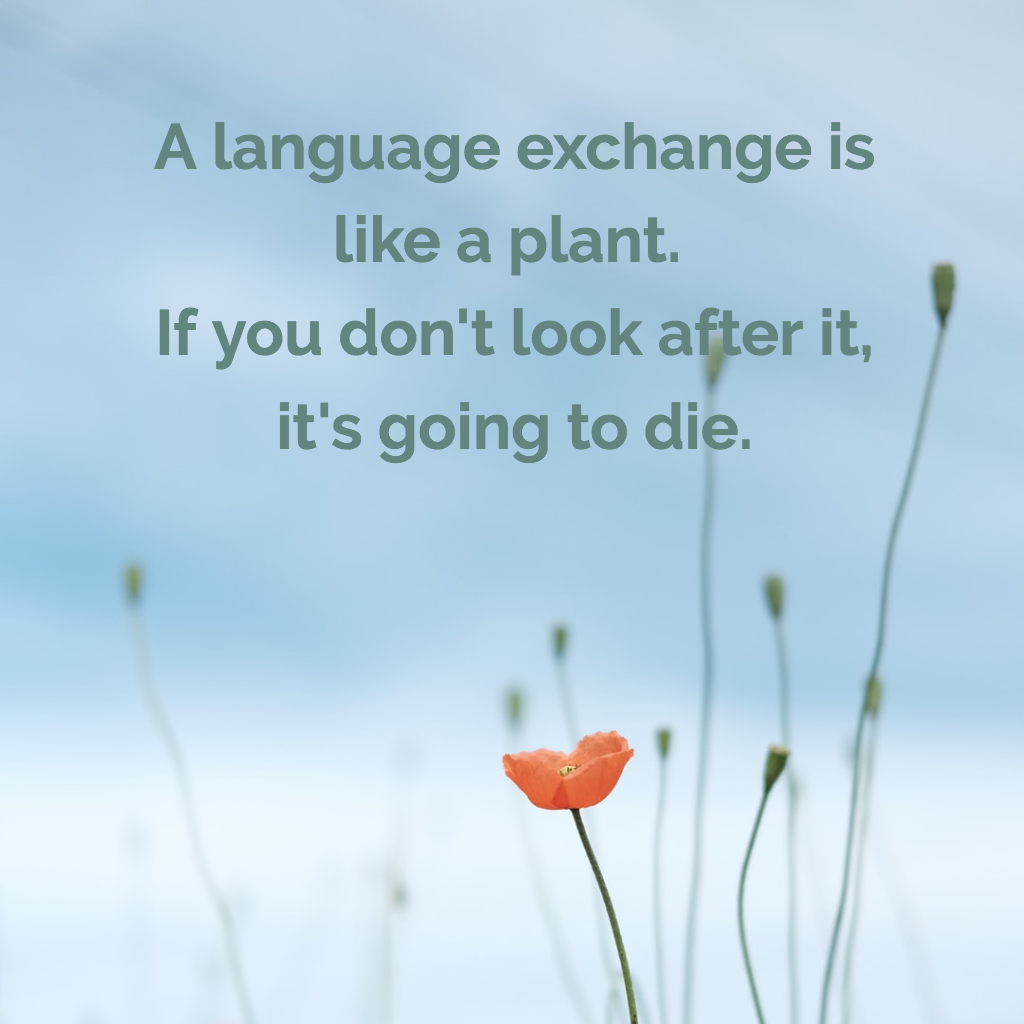
“A language exchange is like a plant: If you don't look after it, it's going to die.”
Jonathan
Great job, you’ve started meeting your language exchange partners. Here’s how to make sure the new connection doesn’t fizzle out.
Keep the Conversations Interesting
Prepare something to talk about in each session and make sure you don't let each other down and spend the whole session asking superficial questions. For example, find a news item and explain what it means in your local context, share a recipe, or select a conversation starter question. This directory is an incredible list of topics, you’ll never run out of ideas.
Stay Kind to Yourself

No one needs to expect a miracle from a language exchange. If you are shy and you don't establish what you have in common with another person, your language exchange will be just as uncomfortable as it would be in a monolingual environment.
Before and during the exchange, it helps to have a notebook ready. You can even start a language learning journal so you have space to reflect on how it went. Here’s my online course showing you exactly how to organise this journal for success, and here are some tips about using the bullet journal technique.
We love to try these tricks for helping you with your mindset and any self-doubt that comes up while you’re speaking another language. And if you want more ideas, here’s a list of 5 creative ideas for language lessons and exchanges.
Don’t Partner-Hop Like You’re on Tinder
Language exchanges are best treated like a really great friendship. Find consistent people to talk to so you can establish common ground and start going beyond the broring, repetitive topics that happen at the start of creating a new relationship.
Try alternative ways of making your exchange work, for example recording yourself so you can send a "message in a bottle" and still stay in touch even when life gets busy.
Don’t Forget About Group Exchanges
If you haven’t found a 1:1 language exchange partner yet, you can also join a language exchange group and talk to other learners.
In my podcast episode with Brian from Online Language Exchange, we discussed the best ways to get a lot out of these groups.
Don’t worry if you are a beginner: If you find somebody who is at a more advanced stage than you are, you can give them advice and share tips and resources.
No more dull textbooks or mundane drills – you'll be part of a community of like-minded learners who are passionate about mastering new languages. See you in the newsletter!
Frequently Asked Questions
How do you start an effective language exchange?
Remember, language exchanges are about building relationships. So don’t just look for “someone to talk to”, instead imagine you are getting in touch with a brand new friend. You can find exchange partners online in forums, groups, through apps like HelloTalk and the fantastic website italki. (affiliate link, we recommend italki)
What makes a good language partner?
A good exchange partner will be learning a language you know well, and fluent in a language you are learning. This way, you can share the time each of you spends practicing speaking.
It has to be someone that you enjoy talking to, and feel comfortable with. In conversations, it helps if your exchange partner is patient, interesting, and doesn’t correct too much.
What do you talk about during a language exchange?
There are no rules! You don’t have to talk about language rules at all, because exchanges are not like lessons. Find some common ground, talk about what you like, the sports and hobbies you do, favourite foods, and what bands you’ve seen live. A great language exchange is just like talking to a good friend…only in another language!
Why is a language exchange good?
Language exchanges are a powerful language learning tool! They give you
Authentic conversations to improve your listening skills, pronunciation, and fluency
Language learning on a budget. They are often free, both partners give up their time.
A great opportunity to meet new people, grow your relationships, and learn more about the culture of your target language.
Do you need to practice with native speakers?
You don’t have to find a native speaker! Often, learners who are more advanced than you are a great person to practice with. With native speakers, it can be difficult to understand regional accents and they don’t always know how to explain their language rules in detail.
To get native-level practice into your studies before you go hunting for speakers all over town, try bringing in audio resources or even TV. It's easy to watch television in other languages or use cool software like Yabla. (affiliate link)
Read more about this in this blog article: Language Practice: Why You Don't Need A Native Speaker
Quick'n'Easy Guide to Language Blogging
If you’re a language learner wanting to connect with others and share your project journey online, why not start a language learning blog? This article will help you get started!
Let me just switch on my psychic super-skills for a minute and guess who you are. Are you a
language learner
who spends an hour or two online every day
and likes getting new tips and ideas for your language learning?

If that is you, then this article is for you more than ever.
I don't see enough of real people dedicating time to language learning along their normal lives. If you're learning a language in the evening, at the weekend, in your lunch break, make your voice heard because you will inspire so many others.
Well guys, here we are nearly half way through the year. It's time to talk to you about this blogging. Have you started yet? If not, here are some quick and easy tips to get you started. Leave a comment and share your blog. I can't wait to see it and hope to share the best of them right here on Fluent!
Where to Start Your Blog
There are many dedicated websites out there showing you how to start a blog, and in fact most website builders come with blog facilities are built in. The core message for your personal blog as a language learner won't be included though, because there's only one step to take: Get Started!
It doesn't matter if you sign up to Wordpress, Weebly or Squarespace, or what your domain name is. You could even blog on Instagram! All that tech stuff can be changed later, but getting started should not wait. So here are the steps:
Create an account on a blogging website
Write an article
Put a picture on it - and you can have lots of fun with your images using apps like Canva
Publish
What to Include In Your Blog
It is not easy to answer the question of what you should include, but I know how tough it is to be staring at the blank screen or page when you are first getting started. So here are five articles I would like to see on every language learner's blog. Link to them permanently if you can, for example from your homepage, so that all new visitors to your page can easily learn more about you.
Which language(s) are you learning - why those?
What do you find really annoying about language study?
What do you find really awesome about language learning?
Do you have a favourite place to study? It would be so interesting to see pictures.
What was the first time you spoke to a native speaker like?
These ideas are of course not a "must write" list, but if you are short of inspiration why not pick one and just get going? Even 500 words of writing could be the start of a truly excellent blog. For example, if you look all the way back to the start of Fluent you will find a pretty quick note - my commitment to grammar. Good job it hasn't damaged my business!
Inspiration is easy to find on the web, but don't feel as if you must hold yourself to the high standards of quality that an established blog produces. The really big names, even in language blogging, have a lot of help with planning, editing and producing great posts. That might be where you're headed, but right now it's just about getting something out there.
Which language is best for blogging?
You can write your blog in your native language or in the language that you are learning. Or why not combine both and create a multilingual blog? I have often done this with my multilingual podcasts, and they brought me
a chance to practice the language I’m learning, AND
the ease of processing my thoughts and expressing myself most confidently in English
So in a blog article, you could switch between languages too and make it bilingual!
If you want to attract a big readership from a specific area of the world, it will be helpful to use the local languages and even write about places in the region.
How to Start a Language Learning Podcast
Maybe writing and reading isn’t for you, but you love to talk? I started my podcast The Fluent Show in 2013 and it was one of the most brilliant projects I ever created.
Read more here about how you can even boost your language learning by creating your very own podcast.
Share Your Blog
It is no fun to be writing when no one sees your articles, so let me help you find new friends and readers.
Here's what to do:
Write a comment in response to this blog article
Include a link to your blog and your own favourite article
Tell me in a few sentences why you started the blog
The best submissions will be featured on the Fluent blog in future and invited to submit a guest post too. Can't wait to hear from you.
Thanks for reading this article on Fluent - The Language Learning Blog. Don't forget - if you sign up to our newsletter, you will receive my best tips from 10 years of language blogging, podcasting and teaching in your inbox every Thursday.

How to Flirt in German (Plus: A bit of German Romance)
In love with a German? Ready for romance in Germany? If you need a little help on how to flirt with German, look no further than these easy phrases to use the next time you meed someone very special ❤️ Let’s flirt in German!

In celebration of Valentine's Day, Fluent is in love today and I want to teach you some fun little expressions to tell your loved one. German is not often considered a romantic language, so you may find it surprising that Germany actually had a whole romantic period in history! As a country of castles, hills and walkers this was a great time for poetry and passionate writing. You can check out more about them in Caspar David Friedrich's paintings and love letters from Goethe, a beloved German writer. You might have heard of Goethe? He wrote Faust and came out with some excellent one liners - a bit like a German Shakespeare.
Your Free Speaking Guide
Matching this topic, I've created the new guide Make Your German Sound Amazing, featuring 26 Key Phrases For Conversations with German Speakers. Pop your details into the form below to join my email list and get the guide immediately!
Set the scene for a German romance and get to know some useful expressions. I'm pretty loved up this year, so for me these three words will never get old.
3 Ways to Say "I Love You" in German

1) Ich liebe dich (I love you)
A classic - with these three words you won't put a foot wrong.
2) Dein ist mein ganzes Herz (my entire heart is yours)
No matter if you are romancing a woman or a man, this wonderful line is guaranteed to stir up happy emotions - My Whole Heart is Yours should be said over the soundtrack of this Youtube clip so that you know you'll definitely score the full romance points.
3) Ich möchte für immer bei dir sein (I want to be with you forever)
"I want to be with you forever." Ahh, that's the start of a great proposal..<3
3 Loving Nicknames to call your partner in German
1) Mein Schatz (My treasure) - it’s what I call my husband!
2) Mein Schneckchen (My little snail!)
3) Meine Herzallerliebste/Mein Herzallerliebster (My heart's favourite - adapt for feminine or masculine)
And if you're currently on the lookout for a new date, there is something I can do to help you. Try these:
The Top 3 German Conversation Starters (for Singles)
1) Ich spreche normalerweise keine Frauen/Männer an, aber.. (I don’t usually chat up women/men, but…)
The greatest way of humbling yourself and bringing in a compliment at the same time is to say "I would never do this, but for YOU it's a different story." Complimenting the person should come next, for example "du siehst so nett aus!" (you look so nice!).
2) Komm, wir brennen zusammen durch! (Let’s run away together!)
For the adventurous among you, this call for your love to run away with you could bring up romantic images of freedom, open road and romance. Perfect for suggesting a wild date...er...in the park.
3) Hi, sag mal, was hältst du denn vom Essen/Design/Kaffee hier? (Say, what do you think about the food/design/coffee here?)
Asking the other person's opinion is guaranteed to get you a response, and also some natural German language practice!
No matter where you are or if you're single or in love, I wish you a wonderful Valentine's Day!
Recommended German Courses
German Uncovered: Learn German the natural way without complex grammar explanations and boring lessons. This course is based on a story, so you’ll be reading and having fun as you progress to level A2 at high speed.
Speak German Like a Native: If you want to sound 💯 or you find spoken German hard to understand, you need this course. This is my masterclass on every sound of German (and word stress!), suitable for all levels. No other course digs into the sounds of the German language, giving you the confidence to even say Eichhörnchen and Wechselstrom like a native.