

What Is Fluency, What Is Mastery...And How Do You Get There?
This week on the Fluent Show, Lindsay and I went deep into what fluency is, adding in a few other words that often feel awkward to use. It's a great conversation, and will provide you with a new sense of clarity and inspiration, so you can confidently go out there and do what you need to do: learn languages and feel great about it!
If there is one question that haunts language learners, it must be this one:
"How many languages do you speak fluently?"
Often asked innocently by people who are interested, it can strike terror in your mind. Will they test you on your languages? Are you allowed to say you're fluent if you still make mistakes?

Oof! Those are heavy questions, and none of them are difficult to answer. Even for those of us who have studied for decades, the question of fluency still causes confusion.
This week on the Fluent Show, Lindsay and I went deep on those questions.
It's a great conversation, and will provide you with a new sense of clarity and inspiration, so you can confidently go out there and do what you need to do: learn languages and feel great about it!
Press play now, and don't forget to leave us a comment below to share what you thought of the show.
Podcast Notes
Our warm-up discussion revolved around the labels we see in our space, and whether they apply to you.
If You Travel And Work On A Laptop, Are You a Digital Nomad?
A digital nomad is a person who travels and works online, right? But for some reason, the term can feel icky to us. In this week's episode, we discussed how some words walk that line between being descriptive and defining.
When being a digital nomad (or "polyglot", y'know..?) becomes a label that you like to put on yourself, it's worth taking a second to consider who that YOU really is underneath. After all, at some point everyone might want to stop travelling and settle up with a nice cat, just two target languages instead of 12, and a garden and a veg patch. And that is super cool, because that's you.
If you thought that this discussion of who YOU are was deep, wait until you hear what we moved on to!
How Will You Get Fluent? How Can You Achieve Mastery?
I have received several messages from listeners recently, asking the Fluent Show to weigh in on how we can achieve goals such as fluency and mastery. And interestingly, each one of them asked another question:
"How do I know when I have achieved it?"
What Is Fluency In A Language?
Our first question came from Evan, and he wondered when one can consider oneself fluent in a language. In the question, Evan considered quite a range of definitions from "making no mistakes" to "dreaming in your target language".
Our discussion starts off with this fluency mindmap I drew:
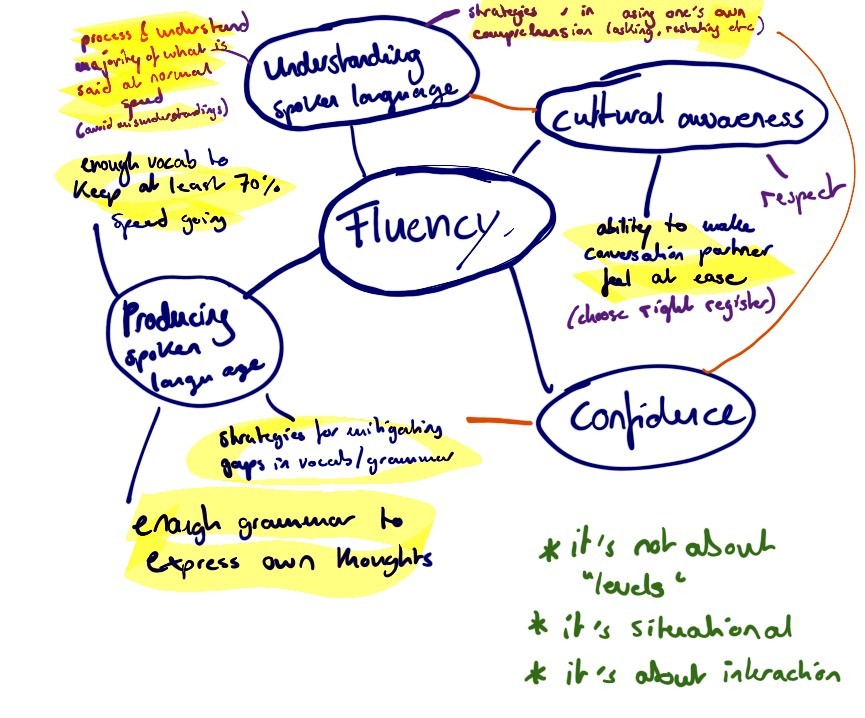
Bet you love my handwriting. Here's more about our take on fluency..
- "Fluency" implies speed and ease when using a language, which comes out most strongly when you're interacting with someone in person
- Usually interacting with someone in person means speaking
- The concept includes intercultural awareness that helps you put your conversation partner at ease and how to interact in a way that is appropriate for their style
- It implies confidence, meaning you have strategies to keep a conversation going
Fluency In A Language Is A Moving Target
Ultimately, your own definition of what fluency means to you is personal and unique. We believe that there are different points of fluency. These can relate to your goals and the purpose of your language learning. They can relate to what you are aiming for next, or what you're finding around you right now.
Just as life is forever changing, you may constantly evaluate your requirements for being "fluent".
What Is Mastery Of A Language?
Moving on from the fuzzy concept of fluency, we turned our minds to "Mastery" and how it is different from the former.
Madeline wrote in and asked:
What counts as mastery? Does every native speaker even possess it?
Our Thoughts on Mastery
This one was even trickier to nail down, believe it or not!
- Mastery is a point of pride and confidence for many, something we actively aim for and
- The word implies comfortable command, being able to use a skill (i.e. a language) with ease
- Mastery includes understanding beyond the literal meaning of the words in a target language
- But it can also imply superiority, like being the best out of everyone who uses that target language. Which isn't quite right in this context.
- For me, mastery is about more than just conversation and personal interaction. It encompasses the four core skills: listening, speaking, reading and writing
Our Conclusion
Both fluency and mastery are wonderful concepts to consider, but as Lindsay says, she is happy to not be fluent or masterful in every language. There is so much to discover and learn, and we can take a lot of joy out of appreciating the way that's ahead of us.
Yes, you can always get better. But there's no point in stressing about whether you are a fluent master - walk your own path, keep moving forward, and allow yourself to feel fluent on your own terms.
What a 60 Minute Yoga Class Taught Me About Language Learning
Did you know that I used to try to be absolutely perfect in English? That even today it bothers me a tiny bit when people tell me they can hear my German accent?
I remember that I used to be the best in my class in English. Then I changed schools and better people came along. I was the best IELTS taker my university had ever seen at IELTS 9.0. Then I went out to the pub and understood no one. One thing I learnt in that progress is that trying to be flawless is like guaranteeing yourself a failure. Turns out perfectionism doesn't work if you want to learn a language. We don't have to be the best to be good.
In the haze of ambitious new year's goals, let's have a look at how to achieve everything you want without pressure and perfectionism.

Perfectionism By Another Name
You are probably already aware that "perfectionism is bad". There are many who warn about its dangers. It makes logical sense to start before you're ready and keep practicing until you achieve fluency, but in reality I've seen many learners who never seem to be ready. A former German student of mine had this habit of pausing in the middle of the sentence because he forgot a word. He'd switch to English very quickly, exclaiming that he's tired and today just isn't the right day. He asked for grammar exercises instead, trying to rule out any language learning flaws before he even started.
The "I have to be perfect" feeling is sneaky. It doesn't hide in a labelled box inside your mind and heart. Perfectionism works hard to keep its hold on you. Funnily enough, the feeling loves it most when you are trying to speak in your target language. This is when perfectionism has a good day. Here are statements to look out for. Ever had a thought like this?
- "I need to be ready before I can speak"
(and what exactly is ready?)
- "I just want to make sure I get this right"
(what if there is no right?)
- "Is this how a native speaker would say it?"
(native speakers aren't perfect)
- "Am I making enough progress?"
(if you are learning, the answer is yes)
- "Am I good enough?!"
(yes)
Perfectionism is Bad Because..
It paralyzes you, because your high ambition will stop you from trying before you are "ready". It's never worse than when the task is to speak. The fear of what others may think of you, the instant vulnerability of being on the spot, and the stress of thinking so fast are good nutrition for perfectionism. This is why you may prefer to keep quiet or spend another few days preparing. And before you know it, a year of study has passed and you've spoken to nobody.
It frustrates you and kills your will to try again. Last week, I was chatting to a girl at a friend's party and mentioned that I'm a Welsh learner. She exclaimed "wyt ti'n dysgu cymraeg?!" and revealed that Welsh is her native language. Oh my! I had to speak! After a few sentences of conversation she complimented me on my skills (which is ridiculous since half the conversation was "how do I say .... in Welsh?"). Then came the fatal moment. I said something, and she replied "that's not how we would say it in Wales", then explained to me how the locals shorten words in slang. And of course I felt embarrassed! Of course I was gutted to have been so uncool and use stilted uncomfortable Welsh.
The frustration of that moment must not stop me from learning more and trying again. I'll have to keep speaking in textbook Welsh for now. I have to stay on my own path, and the same goes for you if you're learning another language. Never let yourself feel frustrated enough to stop, just because you made a mistake once before.
Remember that being bad at your target language is good, because you'll get better. But when you stop, that's the single way you will fail at learning a language.
The Yoga Analogy
In yoga, there is a philosophy that freedom in the practice means freeing yourself from the desire to achieve perfect poses at all times. It's about letting go of your ego and of having to be right all the time. You work with recognizing your own body and its capabilities. You accept good days and bad days, and you thank yourself for doing what you can. Your prize is not a perfect yoga pose, but a better relationship with your body.
In language learning, that wonderful freedom is waiting for you too. I have received feedback about my failings time and time again, and have had to remind myself that language is a living and evolving tool, never used in the perfect way. Now at age 32, I guess my way through Welsh conversations and feel excited when mistakes are corrected. I work on my mindset much more than my "conversation prep", and trust that everything others correct will be the best and most useful vocabulary I could possibly acquire.
Something magical happens when we put aside those high standards and just surrender. Surrender to mistakes as and when they happen. Surrender to looking like a non-expert. Surrender to trusting the process and letting yourself learn.
With allowing your mind to simply engage and progress at its own speed, you get to discover how capable you really are. The question of being "good enough?" becomes irrelevant as you discover that you are truly the best that you can be. And verb endings, imperfect accents, all those things that trip you up in speaking your target language become things that you learn as you go along.
Mistakes are visitors you bump into on your journey. They are added training bonuses that show you where to focus. They're what keeps you in the game when you risk complacency. I wish we would reframe the way we think about mistakes in language learning and accept that they are boosters, power-ups, encouragers - whatever you want to call them, mistakes are that perfection you're looking for.
3 Practical Tips for Being Perfectly Non-Perfectionist
1) Start Before You're Ready, But Start Easy
So you've studied Polish for 3 weeks and not talked yet? Come on now. Just get yourself to the Polish shop, to a community class, or to italki, or on HelloTalk and quit having excuses.
Language learning is not about being the best or the most impressive person out there. Your interest in another language is enough validation, so go with the journey and take it super-easy at the start. It is NOT embarrassing to aim for saying one sentence correctly before you say another. Remember that yoga pose: You want to ease into it, not muscle into it.
2) Prep 5 Stock Phrases
Stock sentences are useful phrases that you can always say to buy yourself a little time, to enter or exit a conversation. They're useful things like "What does _ mean" and "How do I say _", along with asking the other person to slow down and be patient. Stock phrases also contain polite formulas like please and thank you, and maybe "Do you want a drink?". When I say prep, what I mean is you should have these stock phrases down so well that you could recite them at 3 in the morning if I shake you out of your sleep.
These stock sentences are your safety blanket, the lines you know you've got right no matter what. The reason I recommend you learn no more than 5 is that studying stock phrases isn't the point of learning a language.
You need enough to help you manage, but not so much that it stops your creativity. Remember - this is all about embracing restrictions so that you
3) Keep A Log
Instead of remembering the times that you made a mistake and "looked like an idiot", make sure you make a note of every correction that you get. Focus on what you're learning and how the other person is helping you improve. Even if you post a pronunciation video on YouTube and get "Your Russian Sucks!", so what! Ask the commenter what exactly you did wrong and upload another one. Remember that Yoga pose, where you are building your strength and easing into it.
Love Yoga? Love Languages?
If you enjoyed this blog article, check out my regular newsletter and please leave me a comment letting me know what your own perspective on mistakes and perfection in language learning is.



Struggling with listening? Discover realistic tips, challenge prompts, and the best tools for improving your listening skills as a self-guided language learner