

Listening Masterclass: How to Understand Native Speakers in Another Language
Struggling with listening? Discover realistic tips, challenge prompts, and the best tools for improving your listening skills as a self-guided language learner

Raise your hand if listening in another language makes you feel like someone hit “fast forward” on real life. No shame in that. For most of us, understanding native speakers at full speed is the Mount Everest of language skills.
But good news: nobody expects you to make it to the summit on day one. Not me, not other learners, not even the slightly-grumpy waiter in Türkiye (Turkey). Let’s break it down together.
Even Bad Listeners Aren’t Hopeless
I'll let you in on a secret: My listening skills aren't really world famous. I have a tendency to guess ahead in conversations and get excited, cut in, intterupt and so on (similar to ADHD symptoms). Hey, it keeps life interesting!
But as with all weaknesses, it's good to work on them a little. I’ve collected a treasure chest of tips that make listening less intimidating – for me and for you.
The Truth About Listening in Other Languages
The difficulty of listening to native speakers talk at their unadjusted speed is HUGELY underrated, it is much much harder than most people think.
Words are not pronounced the way you learnt them. Real native speakers will skip and shorten words, let them run into each other, and link sounds that are invisible on paper.
Your brain can’t process things at full speed because it’s still learning all the sounds and meanings, let alone combining all that with non verbal clues and composing a reply.
You will, I repeat WILL, miss things. Especially before B1. That’s not failure, that’s normal.

Listening from Day 1 is Easy
Here’s a mind-boggling thought: Listening is the one skill you can start from day one. No vocab, no grammar, just pure sound. It’s connected to comfort, confidence, and even better pronunciation down the road.
So my advice really is this: Listen from day 1.
In fact, make that day 1 about learning your new alphabet and copying the sounds you're hearing. Omniglot, for example, has some excellent alphabet resources.
🇩🇪 Want to learn German and improve your listening skills? Get the German Accent & Pronunciation Masterclass to master the full range of German letters, umlauts & special rules.
5–10 Minute Listening Activities for Language Learners
You asked for bite-sized, practical activities – here’s my snack box!
Listen to something every day, but especially content for learners or truly “simple” media. Reality TV works (the dumber, the better), so does kids’ news. Context is your friend and subtitles are welcome.
Try note-taking, even in your native language. Jot down key ideas, repeat and summarize what you hear – don’t obsess over unknown words. I love pen & paper (here’s my language journal guide).
Use transcripts! Many podcasts and videos provide them, and you can easily create your own using AI tools. Read along, or try writing your own version, then compare (trains your ear AND your spelling).
For more AI-powered Listening tips, check out AI Shortcuts for Listening Practice by AI Language Club.Dive into music. It’s fun, memorable, and repetitive. Lyricstraining and Clozemaster both let you play with gaps and missing words in songs, which is an efficient way to squeeze in extra listening practice.
Pick a short audio clip and listen three times in a row. Each time, see if you catch a new word or phrase. (If bored, try speeding it up – your brain can handle more than you think!)
Try This Today: Make a running playlist or queue on your favourite app and add one song/podcast episode in your target language. Listen when you walk, drive, or wash up. If you’re a Spotify user, here is how to learn languages with Spotify.
Use a Vast range of sources
Your target language has many sub-sets of language groups, and in real life situations you may never know which one you are going to encounter. So especially when you work on listening skills, it's important to cast the net wide. Take turns listening to the news, rap songs, local dialects and whatever you can get hold of. To get you started, note that many news services do a simplified language version of their own news casts, for example DW in German, RFI in French or Sveriges Radio for Swedish.
Active Listening (But Not the Overwhelming Kind)
Want to get proactive? Active listening is all about catching the message, not every single word. Trust yourself to guess from the context. If a speaker goes too quickly, don’t panic!
Ask them to repeat, slow down, or point at what they mean. The first few interactions will probably be awkward and a little funny. Stick with it – things get less painful FAST. It’s fun to try, ask them to slow down, try again, point at things, say the words you know.
Mini-Dare: Strike up a short conversation (even just a greeting) in your target language this week. If you blank out or only get 20%, that still counts!
You’ve got this.
Is it really a problem to be daydreaming during your listening sessions?
There are different levels of listening.
What you don’t want to do is set yourself up for failure or disappointment, so before you switch that input on it’s worth focusing on whether you are here
for pleasure
to get the gist
to study
If you’re too tired for study, don’t worry about that aspect and set your expectations differently.
Paying lots of attention, extracting 100% of meaning and nuance, listening in detail
Podcasts often require attention and demand a lot of attention
When you’re listening for study, you will want a transcript!
Listening for the gist, being happy understanding most
TV can be a good practice element for this, where there’s a narrative to follow - films too. Decide if you want scripted or spontaneous dialogue.
Subtitles are absolutely ok, and there are strategies for weaning yourself off them
Understanding very little, “immersion listening” at an early point
I always remember Ron Gullekson’s quote about making himself uncomfortable as early as possible
This is great for exposure, but beware - if it’s just a wall of sound, you’re not doing much good. You need to be able to distinguish where a word starts and ends.
Listening for Training — How To Go About It
Know your target language’s pronunciation rules
Determine what your audio is about, make sure you have some structures and vocab ready to go
Listen without reading, just see what you can get, make your notes, stop and start, vary the speeds
Repeat
Enlist the help of a transcript if available - ideally you do want that transcript there but you can also transcribe the text yourself or summarize it to read it back to a tutor
Discuss with a tutor, get them to ask you questions…or if you’ve got no one on hand, read a translation of the text
Find great tutors at Preply or italki.
Where can you go to find good listening material?
During selection of materials, consider:
Level right for you?
Language register (formal/informal) right for you?
Topic interesting?
Affordable and accessible for you?
What do you need to understand, what do you want to understand?
Remember: “A polyglot cannot survive on audio alone”. Combining with text, visual and even speaking is very crucial for a balanced approach.
Want a deeper dive?
Check out my podcast episodes on this topic for more “real talk” about what works (and what definitely doesn’t).
Q&A: How Can You Train Your Listening Skills?
Can Helpful Notes Cut Your Reaction Time in Conversations?
And, while you’re here, join the Fluent Language newsletter so you don’t miss the next batch of encouragement and practical language wisdom.
How to Learn a Language with Spotify, The App for Learning Languages with Music
If you’ve ever had trouble finding more songs and artists to listen to or if you’ve wondered whether it was worth it to try a popular music app like Spotify, here are some tips that can help you make the most of learning with all that Spotify has to offer.
How would you like to learn a language with the help of a famous musician?
Sounds awesome, right? Truthfully, the idea isn’t so far-fetched.
Learning a new language isn’t all about studying grammar and memorizing vocabulary. In fact, many of us have listened to music in another language and even learned a few things from our favourite songs.
For example, who knew the name of Seoul’s cool kid district before "Gangnam Style" became a sensation?

As you can see, it’s always a good idea to explore music in your target language.
Using music to learn a language can help you feel more connected and invested in a language as well as add a bit of creativity to your usual routine.

Photo by Vidar Nordli-Mathisen on Unsplash
The tough news is that can be hard to find music you enjoy listening to in your target language(s). How do you find the top artists in German or French? What if you don’t care for the top hits and want to search for songs in a particular genre?
That’s where music apps like Spotify turn into amazing resources for language learners.
If you’ve ever had trouble finding more songs and artists to listen to or if you’ve wondered whether it was worth it to try a popular music app like Spotify, here are some tips that can help you make the most of learning with all that Spotify has to offer.
Spotify Basics
What is Spotify?
Spotify is a streaming service that lets you listen to music and podcasts on your mobile device or computer. Using the app, you’ll discover music from artists all over the world, which makes it a fantastic resource for language learners.
It’s available for you to use on multiple devices, including your laptop, your phone, your tablet, or your gaming system.
There’s a free version as well as a paid premium version. Both allow you to search for music and podcasts, get recommendations for new music based on your preferences, and create your own playlists.
How To Learn a Language With Music
Spotify is simple enough to use, but how should language learners start using it to actually learn something?
Can you really learn with music?
Yes! Think of music as just another resource. For example, you could..
Look up the lyrics, translate them, and try to sing along
Song lyrics can be simple or complex - some talk about love, others just ask you to put your hands up. Either way, it’s a joy to discover what’s actually being said in the song that you’ve had playing in the background. And once you read along and start speaking or singing the lyrics to yourself, you’ll feel a boost in confidence...like a fluency rock star.
You can even find out about the stories behind your favourite lyrics using apps like Genius. Check out this podcast to learn how it works.

Genius user comments in Spanish
Check out the websites of your favourite artists or follow them on social media
Most artists will post on social media using the language that they sing in, and there’s a wealth of studio pics, in-jokes and fan responses to discover too. Who knows, the next time they announce a gig you might even find the courage to go and see them live? Going to gigs in my target language is one of my top activities!
Discuss your favourite songs or lyrics you don’t understand with a tutor or language exchange partner
Translating lyrics can be tougher than it looks at first, but that’s what you can work on with your tutor. Plus, if you’re working with a local native speaker living in the target country (such as most [italki][0] tutors), they’re likely to tell you about even more groups and artists in the target language.
Songs are natural input, a great way to become familiar with the way native speakers use a language to express themselves. Listening to lyrics is also helpful for training your ear and your pronunciation. I also find that I have a much easier time remembering new vocabulary that I’ve learned from songs because I’ve formed a personal, specific connection with the words and I’ve paired them with music.
Ways to Learn Languages with Spotify
Let it Play
Do you already know at least one song you like in your target language? How about an artist?
Head to the ‘Search’ bar and type in the song or artist you already know. Use that as your starting point and simply let it play. You’ll be able to shuffle through all of the songs under that artist or Spotify will start to play songs similar to what you’ve chosen.
It’s a great way to build up a playlist of songs in your target language, especially if you’re not sure what to listen to. Plus, this option works for both free and premium versions of Spotify.
Find a Playlist
If you’ve already started searching and listening, you’ll soon find that Spotify has some recommendations. You can try shuffling through the recommended artists and albums or try one of the Daily Mix playlists.
You also have the option of listening to other peoples playlists. If a user (or fellow language learner) has made a playlist public, you can choose to listen to the collection of music they’ve put together. In other words, you don’t have to go through the trouble of finding songs to create your own playlist if you don’t want to.
Need Support On Your Language Learning Journey?
Don’t miss out on the Fluent Language newsletter! Sign up today and get weekly language learning advice from me.
Learn with Podcasts
Spotify Search by Language
Music is wonderful, but sometimes you’re up for a bit more learning. Spotify can still help by providing access to hundreds of podcasts.
The easiest way to search is simply by typing your target language into the ‘Search’ bar. You can look up French or français, Spanish or español, Italian or italiano, etc. Either way, you’ll end up with a long list of language related podcasts.
If you already have a favorite podcast in mind, you can search by the podcast name, such as Coffee Break to find all of the Coffee Break language podcasts.
Listen to News Radio
While searching for language learning podcasts, you might come across SBS Radio in your target language. In fact, this is just one of many great options for listening to short news stories. in other languages.
If you search for SBS Radio, you’ll see options in dozens of languages. You can also find popular podcasts like News in Slow German or similar slow news podcasts.
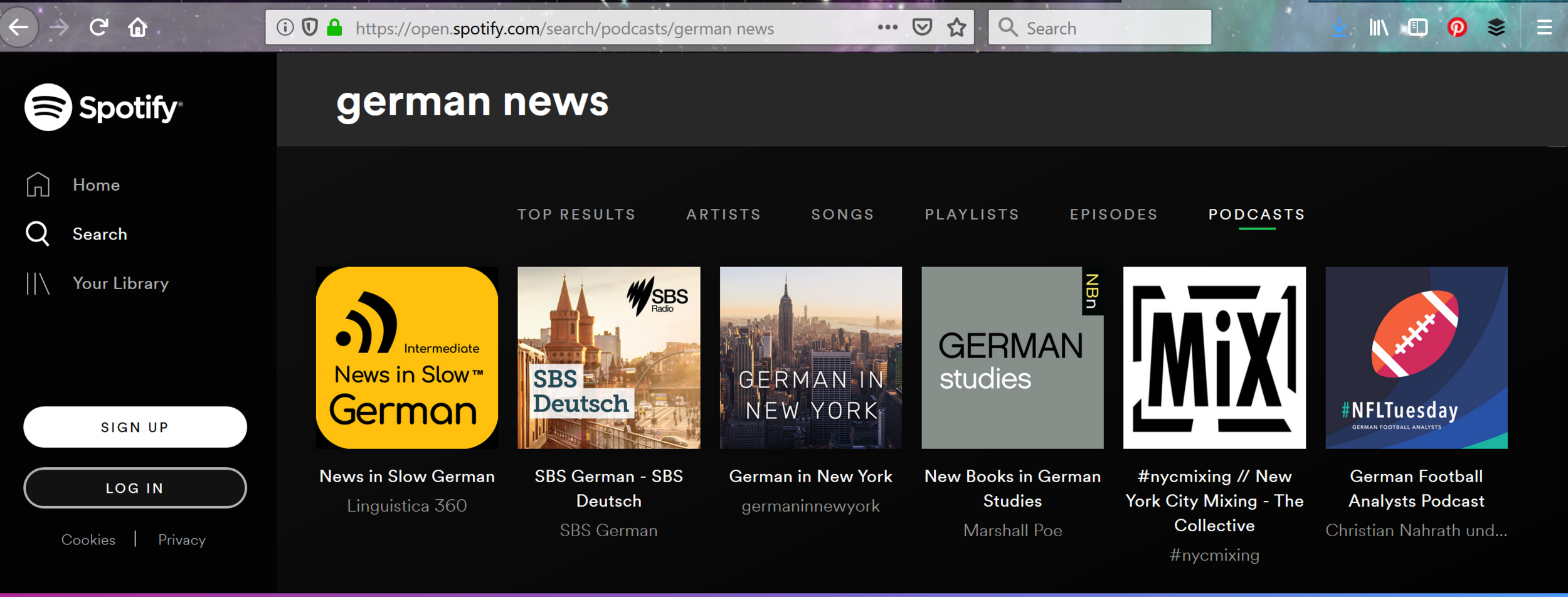
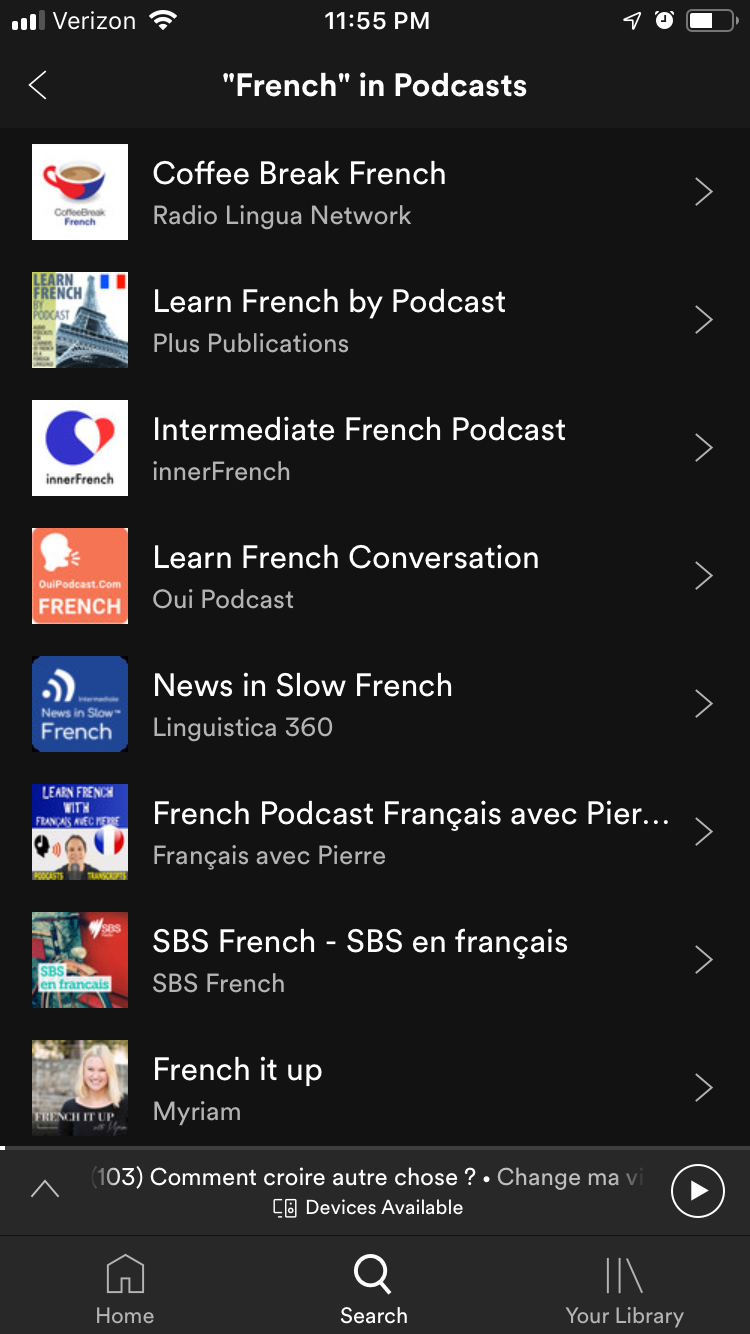
And of course, don’t forget that you can find the Fluent Show (your favourite podcast, right?) on Spotify too. Simply type "Fluent Show" in the search and hit play.
Find Native Language Podcasts
You can easily find podcasts geared towards native speakers as well. If you don’t have a specific topic in mind, type your target language into the Search bar and continue scrolling through until you find a title written out in the target language. In fact, I found one of my favourite French podcasts about personal development with this method, using "français" in the search bar.
If you do have a topic idea in mind, you can also type a related word in the target language into the search bar. Then, be sure to select ‘Podcasts’ or scroll down and select ‘See all podcasts’ (if you’re using the mobile app). This will bring up all the podcasts that have your search term in the name as well as related podcasts in the same language.
Make It A Habit
Adding music to your language learning can make things easier, but your efforts will only pay off if you take the time to learn and use the vocabulary your favourite song can teach you. Most of all, you need to do it consistently.
Listening and learning from music can be both fun and useful when you make it a regular habit.
Frequently Asked Questions
How can Music Help you Learn a Language?
Music can be an effective tool for learning a new language, here is why:
Memory Boost: Music's catchy nature makes it easier to remember words and phrases.
Better Pronunciation: Listening to music lets you hear natural pronunciation and accents that textbooks might miss. Singing along helps you practice these sounds.
Effortless Vocabulary Learning: Songs are filled with new vocabulary. By listening to and analyzing lyrics, you learn new words and see how they're used in context.
You can check out my series on using music for language learning. Where to look for inspiration, and some musical hacks
Can you Learn a Language Using Spotify?
Yes! Spotify is an excellent tool for language learning. In today's blog post, we explored how to fully leverage Spotify for this purpose.
If you've been struggling to find new songs and artists or have been curious about using a popular music app like Spotify for language learning, we've got some tips to help you make the most of what Spotify has to offer.

What Music is Best for Studying a Language?
For concentrating during your studies, choose gentle music without lyrics, attention-grabbing riffs or loud percussion. Try searching for “focus playlists” on Spotify, as there are many available. For learning a specific language, use the tips in this article to get the most out of the lyrics and learn more about which artists are popular in each country.
Try These Ideas!
What now? Pick one of the following ideas, open up your Spotify app, and let’s try it out!
Search for a playlist in your target language
Find a song you like? Search for the artist on social media or check out their website
Search for podcasts in the language so you can hear it spoken!
If you’re an independent language learner, forming successful habits and doing more with the songs you love in your target language isn’t always easy. For those who struggle to create an ideal language learning routine, check out The Language Habit System. It’s meant to help you create habits that work for you, which includes adding the music you love to your language learning.
Want podcast inspo? Check out our Best Podcasts series!
Why is it so Hard to Find Pop Music in Other Languages?
This podcast goes into so much detail - it's an exploration of pop music in languages and language learning.
- Why does pop music matter for language learning?
- What influence does the industry have for which music gets made and which doesn't?
- Why is English such a convenient language for pop music?
- How should you incorporate pop music into your language learning routine...or should you?
- Where can language learners find music in their own target language?
- Who are our favourite artists in other languages?
I remember learning hundreds of new words as I was listening to my favourite bands, reading the CD liner notes to understand the lyrics. Music is an amazing language learning tool. It gets your pronunciation into gear, it motivates you to open your mouth and sing, and of course it's fun so you'll be engaging again and again!

Listen to Lindsay Williams and me in Creative Language Learning Podcast episode 57 to discover:
- Why does pop music matter for language learning?
- What influence does the industry have for which music gets made and which doesn't?
- Why is English such a convenient language for pop music?
- How should you incorporate pop music into your language learning routine...or should you?
- Where can language learners find music in their own target language?
- Who are our favourite artists in other languages?
Links from this Podcast Episode
- How to Use Spotify for Language Learning
- Quora: Why do non-English speaking countries listen primarily to English-sung songs instead of producing modern/pop songs in their own languages?
- Guardian: Behind the music: What it costs European acts to sing in their own languages
In dance music it's generally more important how lyrics sound than what they actually mean. Artists with English as a second language can be less judgmental about what's deemed a cliche.
- 10 Great Songs That Topped US Charts But Weren’t Performed In English
- Foreign language songs that got to Number 1 in the UK
- The Hottest German Lesson in Town: Deutschland 83 and Major Tom (PLUS Free Lyric & Vocab Sheet
- How I Built This, an NPR Podcast
- Honest Reggaeton (not 100% SFW)
The Biggest Pop Genres That Succeed in Other Languages
Latino pop
Notable collaborations include Despacito with Luis Fonsi, Daddy Yankee, Justin Bieber, and Bailando with Enrique Iglesias, Sean Paul et al.
- Alt.Latino Podcast
- Residente by Residente), an album exploring the artist's international heritage
K-Pop
European Music and Eurovision
Check out Stromae, KRO, Prince Pi, Indochine, Robyn (in English).
And I am delighted to sign off with one of the amazing "Moskau" performance by Dschinghis Khan:
The Hottest German Lesson in Town: Deutschland 83 and Major Tom (PLUS Free Lyric & Vocab Sheet)
One of the most wonderful things about learning a foreign language is to get to know the country behind that language. What is beyond the flashcards? What makes that place? It's awesome to dive into history and geography, cook a few recipes (like Shannon from Eurolinguiste) and of course discover what they watch and listen to.
If you're a regular listener of the Creative Language Learning Podcast, you may have already noticed that there is a new German language TV show on the block. Deutschland 83 is a spy drama set in one of my favourite periods of German history: the 1980s, right in the cold war. You can catch it on iTunes, on Amazon, or currently on Channel 4 in the UK.

German History: Spies, Terror and Economic Miracles
So here's the world at the time of Deutschland 83: Germany lost a world war and then the Eastern part of the country was made into a Socialist republic. The West started a kick-ass economy that went so well it became known for its Wirtschaftswunder, the economic miracle of the 1950s. In the 1960s, youth rebellion and peace movement shook our society, and Western Germany even struggled with its own terrorist group, the Red Army Faction. All the while, the Eastern part of Germany was locked away behind a wall and involved in the hottest army race of the 20th century: the Cold War.
Plenty going on at the time of Deutschland 83 then! The show's premise places a young Eastern German soldier into the West, where he's given a new identity and a bunch of adventurous spy tasks. It shows society in the West and East, the big fear of atom bombs laying waste to all of Europe, and a few hilarious scenes where a confused bunch of high-level spies stare at a floppy disc, wondering what it does.
Discover Germany's Answer to David Bowie
One of the unmissable things about Deutschland 83 is its awesome soundtrack. Let me introduce you to its theme song "Major Tom", Germany's synth driven response to the wonderful David Bowie. I've prepared a lyric sheet for German learners which you can download below.
Major Tom, written by Peter Schilling, was inspired by Bowie's song "Space Oddity", which tells the story of an astronaut abandoning his mission, decoupling from base and going off to live in space. In Germany, the song became a huge hit and one of the flagship sounds of Neue Deutsche Welle, the biggest 1980s pop music trend which also included Nena and her famous song "99 Luftballons". In fact, if you pay attention in episode one of Deutschland 83, you'll hear the song playing in the background at a party in East Germany (where playing Western music would have been an offence!).
Germans have never stopped loving Major Tom, and today there is no good beerfest without everyone shouting völlig schwerelos (completely weightless) and waving their hands about.
Bonus: Major Tom in French
Major Tom's fame was all over Europe in the 80s, so if you're a French learner you can use the same song for study. Here's the cover by Belgian synthmeister Plastic Bertrand (of Ça plane pour moi fame) will make sure that you don't miss out.
If you're listening to this song and can't shake the feeling that you know it from somewhere, it might be because Deutschland 83 is not the first show to feature Major Tom. If you're a fan of AMC's "Breaking Bad", you might remember the Gale Boetticher version - are those Thai subtitles?
Share Your Playlist
I'd love to hear from you about your own favourite 1980s tunes. Do you love pop music like Major Tom? Tell me about your playlist in the comments.
If you love the sound of Major Tom, don't forget to download your free Vocab & Lyric Sheet.
You can also check out this article to get a step-by-step guide to using music for language learning.
How Becoming a Musician Can Improve Your Languages: Shannon Kennedy from Eurolinguiste on the Podcast
Take just 2 minutes and win prizes by telling us about you in our Creative Language Learning Podcast Listener Survey.

In Episode 25, I enjoyed a conversation with Shannon Kennedy. Shannon writes the travel, language and life blog Eurolinguiste. She's a musician. And knows seven languages.
During the course of this interview I took the neatest notes I have ever written. My guest Shannon Kennedy just has that effect on you. She's calm, considered and very experienced in language learning.
You'll hear about:
- Why Shannon's blog a language learning blog with travel tips and recipes
- How to take responsibility for your books and apps
- What it takes from you when you study with a teacher
- What it's like to study a language as an introvert
- How becoming a musician can make you a fantastic language learner
- The Benefits of Language Switching
- The lovely lovely word indulge
Tips of the Week
Shannon's choice of the week was tip 3, because transliteration can help you no matter if you are learning another writing system or an unusual grammar structure.
1) Join a Choir, learn a language
2) Use Mind Maps for learning a new language (here's an article about this in German)
3) Use transliteration to master foreign writing systems
Tips and Links from this Podcast
- The Digital Language Collective
- Eurolinguiste
- Shannon sings and plays the Sax
- Blog Post: How to Learn French as a Food Lover
Don't forget to take our Listener Survey today.



Struggling with listening? Discover realistic tips, challenge prompts, and the best tools for improving your listening skills as a self-guided language learner