
It's a free app loved by millions. Is Duolingo wasting your time?
Whenever I hear that someone new is starting language learning, I get excited.
But then, they mention Duolingo and I know how this is going to go.
I’ve spent years teaching, learning, and experimenting with language tools, and the little app with the Duolingo owl has always felt like a toy version of what language learners really need.
Using the app feels like language learning. You’ll pick up a few phrases. Cartoons cheer you on.
But deep down, it’s cosplay. Why?
What’s Good About Duolingo
This app felt like a revolution when it first came out. Here’s why:
Free-ish, easy access to language learning from your smartphone. Nice.
Lovely design with lots of fun illustrations
Gamified learning keeps you coming back!
It gets you from zero to somewhere in language learning, and officially works for getting people to do well on tests. (research sponsored by Duolingo itself though 👀)
The Downsides of Duolingo
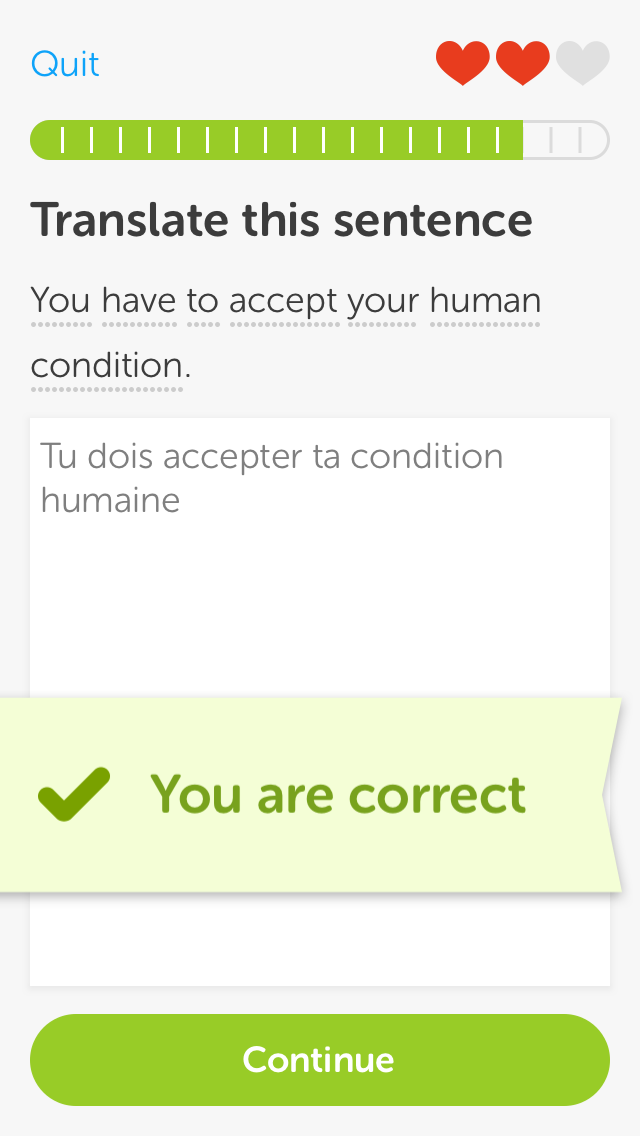
Duolingo telling me what my problem is.
You probably know about a lot of these issues by now, but let’s recap:
You have to learn endless nonsense sentences.
No flexibility about how you express yourself in your new language, so you’re not learning how to communicate.
The feedback is too easy to ignore.
Of course it’s not really free. Duolingo is now an ad-packed freemium app, and their business model has always cost teachers and learners. (Want the back story? Listen to this podcast about the hidden cost of cheap & easy language learning.)
Zero nuance, extremely limited explanations, no culture context.
Language learning should make people curious, but Duolingo doesn’t do that.
You don’t become a communicator. You become a really good Duolingo user.
What I Wanted to See Instead (So I Built it)
As a language teacher, AI has blown my mind. This endless resource of natural languages is easy to access, like a rich practice playground.
From the start, I wanted to build a community-driven, AI-powered space that actually helps people make progress:
Fresh, exciting ideas developed for real learners
Tools that help you learn with freedom, explore and have fun
Real-time personalised feedback, not just error messages
Content rooted in culture, context, and actual conversation
And most importantly: a support system. Other humans. (Plus AI that doesn’t sound like it’s dying inside.)

So I opened AI Language Club, where we create and experiment with fresh, interesting language learning ideas in ChatGPT, Gemini, and other AI tools.
If you are just getting started with a new language, don’t sleep on the big possibilities of AI, because it can do so much more than Duolingo!
What to Read Next
3 Tutor-Approved Ideas for Improving Your Duolingo Experience
Finding the Button That Makes AI Easier for Language Learners
If you are ready for fun, exciting language learning with fast results, come and join our club!
How to Speak More Fluently by Building Good Conversation Habits
Ever hit a wall in conversation when trying to speak another language? Discover the different ways that you can handle that wall. Knowing how to handle a conversation breaker means knowing how to keep things flowing, and it’s the only way for you to approach fluency.
No matter if you are new to language learning or you're a certified multilingualist, I bet you know the conversational wall. It's that feeling where you just don’t know how to say something. It could be a missing word, and sometimes you can’t find words for what you’re even trying to say.
The wall creates that awkward moment with your conversation partner, where you just stall the whole thing. You’re running on empty, grasping around for words, and in fact you’re feeling like an idiot. How frustrating it is for an articulate adult to fail when it comes to saying stupid basic things like “I don’t like boiled potatoes” or whatever. How far you have to go!

In today’s blog article, I want to introduce you to the different ways that you can handle that wall. Knowing how to handle a conversation breaker means knowing how to keep things flowing, and it’s the only way for you to approach fluency.
What You Have Tried Before to Get Fluent in a Language
The following three options might all feel pretty familiar and perhaps even helpful to you if you run into one of those walls. But are they really the best way of dealing with the problem?
You’ve Hit More Language Books
Many people who are new to language learning feel like their only way of dealing with the wall is to give up trying to have the conversation and return to the books. The logic is that if you don’t know how to say everything, you obviously haven’t studied enough yet. But in reality, this is a sign that your learning mindset needs a breath of fresh air.
A student once told me “I’ve always been used to excelling at the things I put my mind to. Law exams, university grades, that all didn’t feel so hard to me. So why can’t I ace this language!?”. As his language coach, it’s my duty to remind him of several trap doors that he’s opening up with that kind of thinking.
Firstly, believing that first time mastery is the only way to be a good language learner is a way of closing a door to true growth in your own mind. And moreover, it’s important to recognise that language learning is not only graded by what you remember and express correctly. Creativity, flexibility and conversational confidence play a huge part in fluency and form part of the learning experience.
The key is to understand that you’re not failing when you run into a wall. You are actually succeeding at discovering your skills. Keep on exploring.
You’ve Tried to Change the Topic
Changing the topic may help you save face, hide that panic and manoeuvre your conversation back onto safer ground. Overall, it’s a pretty solid option and one you can try if you are feeling particularly embarrassed. Remember that everyone loves to talk about themselves, so your sneaky way back from the conversation wall is to put the focus back on the person you are talking to. With a little bit of luck, they may even say exactly what you were thinking - and they’ll show you how to express it in your target language.
If this is a good option, why isn’t it the best one? The answer is simple. How many times are you going to change topic before you realize you still haven’t said what you need to say?
You’ve Tried to Look Up Words in Google Translate
The part of you that considers herself a solid and obedient learner will want to do this. The part of you that wants to demonstrate that you are truly accomplished will want to do this. The easy way out of not knowing something is to look it up. Of course! And yet I urge you to consider the negative effects of looking up words every single time.
First of all, your smartphone battery isn’t going to last forever. Secondly, it’s not actually all that polite to keep your conversation partner waiting while you whip out a phone and start googling for an answer. They’re right there! They might just be dying to help you. And thirdly, you’re training your brain to know where to look, but not to remember anything that you are learning. Neither your brain nor your mind will thank you for relying on a lazier way of thinking.
So with all those kind-of-okay options ruled out, what could be the way a truly fluent learner approaches the conversation wall? From my observations in lessons and in my own language learning experiences, it comes down to a few significant shifts in attitude. Remember that Growth Mindset I’m so very fond of? Here is where you use it. Here is where you show your head who’s boss!
Here's How to Be More Fluent in Conversation
Step 1: Walk through the Awkwardness

If you’re a perfectionist or someone who holds themselves to high standards you’re not going to like this option at all. A way through? You mean I’m telling you that you should admit when you don’t know something and sit there all awkwardly looking like an idiot? Yes. That is exactly what I am telling you to do. There are so many learning benefits from finding your way through that awkwardness. First of all, you’ll quickly realise that missing a word in foreign language conversation is a pretty common thing.
My friend Lindsay recently told me about British nursery rhyme We’re Going on a Bear Hunt. In the story, the brave bear hunters encounter all kinds of obstacles. Mud, snowstorms, rivers, everything is in the way. There’s no way under it. There’s no way over it. So they decide to go the only way that they can: through it!
When you are facing your own linguistic obstacles, remember that you can’t go over or under. You’ve got to get through it. That awkward moment when you feel restricted and stupid because you don’t know how to say what’s on your mind? That’s normal. Just notice it’s happening, take a breath and continue to Step 2.
Ideal Step 2: Accept the Challenge
The idea of accepting a challenge sounds like this is a big thing, but I assure you that this is an attitude shift that will become your best new habit within a matter of hours. So you don’t know a word. So someone’s looking at you and waiting for you to say something and you don’t know how. So WHAT! What can you do next? How are you going to go from awkward to outspoken?
Ideal Step 3: Describe What You Want to Say
Okay, here is where you flex your real fluency muscles. A confident foreign language speaker is not intimidated by gaps in her vocabulary. Instead, she will embrace the learning opportunity and look for a way around the gap. The first step to take is to prepare a set of useful fillers in your target language. These filler lines should become as comfortable to you as hello and thank you. You will need them for ever and ever - trust me, I’m so fluent in English and words still fail me on a regular basis.
Good filler expressions include the following:
“I don’t know how to say, but I mean a thing that…"
“Help me out here…how do you say…?"
“You know, it is a little like…"
The key component in a good filler line is that they all allow you to describe the thing you are trying to express. No matter if it’s a noun, verb or expression you are searching for, the key to fluency is in opening yourself up to learning the word from your conversation partner.
It’s absolutely essential to remember that these moments of hitting the wall are where you really show your skills in language learning. Not because you are measured by how many times you encounter the wall, but by how many times you get through it, over it or under it. This is the way that you will have confident conversations in weeks, not years.
So are you ready to start having truly fluent conversations?
Thanks for reading this article on Fluent, the Language Learning Blog. Please share this post on Twitter, Insta, or Facebook using the Share buttons. If you are feeling stuck right now, why not subscribe to Fluent.


How to Decide Which Languages to Learn Next
Got a whole bucket list of languages to learn, and no hope of ever getting it all done? Fear not! Here are some simple ways to help you streamline that list and re-focus on learning what you need without distraction.

Do you have a long list of languages to learn in your life?
Feel like you started a language years ago and now you're stuck learning it forever?
If you need help with choosing your language list, I've got tips to help you streamline all your options.
You can listen to my best tips on the Fluent Show episode below:
How do I decide what to keep and what to omit from my languages list?
Language learner Sheela got in touch with me to ask the following question:
I would love to get your thoughts and advice on how to narrow down or simplify my ' to learn ' languages list!
How do I decide and know what to keep and what to omit, from my languages list?
I feel moreover, if I have studied the language in the past, I am obligated to 'keep' it on the list. Is it okay to let go of some languages and concentrate on others, you think?
What an interesting question! Language choices are a regular polyglot dilemma, but it's not every day that a learner grapples with how to clean up i.e. how to reduce the languages on their list.
What To Consider When Choosing A Language To Learn
Here are a few helpful thoughts when you are working on that list of languages to add to your "lifelong homework".
You're Destined To Leave Something On The Table
With over 7000 languages spoken by humans on planet Earth, one thing is clear: There is not enough time to learn them all.
Even a very accomplished and focused learner who has accumulated way more languages than most of us can imagine doesn’t usually go far above 50. So in other words: We’ve got to make friends with the idea that we’ll miss out in life, and we’ll have to leave a little bit of language on the table.
It's Possible to Have Different Target Levels for Different Languages

Some people differentiate when it comes to language levels and ambitions. We can dabble in more languages (say up to 40 hours) than we can start learning (say 100+ hours), that’s natural. And this can feel like a serious choice to make.
The question only you can answer is what you are expecting to gain from learning your target language.
If you want to feel accomplished, hold conversations, feel like you are adding a useful tool to your list of skills, then dabbling in a language can feel more frustrating than fun. But if you’re preparing for a temporary trip or you’re curious but not committed, by all means have that fun play with a language.
It's Possible To Re-Learn a Language You've Studied Before
We forget languages we’ve learnt, but not entirely. This is especially true if you have learnt several languages from a similar language family, but it applies to all. For example, I remembered completely forgotten Russian words in Croatia, and I can still muddle through Spanish for 15 minutes even though my last straight up lesson was 10 years ago.
For more information about re-learning a forgotten language, check out this Fluent Show episode.
Before I go into a few more tips in relation to this week’s question, I want to address a really great point that Sheela makes in her email, which is that there is no rule that says…. This is RIGHT!
There is no rule that determines how you go about learning your languages, what your list looks like, and how you make your choices. You're not getting it wrong.
3 Steps for Choosing Your Languages Without the FOMO
Here are a few options for getting more clarity in your list:
- Allow yourself a dabble in some languages and choose only one or two big focus languages in a year. (why not try the beautiful Welsh language for a little spin next time? I've got a mini course to help you with that!)
- Focus on the languages that are most relevant to your life right now. This could be because you have travel plans, people to speak to, or you’re simply drawn to a special language.
- It is ok to let go of some languages. Trust that re-learning in the future will be easier than expected.
One final thought to help you feel like you're not missing out on a language:
Most people I know have a pretty long bucket list, but very few squash it all into a short period of time.
I don’t know your age, but there’s a good chance you have at least 20, maybe even 40 or 50 years left in life to learn languages. Consider the many polyglots who are in their 60s and 70s, and still adding languages.
We have so much more time than we think!
Have You Ever Kicked A Language Off Your To-Learn List?
I'd love to hear how you deal with your "language list" if you have one. Get in touch if you want to share your story!

#clearthelist August 2019: How I Keep Motivation for Learning Languages
Check in with me! Every month I write about my language learning goals and progress. Currently I’m focusing on 2 languages: Mandarin Chinese and Welsh. Read this blog article to find out how it went in July and what I am definitely changing for next month.

Hello and welcome to #clearthelist, a monthly language learning goals round-up. This blog round-up of goal trackers is hosted by Lindsay Williams and Shannon Kennedy here.
What Happened in July?
July 2019 seemed like a long month with lots going on. Here at Fluent, I’m currently head down in some preparation work for big things to come later in the year, such as my first membership community and a course update for the Language Habit Toolkit.
I spent 10 beautiful days on holiday visiting Hamburg and the German island of Fehmarn. My first island and my first ever experience of the famous German Strandkorb. Fehmarn is gorgeous and I didn’t want to leave.
In the following week, Britain braved a heatwave and I achieved a particular personal goal: my British citizenship. I am now a dual national, which was a move entirely motivated by Brexit and therefore bittersweet at best.
Fun fact 1: At the ceremony I had to say a pledge of allegiance. I asked to do it in Welsh but was denied because "we have to be able to understand you". I now speak more British languages than the Brits who held my citizenship ceremony.
The Fluent Show
This month I was pleased to publish five podcast episodes, all of which just stand their own. My favourite conversation was with María Ortega Garcia, giving me such a zest for play in how I teach.
And I can’t leave you without recommending the episode Indigenous Languages Explained, which is a topic that you’ll find both important and interesting.
The Fluent Show also hit a huge milestone this week. We counted ONE MILLION DOWNLOADS 😲in the last two years. It’s an absolute whopper number and made me so excited and proud. Thank you, listeners!
Time to get to those language goals now then…oh my.

Citizenship ceremony in 38 degrees 🥵
Language Goals and Progress
Fun fact 2: When I do not print out my goals or write them by hand and pin them on the wall behind my computer monitor, I don’t do as much towards them. Fancy that. It’s a reminder that even faint awareness of our goals can help us move towards them.
Let’s talk about Welsh first.
Welsh Language Maintenance
This was a maintenance month where I didn’t focus so much on the Welsh language. I picked up the book Ffenestri by Lois Arnold - picked it up from my shelf, that is - and finally started reading it during our long train journey to Hamburg. This book is so lovely. It is divided into 3 levels and I breezed through the beginner section and most of the intermediate section. I’m a B1/B2 reader in my book!
After the holiday, I’d not had the chance to pick the book back up…but I look forward to the next parts.
In terms of listening and writing, there wasn’t daily contact but still a consistent stream of language input through S4C and even my Intermediate Grammar book.
Only thing…I didn’t speak a lot of the language at all. It’s a classic problem for those of us who live further away from our target language communities, and the answer is to simply rope in friends or book more online lessons.
Welsh is now a pleasure language for me, one that I enjoy every time I get to experience it. Sadly I’m missing the Eisteddfod this year, but I’m eager to plan my next trip to Cymru.
Chinese Language Progress
Now, for my little Chinese progress.
Listening
I watched the odd YouTube video and tried out a few resources, but like in previous months I know I’ve got a gap here. Might be time to purchase a course with practice audio.
The good thing: I’ve discovered Mandopop and am now happily bouncing around Spotify so that I can get into more of a positive mindset with Mandarin Chinese.
Reading
I had high hopes that I would make lots of progress using Lingq, but instead the progress was somewhat slack as I found myself reviewing vocabulary rather than adding new words.
In the long run, I’m sure I’ll be glad that I didn’t just press on to get ego numbers. But right now, it’s a bit of a ¯(ツ)/¯._
My biggest reading contact comes from the language learning apps that I fall back on while I’m studying: Drops, Lingodeer, Memrise. This month was a strong showing for the apps, which kind of goes to show how little concentration time I put in.
Speaking
I took one italki lesson and enjoyed it, didn’t really speak a lot more than that.
Writing
2 pages of vocab notes after reviewing the italki lesson, and I’ve been writing a few little pages of introduction stuff as well.
A Word on The Value of My Vision Goal
In July I lost track of tracking, and now that it’s coming round to review time I can feel the impact. I’m a great Chinese student when I sit down and focus, when I’m in the habit, when I want to. But after some time off, I wasn’t in a good routine.
When you are at a beginner level in any language, that routine is incredibly important. Once you can speak, enjoy TV, read, everything becomes easier to integrate.
So I’m definitely a beginner and for a few minutes I was even considering throwing the towel. But I am not ready to abandon this project! I want to understand more Chinese when I hear it, chat to a few people, initiate conversations. I am happy to get the study materials back out and spend 15 minutes on them every day.
You can’t always keep up the same levels of motivation and action. To learn a language in a busy life, you need a moment to remember the big picture.
If you want to learn more about the importance of a vision goal, this blog article is a good start: How To Learn A New Language With Smart And Useful Goals
Language Goals for August 2019
Let’s be realistic: I’m spending almost 2 weeks of this month travelling. I’m unlikely to be carrying around a Chinese book or running into lots of Welsh speakers.
With that in mind, who am I to give up, right? Here are my goals for the month:
Welsh Language Goals
Mae popeth yn iawn, everything’s okay with Welsh. I’d only love to speak more so I’ll have to make sure that I have one or two real conversations with someone. Please volunteer in the comments. 🤗
Chinese Language Goals
I am going to travel with my phone and iPad, so this month my goals are digital.
Listening
Skipping this, except for more of the Mandopop.
Reading
I am reading a story on Lingq and will continue with it, hopefully making more Lingqs in the process. I will say I’d like to get to 100 Lingqs, bearing in mind my slow pace as I do review everything several times.
Speaking
I am in the market for a new tutor, and I’m also going to record a few videos of myself speaking Chinese to post on Instagram or share with a tutor. I live in such a student town that I also imagine it might be lots of fun to find a local exchange partner…but I’ll do that once I have acquired some basic level of decent skill.
Writing
I’ll continue to write by hand (characters and pinyin) while I’m home when I have time, but my only firm goal is to figure out how to type characters on an iPhone.
And that’s it for my round-up and goals for August 2019!
How do You Record Your Goals?
How do you keep track? Tell me in the comments below!
On The Need For Fun And Creativity In Languages

What do you think of when you see the word “creativity”?
For me, creativity used to mean being particularly gifted in visual arts. Painters and sculptors were creative. In school, it was clear that being creative was how you got good grades in art classes.
I was a pretty terrible artist, and so I always assumed that I’m not creative at all.
But then I got a job and started noticing things. In work meetings, ideas for alternative solutions to problems would bubble out of me. When I started teaching and learning languages on my own, I felt constrained by the ideas of learning with a textbook and classroom structure.
Instead of putting off my ideas as delusions, I started to listen to them and put a few into action. And slowly I realised…I’m creative after all!
You Have The Tools to Be a Creative Language Learner
My own discovery encouraged me to start looking differently at language learning. I quickly discovered that adults learn best when creativity and fun come along for the ride. So I started to seek out creative ideas of learning.
If you are a first-time solo language learner who’s busy in her life and wants to know how to become fluent without sacrificing all your leisure time, creativity is what will get you to your goals.
I know lots of people who start off and and think “learning is the books and the app”, and when you box your language learning in like that, your motivation suffers as a result.
Creative Ideas For Language Learning
In this episode of the Fluent Show, Lindsay and I discussed the easiest ways to start building a fun and creative language routine.
Listen to the show here to get our full discussion:
Warning: These may not feel like study, but you’ll learn a lot anyway.
Language Learning With Music
Research and discover songs in your target language and music from the target country. Learn new words and expressions by understanding the lyrics of the songs you listen to.
Playing Games
It’s a common theme on this blog: We learn best when we’re having fun. Playing word games like Taboo, or even classic board games in your target language gives you a subtle way of creating a space where you learn a few new words free from pressure.
When you’re on your own, video games create another interesting option for language learning, and some of them are even [developed with language learners in mind.]
Games are especially handy when you want to share your language with kids.
Poetry and Literature
You might think you have to be an advanced level language wizard before you can even touch a book of poems in your target language, but that is not true! Enjoy a story with tools like [Interlinear books], try your first ever haiku, or lose yourself in a rhyming dictionary.
The key here is to express yourself freely and have fun in the process, getting out of your head and into the feeling that you want to have.
Technology
It’s the 21st century, which means you’re more likely to be reading this on a phone than on a desktop computer right now. And that means it’s time to get creative with tech in your new language.
Lindsay recommends creating a language space in social media that’s dedicated to learning your target language, for example a “Norwegian only Instagram”. I’ve tried this too through Twitter lists. The result is fabulous: it’s instant mini lessons, whenever and wherever you want them.
Exercise
Movement boosts memory! Have you ever thought about combining a language workout with a body workout? We had lots of ideas in the podcast, like example looking for exercise videos in your target language, and taking a language podcast out on a jog.
This one’s great for teachers of any age group, too, as you can create a whole new lesson plan when you think about different ways of moving around your classroom (or outside!).
Bricolage / Crafts
For thousands of people, getting creative means creating cool craft projects like woodwork, scrapbooks, or small art. With craft projects, you have so many options of incorporating language.
Of course you can search online for videos and instructions in another language.
Or you could take printed items from the target country and use them to decorate your home. Or make special art pieces celebrating the words you love the most. Or create a photo essay based on inspiring expressions.
Listen to the podcast to hear more about the special things I created as a teenager (Lindsay calls them ransom notes!).
Cooking
Everybody’s got to eat, and most people have to cook. So what could be more practical than cooking yourself a meal in your target language? From seaweed scones to the secret cuisines of Paraguay, we’ve tried this out and recommend it whole-heartedly.
It’s SO Easy To Get Creative in Language
When it comes down to it, we found that it’s almost impossible to be anything BUT creative in language learning. Yet…many learners avoid getting involved.
Or when we do play and enjoy in our target language, we feel guilty as if this isn’t “proper learning”.
So this made Lindsay and me wonder: why the heck did school teach us that language learning has to look like classroom-exam-teacher-class-snoozefest?
STUDY and LEARNING are concepts that feel like they should look a certain way, when in reality they are not.
Creativity is about permission!
In the podcast, Lindsay and I looked deeper into this idea of permission and allowing ourselves to let go of language learning guilt. Guilt does not do us any favours at all so we should learn to let it go.
Whenever you feel like your activity is not “real learning”, it might be time to reconsider and remind yourself to:
- Accept our mistakes (both in language and process and habits and study)
- Be kinder to ourselves (does it really matter if we break a streak?)
- Impress NOBODY but ourselves
How do YOU get Creative in Language Learning?
Do you cook, craft, run, or rhyme with your target language? Or are you worried that these activities mean you won't learn anything?
Leave a comment below and hare your thoughts!



Struggling with listening? Discover realistic tips, challenge prompts, and the best tools for improving your listening skills as a self-guided language learner