

How To Create The Best Vocabulary Learning Technique In Any Language
How can you make sure that your memory is always sharp - even when you're learning important vocabulary?
Here are a few important points that will help you set up your language learning routine. The concept always remains the same: You need to acquire, memorize and review your words until they go in
How can you make sure that your memory is always sharp - even when you're learning important vocabulary?
Here are a few important points that will help you set up your language learning routine. The concept always remains the same: You need to acquire, memorize and review your words until they go in.

Follow The Vocab Flow: Acquire, Memorize, Review
There are three steps that I want to take you through about vocabulary. These steps don't make up a method, but they will teach you how to think about vocabulary.
1) You Can Learn a Language Without Frequent Word Lists
The first step is growing (or acquiring) your vocabulary, and this one is about organization. You need to know where to find the words. Some learners use frequency lists for this, but in reality your new vocabulary is all around you.
It's more helpful to you if you think about which words matter the most to you and what you will want to talk about. For example, in Welsh I learnt the word for "self-employed" really early because a lot of new friends at the Eisteddfod asked me what I do. That is not a word you'll find in frequent word lists, but it's definitely one I need.
2) How to Memorize Vocabulary With Ease
There are lots of methods for memorizing vocabulary. For me, two core steps work best: First of all, I examine my vocab lists and start looking for patterns. Words are made up of different components, and many of those components repeat in language.
My background in having learnt Latin and many other languages comes in very handy here. For example, look out for prefixes, for example I started seeing more words that started in cefn in Welsh, so I looked up the meaning of cefn by itself and started to see a pattern in how all those words connect.
Related Blog Article: What Gets Easier When You Study More Languages?
If you're a German learner, check out this interesting explanation of how the prefixes work and what many of them mean.
If you don't want to observe your words themselves, you can also check out word association and even Memory Palaces. Connect your words to something that is meaningful and vibrant for you - this works with phone numbers and grammar rules too. Pretty much anything. In The Vocab Cookbook, I described some of these methods step-by-step so you can practice memorization immediately.
3) You Can Train Yourself to Remember Vocabulary
No matter how well you memorize a word, your brain might forget it at some point. This isn't a failure - in fact, it's normal.
All language learners recognise that forgetting is part of this learning process. The forgetting curve isn't so easy to control, either. Sometimes a word can stay in your mind for a week or two, just to disappear after another week. This is why good systems work on the spaced repetition system (SRS), meaning you will need to revisit words many times over...but you also get a break in between.
Great online systems that are built on SRS abound, and you will find that most flashcard apps are built on it. My personal system is first based on handwriting and working away from screens. But for the stubborn words, I also add in a Memrise course in which I curate the words to be the most efficient use of my time.
But every now and then, I trail off and just study everything. Make it your own and "do you" -- it's one of my favourite rules!
What's Your Best Vocabulary Learning System?
You don't have to follow every single step and become a slave to my method.
Instead, experiment through finding a style that you can set once and use for ANY language you'll ever want to learn.
Inside The Tandem Language Exchange App: A Full Review
What if I told you that right now you're only 10 minutes away from chatting about your dreams for the future in your brand new language...on your phone? Sounds mad, but that's exactly what the language exchange app Tandem is designed for.
In this full review, you'll discover exactly how to make the most out of language exchanges and become fluent on your phone.
If you're new to a language exchange, the concept won't be hard to understand: You find a speaker of your target language. That person should want to learn your native language. When you chat to each other, you spend a little time speaking each language, and voilà...it's free, mutual, friendly practice.
Finding those other language lovers used to be a massive pain. Back in the day, you might have to strike up a conversation and exchange addresses with a tourist in the nearest town. Or if you're lucky, someone might put up a notice on a pinboard in the local café.
But what if I told you that right now you're only 10 minutes away from chatting about your dreams for the future in your brand new language...on your phone? Sounds mad, but that's exactly what the language exchange app Tandem is designed for.
How to Start a Language Exchange
Of course, language exchanges are not new. Good ideas start early and stick around. The language exchange concept has been around since the 1970s, named "Tandem" after the word for a two-person bicycle.
Here's an amazing quote from Tandem Fundazioa, explaining the bicycle analogy:
TANDEM is a bicycle designed for two riders both involved in getting forward. We have taken this word into our method of learning by exchanging languages with our motto: "In order to understand each other better I help you to learn and you help me to learn." TANDEM is therefore the bicycle among various language learning approaches - it is cheap, individual and ecological.
Check out this article for more inspiration about how language exchanges can make us happy.
Who'd argue with that... no one. So for free language practice, could the Tandem App be your step into the world of exchanges?
How Good is Tandem Language Exchange App?
You can download Tandem in the App Store for iOS and on the Google Play store for Androis. In this review, I focused on using the iPhone app on an iPhone 7. The app is completely free, with no limitations or premium memberships.
When I opened up the Tandem app, I was immediately taken in by the design and the personalised approach that they took. You open Tandem, connect your profile, and crucially you will tell the app a few things about yourself and your preferences.
There is an approval process, so you cannot join the app randomly and it's monitored by a staff member. I found this reassuring - after all, it's important that you keep your data safe online! Community is very important to Tandem, which has 1 million members from 150 countries.
There are three big sections in the app:
- The Community, where you can search for new people
- The Tutors section, where you can find and book lessons
- The Chats, where you can view all your conversations
Optimizing Your Language Exchange Profile
Before you can join Tandem you have to make an application and become approved by one of their staff members. Your profile will be linked to Facebook.
Once you're in, your profile won't be quite as protected as on other apps. I enjoyed the fact that I could see more photos of my new language friends and learn who they are before I chat to them. This can make it easier to find a good match, but be aware that you're also sharing more data with a big community.
Here are some tips for optimizing Tandem:

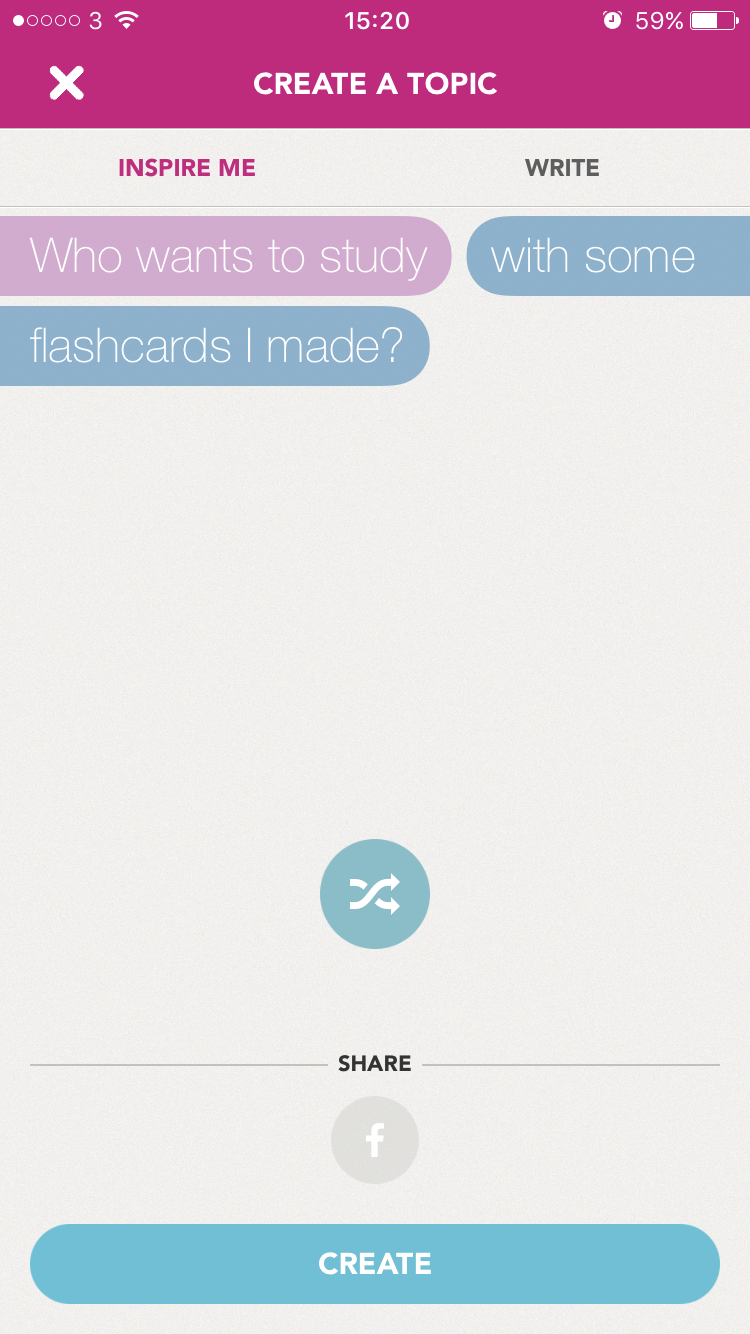
The "My Topics" section makes you an interesting exchange partner.
- Check out the Settings area in your profile to decide who should be able to find you.
- Select something fun you want to talk about in My Topics. The app offers lots of fun and inspiring prompts, or you can make your own conversation starters. These will be seen by others when they find your profile.
- Go into About Me to make sure you're happy with your profile picture and information.
Finding Language Exchange Partners
The partner search is the most important part of any good exchange app.
Tandem suggests people for you based on your language, but there's also a search bar. I had lots of fun on there, as you can search for anything. I tried
- Westworld
- hockey (nothing)
- Manchester United (SO MANY PEOPLE)
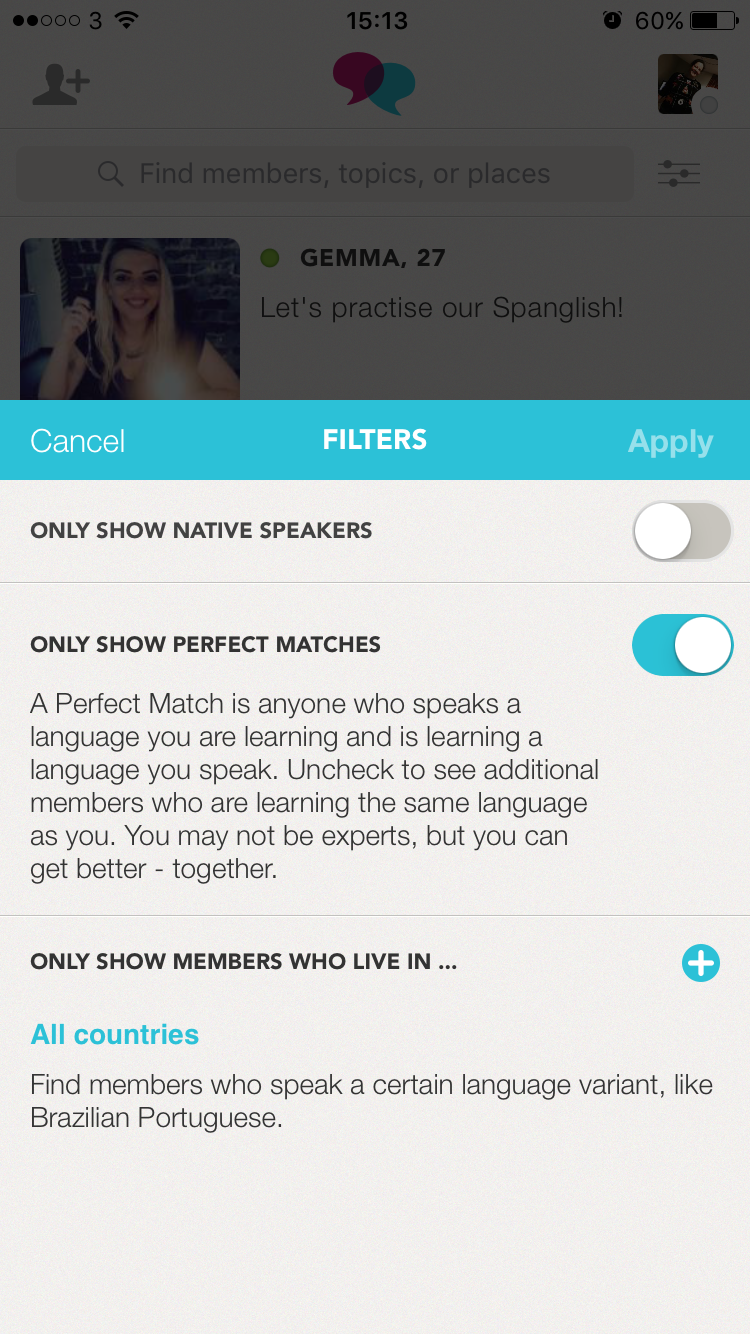
It was easy to find Welsh speakers on this app, as well as people learning each one of my interest languages. Remember not everyone needs native speakers.
The search is automatically limited to those users who are some kind of match for your languages, so you save time.
Tandem feels a little like a dating app. The personality of every profile comes out so well through that deeper connection with photos, likes and information. And to top it all off, you can leave comments on a language partner's profile to recommend them and tell others how nice they are.
All in all, I would say 5/5 - well done Tandem for your search experience.
How to Chat With People on Tandem
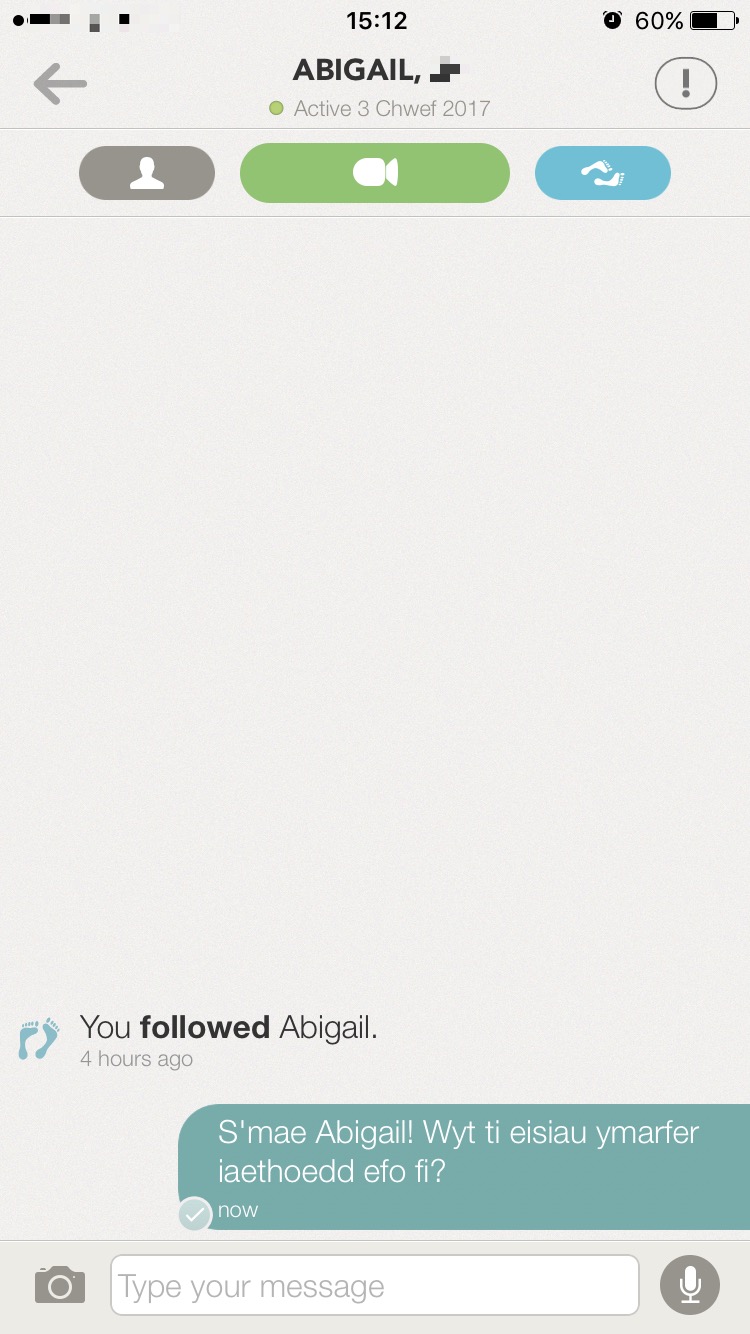
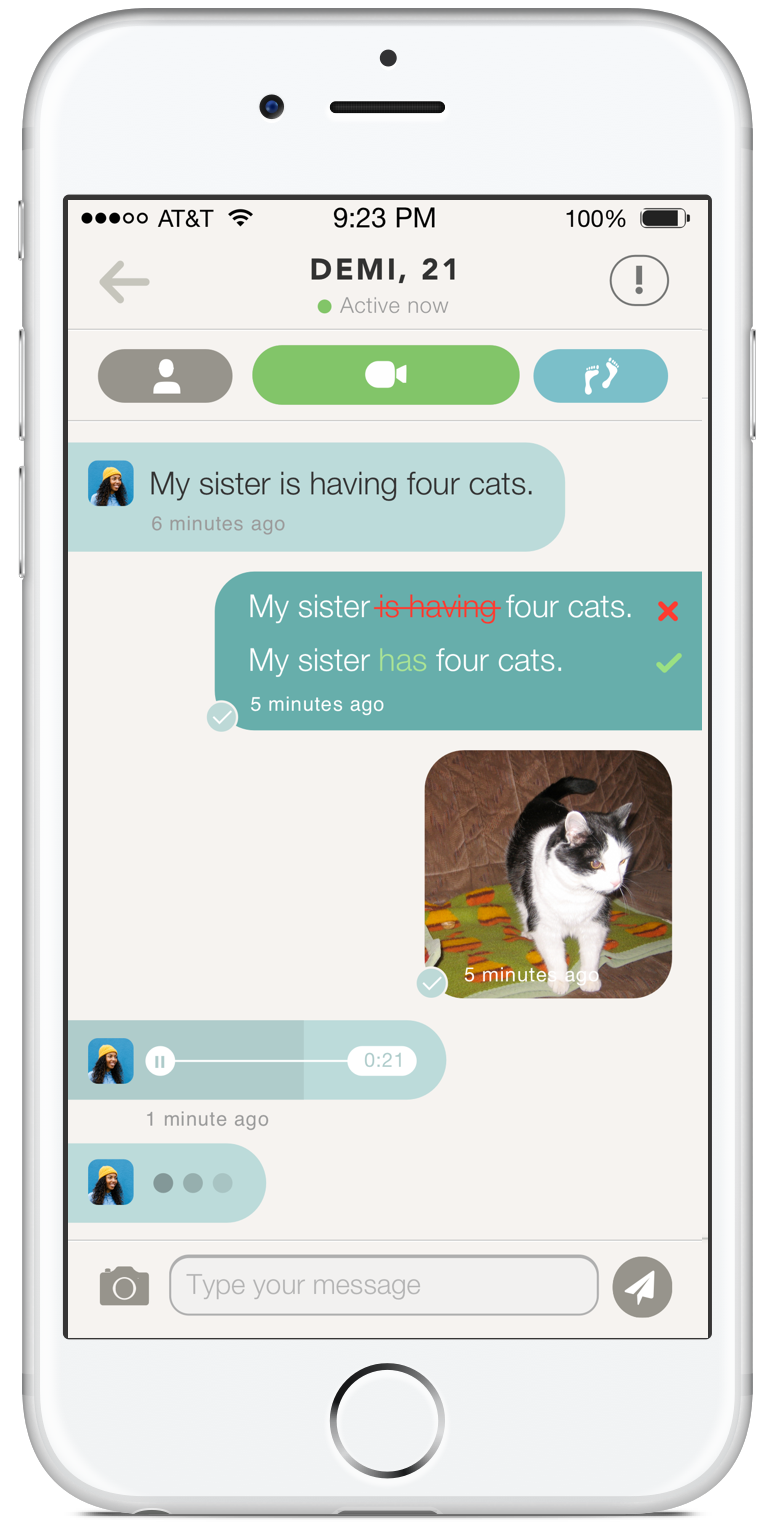
Chatting to someone on Tandem is straightforward. You shoot them a message through your profile. This app has the closest experience to texting that I've seen so far. You can send texts and voice messages, phone them on VOIP or go all out and make a video call.
I like how Tandem has simplified the design of its chats to remove anything you don't need.
Unlike other exchange apps, there is no in-app dictionary, but you can correct your partner's sentences easily. Chats are a friendly experience , making languages a tool for connecting with people. And the community moderation made me feel more comfortable sharing pictures and voice messages, too.
If you find someone who looks interesting and you're feeling shy, you have the opportunity to follow their updates and maybe contact them later. I am not sure how useful this feature is in practice, though.
Make Language Exchange Friends Without Losing Interest
If you go ahead and partner up with someone on Tandem, here are a few tips for making the process easier for you both:
- Arrange a time to meet and video chat or send each other longer messages on a regular basis. If it's a calendar appointment, you won't ignore it as much
- Allow for each person to ask a lot of questions and answer in longer sentences so you don't run out of things to say
- Prepare some interesting and unusual topics to talk about, for example these ideas on the Tandem blog:
- Follow Up each new exchange session by reviewing vocabulary and making sure you follow the acquire-memorize-review technique (I describe this in detail in The Vocab Cookbook)
Language exchanges do come with a small cost, as it takes your time and energy to prepare properly. In a good exchange, you both have responsibility for making this a fun conversation, so get creative and make sure you put in a little effort.
I give the chat experience a 3/5 - personally I'd like more language tools, but the design was lovely.
Or if an exchange sounds like it doesn't suit you right now...
You Can Find Language Tutors in The Tandem App
The inclusion of language tutors in Tandem touches on a really important point: You cannot expect your language exchange partner to be your tutor. I love that this app gives you the option of deciding how you want to be supported in your language learning journey.
Sometimes we all need extra help. Language tutors can explain more complex concepts, tricky grammar rules and fix your pronunciation.
More about this in my article on what you can expect to pay a tutor.
I tried out the tutor process and was absolutely satisfied. There is a personal vetting process, so that tutors have to apply and show how they are qualified and experienced for offering this paid service. The profiles are also reviewed by other users, so you know what you're getting.
Some tutors offer a free trial, but to be honest I found the prices so low that most people should not have to think twice before paying. The app even takes Apple Pay, a testament to its great user experience.
One thing was weird. I know that there are currently no Welsh tutors on Tandem. But even so, the app showed me tutors for everything. I'm a language nerd, so this wasn't a low point. I found it more inspiring...I could learn Korean! American Sign Language! Polish!
I'm giving the tutors in Tandem a 5/5 - this isn't a language school, and the support level seemed perfect for the app purpose.
Conclusions: Should You Try Tandem?

When it comes to recommending Tandem, I'm giving this app a big thumbs up. 👍 It's perfect for aspiring polyglots, because the community is both enormous and very varied. The user experience in the app is the nicest I have seen so far.
Within minutes, you can start swiping and reviewing dozens of cool people's profiles. Who knows what could be uncovered...a new local friend, an exciting connection around the world? No need to leave your house - you can strike up a conversation halfway around the world without ever getting off the couch.
The tutors as a support network are a really smart idea because they keep you committed.
My one bugbear would be with the general lack of integrations - I dream of a language learning app that lets me connect to my flashcards, my other apps, and more. If it works with Facebook, surely it can be done with Memrise?
I am closing my review with a solid 4.5/5 for Tandem. This app is totally free and worth checking out.
You can download the free Tandem app right now
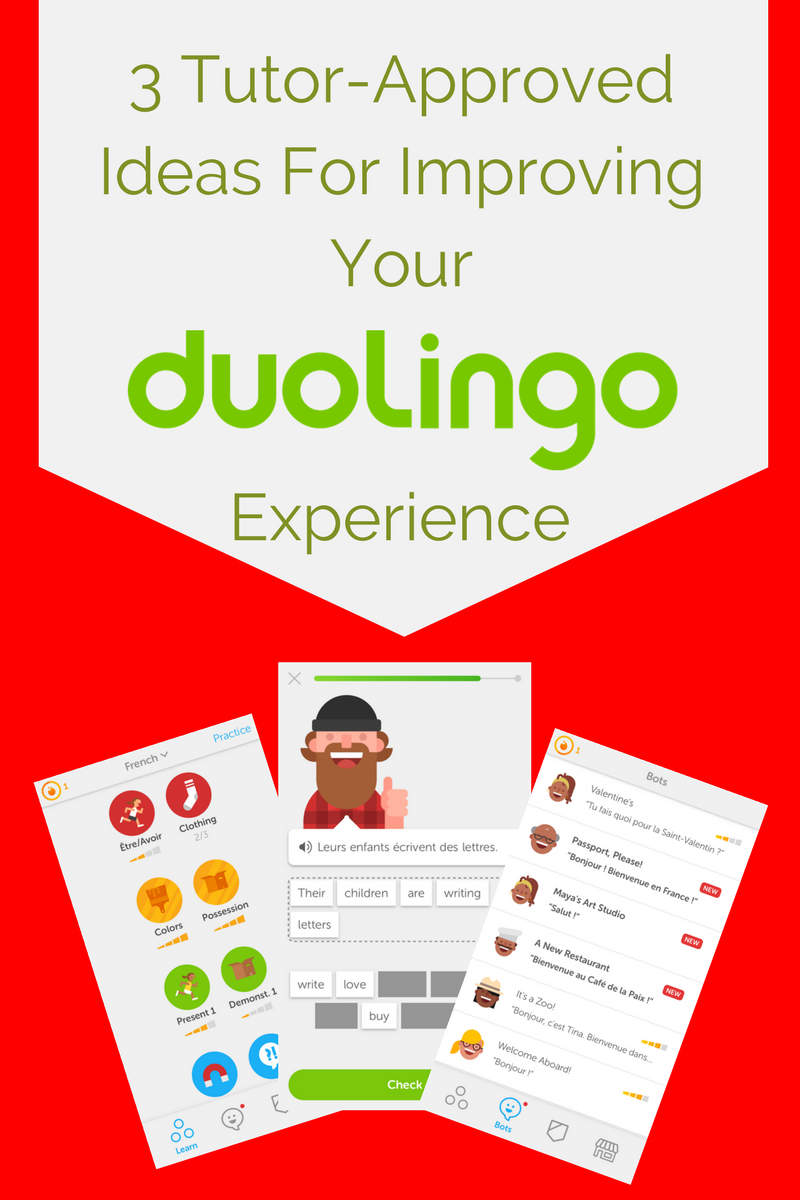
3 Tutor-Approved Ideas For Learning a Language With Duolingo
Language learning was so boring before a little owl in a tracksuit came along.
Armed with addictive streak and modern technology, today's smartphone language learning feels more like a computer game than a language lesson. And in many ways, that's a great thing.
Read on to find out my top 3 tips for getting the most out of your Duolingo time.
Language learning was so boring before a little owl in a tracksuit came along.

Armed with addictive streak and modern technology, today's smartphone language learning feels more like a computer game than a language lesson. And in many ways, that's a great thing. Did you know that every month, the world completes over 6 billion Duolingo exercises? That's a lot of language learning done voluntarily - no school teacher forcing you, no boss breathing down your neck asking "where are you with that language tree?"
Is Duolingo Good For Language Learning?
On the whole, I'm on record as a Duo skeptic. I'm a tutor, I've used it and worked with app users, and it really didn't make them "fluent". But I've come to realize that making you fluent is not the point of Duolingo.
Duolingo mobile provides structure and training in several core skills. Plus, it's sort of a productivity app, with the streaks and bite-sized lessons designed to fit into user's busy lives with ease. All in all, you get a free language-based computer game, an addition to classic courses and tutors and most certainly not a replacement.

Chat bots are a recent addition to Duolingo's courses in more common languages. I haven't seen any in Welsh yet.
I could make a clear case both for or against using this app. On the one hand, I want you to ignore when Duolingo tells you that you are "now 53% fluent" because that is laughable. But on the other hand, I've been truly excited to see constant improvements in recent years.
This app might not become any more effective in terms of teaching you language. But as users, we're becoming better at fitting a language learning app into our lives. And if you've tried it, here are some invaluable tips for raising your Duolingo game.
1) Use the Web Version of Duolingo
Duolingo's mobile app is nice enough, but it lacks solid explanations. If you're a new language learner, you might find it difficult to figure out many of Duolingo's exercises by yourself. Sometimes you are asked to construct sentences, even though the app never taught you how to do these things. In other exercises, a new topic is introduced and can feel overwhelming for app users.
The Duolingo web app is a different story and comes with Personally, I don't use the web app much - Duolingo is a mobile experience for me and I enjoy learning away from the desktop (more about how I learn in my Welsh language updates). But if you're a committed user and want Duolingo to be your main resource, here are 3 awesome things you will find in the web version:

Explanations in Duolingo's web-based interface
The web version offers a fun practice option called "Timed Practice", allowing you to challenge yourself against the clock.
The ability to use the full keyboard and type out each of your answers, helping you to increase your spelling skills.
Explanations 👏! Duolingo web offers an extended "Tips and Notes" section. There are explanations, tables, and even references to which textbook unit you can use to train the same exercise. The content isn't uniform and varies by language, because Duolingo courses are partly created by volunteer experts in each language.
2) Use The Duolingo Skill Tree as a Guide
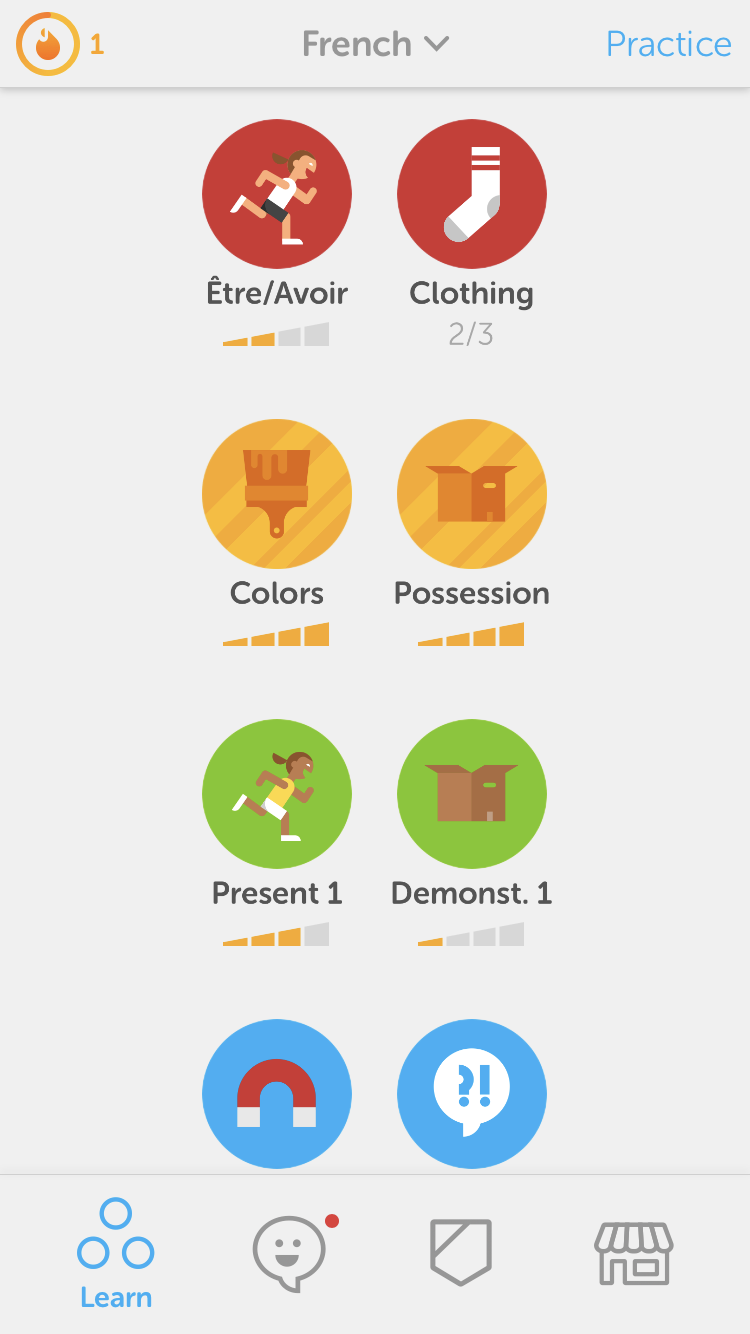
The Duolingo Skill Tree
The skill tree is a the heart of Duolingo and structures it in a way that's quite similar to textbooks. So using the Duolingo setup as a guide, you can let your own questions guide you. Have a classic resource available to answer those questions - why not outside of Duolingo?
A few resources you could try are grammar books, textbooks, podcasts, online courses, language tutors, and even social media. You can read recommendations for more language learning resources in my Resource Guide when you sign up to the Fluent Cool Kids Club.
If you're wondering about the cost of extra books, I recommend checking out your local libraries and charity shops. You're more than likely to find resources for pennies.
Related: Watch My Talk "What You Need to Know Before Spending Money on Language Learning" on YouTube
3) Take Duolingo For What It Is
Duolingo is a language learning app, nothing more and nothing less. In many ways, this makes it perfect for casual users who want to fit in a few minutes of practice at different moments in their day.
It's certainly not a waste of your time if you work your way through a few lessons, and there are dozens of great advantages of using Duolingo. It's cute, it's a fantastic performing app, it's supported by language communities.
If you're a beginner and learning your first or second foreign language, I think that the web version can be your genuine "digital language textbook". But don't rely on it solely and start adding in other resources very early. A good language learning routine is built on habit, human contact and variation in resources.
Do You Use Duolingo?
Are you happy with the little owl? Or does it make you want to howl? I'd love to hear more from you in the comments - tell me which app version you're using!
And for more guidance on language learning apps, join our Fluent Language Learners Facebook group, where I've got a video in the archive for you.

Writing: The Magic Skill for Better Memory and Focus in Any Language
Writing in another language is so deep, focused and beneficial. It can be a little difficult to build a writing habit at first, I know. But with a clear focus on fluency and a few simple steps to break down your practice, this is not something you'll want to miss out on. Check out these simple tips - they work for any level.
Writing in another language is so deep, focused and beneficial - think Deep Work by Cal Newport. It can be a little difficult to build a writing habit at first, I know. But with a clear focus on fluency and a few simple steps to break down your practice, this is not something you'll want to miss out on.
Do You Like Videos?
Check out my Fluent Friday video on this topic, click here to find it in my Facebook community.

So how should you effectively build the writing skill into your language learning routine? Let's jump right in and examine the best ways to get going.
And remember: As long as you're doing it, there's no way you're doing it wrong. (Click here to tweet this)
1. Practice At The Right Level
In case you've been focused on speaking practice and audio courses, you might not be familiar with writing routines yet. There are several levels you can use for getting started.
>>> Word Level Practice
My husband is a sporadic German learner who loves using apps, and recently I got him to try out Memrise in addition to Duolingo. The difference was surprising. Both offer a course for complete beginners, yet he quickly noticed that Memrise felt "a lot tougher, more like a challenge". There are several differences, but a key observation is that Memrise makes its users write their vocabulary words a lot more.
We cannot solve the problem of spelling without knowing something about how the rest of language works. (David Crystal)
Writing words makes you pay attention to spelling, to how the sounds connect and how pronunciation influences how a word looks. The coolest thing about core language skills (listening, speaking, reading and writing) is that you never practice one in isolation.
>>> Chunk and Sentence Level Practice
Done with words? Start putting them together! If you want to become that language expert who can say anything they like...if you want to break free from templates and stock sentences...nothing will be nicer than writing your own!
Start with simple gap filling exercises that you can find in any textbook, and then get creative! If you can write "good" into this gap, how else could the sentence look? What if there was a feminine word here?
Write your first small pieces, core sentences like a journalist: What happens when, why, how? Who is involved?
>>> Transcription Level Practice
Next it's time to start writing what you hear. For this method, you need a small and comprehensible audio source. Try a song, a short video clip with subtitles, or perhaps Glossika audio packages. This is important: There must be a correct (official) transcript that you can use as an answer key.
Listen to the recording and write down what you hear. Pause it as many times. Be as accurate as you can possibly be. And when you're done, it's the moment of truth: Check the answer key, analyze your mistakes, and correct what you've written.
My colleague Ron Gullekson has written a guide to transcription on Languagesurfer.com, which is worth bookmarking!
2. Use Writing To Boost Accuracy
You probably know that "fluency" is a tough one to define. For me, the following definition from Keith Johnson's book "An Introduction to Foreign Language Learning and Teaching" sums it up best: Fluency is a mix of rapidity and accuracy in another language. So your speaking practice is giving you rapidity, and you need to boost your accuracy too.
In conversation and especially in speaking practice, you can get away with a lot. The purpose of your speaking practice is to keep moving, to make yourself more flexible and recover swiftly from forgotten words and wrong grammar. Speaking practice is about developing that rapid sense of "fluency", of handling a real chat in another language.
In writing practice, there is no place to hide. This is where you train your accuracy, the linguistic skill that you need for true fluency, confidence, and ultimately for coming anywhere near the level that you dream of achieving.
3. Write By Hand, Boost Your Memory
Working with pen and paper offers you lots of extra advantages when it comes to organizing and tracking your language progress. There are the simple benefits, like tracking visible progress on paper and resting your eyes after many screen hours.
But even beyond those things, handwriting is also scientifically proven to aid memory many times over. Do you keep forgetting vocab? Get yourself a handwritten list. Need to nail down core phrases for your next conversation? Jot them on a card.
For more details on why this works, check out The Miraculous Benefits of Keeping a Language Notebook. And make sure you hop on the Fluent Newsletter today so you're the first to know when my brand new language tracker goes live and you can print & use it at home!
4. Get The Most Out of Every Error
Since writing is a practice that really brings out your hidden weaknesses, it's easy to abandon your practice after you get the first feedback. I feel it all the time when someone writes a friendly comment on my Instagram feed, correcting my Welsh. It's embarrassing!
If you're trying to learn another language, you'll already know one thing. Embarrassment is not just necessary. It is WELCOME. Start learning from your mistakes in this simple way: After you receive a correction, go back and rewrite what you have previously written. Make that text as pure and lovely as you intended. Heck, go ahead and post it online!
I find that correcting my mistakes in writing is one of the most satisfying things in language learning. It's rewarding because you can feel yourself learning.
5. Aim For Exams
Writing big, long, connected pieces of prose is a very advanced language skill. If you're able to put together a postcard, a simple letter or a short description of something, congratulations. You're a language learner who's mastered everything you need for core communication.
To grow your writing practice, my top advice is to work with the exam sets for levels B1 and upwards. These exams get more demanding for language writers, while the lower levels are too easy to master and wouldn't help you catch all your errors.
Related post: Achieve More With a Language Test (No Matter If You Need It or Not)
For corrections of advanced writing, try a good and specialised italki tutor, a translator from ProZ, or an academic proofreader.
The Bottom Line
You might not enjoy the slow pace of writing practice at first, but that's because writing in another language is a routine that delivers real focus. Focus takes effort, but in the end, you will start developing a huge sense of progress and achievement in your target language. Your core skills will appreciate the little lift you're giving them, and those new memory connections are invaluable.
For more about core skills check out my book Fluency Made Achievable> >
Do you already have a writing practice? What are some of your best tips? Share them below or hop over to our Facebook group to learn more!

What Gets Easier When You Study More Languages?
People often ask me how many languages I speak. But recently, I was asked one question that made me think more deeply about why and how learning more languages works for me:
Does it get easier when you are learning more languages?
The short answer is "yes". It definitely does.
Here are the things that are helpful, relevant, and different when you are learning your 7th language.
When you are learning your first foreign language, everything feels bizarre. Somewhere in your mind, it seems nuts that you might know that language confidently one day.

You start to look around at multilingual people, you watch a few YouTube videos, read a few blog articles. There's clearly people out there who are learning languages. They seem to know more than just one or two - some people know more than 10 languages!
Like most polyglots, people often ask me how many languages I speak. But recently, I was asked one question that made me think more deeply about why and how learning more languages works for me:
Does it get easier when you are learning more languages?
The short answer is "yes". It definitely does.
Here are the things that are helpful, relevant, and different when you are learning your 7th language.
1) You Know What Language Learning Strategy Works For You
When I first started learning languages, there was one source of information that told me how to learn languages: my teacher. No one told me about the Goldlist method and Anki and even the International Phonetic Alphabet.
Sounds like I had all the chances to mess up, right? But my language isolation bubble had a silver lining: I had the freedom to develop a learning strategy that works for me. I simply discarded the things that waste my time, and perfected those that I need. I amused my mum with vocab sheets taped to the bathroom mirror. I tried, tested, and grew my own masterplan, learning to trust my instincts.
If you follow language learning blogs, you know that there are many methods out there. Bloggers like Benny Lewis advocate speaking very early in the process, others like Gabe Wyner talk about pronunciation above all things. What you discover over the course of many language learning years is that you are always doing it right. The doubt of whether you are using "the best method" simply goes away.
The big secret to learning any language is this: Just don't stop.
2) You Become Confident About Your Language Learning Skill
When people learn a language in school, they often experience languages in a box. They're are on the curriculum, so they're taught inside a classroom and rarely used outside of one. The idea that there are whole communities in the world actually living their lives in different words seems kinda nice...but what's it got to do with you?
Even at exam times, you're tested on theory and abstract skill. The exam papers are about correct grammar and vocabulary. That's undoubtedly important, but it misses out on the greatest part of learning a language: realizing that you can make an amazing connection, right now.
When you start out with your first language or even your first 2 or 3, there is that lurking question inside:
"Am I really able to do this?"
But as you stick with the process, here is what changes: It stops being a classroom exercise. No one who is learning a 5th or 6th has got there without finding a spark that brings their language out of the box. The spark is different for all of us, but once you've got it you know that "good performance" isn't the point. It's all about connection and trusting the process.
I no longer ask myself if I can do this. I know that, given time and dedication, I can learn any language to a very high level. And the reason I know this is because I know that it doesn't matter - I will always be doing this for myself, too. That's what the spark did for me.
3) You Realize There Are Always More Languages to Learn
No matter if you have learnt one language, or seven, or 20: There will always be more languages to learn. Being a prolific language learner is a lifetime commitment, a little like a lifestyle change. I have now realised that I am never going to learn all the languages that are on my list, because that list is forever going to grow.
Our planet and the human race are so wonderfully diverse. We are blessed with thousands of languages, communication systems and scripts. Once you dive into learning one or two of those languages, you enter this amazing world of human communication. And by language number 7, you'll have caught the communication bug.
Even the most multilingual people in the world know fewer than 100 languages. They're certainly not done. I stilll have to work hard to learn a new language, and I still feel like I know nothing. Achieve fluency in many languages - it will open your mind to what you don't know!
4) You Know Being a Polyglot Ain't Special
Learning foreign languages is an unusual hobby, and in monolingual cultures like most of the UK, it's even more of a rarity. At the same time, most people have touched a bit of a foreign language - enough to know that it can make your brain hurt. So the conclusion people draw becomes that it takes a special language gift (perhaps a different brain?).
I believe that learning many foreign languages is a wonderful and incredible achievement. The work, commitment, focus, and dedication of prolific language learners are incredible.
But know that there is no language gene, or polyglot brain. Someone who knows many languages is just as capable as you are. When you are on language number 5 or number 10, you're more efficient, knowing more about your own favourite methods. But it's still hard work.
So here's my bottom line: You should learn a language because it will show you incredible things about your own capabilities. There's nothing to it, really. Nothing you've not got already, anyway.
Which Good Lessons Can You Add?
I'd love to hear your stories in the comments below. And of course, stay encouraged and keep going. You can totally do this.
For more information about coaching and access to lots of free toolkits and worksheets, check out my book The Vocab Cookbook and hop onto the Fluent Language Newsletter today - can't wait to say hello to you on there!



Struggling with listening? Discover realistic tips, challenge prompts, and the best tools for improving your listening skills as a self-guided language learner