
9 of the Best Podcasts for Learning Spanish
Embark on Your Spanish Learning Journey with the 9 Best Podcasts! Dive into immersive language lessons, culture, and more with our top picks. Enhance your skills and explore the beauty of the Spanish language and culture.

Imagine what you would do if you could easily understand spoken Spanish.
You could finally travel to the Spanish-speaking countries you’ve dreamed of, watch foreign films and addictive telenovelas, or understand a paella recommendation from the menu del día on a Thursday in Valencia.
Best of all, you’d be prepared for real conversations with native Spanish-speakers. The only question is: how do you find the time to practice your Spanish listening skills?
Podcasts are a great way to add Spanish listening practice into your day-to-day life. They are free, and can accompany any part of your day: driving a car, washing your dishes, doing laundry, working out, reading, and more.
The Fluent Show
In addition to the Spanish podcasts you’ll find in this article, check out the Fluent Show. That’s my own podcast where we discuss languages, learning methods, and how to live a multilingual life.Click here to listen and subscribe.
Need support on your Spanish learning journey?
Then make sure you join the Fluent Language newsletter right here! Subscribe now, and every week, I'll send you handpicked language learning tips right in your inbox.
Looking For More Spanish Resources?
Click here to get my top tips for Spanish learners.
These 9 online resources are some of the best when it comes to learning Spanish.
Quick Primer: How Do Podcasts Work?
If you're curious about podcasts, but not quite sure how they work, here's what you need to know:
- You can subscribe for free to podcasts on your phone, tablet, or computer.
- If you use an iPhone or iPad, go to the Podcasts app. If you're on a Mac, use theiTunes directory.
- On a PC or Android device, try theStitcher app for a quick and easy start.
- Subscribing means you'll always have the latest episode ready and waiting for you as soon as it's published.
Spanish Podcasts For Beginners
Castilian Spanish

Notes in Spanish is a podcast run by Marina, a native speaker from Spain, and Ben, an Englishman. Each episode is actually a conversation between the two. There are episodes dedicated to beginners as well as intermediate and advanced learners. For beginners, the hosts also go over key vocabulary, phrases, and basic grammar points both before and after their conversations.
Since Ben is also a Spanish learner, he offers a lot of useful tips for listeners while Marina often provides corrections and points out common mistakes. They speak clearly, making it easy for beginners to follow along.
Castilian and Latin American Spanish

SpanishPod101 from InnovativeLanguage covers the basic through advanced levels of Spanish. The episodes are exciting and immersive. Plus, you can find episodes for both Castilian and Latin American Spanish along with the differences between them. There are even episodes that explain some of the regional vocabulary from places like Costa Rica, Peru, Mexico, and Spain.
The dialogues are presented by engaging hosts in a clear, concise way covering many grammatical features and cultural topics. On the website you can sign up for premium content to access spaced repetition flashcards, PDF lesson notes, and a community forum.
Spanish Podcasts for Intermediate and Advanced Learners
Castilian Spanish

Unlimited Spanish with Òscar Pellus uses a unique storytelling technique based on Òscar’s method of learning Spanish through exposure and repetition. Every episode includes a quick story followed by a question and answer session that encourages listeners to practice their speaking skills as well. It’s also a great option for anyone who doesn’t care for lengthy grammar explanations.
Podcast topics include various aspects of Spanish culture, including places and food, as well as social topics and situations. When necessary Òscar touches on some relevant vocabulary and grammar, but it isn’t overwhelming. The podcast is entirely in Spanish, but if you have any trouble understanding, you can download transcripts of every episode in PDF format.

Done entirely in Spanish, this podcast is meant to provide an immersive experience for intermediate to advanced learners. The host, Karo Martínez, is lively, engaging, and speaks both clearly and naturally.
There are over 100 episodes to choose from, some of which explore grammar concepts, offer tips to improve your pronunciation, or explain colloquial expressions. Other episodes talk about different parts of Spain or even how to learn Spanish with popular shows like Game of Thrones.
The Español Automático site offers episode transcripts along with additional guides and resources.
Latin American Spanish

Though this podcast is directed towards those learning Spanish for work, its main goal is to help listeners get used to and understand native, spoken Spanish.
The host, Miguel Lira, is a native Spanish speaker from Mexico and a Spanish learning coach. Each episode goes over a particular conversation exchange in Spanish, such as conversations between workers or while simply ordering coffee. Miguel, as the sole host, uses a different tone of voice for each speaker, which is both entertaining and helpful as you follow along. There are also a few episodes on cultural subjects, like The Day of the Dead in Mexico.
In addition, the website offers notes, transcripts, and other resources to help you review the conversations.
Castilian and Latin American Spanish

News in Slow Spanish is an intermediate level podcast. This podcast covers world news, grammar, and expressions and slows down all the dialogue to make it easier to process what you hear. Every episode breaks down a point on grammar and vocabulary. It also lets you choose between Castilian and Latin American Spanish.
The audio is very clear and easy to follow. On the website, there are transcripts for each episode available with grammar, expressions, pronunciation, and quizzes.
Spanish Video Resources

Yabla is a video-based learning platform with bilingual subtitles and integrated dictionaries. The subtitles are interactive, which is a really cool concept! Check out how Yabla works in detail by reading myfull review.
Yabla is great for all levels from basic to advanced. You can check out their podcast and choose between videos from Spain and Latin America for hours of entertainment.
Story-Based Shows
Castilian Spanish

Coffee Break Spanish, a podcast from Radio Lingua Network, combines Spanish language lessons with a lot of useful information about Spanish food, culture, Spanish speaking countries, and so on.
My favourite part of the podcast is the chemistry between relaxed and charismatic host Mark from Scotland (who is fluent in Spanish) and Spanish learner Kara from Scotland. Mark guides both Kara and listeners through Spanish grammar, conversation, culture, and society.
The dialogues are presented in a clear, concise way, covering many grammatical features and cultural topics. On the website you can sign up for the premium content to access spaced repetition flashcards, PDF lesson notes, and a community forum for a subscription fee.
Latin American Spanish

If you want to discover the Spanish language with a powerful dash of music and culture, then Spanish con Salsa is for you! Created by bilingual Tamara Marie (meet her in my interview here!), this podcast is perfect for people who love travel, immersion, and Latin dance.
You can learn Spanish hacks from songs like Despacito, and train your ears to understand spoken Spanish even better.
And if you want to take your Spanish to the next level, the Spanish con Salsa online course is highly recommended because it's built around learning with music - learn more about it here.*
Advanced Learner Tip: Native Spanish Podcasts
If you’re interested in a more immersive experience, there are plenty of podcasts intended for native Spanish speakers available.

One great option is the Radio Ambulante podcast. Radio Ambulante is a longform journalism podcast that shares real-life Latin American stories. There are stories about language, sports, education, events, and more. Plus, there are both English and Spanish transcripts available for every episode.
Spanish Language Learning FAQ: Your Top Questions Answered
Can You Learn Spanish Through a Podcast?
Spanish language podcasts are a fantastic resource for learners at all levels! Click here to get my best advice for listening skill training. When you progress in your skill level, you can learn even more of the language and the cultures of the Spanish speaking world. As one of the most widely spoken languages in the world, you can find over 100,000 podcasts available in the language. Build podcasts into your language learning routine and make them part of your goals. In this article you’ll find many great ones to get you started.
How Can I Learn Spanish by Listening?
Listening is a critical skill for language learners, one of the four core skills that build your language ability: listening, speaking, reading and writing. Listen to a lot of spoken Spanish through podcasts, exchanges, and tutor sessions. If you can find a transcript, that’s even better! Soon you’ll find that you will begin to understand more and more of the spoken language, even when it’s fast.
Dedicated listening practice can be time-consuming, so it's essential to be mindful of your language learning routine to avoid wasting valuable time on unnecessary activities. For a detailed guide on how to establish a successful language learning routine, I invite you to explore my blog article by clicking here.
What Should I Watch If I Want to Learn Spanish?
While some learners enjoy kids’ television and cartoons at the start of their language learning project, you may also find easy Spanish courses super helpful. Look for videos that come with a transcript, and don’t be afraid to take it step by step. One of my favourite places to find the perfect videos that are interesting and helpful is Yabla, and you can find even more ideas on my Spanish learner page.
This article was written by Cassie Wright and me. She’s a freelance writer who loves languages. Affiliate links are marked with a *
Looking for more Spanish resources?
9 of the Best Podcasts for Learning English
Learning English with podcasts is so easy - you can find millions of shows online. But which ones are great for learners at any level? In this article, I’ll give you the 9 best shows for English learners who want to polish their English language skills.
There are podcasts in American English and in British English, so have a look and see what you can discover.

What would you do if you could easily understand spoken English?
Would you finally watch your favourite films or TV series without worrying so much about subtitles? Maybe you’d be able to travel without feeling anxious or even study abroad in an English-speaking country. Imagine just being able to order a beer at the pub with some new friends, buy a big slice of New York pizza, or attend a BBQ on a beach in Australia.
There are lots of ways understanding English could help you achieve your dreams and finally allow you to feel comfortable during real conversations with native speakers. The only question is: how do you find the time to practice your English listening skills?
Podcasts are a great way to add a little English listening practice into your day-to-day life. They are free, and can accompany any part of your day: driving a car, washing your dishes, doing laundry, working out, reading, and more.
The Fluent Show
In addition to the English podcasts you’ll find in this article, make sure you sign up to our newsletter, where we discuss languages, learning methods, and how to live a multilingual life. Click here to listen and subscribe.
Quick Primer: How Do Podcasts Work?
If you're curious about podcasts, but not quite sure how they work, here's what you need to know:
- You can subscribe for free to podcasts on your phone, tablet, or computer.
- If you use an Apple computer, iPhone or iPad, go to the Podcasts app. If you're on a Mac that does not have the Podcasts app, use the iTunes directory.
- On a PC or Android device, try the Stitcher app for a quick and easy start.
- Subscribing means you'll always have the latest episode ready and waiting for you as soon as it's published.
The 9 Best English Podcasts for English Learners
In this article, you’ll find:
- British English Podcasts
- American English Podcasts
- Podcasts with both British and American English
- English Video Resources
- Story-Based Shows and Business English Podcasts
- A Special Tip for Advanced Learners
British English Podcasts

This podcast by English teacher Michael is fun and friendly!
Start with this episode, an interview with Kerstin (that's me!), where we talked about how I learnt English to native level myself, how I worked on my English accent, and what you can do when you're struggling with English.

What's better than practicing your English with real English converesation? In this podcast, hosts Abigail and Audrey get together for a chat in English. One is from England and one is from Australia!
American English Podcasts

If you’re after real conversations about interesting topics rather than language lessons, Conversations with Kate is a great resource. Host Kate invites both native and non-native English speakers from around the world as guests to help learners become familiar with different accents as well as learn about people, language, and travel.
Start with this episode, in which I visited Kate to introduce the Women in Language conference.

Looking to improve both your business English and your everyday English? All Ears English Podcast covers business topics as well as English grammar, expressions, American culture, and even IELTS (International English Language Testing System) specific topics.
The website also has short summaries for each episode. Subscribers can also get access to full transcripts.
Recommended episode: 3 Study Tips for the IELTS exam
British and American English Podcasts

EnglishClass101 from InnovativeLanguage covers everything from basic through advanced English. The episodes are exciting and immersive. You’ll easily find a large variety of topics, including both American and British culture, idioms, and even business-related episodes.
The dialogues are presented by engaging hosts in a clear, concise way covering many grammatical features and cultural topics. On the website you can sign up for premium content to access spaced repetition flashcards, PDF lesson notes, and a community forum.

English Video Resources

Yabla is a video-based learning platform with bilingual subtitles and integrated dictionaries. The subtitles are interactive, which is a really cool concept! Check out how Yabla works in detail by reading my full review.
Yabla is great for all levels from basic to advanced. There is a free English podcast available with plenty of videos to watch.
Story-Based and Business English Podcasts

This podcast series from the British Council follows conversations that take place between hosts Tess, Ravi, and their guests as well as the activities of a fictional student, Carolina. These episodes on on the longer side, ranging from 20 to 35 minutes, but they’re split up into sections so you can pause if you need to.
Complete transcripts are available for each episode. Plus, the website offers short quizzes to test your comprehension and practice exercises.

For those who are motivated to improve their English for business reasons, Business English Pod covers everything from sales and communication to presentations and job interviews.
Episodes are easy to understand and contain an explanation of the topic along with some cultural tips. These explanations are followed by conversational dialogues as well as explanation and practice sections. Members can also access PDF transcripts, online quizzes, and additional lessons.
Advanced Learner Tip: Native English Podcasts
English learners who are looking for something a bit more interesting and immersive might prefer to check out podcasts intended for native speakers. If that’s the case, try searching through popular English podcasts for something that sparks your interest, like true crime podcasts, TED Talks, or podcasts that keep you up-to-date on pop culture.
There are also a few public radio stations that offer apps you can explore, including BBC Sounds, SBS On Demand, and NPR. These apps offer a wide variety of English podcasts to make your search a bit easier.
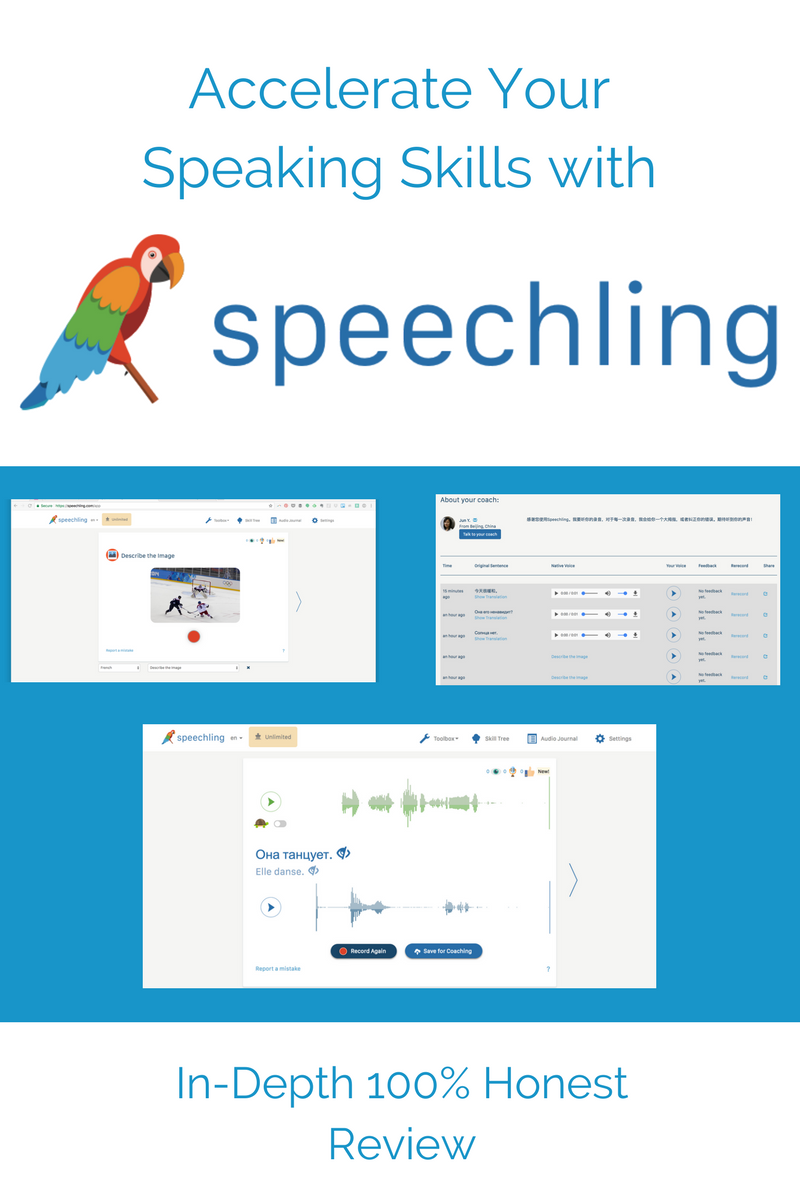
Accelerate Your Speaking Skills with Speechling: In-Depth 100% Honest Review
Speaking in other languages is harder than it looks at first. You can read books and study flashcards, and still choke when you speak to a real person.

It can be difficult to practice pronunciation and have conversations on a regular basis. Tutors are awesome, but your lesson time is limited. And many apps and bots make us feel detached.
Speechling claims to have cracked that problem. This new app offers speaking skill training, attractive design, and the most convenient access to a real person tutor that I have ever seen. No scheduling, no exchange of Skype names.
Sounds good, but does it work? In this review, let's take a deep dive and find out.
How does Speechling Work?
Speechling's courses use sentence repetition, a premise that you may know from fellow Fluent favourite Glossika. But there is a twist: Speechling includes feedback on everything you record, from an actual human.
After repeating the sentence you see and hear on the screen, you have the choice of listening back to your pronunciation, or to save it for coaching. After you save your recording, you will receive feedback and tips from a Speechling coach.
How I Tested The App
Speechling's six language options gave me the chance to test ot for at different levels:
- Advanced (French),
- Confident Beginner(Russian)
- Absolute Beginner (Chinese).
The Advanced Learner Test: French
In French, my language level is around B2-C1 on the CEFR. I can navigate most conversations without hiccups, and I know for a fact that speaking French is what I need the most.
So for my level, saying a few sentences every day at my own convenience was perfect.
The live feedback here was eye-opening. I have an optimistic blind spot to my own weaknesses in pronunciation and word choice. I always learnt French in academic environments, so I produce great grammar. But in reality, my spoken French sounds textbook and a little uncomfortable. The coach feedback made me more aware of my little mistakes without discouraging me completely. I felt encouraged to try again, to fix what I was saying and carry on.

Describing a picture using Speechling's Freestyle mode
With the freestyle mode, I got to practice free speech instead of repeating pre-written sentences. In the dictation feature, I added listening comprehension at natural speeds.
The Confident Beginner Test: Russian
Russian is a language I studied about two years ago and I was able to have very basic exchanges (“what did you have for breakfast?” - “I had porridge”, that kind of stuff). I pronounce words correctly, and can read Cyrillic. So with this language, I wanted to see
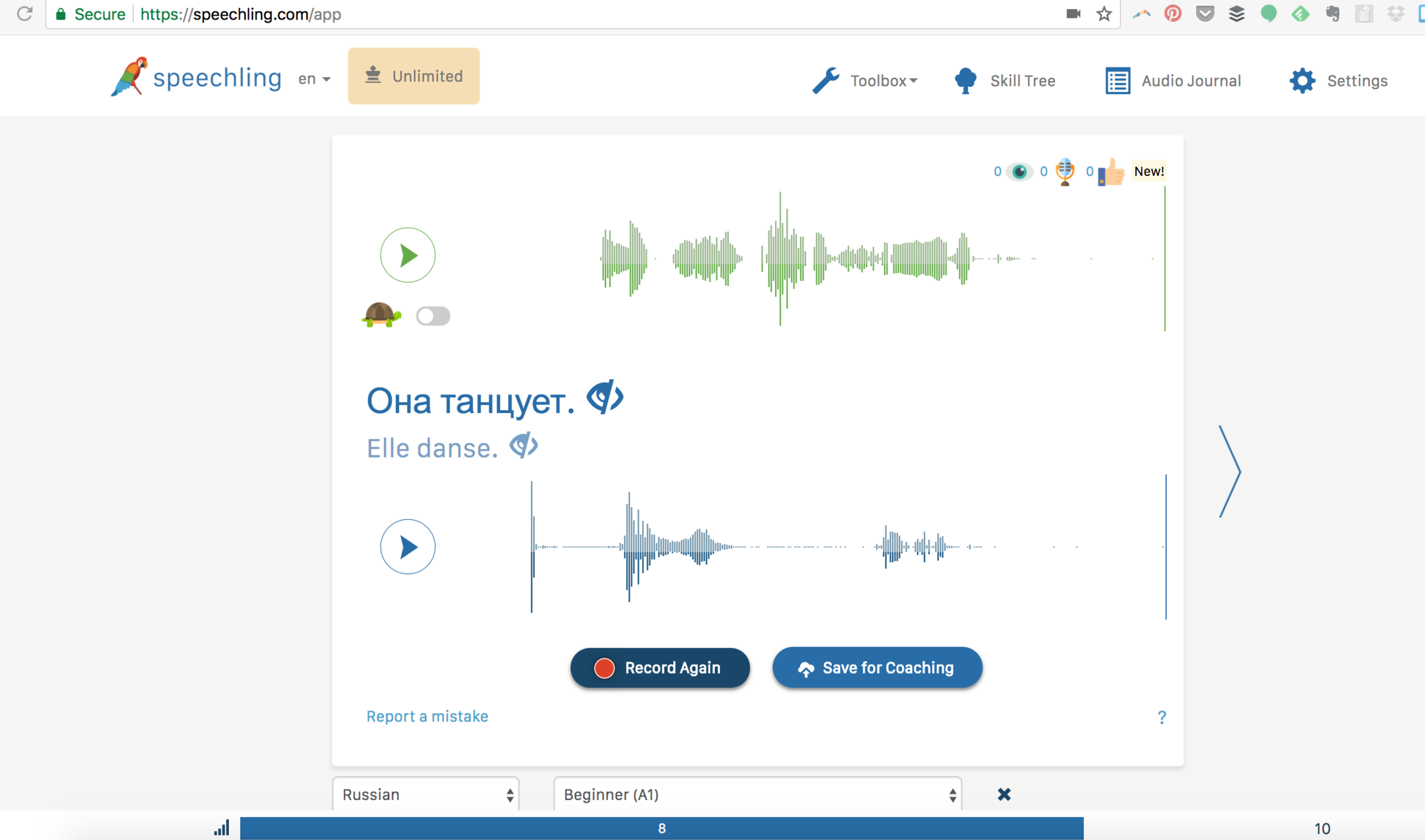
- if Speechling can teach me something new and
- if my pronunciation is accurate.
The module I chose was “Beginner (A1)”, which was a great entry point after a few years off. With each repetition, I felt like I was learning. The examples were well pronounced, came at a speed that felt like a suitable challenge, and soon I was improving.
I also felt that pronouncing each new word immediately helped me remember it, especially when I added a recording. The accountability of recording and coaching (“someone will actually hear this”) helped me link the phrase with a strong emotion. For more about how emotions amplify memory, check out my interview with Gabriel Wyner from Fluent Forever.
With a language like Russian, you need regular exposure to stay comfortable with the alphabet and pronunciation. Speechling surprised me here because it felt like the perfect tool. There were so many sentences I had never said before, and so many opportunities for me to improve.
Best of all, I was speaking Russian right there and then without any hesitation.
Of course, exposure to lots of sentences won't teach me more than lots of sentences. If I wanted to get back into Russian and start making steady progress, I would definitely use Speechling and I would add a textbook, dictionary, grammar explanations, and lots of input resources.
The Absolute Beginner Test: Chinese
Chinese is the only language out of Speechling’s range that I have never studied, so I decided to go for the “simplified” version. Does that mean easy Chinese? No idea, but it's worth a try. The module I chose was “Beginner (A1)”, as there was no way of picking anything even easier.
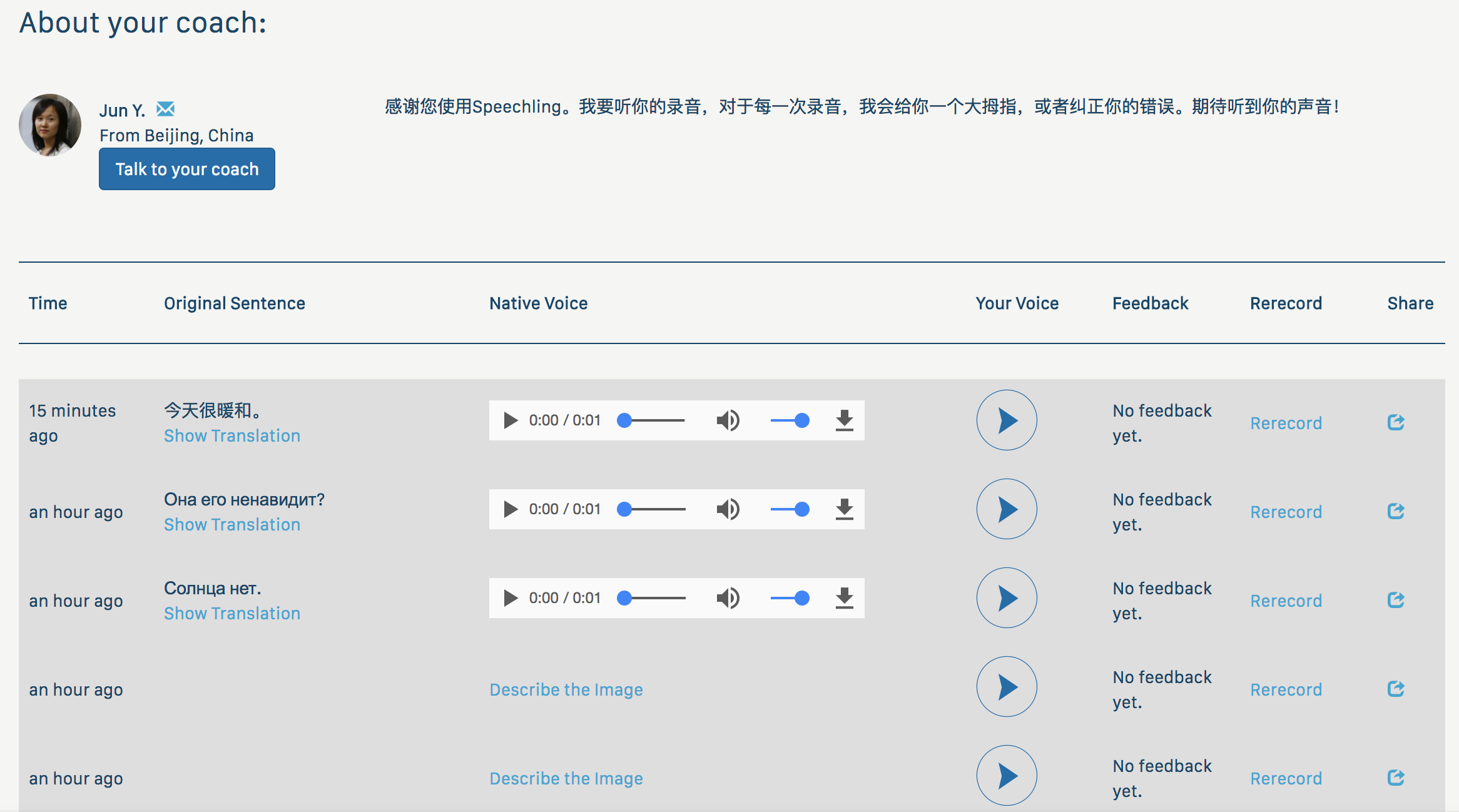
My Speechling Audio Diary
With Chinese, Speechling shows the sentences in Hanzi (Chinese characters). There is also the option of viewing the sentence in pinyin. Good job - it was the only way I could even start to guess at repeating the sounds I was hearing.
For a complete beginner like me, the sentences were interesting. I had to repeat the audio input 4-5 times before I dared to repeat the sounds. Surely, any Chinese speaker would be impressed?
Speaking Chinese to a Chinese Native After 5 Minutes
Well, I do know a Chinese speaker so I was ready to shine. Having newly acquired the sentence 今天很温暖 (“it’s warm today”), I asked my co-working buddy to listen to my Chinese and tell me if it’s correct. And he did understand what I was saying, although “impressed” would be stretching the truth a bit.
I also sent my recorded sentence to the Chinese coach, who drew my attention to the specific parts I got wrong.
Learning mass sentences as a complete beginner isn’t ideal. It leaves you without a sense of what each word means (which one out of jin tian hen nuan huo is “warm”, which one is “today”....and what do any of those symbols mean?). Learners don't get to understand what any of the rules of speaking are. But that’s okay, as Speechling not designed for that. This tool is a great confidence builder and accent sharpener. I could imagine it as a fantastic basis for tutoring, sending students away with homework on a topic.
Multilingual Usage

If you have studied more than one of Speechling’s range of languages, you can view translations in any of the six languages. This means you get to practice two languages at once, and it’s one of easiest ways to train your polyglot muscles.
Downsides of Speechling
On several occasions, my recordings were too long to be saved for feedback. This is understandable, but it was frustrating particularly in the freestyle mode. It’s disappointing when you say a complex sentence to send to your coach, and then get a message saying “file too large - cannot save”. It would be great if Speechling could include a guide on how long I can record for.
For languages where I knew nothing at all, I’d also like to see a primer module so I understand what I'm doing. But this is a tiny point, especially since Speechling is not aimed at complete beginners.
In Conclusion: Speechling is Great
All in all, I found Speechling a great addition to my studies. It was challenging and helped me improve my pronunciation and speaking skills in three languages. I was most excited about what Speechling could do for my Russian language skills. I improved both my vocabulary and accent, and the process was efficient and fast.
Speechling is free from robot voices and works with male and female voices (native speakers, of course). Its interface looks great and it gets you into the action immediately.
I love the record-feedback cycle, because it prompts you to re-record a better version of what you said. You get feedback, and you improve pronunciation, confidence, and speed.
The coaches were great for all the languages I tried. They recorded speedy corrections. At the very early levels, feedback is not rich, because they are native speakers and they use their native languages. But even so, it was clear where exactly I was supposed to change something. The more you learn, the more you will get out of these coaches.
If you work with a tutor that you don’t see every day, definitely try adding Speechling to your language routine. You will be speaking your target language more, you'll build a better accent. And best of all, pronouncing all the new words will help you remember them faster.
How to Get Started (+ Speechling Discount)
Create a free account and start speaking at Speechling.com, or by download the app from the App Store or Google Play Store.
Speechling is currently available in six languages: French, German, Spanish, English, Russian, and two types of Chinese.
It’s a freemium app, and you get 15-20 minutes of feedback for free every month. I would recommend checking out the paid plan (see below for 10% off) if you want to
- get a speaking boost, especially when there’s a deadline
- learn more than one language at once
- keep track of your progress with the audio journal.
The unlimited plan is open to Fluent readers at a 10% Lifetime discount: Make sure you use the code FLUENT when you sign up.
Good to know: Speechling is a non-profit company and also has a classroom version called Speechling for Education. I have an existing relationship with Speechling as they are a sponsor of my podcast. This only influenced the amount of attention the product received, not the verdict. It is a cool app.
Have You Tried Speechling?
Are you a pronunciation master now? How did you like the coach feedback? Leave a comment below and share your story.
***hello from the future!!***
Since my original review of Speechling in February 2018, these folks have been hard at work and have just emailed me to share the following new developments.
1. A new module called "Speechling Foundations", which will teach newbies from the very beginning. This start from zero module covers teaches the most essential words in context.
2. New listening options: Speechling now offers listening comprehension, multiple choice, fill in the blank, and flashcards. It's all available for free without login. All of this works on mobile too.
3. More language! They've more than tripled our content collection.
4. Offline mode!! Premium users can download a huge chunk of Speechling’s sentence collection (~10k sentences) and even audio books and Anki decks .
And added in March 2020
1. Speechling now includes Italian, Japanese, Korean, and Portuguese.
2. The recording time has been upgraded to 15s as Standard! It’s quadrupled to 30s for paid users.
3. There are now over 10k recordings (male + female combined) for each language, from words to complex sentences.
4. Speechling now includes word hints where you can mouse over words and get pronunciation tips and definitions.
I love it when an app listens to its users, this alone makes it worth checking out!
Inside The Tandem Language Exchange App: A Full Review
What if I told you that right now you're only 10 minutes away from chatting about your dreams for the future in your brand new language...on your phone? Sounds mad, but that's exactly what the language exchange app Tandem is designed for.
In this full review, you'll discover exactly how to make the most out of language exchanges and become fluent on your phone.
If you're new to a language exchange, the concept won't be hard to understand: You find a speaker of your target language. That person should want to learn your native language. When you chat to each other, you spend a little time speaking each language, and voilà...it's free, mutual, friendly practice.
Finding those other language lovers used to be a massive pain. Back in the day, you might have to strike up a conversation and exchange addresses with a tourist in the nearest town. Or if you're lucky, someone might put up a notice on a pinboard in the local café.
But what if I told you that right now you're only 10 minutes away from chatting about your dreams for the future in your brand new language...on your phone? Sounds mad, but that's exactly what the language exchange app Tandem is designed for.
How to Start a Language Exchange
Of course, language exchanges are not new. Good ideas start early and stick around. The language exchange concept has been around since the 1970s, named "Tandem" after the word for a two-person bicycle.
Here's an amazing quote from Tandem Fundazioa, explaining the bicycle analogy:
TANDEM is a bicycle designed for two riders both involved in getting forward. We have taken this word into our method of learning by exchanging languages with our motto: "In order to understand each other better I help you to learn and you help me to learn." TANDEM is therefore the bicycle among various language learning approaches - it is cheap, individual and ecological.
Check out this article for more inspiration about how language exchanges can make us happy.
Who'd argue with that... no one. So for free language practice, could the Tandem App be your step into the world of exchanges?
How Good is Tandem Language Exchange App?
You can download Tandem in the App Store for iOS and on the Google Play store for Androis. In this review, I focused on using the iPhone app on an iPhone 7. The app is completely free, with no limitations or premium memberships.
When I opened up the Tandem app, I was immediately taken in by the design and the personalised approach that they took. You open Tandem, connect your profile, and crucially you will tell the app a few things about yourself and your preferences.
There is an approval process, so you cannot join the app randomly and it's monitored by a staff member. I found this reassuring - after all, it's important that you keep your data safe online! Community is very important to Tandem, which has 1 million members from 150 countries.
There are three big sections in the app:
- The Community, where you can search for new people
- The Tutors section, where you can find and book lessons
- The Chats, where you can view all your conversations
Optimizing Your Language Exchange Profile
Before you can join Tandem you have to make an application and become approved by one of their staff members. Your profile will be linked to Facebook.
Once you're in, your profile won't be quite as protected as on other apps. I enjoyed the fact that I could see more photos of my new language friends and learn who they are before I chat to them. This can make it easier to find a good match, but be aware that you're also sharing more data with a big community.
Here are some tips for optimizing Tandem:

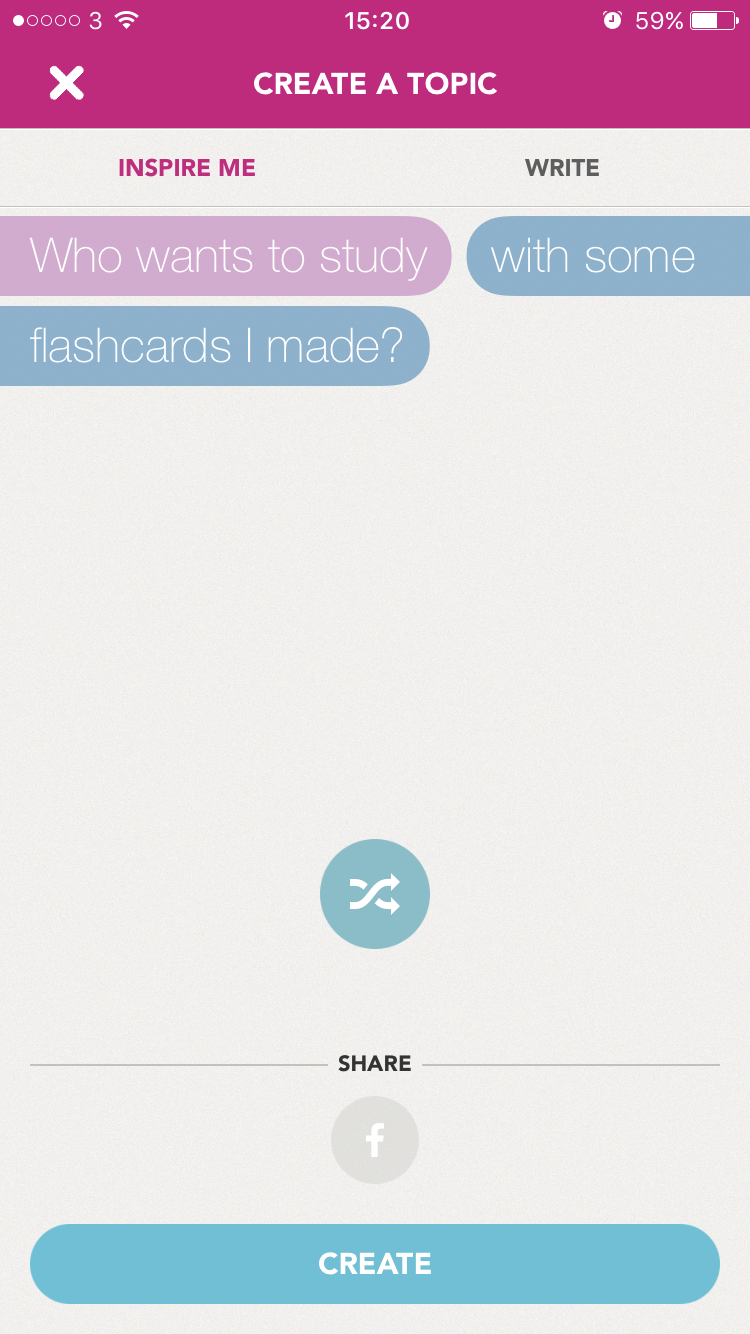
The "My Topics" section makes you an interesting exchange partner.
- Check out the Settings area in your profile to decide who should be able to find you.
- Select something fun you want to talk about in My Topics. The app offers lots of fun and inspiring prompts, or you can make your own conversation starters. These will be seen by others when they find your profile.
- Go into About Me to make sure you're happy with your profile picture and information.
Finding Language Exchange Partners
The partner search is the most important part of any good exchange app.
Tandem suggests people for you based on your language, but there's also a search bar. I had lots of fun on there, as you can search for anything. I tried
- Westworld
- hockey (nothing)
- Manchester United (SO MANY PEOPLE)
It was easy to find Welsh speakers on this app, as well as people learning each one of my interest languages. Remember not everyone needs native speakers.
The search is automatically limited to those users who are some kind of match for your languages, so you save time.
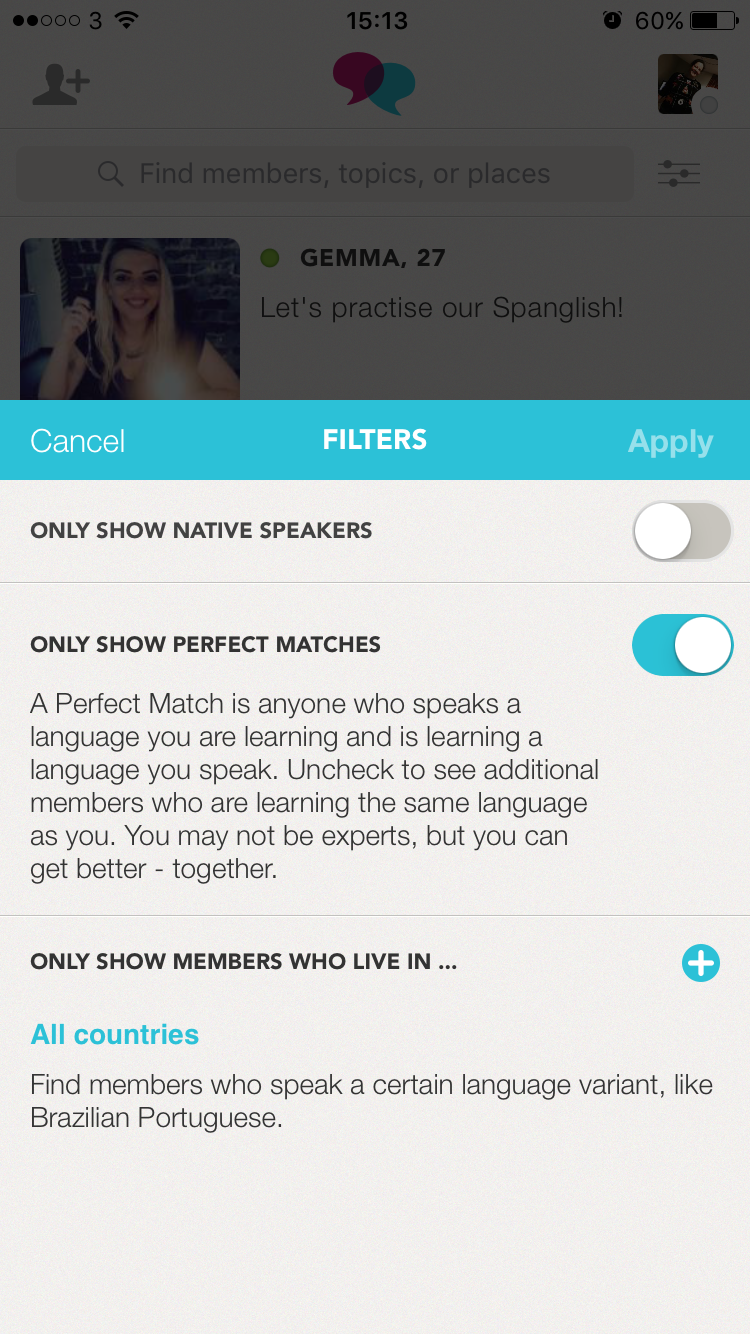
Tandem feels a little like a dating app. The personality of every profile comes out so well through that deeper connection with photos, likes and information. And to top it all off, you can leave comments on a language partner's profile to recommend them and tell others how nice they are.
All in all, I would say 5/5 - well done Tandem for your search experience.
How to Chat With People on Tandem
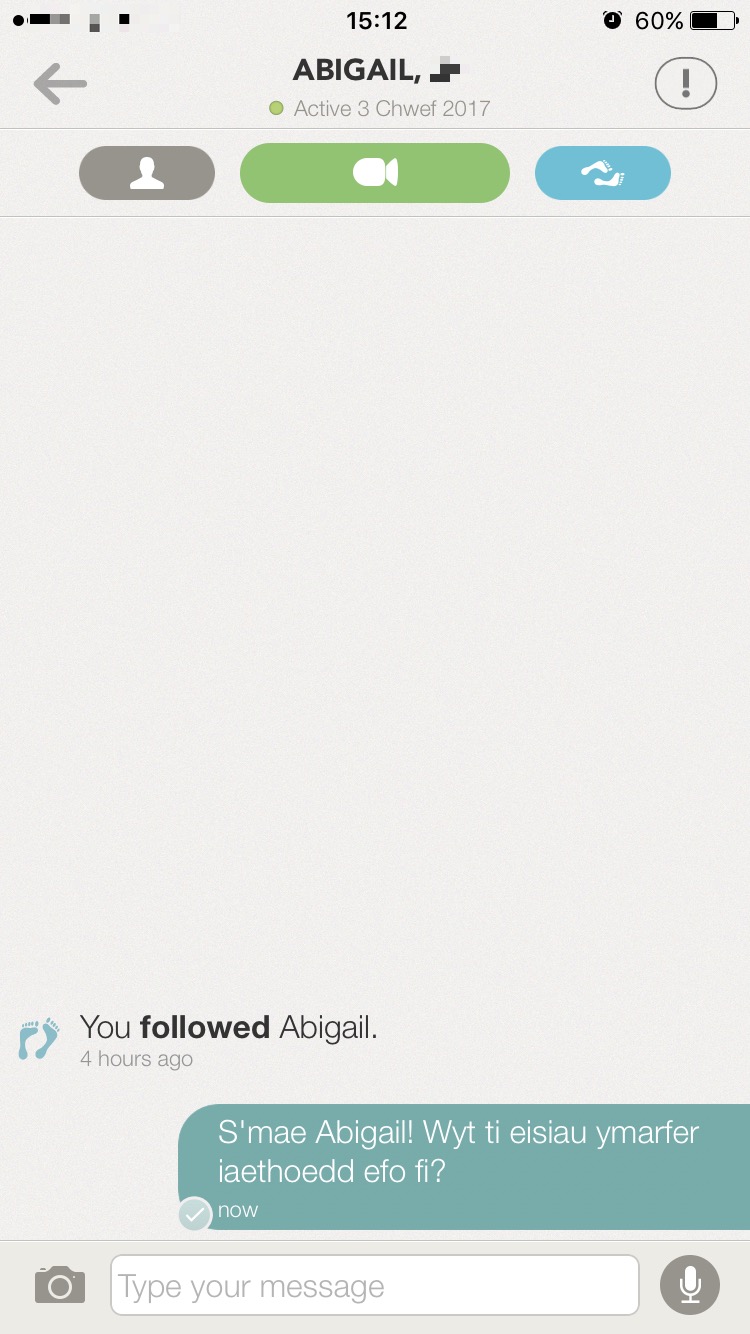
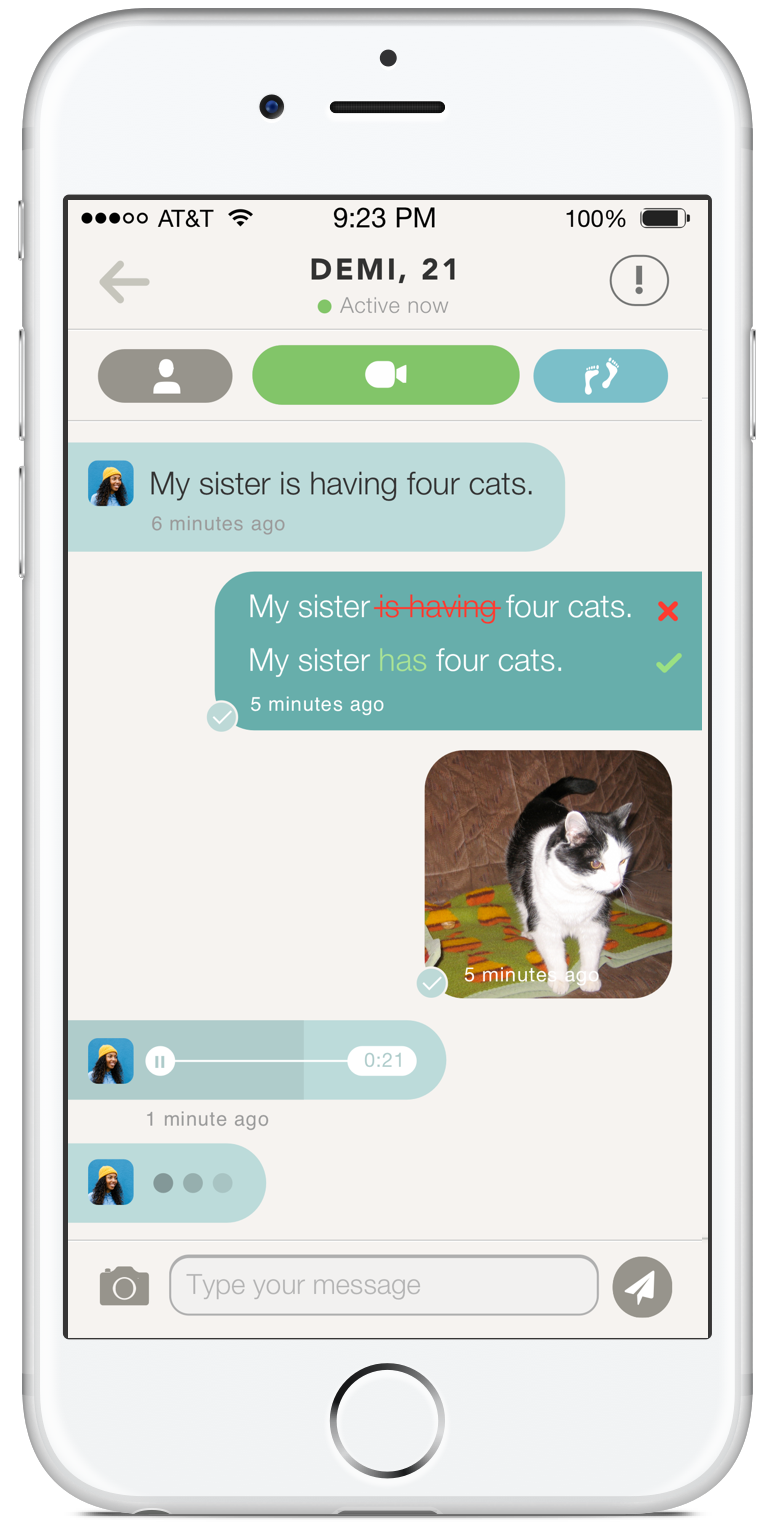
Chatting to someone on Tandem is straightforward. You shoot them a message through your profile. This app has the closest experience to texting that I've seen so far. You can send texts and voice messages, phone them on VOIP or go all out and make a video call.
I like how Tandem has simplified the design of its chats to remove anything you don't need.
Unlike other exchange apps, there is no in-app dictionary, but you can correct your partner's sentences easily. Chats are a friendly experience , making languages a tool for connecting with people. And the community moderation made me feel more comfortable sharing pictures and voice messages, too.
If you find someone who looks interesting and you're feeling shy, you have the opportunity to follow their updates and maybe contact them later. I am not sure how useful this feature is in practice, though.
Make Language Exchange Friends Without Losing Interest
If you go ahead and partner up with someone on Tandem, here are a few tips for making the process easier for you both:
- Arrange a time to meet and video chat or send each other longer messages on a regular basis. If it's a calendar appointment, you won't ignore it as much
- Allow for each person to ask a lot of questions and answer in longer sentences so you don't run out of things to say
- Prepare some interesting and unusual topics to talk about, for example these ideas on the Tandem blog:
- Follow Up each new exchange session by reviewing vocabulary and making sure you follow the acquire-memorize-review technique (I describe this in detail in The Vocab Cookbook)
Language exchanges do come with a small cost, as it takes your time and energy to prepare properly. In a good exchange, you both have responsibility for making this a fun conversation, so get creative and make sure you put in a little effort.
I give the chat experience a 3/5 - personally I'd like more language tools, but the design was lovely.
Or if an exchange sounds like it doesn't suit you right now...
You Can Find Language Tutors in The Tandem App
The inclusion of language tutors in Tandem touches on a really important point: You cannot expect your language exchange partner to be your tutor. I love that this app gives you the option of deciding how you want to be supported in your language learning journey.
Sometimes we all need extra help. Language tutors can explain more complex concepts, tricky grammar rules and fix your pronunciation.
More about this in my article on what you can expect to pay a tutor.
I tried out the tutor process and was absolutely satisfied. There is a personal vetting process, so that tutors have to apply and show how they are qualified and experienced for offering this paid service. The profiles are also reviewed by other users, so you know what you're getting.
Some tutors offer a free trial, but to be honest I found the prices so low that most people should not have to think twice before paying. The app even takes Apple Pay, a testament to its great user experience.
One thing was weird. I know that there are currently no Welsh tutors on Tandem. But even so, the app showed me tutors for everything. I'm a language nerd, so this wasn't a low point. I found it more inspiring...I could learn Korean! American Sign Language! Polish!
I'm giving the tutors in Tandem a 5/5 - this isn't a language school, and the support level seemed perfect for the app purpose.
Conclusions: Should You Try Tandem?

When it comes to recommending Tandem, I'm giving this app a big thumbs up. 👍 It's perfect for aspiring polyglots, because the community is both enormous and very varied. The user experience in the app is the nicest I have seen so far.
Within minutes, you can start swiping and reviewing dozens of cool people's profiles. Who knows what could be uncovered...a new local friend, an exciting connection around the world? No need to leave your house - you can strike up a conversation halfway around the world without ever getting off the couch.
The tutors as a support network are a really smart idea because they keep you committed.
My one bugbear would be with the general lack of integrations - I dream of a language learning app that lets me connect to my flashcards, my other apps, and more. If it works with Facebook, surely it can be done with Memrise?
I am closing my review with a solid 4.5/5 for Tandem. This app is totally free and worth checking out.
You can download the free Tandem app right now
The Book That Will Change How You See Language Learning (+ Clever Notes & Action Plan FREE)
One of the most common things I hear from language learners is
"what is the best way to do this?" You want to know how to learn a language, in as much detail as possible.
And it's hard to answer that question once and for all, for everyone. People are different, and no one's going to teach you good habits overnight. I know there are plenty of players out there telling you that their way of doing flash cards or listening to native content is the real answer.
But seriously, guys. What it really takes is that you learn to understand your own smart and capable self. That's where a book like Becoming Fluent comes in.
By the way, I've gone ahead and done a little bit of hard work for you guys. You can now enter your details below and download my book notes for Becoming Fluent along with a fab little action plan template so you know what to do next.
What Is Becoming Fluent?
Becoming Fluent is an impressive book in the field of language acquisition. It's written with the scientific background expected from academics. But that doesn't mean that language learners cannot apply it to their lives: Throughout the book, the authors mix explanations and practical tips. The book is written for adult learners who want to conquer another language, and goes into the following topics:
- What do you have to do to make sure you become a successful language learner?
- How can you choose the right target language to study?
- What are the best
- How important is it to know the culture and norms of people who speak your target language every day?
- How can you get better at memorising and remembering more?
Why It's Awesome
There are many language learning books out in the market that tell you all about how wonderful the author's methods are. Most successful polyglot-style books follow this system. The logic is that if following certain steps made the author fluent in another language, then you can do the same by copying the steps.
In Becoming Fluent, I detected none of this. The authors do work from their own experience in languages but never claim to know all the answers. Each chapter is based on a new aspect of language learning and gives a neutral summary of what the science says, followed by practical advice.
I've never used or endorsed the "copy a winner" approach, and I don't think it's quite how things work for language learners. Success in language learning is about more than just playing the game right. The more you learn and discover about yourself, your habits, your preferences and strengths in language learning, the more you will approach a real ability to learn any language quickly.
So for me, Becoming Fluent was an outstanding book about language learning because it doesn't tell you what exactly to do. This one is about empowering yourself to find your own perfect method.
What Wasn't So Great
Becoming Fluent is smart and thorough and scientific, which is a big rarity in language learning. It's great to read such a sensible voice in our field. The book comes at language learning from so many different angles that some great aspects get a little lost.
I would have liked the book's action-focused tips to be highlighted or separated from the main text, making it easier to find exactly how to put new insights into action. As it is, Becoming Fluent does require you to put in a few hours for reading, but this is time well spent.
My Favourite Parts
- All of chapter 2, which addresses the many lies and misleading beliefs that we hold in our heads before we even start learning. If you can only listen to/read one part of the book, this chapter is going to make a massive difference. It's a small window into how your brain trips you up.
- This sentence in Chapter 3:
"The REAL test of how well you speak a language is how easily you communicate when you are using that language, and the pleasure you derive from speaking it."
- The ideas behind common ground and the zone of proximal development, which are all about how you think of how good you are, how good other people are in comparison, and how you can get better step-by-step.
- The focus on learning and speaking a language like an adult, not a kid or teenager. This focus builds great insights, for example the understanding that it's more important to be yourself in another language than to sound "exactly like all the native speakers".
- The image of tutors and helpers as a Sherpa, i.e. Someone who's climbing the mountain with you, showing you the way, teaching you about the process as you're doing it.
- The concept of cognitive overload, which explains exactly why and how and when you get tired.
Overall, I am very happy that I read Becoming Fluent and recommend you check it out too. I ordered my copy from the local library and am very glad that it's in their catalogue now. You can get your own printed copy in the same way, or order it from Amazon (here's the US link and the UK link).
Don’t forget, you can grab my full book notes (9 pages!) by clicking the button below. They include your own action plan template and a checklist of books to check out, so next you can be prepared on your next visit to the library or to Amazon.
Don’t forget to sign up here to get the free notes and action plan.



Struggling with listening? Discover realistic tips, challenge prompts, and the best tools for improving your listening skills as a self-guided language learner