

Master Language Learning: The Benefits of Keeping a Language Learning Journal
Discover how a language learning journal can enhance your self-teaching methods and boost your fluency goals. Featuring a gallery of language notebook examples and podcast with expert language learners.

Are you an electric language fiend, armed with Flashcard apps and podcasts? Or going it old-school with pen and paper?
What if you had a language learning tool that costs you hardly anything, adapts to your own preferences, boosts your memory and helps concentration?
Turns out you do, and it's probably in your bag right now: Your notebook!
In today’s article, I want to introduce you to some of the tricks I use to get the most out of my language learning routine without adding to my screen time.
On the podcast I'm joined by language lovers Kathryn and Sam who are passionate about taking fantastic language notes. Listen to discover their experiences, language learning tips and strategies for effective note taking.
My absolute language learning essential is a notebook. Flashcards are great for vocabulary lists, but notebooks are for everything. The first thing I do with a new word is write it down in a notebook, maybe with an example and pronunciation note.
Get Step-by-Step Journal Tips with Write Your Way to Fluency: only $9!
Dive into a world where motivation meets organization, and discover how a simple journal can become your most powerful tool for mastering a new language. Click the image to find out more!

Like this article?
Then you’re going to LOVE Write Your Way to Fluency, my new guide to creating your language learning journal.
Why Keep a Language Learning Notebook?
Working with a paper notebook can bring many excellent benefits to your language learning routine. It provides a refreshing break if you spend most of your time chained to a computer screen or mobile phone. Here are a few reasons that writing on paper can help you add vocabulary, improve your memory and create a better learning experience:
Personalised Learning
Language learning notebooks are a completely blank canvas where you can design the textbook of your dreams. You control the layout and the content, and get to create what makes sense to you.
As you add notes, you are filling pages of paper with clear signs of your work. It is unmistakably yours as it’s written in your personal style and handwriting. No matter if you are 5 or 50 pages into the adventure, there is nothing like the proud feeling of looking back over what you have already done.
You are in charge of your learning experience. Writing allows you to start from zero and design your page in the way that aligns best with how your mind works.
Clearer Thinking

Writing in a notebook means expressing concepts and sentences in a way that makes sense to you personally. It automatically helps organise what you are learning. In the podcast episode, Sam mentions that he selects what he finds most helpful and important from podcasts, YouTube videos and online lessons so he can curate his own version of a personal textbook.
Your thoughts become clearer in your own mind. The UK Handwriting Association features this great quote from a 17-year-old student on its website, illustrating the way in which a screen can actually make it harder to focus on what you are learning. He says:
“The process of handwriting promotes clear thought and natural structure. Being so close to the page means that translation of thought has less opportunity for deviation.
When typing I find I compulsively re-read my work on the screen and the ability to edit is sometimes paralysing, Although computer work can allow for more complex structure, it is often too complex and has many complications for timed conditions.”
Memory Boosts
When you write your notes by hand, you become better at remembering them. The act of writing, perhaps even colouring or illustrating your note is an in-depth repetition of what you’re learning. Add to that the personal connection as you write what is meaningful to you, and the increased repetitions as you look back over your notebook, and what you have created is a reliable system for remembering what you learn.
If you want more inspiration for creating effective study notes in your notebook, check out my short course Write Your Way to Fluency.
Language Learning Motivation
Filling a book is visible progress, a huge psychological benefit which is going to keep you motivated and coming back to your language time and time again.
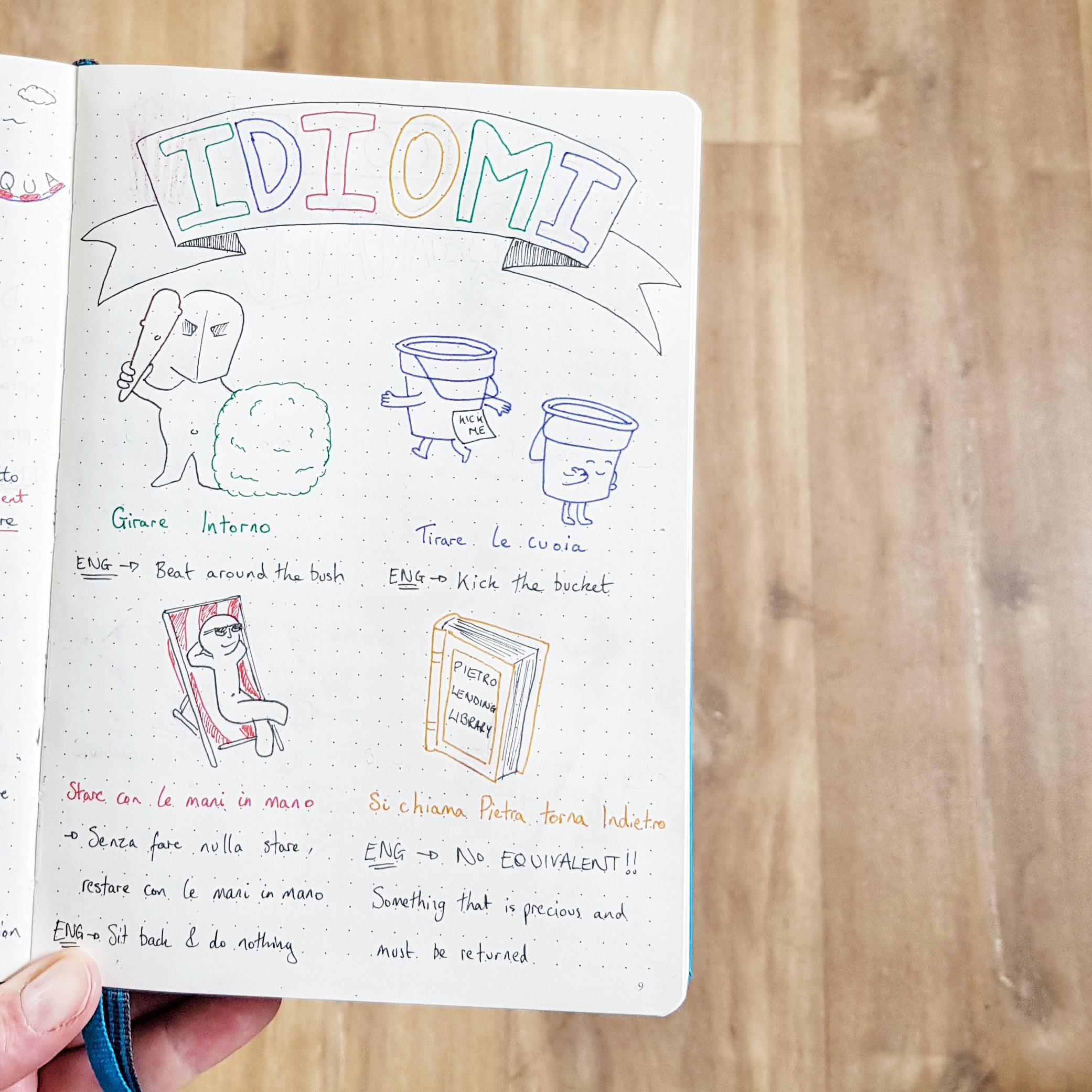
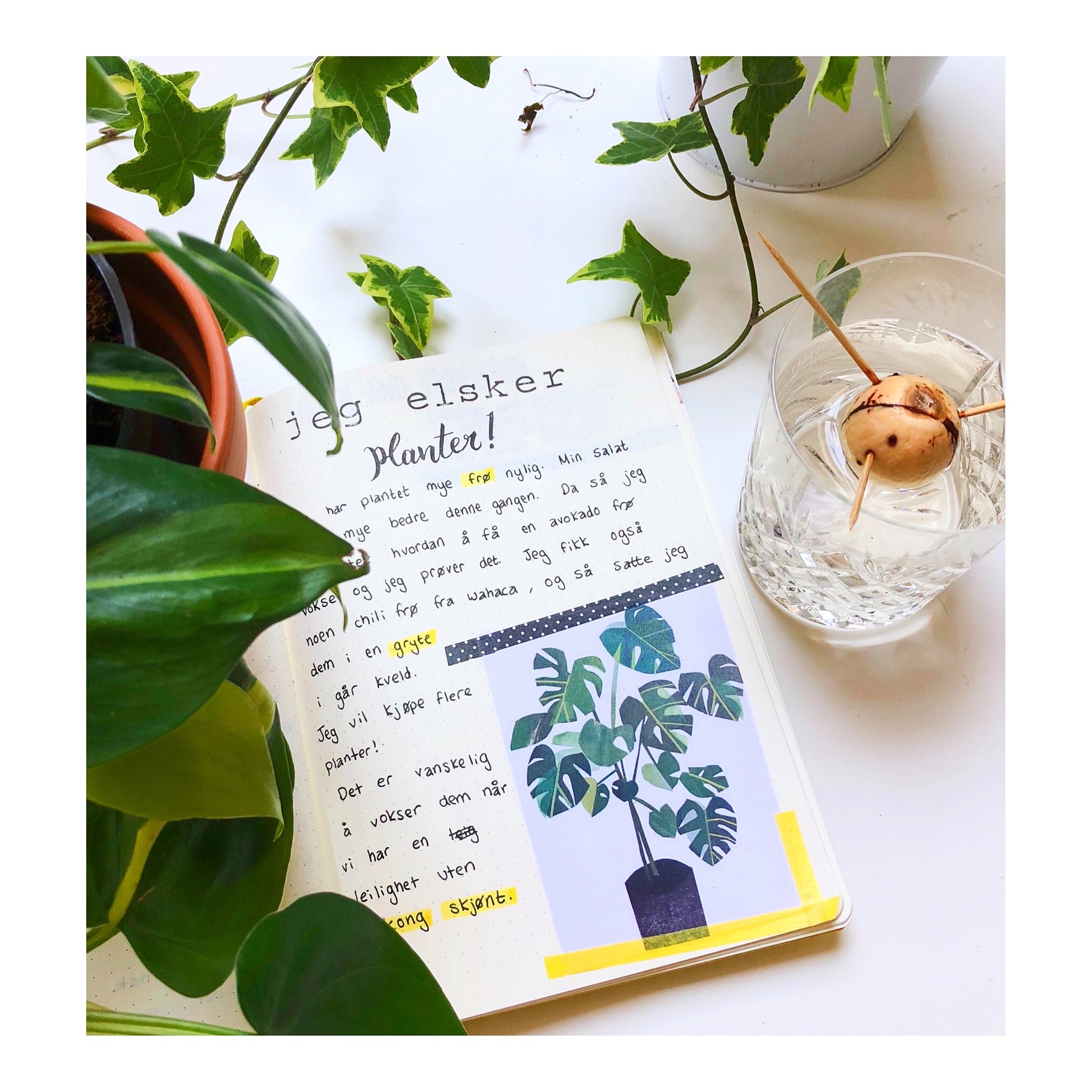
If you have a creative side you’d like to unleash, your language learning notebook is a welcome new playground. Kathryn and Sam already loved drawing, design and papercrafts. The language notebook became a way of adding language to what they enjoy, and it has helped create time to combine two great hobbies.
Freedom from Screens
Learning online gives you access to infinite materials, but sometimes it’s hard to remember everything that you see. The notebook becomes your place to capture the coolest bits you find online, the new words you learn from an app, everything you find in your personal language learning world.
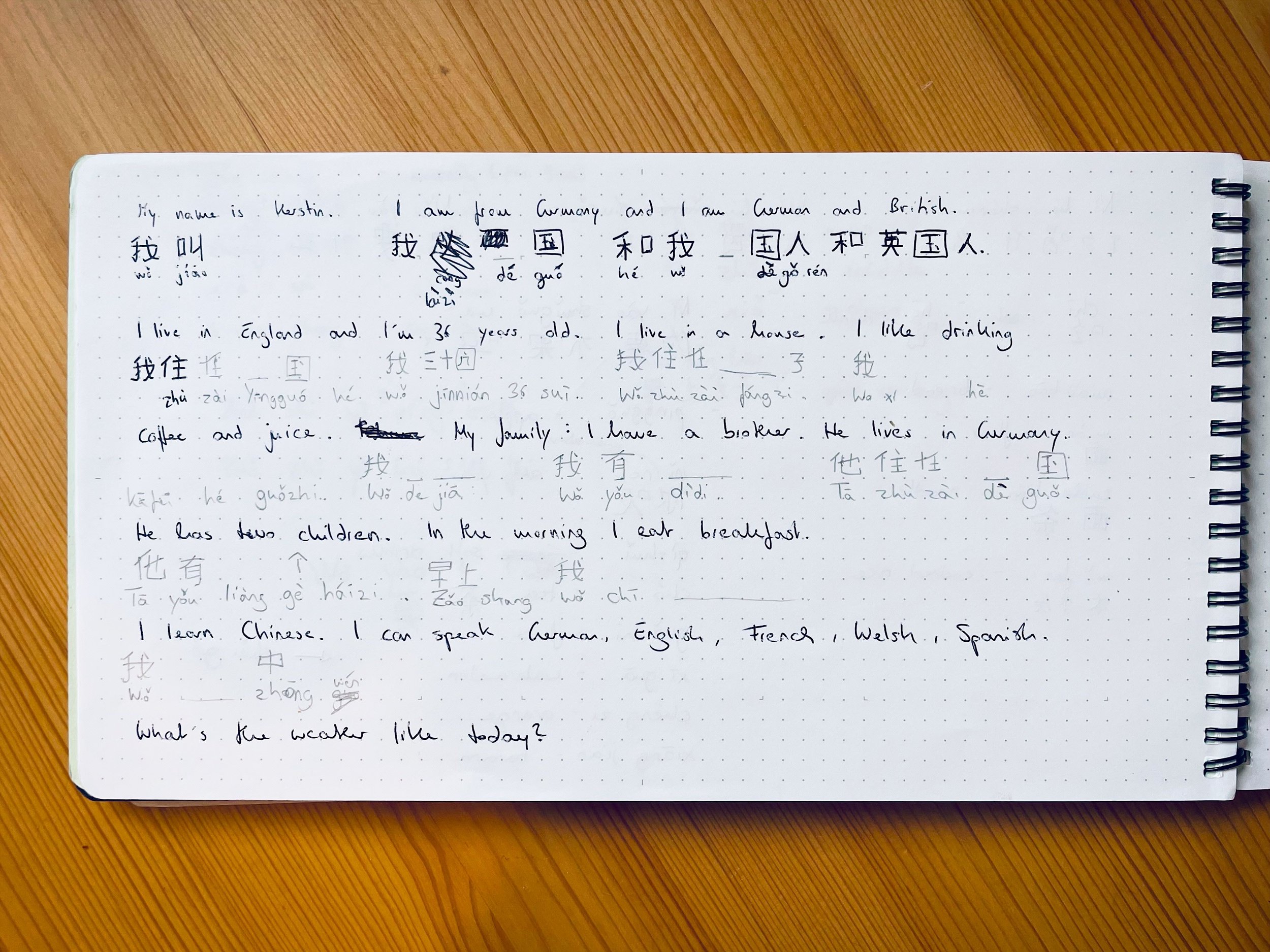
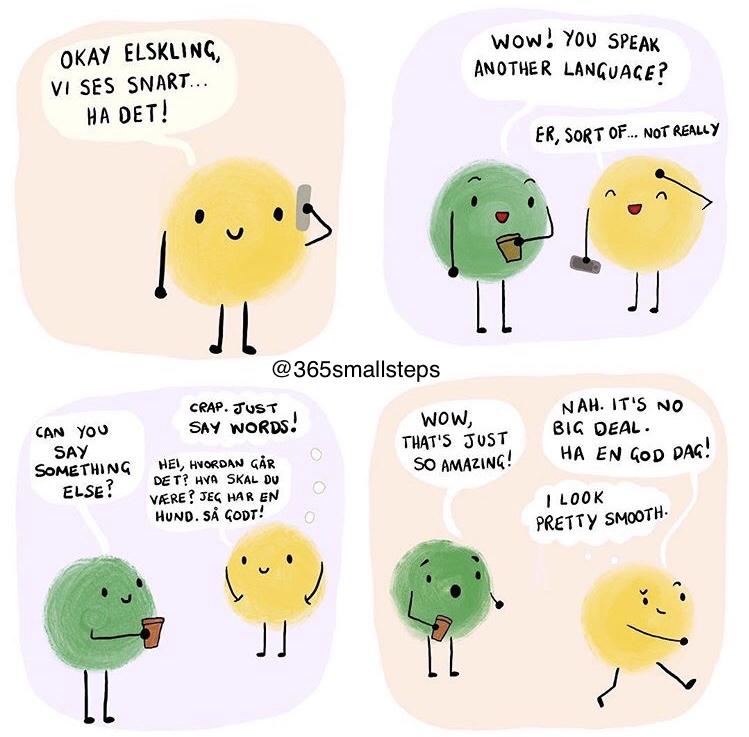
Need Inspiration? Welcome to our Language Learning Notebook and Language Journal Gallery


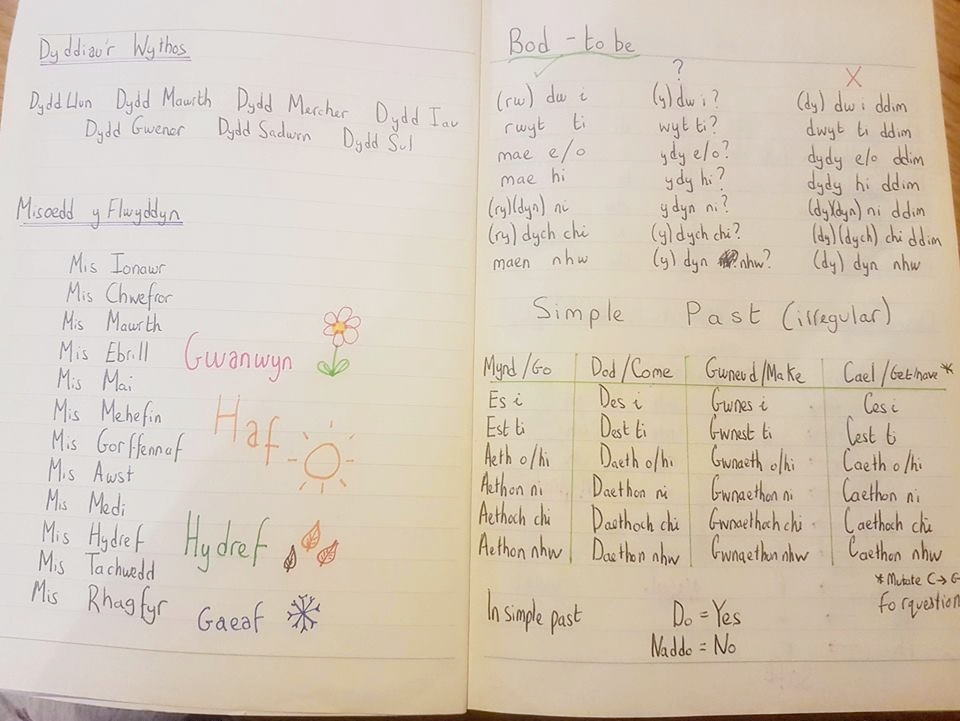
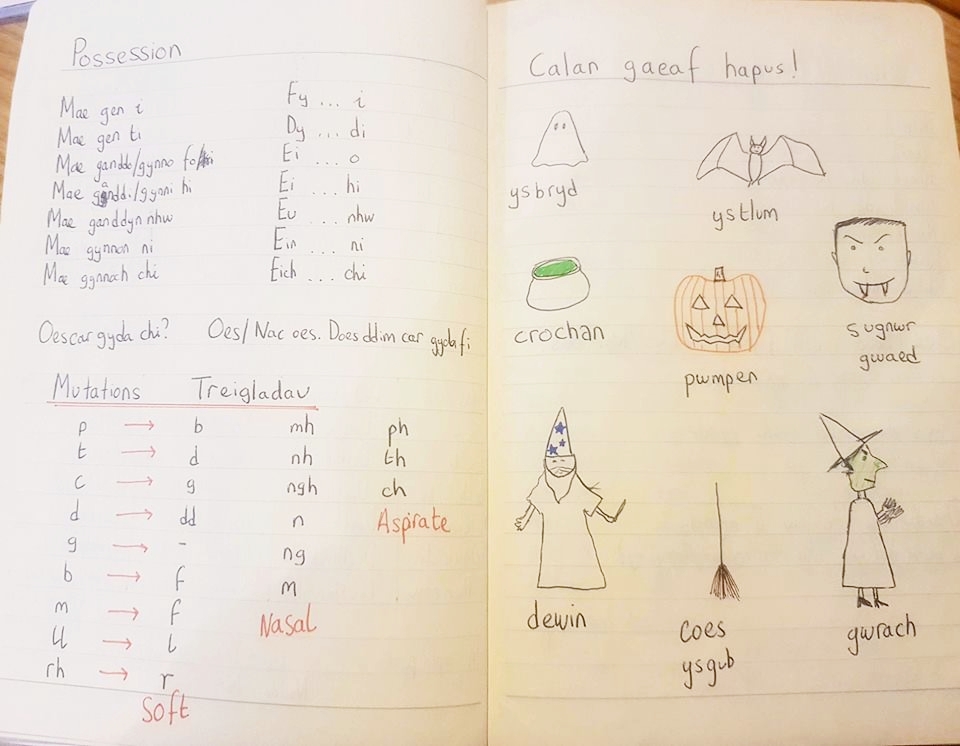
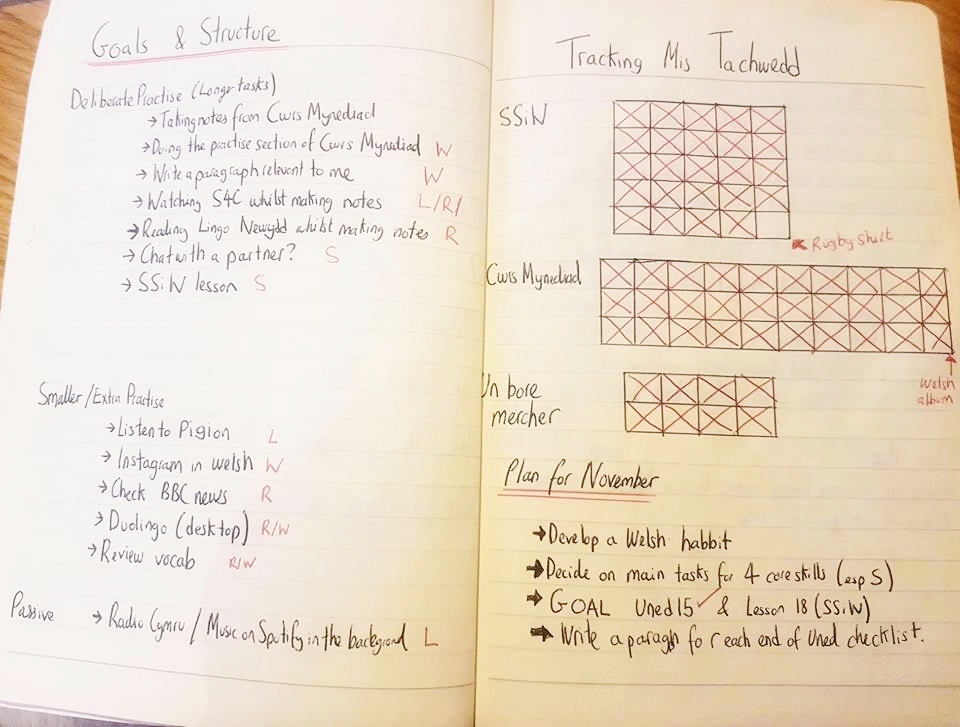
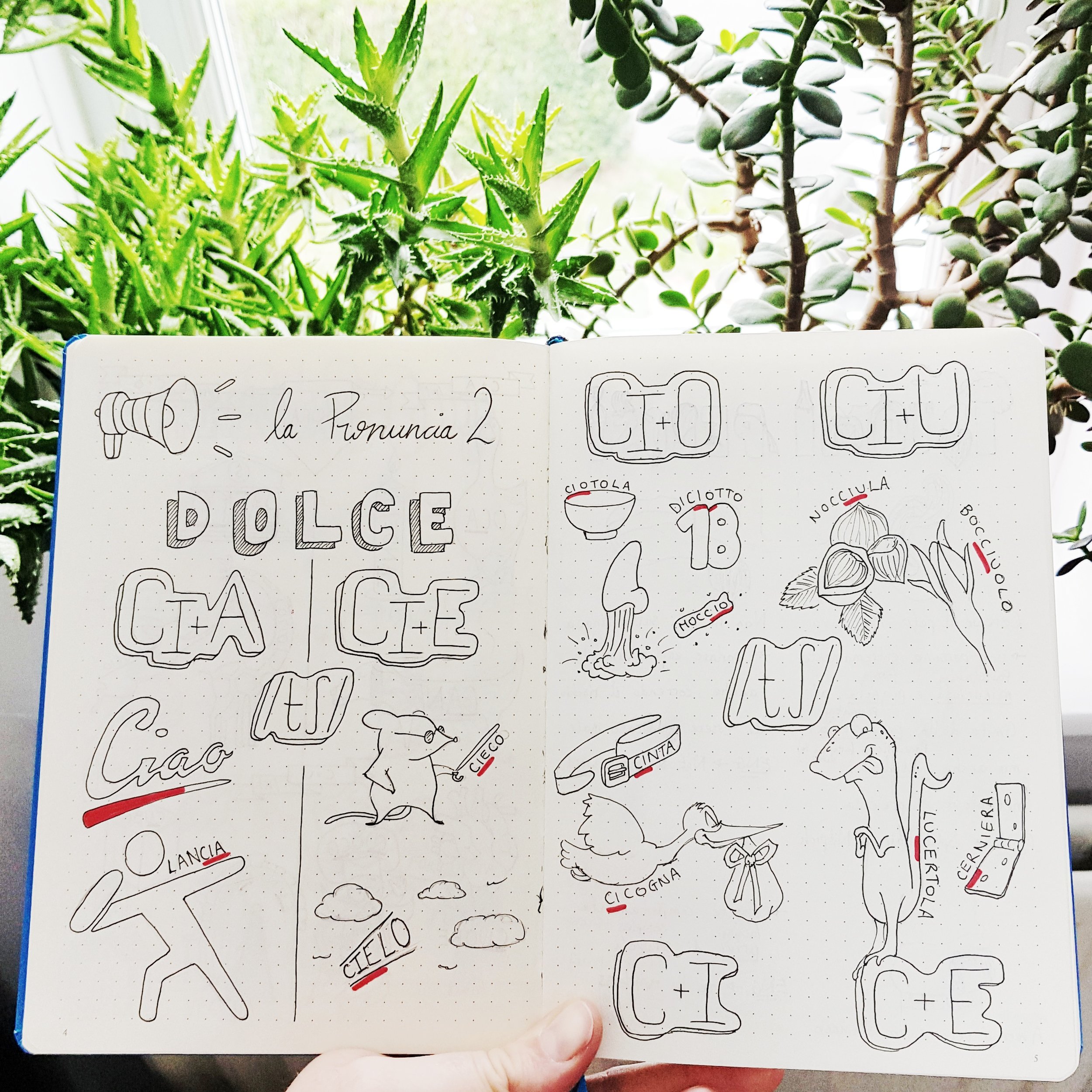
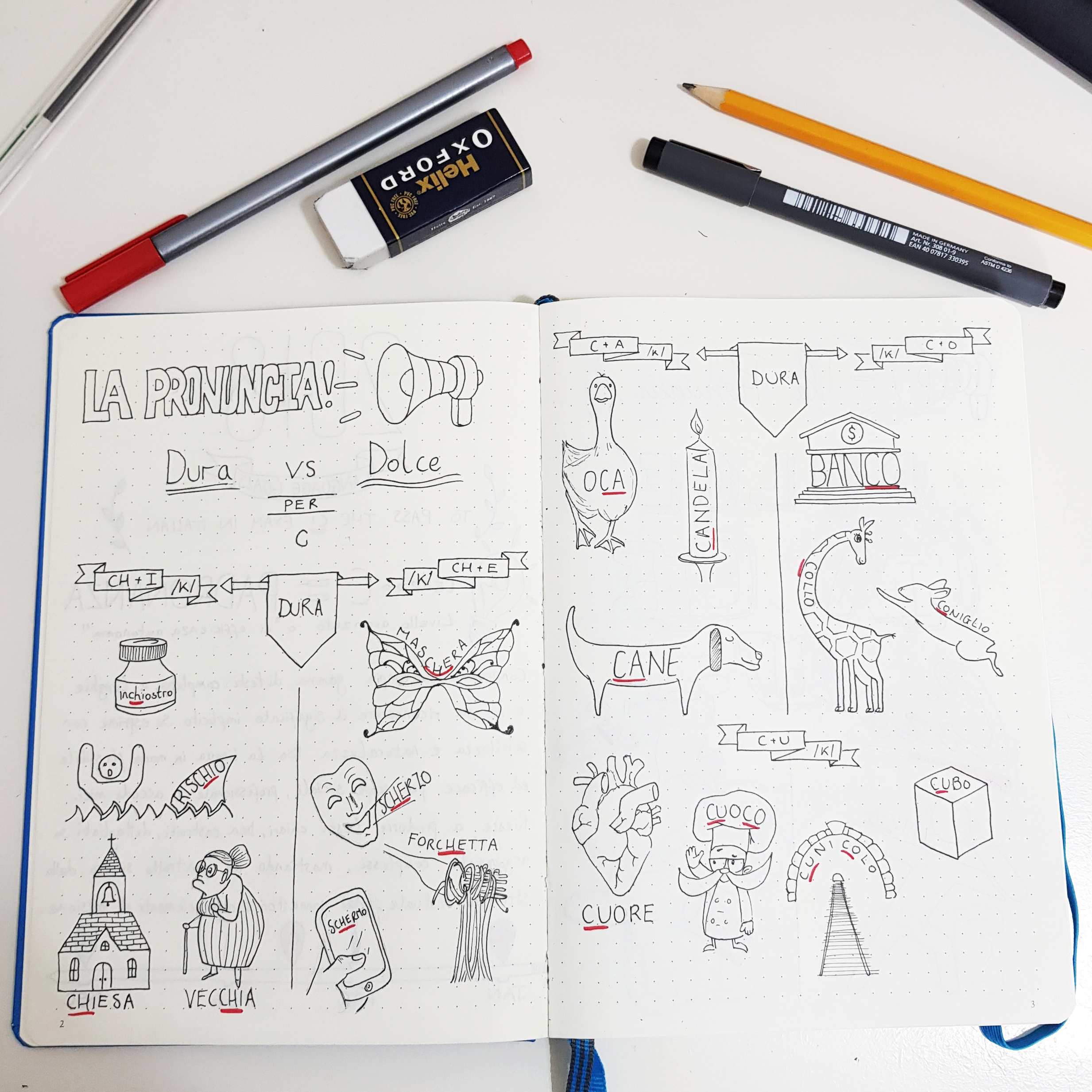
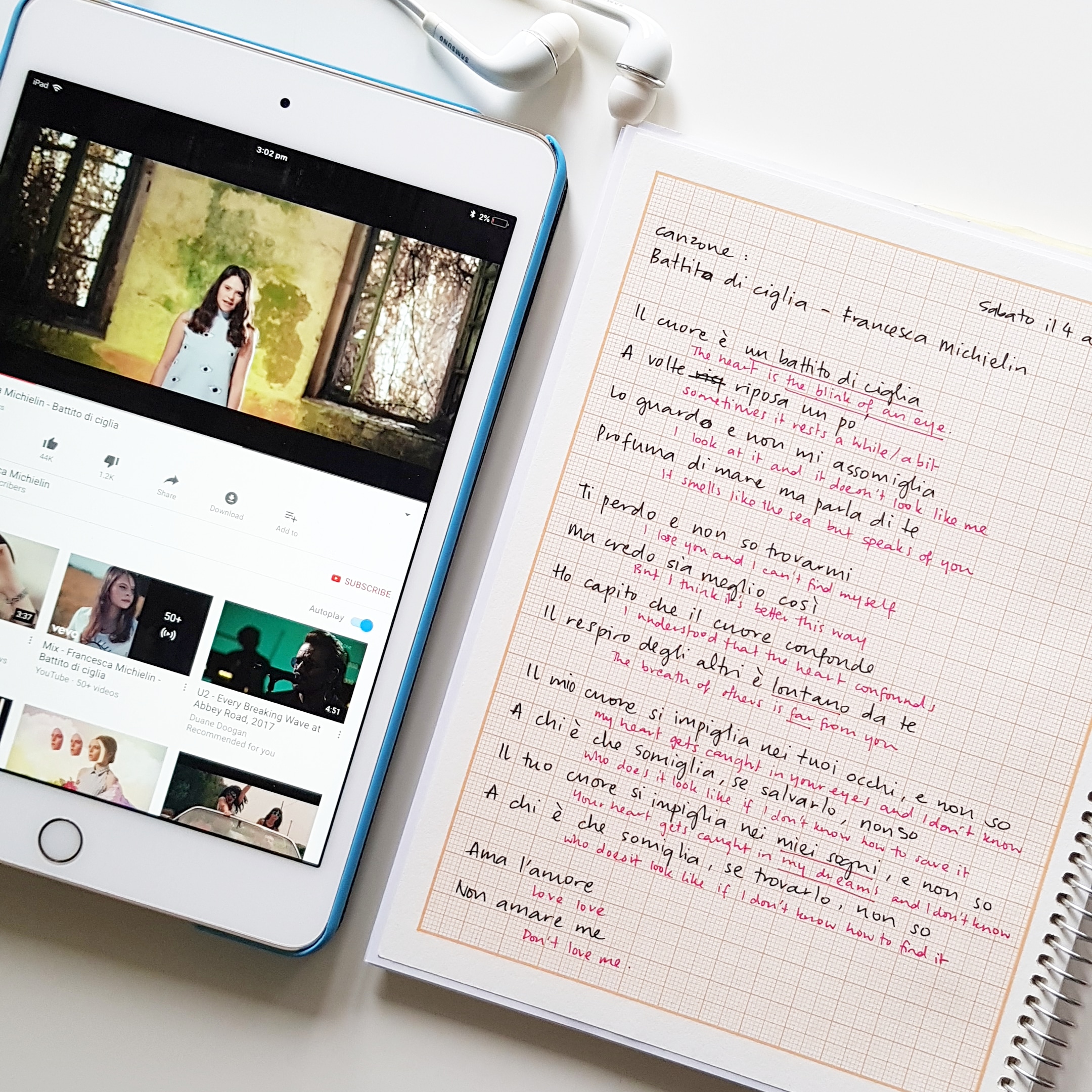
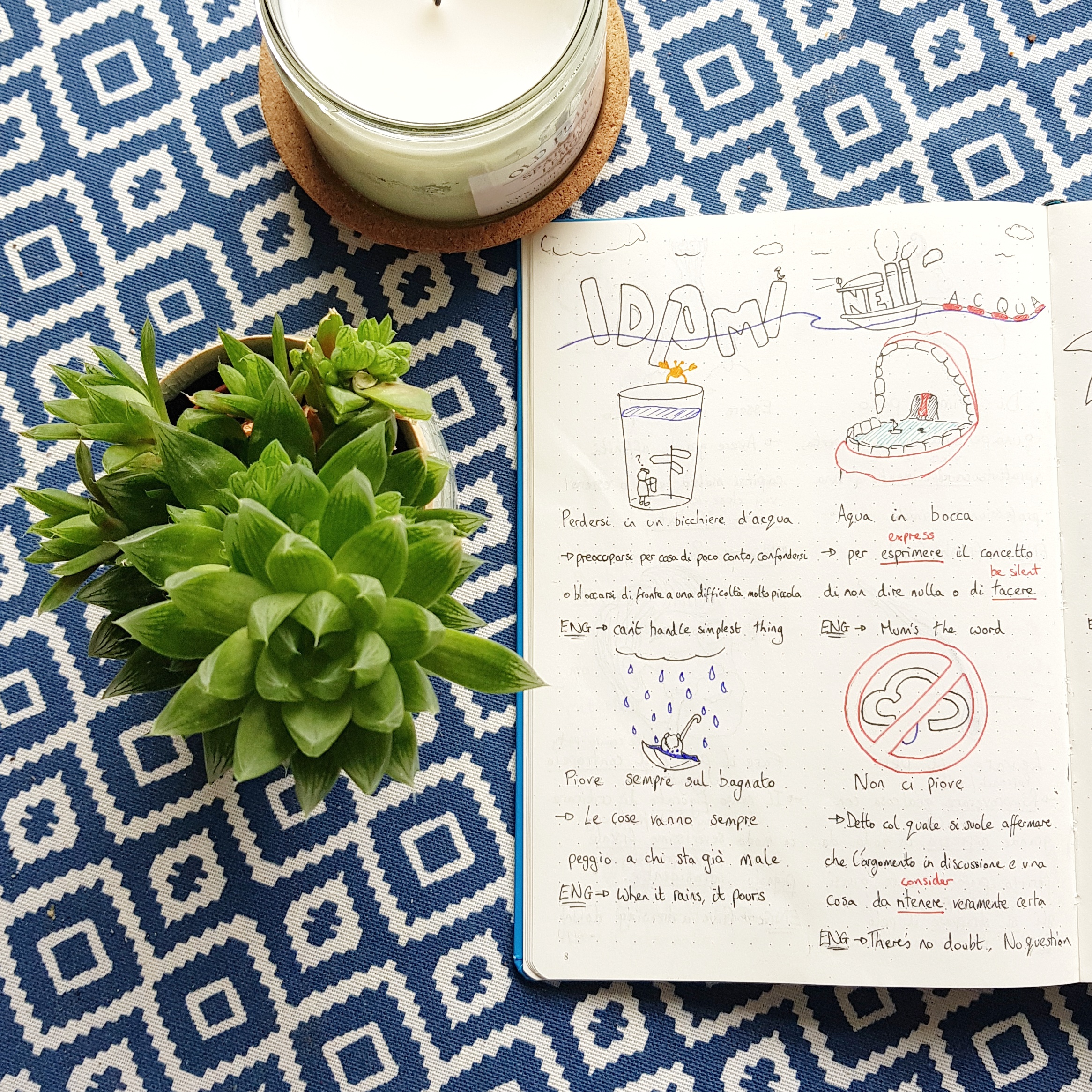
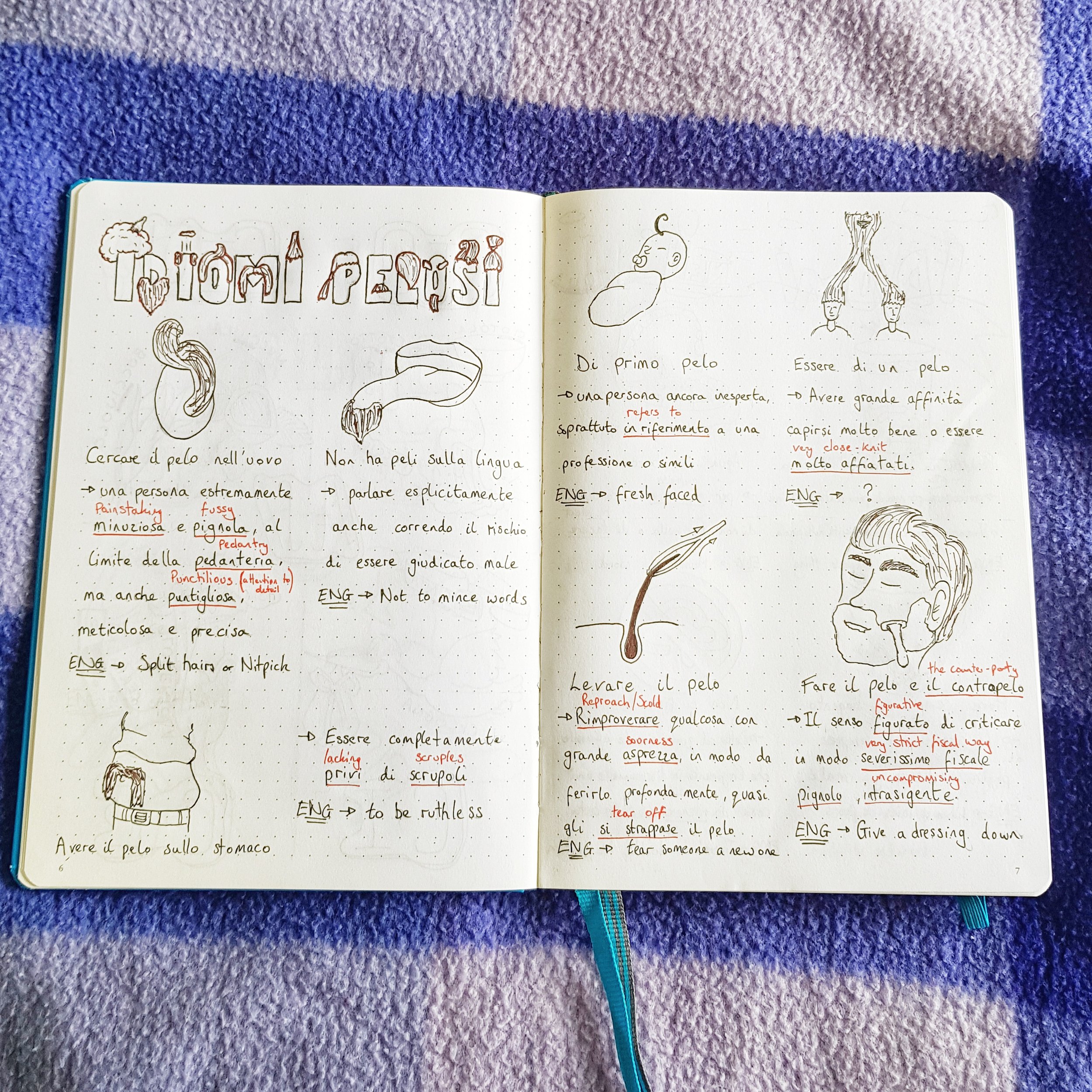

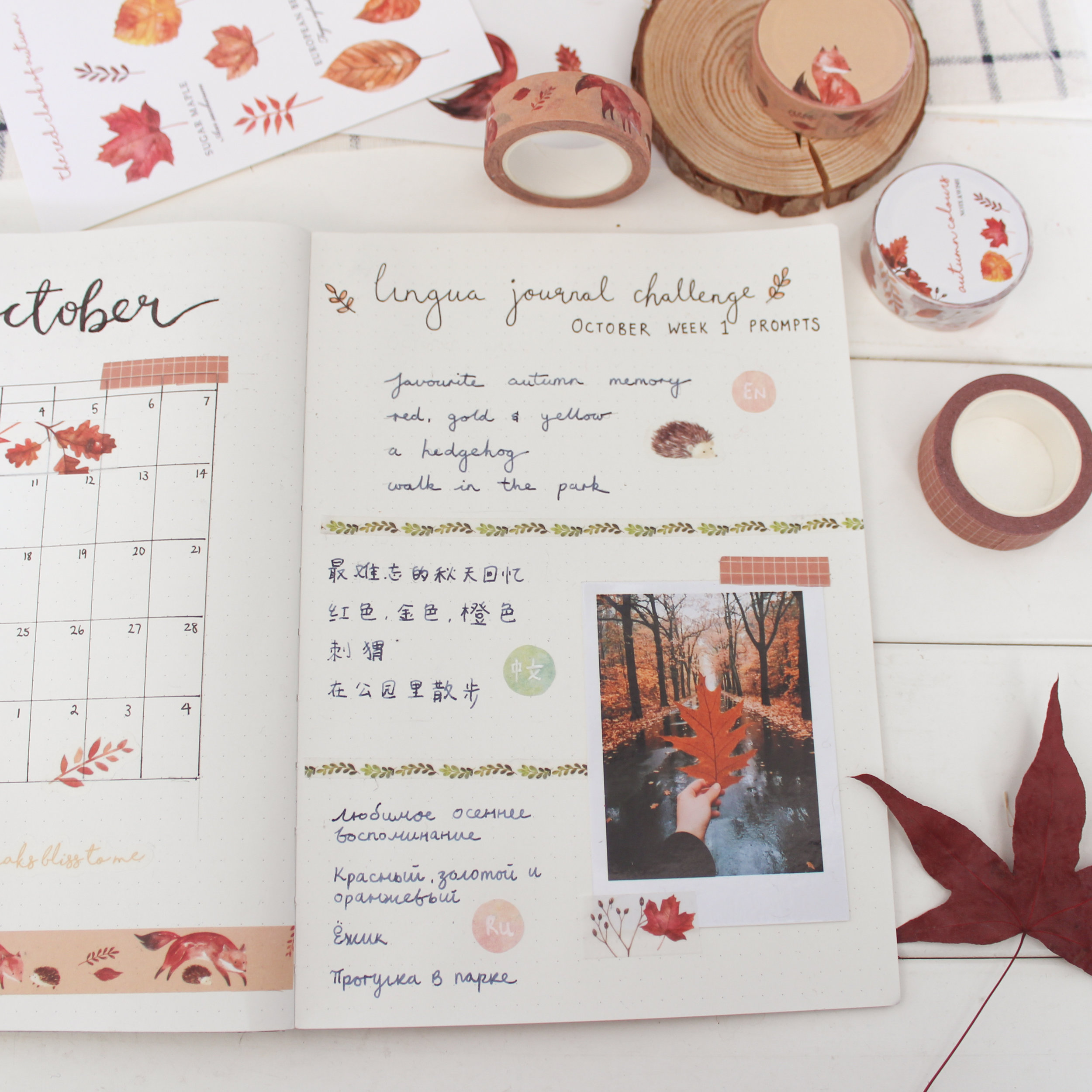
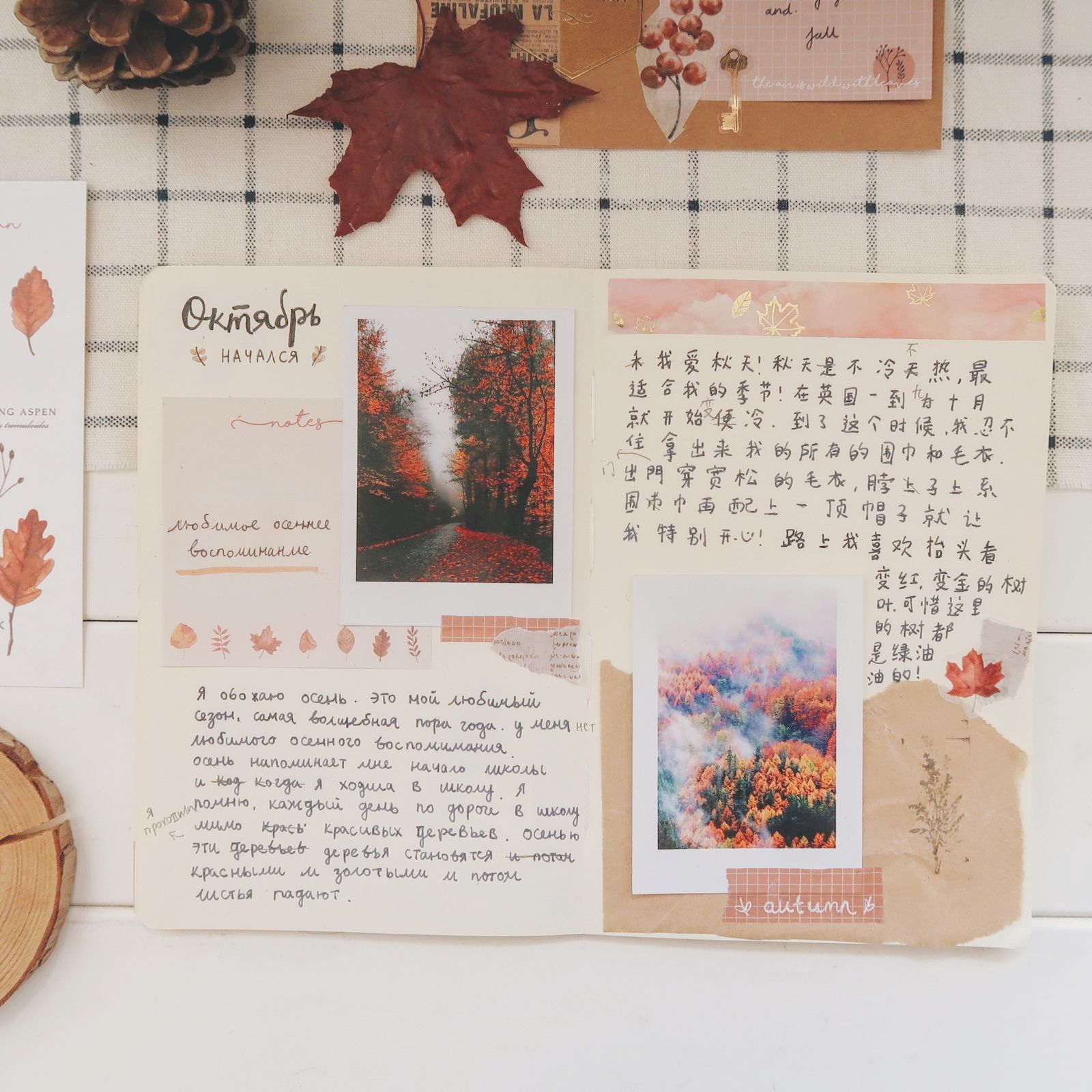

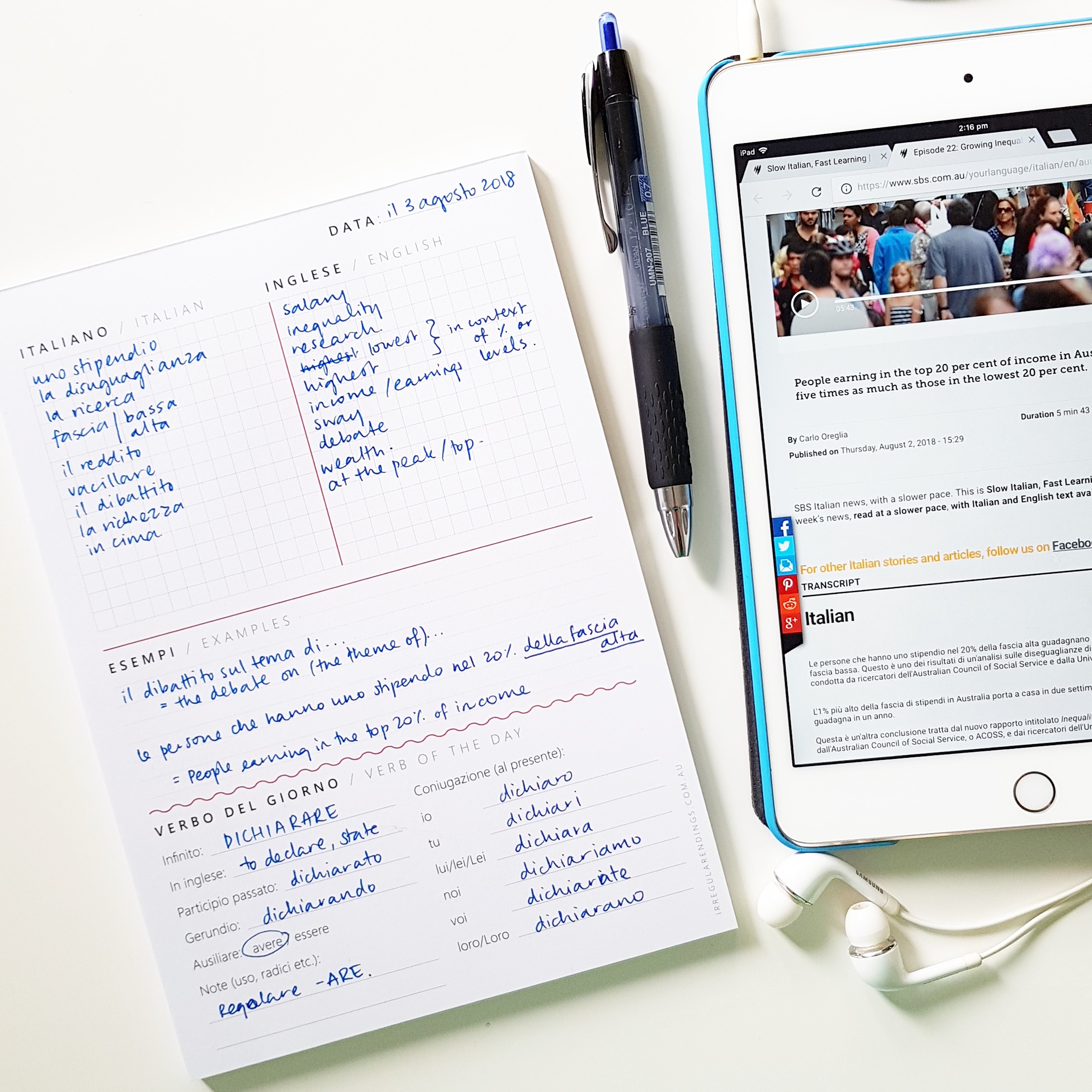
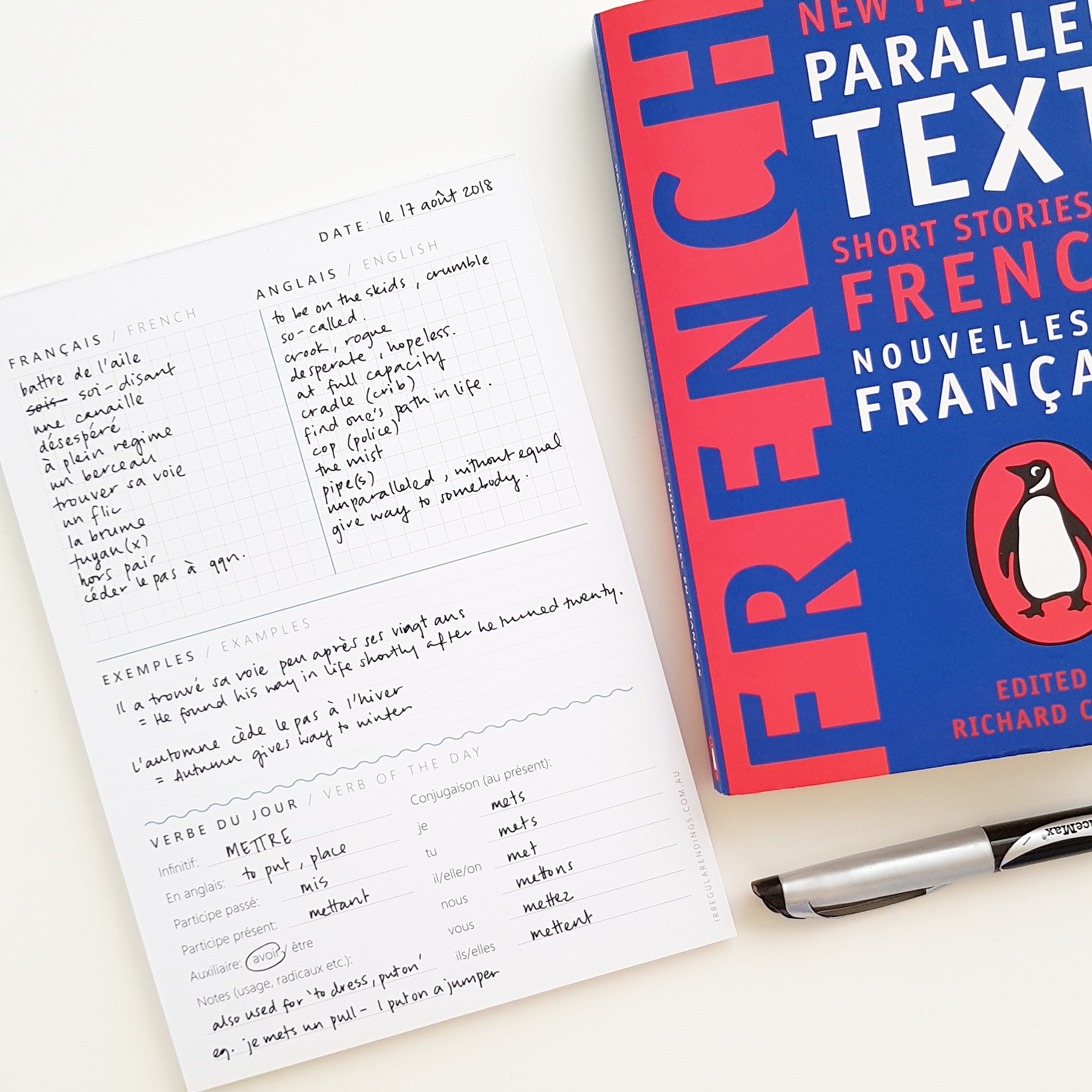
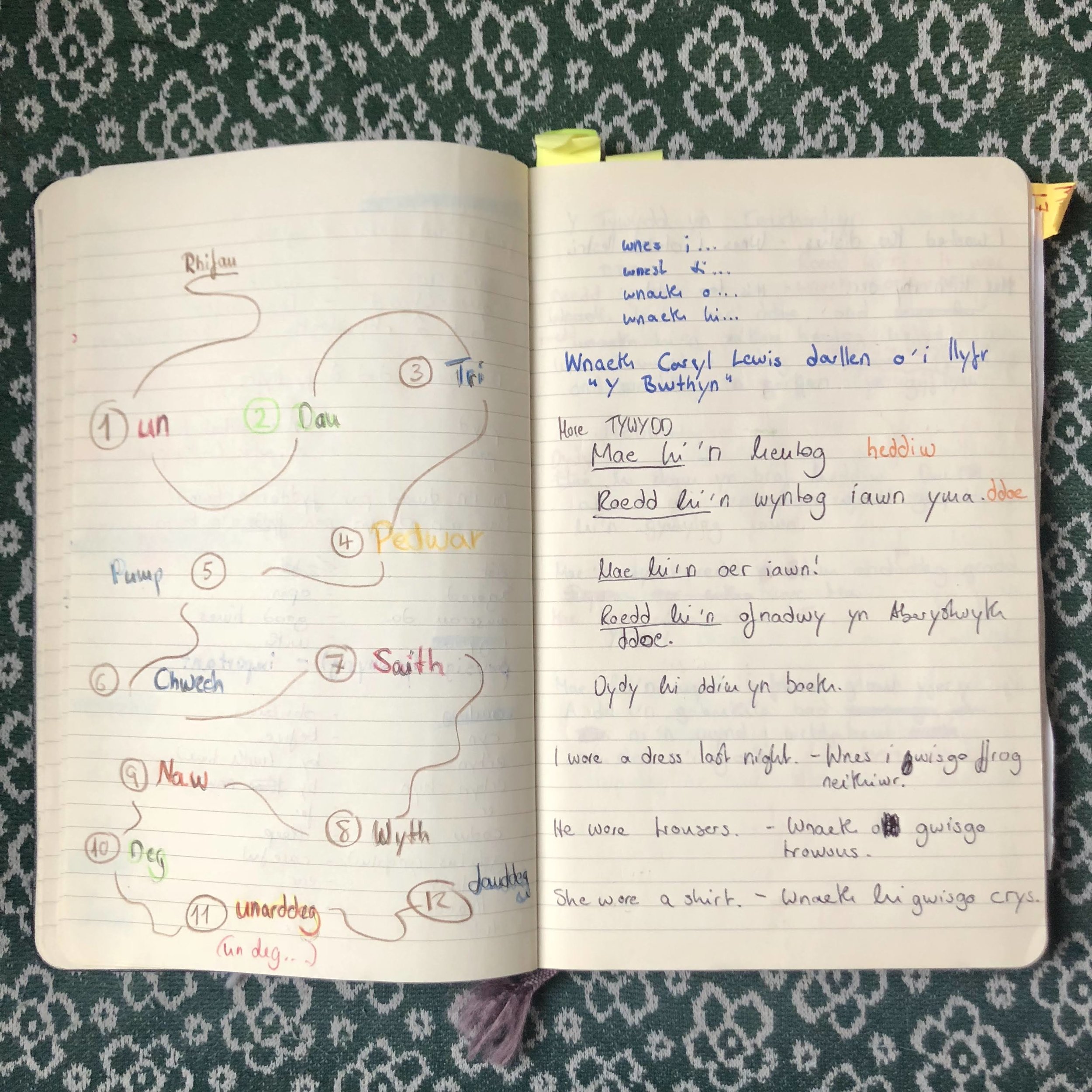
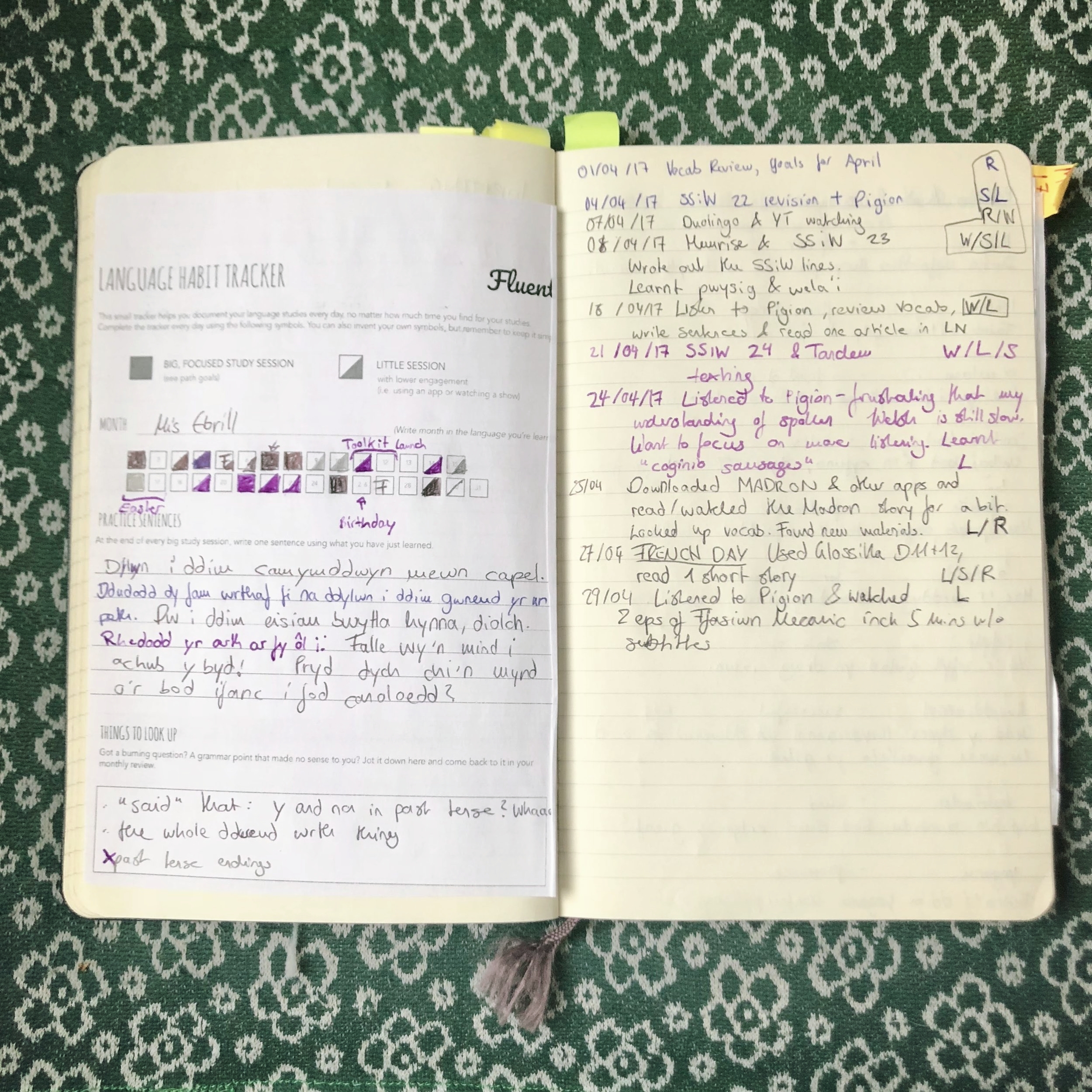
How To Work With The Language Notebook?
When you start learning languages, the notebook becomes more than just the place to note down the bare facts. You can use it for two core purposes:
1. Language Learning
Noting new vocabulary as and when you hear it, drawing memory aids, mapping out your memory palace even. Notebooks are also the right space to write down grammar rules and example sentences. On the pages of my own notebook, I see pronunciation notes and alphabet practice. Basically, anything.
For reviewing and testing yourself, there can be pages dedicated to vocabulary learning. My technique for such pages is to create special reference sections. This works in any book or journal, and you can learn it step by step in my $9 course, Write Your Way to Fluency. .
Here is an example of what this looks like in my current book:

It is easy to highlight words that I tend to forget, and even easier to add them to another list at a later stage so that my revision materials always stay fresh.
At the start of every new session, try looking through previous pages to review what you have learnt before. There is no need to memorize it word for word, but it will jog your memory and set up the ground today’s session can grow from.
2. Goal Setting and Productivity
Language learning is a big journey. For some learners it’s about growth and development, for others it’s a hobby or an aspiration. No matter what your goals and motivations are, you can gain a lot from creating a language learning journal..
Consider adding interesting facts about places, drawing maps or pasting in tickets and mementos from your trips.
Again, writing by hand and focusing on the book in front of you aids clarity and minimises distraction. In a busy world full of overachievers, this is more important than ever.
Here are some more ideas for what you can write in your language learning journal:
Vocab doodles or lists
Jokes & Cute Pictures
Repeat and review things you learnt from YouTube or a podcast
All types of language learning goals and motivations
Memories from cool things you’ve done
Tracking: Core skills balance, daily contact with an app
Your resource lists
Weekly learning plans
Ready to transform your language learning journey with just a pen and paper?
Join Write Your Way to Fluency for only $9! Dive into a world where motivation meets organization, and discover how a simple journal can become your most powerful tool for mastering a new language.
How Can You Navigate Your Language Learning Notebook?
One of the downsides of paper is that it doesn't have a search bar.
To aid yourself with a bookmark system, consider colour-coding areas like "grammar", "vocab" or "situations". Again, the beauty of your notebook is that this is your personal space. You’re no language learning robot, so work with what feels good to you.
The great thing about building your personal language learning system is that these categories can be unique to you and help you build the exact language course that you need (remember that this is one of the core principles in independent language learning).
My favourite bookmarks are sticky notes such as this cute set from Filofax, but this isn't the only way. You can experiment with a notebook in sections, with highlighter pens or beautiful bookmarks.
Good Notebook Options
You can get paper from anywhere of course, but the best language learning notebooks are durable and built to handle a bit of use.
Go for a notebook that is bound like a real book and lasts you all year. Next, discard any paper that is too thin or delicate to take scribbles, highlighters and different kinds of pen. You never know when you'll want to write something down and all you'll have to reach for is your auntie's fountain pen.
The style of paper does not matter - go for squared, lined or blank and pick a paper size that gives you a little space to work with. The language learning notebook works best it doesn't fill up too quickly. My favourite options are:
Frequently Asked Questions
How to Use A Bullet Journal for Language Learning
Having a bullet journal can be an incredibly effective tool for language learning, combining the flexibility of a notebook with the structure of a planner. Bullet Journaling not only improves productivity, it is also extremely flexible in terms of personalizing it for your own needs
Pinterest is excellent to see how other people are designing their bullet journals and to get inspiration for your own.
To keep simple, you set yourself a number of keys, which basically mean you choose which symbols have which meanings. Clarifying your keys is, pun intended, key to using bullet journaling successfully.
Once your keys are sorted, you need to decide on a format. This, however, doesn’t need to be strictly adhered to – indeed, I would actually encourage you to try out different things, since you will know when you’ve got a format that works for you. I like planning my whole year very briefly at the end or the beginning of my notebook. I use a Leuchtturm 1917 with dotted pages, having weekly spreads with the key events from each day, then doing daily pages with detailed to dos and agendas.
Why Do You Need a Language Learning Journal?
A language learning journal is an essential tool that helps you learn a new language more effectively and enjoyably.
Here's why a language learning journal is essential:
Progress Tracking: Helps you visually track your improvements and milestones.
Focused Improvement: Allows you to identify and concentrate on areas needing more work, like grammar or vocabulary.
Memory Aid: Writing down new information helps in better retention.
Customized Learning: Lets you tailor your notes with examples and visuals that make learning more fun and effective.
Self-reflection: Offers a space to ponder your learning methods and discover what techniques suit you best.
Share This Blog to Spread Language-Learning Inspiration With Your Friends!
Share this link on your Instagram stories or Facebook so your friends can create their own personalised language journal: https://www.fluentlanguage.co.uk/blog/language-notebooks.
Who knows, maybe you'll motivate someone to start learning. The more people you know who are learning a language, the more motivated you are!
Don't forget to tag @kerstin_fluent on Instagram or @fluentlanguage on X when you share it!
Further Links
Write Your Way to Fluency, your easy guide to creating the best language learning journa. (just $9)
How To: Bullet Journal for Effective Language Learning by Fluent Language
The Language Habit System | Fluent Language — Templates for building your language learning routine
Learning German With TV Shows: The Most Effective Strategies and Resources for Your Study Routine
Boost your German language learning with TV, podcasts, and radio shows! Discover how to pick the perfect show for your skill level. Say goodbye to dull lessons and hello to rapid vocabulary expansion.
Here's a dream scenario: Watch an hour of German TV every day. Within two months, you will understand everything.

Think that's impossible? Well, you're kind of right. No passive activity is going to give you a huge result if that's all you do.
But working with TV, podcasts and radio shows does deliver excellent results. It's not just a great addition to language learning routines that lack interaction. Using content like this also saves your lessons and study time from terrible dullness.
If you are interested in mastering the German language using podcasts, make sure to take a look at these 9 of the Best Podcasts for Learning German.
Just remember to do your work and think about where these fit into your study routine.
In today's article, I'm sharing recommendations for German shows that fit into your study plan and help you get big results.
Understand German Grammar In Minutes Without Frustration

So How Difficult Should A Show Be?
Opinions vary on how much of your input you should understand in depth for it to count as helpful for your language learning.
Intensive Listening
Intensive listening and watching helps learners develop better listening comprehension. You should want to work more in-depth with your materials, and aim for shows that you understand well. Make sure you are happy to spend an hour or two on the subject. The key expression here is comprehensible input, meaning you work with language that you actually understand.
There is no embarrassment in going for the "this is right for me" label, let’s not be over-ambitious. Slower speeds and easier vocabulary are helpful and mean that you can get the full effect out of the time you put in. Understanding more words is going to help you absorb German grammar naturally.
Extensive Listening
Got no patience for feeling like a learner? Then watch and listen a little above your level. No need to go straight for the intellectual talk rounds, keep it realistic and find a show about what you love.
This approach is best if you’re all gung ho about your learning and want to approach it with zest, speed, and intense practice sessions. You’ll be pushing your boundaries and get a fast sense of progression. The cost? Rapid learning loses thoroughness. The benefits of working with natural input are fast vocabulary expansion.
So pick your level of challenge first. Now, let’s think about the topics and materials that are likely to work for you.
How To Find a Show That Works For You
Millions of language learners have bought books of short stories and graded readers in many languages. Materials that are written for learners help you enjoy a good story while learning a language, and often give you extra vocab help. And what's more motivating than wanting to know what happens next? I think it’s brilliant, and encourage you to look for the kinds of things you enjoy in a foreign language.
Books have a huge advantage: They move at your speed and allow you to pick your own level of engagement. You can skim or speed-read for that immersion effect ("extensive reading"). For "intensive reading", give your text the full study treatment.
Reading and listening are both important, of course. They are two of the four core language skills (listening, reading, speaking and writing). If you want to learn more about core language skills and get tips on how to focus on them, check out my book Fluency Made Achievable.
Right now of course, you're not looking for a book. We're ready to listen! I have written an article on The 9 Brilliant German TV Shows and Movies. These shows will offer you enough entertainment in German to keep you on the couch for weeks in German binge-mode. Los geht’s!
Here are my favourite shows to add to your learning routine:
Designed for German Learners:
Learn Out Live Audiobooks
André Klein is awesome, you already know that if you’ve checked out his written materials in the Dino lernt Deutsch and Aschkalon Fantasy book series. Over the last year, André has also worked on adding audio versions of his popular stories. If you like an engaging story, these audiobooks are perfect practice material and the right choice for learners at A2 or higher. The books are read by the author himself and put you right into the middle of the story. The background sounds bring the story to life. André focuses on practice and pronunciation to help you learn German.
Here’s a sample so you can try it for yourself:
I reviewed Yabla here on Fluent Language a little while ago and I'm still ever impressed with their language learning content. The Yabla player offers one of the best multi-media experiences for learning that I've seen so far. Slower speed, multilingual subtitles and regular reports from all walks of life make this more than just one show.
Yabla is the kind of thing you should check out if you wish there was a whole TV channel just for language learners.
Jojo sucht das Glück
With this telenovela, Deutsche Welle has produced something incredible for language learners. The show is a professionally produced telenovela. Its story focuses on the adventures of Brazilian student Jojo as she moves to Germany and starts her new life in Cologne. There’s romance, music, and grocery shopping. It’s great for speakers upwards of B1 level. The website offers worksheets and exercises to make each episode into a full learning experience. If you’re working with a tutor, this is a great one to share. The addictive Jojo effect is good for extensive learning, because every short episode will make you want to watch the next one. German teachers, check out this page for guidance on how to teach with Jojo.
Slow German
Slow German with Annik Rubens is a culture and language podcast narrated by a native German speaker. Annik tells stories about what Germans get up to in everyday life. She talks about current affairs and offers transcripts and exercises in the paid premium edition.
Langsam Gesprochene Nachrichten
Ready to engage with German at a higher level? Then this podcast from Deutsche Welle is a great resource. This slow news show comes out every day and offers German learners an insight into current affairs. It's recorded at slow speeds to help you focus on understanding as much as possible. The language is not simplified, so this podcast is suitable for learning levels C1/C2. And if you’re not finding this enough of a challenge, you can check out the same broadcast at the original speed.
Logo
Logo is a kids’ news show that has been going since 1988 and enjoys huge popularity in Germany. The show’s web version features written articles, videos and images to help explain what's going on in the world. I like using Logo’s written articles because they have a great way of explaining current affairs and offering background insights and straightforward answers. If read things like Reddit’s “ELI5” (Explain like I’m Five), this news show is perfect for you.
When listening to radio shows or watching TV in German, remember materials for children are not designed for learners. The speakers will be talking quickly, and sentence structures are not be simplified. These materials don't offer transcripts or exercises, either.
Logo is made for native speakers, but its clear explanations make it a fab choice for German learners.
How To Use Your Time Wisely
No matter which of these programmes you choose to check out, remember the purpose of your activity.
- Are you taking a serious study approach to your material?
- Or is this something you're adding onto basic study to give yourself more motivation?
Each approach is valid. Still, you can't expect great results from minimal input. An hour of watching German TV with English subtitles is fun and keeps you interested. An hour of watching Jojo sucht das Glück while reading the transcript, adding new words to your notebook or flashcard deck, and then working through every exercise? Yep, that's going to deliver a BIG result. It's also going to make you more tired.
The key is for you to think about what you really want. If you want to understand more spoken German, it's pointless to work with materials above your level. That is just not how immersion works.
Ultimately language learning isn't down to genius or age or talent. You do the work and you get the results. There could be nothing simpler in the world, and still it's tough to consider.
What are your views about studying with TV shows and radio?
Which do you use for your own language lessons? And what are YOUR real results from building these into your learning routine?
Frequently Asked Questions
Can You Learn German Just by Watching TV?
While watching TV can certainly be a helpful supplement to your language learning, it won’t be sufficient on its own to fully learn a language like German. Relying solely on passive activities won't give you a huge result if that's all you do.
However, incorporating TV, podcasts, and radio shows into your language learning routine along with a practice of speaking and reading does deliver excellent results. It's not just a great addition to language learning routines that lack interaction. Using content like this also saves your lessons and study time from terrible dullness.
How Long Does It Take to Learn German on Your Own?
It doesn’t have to take you very long to learn basic German. For example, with my recommended resources, you’ll have the basics down in just a few hours. German is a beautiful language with many words that will be familiar to you as an English speaker, and the people are welcoming and friendly.
Stick to your new routine for 3-4 months and you’ll soon be having your first conversations. Learning a language to the highest level will take many years, but don’t let that put you off, because learning is a lot of fun!
Does Watching German Shows Help You Learn German?
Yes, watching German shows can be a super valuable and enjoyable add-on to supplement your German learning routine. watching German shows, you get exposed to authentic spoken language, helping you become more familiar with the nuances of the language.
The entertainment factor of watching shows in German can make the learning experience more enjoyable and less of a boring and daunting task. Learning a new language can sometimes be challenging, but incorporating fun elements like watching TV can turn it into a rewarding and entertaining activity.

Discover the Power of AI: Your New Language Learning Must-Have
I’m putting it on record: AI took me by surprise. As a pen-and-paper lover who’s never too far from her language learning journal, most language learning apps have failed to capture my heart.
Sure, Duolingo has a cute owl, but I never progressed fully out of the skeptic state myself (here’s my 2020 review).
So when the latest AI tools and chatbots like ChatGPT and Google Bard became popular, I was surprised by how excited I was very very fast!
Unlike curriculum-driven apps, these new tools added the flexibility and fun that I had been missing for my languages. So today, let’s have a deeper look into into why AI is a brilliant new language learning resource, and how you can start taking advantage of it for your own language learning routine.
I’m putting it on record: AI took me by surprise. As a pen-and-paper lover who’s never too far from her language learning journal, most language learning apps have failed to capture my heart.
Sure, Duolingo has a cute owl, but I never progressed fully out of the skeptic state myself (here’s my 2020 review). So when the latest AI tools and chatbots became popular, I was surprised by how exciting it felt!
Unlike curriculum-driven apps, these new tools added the flexibility and fun that I had been missing for my languages. So today, let’s discover how you can start taking advantage of it for your own language learning routine.
Podcast Recommendation: Inside the Mind of an AI Expert and UN Interpreter
If you would like to hear more about how my language-tech obsessed friend Josh Goldsmith and I created the new AI Language Club, then hit PLAY here to listen to our podcast episode.
Join the Fluent Newsletter for More Language Learning Tips
Why does AI Work Well For Learning a Language?
AI, or Artificial Intelligence, is a cutting-edge technology that enables machines to simulate human intelligence.
Computer programmers and linguists (people like polyglot superstar Judith Meyer!) have built huge datasets called LLMs (Large Language Models).
These datasets enable AI tools to understand natural language, meaning you can write and talk to it like you would in a normal conversation. There is no need to use code anymore!
AI is used in many places around us, from stock-trading software to number plate recognition in your nearest supermarket car park. You might already know ChatGPT, Google Bard and Microsoft Bing/Copilot.
And since AI is so well trained on real-life language, it is brilliant for natural communication training. Exactly what you’re looking for!
Discover Your Own Language Learning Style: AI as a Resource
AI tools are brilliant for your language learning needs because they provide you with tailored content for your level. When you chat to an AI chatbot, your learning experience can become more effective and engaging.
AI quickly lets you
🃏 create and play any game you like,
✍️ get feedback on your writing,
✅ generate instant quizzes for deeper understanding.
You can ask AI to write about any topic you’re interested in, and converse with chatbots in natural language. Writing with AI feels as easy as texting a good friend.
👉 If you would like to go deeper into the latest lessons and tutorials for AI-based language learning, join me and Josh in AI Language Club.
3 Killer Prompts for Effortless Language Learning with AI
At this point, you might be eager to give AI a try for yourself. I’ve decided to look into the treasure box of AI Language Club and bring you 3 super effective prompts that help you get started.
Level Indicator: Many AI chatbots know what common language levels and exam scores mean, so you can tell them your level and even your gender for a highly suitable language output. For example, tell ChatGPT or Bard that you are a “level A2 French learner” and it will generate simpler text than if you tell it you are “level C1”.
Role-Play Scenarios: You can ask AI chatbots to help you play through different scenarios in your target language such as job interviews or travel experiences. Conversations with AI can help you gain fluency, improve your vocabulary, and boost your confidence.
Vocab Brainstorm: AI is a powerful tool for brainstorming lots of words around a topic you’d like to talk about. This is great for preparing language lessons with your favourite tutor or exchange partner. You can even ask for the vocab in a neat table format or export it so you can pop it into a flashcard app like Anki or Quizlet.

AI vs. Language Learning Apps: What Sets AI Apart?

While most language learning apps focus on bringing you into a course-style curriculum, using AI tools is different.
The approach of using an AI chatbot requires you to have a sense of what you want to get out of each conversation. It can be your search engine, feedback and practice tool, plus a flexible source of input that matches your level and interests exactly.
If you’re coming to language learning from zero, an app may be easier to start with for now. You'll enjoy the tracked progress as you follow the curriculum. Add AI as a practice resource (more resource tips here).
For experienced language learners, professionals, or people who want additional resources on top of an existing course, AI takes things to a whole new level. With ideas like the ones we’re sharing here and in AI Language Club (catch our free training!) you’ll have hours of language learning fun sorted.
Can AI Replace Your Language Tutor?
One important aspect of language learning is discovering and embracing your own learning routine. So while you might think that you could become fluent with the help of ChatGPT, my view as an experienced coach and teacher is this:
AI serves as a resource that complements your individual approach to learning.
You won’t be able to replace 100% of your other resources with it, but AI can enhance your language journey.

AI can’t replace the full human connection you feel in language learning
If you learn languages for human connection and intellectual achievement, you’ll always need real-life practice in your routine.
My tip is to think about where AI fits into your resource stack, and to start building it into your tutoring sessions to make them even more fun.
Is an AI Chatbot a Language Coach?
While I have seen a few marketing messages around from language apps that do use the words “language coach”, for me the answer is a clear no. A language coach is not the same as a tutor or practice partner.
In my experience, the types of language learning tips and strategies you will get from AI chatbots are generic common sense. With a good language coach, expect personalised, targeted advice from an expert who’s here to listen. They'll help with the next steps towards reliable fluency.
Click here to discover how you’ll benefit from working with a language coach
Will AI Make Language Learning Obsolete?
When you look at all the great capabilities that AI gives language learners, you might start to wonder “does anyone even need to learn a language anymore?”. The answer is in the deep connection, joy and fulfilment that comes when you make a human connection and discover other cultures.

Language learning brings people together and nothing beats the fun of experiencing other cultures for yourself
Yes, AI can make it easier to communicate important needs when you are travelling, but the most powerful results always come from the inside. It’s about who you can become when you learn another language.
Which is the Best Language for AI?
From a user perspective, the languages with the biggest datasets will be most easily available and give you the most accurate results. Most of the big AI chatbots are now able to support a large number of languages, so as a language learner you can start a conversation and even switch languages during the conversation.
It’s great for multilingual experiments like I teach in Multilingual Power-Up.
Want to learn a rare language? Click here to discover tips that will help you do it.
What are the Risks of Using AI for Language Learning?
It’s important to use well-established platforms and bear in mind that most free AI tools will use your data to train their language model. If you share a personal story, some confidential information, or a copyrighted piece of work, you may compromise privacy. Be careful and consider looking for tools that let you opt out of this training.
My view is that most language learning usage ideas (like the ones we share in AI Language Club) do not come with any bigger risks. You can generally feel safe to experiment and practice using many tools.
Enjoy your AI language adventures!

Boost Your Language Learning With AI!
Watch our webinar, How AI Can Boost Your Language Learning, to discover exciting tips, strategies, and techniques.
9 Of The Best Podcasts For Learning French
Want to fit French listening practice into your life? Try one or two of these podcasts for French language learners, which range from podcasts for French beginners all the way to French immersion podcasts and courses.
Podcasts are great for language learning, because you can listen anywhere, discover new voices, and find great teachers at a low cost.

Do you ever find it difficult to fit French listening practice into your life?
Do you want to understand native French speakers?
Podcasts are a great way to add a little French listening practice into your day-to-day life. They are free, and can accompany any part of your day: driving a car, washing your dishes, doing laundry, working out, reading, and more.
Need to kickstart or refresh your French grammar so you can understand these podcasts even better? Don’t miss my course Finally Get It in French Grammar!
Quick Primer: How Do Podcasts Work?
If you’re curious about podcasts, but not quite sure how they work, here’s what you need to know:
You can subscribe for free to podcasts on your phone, tablet, or computer
If you use an iPhone or iPad, go to the Podcasts app. If you’re on a Mac, use the itunes directory
On a PC or Android device, try the Stitcher app for a quick and easy start
Subscribing means you’ll always have the latest episode ready and waiting for you as soon as it’s published
French is a great language for learning by podcast. There is a big selection, so I’ve gone and selected 9 of the best shows for you to discover.
Need to kickstart or refresh your French grammar so you can understand these podcasts even better? Don’t miss my course Finally Get It in French Grammar!
Beginner Level


FrenchPod101.com (InnovativeLanguage)
FrenchPod101 from InnovativeLanguage covers any level you can think of from basic to advanced French. With enticing titles and interesting themes for each episode, you’ll never get bored.
The dialogues are presented by engaging presenters and the hosts Céline (a native speaker) and Sam (a fluent speaker) cover both cultural and grammatical aspects clearly and concisely. On the website you can sign up for the premium content to access spaced repetition flashcards, PDF lesson notes, and a community forum for a subscription fee.
The lovely people at Easy Languages bring us a global phenomenon of language learning videos on YouTube. In their podcast of the same name, you’ll hear friendly, relaxed conversations. You can join their Patreon membership to get full transcripts and additional worksheets.
If you want to find out more, here is my interview with the founders.
Learn French By Podcast is a bilingual podcast in English and French. It's presented by two hosts, one French speaker speaks in French and one English speaker who explains what the French speaker said. The audio is very clear and easy to follow and the format is great for beginners and intermediate learners. It eventually progresses from basic conversations to intermediate and advanced-level dialogues about a variety of everyday topics. PDF guides are available on the website.
Intermediate/Advanced Levels

News in Slow French is an intermediate level podcast. This podcast covers world news, grammar, and expressions and slows down all the dialogue to make it easier to process what you hear. Every episode breaks down a point on grammar and vocabulary.
On the News in Slow French website there are transcripts for each episode, plus added resources and quizzes on French grammar, expressions, pronunciation.
One Thing In A French Day describes the daily life of author Laetitia in France. Each podcast episode covers different events in her life such as going to the bakery, shopping, going to the gym, seeing friends, among others. Her French is spoken very clearly and crisply at a regular speed and her words is easy to understand. Laetitia publishes articles every Tuesday, Wednesday, and Thursday. I certainly recommend this one for intermediate and advanced learners of French!

This podcast by Radio France International (RFI) is a show that is designed for intermediate and advanced learners of French. It's a genuine news broadcast from the French radio station, but read a little slower so you can become comfortable listening to French.
The episodes each have the most important news of the day in just 10 minutes (great for those who don’t have a lot of time in the day!) and come with a free online transcript.

The Français Authentique podcast is great for upper intermediate and advanced learners of French. It’s total immersion combined with lots of interesting topics and explains idiomatic and colloquial expressions. It is the companion podcast to the popular French learning website Français Authentique by Johan Tekfak.
Jonan is not just a super likeable host, but he also invites you to join his life and adventures by talking about them in French.
French Video Resources

Yabla is a video-based learning platform with bilingual subtitles and integrated dictionaries. The subtitles are interactive, which is a really cool concept! Check out how Yabla works in detail by reading my full review.
Yabla is great for all levels from basic to advanced. There is a free French podcast available with plenty of videos to watch.
Great French Audio Courses

Coffee Break French, a podcast from Radio Lingua Network, combines French language lessons with a lot of useful information about French food, culture, French speaking countries, and so on.
My favourite part of the podcast is the chemistry between relaxed and charismatic host Mark from Scotland (who is fluent in French) and French learner Anna from Scotland. The segments are also great: Cultural Correspondent has great cultural advice, and Grammar Guru discusses grammar in a clear, easy-to-understand way.
Advanced Learner Tip: Native French Podcasts
The easiest way to access native French language podcasts is to go to iTunes and switch your country setting to “France”, “Belgium”, “Switzerland”, “Canada”, or any other French-speaking country.
There’s no restriction on your switch, and you’ll be able to access all podcasts in the same way that listeners from France can. One of my favourites is Whisperos, a native French podcast getting into every little detail about Game of Thrones.
How to Learn More French
For more tips that will help you learn the French language, check out my special blog page for French learners.
This article was updated on 9 August 2022.

5 Hilarious Games for Learning Languages in a Group
It’s an open secret among experienced language teachers: We love playing games! During my retreats and lessons, I’ve had so many experiences when an hour of Articulate in German helped my students speak fluently with more ease than a hundred other lessons. In this guest post, Italian teacher Gloria presents her top 5 games for learning languages.

It’s an open secret among experienced language teachers: We love playing games!
During my retreats and lessons, I’ve had so many experiences when an hour of Articulate in German helped my students speak fluently with more ease than a hundred other lessons. In this guest post, Italian teacher Gloria presents her top 5 games for learning languages.
Many of these games will be a lot of fun for learning other languages, too. Over to Gloria…
Among the tools we can use to learn languages, games are surely the ones I love the most. I know it sounds weird said from a teacher, but I’ve never really liked traditional learning methods. Sure, when I was learning languages at school, these traditional methods made me feel like I was doing the right thing. Still, I found them endlessly boring and energy-consuming. All those drilling activities, fill-in-the-blank exercises, multiple-choice quizzes… they just made me feel anxious and in the end, they weren’t contributing to my learning.
The Problem With Traditional Study Methods
When you feel tense or anxious, you are pushing yourself away from your learning goals. Why? Because we need to create positive memories if we want to store new information into our brain. If we want to secure a long-term learning or, in other words, if we want to truly acquire new information, we need to be in a relaxed and stress-free state of mind. Stress prevents new information from coming in. Conversely, happiness and calmness open us up to letting new information in.
This is especially true for Italian.
Italian is known particularly for its charm, but also for being quite a complicated language. If English is your first language, you might have experienced a few tough moments when approaching Italian for the first time.
Group Games for Language Learners
Below you will find some creative group games which will help you add some fun to your Italian practice and secure yourself a stress-free and efficient learning.
1) Strega Comanda Colore (Witch commands colour)
This game comes straight from my childhood and is a part of the Italian kindergarten-games tradition. Here I would like to propose it with a small variant. Originally, we have one person who plays the witch and who says “strega comanda colore…” (witch commands colour…) and then he or she adds one colour of their choice. Once the other players have heard the colour, they have to run and touch one object with that specific colour before the witch catches them. If someone gets caught, they become the witch, and the game continues until everyone gets caught.
Now, here is the variant I would like to propose to you: When you touch an object, you can also shout the name of that object. This way, you will create an opportunity for learning and revising new Italian words.
You can also stick a post-it note on the objects you haven’t learned yet. After that, you can remove the post-it note and add a bit of a challenge to your game by relying on your memory. If you want, you can use this game to revise words in other languages as well and spread a little bit of the Italian traditions all over the world.
2) The Miming Game
We can use this game for many languages, and for Italian it comes particularly in handy when you want to revise verb conjugations. When you struggle with verb conjugations, the miming game gives you an opportunity to practice Italian verbs in a laid back and fun way.
First, write a subject pronoun like io (“I”), tu (you) or lui (“he”), on a paper or a whiteboard, and mime a verb of your choice. The other players will have to guess the verb and say it conjugated according to that subject. If, for example, you choose the subject “noi” and you mime the verb bere (to drink), the participants will have to shout beviamo. The first player who guesses the right answer will take your place, and the game will continue until you all decide it’s over.
You can then choose which tense you want to revise. You can begin with the present tense and then shift to the passato prossimo or the imperfetto as well. If you want, you can also choose to revise more tenses together.

A round of Pictionary in our comfortable lounge at the Fluent German Retreat
3) Pictionary
It’s the perfect game to play with a language buddy or a small group of friends. One person begins by drawing a picture, and the other participants have to guess what that picture is and say their answer in their target language.
You can draw pictures representing nouns like cane (“dog”), albero (“tree”) and libro (“book”). You can even draw adjectives like felice (“happy”), stanco (“tired”) and triste (“sad”). Then, you can also draw verbs like mangiare (“eat”), dormire (“sleep”) and leggere (“read”). You can use this game to revise what you’ve already learned.
It’s a good opportunity to spend some good time with friends and turn a leisure moment into a learning opportunity.
4) Pronunciation Memory Card Game

Everyone loves the sound of the Italian language, but how many out there find Italian easy to pronounce? So, here I want to propose a variant of the classic memory card game.
You can still match pictures and words, but, in order to help you with your pronunciation, you can focus on tricky words like ciao, chiesa, schiena, sci, formaggio, laghi… When you find a matching pair, shout the word out loud. If you don’t remember how to pronounce that word, the other players can help you with that.
Remember, this is all about teamwork, it’s not a competition. Plus, working to support each other is going to lead you further than competing against each other.
5) Game of the Goose

It’s the famous board game where you throw a dice and move pieces from one box to another around a track. You can build this game gradually, as you learn new sentences and words.
First, print out a blank template for the game of the goose (there are plenty online) and in each square you can write a question you’ve learnt to answer. Once all the squares are filled in with a question, you and your partners can throw the dice, move your pawns and answer the question where your pawn has landed.
Remember this is about team support, instead of competition, especially if you’re shy and you feel a bit intimidated when it comes to speaking.
As you can see, when it comes to learning Italian - and languages in general, applying creativity is the first step towards a new kind of language-learning experience.
You can play these games with your friends and classmates, or you can even involve your family, if you’re learning together. You will see how easy it is to transform a learning moment into an enjoyable shared moment that will bring beautiful and positive long-term memories.
What Are Your Favourite Games for Learning a Language?

Gloria Spagnoli is a playful Italian teacher online and founder of Speakita - Playful online Italian lessons for beginners. She’s committed to helping shy beginners and false beginners speak Italian confidently, with no stress and by having fun.



Struggling with listening? Discover realistic tips, challenge prompts, and the best tools for improving your listening skills as a self-guided language learner