
How to Establish a Successful Language Learning Routine (+ Examples)
Discover the secret to building a successful language learning routine. As someone who has been through the ups and downs of language learning, I understand why routines can easily fall by the wayside. In this post, I'll explore the common pitfalls that cause people to give up on their language goals, and provide you with 5 key elements that should be part of every effective routine. Plus, I'll share the best language learning resources to help you stay committed, and even give you a peek at my own personal routine. Don't let language learning overwhelm you – read our blog to find out how easy it can be!
Are you one of the many language learners who have attempted to build a language learning routine, but have found yourself falling off the wagon?
If you’re wondering “What’s the secret to learning a language once and for all?”, I’ve got your back.
A lot of language learners struggle because they get trapped in apps or stuck in complicated study plans. Today, let’s dig into where you might be getting stuck and talk through some easy, practical solutions that will help you build an effective language learning routine.
Why do most attempts at building a language learning routine fail?
If you started learning your language full of enthusiasm and excitement and found that it’s not lasted, you are not alone. Getting a consistent language routine up and running can be tricky. Here are some common reasons I’ve seen for running out of steam in your language studies.
Letting Language Learning Apps Run the Show

There's no shortage of language learning apps out there, and I am not here to tell you that you need to throw them all out. Apps are incredibly useful for language learners…but there’s a but!
Be careful with how you’re structuring your routines around these apps. Many of them use gamification and other features to keep you coming back. This is great for keeping a habit going…but it’s the habit of using one app, not of building your new language into your life.
Read more here about how to select a good language learning app
Read more here about how to get the most out of Duolingo
My tip for learning languages with apps is to use them as one of your guides, but make sure you have at least 3 other touch points with your target language every week through your language habit system.
Failing to Set Meaningful Language Goals
Without clear goals, it's easy to lose motivation and direction. And you know…”I want to be fluent” or “I just want to talk to people” are not very clear goals when it comes down to it.
Ask yourself what you want to achieve in a specific time period to make the goal a lot more realistic - this will help you build that sustainable language learning routine. Some fun ideas might include calling your grandma for a chat in her native language, singing a song, or posting your first Instagram post.
Read more about how to set meaningful language learning goals here
Overly High Expectations
One of the biggest problems I see come up again and again for language learners is the belief that you can “become fluent” within a very short time.
It’s absolutely possible for you to improve a LOT in even just a month. But that won’t mean you’re done in language learning. The relaxed conversation stage typically takes a few years. Instead of asking yourself why you’re always falling short, take the long view on this one and, like Bon Jovi, find the fun in being halfway there.

Boring Language Study and Exercises
Your memories of languages at school might be all about boring grammar drills and snoozing through tedious lessons. But hey! Now that you’re in charge of learning, you get to make the rules. In my system for learning languages, the focus is never on hard work. Your brain works better when you’re having fun, so build your new language learning routine with creative ideas, four core skills, and inspiring conversations.
Now we’ve covered some of the reasons your language routine might run out of steam, let’s focus on getting things set up the right way for you!
5 Essential Things Every Language Learning Routine Needs
You’re setting up your language learning routine so you can have long-term success. Here are the 5 key elements that will make life a lot easier for you:
Well-Organised Resources

You’ll be using apps, tools, books, courses, teachers, conversation partners, and probably a whole bunch more as you learn your language. The key is not to stick to the smallest number possible, but to make sure you organise the resources in a super smart way.
No one’s going to be able to tell you exactly which language course or book is the best one for you, because no one’s life and brain are quite like yours! So feel free to give things a try, and allow yourself to cut what doesn’t deliver.
A Balanced Approach to Consistency and Flexibility
You absolutely want to make sure that you can consistently show up in your language learning routine. This might mean scheduling regular study time, booking lessons every week, or simply sticking to a free interpretation of daily contact. While you can’t learn a language just by completing a Duolingo level now and then, it’s still not necessary to become a language robot. 🤖

A Way to Track Your Progress
Once you’re past the exciting first few weeks and months of learning a language, you might start coming into something learners call the intermediate plateau, where it starts to feel like your hard work isn’t paying off as much anymore. This is where “invisible progress” can kill your motivation, so don’t let that happen!
Tracking your progress can be super easy, and it’s the key to success in language learning. The easiest way? Use a journal or help yourself to one of the readymade trackers in my course, the Language Habit System.
Someone to Talk To
If you want to learn a language, it’s because on some level your dream is to communicate more with people. Whether your ultimate goal is travel, career success, living abroad, or just to follow your language passions, my advice to you is to find three types of people:
A practice partner, or someone else to talk to (or sign with or write to)
A mentor, for example a language coach
A few friends or peers who are also learning languages, for example through a language exchange
The more connected you feel to other people while you’re learning languages, the easier you will find it in the long run.
Study Variety
As mentioned above, finding fun resources is key to your success in language learning. Allow yourself to explore everything you like, everything you already do in your life, through the lens of your new language. Of course, TV shows are an easy one to try. How can you take it further? Build activities like finding great playlists to celebrating fun national holidays into your routine so you can hit those goals every day.
My Favourite Resources for Sticking to a Language Learning Routine
Now that you know the essential things your language learning routine needs, I wanted to introduce you to a few of the resources I always come back to when learning languages.

Language Learning Podcasts and Audio Courses
When I first start out with a new language, pronunciation is very important to me. That’s why I focus a lot on listening, and making sure I can take notes and understand how each sound is built. With more language progress, podcasts become a great source of stories and perspectives, and they’re available in dozens of languages.
🎧 Here are my podcast recommendations for learning German, learning French, learning Italian, and learning Spanish.
Language Learning Apps
While I don’t let my apps run the show, they can still be a useful tool for staying consistent with learning my new languages. The apps I use vary depending on the languages I learn. When learning Welsh, my go to is Ap Geriaduron, a dictionary app for my phone, and I also enjoy a bit of Memrise.
My Language Study Journal

I find that handwriting and processing my thoughts with pen and paper is an absolute must-have when I’m learning languages. From French to Chinese, and Welsh to Russian, every language I have ever learnt has been documented in a notebook. The benefits? I get to keep everything organised, tracked, and make sense of complex rules in my own way.
Want to find out more about how to use my strategies for yourself? Click here to discover my mini course, Write Your Way to Fluency, for just US $9.
Language Tutors and Exchange Partners
I usually go to italki (affiliate link) or LanguaTalk (affiliate link) to connect with a teacher who will help me bring my new languages to life. Over the long-term, I also set up exchanges with fluent friends, and practice my speaking and listening skills with people I find in my own network as a language coach.

The Language Habit System
I first created the Language Habit System in 2016 and I still use this method for my own language learning routine. This step-by-step guide to setting great language learning goals, tracking the actions that matter, and figuring out where to go next, is the heart of how I stay on track. The 3 key steps are simple: Plan - Track - Review. I highly recommend you check out the Language Habit System for yourself - it’s been tried and loved by hundreds of language learners!
A Real-Life Example of My Own Language Learning Routine

At this point, we’ve got the essential steps in place and you’re on your way to building that successful language learning routine. At this point, I’ve got a few examples to share from my own approach. But remember, your routine will probably look different and that’s okay! This is just for inspiration.
First, I think about what my language learning goals are. If I’m learning multiple languages, it’s important for me to select my priorities before I go about aiming too high and burning out.
I don’t set a dedicated amount of time to study every single day, but I do have a check-in with myself about making “daily contact” with my target language. My focus is also on making sure I keep each core skill in balance (these are covered in this free training), so that means I do not do the same activity every day.
Read my super popular guide to the core skills, Fluency Made Achievable
A few of my key activities in my target languages are
Listening to my favourite radio shows or watching some easy TV (I like Yabla (affiliate link) for this)
Texting my friends or looking up a few tweets in my target language
Reading a few pages in one of my easy reader books
Going to online classes or language exchange sessions
Making notes in my study journal
Sometimes, I get more organised and schedule extra study sessions in advance..but not all the time. My goals are small and tangible right now because that's how I want them. They may be things like "revise yesterday's vocab list" or "make notes for chapter 4". What I'm trying to tell you here is that I do not feel guilty about picking my own language pace and neither should you.
Well, unless you're in formal education and have an exam tomorrow.
You’re on the way to a great language learning routine!
So that’s a lot of great advice for you today! Building your successful routine might not be instant, but it doesn’t have to be a chore either!
If you can build in that balance of consistency and flexibility, great goals, and even better organisation, you’ll be on your way.
Avoid getting trapped in language learning apps and set realistic expectations for your progress. Remember to make your language learning routine fun and engaging, and connect with others who share your passion for language.
By incorporating these elements and using the resources I’ve recommended for you above, I know that you can achieve all your fluency goals.
Frequently Asked Questions
How do you create a language learning routine?
It takes a little bit of self-knowledge, a great study system, and some guidance through great resources and mentors. The key to language learning is to think of it as a habit that you’re building for the long-term, so it’s important to find the methods that work best for you as an individual.
How many hours should I study a language a day?
Great question, and the answer depends on how fast you need to achieve your language learning goals. I have certainly studied languages for many hours a day at different times in my life. Usually this was when I was in full-time education and learning languages was my job. Now that I am learning languages more as a hobby, I don’t have the time to dedicate many hours a day. This means the progress is slower, but it is still progress!
How do I write a self study plan?
Start by getting clear on your goals, then break those down into specific actions that you want to take so that you can reach those goals. You should allow some space to organise your resources, track your progress, and also review how you are getting on.
Want all of this ready to go in easy worksheets? Then get the Language Habit System. You’ll love it.
Can Duolingo make you fluent?
If you only ever practiced your languages with Duolingo, you would become very good at Duolingo. To become flexible enough to understand real conversations and speak with people, I recommend building a more robust study routine.
Can you learn 2 languages at once?
Yes! You can learn even more languages at the same time, and it can be a lot of fun to do this! Make sure that you match your time and energy to the language learning goals. Here are more tips for learning multiple languages at the same time.
What is the most effective way to learn a language?
Personally, I like learning independently because it allows me to make time for my target language and go at the pace that is right for me. Of course I also buy course books and hire tutors, but I like to be in charge of my learning. It is the best way to bring in my love for the language that I am learning, and to enjoy the process.

9 Unexpected Places To Find Real-Life Language Partners
How cool would it be if you could find real life language lovers to meet up with, learn languages together, perhaps even go to class or see a show in another language? Heck yes!
In this article, get few practical tips to help you reach out and connect with your new language squad IRL.

When you’re a solo learner, the internet plays a huge role in your language learning routine. You use online resources like YouTube, courses and apps. You find cool people who share the love of language on polyglot forums, Facebook Groups and Instagram.
But how cool would it be if you could add a few real life language lovers to your squad of #polyglots? You could meet up and encourage each other, share the latest tips, cook a meal or go for a multilingual walk. Honestly, how do any of us live without wanting such delights!
You may be reading this thinking there’s no way you can find another person in your area who is learning the same language as you.
But are you really the only linguist in the village?
Here are some ideas for finding people off-screen who share your passion for learning languages.
Who To Look Out For
Before you bound out into your street armed with a dictionary and the latest edition of El Mundo expecting to bump into your new Spanish exchange partner, you need to make a profile of all the kinds of people you’d love to hang out with.
Your online network can give you hints of the kind of people you like to find. If you bloom in language exchanges, look for similar arrangements offline. If you love to read or watch the story of other language obsessives, add them to your circle. And if you follow 200 linguists on twitter, that’s another great hint for who you’d blissfully share a coffee with.
Looking at all that, it’s clear that casting a broad net will pay off. Stay open to all of people who are on a similar path to yourself, and don’t underestimate the power of a network.
I was always going to mention the dating analogy (just like we did in this podcast about having the best ever language exchange), and it’s a helpful one to consider. So here goes: Don’t look for the future life partner, and you’ll be most likely to bump into them.
Start By Asking Around
The first step is to start by mentioning your language love wherever possible, to more people than you think will want to hear it. It’s like the first rule of advertising: make sure people know what’s up!
In small talk, try to weave in that you are learning your language. If they are interested, you can mention you’d love to have a chat partner or you’ve been wondering if other people might be interested. You never know, their network might turn something up.
A Few Places To Start
Now that you are ready to embrace the many different ways a language lover may pop up in your life, here are a few places to start looking.
Meet-up Groups
Finding a local meet-up group is relatively easy, funnily enough because many groups are listed online. Here are 3 sites to check out:
Meetup.com
The classic website for local meet-ups, where you can join a few groups and start going to meetings.
Eventbrite
Eventbrite is known as a ticketing website, but browse around your local area and you might well discover a lot more, like business networking and free lectures.
This social media giant is a big player when it comes to finding local groups. Use the search bar or browse around its recommendations. I’d recommend starting your search with the local events, and checking out which groups organise them.
Local Events
Events include talks, festivals, open lectures, trade fairs, and conferences. Choose to go to something new and look out for cultural or internationally themed events.
Here are a few examples:
- Cultural celebrations like the Chinese New Year
- Travel talks about a specific part of the world
- Food festivals where you’ll find lots of international cuisines
- Language Days or Cafés like this one
- Political demonstrations and debates
- Taster lectures for starters of other languages (if you’re tempted, your kinda people will be too!)
If you live near a university, look out for the many different events organised by international and country-specific societies. And if you are religious, look out for friendly faces in your local church.
Anywhere people gather can be the place you meet your language buddy.
To Find Speakers Of Your Target Language:
Ask yourself where your target language speakers might want to go if they’re staying in your area for a while. International students may look for churches or business lectures, or a Latin American expat might attend local Salsa nights. The French speakers may come to Pilates classes, but probably won’t be found at a French learner’s event.
Have you made a language learning friend away from the online world?
How did you guys meet
Share your thoughts and stories in the comments below!

What Gets Easier When You Study More Languages?
People often ask me how many languages I speak. But recently, I was asked one question that made me think more deeply about why and how learning more languages works for me:
Does it get easier when you are learning more languages?
The short answer is "yes". It definitely does.
Here are the things that are helpful, relevant, and different when you are learning your 7th language.
When you are learning your first foreign language, everything feels bizarre. Somewhere in your mind, it seems nuts that you might know that language confidently one day.

You start to look around at multilingual people, you watch a few YouTube videos, read a few blog articles. There's clearly people out there who are learning languages. They seem to know more than just one or two - some people know more than 10 languages!
Like most polyglots, people often ask me how many languages I speak. But recently, I was asked one question that made me think more deeply about why and how learning more languages works for me:
Does it get easier when you are learning more languages?
The short answer is "yes". It definitely does.
Here are the things that are helpful, relevant, and different when you are learning your 7th language.
1) You Know What Language Learning Strategy Works For You
When I first started learning languages, there was one source of information that told me how to learn languages: my teacher. No one told me about the Goldlist method and Anki and even the International Phonetic Alphabet.
Sounds like I had all the chances to mess up, right? But my language isolation bubble had a silver lining: I had the freedom to develop a learning strategy that works for me. I simply discarded the things that waste my time, and perfected those that I need. I amused my mum with vocab sheets taped to the bathroom mirror. I tried, tested, and grew my own masterplan, learning to trust my instincts.
If you follow language learning blogs, you know that there are many methods out there. Bloggers like Benny Lewis advocate speaking very early in the process, others like Gabe Wyner talk about pronunciation above all things. What you discover over the course of many language learning years is that you are always doing it right. The doubt of whether you are using "the best method" simply goes away.
The big secret to learning any language is this: Just don't stop.
2) You Become Confident About Your Language Learning Skill
When people learn a language in school, they often experience languages in a box. They're are on the curriculum, so they're taught inside a classroom and rarely used outside of one. The idea that there are whole communities in the world actually living their lives in different words seems kinda nice...but what's it got to do with you?
Even at exam times, you're tested on theory and abstract skill. The exam papers are about correct grammar and vocabulary. That's undoubtedly important, but it misses out on the greatest part of learning a language: realizing that you can make an amazing connection, right now.
When you start out with your first language or even your first 2 or 3, there is that lurking question inside:
"Am I really able to do this?"
But as you stick with the process, here is what changes: It stops being a classroom exercise. No one who is learning a 5th or 6th has got there without finding a spark that brings their language out of the box. The spark is different for all of us, but once you've got it you know that "good performance" isn't the point. It's all about connection and trusting the process.
I no longer ask myself if I can do this. I know that, given time and dedication, I can learn any language to a very high level. And the reason I know this is because I know that it doesn't matter - I will always be doing this for myself, too. That's what the spark did for me.
3) You Realize There Are Always More Languages to Learn
No matter if you have learnt one language, or seven, or 20: There will always be more languages to learn. Being a prolific language learner is a lifetime commitment, a little like a lifestyle change. I have now realised that I am never going to learn all the languages that are on my list, because that list is forever going to grow.
Our planet and the human race are so wonderfully diverse. We are blessed with thousands of languages, communication systems and scripts. Once you dive into learning one or two of those languages, you enter this amazing world of human communication. And by language number 7, you'll have caught the communication bug.
Even the most multilingual people in the world know fewer than 100 languages. They're certainly not done. I stilll have to work hard to learn a new language, and I still feel like I know nothing. Achieve fluency in many languages - it will open your mind to what you don't know!
4) You Know Being a Polyglot Ain't Special
Learning foreign languages is an unusual hobby, and in monolingual cultures like most of the UK, it's even more of a rarity. At the same time, most people have touched a bit of a foreign language - enough to know that it can make your brain hurt. So the conclusion people draw becomes that it takes a special language gift (perhaps a different brain?).
I believe that learning many foreign languages is a wonderful and incredible achievement. The work, commitment, focus, and dedication of prolific language learners are incredible.
But know that there is no language gene, or polyglot brain. Someone who knows many languages is just as capable as you are. When you are on language number 5 or number 10, you're more efficient, knowing more about your own favourite methods. But it's still hard work.
So here's my bottom line: You should learn a language because it will show you incredible things about your own capabilities. There's nothing to it, really. Nothing you've not got already, anyway.
Which Good Lessons Can You Add?
I'd love to hear your stories in the comments below. And of course, stay encouraged and keep going. You can totally do this.
For more information about coaching and access to lots of free toolkits and worksheets, check out my book The Vocab Cookbook and hop onto the Fluent Language Newsletter today - can't wait to say hello to you on there!
How to Learn a Language Using Snapchat (Podcast Episode 45)
Everyone's talking about social media, some people are talking about social media for language learning. In today's podcast episode, get the most specific advice possible as Lindsay and I guide you through the Snapchat app for language learning.
Listen to the episode:
Don't forget to catch the mention of our good friends at Flashsticks, the language learning post-it guys. You can purchase vocabulary post-it notes in 8 languages and get 10% off with the code KERSTIN10.
What is Snapchat?
Snapchat is a social media app for any smartphone. It lets you share photos or videos, and your snap only lasts 24 hours unless you make it a "memory".
Of course you can change the menu language, but with such strong visual focus that alone won't teach you a language.
It's designed for camera phones and not available on your desktop computer.
Why is it awesome?
- It's easy, fast and low-pressure. In other photo social networks, you would be tempted to make every picture stunning and impressive and beautiful. But in Snapchat, you'll just play and learn in the process. What does that mean? No more shyness, no more reasons to avoid speaking!
- It allows you to stitch things together into a story, so you can share a 5-second snap, or go ahead and combine several videos to show how you speak a foreign language.
- For language learning, the new Memories feature is a way to track your progress. Record yourself speaking today, save the memory, and try the same thing in a month. You'll be surprised at your own progress!
How to Get The Most Out of This For Languages
You may have to set up a little system in order to get the most out of this, for example an evening review or a regular vocab routine.
1. Document
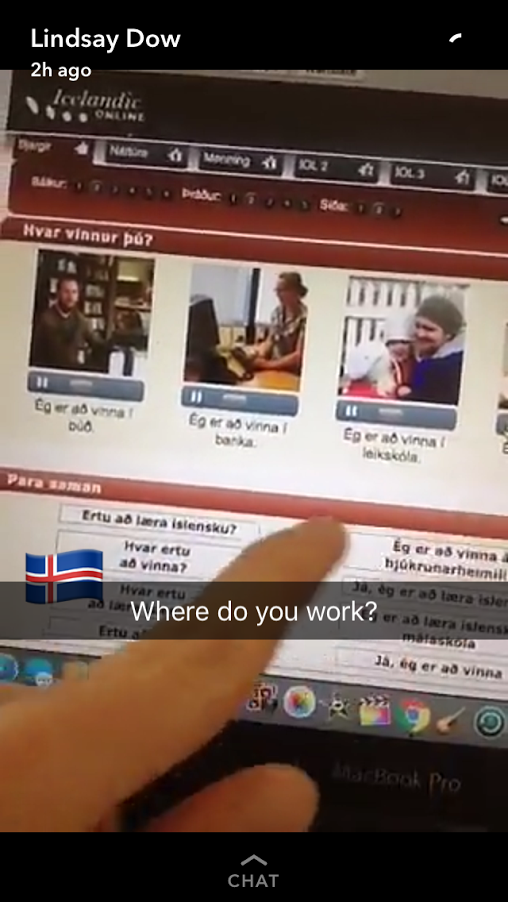
Lindsay studies every morning and documents her mistakes on Snapchat, while I am more spontaneous and use the system to show and share how languages pop up in my day.
2. Check and Correct Errors
One other idea is to practice what you want to practice, then check back and correct the errors that you made. We go into detail about how important it is not just to make the mistakes, but to correct the mistakes so that you can get better.
3. Make Yourself a Vocab Resource
As you go through your day, why not take pictures of all you see around you and build yourself a little daily vocab resource? You can save the story in Memories at the end of the day, or do an evening review to add the words to your vocabulary bank.
Great Accounts to Follow (Click for the Snapcodes)
- fluentlanguage
- ldlanguages
- irishpolyglot
- flashsticks - recommended!
- bradchase

Links and Further Reading - Become a Snapchat Expert
- How I Use Snapchat For Language Learning on Lindsay's blog
- North American Polyglot Symposium, where Lindsay is giving a talk this weekend
- Ghostcodes app
- Die Sendung mit der Maus, German kids' TV show with bilingual credits
Are You a Snapchat User?
If you use Snapchat for language learning (or not), leave us a comment and share your usernames and snapcodes.
Thank you guys so much for being podcast listeners, chatting to us on twitter (I'm @kerstinhammes and Lindsay is @ldlanguages) and making your voices heard!




Struggling with listening? Discover realistic tips, challenge prompts, and the best tools for improving your listening skills as a self-guided language learner