

How Much Will You Pay for a Helpful Language Tutor?
A language tutor can teach you the ins and outs of your target language, and help you achieve your learning goals faster and easier. But the pricing confuses many students. Some tutors cost $50+ per hour, others are available for less money? What’s the difference? Read on to learn more about different backgrounds, levels, and prices.
A language tutor can teach you the ins and outs of your target language, and help you achieve your learning goals faster and easier. But how much should you pay for a language tutor? There are different online teaching platforms where you can choose from a wide range of tutors with different backgrounds, levels, and prices.
For example, on italki*, one of the most popular online language learning platforms, you can find tutors who charge as low as $5 per hour or as high as $50 per hour. You can even find great language exchanges for free!.
So what’s the difference? Read this article to discover which options will be right for you.
Do I need a language tutor?
Experienced language learners agree on one thing: Learning a language with a tutor is a true game changer.

Need Support On Your Language Learning Journey?
Don’t miss out on the Fluent Language newsletter! Sign up today and get weekly language learning advice from me.
It’s impossible to progress as much if you don’t start speaking your language at some point. And for an early stage learner, picking a tutor means working with someone who can help you bridge the gaps with ease.
Language tutor or language exchange?
I would recommend all learners to try at least one tutor, and to be clear about what you’d like from your lessons. A great tutor will ask you about your goals and tailor their service to you.
I wouldn’t recommend tackling a language exchange before you have learnt at least the essential structures and phrases of your target language (use this checklist to help you work out what to study).
Starting an exchange too early might leave you feeling frustrated, and there is a risk that you and your partner rely on the stronger language exclusively.
You do not get top quality at bottom prices
For the purpose of this article, I want to assume that you have made up your mind and you are looking for a tutor.
Now here is the part I want to talk to you about. I disagree with many other articles are telling you. Let's talk about price. Most other articles include a sentence that goes a little like this:
"Language lessons online are very cheap, you can get them for just $5 an hour."
US$5 an hour? That’s less than you pay for a drink at Starbucks. Now I know that wages and currencies vary around the world and I’m not stupid, so please don’t come commenting with the “$5 is lots of money in xyz!” argument. Your online teacher's costs are not just measured in time-per-hour. They also have a family to support, an internet connection and webcam to buy, personal development to cover. These are all part of the job, and that’s the case even if they live in the cheapest country in the world.
Self-employed language teachers will price themselves as low as they can because they really love working with you. But when they are taking on 50 students a week because the price per lesson is very low, they become mediocre teachers. If you are able to approach the exchange with a mindset that considers both payment and benefits, you will not be ripped off.
Read on to find out how to find exactly the right partner for your needs and your budget.
How To Find A Price That Works For You
In order to help you select the right language learning partnership, it is helpful to approach sites like italki* with a clear image of what you are truly looking for.
It's a good idea look beyond italki, because many of the greatest and most experienced teachers I know have their own blogs and websites. You can also try other platforms such as LanguaTalk.*
Option Number 1: The Freebie
Look for a language exchange partner and simply swap time helping them practice your native language for time practicing your target language.
Pros:
- You don’t even have to look online because many foreign students or residents in your town might be looking for language exchanges too.
- Sharing the language learning experience is very motivating and you’ll see the partner’s success just as much as yours.
Cons:
- There is a learning curve and this exchange may be frustrating at first. You have to be comfortable setting boundaries and working with rules, otherwise you become someone else’s free teacher.
- Your partner will speak the language but may not be able to explain it
- You give as much as you get, so prepare to work hard
Got a partner whose language you want to learn? Get our tips about learning a language from your partner.
And if you’re the one who wants to help your partner learn your language, here’s what I’ve learnt from having an English speaker partner (spoiler: I didn’t become his tutor!).
Option Number 2: The Super Bargain
Look for lessons under $10/hour and take advantage of the low living costs in other countries. Bear in mind these types of prices are below minimum wage in most countries, and probably this includes yours.
Pros:
- Maybe you will find a great tutor for peanuts
Cons:
- This is a trial and error technique, it often takes longer to find someone you click with, whose expectations match yours, and who is familiar with students from your cultural background
- The cheaper language teachers tend to be those supporting themselves temporarily, so you don’t get ongoing support as most cheap teachers decide to move on to another job within a few months
- This isn’t really a con from my perspective, but hopefully the tutor will soon raise their rates!
My personal verdict on this option? It’s better than nothing, but the worst of both worlds.
Option Number 3: The Professional
Hire an experienced language tutor for a minimum of $20/hour. Look for someone who is showing their expertise and commitment by having their own website, blogging about their work and knowledge and giving you a clear idea of what lessons will be like.
I’m biased, and here are my Pros:
- You’ll get a free consultation from most experienced language teachers and they will clearly tell you which goals you are working towards, and keep you committed
- The lessons tend to be tailored, long-term and built for you
- You’re doing a great thing because this is the way to support an experienced professional
- Professional teachers strive towards working full-time for you, so they can offer a flexible schedule and will fit the lesson times around you
For more details on how you can find that tutor that's worth your time, here is a list of questions you should ask them.
Cons? Well, we'd all love to get more free things in life.
A Tip for Ethical Teachers
For language teachers who are reading this article and excited about stepping up their business, here’s some important advice:
- Be serious and trustworthy: I would not charge a student until I know for sure that I connect with them. I don't take on each one, only students that understand my style. I don't want people to spend money on me unless I feel like I really understand what they need.
- Commit to your business: If you don’t want to be seen as some kind of fly-by-night operation, you have to show your worth to your potential student. Be worth their investment, be around and be reliable. You can’t do this without a brand and website, but it’s not as difficult as you may think.
For more information, have a look at the “Teach Languages” section here on Fluent, and in particular you should investigate the Live Lessons Course. This step-by-step course is written for language teachers who are excited to start standing out as one of the best out there.

Frequently Asked Questions
How Many Sessions With My Tutor Should I Have per Month?
There is no right or wrong answer to this question. The more sessions you have with your tutor, the more you can benefit from your tutor’s expertise and feedback.
Deciding on the number of tutoring sessions will depend on your personal situation and preferences. Here are some questions to help with your decision:
• What is your language learning goal?
• How many hours do you dedicate to learning your target language?
• How frequently do you have difficulties and need your language tutor's help?
For more detailed questions. Check my blog post 9 questions to ask your language tutor. And if you want deeper guidance to help you answer the questions above and find the right language strategy for yourself, I recommend checking out the Language Habit System or talking to a language learning coach.
Should I Hire A Native Speaker As My Language Tutor?
You don't actually need a native speaker to practice with. This is so important to understand. You just need someone who's good enough or a little better than you. Sometimes it even helps not to have the native speaker, because a non-native speaker has learnt your target language too and can explain grammar and other problems more easily.
You can check my blog post where I dive into why having a native speaker as your tutor might not be necessary.
Are Tutor Lessons A Good Way To Learn A Language?
Yes, they should be part of your system along with helpful resources and input, self-motivation is important so you don't become too reliant on one thing, learn how to build your routine here.

4 Techniques for Switching Your Brain into Language Mode
Have you ever heard of a phenomenon called "Priming"? Priming is what psychologists call it when your brain adapts to the environment around it without you realising. For example, you might automatically walk slower in a nursing home than you do in a gym. The brain helps your body to adjust, and this also affects your memory and even your confidence and the whole way you interpret situations.
How Priming Helps You Turn on Your Brain
Priming is largely unconscious, but now that you’re aware of it you can also use it to your advantage when learning languages. The idea is to switch your brain into “language mode” and use cues from your environment to help you get into the right zone.
Want to learn more about how to be a productive language learner?

©morethanmaths on Flickr
How Subtle Prompts Help You Stay in The “Language Learning Zone”
When I was a German tutor, I’d teach many people in their lunch hour. They would stay in the office at their English-speaking workplace, close the door and open up Skype to start chatting German with me.
In those situations, I’d commonly noticed that it took them a lot of time to warm up, relax, and start chatting away. Having thought about the learning environment and what it means for your performance, I came to the conclusion that these students need to make a brain switch from work mode to learning mode.
In this article on Wired, the author describes how a mere glance at the native speaker will prompt them to blurt out native words.
The different role you need to play as a language learner.
And there’s more at play than just the language you’re speaking.
Many people who work in management or office-based roles are in an environment that looks a bit like school, but demands a completely different behaviour. “Professionals” don't just go out and try things. They are expected to control their creativity and maintain a professional image at all times.
When you think about the good mindset for language learners, it's a contrast: You'll do well if you can combine curiosity, discipline and a complete disregard for embarrassment!
How to Start Switching Your Brain Into a Different Mode
Switching up a part of your environment can help you become a better learner, with simple prompts that take seconds to implement.
Try out some ideas that learners and teachers can use to make priming work in the right way:
1. Listen to Target Language Songs and Watch Movies
I will not promise you that watching an awful lot of films in a foreign language will magically beam fluency into your mind.
The real benefit of surrounding yourself with the target language is that you stay engaged with it and develop knowledge of the country. In terms of the priming benefit, it will work magic. Plus, you get to do it while putting your feet up or driving.
2. Find a Suitable Slot in Your Schedule
Schedule your learning sessions for the right times. For example, I like doing my chatting in Spanish on the drive back from Zumba - partly because the Spanish lady is captive in my car, partly because we've just spent an hour having fun and dancing around. Others also swear by having a nice glass of wine to relax or using breathing exercises.
Another great tip is to create a learning corner in your home - somewhere quiet, free from distractions and full of positive associations.

3. Visualise Your Life as a Successful Language Learner
School classroom teachers have known for a long time that putting up posters and displays around the classroom can get pupils in the right state of mind for learning. They don't have to be written in the foreign language, but just reminders of what's great about the country you're learning about.
Take a tip from this and create your own language learning displays full of things that interest you about your language. They could be recipes, tickets from old trips, tourist brochures or printouts from the internet. I particularly love vintage posters.
You can find more inspiration on my Pinterest boards for German, French and Russian.
4. Warm Up in Your Target Language
In my teaching role, I try to start my lessons off easily with some smaller warm-up activities like asking students how they are or offering them a drink.
Recently, I received the great tip that using the same warm-up activity every time for regular students is actually helpful - here I was worrying people would get bored, but the learner's perspective was that knowing "what's coming" allowed them to prepare and feel confident at the start of the lesson. That puts every learner in the right state of mind for success.
A Festive Take on Using Your Environment as a Study Aid
Click here for my article on learning a language at Christmas (even if you don’t celebrate it)
First published July 2013. Last updated December 2021.
How to Learn a Language Using Snapchat (Podcast Episode 45)
Everyone's talking about social media, some people are talking about social media for language learning. In today's podcast episode, get the most specific advice possible as Lindsay and I guide you through the Snapchat app for language learning.
Listen to the episode:
Don't forget to catch the mention of our good friends at Flashsticks, the language learning post-it guys. You can purchase vocabulary post-it notes in 8 languages and get 10% off with the code KERSTIN10.
What is Snapchat?
Snapchat is a social media app for any smartphone. It lets you share photos or videos, and your snap only lasts 24 hours unless you make it a "memory".
Of course you can change the menu language, but with such strong visual focus that alone won't teach you a language.
It's designed for camera phones and not available on your desktop computer.
Why is it awesome?
- It's easy, fast and low-pressure. In other photo social networks, you would be tempted to make every picture stunning and impressive and beautiful. But in Snapchat, you'll just play and learn in the process. What does that mean? No more shyness, no more reasons to avoid speaking!
- It allows you to stitch things together into a story, so you can share a 5-second snap, or go ahead and combine several videos to show how you speak a foreign language.
- For language learning, the new Memories feature is a way to track your progress. Record yourself speaking today, save the memory, and try the same thing in a month. You'll be surprised at your own progress!
How to Get The Most Out of This For Languages
You may have to set up a little system in order to get the most out of this, for example an evening review or a regular vocab routine.
1. Document
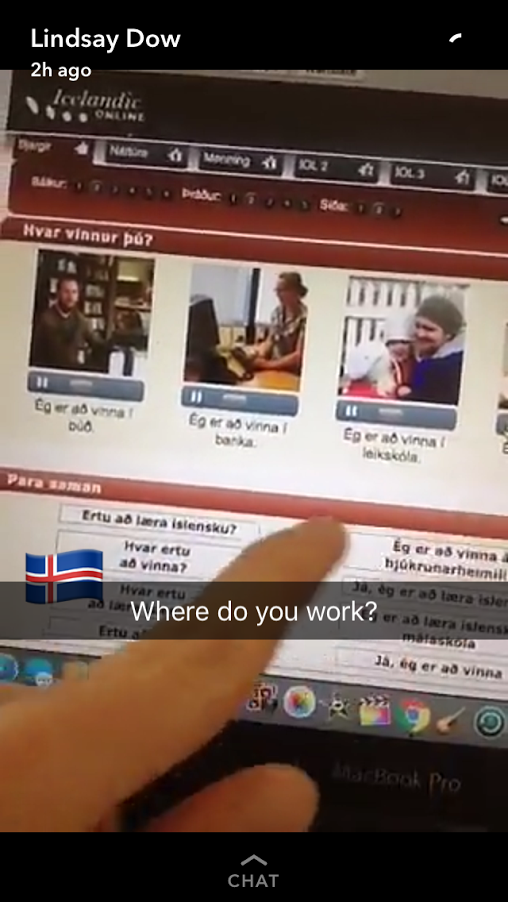
Lindsay studies every morning and documents her mistakes on Snapchat, while I am more spontaneous and use the system to show and share how languages pop up in my day.
2. Check and Correct Errors
One other idea is to practice what you want to practice, then check back and correct the errors that you made. We go into detail about how important it is not just to make the mistakes, but to correct the mistakes so that you can get better.
3. Make Yourself a Vocab Resource
As you go through your day, why not take pictures of all you see around you and build yourself a little daily vocab resource? You can save the story in Memories at the end of the day, or do an evening review to add the words to your vocabulary bank.
Great Accounts to Follow (Click for the Snapcodes)
- fluentlanguage
- ldlanguages
- irishpolyglot
- flashsticks - recommended!
- bradchase

Links and Further Reading - Become a Snapchat Expert
- How I Use Snapchat For Language Learning on Lindsay's blog
- North American Polyglot Symposium, where Lindsay is giving a talk this weekend
- Ghostcodes app
- Die Sendung mit der Maus, German kids' TV show with bilingual credits
Are You a Snapchat User?
If you use Snapchat for language learning (or not), leave us a comment and share your usernames and snapcodes.
Thank you guys so much for being podcast listeners, chatting to us on twitter (I'm @kerstinhammes and Lindsay is @ldlanguages) and making your voices heard!
Podcast Episode 29: How to Be Super Efficient with Languages with SmarterGerman's Michael Schmitz
Thanks to our podcast sponsor Hello Talk - check out their free app.
Note the episode contains two mild swearwords!!
Listen to the latest episode

Things get real with Michael Schmitz, creator of the SmarterGerman blog and teaching system. Michael is dedicated to bringing German learners to a high level in just a few months. And he has some frank opinions about what it takes to get there.
If you want to learn about efficient German learning, this is your show. Listen to discover:
- Why teaching at Berlitz made Michael want to start his own thing
- Why having fun is way overrated in language learning
- What efficiency is all about
- How to become an efficient and productive learner
- Why a polyglot and a language teacher is not the same thing
- Why you should never need external motivation to learn German
"Either you have money or you have time. I can save you many, many hours of your life."
"Language learners need someone to kick their ass sometimes."
Links From This Show
- Michael's website SmarterGerman
- Binaural Songs: How to use damit in German
- Speak German like a Native, my Pronunciation (and Spelling) Course
- Irregular Verbs Wizard App
Tips of the Week
Michael chose tip 1, and added that productivity and efficiency allows for the opportunity to become a creative thinker. Listen to his advice - excellent stuff!
1) Become a More Productive Learner with 12 tips from 5 Minute Language
2) Plan your Imaginary Trip
3) Sing Grammar Songs
This episode is sponsored by Hello Talk, the most focused language exchange app out there.
How to Learn a Language with Thousands of Helpers on Tumblr
Today's post comes from a language learner I've known for about a year. Maria is based in Newcastle and first talked to me during the 50 Calls Project. I love her enthusiasm and her awesome perspectives on language learning. Recently she contacted me to offer a guest post on language learning on Tumblr - I'm not a Tumblr user myself so I jumped at the chance.
Enjoy Maria's post!

Never heard of Tumblr?
The magical world of Tumblr might be new to you. In this case, here's a definition I saw on Yahoo Answers, where they describe Tumblr like this:
A place to "effortlessly share anything. Post text, photos, quotes, links, music, and videos from your browser, phone, desktop, email, or wherever you happen to be. You can customize everything, from colors to your theme's HTML.
So in essence, Tumblr another social media platform. But what separates this one from other social networks is that once you have an account, you can create numerous blogs and join a multitude of intriguing communities, from Doctor Who to interior design.
It's also different because in general on the website, people don't tend to know each other. You don't add your friends or family, but create a family of the people who share your interests! The example I'm going to talk about is, of course, the language learning community on Tumblr!
Start with a Tag
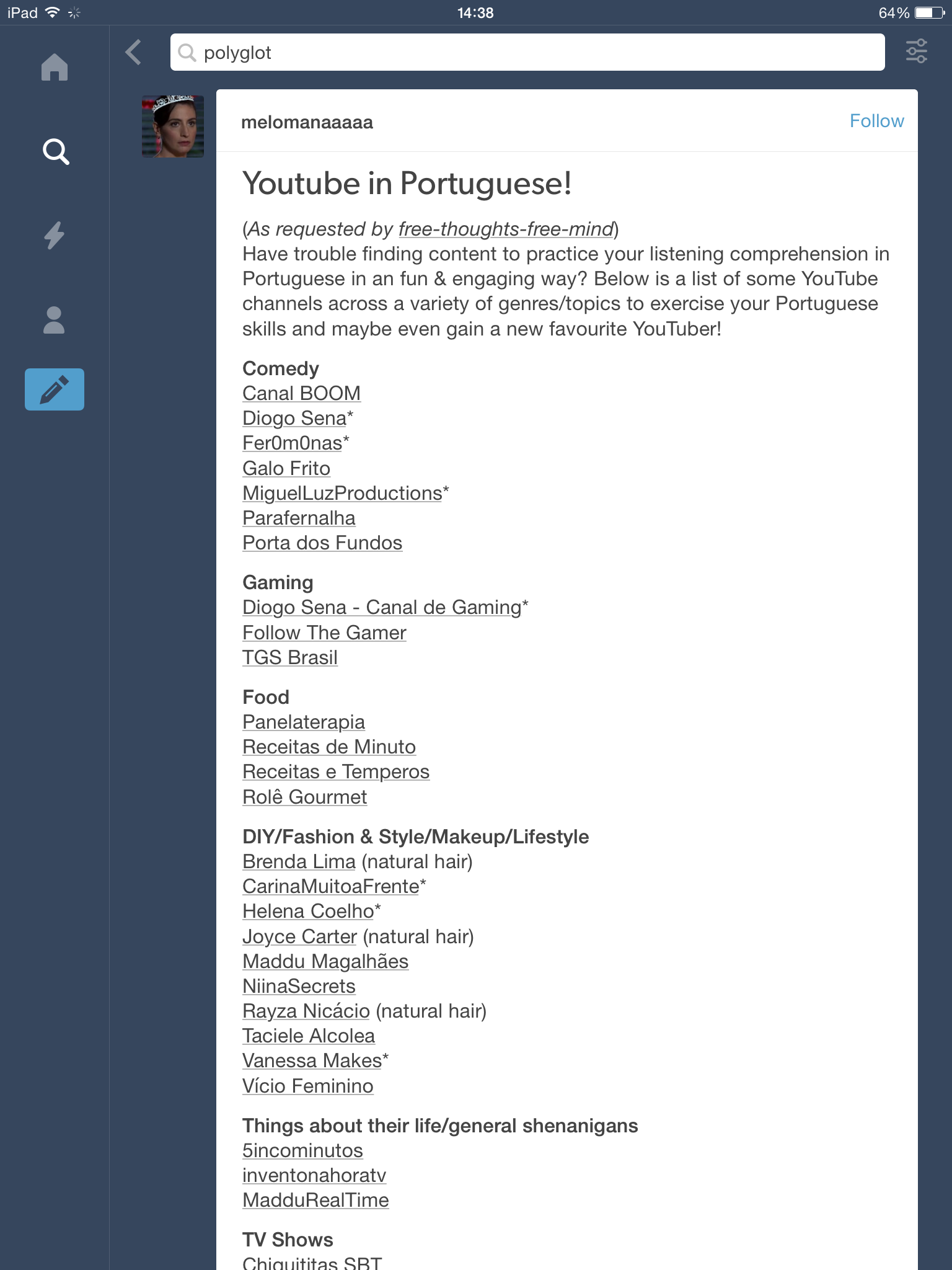
Sound confusing? It's really not. Anyone, any age, anywhere can join a community they like or search for whatever they like. My favourite tag is the 'polyglot' tag but I wouldn't dare call myself a polyglot at all! You don't even need to be fluent in another language. It's just a good bit of fun for people who are interested, while acting as a serious study aid - it certainly helped me get through my Spanish GCSE!
You don't even have to have an account to see the grand world of Tumblr. The website is easy to navigate and you learn more as you go on, building your page and gaining followers. Like Twitter, you can reblog (retweet) and like (favourite) different posts, adding your own comments too! You can directly 'ask' people questions and follow blogs. You can search for a tag to see all the posts under that tag, and that's where the community you want to join will be found!
For languages, you want to be looking at tags like #polyglot, #foreignlanguage, #langblr or of the language you want to see, for example #esperanto.
Tags Give You Everything
From playful jokes to help with confusing grammar from native speakers, the sky is the limit over on Tumblr. There are videos, text posts, photos, and links to other websites. You'll find a lot of relatable posts made by other people in the same position as you, which are bound make you laugh. I can't count the times I've read a post and in my head I'm thinking, 'Oh my gosh, this person is me!'.
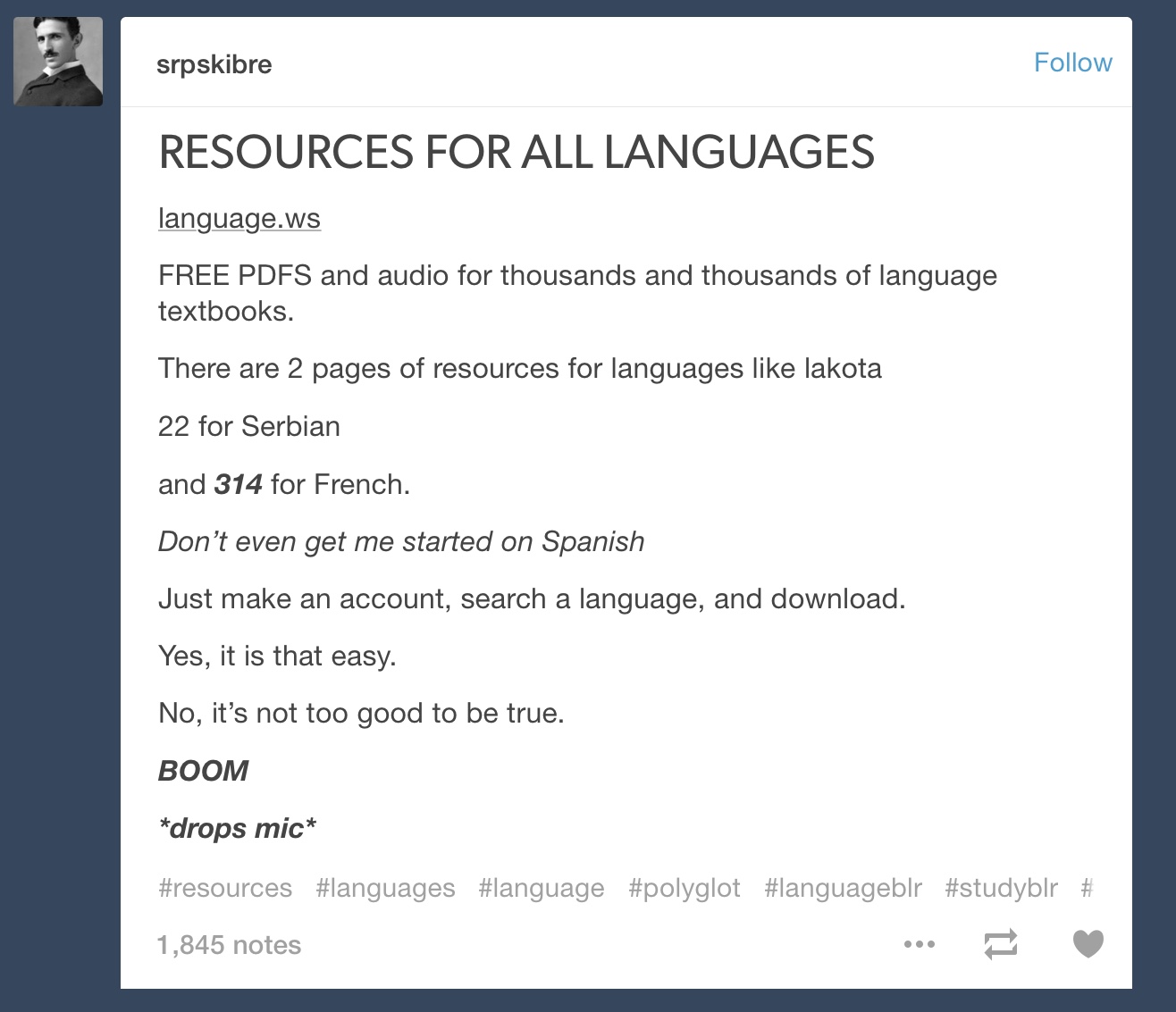
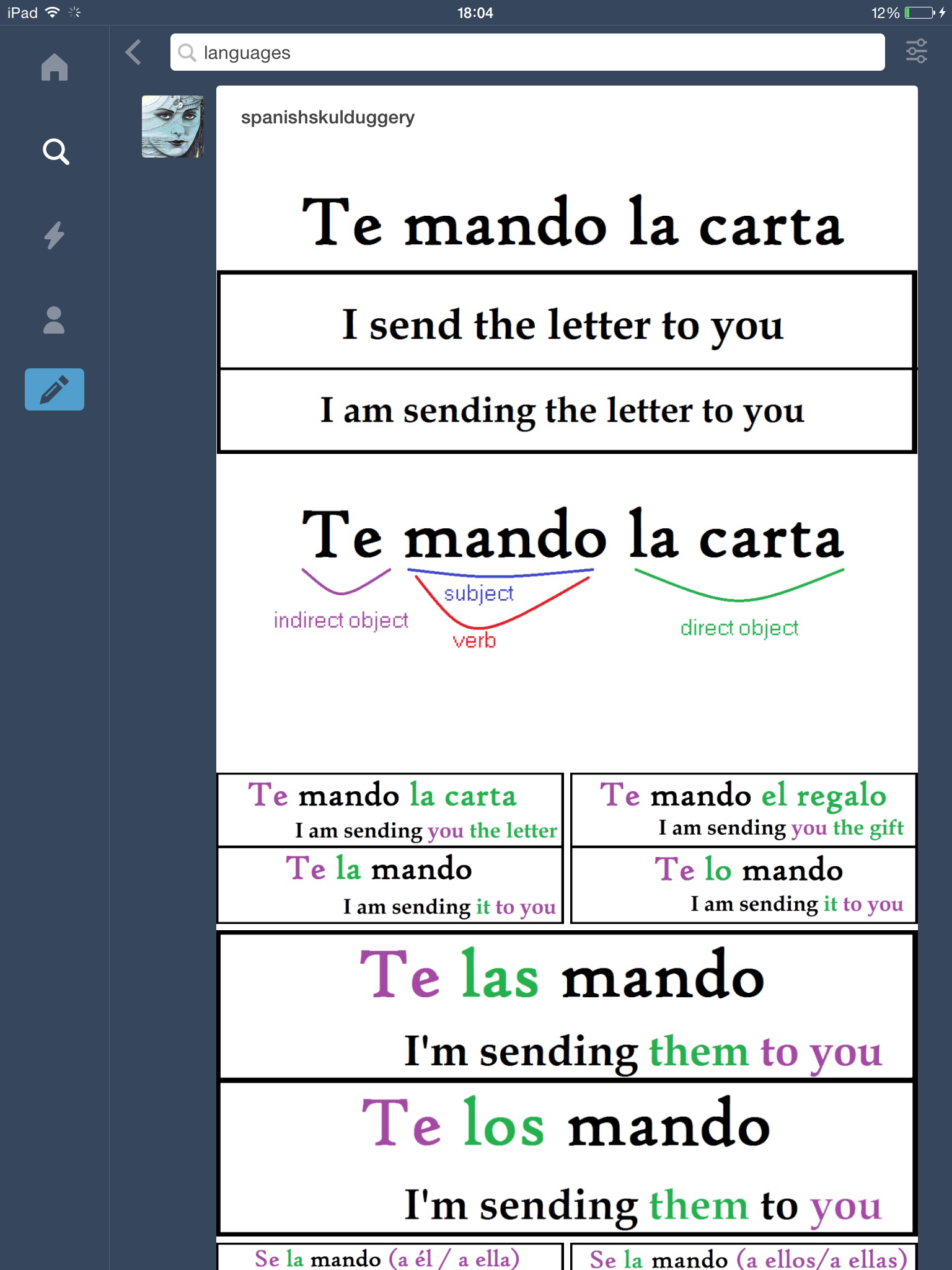
Here are a few good examples:

Supportive Community at the Touch of a Button
But Tumblr is not just for jokes. It can be a serious resource. Users post important grammar points, language tips and expert knowledge on any language.
On one occasion, I looked at a post that finally helped me grasp how to use the cases in Latin, and the next post along I picked up some Argentinian slang. You can directly message people and ask them about your own challenges too and they're more than happy to share their expertise. They might come asking you too.
The people in Tumblr's communities offer support if, for instance, you post about having a tricky patch in a language. Everyone is super friendly! And if you've hit a bit of a barrier recently with your learning, there is motivation left, right and centre on Tumblr. All it takes is a quick scroll down a tag and you see something new and it sparks off the relationship between you and your language again! You can find weekly challenges and search for a language exchange partner, creating global friendships while learning and teaching a language.
But what if I'm learning a really obscure language?
If there's a language, there's a tag. Someone somewhere is learning that language and is posting about it on Tumblr! You might find tips about your target language or resources you've never seen before. They come in heaps, seriously. I've seen list after list of free websites to help you learn French, or specific YouTube accounts for Portuguese. These people have spent their time searching so you don't have to! And it's all at the click of a button!
You can post in foreign languages yourself and ask for corrections, or communicate with people in the community in their language. The ways to stimulate learning are endless, and a lot of the time you're doing it subconsciously as you scroll down the page. There are thousands of people in the community from all corners of the world, and to think so few people know about this language learning gold mine!
If you want to have a peek at the magical language learning world on Tumblr, start with the #langblr tag and enjoy your journey down the rabbit hole..
Okay, as I was editing this post I got pumped up. Maria, I'm on Tumblr too now! Joining the masses! Getting into the community! Are you on Tumblr too? Leave your opinion in the comments and share your favourite Blogs and Tags with us!



Struggling with listening? Discover realistic tips, challenge prompts, and the best tools for improving your listening skills as a self-guided language learner