
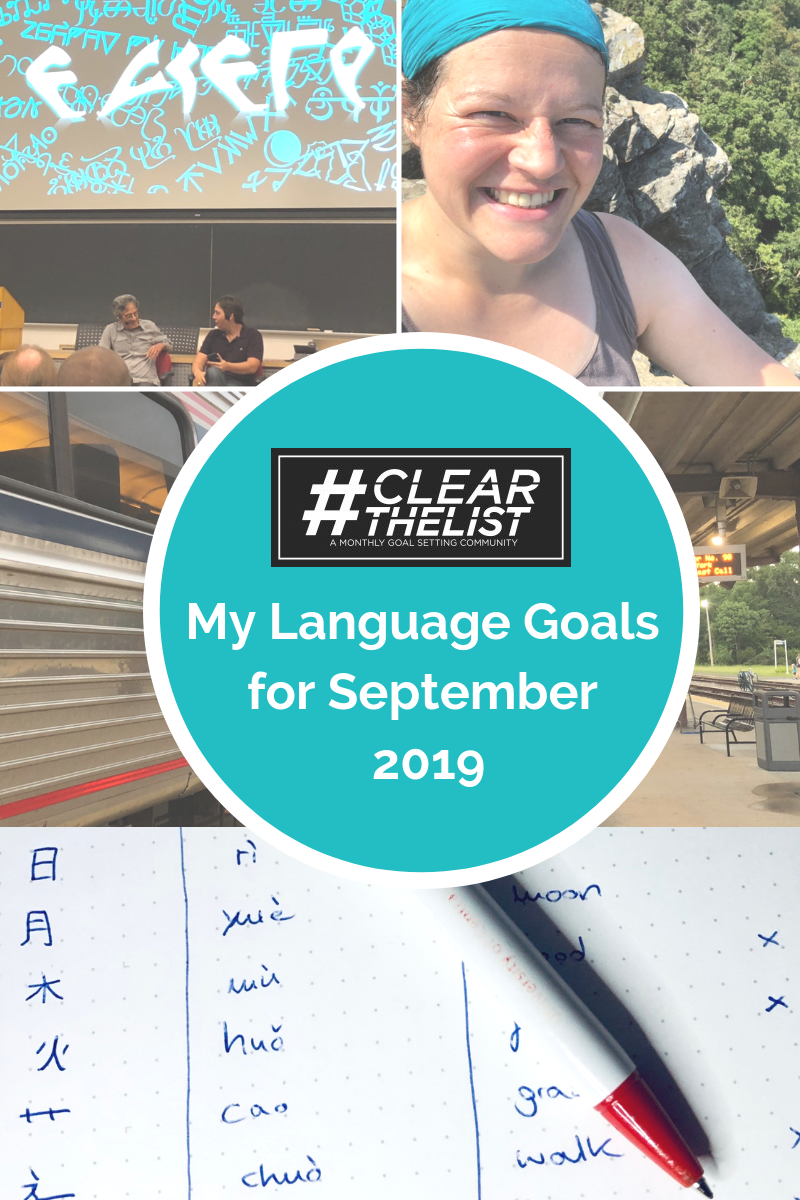
#clearthelist September 2019: The Eleven Languages I Spoke in One Month
Welcome to my language progress and goals update for the new month. My focus languages are Mandarin Chinese and Welsh.
You’ll read about the 11 languages I spoke in August 2019 and catch up with top episodes of the Fluent Show podcast.

Imagine you’re on a long-distance cycling trip, perhaps through all of a country or state. You know the destination and you’re pedalling every day, always pushing ahead even if you know you may not arrive for many days. On a journey like that, what would you be without a necessary stop to find yourself on the map now and then? Can you do it without GPS? I don’t think I could!
Learning a language is a lot like navigating a long trip like that. We often know our destination before we get going and we set off in the right direction. But without regular check-ins, we may pedal and pedal until we fall over.
Here on the blog, I write a monthly check-in like that to keep you up to date with my own language learning goals. It’s part of the #clearthelist round-up hosted by Shannon Kennedy and Lindsay Williams.
Want to try out this check-in process for yourself?

Why not check out my Language Habit Toolkit, an in-depth course designed to help you set useful language goals, track them easily and achieve a new milestone every month.
What Happened in August?
Last month was dominated by my biggest trip of the year, visiting the USA and Canada to participate in two conferences. First, I attended Podcast Movement in Orlando to learn more about how to make great podcasts and support myself well while doing it.

And while I was across the pond, how could I have missed Langfest in Montréal, Canada? Impossible!
The trip in between these two cities was a lot of fun: I took Amtrak to Charleston in South Carolina, having long wanted to try the American train. My impression was…that Europeans love the train even in America, haha!
The Langfest team another excellent language event this year, with so many highlights including meeting the creators of Klingon and Dothraki, and running my own creative writing workshop with María Ortega Garcia.
The Fluent Show
First of all let me say how amazing it was for me to meet so many listeners on the road in August. I’m over the moon to know that the Fluent Show is popular!
This month contained a whole range of amazing episodes so let me share two with you today:
- Langfest 2019 captured in audio, with almost a dozen interviews and voices directly from the show
- What is the Right Mixture for Language Learning Success?, an episode about why so many methods feel like they’re THE best method
If you’re not a Fluent Show listener already, you’ll find lots more exciting shows to listen or subscribe to at www.fluent.show.
Language Goals and Progress
I had pretty clear goals for August 2019, so this time I’ll run through them without breaking it down too much into listening, speaking, reading and writing.
Mandarin Chinese
- Listen to Mandopop
I neglected this, spending more time on podcasts.
- Get 100 Lingqs on the LingQ app
Overall I now have lots of LingQs, the challenge is becoming more about noting and remembering them all! Still enjoying this app and using it in the mornings.
- Post 2-3 speaking videos on Instagram
I only posted one, then travel threw me off the wagon. I did learn some more Chinese from a new friend at Langfest though, so I feel positive about my speaking.
- Find a new Chinese tutor
So here’s what happened: I wanted a new tutor but felt guilty about ghosting the current one. Then as if by magic, she decided she’s taking a break and sent a messaging saying she won’t be available until December. So yay, I was free for a new tutor.
But then I didn’t book one. Hah! I count this as a goal half achieved 😅
- Figure out how to type Chinese characters on the iPhone
Done!
- Practice characters by hand every week
In the weeks I was at home, this was done.
Welsh
- Book a class to practice speaking
Sadly no, but I still got my speaking practice on one occasion this month in conversation with a Langfest buddy.
- Read the book Ffenestri
This book is LOVELY and I’m nearly finished. I’m reading well at all 3 levels, as I should :)
- Plan my next trip to Wales
Sadly this fell through as I prioritised visiting my family in Germany first. Chwarae teg, wouldn’t you say?
- More stuff!
I can now watch Welsh TV without subtitles! 🎉
Other Languages
It’s impossible to travel without practicing other languages, so August also became an opportunity for me to speak my long-neglected languages.

Counting in Klingon
In bilingual Montréal, I spoke lots of French with people from all over. Québécois French is never 100% comprehensible to me, but as always when I speak French I felt reassured that I’m entirely capable.
I bungled my way through a taxi ride with a lovely Colombian in Spanish, though I never did end up where I originally wanted to be. But I blame Lyft and GPS for that instead of my language skills, haha.
And talking of bungling, I also spoke more Italian than I have done in 20 years. The Italian sounded like that, too. It’s R.U.S.T.Y. and has essentially turned into bad Spanish.
I also attended basic workshops on the fictional languages Klingon and Dothraki, as well as Breton and Signed Languages.
Language Goals for September 2019
It’s handy to start setting goals by remembering the time frame available. In other words, the question is “What do you want to achieve in the next 30 days?” - seems a little less intense than wondering how to achieve a lot.
This month I’ve been inspired by intense learning projects and the book Ultralearning by Scott Young (interview coming up on the podcast). What can I commit to that would stretch me, challenge me?
Listening Goals
In Chinese, I’ll look for a tutor and ask them to help me listen, perhaps through some dictation rather than the pressure of conversing instantly.
In Welsh, I’m getting so much better so I’ll keep up what I’m doing.
Reading Goals
I don’t have firm goals here and want to focus on other skills, so I’ll just commit to the tools and say I want to finish Ffenestri in Welsh and use LingQ 4 days a week in Chinese.
Speaking Goals
Here I would like to take it up a notch!
In Chinese I am still fairly shy about speaking - I wish I had a few sample conversations to practice with. Comment if you can recommend any? Meanwhile it’s a good idea to push ahead and find that new tutor!
In Welsh I so want to practice speaking and everything, so I’m going to book myself 3 sessions to speak bad Welsh at people. Yay!
Writing Goals
I’ll go easy on the writing beyond what I usually do, which is to text people. In Chinese I’m also making vocab lists by hand now and writing down set phrases in characters and pinyin.
Here’s an instagram slideshow showing my vocab system in more detail:
\
And that’s it for September’s #clearthelist!
How are You Getting On in Language Learning?
Comment below and tell me how your month of August went! Did you come to Langfest? Would you like to attend it some time? Have you got any strong speaking goals?
Looking forward to hearing from you!

In Language Learning, Are Apps All Amazing? Are All Apps Amazing?
In this episode, we caught up, talked about a new directive on language use in a very special setting: Childbirth!
We also discussed language learning apps and how to make the most out of them, so if you're enjoying Duolingo but you're STILL not fluent, this is the episode for you.
Welcome to Fluent Show episode 79, where co-host Lindsay joins me to catch up, talk about language, and discuss the hot topic of language learning apps.
If you've ever downloaded and used a language learning app, and then wondered "Am I doing this well? Could I learn more from this?", then our discussion will help you swipe and tap your way to fluency.
The Language You Use When She's Giving Birth
The British Medical Journal recently published a blog article sharing guidelines on how to speak respectfully to women during childbirth. Is this "political correctness gone mad", or does it matter how we refer to people in these settings? Would you expect that less dramatic and violent language can help mothers stay calm in labour?
Also, as ever: The important theme of "use her name", and how we'd expected to be addressed in different language environments.
If I got to the stage where I'm having a baby, I would expect to be called signora..not the equivalent of 'girl'
Tune in to our discussion to find out, and leave a comment below to share your own views.
How To Make Good Use of Language Apps

In this episode, we talked about language learning apps and how to use them.
Practical Tips
- Use different apps on different devices if you have them, for example you could make your iPad your reading resource while you use the phone to text language exchange partners
- Take most of the promises that come from language learning apps with a grain of salt - using an app without effort does not mean learning a language without effort
- Customize your experience: Apps are not all you need to learn a language, but it can help you create a language learning environment that is unique to you. We find that when an app is not the only way you're learning a language, your experience and results gets be better.
- Don't ever feel ashamed or embarrassed about your app choices and what works for you!
The Essential Language Apps To Try On Your Device
Apps can be roughly sorted into a few categories, and it's worth trying a few to find your personal preference
- A good dictionary app like WordReference, LEO, or even Google Translate
- A flashcard system like Memrise, Anki, or Smartcards+
- A language course app (often gamified) like Speechling or Duolingo 4. Our sponsors Clozemaster of course!
- A non-language related app that can help you stay productive like 30/30, Timeglass, Pomodoro, or Streaks
Which language learning apps do you use regularly? Can you manage without them?
Leave us a comment below or tweet @thefluentshow.
EPISODE SPONSORS
EPISODE LINKS
- Code-switching - Wikipedia
- italki - where people can find online language tutors
- Humanising birth: Does the language we use matter? – The BMJ
- 12 Ideas For Making the Perfect Language Learning App by Fluent Language
- After Duolingo? : Esperanto
- The Welsh-Dictionary App: Language Technologies Unit, Canolfan Bedwyr
- The Fluent Show: Gabriel Wyner is NOT a Robot (with Fluent Forever author Gabriel Wyner) — Interview with Gabe Wyner, the creator of the Fluent Forever app
- Gboard - the Google Keyboard - Android Apps on Google Play
- STREAKS. The to-do list that helps you form good habits. For iPhone.
- 30/30 | You have never experienced a task manager like this!
- Gretchen Rubin: The Four Tendencies — Cool personality quiz that can tell you more about your habits. See also Fluent Show 32
- clear the list Archives - Eurolinguiste
- Language Learning Goals: Clear The List - March 2018 - Lindsay Does Languages
How To Get Off The Intermediate Plateau in Language Learning
Welcome to Fluent Show episode 76, where I tackle the question:
**"How Can I Get Off The Intermediate Plateau?"**
If you're stuck somewhere in the language weeds, this show will help you untangle them and get those wheels turning again.
Welcome to Fluent Show episode 76, where I tackle the question:
"How Can I Get Off The Intermediate Plateau?"
If you're stuck somewhere in the language weeds, this podcast episode will help you untangle them and get those wheels turning again.
Just like any big goal that leads us to a happier life, language learning for the long haul works best as a habit. It’s possible to reach miraculous short-term results, but if we’re looking for mastery and SUSTAINABLE mastery then there’s no point putting your 6 week boot camp crash challenge attack plan into place.

Note On Progress and Your Sense Of Progress
- You’re in this for the long haul. After reaching a level that shows you’ve been studying this language for a long time, your motivation is likely more than fast progress. It doesn’t help to count the time you have spent learning.
- It doesn’t help to assume that going to A2 from zero is the same as going to C2 from B1 — it really isn’t like that.
Rewards
The problem with the plateau is how frustrating it feels. You don’t feel the rewards anymore. So let’s talk about rewards and how you can bring back the feeling that your work is paying off.
Strategy 1: Get Fresher Rewards
6 months ago, you got a real kick out of being able to watch the news in your target language without subtitles. 3 months ago, you were still watching the news but it started feeling like a chore. Today, you still understand everything but you’re frustrated in a new arena. Rewards are most rewarding when they come after some really hard work towards a desire, and right now your frustration is rooted in your shortfall.
Ask yourself honestly where you are most frustrated right now. What is missing? What do you feel scared to attempt? Whatever it is, it’s likely not something you can do on your current plateau.
(Example of reading a book in Welsh)
Strategy 2: Intrinsic Rewards
This is about your identity, who you are as a language learner, and what you love the most.
Strategy 3: Extrinsic Rewards
These incluce
- Validation from friends
- Passing exams
- Career advancement
Strategy 4: Change the conversation
Reward yourself for effort, not result. No point in burning yourself out.
So now I’ve convinced you to keep going, there is one question remaining. How do you actually get better? How do you study the right topics?
Do Difficult Things
Yes, I mean working hard. Your learning curve is slowing because you are not doing the difficult things anymore, so this is a good problem to have.
Getting to the C levels without the four core skills, without grammar, is not possible.You will not automatically get to the highest language learning levels by just keeping going. Things do need to develop, and if there’s a corner of grammar or a core skill that you have been neglecting, now is when it catches up with you.
Put That Yardstick In Place
If you feel like you’re not making progress, it’s likely because you have lost something that helps you measure your progress. It's time to get the yardstick back. Yardstick options:
- Set consistent path goals and share them with people, then check in every week. Join a learning club or mastermind.
- Write down your goals and be accountable to yourself — keep them in front of you
- Sign up for a language exam and get yourself tested
- Use a guiding resource, something you can really measure
- Work with rewards and treats - there is nothing wrong with celebrating where you are right now. You’ve come a long way
Become REALLY Clear On Your Aims
People often remark on the high quality of my English, and this level of English is impossible to reach without an incredible amount of exposure. But this level is NOT C2 - it is in fact higher.
Find a person who will mentor you.
This doesn’t have to be a paid tutor, but could be a patient and dedicated friend or group of friends. They might not even know they're your mentor. This is why people often report success when they travel - they put themselves in a world where language mentors are easily accessible. But just because something is not quite as straightforward, doesn’t mean it’s impossible.
In Conclusion
It’s easy to give up at this stage…but just because it’s difficult, doesn’t mean we give up. Right? Right!
You never have to finish the language. You never will. It will just speak to your soul in new ways.
EPISODE SPONSORS
CODE: FLUENT
EPISODE LINKS
Mastery and Advanced Level Language Learning (Podcast Episode 46) by Fluent Language
3 Reasons why you're still an intermediate level language learner - The Polyglot Dream
Common European Framework of Reference for Languages - Wikipedia
How To Learn A New Language With Smart And Useful Goals by Fluent Language
Learning Languages at Intermediate Level: My Language Goals, Routine, and Progress in Detail
Feeling stuck on that plateau of "invisible progress"? Here's how to keep going! Here's a snapshot of how I make progress in my target language step-by-step, even after 18 months of study. You’ll learn about my goals for April 2017, and how I fit in learning 2 languages at the same time.
I use the Language Habit Toolkit, a study system I created for learners like me who are self-guided and want to track flexibly.
Unlike some learners who love to schedule a set routine, my study approach is a little more flexible. I have a variety of resources on the go and work with them all on a regular basis, but my routine currently doesn't contain large daily sessions or check-ins at a specific time.
In today’s article, I am going to show you how I make progress in my target language even without committing to daily routines. You’ll learn about my goals for April 2017, and how I fit in learning 2 languages at the same time.
I use the Language Habit Toolkit, a study system I created for learners like me who are self-guided and want to track flexibly.
Planning My Goals (But Not My Schedule)
I'm not the best with schedules and don't stick to them unless I must. This flexibility is a part of my habits personality, so it really shows up in almost anything I do. For example, I struggle take medicines at a set time each day and often forget the time once I am immersed in a task. Don’t get me wrong…I do schedule things a lot. I just don’t always keep my own appointments.
But even so, I don't want that to stop me from finding focus and progress in language learning. In the Toolkit, my focus is on the content of what I'm learning rather than how regular I am or how many sessions I complete each week.
If I know what I want to get done, I find that I automatically start finding the time to work on it. So rather than thinking "I will complete 4 hours of study this week", I focus on my goals and set myself many very small goals that I want to get done throughout the month.
The daily check-ins in the Language Habit Toolkit are very small. I have seen some learners create their own tracking systems like colour codes and legends, but personally I keep to noting "big session" or "small session. Since I started using the Language Habit Toolkit myself, I definitely have been better about checking in with languages every day and I've finally managed to organise myself enough to learn two languages: Welsh and French.
Example: My Welsh Learning Goals for April 2017
In my routine, I use the Language Habit Toolkit worksheet for setting path goals and getting a quick overview of what I want to achieve in the next month. Here’s what I wrote at the start of April:
“Right Now, I’m Working On…”
- Finishing Level 1 of Say Something in Welsh
- Regular language exchanges on Skype with Gareth from How to Get Fluent, which are increasing the length of time I feel comfortable holding a Welsh conversation
- Getting better at using pronouns and speaking/writing in the past tense
In 30 Days, I want to…
- Be done with Say Something in Welsh Level 1 (I actually wrote challenge 26 - turns out there are only 25! Bonus!)
- Be able to watch 5-10 minutes of TV in Welsh without subtitles
- Grow my vocabulary
- Understand how the one word past tense works
My theme for the month was to become more comfortable listening to Welsh even when I don’t understand everything. These were my larger goals, which I broke down into the four core skills.
My Language Learning Goals and Progress in Listening, Speaking, Reading and Writing
Since we’re already through the month of April, I’ll tell you what the goals were and how it went:

Listening
- Listen to the Pigion podcast when it comes out (I’d been avoiding this one because it is still a little difficult for me, and as of April 30th I’ve listened to 3 out of 5)
- Watch 4 shows on S4C (I was procrastinating on this until my moment of joy…the show Ffasiwn Mecanic is back and I love it and today I’ll watch 3 and 4)
I even switched the subtitles off on Ffasiwn Mecanic and set a timer for 5 minutes, and I was able to understand 40% of what was said.
Reading
- Do a reading prep session from BBC Bitesize (this was a red herring - there aren’t any!)
- Review the hand-written vocabulary in my notebook and add more words (done! I did this in 2 sessions and added 20-30 new words for my vocabulary routine)
I actually read more outside of these goals, mostly Lingo Newydd magazine and news articles on the BBC Wales website, so for next month’s goals I can be more ambitious here.
Speaking
- Have 3 meetings with language exchange partners (not. a. single. one…we were both very busy, but next month we’re back to it)
- Record myself reading a poem (done)
Even though I didn’t meet any exchange partners, I started sending more voice messages in Tandem so I wasn’t entirely quiet.
Writing
- Put up a larger piece of writing on Reddit or Lang-8 (Reddit has writing prompts every week, and still I didn’t reply to them. Time to kick into gear.)
- Email my tutor and ask her to give me writing feedback (again, I neglected this over the month)
I did actually write in Welsh in April through text messages in Tandem, but I’ve been shy about sharing longer pieces. Another way to write more was to transcribe Say Something in Welsh’s levels, which really helps!
In terms of grammar, I did look up those confusing past tenses and found explanations that really helped in Wikibooks.
My Secondary Language: French
In French, my level is a passive B2/C1 and my main aim is to reactivate all those tired brain cells and speak French with less hesitation. I didn’t set myself any specific goals but scheduled in every Thursday as jour français. I read the French edition of Flow magazine, chatted to a new colleague in French, and followed Glossika Fluency 123 French. While I love the Glossika, I find its level a little low so I’m looking forward to more challenging Glossika content in the future.
It helps me to know that French is currently my “secondary” language, so I don’t scold myself for allocating less time to it. Perhaps in half a year, the languages I focus on are going to change as my Welsh skills become more solid, and I still have a lot of time for focusing on other languages in the future.
Overall, How am I Feeling After 18 Months of Welsh?
I’ve not really checked in in detail with my Welsh language skills for 6 months, but overall it’s feeling pretty great. I’m nearly starting Level 2 of Say Something in Welsh, and my conversation skills are improving a lot! Being at this more advanced level seems to mean that the structured resources are becoming more scarce.
Funnily, I worked so hard on creating the Language Habit Toolkit’s Review worksheet that I had not actually been able to use it myself yet! I’m really looking forward to working through all review questions and getting the next set of goals onto the road.
I’m looking forward to the next awesome events that are coming up, all of which are great chances to speak more in Welsh and French at the Polyglot Gathering in Bratislava, at Langfest in Montréal, and of course at the National Eisteddfod in Wales this year!
How Was Your Language Month?
What about you? What were your language goals in April? Are you tracking with the Language Habit Toolkit, or with your own systems? I’d love to hear from you in the comments.
Progress Report after 13 Months of "Slow Welsh Language Study"
Waw, mae'r amser yn rhedeg...time flies (or runs, as my dodgy translation implies).
I have been learning this new language for about 13 months now...so let's have a look what the middle ground looks like!
Before you read the post, download your copy of the free "Teach Yourself Toolkit" in the Fluent Cool Kids Club. It's got links to all the resources I use.
I Spoke Lots of Welsh in Wales!

Back in August, I fulfilled one of this year's language goals and spoke Welsh at the Eisteddfod, the National Festival of Wales. The festival was one week long, with a big site located in Abergavenny, South Wales.
I pitched up my tent for 4 days at one of the official campsites. What a total delight! Immediately, I was hearing people of all ages speak Welsh around me and everyone addressed me in Welsh. In fact, I was surprised, because turns out..
Welsh is real, mae'r Gymraeg yn go iawn!
It's not a postcard language, and it's not even a dying language. Not when you hear and see it all around you, witnessing thousands of people as they celebrate their art, music and identity. Even though I had been learning the language for a year, this was my first experience of feeling how truly alive Welsh is in this world.
In terms of culture and enjoyment, the Welsh festival was amazing. Wales is such a small country that you can make friends with everyone in just a week. From meeting the bands I love (Plu, Candelas) to hanging out with the creators and learners of Say Something in Welsh, every conversation evolved naturally. I often found myself invited to film screenings and discussions (lots of gwin am ddim - free wine!), quickly forgetting I was attending the festival on my own.
Language Immersion is Easy
The Eisteddfod visit showed me that it doesn't take much to create an environment where you learn this new language. Simply go where people speak it. Hearing the language spoken around me was a boost even before I opened my mouth. Yet I also worked on creating speaking opportunities from the start by volunteering as a steward so I was forced to get involved and talk to people from the minute I arrived. It was the perfect Welsh immersion environment.
Impressions from Eisteddfod week
I liked having English as a backup. It was very reassuring to know that I can stop or ask for a word when I need to... I would have never remembered the word for "self-employed" (hynan cyflogedig) if it hadn't been for so many reminders from my conversation partners.
The Fight For Welsh Language Rights
One of the groups I want to highlight is Cymdeithas yr Iaith, an advocacy group for Welsh language rights.
Cymdeithas is an activist group founded in 1962, promoting the right of Welsh citizens to live their lives in two languages. Without them, there would be no bilingual road signs. Old Welsh people may not understand official letters sent in English only. And there would be no education in Welsh. In other words, the language would be dying a lot faster.
Find out more about language rights in our podcast episode with Wikitongues.
If you want to join me at the next Eisteddfod, here's a helpful guide for English speakers.
Speaking and Understanding Welsh After 14 Months
The benefits of visiting Wales and speaking and hearing my target language took hold right away. I was myself having a 15 minute Welsh conversation with an old man in a tiny village, just one week after.
Since returning from Wales, it's been tough to maintain this immersion but I continued to practice. Back in October, I booked a tutoring session with Mererid and my range of conversation was HUGELY improved. It's really great to know that you're impressing your tutor!
I continue to work through the Say Something in Welsh lessons and switched from the old to the new course system back in September. Yes, so I started at the beginning again but that doesn't feel like a setback at all. I loved the opportunity to consolidate my language skills so far. In fact, I got through the first 8 lessons at 1.5 speed, and am now halfway through the course. Say Something in Welsh is intense at times, and it's making me feel like a very confident speaker. I'm also reading a lot of Welsh as I subscribed to the learner magazine Lingo Newydd.
Grammar and Vocab in Welsh
My system is to practice WLCR (Write, Look, Cover, Repeat) using my own notebook. I also maintain a personal Memrise course with the 30% of words that are the hardest to remember. So overall, my vocabulary in Welsh has now grown to about 500-700 solid words - maybe 1000? Who's counting! Studying vocabulary is never going to be a walk in the park when you don't have classes or conversations every day.
--> Learn more about WLCR techniques in my Vocab Cookbook
I'm very happy with my grammar progress, finding that I'm able to say and describe more patterns (he says mae o'n dweud...he said naeth o'n dweud...he was saying oedd o'n dweud ...and so on). Everything still seems to have lots of extra rules and dialects, but I've not had to study many tables at all.
Being an experienced language learner is a big advantage for me here. I find myself seeing patterns and recognising the rules a lot more quickly, and I am confident when I make new sentences out of these structures. I always loved how language can be so playful when you get a pattern.
My Welsh Language Level After 13 Months?
I'm not performing to a set standard, however I've recently downloaded the Mynediad (Beginners) exam guidelines. I'm planning to work through these materials with a tutor. I am pretty much there, meaning I've reached the end of level A1 by studying "little and often" for a little bit more than a year.
Is this impressive? No idea. I don't feel that I would be able to share this on YouTube as a major polyglot win, but at the same time this is something I know I've learnt for life.
The thing about studying for 13 months is this: My time is not wasted just because I've not learnt everything yet. It is time well spent, moving forward, step by step to conversation levels. When you think about how quickly you can learn a language, it's easy to consider any slow periods as "wasted time", but I believe that the long-term commitment is what counts when you want to progress and grow your mind.
What's Next?
In terms of listening, I wish that I had more opportunities to hear real people instead of TV or radio characters. I feel ready to graduate from TV subtitles, but the radio and TV are still too fast for me. What to do?
As a podcast junkie, I would love a slow Welsh news podcast like News in Slow French, or perhaps a learner's story show. I have heard that there's some useful stuff on YouTube, but it's not enough. Give me more Welsh!
My biggest goal is to speak and eavesdrop more. I want to be able to witness conversations in Welsh easily, so that means the following practical goals for December:
- Book another tutoring session
- Speak Welsh at Polyglot Pub on 6 December
- Spend an hour every week listening to the language, ideally spoken by real people around me (failing that, BBC Cymru and S4C will do)
I'm also planning a social media project based on my friend Lindsay's new Social Media Course. More about that in the next blog update!
How Are You Getting On In Your Language?
Are you learning lots, or struggling to find time? Let me know in the comments below!



Struggling with listening? Discover realistic tips, challenge prompts, and the best tools for improving your listening skills as a self-guided language learner