

4 Techniques for Switching Your Brain into Language Mode
Have you ever heard of a phenomenon called "Priming"? Priming is what psychologists call it when your brain adapts to the environment around it without you realising. For example, you might automatically walk slower in a nursing home than you do in a gym. The brain helps your body to adjust, and this also affects your memory and even your confidence and the whole way you interpret situations.
How Priming Helps You Turn on Your Brain
Priming is largely unconscious, but now that you’re aware of it you can also use it to your advantage when learning languages. The idea is to switch your brain into “language mode” and use cues from your environment to help you get into the right zone.
Want to learn more about how to be a productive language learner?

©morethanmaths on Flickr
How Subtle Prompts Help You Stay in The “Language Learning Zone”
When I was a German tutor, I’d teach many people in their lunch hour. They would stay in the office at their English-speaking workplace, close the door and open up Skype to start chatting German with me.
In those situations, I’d commonly noticed that it took them a lot of time to warm up, relax, and start chatting away. Having thought about the learning environment and what it means for your performance, I came to the conclusion that these students need to make a brain switch from work mode to learning mode.
In this article on Wired, the author describes how a mere glance at the native speaker will prompt them to blurt out native words.
The different role you need to play as a language learner.
And there’s more at play than just the language you’re speaking.
Many people who work in management or office-based roles are in an environment that looks a bit like school, but demands a completely different behaviour. “Professionals” don't just go out and try things. They are expected to control their creativity and maintain a professional image at all times.
When you think about the good mindset for language learners, it's a contrast: You'll do well if you can combine curiosity, discipline and a complete disregard for embarrassment!
How to Start Switching Your Brain Into a Different Mode
Switching up a part of your environment can help you become a better learner, with simple prompts that take seconds to implement.
Try out some ideas that learners and teachers can use to make priming work in the right way:
1. Listen to Target Language Songs and Watch Movies
I will not promise you that watching an awful lot of films in a foreign language will magically beam fluency into your mind.
The real benefit of surrounding yourself with the target language is that you stay engaged with it and develop knowledge of the country. In terms of the priming benefit, it will work magic. Plus, you get to do it while putting your feet up or driving.
2. Find a Suitable Slot in Your Schedule
Schedule your learning sessions for the right times. For example, I like doing my chatting in Spanish on the drive back from Zumba - partly because the Spanish lady is captive in my car, partly because we've just spent an hour having fun and dancing around. Others also swear by having a nice glass of wine to relax or using breathing exercises.
Another great tip is to create a learning corner in your home - somewhere quiet, free from distractions and full of positive associations.

3. Visualise Your Life as a Successful Language Learner
School classroom teachers have known for a long time that putting up posters and displays around the classroom can get pupils in the right state of mind for learning. They don't have to be written in the foreign language, but just reminders of what's great about the country you're learning about.
Take a tip from this and create your own language learning displays full of things that interest you about your language. They could be recipes, tickets from old trips, tourist brochures or printouts from the internet. I particularly love vintage posters.
You can find more inspiration on my Pinterest boards for German, French and Russian.
4. Warm Up in Your Target Language
In my teaching role, I try to start my lessons off easily with some smaller warm-up activities like asking students how they are or offering them a drink.
Recently, I received the great tip that using the same warm-up activity every time for regular students is actually helpful - here I was worrying people would get bored, but the learner's perspective was that knowing "what's coming" allowed them to prepare and feel confident at the start of the lesson. That puts every learner in the right state of mind for success.
A Festive Take on Using Your Environment as a Study Aid
Click here for my article on learning a language at Christmas (even if you don’t celebrate it)
First published July 2013. Last updated December 2021.
How Can I Inject Fun Into Language Learning? (Special Guest: Olly Richards)
Having fun is a key to success when it comes to most big endeavours. Surely language learning is one of those, too. But how can you best have fun when you’re learning a language? In this podcast episode, Olly Richards from I Will Teach You A Language joined me to discuss how you can love learning languages and have fun with it.

Learning a language is the challenge of your life.
It requires motivation, discipline, empathy, and some serious grey cells. It's an art because you learn to express yourself freely, beautifully, and you paint pictures with new words. It's also a science because you need to experiment with what works and what doesn't work.
But How Much Fun Can Language Learning Be?
In today's podcast episode, my guest is Olly Richards from I Will Teach You A Language. Olly says he used to learn languages for fun, going out with friends, and enjoying a great social life.
We had an incredible discussion - click play below to listen to it in full.
Now he's still learning them, but his motivations have shifted to intellectual gratification. He still gets fulfilment and a sense of achievement out of learning a language but in today's show he joined me to ask
"How Can I Inject FUN Into Language Learning ?"
Olly cites a few reasons in this youtube video, for example:
- He is busier than he used to be, mostly because he works a lot.
- He considers himself a social learner, but he doesn't have access the fun part of social interaction.
- He pursues the intellectual achievement, which means books and rules rather than pints and parties.
In January I sent out a tweet that caught Olly's eye and opened up the question about fun. Here it is:
Golden Rules of Daily Language Learning
Make contact with your target language on a daily basis
Find a convenient way of making that contact - the more convenient it is, the better
Prioritise fun and find something you enjoy in your target language
Olly saw that I talked about fun, and it was on his mind already...so we got together to have an in-depth discussion about having fun while learning languages.
The Discussion

Debate Team
Fun or No Fun, That Is The Question
Enjoying something does not mean that you are not learning anything. In fact, it is often a huge motivator for learning a new language - but both Olly and I agreed that fun and motivation are NOT the same thing. Fun and enjoyment also matter in language learning, because they add motivation. But can the fun ever be in the learning, or is it always part of the result?
Olly says:
"I care much more about speaking a language than the learning process. For me, the real fun is speaking the language."
Language Choices
We have to acknowledge that a language that's easier to learn can be more fun, because you can use all you learn just that little bit quicker. But does that mean your motivation to learn it will fade just because a language is "difficult"? Not necessarily! Deciding which language to learn is about much more than just thinking whether you'll enjoy it.
Conquering A Challenge
Adding to that, it's also fun to discover that you have achieved something you found difficult. But is that fun? I argued yes, but Olly wasn't sure - he thinks it's more about the results. We both found that conquering a challenge is a big motivation and so are the results. But the challenge itself may not always be the fun part. It can be the opposite of fun when something is way too difficult.
It Has To Be Interesting
The #1 fun killer? Boredom!
If you're all about the results and you work through those verb drills...but you're falling asleep over them...that's definitely not fun. It might still be productive though!
Olly thinks it's impossible to have 100% fun in language learning. There has to be a disciplined aspect, there has to be some routine...but if you were to focus on that exclusively, you'd lose sight of why you even started in the first place. This is especially important for those of us stuck somewhere in intermediate levels, when the honeymoon period is over and new words feel like "ugh, another one" instead of "wow, a new one".
7 Tips: How To Enjoy Language Learning More
So what can be done? How to plan for fun? Here are a few tips emerging from our conversation:
- If you have been feeling frustrated or under stress, take the pressure off and focus away from the results for a little bit. Try doing the opposite for a while and see what happens.
- Adjust your expectations of what "learning" looks like. and
- Be sillier, and try to use art, music, poetry to expand your mind and explore language. This isn't always easy to do, so consider reaching out to a coach or tutor to help you find a new way of looking at language.
- Embrace your own personality and work with who you are. If you enjoy play and your hobbies include juggling and clown skills, it's a safe bet that you may enjoy reading and telling jokes in another language. I also see this with analytical-minded engineers I work with, who love focusing on creating the most effective flashcards and routines based on data and hard facts.
- Curate your social life! Put the books down and spend lots of time with speakers of your target language, and make sure you end up in situations where your target language will actually be spoken.
- Change it up. It could be that you're bored because you've done the same thing too long. Olly finds that the ideal time to switch to a new activity is after a period of 3 weeks, and changing things more regularly is beneficial.
- Choose the easy language! This tip is a little tongue-in-cheek, but it boils down to the fact that you have to ensure you're making progress in order to keep enjoying what you're doing.
What About You?
Do you have fun when you're learning a language?
Do you think it's possible to have 100% fun in language learning?
Do you enjoy the language learning process? Or do you only really love speaking to people?
Join our discussion and share your answers in the comments below! I'm looking forward to reading how you treat "fun" in language learning!
Episode Links
Da Costa a Costa — Italian podcast recommended by Olly
The Fluent Show: Learning and Speaking 20+ Languages in New York City — Interview with "Language Learning Hedonist" Ellen Jovin
EPISODE SPONSOR
A Free Skype Class For Everyone! Claim It From Live Lingua Today
How To Get Germans to Speak German To You
One of the most common questions I hear from you guys is how to deal when other people refuse to practice your target language with you. I'm excited to present some awesome advice from Anja at The Germanz in Australia.
Matching this awesome topic, I've created the new guide Make Your German Sound Amazing, featuring 26 Key Phrases For Conversations with German Speakers. Pop your details into the form below to join my email list and get the guide immediately!

Germans and their love for English
When you get lost in Australia, the States or the UK and ask for directions, people will most likely answer in English. When you get lost in Germany, people will most likely answer in English too.
Studies suggest that (only) 62% of the German population is actually able to hold a conversation in English and most movies and TV shows are still dubbed into German. In fact, most German customers still prefer things the German way and speaking German is still a necessity no matter where you live in Germany (with the exception of Berlin).
So why is it that German learners complain that Germans respond to them in English?
What if I told you that you don’t just have to take it? No doubt, you can help Germans stay on track and chat away in German for ages.
I’m German myself and I’m going to tell you about a few easy things you can do.
Why Germans Switch To English
Germans switch to English for three reasons.
Sometimes they want to help you
Sometimes they want to help themselves
Sometimes they just prey on the vulnerable and make you the practice tool
But most of the time, they just don’t know any better.
1. They want to help you
Sometimes Germans simply think it’s being polite. They want to help you communicate more efficiently.
When you ask them, “How goes you? I not finds the station train”, they will most likely help you out in English without speaking a word of German. ‘Oh, that’s cool, they tried in German. They’ll probably understand better when I tell them where to go in English!’, the efficient mind will think.
Germans love speaking English, even when speaking German. Even though many Germans learn at least one foreign language in school, some of them fail to remember that only practice makes perfect.
Additionally, some seem to forget that the comprehension skills of a learner usually outweigh their speaking abilities.
The innocently English speaking German simply doesn’t get that you may understand, that it would be polite and helpful to respond in German. It’s like they buried their teenage memories somewhere in the deepness of their minds, along with that sneaky first kiss behind the school building.
Germans will think you just want to break the ice by saying a few words in German. They will return that favour and will try to make the conversation as unconditionally comfortable as possible for you. In English.
2. It's easier for them
But Germans are not always driven by lovely innocence. Some Germans are simply not patient enough: ‘It will be quicker and easier if I just tell them in English. I’m almost late already!’
If their guesstimate places your German skills below their own English proficiency, they might respond in English.
For Germans, it’s all about communicating efficiently. No overexcited small talk, no politely beating about the actual topic, no exchange of unnecessary information, but rather direct communication, cutting to the chase and getting this question answered as accurately and quickly as possible. In English.
3. Germans want to practise their English skills
Of course, let’s face it, a few Germans simply want to practise their English on you because they know how awesome it feels to finally speak in your language of choice.
Moreover, they want to show off how good their English is to impress you (and others). They are going to take advantage of you.
Imagine how convenient, they don’t even have to leave their country to get what they crave. Speaking English. ‘Perfect! This guy from England gets to speak German every day; doesn’t he live here in Germany?’
They quickly forget that a lot of others see their opportunity as well, and this poor guy from England and his German skills fall by the wayside.
Here’s what you should do, as well as what you should avoid, to keep up the conversation in German.
How to Make Them Speak German
How can you fulfil your dreams and get those Germans to speak in German to you? Embrace these two rules that everything boils down to:
1. Speak no English to Germans
And
2. Make your German sound better than it is.
These two rules are the magic tricks that will lead to a happy life in Germany.
Let’s have a look at how to put them into practice with concrete examples and workarounds.
Respond in German
To really cash in and get the Germans speak German, you want to stay away from English as much as possible.
Certainly, it will take some courage especially when you think your German is not good enough. But you know what? The Germans will work it out. If they don’t get what you mean, they will ask (in English or German, it doesn’t really matter).
But if you’re asked, you’ll get a second chance to say it. You may even get some valuable feedback.
More importantly, when someone starts speaking English to you, just keep responding in German.
If your German is already good enough, try to translate the English response into German and say it back to them in German. Be patient and stick to German to get them back on track, no matter what.
If you don’t understand, ask them what it means, in German
Once more, under no circumstances switch to English.
If you can’t remember the word and you really need to know it, do the following:
Describe the word in German and ask them about the correct word.
Was heißt nochmal das eine Pedal im Auto? -Nein, das andere. Ach, ja, das Gaspedal. - What would you call that one pedal in the car? -No, the other one. Ah yes, the gas pedal.) or
Ask them for the translation in German.
Wie heißt nochmal ‘dog’ auf Deutsch? - What’s the word for ‘dog’ in German again?
Work on your pronunciation
As Germans like to switch when they think that communicating with you might not go too smoothly, how about you make your language skills less of a problem?
If Germans think that you’re comfortable speaking in German, they are less likely to switch.
One way of making your German sound better than it is, is to be amazing at pronouncing things. Just practice the proper pronunciation and know how the intonation pattern of a sentence works.
Use phrases and conversation fillers
You could also use phrases and conversation fillers to make your responses sound more natural.
The idea is again that we want to make our German sound better than it is. It’s like saying, “Keep going, nothing to see here”.
To keep up the flow when speaking, it’s a great idea to have handy the vocabulary you will need. But also don’t forget that natives use clichés and filler words, and they say ‘uhmm’ a lot.
Here are some examples:
Ach wirklich/Echt? - Ah really?
Cool!
Macht nichts!/Kein Problem. - That’s alright!/No problem.
Hört sich gut an. - Sounds good.
Ach so. - Ah yea.
Stimmt!/Genau - I agree./Yeah, that’s right.
Na ja, vielleicht. - Yeah, maybe.
Compromise
Let’s face it, sometimes there’s no way that subtle hints will get them back on track.
Please don’t take it personally, they might not even notice. The only thing that will help here is to be very clear about your goals, about genuinely wanting to learn proper German.
Apart from saying “Bitte nur in Deutsch”, you can decide to blitzkrieg and offer a language tandem. Your compromise could be
One hour speaking in German, another hour speaking in English.
If you see them every day, you could agree to speak English from Monday to Wednesday and German from Thursday to Sunday.
If the two of you agree to correct each other properly and also provide alternatives for certain sentences and phrases, you could both benefit from the language tandem quite a bit.
Make (new) German friends
As your language skills progress, you’ll be able to chat away on more and more topics. You will be developing your ‘German You.’ It may be the same as — or completely different from — the English-speaking you.
With your ever-improving skills, making new German friends will become a lot easier.
If you have moved to a German-speaking country, you’ll hit the jackpot by joining a club (der Verein) in the German countryside, but clubs can be found anywhere across Germany, even in the big cities. Similarly, you want to get involved and lend a hand at the local Tatort night, the German-speaking weekly handcraft meeting or the local climbing hall.
Try to maintain a healthy ratio of English-speaking and only-German-speaking friends. You have a choice among about 100 million German native speakers in the European Union alone.
Don’t forget, the more you get to speak German, the easier it gets. Just let Germans know you’re up for a challenge. They will be up for it as well.
Summary
In summary, please don’t get turned off by responses in English, keep learning German and remember these two fundamental rules:
Don’t speak English to Germans.
Make your German sound better than it is.
On a concrete note, you could:
Always reply in German.
Ask for missing words and explanations in German.
Improve your pronunciation.
Use conversation fillers and ‘uhm’ a lot.
Compromise by offering language tandems.
Move to the German country.
Make (new) German speaking friends.
You’ll find more nifty tricks on learning and speaking German on my German language blog.
Don’t forget to tell me in the comments about your favourite strategy in dealing with English speaking Germans.
This article was written by Anja. Anja lives in Melbourne, Australia, is originally from Germany and writes about the German language and culture on her blog when she is not busy teaching German language classes. Hang out and have a chat with her on Google+ or Twitter.

11 Short & Sweet Tips To Help You Learn a Language in 2016
Ahh, happy new year to all of you! Even though the last two weeks have been quite busy, I did take a few minutes to note down my resolutions for the next year.
One thing that struck me this year is something I had not realised before. There is this huge difference between goals and resolutions. A goal is something specific, concrete, something that you can achieve and then feel good about your success. A resolution is deeper and comes from your emotional centre. It's about what you really want to change in your life.

Language Learning Resolutions vs Goals
Resolutions are often ambitious and come out of the desire to improve something and feel better as a result. Here are some great language learning resolutions:
- To become fearless in the face of talking to strangers in a foreign language
- To feel comfortable watching foreign TV without subtitles
- To become less self-critical
- To build a habit of reviewing vocabulary every single week
Success comes from combining ambition and goal. So once your ambition is set, think about how to break it down into goals - how much can you do in 3 months, how much can you do in a week? Documenting all those goals will give you a clear roadmap, with the resolution as your fuel and the ambition as the destination.
How to Start Reaching That Language Learning Ambition
The following set of tips is a summary of the best advice that Lindsay and I discussed in Episode 30 of the Creative Language Learning Podcast. You can listen to the episode to find out how we go about learning our own target languages, Japanese and Welsh.
1. Work With a Diary or Calendar
Automating a new habit is such a fantastic way to stop negotiating with yourself. If your diary usually has things like doctor's appointments and meetings with your boss in it, how can you question its authority? So use that rock in your life and start adding little bits of language study time, for example coaching sessions or vocab reviews.
2. Don't Rely on Empty Time
Instead of hoping for that Duolingo-at-the-bus-stop moment, set some time aside as a regular appointment with yourself. Lindsay sets time aside from 7am to 8am so she can enjoy an hour of language learning where she can do what she wants to do. I'm less consistent but have a Sunday afternoon study hour where I work on learning my languages.
3. Don't Be Quiet About Your Resolution
It's too easy to commit to a big resolution without even telling people about it. But when it comes to actually doing stuff, it helps to look out for other people that want to do the same. As language learners, this is more true for us than any other people. You want to learn a language, so you want to talk to people. Get started with the "people" part of it now and find a language learning buddy or a tutor to support you.
4. Build on Existing Habits
If there is a slot in your day that you repeat regularly, you have found a great opportunity to learn your language. For example, I know that every morning I sit on the stairs in my house and drink a coffee. The coffee is already a fixed part of my day, so adding a daily Welsh practice or reviewing one page of my learning notebook won't take too much willpower. Instead of going on Facebook before you drop off to sleep, could you spend 10 minutes with the flashcards?
5. Make Your Chunks Big and Small Enough
When you are studying at beginner level, it's too difficult to aim for passing the big C2 immigration exam. When you are advanced but haven't got travel money for the next 6 months, it's too unrealistic to aim for that in-country conversation with a native speaker. These goals need to be broken down so that you can see the end in sight of your current project. What can you do today so that it's a bit easier for you to get to the vision tomorrow?
6. Be Super Precise
Precision is essential for setting a good language learning goal. You must define exactly what it is that you are aiming for. Fluency is a vague desire, but what you need is more than that. Your goals have to be measurable in precise terms, so try to zoom in on those step-by-step achievements. For example, I tend to avoid putting my goals in terms of "having a conversation". Instead, I may want to finish Lesson 8 in my textbook next week or say 15 new sentences based on what I already know. The key is to DO something that will make you feel good when you've done it. Imagining your success does not count.
7.Once the Course is Set, Do Not Question It
It can be so tempting to set a big ambitious goal and leave a little bit of wriggle-room open for yourself when things don't quite work out. When you are setting your New Year's Resolution, is it so ambitious that you already know you're going to fail? If yes, then revise it. Halve it. Make it achievable so that you know you'll be committed.
This is where writing a goal down and sharing it come in handy. Write it in the comments of this blog article as a first step! Set yourself a reminder to come back to it. Whatever you do, don't just go away and forget what excited you enough to get started.
8. Repeat Your Successes
Meeting a goal doesn't mean that you'll never have to do it again. It is the first step to building an awesome new habit. So once you've had your first Skype lesson, you're one step further along the way. But you're not there. You may never be there.
Last year, my New Year's Resolution was to become a more punctual person. But that is an ambition and not a goal. A goal would have been to say "I will turn up 10 minutes early for every appointment I have tomorrow". And for the first day, I did just that. I was super proud! Now imagine what would have happened if I'd just stopped caring after that goal. I'd be just as late as I always was. But if I met the goal every single day, I'd start building new pathways and habits and become a more punctual person.
9. Identify What's Driving You
Behind all our ambitions for becoming a polyglot, more fluent, a better student, a more productive person, there is an assumption that you have a problem right now. It's extremely important to work out what drives your ambition and to identify this personal issue, so that you can start observing the progress you are making. Even if you don't meet every single goal or milestone along the way, are you learning more about yourself? Are you making progress? Are you trying out a new way of thinking?
10. Observe the Progress
It's very common to feel like you are falling behind within the first few weeks of the new year energy. But could you critique yourself in a positive way instead of being self-critical? Don't forget that failing to meet a hard goal doesn't signal a major failure. I'm reminded of Ron Gullekson's recent blog post where he spoke about failing the German exam he had spent months preparing for. Does that mean Ron is a complete German failure? No! He went through intense preparation, so even he still benefited from a tight learning schedule and improved his written German.
Finally, here is a great tip if you feel like this time is not right for resolutions, but you still want to welcome 2016 in the right way:
11. Set a Theme, Not a Resolution
If you didn't have the energy or courage to set yourself a specific goal, the theme for your year, month, or week can act as a wonderful guide to take its place. It also helps you focus on appreciating what you have got right now without becoming too self-critical. As I am entering a new year in my language studies and my teaching business, my theme will be "Figure it out!", a message to myself that giving up isn't what I'm here for.
What Are Your New Year's Resolutions?
So now it's over to you:
What are your plans?
How are you going to make sure you stay committed?
Have you found a buddy yet?
No matter if you have a language learning resolution or something else, I'm looking forward to reading about what you're planning in the comments below.
For more tips about how to learn a language the right way, check out Lindsay's new course Successful Self Study or my popular books Fluency Made Achievable and The Vocab Cookbook.
New Podcast: Episode 8 -- Lindsay and Kerstin Do Languages
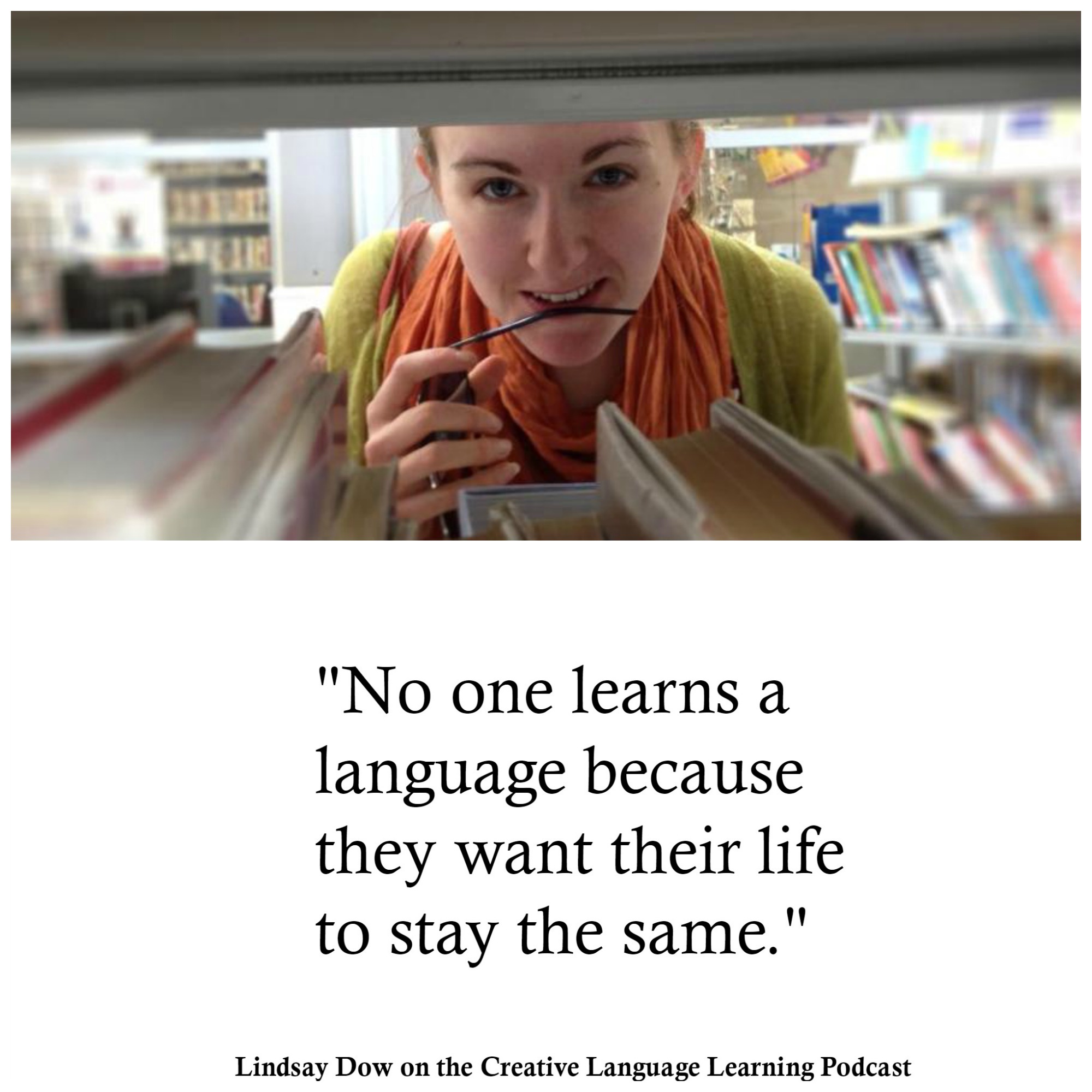
In Episode 8, my guest is Lindsay Dow, a really enthusiastic and cool independent language teacher from the UK. Lindsay is well-known for her great Youtube videos about all aspects of language learning, and she was also a winner in the Sensational Fluent Giveaway.
“No one learns a language because they want their life to stay the same.”
The show doesn't follow the usual interview format, instead Lindsay came on as a co-host and talked about her favourite blogs and articles, as well as her own story of language learning. She also helped me select the Tip of the Week.
Some of the highlights:
- How music and lyrics from Sheffield can teach you great English
- Which Asian language was a total eye-opener for Lindsay
- Why travelling is the greatest motivation for language learning
- How to stop getting bored by the language you’re learning (hint: Celebrity crushes help!)
- Our exclusive permission to you: Learn AS MANY LANGUAGES AS YOU LIKE
Language Learning Tip of The Week
Set yourself some goals and challenges, write them down and try your best to achieve them. For example, making a language video, writing a blog article in another language or reviewing 50 items on Memrise could be a goal.
It's important to make sure that you do go easy on yourself if you don't hit the goal. It doesn't make you a failure, so make sure you know how to do better next time and move on!
Our Tool and Blog Recommendations for the Week
- Wordreference and Linguee, two great online dictionaries
- Language Surfer
- Koko the Polyglot
- A Frog's Life - un blog BD français
- Omniglot
- Oh My God My Wife is German
- Itchyfeet
Language Book Recommendations
- The Meaning of Tingo: and Other Extraordinary Words from Around the World
- Through the Language Glass by Guy Deutscher
And Here are the Other Sites and Tools we Mentioned
- Feedly and Bloglovin for following all the blogs your heart desires
- The Sapir-Whorf Hypothesis
- The Next Tango in Paris by Ta-Nehisi Coates on the Atlantic
- 12 Mind Blowing Number Systems from Other Languages
As always, you can check out the podcast on Stitcher, or head over to itunes.



Struggling with listening? Discover realistic tips, challenge prompts, and the best tools for improving your listening skills as a self-guided language learner