

Essential German to Celebrate St Martin's Day in November
Have you heard about Martinstag (St Martin’s Day)? It’s a great way to celebrate as the autumn season begins in Germany, so you can talk to your German friends about the St Martin’s lanterns, bonfires, and songs.
This article gives you lots of vocab, recipe ideas and inspiration to learn more about Martinstag in Germany.
Full of candy, scared and spooked, disguised as a creature of the night…that's Halloween. The festival is very popular in the English speaking world.
But have you heard about Martinstag (St Martin’s Day)? It’s a great way to celebrate as the autumn season begins in Germany, so you can talk to your German friends about the St Martin’s lanterns, bonfires, and songs.

What is St Martin's Day?
St Martin’s Day is (you guessed it from the name) a religious feast inspired by the story of St Martin of Tours.
Here’s the story of St Martin:
Martin is riding along a path on a cold November night. He comes across a beggar by the roadside and even though he's got nothing on him, he decides to help the poor man out by ripping his cloak in two and sharing it.
Well, this is the version of the story that I remember from Kindergarten anyway. If you read up on it on Wikipedia, the tale becomes a LOT more religious. Religious references aside, what the feast day celebrates today is the value of generosity and sharing with those in need.
Essential German for St Martin's Day
If you love learning German with stories, I recommend German Uncovered, my super comprehensive course loved by German learners all over the world. It was created in collaboration with StoryLearning, and will help you learn German in context without having to cram and rote learn.
Martinstag - St Martin’s Day
der Umzug, die Parade - procession
die Laterne - lantern
eine Laterne basteln - to make your own lantern
basteln - crafting
leuchten - to shine, to glow
das Licht - light
das Martinsfeuer - bonfire to celebrate the day
die Sterne - the stars
der Soldat - soldier
der Bettler - beggar
teilen - to share
Need ideas for remembering vocabulary better? Click here to read how to get great vocab memory.
How Germans Celebrate St Martin's Day

Danke an laterne-basteln.de
St Martin's Day is celebrated in Germany around 11 November. It’s particularly common in the Rhineland.
Many children celebrate by carrying little lanterns (often homemade), and following a procession with music, warm drinks, and sweet treats. Sometimes, the procession is led by a "St Martin" wearing a red coat and riding a horse. Often they are accompanied by a local band playing the famous St Martin's songs.
My own rural German background includes happy memories of lanterns, songs, and a big Martinsfeuer (bonfire) at the end, where people would gather and enjoy seasonal treats. For the adults, I’m pretty sure there was some warm Glühwein (mulled wine) involved.

Martin’s parade (photo via mexicanosenalemania.de)
Read on to find out what sweet treats are in store if you attend a Martinsumzug (St Martin’s Day parade) yourself. And if you spot someone you’d love to chat to 😍, don’t miss my tips for how to flirt in German.
If you want to celebrate St Martin's Day too, you can build little lanterns, sing a song with the children (or with your mates!) or bake a lovely Weckmann (recipe below).
St Martin's Day Songs
The easiest song to learn is "Laterne, Laterne", with its three lines of lyrics.
Laterne, Laterne
Sonne, Mond und Sterne
Brenne auf mein Licht, Brenne auf mein Licht
Aber nur meine liebe Laterne nicht!
(Lantern, Sun, Moon and Stars. Let my light burn brightly, but not my dear lantern!)
Other great songs for this season include "Ich geh' mit meiner Laterne" and "St Martin". You’ll hear these played at processions, bonfires and sung in Kindergarten.
What to Eat on St Martin's Day in Germany
St Martin’s Day is a feast day, so there are plenty of sweet treats to be had.
Look out for these St Martin’s Treats in German Bakeries in November:
Weckmänner are pastries made with sweet dough. They come in the shape of a person, often with raisins for the eyes. The little guy also comes with a clay pipe.
The word Weckmann combines Weck (Southern German word for a bun) and Mann (man). You’ll also hear them called Stutenkerl in some parts of Germany.
Martinsbrezel are sweet dough pretzels covered in sugar.
Glühwein is mulled wine. The wine (often high quality local wine) is heated up with spices and sugar to create a comforting winter drink. If you’re not into drinking alcohol, there’s often a sober version available (look out for words like Punsch and Kinderwein).
Here is a Weckmann recipe in German, with thanks to the website chefkoch.de. How much do you understand?
Zutaten
1 Kilo Mehl, 1 Würfel Hefe, 150 Gramm Zucker, 90 Gramm Butter, 1 Teelöffel Salz und 500ml warme Milch.
Anleitung
Zuerst das Mehl, die Hefe und 125ml Milch vermischen und 10 Minuten gehen lassen.
Butter, Zucker, Salz und restliche Milch auflösen und alles mit dem gegangenen Teig verrühren. Aus dem Teig Weckmänner formen und 10 Minuten gehen lassen.
Mit Milch bestreichen und 15-20 Minuten bei 220 Grad backen.
Quick Q&A About St Martin's Day
Speedy questions, speedy answers!
What do you do on St Martin’s Day?
On St Martin’s Day (11 November), many people in Europe celebrate with seasonal foods, processions, and bonfires.
In Germany, children often craft lanterns and sing songs at local processions.
Why is St Martin’s Day celebrated?
St Martin’s Day commemorates St Martin of Tours, known for sharing his red cloak with a freezing beggar during a snow storm. St Martin stands for generosity and charity.
How long has St Martin’s Day been celebrated?
St Martin’s Day, also known as Old Halloween or Martinmas, has history going back over 1500 years. It falls on the end of harvest season and was celebrated throughout the Middle Ages, and all over Europe.
Where to Learn German for St Martin's Day
If you love learning German with stories, I recommend German Uncovered, my super comprehensive course loved by German learners all over the world.
It was created in collaboration with StoryLearning, and will help you learn German in context without having to cram and rote learn.
Here are some more handy links for German learners:
My full German learning resource list for all levels
Little-known facts about speaking German to level up your pronunciation skills
Hope you enjoyed this article - have a great St Martin’s Day, wherever you are celebrating! 🏮

Brilliant German TV Shows and Movies to Turn Up Your Language Immersion
Discover 9 new German TV shows and films that will help you relax and learn both German language and culture.
Heads up: My free mini-guide to speaking German is out now and will give you the best tips and 26 key phrases to make you ready for any conversation. Pop your details into the form below to join my email list and get the guide immediately!

Ever since I started teaching myself languages, television has played a big role in my study routine. It’s not always the place where I actively learn a language through deliberate practice. Still, the ongoing exposure to my target language’s culture and sound keep me interested and allow me to test my learning progress by switching subtitles on and off.
And since I am a German teacher who also shares a home with a sporadic German learner, our cosy nights on the coach often feature TV shows in my native language, German.
In this article, I’ve listed 9 shows and films that we loved. These will offer you enough entertainment in German to keep you on the couch for weeks in German binge-mode. Los geht’s!
German TV Shows
More and more amazing shows are pulling in top writers and actors from Germany’s film industry, and there’s something for everyone.
If You Want Spy Drama and Retro Fashion by the Berlin Wall

The Same Sky is centred around the “Romeo” assignment of Lars, a young East German soldier in the 1970s. It’s called “Romeo” because his job is to befriend and seduce a female target who works in a military institution (played by The Bridge’s Sofia Helin!) and move her to reveal secret intel on who’s spying on the East German state.
As Lars embarks on his adventure in the “capitalist snake pit” of 1970s Berlin, a few secrets about his own past come to light.
With great acting, amazing shots of Berlin, and mind-boggling insights into the daily life of citizens in socialist East Germany, The Same Sky belongs on any German learner’s Netflix queue.
If You Wish There Was a German Telenovela
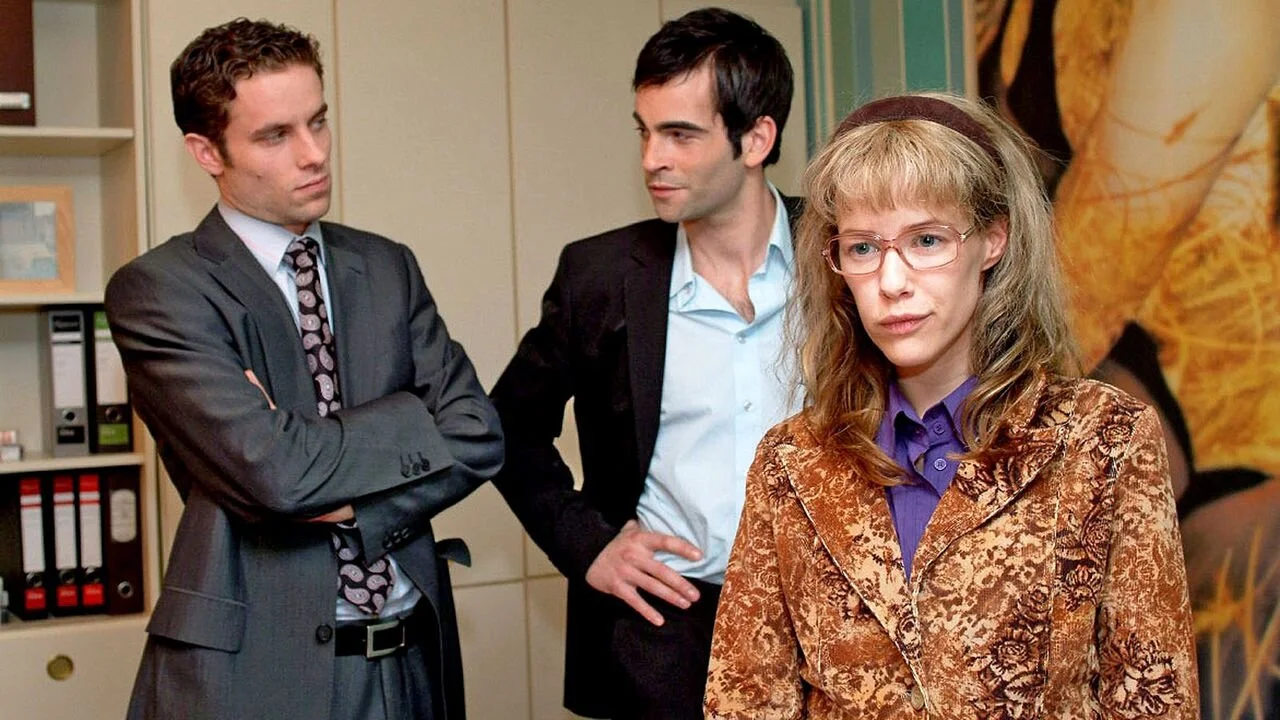
Guess what…there’s a German telenovela! It’s called Verliebt in Berlin (a pun meaning “in love in Berlin” and “in love with Berlin”). I don’t need to explain the plot in too much detail, but rest assured it involves young women and men, various love affairs, and at least one internship in fashion.
If You Wish There Was a German Telenovela for German Learners

German TV really has got it all! The series Jojo sucht das Glück is not a traditional TV show, but a programme developed by Deutsche Welle for German classrooms and learners all around the world.
As you watch the adventures of Jojo, a new student arriving to Cologne from Brazil, you can watch each episode with a full German transcript and follow it up with language exercises.
If You Want German Sci-Fi That is More Confusing Than the German Language
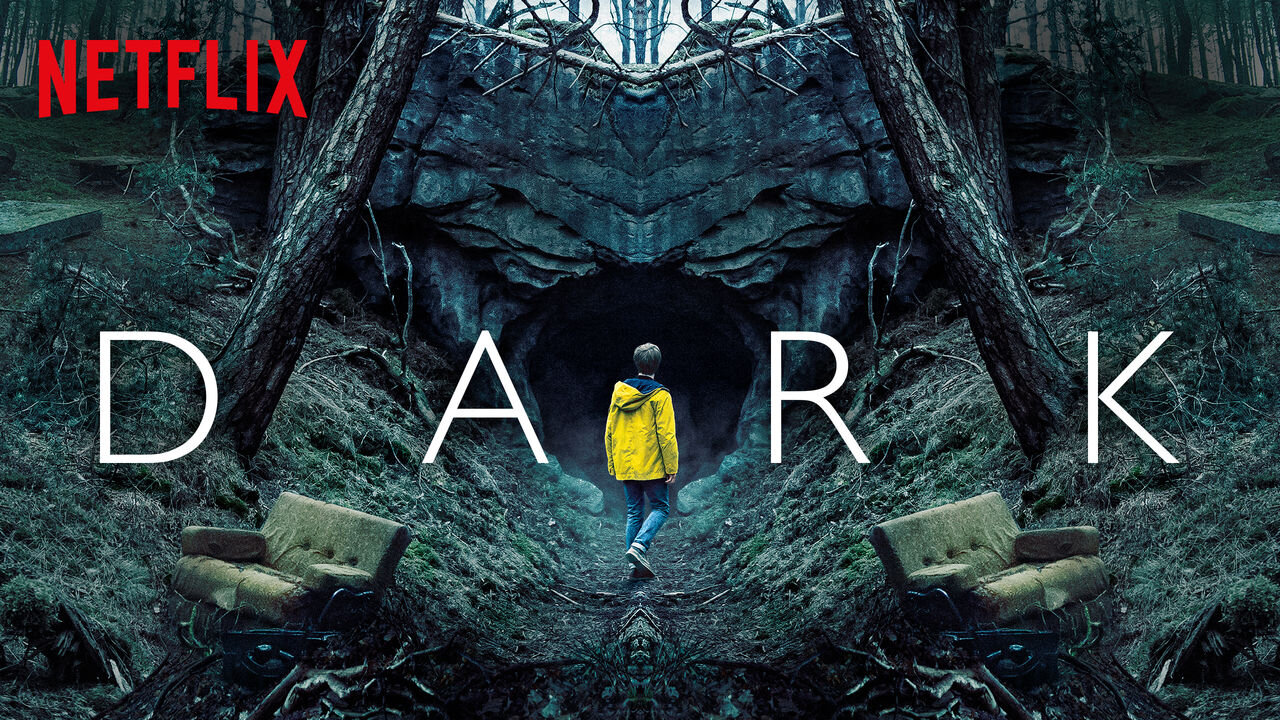
Dark is a gem and a rarity as a Netflix TV show produced by Germans and filmed entirely in German, to be released on the international market. And the gamble has paid off as the show became a fan favourite and won awards and top ratings across the board.
Dark is set in the small German town of Winden, where idyllic town life starts to go wrong as children start to disappear. The events are set in 2019, but very quickly the plot thickens when teenager Jonas discovers a portal that takes him back to Winden in 1986.
Can Jonas change the future? Did the disappeared children travel in time? And what’s the nuclear power station got to do with it all?
Dark is the perfect show for you if you enjoyed the otherworldly mysteries of shows likeStranger Things and don’t mind throwing time travel into the mix.
If You’re a Reality TV Junkie
Most of the big international TV hits have been produced in Germany as well as in other countries. For example, you can watch Das Große Backen if you love the happy world of home baking. Or if you’re an action junkie who wants to cheer on your favourite athlete, check out the German commentary on seasons 1 and 3 of Ultimate Beastmaster which is produced by Sylvester Stallone himself!
German Movies
The German film scene is world class, and here are a few suggestions to get you started.
If You Want an Oscar-Nominated Portrait of Terrorism in Germany
The Baader-Meinhof Komplex. They’re oddly well-dressed for terrorists, aren’t they? This film tells the story of Germany’s notorious Rote Armee Fraktion, a domestic terrorist group that emerged from the 1960s student revolts.
Fired up by rebellion against a generation of parents who let fascism happen on their watch, the young students around Ulrike Meinhof and Andreas Baader start to take action and things become increasingly violent.
This film is a must-see for anyone who wants to start getting an insight into the many ways Germany has had to face and deal with its Nazi past.
If You Think You’re Too Busy to Relax With a German Movie

Allow the bittersweet story of Toni Erdmann to change your mind. The film follows corporate consultant Ines, who is working double time to move her career forward. Her father Winfried misses their relationship and tries to win her attention through practical jokes.
Nothing works until Ines sets off on a company trip..just to find her father has decided to come along and style himself as her life coach. This film is funny and sweet with a genuinely sad undercurrent.
In Toni Erdmann you’ll discover the gentle, so absurd-it’s-serious style of humour that is so typical for Germany.
If You Are Ready to Feel the Heartbreak of Berlin’s Divided History

Das Leben der Anderen (The Lives of Others) is an Oscar-winning film about what happens when you work in audio surveillance and listen in on people so much that you end up caring about them.
Lonely Stasi man Gerd is played by Ulrich Mühe in one of his best performances ever. Watching the film, you will feel yourself drawn into his world and the conflicts he has to face between duty and integrity.
Want to Learn German With TV and Cut Out the Subtitles?
If you are an advanced learner and want to try watching without subtitles, don’t miss out on this episode of the Fluent Show with listening expert Cara Leopold.
What is Your Favourite German TV Show?
Comment below and tell me which show you cannot get enough of! I’m looking forward to adding it to my playlist.

9 Great Websites For German Beginners
Looking for inspiration and great courses to help you learn the German language? Here are 9 great websites that will help you learn German
Pop quiz - Which one of these is your favourite reason to learn German?

You fell in love with a German speaker
You fell in love with the atmosphere of a beer fest or a Christmas market
You have not yet tasted the greatest bread on this Earth, but you’d really like to, and you’ve heard the bakery only offers it to German speakers
Your company works with German clients and their English is so good it’s embarrassing all you know is jawohl ein Bier bitte
You want to visit Germany and get a taste of the wonderful nature, forests, skiing, castles, Roman history, medieval town centres, comfortable trains, inviting restaurants, fairy tale rivers
There are no wrong answers here. ALL of the above are fantastic reasons to get started learning the German language. I have been teaching and sharing German language and culture for five years, and today I’m sharing some of my favourite resources for beginners.
Make Your German Sound Amazing
My free mini-guide to speaking German is out now. It's called Make Your German Sound Amazing and will give you the best tips and 26 key phrases to make you ready for any conversation. Pop your details into the form below to join my email list and get the guide immediately!*
Check out 2 or 3 of these resources and make sure you bookmark them to visit again and again!
Great German Learning Websites
Beautiful German castles and Germany.travel
Sometimes it's necessary to check out of verb tables and remember why you chose to learn this language in the first place. What better way than to dream of hiking up beautiful hills and discovering romantic castles? Castles beat cases, after all.

Mein Weg nach Deutschland
This is a great project from the Goethe institute. Where would we be without them! Follow the story of Nevin, a newbie in Germany (who excitedly photographs pretty much anything on her mobile phone). The videos are available with and without subtitles and each episode has practice exercises too!
Deutsch Plus and Jojo sucht das Glück
There are some truly great telenovelas out there, designed especially for German learners. Lovers of retro Germany will like Deutsch Plus, the story of shy TV intern Nico from Romania - it's vintage 1996 work. Even better - it's suitable for starters from day 1. For improvers, Brazilian student Jojo will be a fun resource.
Listening: Radio D
Another suitable resource for beginners right from day 1 - Radio D is an audio course. Nice plot and a very well supported website with grammar hints and word lists make this resource a go-to page for German learners of any age.
Dictionary: LEO
No German learner can do without LEO - it must be one of the best online dictionaries around! Language searches available in both directions, 7 supported language pairs with German, audio pronunciation and a well-attended forum finding even the most obscure expressions make this a bookmark no-brainer.
TIP: Read more on how to use a dictionary like the most successful language learners
German Uncovered
Learn German the natural way without complex grammar explanations and boring lessons. This course is based on a story, so you’ll be reading and having fun as you progress to level A2 at high speed.
Speak German Like a Native
If you find spoken German hard to understand, you need this course. This is my 5* masterclass course for all levels. No other course digs into the sounds of the German language, giving you the confidence to even say Eichhörnchen and Wechselstrom like a native.
Got More To Add?
The German learning community out there is always growing, and I’d love to hear what you’ve uncovered online.
Leave a comment if you know where to go for grammar that makes sense, or the best Swiss expressions.
How To Get Germans to Speak German To You
One of the most common questions I hear from you guys is how to deal when other people refuse to practice your target language with you. I'm excited to present some awesome advice from Anja at The Germanz in Australia.
Matching this awesome topic, I've created the new guide Make Your German Sound Amazing, featuring 26 Key Phrases For Conversations with German Speakers. Pop your details into the form below to join my email list and get the guide immediately!

Germans and their love for English
When you get lost in Australia, the States or the UK and ask for directions, people will most likely answer in English. When you get lost in Germany, people will most likely answer in English too.
Studies suggest that (only) 62% of the German population is actually able to hold a conversation in English and most movies and TV shows are still dubbed into German. In fact, most German customers still prefer things the German way and speaking German is still a necessity no matter where you live in Germany (with the exception of Berlin).
So why is it that German learners complain that Germans respond to them in English?
What if I told you that you don’t just have to take it? No doubt, you can help Germans stay on track and chat away in German for ages.
I’m German myself and I’m going to tell you about a few easy things you can do.
Why Germans Switch To English
Germans switch to English for three reasons.
Sometimes they want to help you
Sometimes they want to help themselves
Sometimes they just prey on the vulnerable and make you the practice tool
But most of the time, they just don’t know any better.
1. They want to help you
Sometimes Germans simply think it’s being polite. They want to help you communicate more efficiently.
When you ask them, “How goes you? I not finds the station train”, they will most likely help you out in English without speaking a word of German. ‘Oh, that’s cool, they tried in German. They’ll probably understand better when I tell them where to go in English!’, the efficient mind will think.
Germans love speaking English, even when speaking German. Even though many Germans learn at least one foreign language in school, some of them fail to remember that only practice makes perfect.
Additionally, some seem to forget that the comprehension skills of a learner usually outweigh their speaking abilities.
The innocently English speaking German simply doesn’t get that you may understand, that it would be polite and helpful to respond in German. It’s like they buried their teenage memories somewhere in the deepness of their minds, along with that sneaky first kiss behind the school building.
Germans will think you just want to break the ice by saying a few words in German. They will return that favour and will try to make the conversation as unconditionally comfortable as possible for you. In English.
2. It's easier for them
But Germans are not always driven by lovely innocence. Some Germans are simply not patient enough: ‘It will be quicker and easier if I just tell them in English. I’m almost late already!’
If their guesstimate places your German skills below their own English proficiency, they might respond in English.
For Germans, it’s all about communicating efficiently. No overexcited small talk, no politely beating about the actual topic, no exchange of unnecessary information, but rather direct communication, cutting to the chase and getting this question answered as accurately and quickly as possible. In English.
3. Germans want to practise their English skills
Of course, let’s face it, a few Germans simply want to practise their English on you because they know how awesome it feels to finally speak in your language of choice.
Moreover, they want to show off how good their English is to impress you (and others). They are going to take advantage of you.
Imagine how convenient, they don’t even have to leave their country to get what they crave. Speaking English. ‘Perfect! This guy from England gets to speak German every day; doesn’t he live here in Germany?’
They quickly forget that a lot of others see their opportunity as well, and this poor guy from England and his German skills fall by the wayside.
Here’s what you should do, as well as what you should avoid, to keep up the conversation in German.
How to Make Them Speak German
How can you fulfil your dreams and get those Germans to speak in German to you? Embrace these two rules that everything boils down to:
1. Speak no English to Germans
And
2. Make your German sound better than it is.
These two rules are the magic tricks that will lead to a happy life in Germany.
Let’s have a look at how to put them into practice with concrete examples and workarounds.
Respond in German
To really cash in and get the Germans speak German, you want to stay away from English as much as possible.
Certainly, it will take some courage especially when you think your German is not good enough. But you know what? The Germans will work it out. If they don’t get what you mean, they will ask (in English or German, it doesn’t really matter).
But if you’re asked, you’ll get a second chance to say it. You may even get some valuable feedback.
More importantly, when someone starts speaking English to you, just keep responding in German.
If your German is already good enough, try to translate the English response into German and say it back to them in German. Be patient and stick to German to get them back on track, no matter what.
If you don’t understand, ask them what it means, in German
Once more, under no circumstances switch to English.
If you can’t remember the word and you really need to know it, do the following:
Describe the word in German and ask them about the correct word.
Was heißt nochmal das eine Pedal im Auto? -Nein, das andere. Ach, ja, das Gaspedal. - What would you call that one pedal in the car? -No, the other one. Ah yes, the gas pedal.) or
Ask them for the translation in German.
Wie heißt nochmal ‘dog’ auf Deutsch? - What’s the word for ‘dog’ in German again?
Work on your pronunciation
As Germans like to switch when they think that communicating with you might not go too smoothly, how about you make your language skills less of a problem?
If Germans think that you’re comfortable speaking in German, they are less likely to switch.
One way of making your German sound better than it is, is to be amazing at pronouncing things. Just practice the proper pronunciation and know how the intonation pattern of a sentence works.
Use phrases and conversation fillers
You could also use phrases and conversation fillers to make your responses sound more natural.
The idea is again that we want to make our German sound better than it is. It’s like saying, “Keep going, nothing to see here”.
To keep up the flow when speaking, it’s a great idea to have handy the vocabulary you will need. But also don’t forget that natives use clichés and filler words, and they say ‘uhmm’ a lot.
Here are some examples:
Ach wirklich/Echt? - Ah really?
Cool!
Macht nichts!/Kein Problem. - That’s alright!/No problem.
Hört sich gut an. - Sounds good.
Ach so. - Ah yea.
Stimmt!/Genau - I agree./Yeah, that’s right.
Na ja, vielleicht. - Yeah, maybe.
Compromise
Let’s face it, sometimes there’s no way that subtle hints will get them back on track.
Please don’t take it personally, they might not even notice. The only thing that will help here is to be very clear about your goals, about genuinely wanting to learn proper German.
Apart from saying “Bitte nur in Deutsch”, you can decide to blitzkrieg and offer a language tandem. Your compromise could be
One hour speaking in German, another hour speaking in English.
If you see them every day, you could agree to speak English from Monday to Wednesday and German from Thursday to Sunday.
If the two of you agree to correct each other properly and also provide alternatives for certain sentences and phrases, you could both benefit from the language tandem quite a bit.
Make (new) German friends
As your language skills progress, you’ll be able to chat away on more and more topics. You will be developing your ‘German You.’ It may be the same as — or completely different from — the English-speaking you.
With your ever-improving skills, making new German friends will become a lot easier.
If you have moved to a German-speaking country, you’ll hit the jackpot by joining a club (der Verein) in the German countryside, but clubs can be found anywhere across Germany, even in the big cities. Similarly, you want to get involved and lend a hand at the local Tatort night, the German-speaking weekly handcraft meeting or the local climbing hall.
Try to maintain a healthy ratio of English-speaking and only-German-speaking friends. You have a choice among about 100 million German native speakers in the European Union alone.
Don’t forget, the more you get to speak German, the easier it gets. Just let Germans know you’re up for a challenge. They will be up for it as well.
Summary
In summary, please don’t get turned off by responses in English, keep learning German and remember these two fundamental rules:
Don’t speak English to Germans.
Make your German sound better than it is.
On a concrete note, you could:
Always reply in German.
Ask for missing words and explanations in German.
Improve your pronunciation.
Use conversation fillers and ‘uhm’ a lot.
Compromise by offering language tandems.
Move to the German country.
Make (new) German speaking friends.
You’ll find more nifty tricks on learning and speaking German on my German language blog.
Don’t forget to tell me in the comments about your favourite strategy in dealing with English speaking Germans.
This article was written by Anja. Anja lives in Melbourne, Australia, is originally from Germany and writes about the German language and culture on her blog when she is not busy teaching German language classes. Hang out and have a chat with her on Google+ or Twitter.

The Hottest German Lesson in Town: Deutschland 83 and Major Tom (PLUS Free Lyric & Vocab Sheet)
One of the most wonderful things about learning a foreign language is to get to know the country behind that language. What is beyond the flashcards? What makes that place? It's awesome to dive into history and geography, cook a few recipes (like Shannon from Eurolinguiste) and of course discover what they watch and listen to.
If you're a regular listener of the Creative Language Learning Podcast, you may have already noticed that there is a new German language TV show on the block. Deutschland 83 is a spy drama set in one of my favourite periods of German history: the 1980s, right in the cold war. You can catch it on iTunes, on Amazon, or currently on Channel 4 in the UK.

German History: Spies, Terror and Economic Miracles
So here's the world at the time of Deutschland 83: Germany lost a world war and then the Eastern part of the country was made into a Socialist republic. The West started a kick-ass economy that went so well it became known for its Wirtschaftswunder, the economic miracle of the 1950s. In the 1960s, youth rebellion and peace movement shook our society, and Western Germany even struggled with its own terrorist group, the Red Army Faction. All the while, the Eastern part of Germany was locked away behind a wall and involved in the hottest army race of the 20th century: the Cold War.
Plenty going on at the time of Deutschland 83 then! The show's premise places a young Eastern German soldier into the West, where he's given a new identity and a bunch of adventurous spy tasks. It shows society in the West and East, the big fear of atom bombs laying waste to all of Europe, and a few hilarious scenes where a confused bunch of high-level spies stare at a floppy disc, wondering what it does.
Discover Germany's Answer to David Bowie
One of the unmissable things about Deutschland 83 is its awesome soundtrack. Let me introduce you to its theme song "Major Tom", Germany's synth driven response to the wonderful David Bowie. I've prepared a lyric sheet for German learners which you can download below.
Major Tom, written by Peter Schilling, was inspired by Bowie's song "Space Oddity", which tells the story of an astronaut abandoning his mission, decoupling from base and going off to live in space. In Germany, the song became a huge hit and one of the flagship sounds of Neue Deutsche Welle, the biggest 1980s pop music trend which also included Nena and her famous song "99 Luftballons". In fact, if you pay attention in episode one of Deutschland 83, you'll hear the song playing in the background at a party in East Germany (where playing Western music would have been an offence!).
Germans have never stopped loving Major Tom, and today there is no good beerfest without everyone shouting völlig schwerelos (completely weightless) and waving their hands about.
Bonus: Major Tom in French
Major Tom's fame was all over Europe in the 80s, so if you're a French learner you can use the same song for study. Here's the cover by Belgian synthmeister Plastic Bertrand (of Ça plane pour moi fame) will make sure that you don't miss out.
If you're listening to this song and can't shake the feeling that you know it from somewhere, it might be because Deutschland 83 is not the first show to feature Major Tom. If you're a fan of AMC's "Breaking Bad", you might remember the Gale Boetticher version - are those Thai subtitles?
Share Your Playlist
I'd love to hear from you about your own favourite 1980s tunes. Do you love pop music like Major Tom? Tell me about your playlist in the comments.
If you love the sound of Major Tom, don't forget to download your free Vocab & Lyric Sheet.
You can also check out this article to get a step-by-step guide to using music for language learning.



Struggling with listening? Discover realistic tips, challenge prompts, and the best tools for improving your listening skills as a self-guided language learner