

7 Reasons Your Cultural Awareness Matters More Than Perfect Vocabulary
You know about vocabulary lists, flashcards and pronunciation guides, but sometimes there’s more at stake than just knowing the language. In this article, you’ll learn about the hidden ingredient you need for avoiding misunderstandings (even offence!) worldwide.
The following post is written by the lovely Michele from Intrepid Guide, a blog dedicated to language and travel.
How well would you say you speak the foreign language you’re learning? Are you beginner, intermediate or even advanced and near fluency?
Now, I don’t want to bust your bubble, but, you may not be as ‘fluent’ as you think.
While we may learn languages with the goal of being fluent (whatever that means to you) the most important question to ask here is, how culture-savvy are you?
You may understand a foreign language but that doesn’t guarantee that you understand the nuances and the whole range of meaning that native speakers communicate to you.
Communicating in another language requires more than just memorising words and grammar. We have to learn how to communicate beyond words by understanding its culture. Therefore, as we study a language, we must learn it alongside its culture.
Afterall, language is culture!
What is Cultural Awareness?
Cultural awareness understanding that our own culture differs from one individual and group to the next, and specifically from our target language.
Being culturally aware helps us recognise and have an appreciation for other’s values, customs and beliefs and meet it without judgement or prejudice.
As we encounter new languages and cultures we begin to make comparisons and realise that our own behaviours, values and beliefs are not the general norm found elsewhere in the world.

Michele at the Vatican
Why is Cultural Awareness Important?
Cultural awareness is key when we communicate with people from other cultures. Since we use language to communicate, our knowledge of foreign languages gives us ‘access’ to different societies and cultures. We become mediators between cultures.
The most important reason why we should be culturally aware is so we have an increased awareness of people all over the world. This helps us develop a deeper understanding of our own and other people’s cultures, while broadening the mind and increasing tolerance.
Expressing Respect
When we are culturally aware we know what is considered inappropriate or offensive to others. For example, incorrect body language and can lead to misunderstandings. Even something as simple as nodding your head in agreement can be misunderstood in places such as Greece, Bulgaria, and Albania where shaking one's head can actually mean yes.
In Western culture we’re taught that it’s polite to look someone straight in the face when talking to someone, however, in Japan this is considered disrespectful.
Being culturally aware isn’t just for those learning a foreign languages either. As an Australian who swapped her life in Melbourne for a life in Rome and then again for London (where I’m currently based), I learned that even between English speaking countries our cultures can differ and that these differences can surface in unsuspecting ways.
During the past 5 years of living in the UK, I’ve accidentally ruffled a few feathers and learned some important cultural lessons the hard way.
Here are 7 times learning cultural awareness changed my life way more than any vocab table ever could
1. Inviting STRANGERS Round To Yours - Kidnapping Or Hospitality?
Whilst living in Italy, I travelled the country extensively and took many walks and tours with local guides. Each of Italy’s regions has its own personality, unique history, culinary delights and beauty. You can’t just visit Florence or Rome. You have to visit other cities too to really understand Italy.
When I was on one of these local tours in Milan, our guide explained that we shouldn’t be ‘discouraged’ if we encountered a ‘rude’ Milanese. She explained that people from Milan can seem rude or cold at first, but once you make an effort to get to know them they are just as warm and welcoming as we’ve come to know Italians to be.
Compare this with an experience I had at the opposite end of Italy in Sicily. One summer I was in Palermo celebrating a girlfriend’s birthday with 4 other girlfriends. we went to dinner at a popular restaurant frequented only by locals. It’s fair to say we stuck out a sore thumb.
After about 10 minutes at our table, a middle-aged lady from a neighbouring table who was with her family enquired where we were from. Her eyes lit up when we replied in Italian. After no more than 5 minutes of chatting, Maria invited all 5 of use around to her house the next day for coffee and cake! She gave us her number, address and a time. It was all set.
I’d never in my life received such an invitation. After some internal juggling wondering if we were about to experience Liam Neeson’s movie ‘Taken’, we decided to take our chances and go. I’m so glad we did. Maria had very kindly baked two different homemade cakes and even gave us her recipe.
This would whole encounter would never happen in Australia, or the UK for that matter. To this day I still can’t believe it did. It just goes to show that just because you do things one way in your country, doesn’t mean it’s the same everywhere else.
2. American, British, and Australian English: Similar but Different
Even though Australia is a British colony and Australian English is based on British English, we’re not very politically correct with our choice of words. Australians say things that can be considered highly offensive, but we do so without malicious intent.
It's like we’ve used these words so much in everyday speech that they've lost all power and negative connotations that it no longer offends anyone, hopefully.
This was and still is the hardest lesson for me to learn since living in London and something I still struggle with today.
An example of a word that Australians will use without batting an eyelid and which makes up part of many common Australian idioms is the word ‘bloody’. So common is it for us to say ‘bloody’ that it was even part for a A$180 million advertising campaign by Tourism Australia that was banned in the UK for being too offensive. The slogan read “So, where the bloody hell are you?”.
A more extreme example, which I know will probably make you cringe, is the use of the highly offensive c-word. It may surprise you to learn that many Australian males will use this as a sort of term of endearment towards other males. They’ll say things like, “Hey c&!, how are ya?”, or “he’s a good c%!.” The c-word is never directed to females or used by them as it’s still considered an offensive word, but it’s not nearly as taboo as it is in the UK or America.
3. Being 'On Time' Means Being Early, Late, Or Just On Time Depending On Where You Are
Even being punctual can cause misunderstandings. While Germans consider punctuality to be very important, the exact opposite is true in South America where it is considered rude to arrive on time.
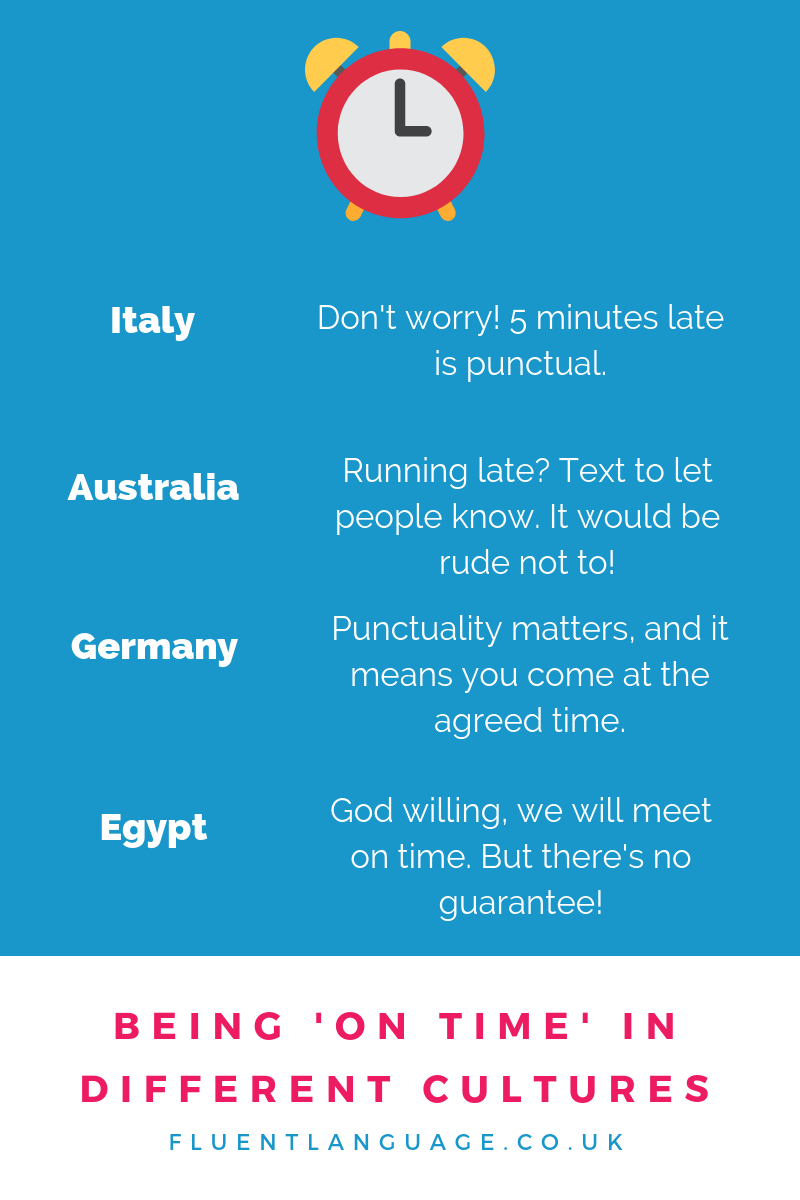
During my early days in Rome, I distinctly remember the first time I was running late to an appointment with my Italian friends. I messaged my friend Marta and apologised for running 5 minutes late. She responded with Ma Michele, sei troppo anglofono. Non ti preoccupare! (Michele, you’re too English, don’t worry!).
When I started learning Arabic leading up to my trip to Egypt, I learned that if you say to someone that you’ll see them tomorrow they might reply with, ‘in sha Allah’ or ‘insha'Allah’ which literally means ‘god willing’. This is often used in response to anything tentative, or when timing is in question.
The phrase expresses the belief that nothing happens unless God wills it ("if God doesn't want me to be on time..." ¯_(ツ)_/¯ ). From this one phrase we can see just how much of an influence religion plays in the Arabic language and in the lives of those who speak it.
A similar phrase is also found in Spanish and Portuguese, ojalá (Spanish) and oxalá (Portuguese). This was adopted into both languages after they came into contact with the Arabic speaking world as far back as the 8th century.
4. Saying 'Thank You' Can Make Your Host Unhappy - Only In Italy?

One year I celebrated Easter with a friend’s family in Naples. They welcomed me and my Dad who was visiting into their home and fussed over us making sure we had everything we needed and making special dishes just for us. They made us feel so special, like we were part of the family. I was so grateful and I wanted to let them to know.
Everytime Carmela, my friend’s mum, would hand me a plate, or do anything, I would say “grazie” (thank you). On the third day, Carmela said something I’ve never forgotten.
“Michele, devi smettere a ringraziarmi, mi fa piacere. Siamo famiglia e non si ringrazia familia. Non mi piace,... ci separa.” (Michele, you have to stop thanking me, it’s my pleasure. We’re family and you don’t thank family. I don’t like it,... it separates us.)
Before that moment, I never thought that thanking someone could offend them but I could understand Carmela’s point. At the same time, it felt foreign to me to not show my appreciation and gratefulness towards her for everything she was doing for us. I felt like I was being rude, but it was what she wanted so I had to fight my instincts so I wouldn’t not offend her again.
5. You Can Scare Italians With An Ill-Timed Party
After organising my birthday party whilst living in Rome, I learned just how superstitious Italians are.
You see, I have the unfortunate pleasure of being born two days after Christmas when most people aren’t around to celebrate with me. This usually means I have organise my birthday celebrations a couple of weeks in advance while everyone is still around.
The first time my birthday rolled around in Rome, I knew I wanted all my friends to be there and that since most of my friends weren’t from Rome and would be heading home for Christmas, no one would be around to celebrate my birthday on the 27th of December.
With that in mind, I booked a venue two weekends prior to my actual birthday and sent out the invites. Within minutes I was inundated with messages “Ma, Michele, non si può festeggiare il compleanno in anticipo, porta sfortuna!” (But, Michele, you can’t celebrate your birthday early, it’s bad luck!).
Up until this point I had never heard of such a thing. Growing up in Australia, it was something I was used to doing otherwise I’d never see my friends for my birthday. I felt that if I celebrated after the fact (which by then would be New Year’s Eve) everyone would be all partied out and celebrating the following year just didn’t feel right.
After explaining that for an Australia it wasn’t bad luck, they tried to understand but it still didn’t sit well with them. On the night of the party they didn’t wish me happy birthday, they insisted on waiting until the my actual birthday to tell me.
6. Gruesome Things Can Happen If You Don't Make A Toast With Caution

The custom of making a toast is universal. That moment when you say Cheers! Prost! Salud! or L’chaim! in celebration of anything from New Year’s Eve to weddings to a night out with friends.
This seemingly simple and harmless practice comes with disclaimers in some culture who have their own twists on this tradition.
In Spain, for example, making a toast with water or any non-alcoholic drink is considered bad luck resulting in ‘seven years of bad sex.’
Those in France or Germany believe the same to be true it you don’t make and hold eye contact whilst making a toast.
Living in Italy, I learned that Italians take things a step further. Aside from not being able to toast with water, and making sure you maintain eye contact, you also can’t toast with a plastic cup and you have to touch a table or ledge with the bottom of your drink after clinking glasses with everyone.
Interestingly, this superstition comes from the Ancient Greeks who, according to Greek mythology, would toast to the dead with glasses of water to symbolise their voyage, via the River Lethe, to the Underworld.
Who knew making a toast could be so complicated?
7. La Dolce Vita, Let It Change Your Outlook On The Working World
When I moved to Italy, I left behind a pretty intense job where I worked crazy hours, sometimes working til 1 or 2 am. In places like Australia, the UK and America, you’re rewarded for working overtime which usually comes in the form of a pay rise or promotion, where funnily enough you’re given even more work to do!
Living in Rome made me realise how flawed this whole concept was of working hard and sacrificing time with friends and family for the sake of climbing the corporate ladder. I quickly learned that Romans value time with their family and friends so much that they don’t have this poisonous desire to work overtime just to get ahead. Quite often, I would go out with friends til 1, 2 sometimes 3 am on a “school night”. We weren’t getting drunk, were were just socialising and just hanging out.
I never did this in Australia, but in Rome I was living La Dolce Vita or the Sweet Life. I replaced my work addiction with friendships and I began to value my relationships over work. I enjoyed life to the fullest with the people who matter and sometimes that meant staying out until the wee hours of the night.
La Dolce Vita isn’t just for Italians though, the Danes have their own version of this too. Unless you’ve been living under a rock, the Danish word hygge (pronounced hue-guh) has gained worldwide popularity. Hygge describes the feeling you get, either alone or with friends, where you feel cosy and have warm feelings of togetherness, contentedness and enjoying the simple things in life.
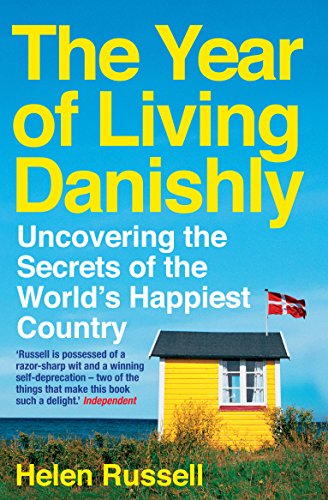
The Danes also don’t believe in overtime. Helen Russells explains in her book, a The Year of Living Danishly, that working overtime is not only frowned upon by your peers but you’re considered as being inefficient!
In Conclusion
Being knowledgeable in foreign languages shows native speakers that you respect their ideas and their way of living. This is why I encourage travellers to learn some of the local language before their travels and I’ve created a collection of free travel phrase guides to help my readers do that. Knowing even a just a little bit of the language can help offset cultural shock and open you up to new experiences in a destination.
Cultural awareness extends into your everyday life, not just while travelling. Think about how valuable this skill can be (and it is a skill) to the development and advancement of your career. Being able to communicate with global communities is invaluable to a business when they scout new talent.
Being able to communicate effectively has a lot to do with context and culture. Therefore, understanding cultural implications is just as important as learning correct grammar, vocabulary and pronunciation. Neglecting this part of the learning process can lead to unnecessary misunderstandings or miscommunications.
When Have You Learnt More Than Just Language?
What moments of cultural awareness have you encountered? Ever you offended someone or embarrassed yourself like me? I'd love to hear from you - share your story in the comments below.
About Michele
Michele from The Intrepid Guide is a language and travel blogger and author of Learn Italian FAST. Originally from Australia, Michele moved to Rome in pursuit of improving her Italian. Currently based in London, she lives by the motto “The more we travel, the more we learn.”
With her blog, Michele shares her passion for bringing language and travel closer together with detailed destinations guides, and free travel phrase guides, and more! You can follow her on social media as she shares fascinating and little-known linguistic and cultural facts.
Slower Travel: How to Buy Cheap European Train Tickets (Plus: Travel Itinerary from Germany to Sweden)

Back in January I showed you how Christian and I travel Europe in my article on train travel from the UK to Germany via Belgium. This time, let me share a trip I am taking as a solo traveller!
Vineyards and Scandi Forests
As I am writing this, I am sitting on a train to Stockholm Central, typing on my laptop. I am on day 2 of travelling by train and have come a long way from the South! My summer trip started out with a flight from Manchester to Cologne (best flight option currently by Germanwings) for a family event. But as I was preparing to book my normal return flight, a Facebook post caught my eye:
“Need someone to look after our cat while we travel. Would any of our friends be interested?"
This came from a friend who lives in Stockholm! A new cat to hang out with and accommodation in an apartment in Stockholm? I was excited, and after some planning we matched up the dates and I decided to make my summer trip home to Germany into a big train adventure.
Here’s how the trip breaks down:
Day 1: Travel by plane from Manchester to Cologne, then by train to Wittlich Hbf

Img ©Christian
The first destination in Germany is always the Mosel valley to me. I was there to visit my family, but don’t think that this wouldn’t be a beautiful place for you. The Mittelmosel can be reached by train to Wittlich Hbf with a bus connection to any of the small villages. It’s focused on winemaking, with lush green vineyards on the hills and a stunning river winding its way through the valley.
Language Tip: Hbf stands for Hauptbahnhof, the central station of any city.
The Mosel region is world famous for its wines and amazing scenery. Visit a local wine estate and enjoy a wine tasting with the original producers - guys who know what a vineyard, wine cellar and tractor look like. There are over 15 wineries in my home village alone, and of course I recommend Weingut Hammes (tell them I sent you!). The biggest wine festival of the region is called the Weinfest der Mittelmosel and takes place in Bernkastel/Kues in early September. If you are in town, don’t miss out on the parades, funfair, fireworks and the wine street.
The temperatures during my visit regularly reached 35 degrees, with nighttime temperatures around 20. Some of my favourite things to do include getting amazing gelato at Venezia, swimming outdoors and camping by the river.
Day 7: Travel from Wittlich to Hamburg, via Koblenz.
This is a 7 hour journey including one change and features the lovely rivers Mosel and Rhine as its backdrop up until Cologne. On the trip you will get to see German landscapes changing to the flat and the nautical. Hamburg makes a very beautiful overnight destination, as everything is close by and the city’s sights are within easy reach. It also allowed me time to catch up with a long-time-no-see school friend, Verena who is chief blogger at Hamburg von Innen. She has kindly put a few tips together for you so you can get the most out of Hamburg:
Start at the Landungsbrücken and get set for your day with a Fischbrötchen, the classic Northern German snack. While you're there, take the lift to the old Elbtunnel and cross the river to admire the new Elbphilarmonie building (set to complete in 2017). The views in this part of town are fabulous.
Walk through the Portugiesenviertel to the Michel, Hamburg's iconic church which offers the best views in town from its tower. On the way there, stop at Milch for an excellent coffee break. You shouldn't miss Jungfernstieg and Binnenalster, with a visit to Warnecke for some ice cream.
Take a stroll around the Speicherstadt and admire this UNESCO-listed cultural treasure. The best Hamburg-style food is Labskaus or Hamburger Pannfisch with an Alsterwasser (shandy).
My accommodation in Hamburg was a friendly little Airbnb apartment in Altona.
Day 8: Travel from Hamburg to Stockholm, via Copenhagen
There’s currently no direct train running between Hamburg and Stockholm, but the trip via Copenhagen is fun and adds little time in total. For this journey, I was on the tracks for 12 hours in total, with a 2 hour changeover. Hamburg to Denmark offers views of picturesque Friesland and a crossing of the Baltic Sea to get to the island of Fehmarn.

The journey features a truly exciting extra: Your train drives ONTO A BOAT. I was absolutely amazed by this. The ScandLines crossing between Fehmarn, a German island in the Baltic Sea, and Roedby in Denmark takes 45 minutes and gives everyone a chance to stretch their legs.
The Swedish part of the train journey is all trees and meadows and water, a wealth of things to look at. The SJ train was comfortable and fast, offered free wi-fi, plugs and a little bistro so that you couldn’t be more comfortable.
Here in Stockholm, I’m getting around using the T-Bana (the city metro). My city guide book recommends Skansen, the open air museum to take visitors back to Viking times. I’m also planning to give a little bit of time to a nice walk around Södermalm, the beautiful old town and the open air baths. Being self-employed and staying here as a house sitter has made it possible for me to combine working and discovering this new city and I am very much looking forward to my stay (and to hanging out with Moppet, the cat I’m looking after).
How to Purchase your Tickets
Although navigating the Deutsche Bahn website can take a little getting used to, its wealth of connection and saver fare data means it remains a must when you are planning Euro train travel. Journeys abroad are open for booking as long as they’re offered by or in partnership with Deutsche Bahn. Alternatively, try The Trainline Europe.

I decided to opt for a mobile ticket, meaning I had to download the DB Navigator app and log in. I was amazed at how well this worked, conveniently allowing me to access my tickets and timetables on my phone, research alternative routes and get platform information. Even on the trip from Copenhagen to Stockholm, the conductor accepted my foreign e-tickets without question. Deutsche Bahn offers the option of posting the train ticket to you in hard copy. Be aware that lost tickets will not be replaced if you take that option, and there’s a small extra charge for it.
I bougnt a BahnCard too, a special offer from Deutsche Bahn which gives you 25% off each journey you take. Since the full trip from Wittlich to Stockholm was booked and paid through the Deutsche Bahn website, I was able to make this journey for just €110. That’s an outstanding deal, especially since I realised that it includes a ferry!
Notes on Learning German, Swedish and Danish
Learning German? My native language? Oh yes! This trip took place so recently after I developed my new German pronunciation course that my ears were more attentive than ever. My parents and I watched the news and listened closely to make sure the pronunciation is real Hochdeutsch. And we spoke more Moselfränkisch to each other than ever. On the train trip to Koblenz, I got to listen to some Trier boys drink beer and speak dialect. Do any of these expressions make sense to you German learners? I love and understand them all:
- Hal dau mol de Schniss weile!
- Du komen am Sunndisch die Frimmen vorbéi.
- Dau Flappes!
- Eisch hann die Freck, haut kann eisch néist.
The prize for most languages during a train announcement goes to the Danes this time, who racked up Danish, Swedish, German and English on their leg of my journey. I didn’t really stop in Copenhagen for very long, skimming over the Danish language on my trip to Sweden.
Everyone I have spoken to in Stockholm so far speaks English at an incredibly high level. But once again, you can tell that the “they all speak English anyway” excuse just doesn’t fly. They may be able to speak English to me, but they don’t choose to. I am happily wandering around at the moment armed with this little beauty, a dictionary from 1975:

The way I use my dictionary to help me learn the language is so much fun to me. I carry it around everywhere and take time to look up words that I see come around again and again (på, och, uttlev) and translate written texts. The dictionary also contains a pronunciation guide, and once I feel like I’m ready to do it I’ll try out my new word on a Swedish person just to check I’m getting it right. Spoken Swedish is not making a lot of sense to me yet, which is to be expected on day 2 a 10 day visit. But every day, I'll be adding words and making memories.
And here’s a little closing note on the languages of this trip (no Norwegian included):
If it’s got an ø (pronounced “gulp” or something like that), it must be Danish. If it’s got an å (pronounced “oh”), it must be Swedish.
I would love to hear from you! Have you ever been to Sweden? Have you travelled a long distance by train? Share your best train travel experiences with me in the comments.
The Best Apps for Travelling the World
There is a German saying that sums up all that is annoying and all that is important about travelling:
Es gibt kein schlechtes Wetter. Es gibt nur schlechte Kleidung.
This means "there's no bad weather, there's just bad clothing". While single-handedly giving you and explanation for all those German tourists dressed in pro-level hiking gear, the saying also talks about attitude and preparation. Without good prep, travel won't be fun, so today I thought I'll share a few tools that I use every single time I travel abroad. And no, it hasn't stopped me from doing some remarkably stupid things such as forgetting my passport at home (ouch) and turning up at the airport a whole 24 hours too late. But imagine how much less organised I could be!
Be Smart about App Usage on the Road
It's important to watch your smartphone's data consumption when you travel. The EU roaming fee law that we all waited for has now been pushed back until 2018, so even from the UK to Germany it's important to ensure you've researched before you go.
I'm UK-based and have found the best deals for using my smartphone abroad with Three and o2. More information for UK-based users is available on the always excellent Money Saving Expert website.
No matter where you are, here are my top phone tips before you go travelling:
- Get your phone unlocked and research buying a local SIM if you stay longer than a week, you travel to another country regularly or you're planning to use a lot of data.
- If in doubt, switch off international roaming.
- Research where you can get free Wi-Fi access.
The List of Apps and Services
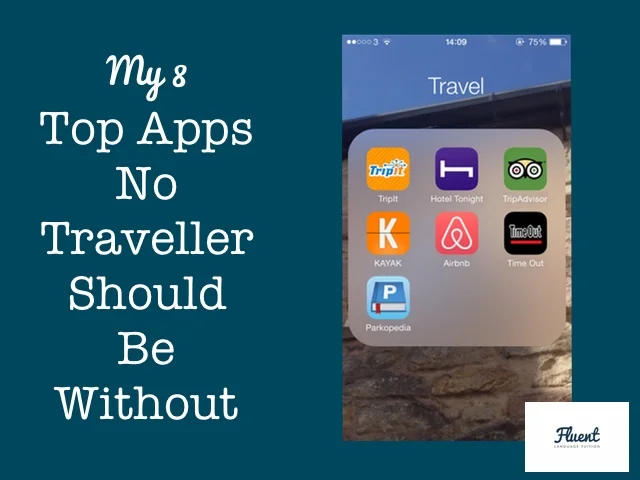
This is the list of travel apps that I am never without on my phone. Most offer app options for iOS and Android. I'll be linking to their websites so you can select your download option. None of the links in this article are affiliate links, but I've used my "Refer a Friend" where I've got it.

Oh my god, I'd be lost without this site. TripIt creates a master travel itinerary. You can forward most train, car hire, hotel and flight confirmations to their plans@tripit.com email address and it reads them automatically and puts them into the calendar. The service also integrates with online calendars, so your diary is up to date.
The best thing about TripIt is that I can share my itinerary and allow others to post things to it. It's completely stopped that irritating "What time is our flight again? Which terminal?" conversation I used to have with my partner on every single trip. Instead, we just say "it's in the TripIt".

The above link gets you free travel credit, feel free to use it!
I started using Airbnb in 2011 and it's become one of my go-to travel tools since then. Airbnb has been a big success story. It allows people with a little extra room, from a spare couch to a tree house, to rent out that space to travellers and visitors. I know that Couchsurfing runs this for free, but after years of business travel I just became a little spoilt and I'd rather set up a transaction with my host and have guaranteed safety and comfort in return.
I've now used Airbnb on trips to Cardiff, Kendal, San Francisco, Portland and London and have never had a bad experience. One of my friends has also started hosting on there, so if you're ever going to Edinburgh, email me for more details.
Click the link above. The first 10 people to use the code "free-siaumd" get an upgrade coupon through my account.
If you never use your frequent traveller miles, you're not alone but you're missing out. AwardWallet is a website that tracks your airline and hotel loyalty schemes - something no one can really keep track off properly, right? The site will give you one central point to check your balances of every loyalty scheme going, including expiry dates and links to the original scheme websites.
Last year, I travelled around the USA and back for just $500, by the way. That was entirely due to using my frequent flyer miles, so this is worth looking into!

My Referral Code KHAMMES will give you a £15 discount.
When I travel on my own, I like to be as free and unrestricted as I can. Road trips, spontaneous day trips and added nights in beautiful places are commonplace for me, so that means I rarely book a full itinerary in advance. There always has to be an unorganised bunch of nights in there, allowing me to feel free to roam. And HotelTonight has got to be the BESTEST EVER THING FOR PEOPLE LIKE ME.
The app is pretty, reliable and so easy to use it's unreal. Originally a last-minute reservation service for "tonight" only, they've now expanded their offering and allow you to use the app for reservations up to 7 days in advance. The rates are always competitive and their range of hotels is gorgeous. Without HotelTonight, my road trip to California would not have been as much fun.
A new addition to my travel arsenal, Parkopedia is a British website listing reviews and tips on the best and most affordable parking spaces in 52 countries. It's saved me hundreds on my most recent Christmas trip by simply showing us a cheaper car park 500 metres away from our hotel. Absolutely worth looking into!

Both of these websites are designed to deliver straightforward flight searches, allowing you to get the best connections all around the world. There are of course millions of flight search websites out there. Google has recently added its own service to the market as well after they bought the awesome ITA Scanner a few years ago. But for a bargain hunter like me, the two above are always worth checking out.
Kayak is great as a starting point for major airline connections and offers you a search featuring nearby airports, flexible dates and lots of route options. They miss out a bunch of low-cost airlines, so Skyscanner is my second favourite place to check for flight options because they will include Ryanair, easyJet, WizzAir and so on. Invaluable for Euro travel.

If you're a vegetarian on the road, use Happy Cow. If you are looking for quirky restaurants that offer awesome healthy food, use it too. Basically: Use Happy Cow! This restaurant guide has listings of veggie-friendly places in even the most unlikely locations like Moscow and Lisbon. I've often dragged friends and travel partners to Happy Cow locations and had the best meal of my whole trip. The app offers you directions and opening hours and also lists health food stores. For going beyond the usual travel fare, this is your new best friend.
More App Recommendations
The list above is just the tip of the iceberg, of course. I also make regular use of TripAdvisor and the LEO Dictionary app. And I am always on the hunt for a really good packing list app, I've just not found one yet.
What are your own favourite apps for travelling? How do you prepare for a trip abroad?
Thanks for reading this article on Fluent, the Language Learning Blog. If you are feeling stuck right now, why not subscribe to Fluent and check out our language book shop.
How I Travel Europe: The Train from England to Germany
Have you ever stood in the security queue at your airport, realising with a bolt of anger that you're about to have to hand in your big bottle of expensive shampoo? Or been troubled by fear of flying, wishing for solid ground in the middle of turbulence? In today's article, I want to talk about train travel, an alternative way of getting around. My own journeys take place in Europe, and I have taken trains in more than 12 European countries. If you're interested in trying it out, here's how to make it as easy and affordable as you can.

The Place of Travel Talk in Language Learning
As a blog that is mostly dedicated to language learning, I usually stay away from outright travel tales. It's important to encourage language learners out there that you can totally do this without ever leaving your town. But at the same time, language and travel have the same goal. They're about opening doors and showing us what's out there in the world. Most of us language learners are motivated by the thought of going to new places and meeting new people. And as an experienced traveller, I've got a few stories I can share. Today I'm kicking off the travel tales with my tips on train travel across my continent.
Train Travel...
In the age of high-speed everything, you'll likely tell me that there's no reason to spend 20 hours on trains when you can just fly to the same place in half the time. Train travel is slower and more expensive than flying. I've heard all that. But every now and then when you take a sip of the tea you made at home (no liquids restrictions) and enjoy a view of a carnival parade or lovers' argument on a platform, you realise what makes the train so special.
Train travel can be romantic, relaxing and enjoyable. So today, I want to share some tips with you on how to get a good deal and make your journey in record time. My own trip from Lancaster to my German village was done in only 13 hours this year - counting door-to-door this rivals air travel quite closely. To get a great trip like that organised, here are the essentials:
How to Book a Train Across Europe
You can read about any country's detailed booking process on the amazing Seat 61 website. For this article, I will focus only on the countries regularly involved in my own journeys: UK, Belgium, Luxembourg, Germany, France. All of these four countries except the UK have national rail companies, making it easier to get yourself booked onto their journeys. They are Belgian Rail, CF Luxembourg, Deutsche Bahn and SNCF. Within the UK, you will have to book a ticket with a local provider, but those are easily found through ticket vendor sites like National Rail.
Easiest Booking Process
Here is the booking process that I have established over the past years. It's pretty reliable and allows you to book from anywhere.
Step 1
Look up your best connection through Deutsche Bahn. Their trip planner won't sell foreign tickets, but the connections it brings up are really reliable and it's seemingly got access to all of Europe's connections.
Step 2
Get train prices. You book a large chunk of your journey as a connected ticket through Eurostar or the SNCF Rail Europe site. The site will want to sell you tickets in your own currency, which means you may miss out on better rates. Here's a link to its UK-focused site.
Step 3
To make sure you are getting the best rates, look up individual ticket prices with each provider separately. This means opening a few tabs in your browser and keeping an eye on the running total of your costs, but it can save hundreds. I use the following websites when I'm doing this:
- Eurostar
- Red Spotted Hanky in the UK
- Deutsche Bahn
If there is no significant advance booking discount to be had, I often buy my tickets on the counter just before I hop on the next train.
Step 4
Before you make your final purchase, look into getting discounts such as Interrail cards, the German Bahn Card or the British Young Person's Railcard. Each of these cards costs money at the start, but usually pays for itself within 1-2 journeys.
For Visitors to Belgium
If you're making a journey from the UK to or from Belgium, consider buying a ticket that includes same-day travel to "any Belgian station". These can be booked through the Eurostar website and might save you both money and hassle. The train conductors are surprisingly well informed when it comes to knowing where exactly the Belgian border ends and will happily sell you a supplementary ticket.
For example, travelling from Brussels to Luxembourg, this ticket will pay you up all the way to Arlon. When you travel from Brussels to Cologne, your border station is Aachen Süd.
Tips for Your Travel Day
Train travel can be a pain at times, so ensure that you are taking a few steps to make your journey as fun as possible.. If you are spending a full day on trains, make sure that you have allowed enough time to make your connections. Allow for at least 20 minutes of connection times, and take advantage of your train manager - if your train is running late and you're worried about missing a connection, they can often help out by notifying the train you are connecting to or giving you a "hop onto the next one" stamp.
Overall, it pays to be flexible. Trains will be late, missed, cancelled. No one really travels three or more countries by train for the sake of efficiency, so instead make sure you have allowed plenty of time and a bit of budget in case you have to stay over somewhere last minute.
Eating
It may also be worthwhile to plan to eat in the buffet car (I recommend the German ICE for this) or book first class travel, because when you are lucky, you only pay £20-£40 more. Half of this cost will pay for itself in all the free water, wifi and food that first class entitles you to (Virgin Trains are the best providers here). Without planning your food breaks, you may find that your 40 minute connection time has been shredded to bits by a late arrival, and run around scrambling to find a muesli bar.
And finally, a Note for Language Learners
Train travel is an absolutely perfect opportunity for practicing your language skills and meeting new people, and this particular itinerary is a language lover's dream. Announcements on international trains are routinely made in at least two languages, for example on the Eurostar it's English, German, Flemish and French.
The languages spoken can vary within one country, so be respectful and remember that a rail employee is not your practice buddy. For example a Belgian person won't always appreciate being addressed in French by all tourists as much as you expect them to. For the sake of a smooth journey, service employees are at least bilingual. Some train stations will also have different names in the country's official languages, so watch out before you miss your stop. (That pesky Brusssels Midi station is called Brussel Zuid in Flemish, for example.)
I've actually got plenty more tips on train travel, some of which might be useful expansions into the next blog posts here on my travel writing corner. Hope you liked it!
Thanks for reading this article on Fluent, the Language Learning Blog. If you are feeling stuck right now, why not subscribe to Fluent and check out our language book shop.




Struggling with listening? Discover realistic tips, challenge prompts, and the best tools for improving your listening skills as a self-guided language learner