
Welsh Is Not English: How The Welsh Language Fought Back
When I first moved to the UK 15 years ago, I thought Welsh was dying out.
But did you know that people went on protest marches and even got ARRESTED to keep this language alive?
In this podcast episode, I bring you interviews with Welsh learners and teachers, sharing their own passions for this ancient language.
What do you know about the Welsh language?
When I first moved to the UK 15 years ago, I thought Welsh was dying out. I moved to England and never considered that people in the UK speak more than English. To me, the Welsh language was a relic from the past.
But did you know that people went on protest marches and even got ARRESTED to keep this language alive?
In this podcast episode, I bring you interviews with Welsh learners and teachers, sharing their own passions for this ancient language.
Where is Wales?
Wales is one of the four nations that make up the United Kingdom. It's a small part of the UK, located on the western border of England.
It covers just over 8,000 square miles (20,722 km²) - that's about the same size as Massachusetts in the USA or half the size of Switzerland. In other words, Wales is not big.
But it's certainly old. The Welsh history begins with the Celts, and just like the bigger British island, it has a whole history of invasions and territorial fighting on its record. Here is a great timeline guiding you through the last few millennia of Welsh history.
What Is Welsh Like? A Quick Introduction
In terms of the language, Welsh is what was here first. The Celts spoke a dialect that would later evolve into Welsh, so this language is now considered a treasured part of Welsh identity.
Welsh is a Celtic language in the same family as Irish Gaelic, Scottish Gaelic, Cornish, and Manx. It's spoken in two dialects these days: Northern and Southern Welsh.
The Welsh alphabet is quite similar to the English one, with a few quirks:
- The vowels of Welsh are a, e, i, o, u, w, and y
- There are no letters j, k, q, v, w, x, and z
- There are extra consonants, namely ff, ll, rh, and ph
The Welsh letters also mutate when you start putting words together, which means that the first letter can change in all kinds of fun ways. Apart from that though, it's quite easy to pronounce because Welsh is phonetic, meaning what you see is what you get.
Find out more about how the language works and looks on Omniglot
But let's get back to our story.
How Welsh Came Under Attack
Welsh was spoken im Wales for thousands of years. But as the nation entered a turbulent period of history in the 19th century, the MPs and lawmakers in London started to wonder "why are these Welsh folks so much trouble?"
They decided that the existence of Welsh must have something to do with it, and introduced harsh measures to start eliminating Welsh from public and school life. On the podcast, you will hear from Morfydd who remembers her mother avoiding Welsh like the plague...for a pretty good reason!
Fighting For Welsh Language Rights

"I want to live in Welsh" - a campaign poster from the Welsh Language Society
So between the 1800s and the 1950s, the use of Welsh decreased and English became seen as the standard language for any part of the UK.
In the 1960s, the activist language group Cymdeithas Yr Iaith was founded. This group campaigned for many of the things that are now bilingual standards in Wales, such as road signs and official council letters, television, and customer service in Welsh.
Many members were arrested, asserting their willingness to go to court for language rights. And over time, this fight for language rights has led to significant changes in law and society. The Welsh language hasn't died out.
In the podcast, you'll hear from Steffan Webb who shares how Cymdeithas yr Iaith started and what they got up to. Until today, the Welsh Language Society remains an active protest movement and Steffan explained that they see a long way to go.

Bilingual Driving Directions
in Wales
What's Next For Welsh?
The Welsh government is a devolved government, meaning they have the power to determine some of what happens in their area. But officially, Wales is still a part of the United Kingdom and they don't get to determine which languages are spoken.
The Welsh language became an official language in Wales in 2011, with the government act stating:
This means it must be treated no less favourably than English.
Fighting For Welsh Language Rights
Welsh is now on Duolingo, and there is a hugely popular online course called Say Something in Welsh, focusing on enabling learners to speak everyday Welsh.
This means that there are independent Welsh learners everywhere in the world now, learning online just like me (read about my own langauge progress).
Do You Want To Give Welsh A Try?
Every Welsh learner becomes a part of this bigger story. If you're interested in trying the language for yourself, you can download my Welsh Starter Kit here and kick off with the resources that I used to start my own journey.
Before you listened to this podcast, what did you think about Wales? Did you already know this story of protesting in the streets for language rights?
Share your thoughts in the comments - I'm excited to hear from you.
And if you want to support the Fluent Show podcast, make sure you subscribe so you always get the latest episodes and share the story with a friend who loves languages too!
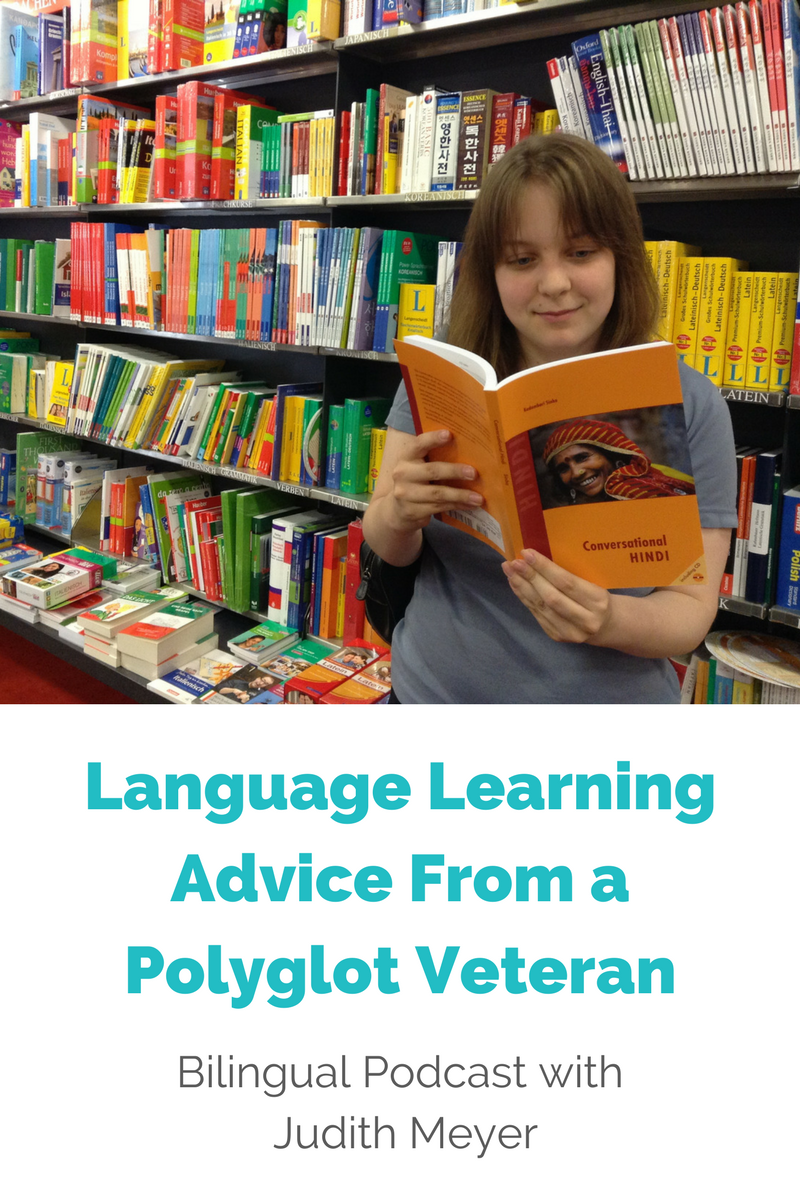
Language Learning Advice From a Polyglot Veteran (Bilingual Interview with Judith Meyer)
In this interview with passionate polyglot Judith Meyer, she shares how she learnt over 14 languages, how you can get over the intermediate plateau, and why learning any other language than English takes a little passion.
We talked about
- what excites Judith about leaving the textbook behind
- how to get over the intermediate plateau
- why using your language is the key to making progress
- what language learners can get out of events like the Polyglot Gathering
Oh...and we did it in two languages! Listen in to find out more.
Judith Meyer is well-known in the language learning world for co-founding the Polyglot Gathering event and writing several language books and courses. She's consulted by many and freely shares her own tips and experiences from learning over 14 languages.
Listen to my interview with her on the Creative Language Learning Podcast:

Happy places
We covered a lot of ground in this interview, and as a language learner you will be delighted to hear her excellent advice.
One Thing You Need to Know About This Episode
This is a bilingual podcast.
If you are not an experienced German learner, there will be some parts of the podcast that you don’t understand. But like all language learners, you’re not alone in that feeling. Try to stay with us, trust that we will come back to English again and again, and challenge yourself to become comfortable with not understanding everything.
German Learners: Click this link to view a full transcript (bilingual) of our conversation, so you can listen and read along at the same time.
The Learning is The Goal
Some people learn for practical reasons like travel or employment. to me is how both Judith and I come from monolingual households. There was no focus on languages, we both started at age 10, and yet this "late start" did not mean that it was impossible to do.
She says she used to try and invent her own writing system as a child because she found Chinese so fascinating.
Use Your Language Early
Judith says that it's important to do something that is NOT studying all the time. She says
I get easily demotivated if it's just studying a textbook
Judith books early lessons with tutors and uses her language in all kinds of ways so she can stay interested.
The Importance of Goals and Tracking
Even though Judith doesn't struggle with the general motivation to learn a language, she does keep track of her progress.
She's kept a spreadsheet on her computer for many years, and maintains a goal of doing a little more each year.
I absolutely agree with her on this, and found myself doing more with my language in the same amount of time when I started tracking. If you're interested in how learning languages works with my system, check out the Language Habit Toolkit.
How to Get Over an Intermediate Plateau

As someone who can hold a confident conversation in over five languages, Judith knows what it takes to go from a plateau to a much higher language level.
The trick is this: Your language level adapts to what you're doing in that language - in other words, you will grow with your challenges. You have to start trying to do something you cannot do.
The hard part is to start before you are ready. Judith describes how new Chinese challenges like presenting and debating tasks helped her get off the intermediate plateau.
But as Judith puts it:
If your lifestyle is such that you don't use C1 German, then good luck learning it.
You might get there for a short while, but to truly stay there you have to keep using your language.
Why Your Reason to Learn a Language Won't Be Enough
Finally, we chatted about the big reasons for learning languages. As a card-carrying member of "the tribe of those who learn a language because it's awesome", Judith has remarkable thoughts on why learning languages is important.
I don't need a reason to learn a language. I need an excuse.
By this she means that if you're looking for a reason, unless you're learning English there's often not a deep seated REASON that will keep you going for long enough to become fluent. Instead, make use of the good excuses out there, like learning for travel or for work.
But if you're just starting a language because you're fascinated, that is perfect.
After all, why would anyone learn so many languages if not for the love of them?
Understanding Germany
As the German part of a German-American couple, Judith knows that understanding other languages is a key part of learning other cultures.
She writes the blog "Understanding Germany", where she offers insights into what the Germans are like, how they think, and what's shaping the German mindset right now.
Click here to access all links and resources mentioned in this podcast
I look forward to hearing your feedback. Did you enjoy this bilingual podcast episode? Did you understand anything...and how did you feel if you did not?
New Podcast Episode: Chilled out Success with Language Surfer Ron Gullekson
““Languages are ultimately designed to bring people together.””
This episode of the Creative Language Learning Podcast is brought to you by Flashsticks - use code KERSTIN for 10% off vocabulary aids in French, German, Italian, Spanish or BSL.
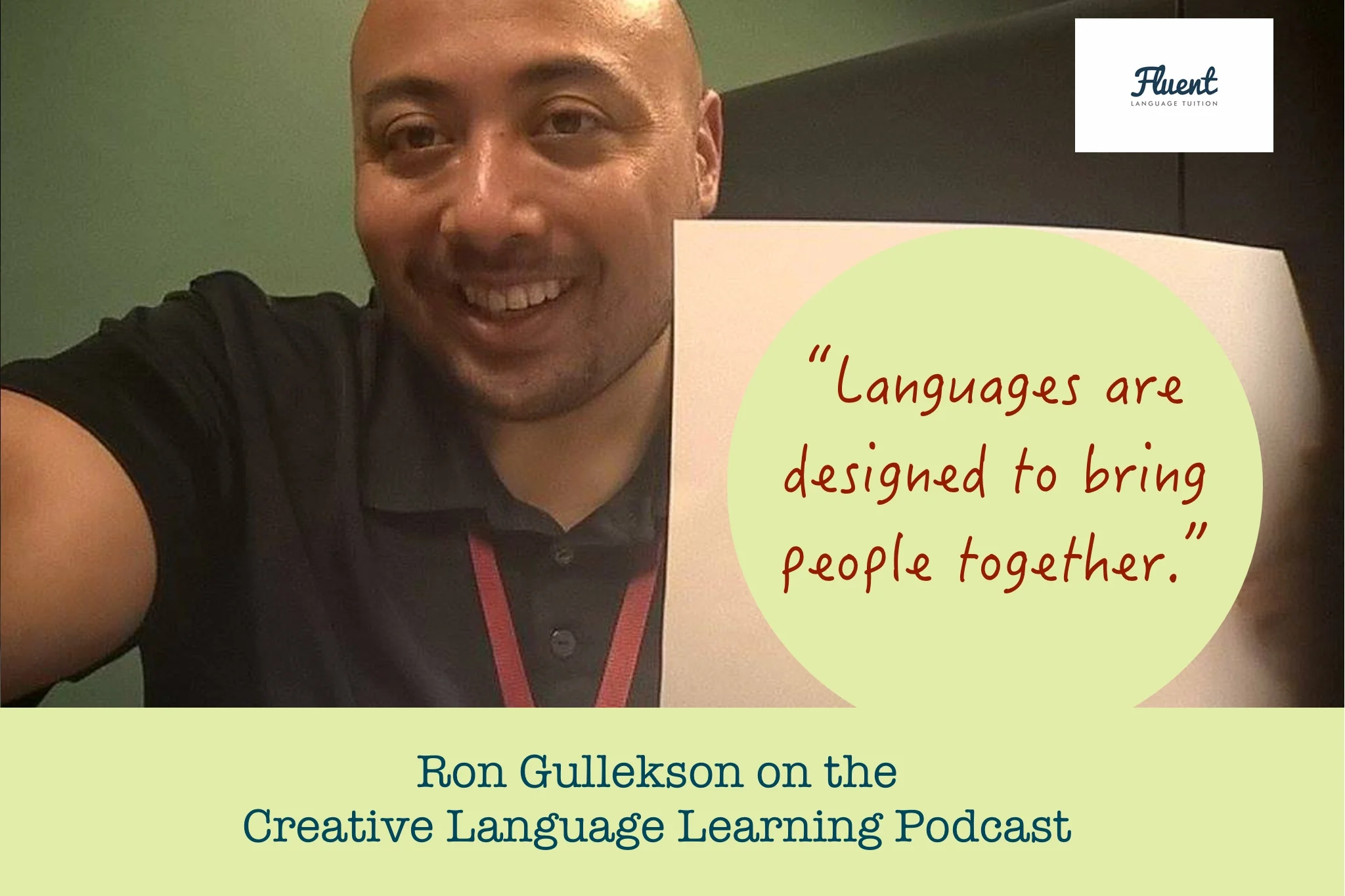
Welcome to episode 19 of the Creative Language Learning Podcast, featuring a current article of the week and an inspiring interview with one of my favourite language bloggers: Ron Gullekson from Language Surfer. His relaxed language learning attitude will make you so comfortable.
In this episode, you’ll learn:
- Why Ron's blog is called Language Surfer
- How formal language learners all know what "drawing a line down the middle" means :)
- How Ron structures his on curriculum for language learning
- Which level of language learning you might be at if you studied Arabic for 8 hours a day..for 64 weeks!
- Free listening, and how soon you can start doing this in your own study routine
- How to create your organic SRS system
"I want to get used to the idea of being lost as soon as possible."
Tips of the Week
I had secretly expected Ron to choose tip 3 as a music fan, but his own choice was tip 1: Get out and talk to people.
1) Meet up in conversation groups offline
2) Find local podcasts by switching itunes to the country's store
3) Learn with music on Spotify
Tips and Links from this Podcast

- Support the Creative Language Learning Podcast on Patreon and I’ll send you a nice card.
- Language Surfer
- Language Master Key: How to Unlock your Brain's Ability to Learn any Language on Amazon UK or Amazon US
- Forvo, a website helping you learn new pronunciations
- Readlang, to help you analyze texts and create Flashcards based on what you learn
- Readlang review from Fluent's guest writer Ricky Rutledge
If you loved this podcast episode, don't forget to check out the other episodes in the Archive and visit our sponsor Flashsticks to use your KERSTIN10 coupon code.
New Podcast: Becky Morales on Perfect Pronunciation and Having 4 Bilingual Kids

Hey, welcome to lucky episode 13 of the Creative Language Learning Podcast. In this episode, I'll be sharing a delicious foodie article and talking about Kid World Citizens with Becky Morales.
You Will Learn More About:
- How Becky went from Maths major to Spanish lover in college
- What it takes and what it means to become bilingual
- How to put together a golden approach to teaching language
- Why pronunciation can be something you master at any age if you only have time, dedication and fun
- How to create an environment where you can learn a language to any level from your own home
Article of the Week
Top Five Russian Pasta DIshes on Transparent Language
Bonus! Recipes of the Week
Tips of the Week
Out of the following three tips, Becky chose number 1 as her favourite tip - personalize your language learning experience by building your own vocab decks.
1) DIY your Memrise Courses
2) Start with Pronunciation (here's Gabriel Wyner's take)
3) Incorporate all the senses into your vocab learning habits (Science Daily)
Tips and Links from this Podcast
The Top 10 Podcasts to Help you Learn a Language
Heartwarming video of Brazilian students practicing with elderly Americans
Kid World Citizen : Becky's Website
The Global Education Toolkit for Elementary Learners, Becky's book onAmazon.co.uk and on Amazon.com (Buy through this link to support my podcast!)
New Podcast: Chris Broholm on Challenges, Information Overload and Book Club (and the Owl!)
In Episode 12 of the Creative Language Learning Podcast, I interviewed a fellow podcaster! Chris Broholm is a language learner with a big mission: 10 Languages in 10 Years!
Listen to our interview to find out more about
Who everybody's favourite owl is!
How Chris built up his own support community of inspiring language learners through the Actual Fluency Podcast
Whether there is a best way to approach language learning methods
What to think about when you set yourself an ambitious goal like Chris Broholm's 10 Languages in 10 Years
The importance of bewaring information overload
The language learning method that you absolutely must try out
And why trying it out is all that we can tell you to do!
“As long as you’re doing something, you’re doing it right.”

And most importantly...
We talk about Language Book Club and how much we're looking forward to it!
Article of the Week
Duolingo is Getting More Serious by Kay Alexander on Fair Languages
Tips of the Week
Chris chose Tip 1 as his favourite, because goal setting is still WAY undervalued in learning a new language.
Tip 1: set your chosen Fluency level (travel fluent, job fluent?)
Tip 2: Be a historical linguist
Word origins and vocab divergence can help with remembering words
Look up "etymology"
Tip 3: Sprint with the Language Challenge
Tips and Links from this Podcast
Support the Creative Language Learning Podcast through Patreon - from just $1!
Actual Fluency Indiegogo Campaign
The italki New Year Challenge: Study 20 Lessons and Win
Actual Fluency Episode 32 with me talking about how to be an independent online teacher
Russian in 10 Minutes a Day by Kristine Kershul
Thanks for reading this article on Fluent, the Language Learning Blog. If you are feeling stuck right now, why not subscribe to Fluent and check out our language book shop.



Struggling with listening? Discover realistic tips, challenge prompts, and the best tools for improving your listening skills as a self-guided language learner