

9 Great Websites For German Beginners
Looking for inspiration and great courses to help you learn the German language? Here are 9 great websites that will help you learn German
Pop quiz - Which one of these is your favourite reason to learn German?

You fell in love with a German speaker
You fell in love with the atmosphere of a beer fest or a Christmas market
You have not yet tasted the greatest bread on this Earth, but you’d really like to, and you’ve heard the bakery only offers it to German speakers
Your company works with German clients and their English is so good it’s embarrassing all you know is jawohl ein Bier bitte
You want to visit Germany and get a taste of the wonderful nature, forests, skiing, castles, Roman history, medieval town centres, comfortable trains, inviting restaurants, fairy tale rivers
There are no wrong answers here. ALL of the above are fantastic reasons to get started learning the German language. I have been teaching and sharing German language and culture for five years, and today I’m sharing some of my favourite resources for beginners.
Make Your German Sound Amazing
My free mini-guide to speaking German is out now. It's called Make Your German Sound Amazing and will give you the best tips and 26 key phrases to make you ready for any conversation. Pop your details into the form below to join my email list and get the guide immediately!*
Check out 2 or 3 of these resources and make sure you bookmark them to visit again and again!
Great German Learning Websites
Beautiful German castles and Germany.travel
Sometimes it's necessary to check out of verb tables and remember why you chose to learn this language in the first place. What better way than to dream of hiking up beautiful hills and discovering romantic castles? Castles beat cases, after all.

Mein Weg nach Deutschland
This is a great project from the Goethe institute. Where would we be without them! Follow the story of Nevin, a newbie in Germany (who excitedly photographs pretty much anything on her mobile phone). The videos are available with and without subtitles and each episode has practice exercises too!
Deutsch Plus and Jojo sucht das Glück
There are some truly great telenovelas out there, designed especially for German learners. Lovers of retro Germany will like Deutsch Plus, the story of shy TV intern Nico from Romania - it's vintage 1996 work. Even better - it's suitable for starters from day 1. For improvers, Brazilian student Jojo will be a fun resource.
Listening: Radio D
Another suitable resource for beginners right from day 1 - Radio D is an audio course. Nice plot and a very well supported website with grammar hints and word lists make this resource a go-to page for German learners of any age.
Dictionary: LEO
No German learner can do without LEO - it must be one of the best online dictionaries around! Language searches available in both directions, 7 supported language pairs with German, audio pronunciation and a well-attended forum finding even the most obscure expressions make this a bookmark no-brainer.
TIP: Read more on how to use a dictionary like the most successful language learners
German Uncovered
Learn German the natural way without complex grammar explanations and boring lessons. This course is based on a story, so you’ll be reading and having fun as you progress to level A2 at high speed.
Speak German Like a Native
If you find spoken German hard to understand, you need this course. This is my 5* masterclass course for all levels. No other course digs into the sounds of the German language, giving you the confidence to even say Eichhörnchen and Wechselstrom like a native.
Got More To Add?
The German learning community out there is always growing, and I’d love to hear what you’ve uncovered online.
Leave a comment if you know where to go for grammar that makes sense, or the best Swiss expressions.
What To Do When Duolingo Gets Boring
After 3 months of learning Spanish with Duolingo, Luka has had enough and wrote to me asking how to move forward. Listen to my response in this episode of the Fluent Show.

Every other week on the Fluent Show, I put aside a little time to answer your listener questions. Email your question to me at kerstin@fluentlanguage.co.uk or tweet it to @thefluentshow
Luka asks:
I have been learning Spanish for 3 months. I started learning with Duolingo and was really into it, and recently I have been using a textbook as well but have become really demotivated - not because I give up, because I am bored of duo lingo. I’m tired of the way it’s trying to teach me and I don’t feel like I’m progressing. [..]
My question is, if I’m not using duo lingo, what can I actually do to learn Spanish? I’ve looked everywhere and all the websites have a lot of ‘tips’ but not an actual guide saying things like resources to use etc.
Does that sound familiar?
Listen to my answer and the best tips on how to learn a language here:
How To Refresh Your Duolingo Experience
Duolingo is a small app with a big promise, and largely it keeps its promise because it’s a game and it does correct you right in the lesson. Duolingo is nice enough, but it can become a monotonous experience and it sounds like you’re hitting a wall
Tips for dealing with Duolingo boredom - in Duolingo!
Get on the web version so you can read explanations (more about this here)
Restrict yourself to a few minutes a day - how about Duolingo while waiting for your kettle to boil or your bus to arrive?
Try out one of the in-app clubs so you can compete with your friends and compare progress.
Duolingo is great, but…in all these scenarios, you’re still reacting to a screen and you maintain your sense that you don’t have a plan. So let’s address the other issue: Motivation!
How To Refresh Your Whole Language Learning Experience
Most projects, be they language learning or dieting or a new job, start with enthusiasm and optimism. You have reasons why you’re doing this.
But that initial motivation, that burst, does not last. Motivation is cyclical: It leads to an experience of success, and then that boosts you on to work through a boring period, and then you have another success experience. So in a way, you’re not having that experience of success.
How To Create A Sense Of Progress And Success
In order to feel successful in a predictable, sustainable way, you need to learn how to set good goals for yourself. Your success must be more than a vague sense of progress, it has to be “I achieved what I set out to do".
Your practical goals - I call them Path Goals - need to be SMART: Specific, Measurable, Achievable, Relevant/Realistic…and whatever people say the T stands for. I go with Time-Bound.
I also advise learners to work with the 4 core skills listening, speaking, reading and writing.
Your start is to set yourself goals, think about where you want to be and what that looks like. Get specific! And then ask “what do I need to do to get there?"
Your goals can totally include Duolingo and your text book, but I would advise you to start where you are. Right now where you are is bored with no sense of progress. So your goal has to be:
Excited about Spanish learning
Feeling like I’m getting somewhere
So what will help you answer those two questions? That’s the interesting bit.
Example: Learning Spanish For Travel

In a coaching session, this is what we’d explore. What are you into? What is interesting you about Spanish?
Let’s say you’re dreaming of walking the Camino de Santiago in Northern Spain. So you’re interested in travel, you dream of speaking Spanish to the locals there, to have the right words to talk about your religion and spirituality, and to feel confident sorting your own food and accommodation.
That’s your Vision goal - the big, inspiring thing you dream of.
To get a sense of your Path Goal, ask yourself how much time you have and what you want to tackle first. Let’s say it’s ordering food and learning about Northern Spanish food.
Your 3 month goals could be
to cook a meal for yourself
to role play a restaurant scenario with a tutor
to know 50 words for food items
to study a restaurant menu
to listen to 10 podcasts so you can understand the words
to pronounce every place name on the Camino.
These are specific goals. They’re way less boring than doing Duolingo forever in the hope you’ll finish a skill tree, because they are YOURS.
No app or textbook is leading you now because your routine is becoming personal. The next question? What do I need to get there? Duolingo becomes a part of the journey, rather than your leader.
No, a short-term goal approach won’t teach you all of Spanish instantly. But that’s because that doesn’t exist. Language is a long-term game.
Yes, you will have to think differently. But this is how to fire up your motivation and keep going.
The Language Habit Toolkit
If you want to learn more about this, the Language Habit Toolkit is designed to help you set up exactly this way of thinking and create a solid language learning routine.
There’s even a Resource Manager worksheet included, in which I’ve listed exactly what you need to set up a good and supportive set of resources. Duolingo is a good start, but I’d advise you add an input resource and a set of reference material.
A few final tips:
Practice with people, either native speakers or at least by finding like-minded folks. Feeling like you’re on your own with this makes motivation harder to maintain. Come and join our Facebook group for check-ins every Saturday.
I actually spoke to you Luka and you mentioned you’ve listened to Spanish music. That’s so awesome! Always look for interesting input from real life like stories, music, conversations. Lyrics are great for interest.
Always consider how far you’ve come - being aware of your progress from a few months ago is an instant cure for feeling like you’re getting nowhere.
For Spanish Learners
You can find my curated list of resources and articles for Spanish learners at www.fluentlanguage.co.uk/for-spanish-learners.
The Fluent Show is supported by LiveLingua, where you can have your first Spanish lesson entirely for free. I tried it out, and spoke Spanish for a whole hour. And they have many other languages available like German, French and Russian. Get your free lesson by clicking here.
Episode Links

7 Tips For Learning A Language From Your Girlfriend or Boyfriend
If I had 5p every time I read someone telling someone else that the best way to learn a language is to "get a native speaking girlfriend", I think I could retire at 35. But don't get me wrong: having a native speaker on hand at any time of day certainly has its advantages.
Today, you'll hear from English teacher Nick Vance, who is in the lucky position of having that girlfriend. So, how's it working out?
If I had 5p every time I read someone telling someone else that the best way to learn a language is to "get a native speaking girlfriend", I think I could retire at 35.
Today, you'll hear from Nick Vance, who is in the lucky position of having one of those handy "native speaker girlfriends". So, how's it working out?
In this article, Nick will share 7 useful tips to help you understand how to learn a language with your sweetheart.
Learning German from My Girlfriend

As an American living in Berlin with my German girlfriend, Natalie, people constantly ask me the same questions.
Where did you two meet? In Costa Rica - surprising, but true!
Did you move to Berlin to be with her? Nope - it took us many years to finally fall in love.
Is she the reason you speak German fluently? Jein - a combination of the German words “ja” and “nein” (“yes” and “no”).
Natalie did indeed play a huge role in helping me reach fluency in German. However, she didn’t actually teach me very many things about the language. She “just” talked with me for thousands of hours, giving me the opportunity to practice. I learned German grammar, vocabulary, and pronunciation in a language school, through self-study online, and in private one-on-one lessons.
Your partner can be a big help in you learning their native language, but it’s important to be careful about expecting too much from them. Today I’m going to share some concrete tips for how you and your partner can work together to learn each other’s languages.
Speaking Practice with Your Partner
Once you’ve reached about B1 level, you can start having real conversations about real topics. Awesome! This is the area where your partner can really help you, and you can start making lots of progress really quickly.
Set Up Some Rules
There’s no right or wrong way to set up your plan on how and when you speak which language, but they need to be agreed upon by both people. For a long time Natalie and I would alternate weeks. Every Sunday night at midnight, we would switch from English to German, or the other way around. Yes, I would sometimes look at the clock and switch at exactly 12:01 am, mostly just because I thought it was funny. Other people might agree to always speak Spanish at the dinner table, or to speak French on weekends, or whatever. My advice: the simpler the plan, the better.
Focus on What You Say (Not How You Say It)
This part of your language practice should be fun and focused on improving your ability to quickly form sentences and communicate them. Avoid correcting the other person during this time. If you BOTH agree, take some time maybe once a week for the native speaker to share some feedback on what you can improve.
But what if you’re still at level A1 or A2?
Honestly, your conversations aren’t going to be that interesting. However, you can still have some short conversations to get used to the idea of speaking in that language. For example, speak in the language for the first 5 minutes when you see each other in the evening. Depending on your relationship, that’s often how your day was and what you did. You’ll quickly get used to this vocabulary and be able to feel more comfortable in the language.
Your Partner Isn’t the Perfect Teacher
Teaching Is a Skill
I’ve heard lots of stories from friends in similar relationships who were frustrated that their partner wasn’t able or willing to teach them their native language. Some of them even blamed their partner, calling them lazy, uninterested, or simply unhelpful. The more likely explanation is that teaching is a skill that not everyone has.
If you’re just starting out in a language (A1 / A2 level), your partner probably doesn’t understand pedagogically how to teach a language. Should you first focus on learning all of the tenses and their uses? How important is learning vocabulary compared to improving your pronunciation? What books are appropriate for your level? These are questions that a normal person just doesn’t know about their language.
Additionally, your partner might not know exactly how their language works, even if they speak and write it perfectly. For example, what’s the difference between “while” and “during” in English? I only learned this when I became an English teacher. Before then I always used the correct word, but it was just because it “felt” right.
Different Roles
In your relationship, you and your partner have specific roles. Perhaps you make vacation plans while your partner just shows up at the airport and follows your lead. But that’s made up for by your partner cooking dinner every night for the both of you. Everything is great as long as both sides are comfortable with the arrangement.
Teacher-student is a very special role that comes with lots of built-in assumptions. If your partner (acting as the teacher) tells you to work on your pronunciation of “th,” and you don’t practice it, what happens? If the person is just a teacher, that disappointment, frustration, or embarrassment is left in the classroom. If that person is also your partner, it can bleed into the rest of your relationship and cause bigger problems.
Give It a Shot!
This all is not to say it’s impossible. If you both are willing, give it a shot. Maybe your partner is actually quite good at explaining when to use what tense, and you develop a teacher-student relationship that doesn’t does lead to any other issues. Learning the language from your partner could then be a great way to spend time together and strengthen your bond.
But if it feels like a struggle, don’t force it. Accepting this limitation is important for preventing feelings of resentment.
Their inability to teach you about subordinate clauses shouldn’t be seen as a lack of love for you, but only their inability to teach subordinate clauses.
It’s not language learning, but I recently learned how to drive in Germany - both the rules of the road and how to drive stick shift. I’d been driving automatic cars in the US for 15 years, but had never needed to drive stick.
Once again, I hoped to profit from Natalie’s knowledge. We decided that she’d try to teach me a couple of times, and if it didn’t work out, I’d pay for driving lessons from a professional. Even though she had no experience as a driving instructor, she was an amazing, patient teacher, and it was a fun experience. And now I can drive in Germany!!!

No More Borders
No more borders - Nick (from the US) and Natalie (from the former East Germany) on a bridge that once marked the border between East Germany and West Germany.
Being a Supportive Language Helper
If your partner is trying to learn your language, you have a unique responsibility. Even if you don’t act as their teacher or even speak the language with them, there are things you can do to help or hurt their progress. Here are some things that you should definitely avoid.
Don’t Make Fun of Their Language Ability
I’m sure you don’t intend it to be mean, but little comments or jokes can make your partner feel self-conscious and kill their desire to speak. This doesn’t mean you can’t laugh about the language, but just be extra careful you’re laughing with them. Like when I asked Natalie if she had used the helicopter to clean our apartment (I meant vacuum cleaner but had somehow mixed up the words Hubschrauber and Staubsauger… they still sound similar in my head, but apparently in no one else’s).
Don’t Talk about How Difficult Your Language Is
This is usually meant in a helpful way, letting your partner know that they shouldn’t feel bad about struggling or to show them how impressed you are at the progress they’ve made. However, it often comes across as “why are you even bothering.” I can’t tell you how many people have told me that German is “so hard” and “impossible for foreigners to learn.” Yes, there are some things that take time to learn or do 100% perfectly, but there are millions of immigrants in Germany today proving them wrong. If you need help with this language in particular, Kerstin has some great German learning resources.
Conclusion
In the end, there are plenty of ways your partner can help or hurt your language learning. Find out what works best for the both of you, and don’t try to force something that isn’t working. They might be the love of your life, but that doesn’t mean they have to be your language teacher.
If you’d like some more tips, check out Kerstin’s article about helping your partner learn your native language. And I’d love to hear about your experiences.
Share with me in the comments your ups and downs about learning a language from or teaching a language to your partner. Especially if there were any hilarious misunderstandings!
Nick Vance is originally from the U.S. but has been living in Germany the last 6 years. For him, being able to speak German fluently has been a key to feeling at home in Berlin. Learning a language as an adult is much different than learning in school, and Nick uses his own personal language learning experience when he teaches English. You can find more information about his online English lessons at Skype Englisch (in German) or English with Nick (in English).
Welsh Is Not English: How The Welsh Language Fought Back
When I first moved to the UK 15 years ago, I thought Welsh was dying out.
But did you know that people went on protest marches and even got ARRESTED to keep this language alive?
In this podcast episode, I bring you interviews with Welsh learners and teachers, sharing their own passions for this ancient language.
What do you know about the Welsh language?
When I first moved to the UK 15 years ago, I thought Welsh was dying out. I moved to England and never considered that people in the UK speak more than English. To me, the Welsh language was a relic from the past.
But did you know that people went on protest marches and even got ARRESTED to keep this language alive?
In this podcast episode, I bring you interviews with Welsh learners and teachers, sharing their own passions for this ancient language.
Where is Wales?
Wales is one of the four nations that make up the United Kingdom. It's a small part of the UK, located on the western border of England.
It covers just over 8,000 square miles (20,722 km²) - that's about the same size as Massachusetts in the USA or half the size of Switzerland. In other words, Wales is not big.
But it's certainly old. The Welsh history begins with the Celts, and just like the bigger British island, it has a whole history of invasions and territorial fighting on its record. Here is a great timeline guiding you through the last few millennia of Welsh history.
What Is Welsh Like? A Quick Introduction
In terms of the language, Welsh is what was here first. The Celts spoke a dialect that would later evolve into Welsh, so this language is now considered a treasured part of Welsh identity.
Welsh is a Celtic language in the same family as Irish Gaelic, Scottish Gaelic, Cornish, and Manx. It's spoken in two dialects these days: Northern and Southern Welsh.
The Welsh alphabet is quite similar to the English one, with a few quirks:
- The vowels of Welsh are a, e, i, o, u, w, and y
- There are no letters j, k, q, v, w, x, and z
- There are extra consonants, namely ff, ll, rh, and ph
The Welsh letters also mutate when you start putting words together, which means that the first letter can change in all kinds of fun ways. Apart from that though, it's quite easy to pronounce because Welsh is phonetic, meaning what you see is what you get.
Find out more about how the language works and looks on Omniglot
But let's get back to our story.
How Welsh Came Under Attack
Welsh was spoken im Wales for thousands of years. But as the nation entered a turbulent period of history in the 19th century, the MPs and lawmakers in London started to wonder "why are these Welsh folks so much trouble?"
They decided that the existence of Welsh must have something to do with it, and introduced harsh measures to start eliminating Welsh from public and school life. On the podcast, you will hear from Morfydd who remembers her mother avoiding Welsh like the plague...for a pretty good reason!
Fighting For Welsh Language Rights

"I want to live in Welsh" - a campaign poster from the Welsh Language Society
So between the 1800s and the 1950s, the use of Welsh decreased and English became seen as the standard language for any part of the UK.
In the 1960s, the activist language group Cymdeithas Yr Iaith was founded. This group campaigned for many of the things that are now bilingual standards in Wales, such as road signs and official council letters, television, and customer service in Welsh.
Many members were arrested, asserting their willingness to go to court for language rights. And over time, this fight for language rights has led to significant changes in law and society. The Welsh language hasn't died out.
In the podcast, you'll hear from Steffan Webb who shares how Cymdeithas yr Iaith started and what they got up to. Until today, the Welsh Language Society remains an active protest movement and Steffan explained that they see a long way to go.

Bilingual Driving Directions
in Wales
What's Next For Welsh?
The Welsh government is a devolved government, meaning they have the power to determine some of what happens in their area. But officially, Wales is still a part of the United Kingdom and they don't get to determine which languages are spoken.
The Welsh language became an official language in Wales in 2011, with the government act stating:
This means it must be treated no less favourably than English.
Fighting For Welsh Language Rights
Welsh is now on Duolingo, and there is a hugely popular online course called Say Something in Welsh, focusing on enabling learners to speak everyday Welsh.
This means that there are independent Welsh learners everywhere in the world now, learning online just like me (read about my own langauge progress).
Do You Want To Give Welsh A Try?
Every Welsh learner becomes a part of this bigger story. If you're interested in trying the language for yourself, you can download my Welsh Starter Kit here and kick off with the resources that I used to start my own journey.
Before you listened to this podcast, what did you think about Wales? Did you already know this story of protesting in the streets for language rights?
Share your thoughts in the comments - I'm excited to hear from you.
And if you want to support the Fluent Show podcast, make sure you subscribe so you always get the latest episodes and share the story with a friend who loves languages too!
#clearthelist March2018: Update On My Welsh Language Progress
Learn how I am studying languages in this monthly goals update. This month marks the first time you're hearing about my Welsh progress since like 2016.

Welcome to a new kind of blog post here on Fluent - I’ve long been aware that my last personal language update was about a year ago and this blog should include more of that good stuff. So this month, I am joining Clear The List, a monthly language strategies update.
You may have heard me talk to Lindsay about it on the Fluent Show - Clear The List is open to everyone and gives us support and accountability by sharing regular language learning goals and stories.
Every month, I set my goals using the Language Habit Toolkit worksheets and I put them up behind my computer screen to keep them in mind. And this month, I had a LOT of them in Welsh. The mindset was not to expect too much from myself, but to remember the direction I was aiming for.
What Happened in March 2018?
Up to the 11th of March, my working life was dominated by sharing and co-running the absolutely wonderful Women in Language conference. If you were there, you’ll know that we had a great time.
Click here to read my full debrief of Women in Language, which includes
- the 5 most important lessons I learnt at the conference
- some behind the scenes details
- tips for you on what to do if you also want to be a speaker
- lessons learnt on what we’ll do differently next time.
Special Guests
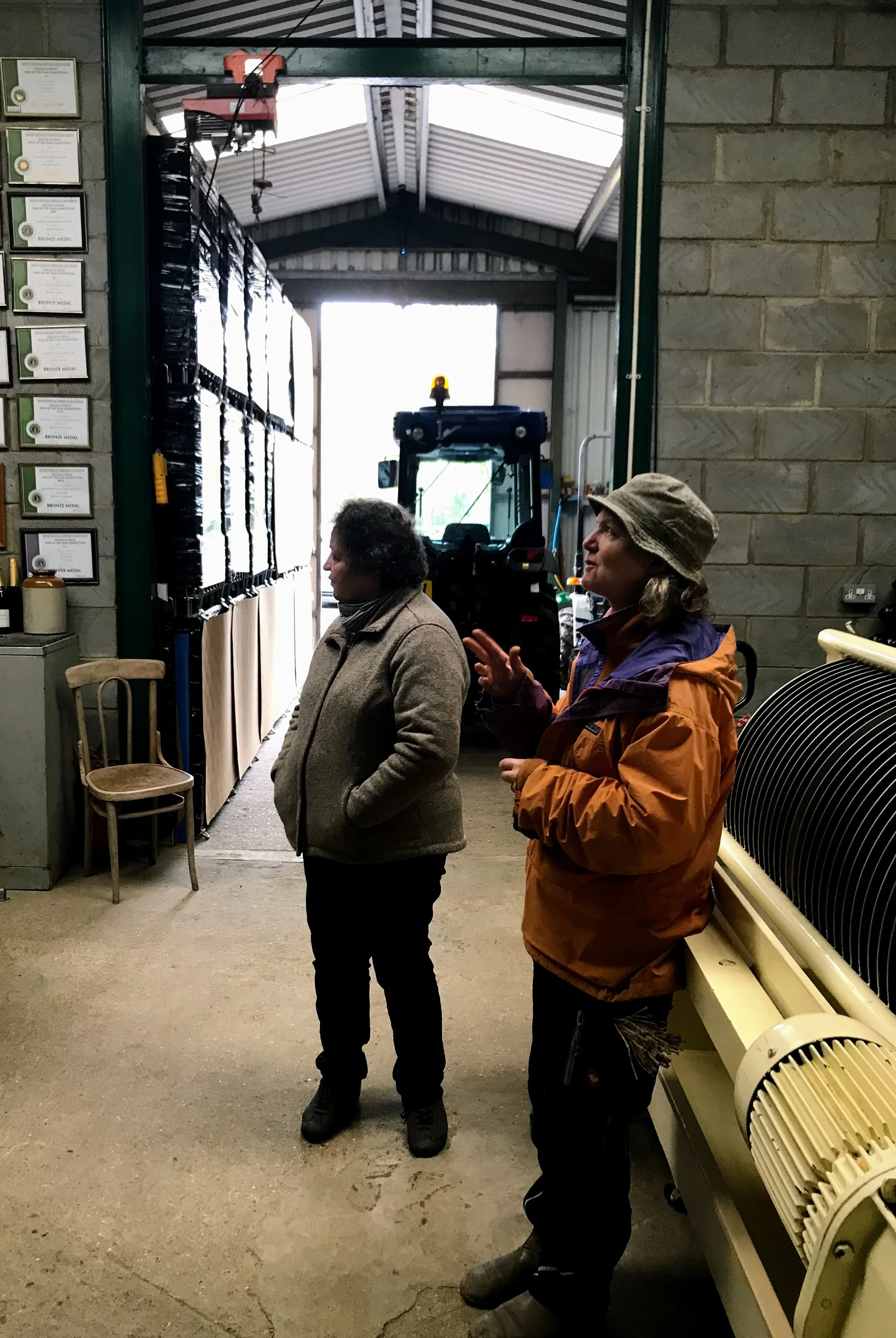
English Vineyard Visit
Right after the conference I experienced another unusual week with lots of spoken German as my parents came to visit me in Canterbury. We had a great time pottering around and I did my usual interpreting job and listened to my husband’s German.
If you are visiting Canterbury and want to practice your German on a city tour, do give me a shout through the contact page.
Highlight: A visit to an English winery, showing me that I know more winemaking vocab than I expected. My parents are winemakers, so this always seems to happen when they’re around.
One more unusual event was the news that my favourite ever English teacher had passed away. He was one of a few English teachers who influenced and inspired me as a teenager, spoke lots of English in class, and shared the literature he loved. What a reminder to appreciate those who inspire us.
The Fluent Show

March marked one month since the Creative Language Learning Podcast became the Fluent Show. Thank you so much for listening!
Here’s my favourite episode from this month: In Language, Are Apps All Amazing? Are All Apps Amazing?
My Welsh Goals For March 2018
With so much going on, did I even get ANY language study done?
Contact Goal
On an everyday basis, I have one important goal: Have contact with my target language. So I have a lot of mini-sessions on Duolingo, Clozemaster, with flashcards, with vocab lists. I read tweets in Welsh, look out for books, anything. All these different strategies add up to consistent slow progress, but they are the basis for all other goals.
I track my contact with Welsh using the Streaks app on my iPhone. In March, I logged 22 days of contact.
Here are the Path Goals I set, and how it went:
Listening
Watch S4C every other day for 10 minutes: Did this about three times. I’m not sure my devices have S4C set up to be accessible as easily as possible. Also, 10 minutes is an awkward length for a TV show. I did watch some YouTube clips, so I’ll take that into account as a goal format.
Listen more when I’m having real conversations Listening is the conversation habit I always need to bear in mind. I had one tutor conversation in Welsh this month, and I did shut up and listen to her a little more than usual. A good job with room for improvement.
Transcribe 1 Song from Listening What was I thinking? Not really a goal I’ll go back to.
This month, I resubscribed to the Pigion podcast and listened to the weekly episodes. I discovered that they provide a vocab list with each episode and reviewed the vocab before I start the episode.
Speaking
I wanted to work through the Sylfaen (Foundation Level) exam questions to practice speaking at a higher level, but found the exam paper so boring that I never went back to it. But on the positive side, I feel confident that I could tackle all of the questions on it, so I’m now definitely on that level or even further ahead.
My other goal was to get to 30 minutes all-Welsh conversation, so my tutor session was a 60 minute time slot, and we had nearly a full hour of Welsh conversation. Very exciting! ✅ I also got to the halfway point on Say Something in Welsh level 2.
Reading
Read articles or 1/2 book page in Welsh every 2 days. The goal here was to acquire new vocabulary, and build up my reading capacity to “more than a tweet”. I don’t think I read enough, partly because I don’t know where to find easy Welsh articles online.
Writing
My goal was to write 1/2 a page and share it with my tutor 3 times. This is where the MAGIC happened. Inspired by one of the talks at Women in Language, my writing practice evolved to include poetry in my target language. It’s really fun - one of the best ways I’ve found to use Welsh creatively.
I haven’t shared with my tutor yet, but I did post the poetry on Instagram with #languagpoems and I’ll keep going.
My other goal was to complete Chapters 7-9 in my Grammar exercise book - I’m halfway through chapter 8, so that one’s trucking along.
Goals For April 2018
In Welsh: My listening skills are a little behind and I don’t understand as much as I would like to, so the focus will again be on this core skill so I can get into a routine.
My goals in Welsh are:
Have 3 natural conversations with my tutor/exchange partner and listen carefully: My next tutor session is already booked so I reckon I can smash this one and I’ll continue aiming for 45-60
Practice Welsh listening by playing with no-subtitle TV, and reviewing the Pigion podcast vocab before I listen: These are about listening comprehension, the area I need to improve right now.
Write a longer Welsh poem and continue playing around with different poetry formats: Last month I tried a Haiku. Maybe this month I’ll attempt poetry that rhymes. I’m loving my poetry focus this month and am also reading more of it in English and German.
Finish my easy reader novel and read all of the latest Lingo Newdyy magazine - these are all offline, can anyone recommend easy Welsh websites?
Book a day in Wales: I keep looking at this list of courses and not booking, even though they’re so cheap. Time to dive in!
One Last Thing: Other Languages
This month, I also dabbled in Swedish and spoke a lot of French. I’m still on the hunt for my new language to play with.
Swedish was the first language in which I've tried an official Memrise course and I'm so impressed. WAY better than the usual.
So now we’re caught up, let me assure you that future Clear The List articles will be a little shorter. I will continue setting goals using the framework of 4 core skills, and I always use the Language Habit Toolkit to set and track quality goals that will challenge me without driving me crazy.
Is there anything you’re curious about?
How was your month?
 \
\
If you want to join the linkup and share your own goals for the month, hop on to Clear The List with Lindsay Williams and Shannon Kennedy. Would love to see what you’re up to!



Struggling with listening? Discover realistic tips, challenge prompts, and the best tools for improving your listening skills as a self-guided language learner