
9 Of The Best Podcasts For Learning French
Want to fit French listening practice into your life? Try one or two of these podcasts for French language learners, which range from podcasts for French beginners all the way to French immersion podcasts and courses.
Podcasts are great for language learning, because you can listen anywhere, discover new voices, and find great teachers at a low cost.
Do you ever find it difficult to fit French listening practice into your life?
Do you want to understand native French speakers?
Podcasts are a great way to add a little French listening practice into your day-to-day life. They are free, and can accompany any part of your day: driving a car, washing your dishes, doing laundry, working out, reading, and more.
Need to kickstart or refresh your French grammar so you can understand these podcasts even better? Don’t miss my course Finally Get It in French Grammar!
Quick Primer: How Do Podcasts Work?
If you’re curious about podcasts, but not quite sure how they work, here’s what you need to know:
You can subscribe for free to podcasts on your phone, tablet, or computer
If you use an iPhone or iPad, go to the Podcasts app. If you’re on a Mac, use the itunes directory
On a PC or Android device, try the Stitcher app for a quick and easy start
Subscribing means you’ll always have the latest episode ready and waiting for you as soon as it’s published
French is a great language for learning by podcast. There is a big selection, so I’ve gone and selected 9 of the best shows for you to discover.
Need to kickstart or refresh your French grammar so you can understand these podcasts even better? Don’t miss my course Finally Get It in French Grammar!
Beginner Level


FrenchPod101.com (InnovativeLanguage)
FrenchPod101 from InnovativeLanguage covers any level you can think of from basic to advanced French. With enticing titles and interesting themes for each episode, you’ll never get bored.
The dialogues are presented by engaging presenters and the hosts Céline (a native speaker) and Sam (a fluent speaker) cover both cultural and grammatical aspects clearly and concisely. On the website you can sign up for the premium content to access spaced repetition flashcards, PDF lesson notes, and a community forum for a subscription fee.
The lovely people at Easy Languages bring us a global phenomenon of language learning videos on YouTube. In their podcast of the same name, you’ll hear friendly, relaxed conversations. You can join their Patreon membership to get full transcripts and additional worksheets.
If you want to find out more, here is my interview with the founders.
Learn French By Podcast is a bilingual podcast in English and French. It's presented by two hosts, one French speaker speaks in French and one English speaker who explains what the French speaker said. The audio is very clear and easy to follow and the format is great for beginners and intermediate learners. It eventually progresses from basic conversations to intermediate and advanced-level dialogues about a variety of everyday topics. PDF guides are available on the website.
Intermediate/Advanced Levels

News in Slow French is an intermediate level podcast. This podcast covers world news, grammar, and expressions and slows down all the dialogue to make it easier to process what you hear. Every episode breaks down a point on grammar and vocabulary.
On the News in Slow French website there are transcripts for each episode, plus added resources and quizzes on French grammar, expressions, pronunciation.
One Thing In A French Day describes the daily life of author Laetitia in France. Each podcast episode covers different events in her life such as going to the bakery, shopping, going to the gym, seeing friends, among others. Her French is spoken very clearly and crisply at a regular speed and her words is easy to understand. Laetitia publishes articles every Tuesday, Wednesday, and Thursday. I certainly recommend this one for intermediate and advanced learners of French!

This podcast by Radio France International (RFI) is a show that is designed for intermediate and advanced learners of French. It's a genuine news broadcast from the French radio station, but read a little slower so you can become comfortable listening to French.
The episodes each have the most important news of the day in just 10 minutes (great for those who don’t have a lot of time in the day!) and come with a free online transcript.

The Français Authentique podcast is great for upper intermediate and advanced learners of French. It’s total immersion combined with lots of interesting topics and explains idiomatic and colloquial expressions. It is the companion podcast to the popular French learning website Français Authentique by Johan Tekfak.
Jonan is not just a super likeable host, but he also invites you to join his life and adventures by talking about them in French.
French Video Resources

Yabla is a video-based learning platform with bilingual subtitles and integrated dictionaries. The subtitles are interactive, which is a really cool concept! Check out how Yabla works in detail by reading my full review.
Yabla is great for all levels from basic to advanced. There is a free French podcast available with plenty of videos to watch.
Great French Audio Courses

Coffee Break French, a podcast from Radio Lingua Network, combines French language lessons with a lot of useful information about French food, culture, French speaking countries, and so on.
My favourite part of the podcast is the chemistry between relaxed and charismatic host Mark from Scotland (who is fluent in French) and French learner Anna from Scotland. The segments are also great: Cultural Correspondent has great cultural advice, and Grammar Guru discusses grammar in a clear, easy-to-understand way.
Advanced Learner Tip: Native French Podcasts
The easiest way to access native French language podcasts is to go to iTunes and switch your country setting to “France”, “Belgium”, “Switzerland”, “Canada”, or any other French-speaking country.
There’s no restriction on your switch, and you’ll be able to access all podcasts in the same way that listeners from France can. One of my favourites is Whisperos, a native French podcast getting into every little detail about Game of Thrones.
How to Learn More French
For more tips that will help you learn the French language, check out my special blog page for French learners.
This article was updated on 9 August 2022.
French for Beginners: The Partitif
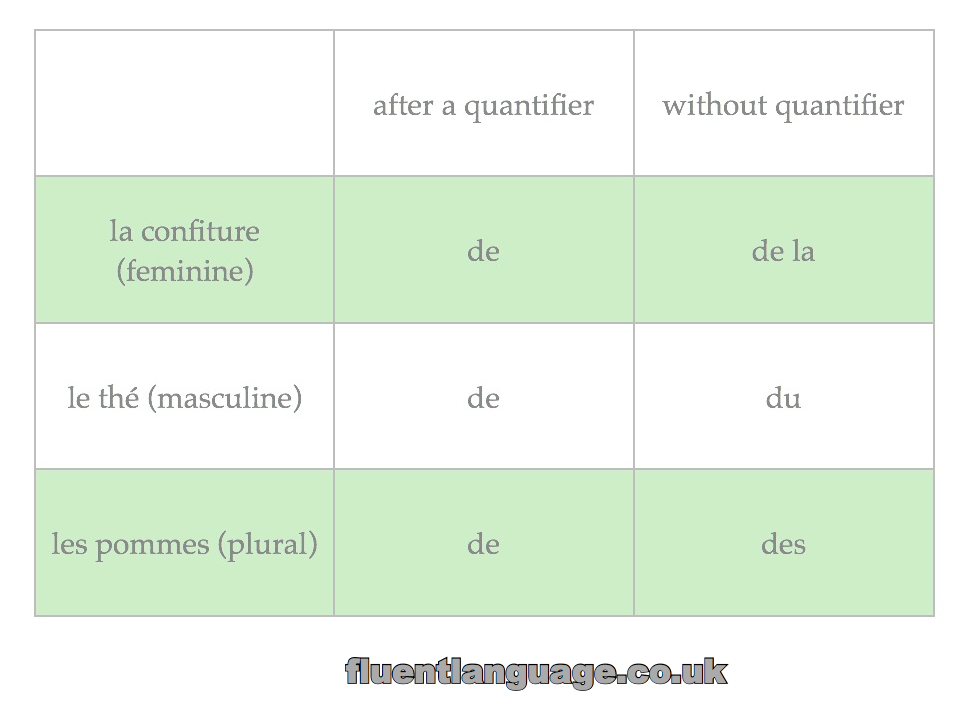
Hello online French learners! Welcome back to the new French on a Windowsill lesson. This time, I've taken the "partitif" and explained it for you. Don't worry - I didn't know it was called that either. In simple words, learning the partitif will teach you how to use de (of).
Watch the Video first
So, just to recap:
There are two types of uses of "de".
- After a quantifier - then it's just "de"
Examples of Quantifiers can be: un kilo, deux pots, 100 grammes, assez, beaucoup, peu...anything that gives you an indication of how much you have. - Without a quantifier - then it changes and becomes a contracted article
Use this Printable Sheet for your notes
Hope you enjoyed today's lesson again, and let me have your thoughts guys. I always look forward to hearing from you!
French for Beginners: Negation (How to say No)
Hello everybody, I hope you're having a lovely day and you are getting comfortable for the next instalment of French on a Windowsill. Here we are at episode 6! How have you liked the grammar hints so far? Is there anything you would like me to cover in the next video?
Today, the little grammar course covers the topic of negation, meaning how to say not, no longer and never. Let's get watching:
Here are some of your reference materials:
When you use the negation in a sentence, just follow this pattern:
SUBJECT + ne + VERB + pas/plus/jamais + ANYTHING ELSE
Examples:
Je ne travaille pas à Londres. (I don't work in London).
Alexandre ne sort jamais. (Alexandre never goes out.)
Il n'y a plus de pain. (There is no more bread.)

These are the three main forms of negation in French.
French for Beginners: Regular Verbs
This post contains the video and reference materials for French on a Windowsill Ep. 05: The one about regular verbs. All standard conjugations are covered. Enjoy!
Hello everybody, after a bit of a break for learning to talk a bit in 25 languages, French on a Windowsill returns! And this time, I bring you regular verbs. Along with some useful grammar hints about verbs, conjugation and stem + ending, you will get to know the 3 groups of regular verbs in French.
Here are your reference materials:
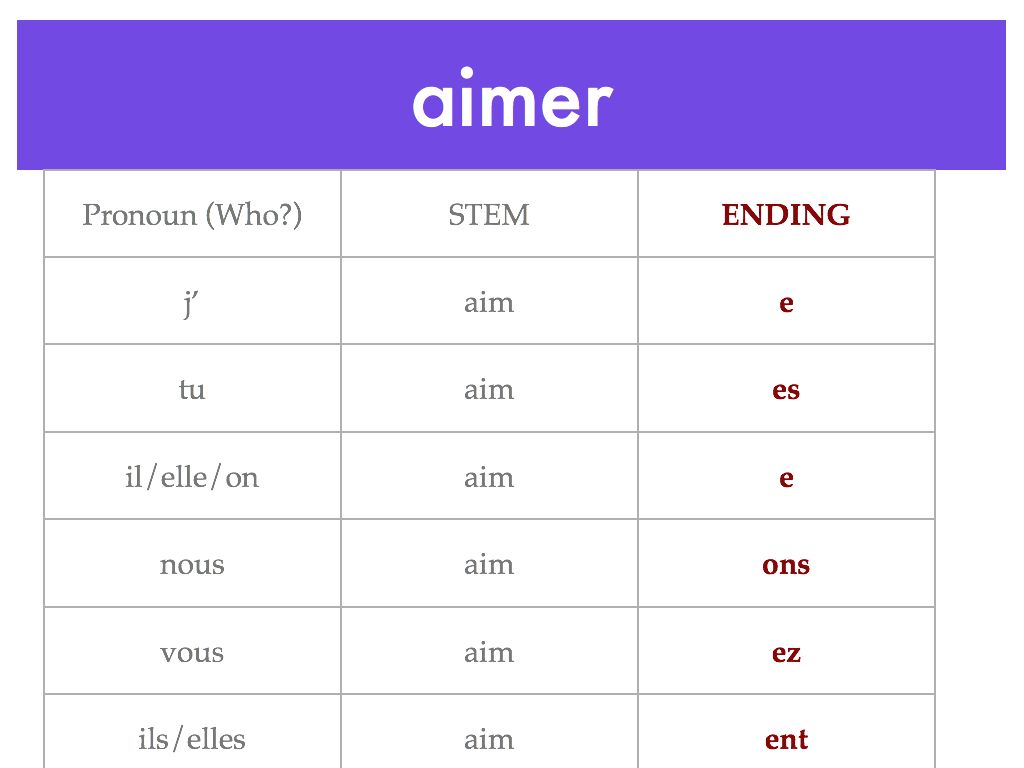
Regular verbs that end in -er
These are pretty common, and the conjugation is fairly conistent as well with a few small exceptions for pronunciation. You follow this ending pattern:
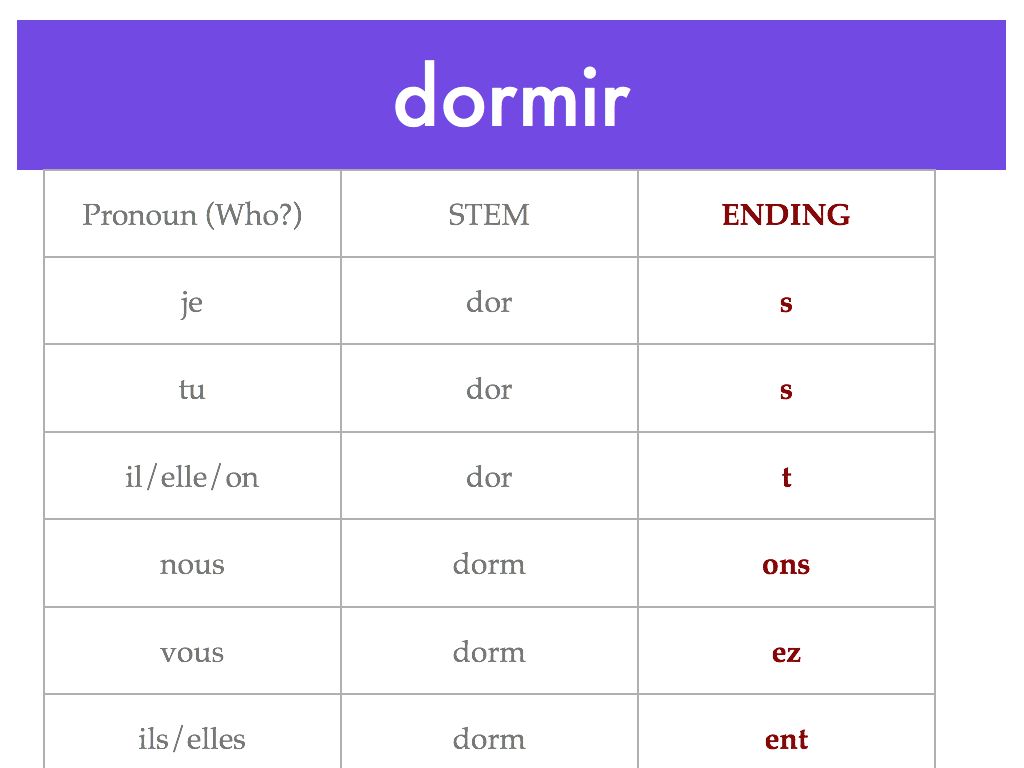
Regular verbs that end in -ir
What's interesting here is that in the first three conjugations you actually chop a letter off the stem, but then it comes back. If your stem ends in a vowel then you add a double s in the last three conjugations (for example with the verb finir). Here is the pattern:
Regular verbs that end in -re
The third group does have a regular conjugation, but do spend some time hugging the dictionary or Bescherelle* because a lot of verbs that end in -re are irregular. Need I say être or faire? But don't be disheartened, because knowing the regular conjugation means you couldn't go too wrong even if you tried:

Some of the vocab featured in this episode:
chanter (to sing)
aimer (to love)
manger (to eat)
commencer (to start)
tutoyer (to be on "tu" terms)
dormir (to sleep)
finir (to finish)
attendre (to wait)
déscendre (to descend, to come down)
Let me know what you think of the episode, as always I hope that this is useful stuff and I'm really looking forward to any feedback you guys might have.
*You may have noticed the link to the Bescherelle leads you to Book Depository. This is an online bookstore fit to rival the big A in many ways, often their prices are in fact lower, and international delivery is largely free. Click on the little link above if you want to support French on a Windowsill as an Affiliate.



Struggling with listening? Discover realistic tips, challenge prompts, and the best tools for improving your listening skills as a self-guided language learner