

9 of the Best Resources for Starting to Learn French Online
Learning French is easy with these fantastic resources for beginners! From online course packages, to TV shows and online tools, we've got you covered.
Bonjour! French is one of the most widely spoken languages in the world and is still considered more important than English in some European countries. It is one of my most advanced languages, so I'm bringing you over 30 years of French learning experience today!
Whether you dream of wandering the streets of Paris and Montréal, or you want to boost your career in fashion, the following resources will be everything you need to start parler français!
This article contains some affiliate links which are marked with *.
9 Top Resources For Learning French Online
1. Finally Get It in French Grammar
This super friendly course is created for French beginners or "false beginners" - those who studied a while ago and don't feel like they got anywhere.
You will learn how to speak simple, correct, beautiful French together with me (and my kitty). Featuring easy explanations of the all the grammar you’ll need for your first year of French, this course will help you eliminate embarrassing errors with a friendly and informal tutor – yep that's me.
The course comes with offers 2 hours of videos, live discussions and worksheets to ensure you have understood everything correctly.

2. TV5 Monde
TV5 Monde is an international TV channel in French, which offers its own language courses and practice under the ‘Langue Française’ tab. From digital libraries to dictionaries and video classes, this website is perfect for beginners who aren’t quite sure where to begin.
3. Intrepid French: Master French Phrases for Travel FAST

Michele from Intrepid Guide is your go-to guide for language and travel! Her resource is the BEST if you want to pick up the language for travelling to France, Québec or beyond.
I love Michele's course because it comes with so many highly valuable extras like a menu guide and great pronunciation guides. Click here to learn about Mastering French for Travel - FAST*
4. Bite Size French*
Bite Size is the perfect companion for anyone who has learnt a little French and wants to become better at listening and speaking.
The course is packed with beginner-friendly dialogues that you can listen to in just a few minutes a day to become better at French without having to work harder and harder.
4. Bon Patron
If you’ve gotten a tiny bit comfortable with the French language, Bon Patron is the perfect place to practice those writing skills. Bon Patron is a French autocorrect tool; you can practice your writing skills by typing in sentences and have it correct the grammar and spelling errors it can find. The perfect tool to practice those sentences you’ve learned!
5. French Language TV Shows
French TV shows are an excellent way to implement some new vocabulary and to get used to the sound and pronunciation of French. Get the DVD, and you'll also have bilingual subtitles to play with. Try these shows for a start:
Les Revenants* is a supernatural drama which follows the residents of a small French alpine town as they come to terms with a series of mysterious and unbelievable occurrences: a small group of deceased men, women and children suddenly return from the dead and attempt to re-join the family and friends they left behind years before. As if this wasn’t creepy enough, the town also begins experiencing a series of chilling local murders.
Spiral* is the perfect show for you crime lovers out there. When the badly beaten body of a young Romanian woman is discovered on a Parisian rubbish dump, we are suddenly plunged deep into a murky underworld of prostitution, drugs, business, politics and justice. If you like CSI, The Wire and 24, chances are you’re gonna like Spiral.
7. Crack the Grammar Code Course
Ready for communicating in French at a higher level? Let this training be your secret!
This resource is not specific to French, but it will definitely help your English speaker brain untangle the complicated grammar of French! Crack the Grammar Code is a step-by-step guide to efficient language learning, giving you the foundation for fluid French learning without having to memorize grammar all the time.
8. Bescherelle Complete Guide to Conjugating 12,000 French Verbs*
One of the hardest parts of learning a new language can be getting used to all the rules for conjugating verbs – sometimes they don’t make sense to the beginner eye!
This is where the Becherelle Complete Guide comes in; it includes just about every verb you can think of. If it’s not in there, chances are you won’t need to know it! This language course book has been around since the mid 80s, I used it in the mid 90s, and is just as useful today as it was back then.
9. BBC Languages French
BBC has a fab introductory hub for learning French. Some of the content is aimed at children, making it perfect for beginners! They have a test where you can test your skills and determine your level, links to French TV and radio websites. Some of it is a little outdated, but still worth a look for the amount of free resources you can find here.
By measuring your progress, you’ll soon feel so confident about speaking French that you won’t be able to wait to talk to someone.
Recommended French Courses
Finally Get It In French Grammar (for beginners and refreshers)
Bite Size French (focus on sentences, not explanations)
French conversations (for intermediate to advanced learners)
Struggling to get ahead in solo language learning?
Join my free training, the Little-Known Secret to Success in Language Learning.

Grammar ♥︎ Practice en Français: 3 Sweet Grammar Tricks for Learning French
Quick Fix French! Learn the essentials of the French language, explained in simple terms that will have you creating your own sentences in minutes. For this post, I have selected 2 grammar topics for beginners and 1 bonus for improvers, meaning that you’ll get a great tip no matter your level.
Get out the macaroons for some sweet sweet grammaire française. Yes, I've got a treat for those of you wanting to take grammar ♥︎ to the next level with a dip into the grammar of a language I've learnt for 20 years: French!
In this post, you're going to learn the essentials of the French language, explained in simple terms that will have you creating your own sentences in minutes. It is a collaboration with Shannon from Eurolinguiste, who is covering how to use the past, present and future tenses in French on Monday.
I have selected 2 topics for beginners and 1 bonus for improvers, meaning that you can study French and crack on with this post at any level.
Beginner Step 1: Using French Nouns
Sentences are made up of different components, but only two of them are absolutely essential:
- the verbs, telling you about an action
- the nouns, telling you who is acting and what they're acting with
French nouns come in two gender variations, feminine and masculine. The gender isn't really visible in a word itself, but it has an impact on the kinds of words you have to use around it.
Firstly, make sure you use the right article with your noun. There are definite articles (like the English the) and indefinite articles (like a or an). You have to choose the right one according to the gender, so here it matters if your noun is feminine or masculine.

Quick Guide to French Articles
New French learners find themselves frustrated when they realize that the gender of a noun is impossible to predict. I agree - it's tricky! There are a few good rules, however, that you can use to spot helpful patterns. For example, words ending in -ment are always masculine, words ending in -tion are always feminine, and according to my French teacher in secretary school "all the bad things are masculine" (divorce being her example!).
What If You Get The Gender Wrong?
There is no big penalty for getting the gender of a French noun wrong as you are learning the language. In fact, it happens all the time! Native speakers will not think that you are bad at speaking French because even after decades it's still difficult to assign every gender correctly.
###Easiest "language hack"?
Just ask: ...c'est féminin où masculin, s'il vous plaît?" (is that feminine or masculine, please?).
Beginner Step 2: Using French Adjectives
Adjectives are descriptive words (for example grand meaning big), and you can just pick those out of the dictionary...and then you've got to change them according to the gender of the noun. So in other words, the adjective will always be looking to its big noun brother.
A bit like that kid who hangs out with the stronger kid in the playground and shouts "yeah right!" every time the big kid does some thing. The agreement also covers if the words are in singular and plural
Here is a Quick Reference List of the Rules
- When the adjective usually ends in a consonant, the feminine version will take an extra -e at the end. For example, grand and grande.
- When the adjective ends in -eux, the feminine version will be -euse. For example, heureux and heureuse.
- When it ends in -ien, the feminine version is -ienne, like in ancien and ancienne.
- When the adjective already ends in an -e, it doesn't change. Bonus! For example, jeune stays the same.
Here are a few helpful words that you can use to describe yourself. The French for "I am" is Je suis. Try it!
Quelle est ta nationalité? - Je suis..
- anglais, -e - English
- allemand, -e - German
- américain, -e - American
- canadien, -ne - Canadian
- autrichien, -ne - Austrian
French Grammar for Improvers: Contracted Articles
Shortly after learning the essentials such as nouns, verbs and adjectives, it's time to get into details. French has so many little details that make it sound prettier!
In fact, I have a French textbook from 1948 at home which was owned by my grandfather during the French occupation of Germany. And this book starts with some ground rules of French. Rule number one: Wohlklang, the principle that everything in French has to sound nice. Hah!
Here's what that has to do with French articles. You already know how to say articles from the table above. But here's something you might not realize. Every time the article connects with the words de (of/from) or à (at/to), the two little words try to connect and form a contracted article.
French Contracted Articles in 7 Minutes
Learn the details of how this works in the following video, featuring Kerstin in the summer!
So as you can see, the French grammar really strongly revolves around this idea of sounding nice...well no, actually it's all about your noun being feminine and masculine and this concept determines how the words around it are arranged. Check out Shannon's partner post to learn about the other essential in a French sentence: the verb!
How to Know if You Should Use à or de with a verb
While grammar has many rules that help us avoid memorizing, the case of "how the verb connects to the next word" has to be learnt with a good verb list or table. Those little connecting words are called prepositions, and they cannot be translated directly. When you look up one of the little ones in the dictionary, you're likely to find about 5 meanings.
So for example, "be interested in" is s'intéresser à but "look forward to" is s'attendre à, giving the French word à two different meanings. And that's just the tip of the iceberg.
I was lucky to have a teacher who put a lot of stress on learning the verbs with their connectors right from the start, so that I never developed a big gap. The verbs that connect directly to the next verb are called "pure infinitive", and the other groups are "infinitive with de" and "infinitive with à". If you're a self-teaching French learner at an early stage, do yourself a favour and study them too.
My go-to reference for everything about French verbs is the Bescherelle L'Art de Conjuguer. In my version (the German one), the relevant lists are in section 164 of the grammar part. Very handy!
Like This Post? Check Out The Full Course
If you loved this blog post, you will undoubtedly enjoy learning French with me in Easy French Grammar for Beginners.
This course contains all the explanations that I wish I had had when I first started out. It's plain and simple, putting things in straightforward terms that just make sense.
Several learners have already written to me with gratitude because the course finally helped them understand complicated concepts.
I'd love for you to try it out, and you can do so right here.
French for Beginners: The Partitif
Hello online French learners! Welcome back to the new French on a Windowsill lesson. This time, I've taken the "partitif" and explained it for you. Don't worry - I didn't know it was called that either. In simple words, learning the partitif will teach you how to use de (of).
Watch the Video first
So, just to recap:
There are two types of uses of "de".
- After a quantifier - then it's just "de"
Examples of Quantifiers can be: un kilo, deux pots, 100 grammes, assez, beaucoup, peu...anything that gives you an indication of how much you have. - Without a quantifier - then it changes and becomes a contracted article
Use this Printable Sheet for your notes
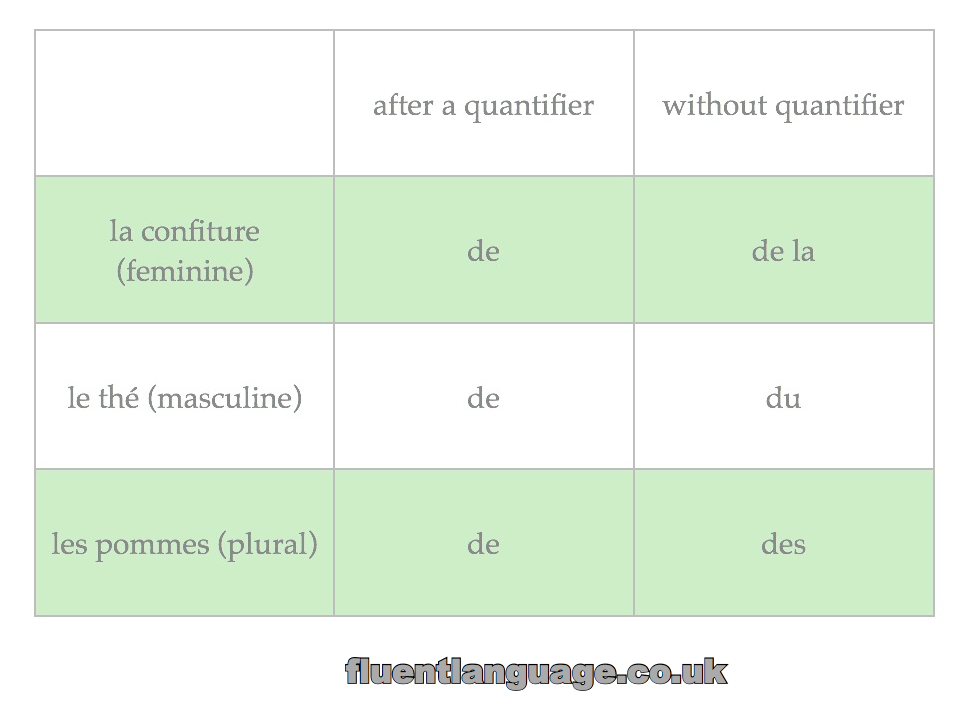
Hope you enjoyed today's lesson again, and let me have your thoughts guys. I always look forward to hearing from you!
French for Beginners: The Possessives
Welcome back, French on a Windowsill watchers! After we had a little
break and revision getting into the celebrity quiz on youtube, it's back
to the books today. Click to learn all about the use of possessives with a brand new video and handy tables.
Welcome back, French on a Windowsill watchers! After we had a little break and revision getting into the celebrity quiz on youtube, it's back to the books today with my introduction to possessives. These are the ways in which you can show what belongs to whom in a sentence.
There are two types: Determiners, which go with a word and work exactly like "my, your, his, her, our, their" in English. And then there's pronouns, which actually stand for a word - in English these are "mine, yours, his, hers, ours, theirs". Make sure you understand this difference in your own language and you won't have a problem in French!
Easy Example
"This is my mug. Where's yours?"
"Oh, mine is in the kitchen."
The word "my" is a determiner, because it goes together with the noun "mug". The words "yours" and "mine" stand FOR the mug, so they are pronouns.
And now for how it works in French
Thanks for watching!
It's important to remember that in French, the possessive will change according to the gender and number of the word after it, not the word before it.
Print or save these tables for use in your revision.

The possessive determiner

The possessive pronoun
French for Beginners: Negation (How to say No)
Hello everybody, I hope you're having a lovely day and you are getting comfortable for the next instalment of French on a Windowsill. Here we are at episode 6! How have you liked the grammar hints so far? Is there anything you would like me to cover in the next video?
Today, the little grammar course covers the topic of negation, meaning how to say not, no longer and never. Let's get watching:
Here are some of your reference materials:
When you use the negation in a sentence, just follow this pattern:
SUBJECT + ne + VERB + pas/plus/jamais + ANYTHING ELSE
Examples:
Je ne travaille pas à Londres. (I don't work in London).
Alexandre ne sort jamais. (Alexandre never goes out.)
Il n'y a plus de pain. (There is no more bread.)

These are the three main forms of negation in French.



Struggling with listening? Discover realistic tips, challenge prompts, and the best tools for improving your listening skills as a self-guided language learner