

9 of the Best Resources for Starting to Learn French Online
Learning French is easy with these fantastic resources for beginners! From online course packages, to TV shows and online tools, we've got you covered.
Bonjour! French is one of the most widely spoken languages in the world and is still considered more important than English in some European countries. It is one of my most advanced languages, so I'm bringing you over 30 years of French learning experience today!
Whether you dream of wandering the streets of Paris and Montréal, or you want to boost your career in fashion, the following resources will be everything you need to start parler français!
This article contains some affiliate links which are marked with *.
9 Top Resources For Learning French Online
1. Finally Get It in French Grammar
This super friendly course is created for French beginners or "false beginners" - those who studied a while ago and don't feel like they got anywhere.
You will learn how to speak simple, correct, beautiful French together with me (and my kitty). Featuring easy explanations of the all the grammar you’ll need for your first year of French, this course will help you eliminate embarrassing errors with a friendly and informal tutor – yep that's me.
The course comes with offers 2 hours of videos, live discussions and worksheets to ensure you have understood everything correctly.

2. TV5 Monde
TV5 Monde is an international TV channel in French, which offers its own language courses and practice under the ‘Langue Française’ tab. From digital libraries to dictionaries and video classes, this website is perfect for beginners who aren’t quite sure where to begin.
3. Intrepid French: Master French Phrases for Travel FAST

Michele from Intrepid Guide is your go-to guide for language and travel! Her resource is the BEST if you want to pick up the language for travelling to France, Québec or beyond.
I love Michele's course because it comes with so many highly valuable extras like a menu guide and great pronunciation guides. Click here to learn about Mastering French for Travel - FAST*
4. Bite Size French*
Bite Size is the perfect companion for anyone who has learnt a little French and wants to become better at listening and speaking.
The course is packed with beginner-friendly dialogues that you can listen to in just a few minutes a day to become better at French without having to work harder and harder.
4. Bon Patron
If you’ve gotten a tiny bit comfortable with the French language, Bon Patron is the perfect place to practice those writing skills. Bon Patron is a French autocorrect tool; you can practice your writing skills by typing in sentences and have it correct the grammar and spelling errors it can find. The perfect tool to practice those sentences you’ve learned!
5. French Language TV Shows
French TV shows are an excellent way to implement some new vocabulary and to get used to the sound and pronunciation of French. Get the DVD, and you'll also have bilingual subtitles to play with. Try these shows for a start:
Les Revenants* is a supernatural drama which follows the residents of a small French alpine town as they come to terms with a series of mysterious and unbelievable occurrences: a small group of deceased men, women and children suddenly return from the dead and attempt to re-join the family and friends they left behind years before. As if this wasn’t creepy enough, the town also begins experiencing a series of chilling local murders.
Spiral* is the perfect show for you crime lovers out there. When the badly beaten body of a young Romanian woman is discovered on a Parisian rubbish dump, we are suddenly plunged deep into a murky underworld of prostitution, drugs, business, politics and justice. If you like CSI, The Wire and 24, chances are you’re gonna like Spiral.
7. Crack the Grammar Code Course
Ready for communicating in French at a higher level? Let this training be your secret!
This resource is not specific to French, but it will definitely help your English speaker brain untangle the complicated grammar of French! Crack the Grammar Code is a step-by-step guide to efficient language learning, giving you the foundation for fluid French learning without having to memorize grammar all the time.
8. Bescherelle Complete Guide to Conjugating 12,000 French Verbs*
One of the hardest parts of learning a new language can be getting used to all the rules for conjugating verbs – sometimes they don’t make sense to the beginner eye!
This is where the Becherelle Complete Guide comes in; it includes just about every verb you can think of. If it’s not in there, chances are you won’t need to know it! This language course book has been around since the mid 80s, I used it in the mid 90s, and is just as useful today as it was back then.
9. BBC Languages French
BBC has a fab introductory hub for learning French. Some of the content is aimed at children, making it perfect for beginners! They have a test where you can test your skills and determine your level, links to French TV and radio websites. Some of it is a little outdated, but still worth a look for the amount of free resources you can find here.
By measuring your progress, you’ll soon feel so confident about speaking French that you won’t be able to wait to talk to someone.
Recommended French Courses
Finally Get It In French Grammar (for beginners and refreshers)
Bite Size French (focus on sentences, not explanations)
French conversations (for intermediate to advanced learners)
Struggling to get ahead in solo language learning?
Join my free training, the Little-Known Secret to Success in Language Learning.

Grammar ♥︎ Practice en Français: 3 Sweet Grammar Tricks for Learning French
Quick Fix French! Learn the essentials of the French language, explained in simple terms that will have you creating your own sentences in minutes. For this post, I have selected 2 grammar topics for beginners and 1 bonus for improvers, meaning that you’ll get a great tip no matter your level.
Get out the macaroons for some sweet sweet grammaire française. Yes, I've got a treat for those of you wanting to take grammar ♥︎ to the next level with a dip into the grammar of a language I've learnt for 20 years: French!

In this post, you're going to learn the essentials of the French language, explained in simple terms that will have you creating your own sentences in minutes. It is a collaboration with Shannon from Eurolinguiste, who is covering how to use the past, present and future tenses in French on Monday.
I have selected 2 topics for beginners and 1 bonus for improvers, meaning that you can study French and crack on with this post at any level.
Beginner Step 1: Using French Nouns
Sentences are made up of different components, but only two of them are absolutely essential:
- the verbs, telling you about an action
- the nouns, telling you who is acting and what they're acting with
French nouns come in two gender variations, feminine and masculine. The gender isn't really visible in a word itself, but it has an impact on the kinds of words you have to use around it.
Firstly, make sure you use the right article with your noun. There are definite articles (like the English the) and indefinite articles (like a or an). You have to choose the right one according to the gender, so here it matters if your noun is feminine or masculine.

Quick Guide to French Articles
New French learners find themselves frustrated when they realize that the gender of a noun is impossible to predict. I agree - it's tricky! There are a few good rules, however, that you can use to spot helpful patterns. For example, words ending in -ment are always masculine, words ending in -tion are always feminine, and according to my French teacher in secretary school "all the bad things are masculine" (divorce being her example!).
What If You Get The Gender Wrong?
There is no big penalty for getting the gender of a French noun wrong as you are learning the language. In fact, it happens all the time! Native speakers will not think that you are bad at speaking French because even after decades it's still difficult to assign every gender correctly.
###Easiest "language hack"?
Just ask: ...c'est féminin où masculin, s'il vous plaît?" (is that feminine or masculine, please?).
Beginner Step 2: Using French Adjectives
Adjectives are descriptive words (for example grand meaning big), and you can just pick those out of the dictionary...and then you've got to change them according to the gender of the noun. So in other words, the adjective will always be looking to its big noun brother.
A bit like that kid who hangs out with the stronger kid in the playground and shouts "yeah right!" every time the big kid does some thing. The agreement also covers if the words are in singular and plural
Here is a Quick Reference List of the Rules
- When the adjective usually ends in a consonant, the feminine version will take an extra -e at the end. For example, grand and grande.
- When the adjective ends in -eux, the feminine version will be -euse. For example, heureux and heureuse.
- When it ends in -ien, the feminine version is -ienne, like in ancien and ancienne.
- When the adjective already ends in an -e, it doesn't change. Bonus! For example, jeune stays the same.
Here are a few helpful words that you can use to describe yourself. The French for "I am" is Je suis. Try it!
Quelle est ta nationalité? - Je suis..
- anglais, -e - English
- allemand, -e - German
- américain, -e - American
- canadien, -ne - Canadian
- autrichien, -ne - Austrian
French Grammar for Improvers: Contracted Articles
Shortly after learning the essentials such as nouns, verbs and adjectives, it's time to get into details. French has so many little details that make it sound prettier!
In fact, I have a French textbook from 1948 at home which was owned by my grandfather during the French occupation of Germany. And this book starts with some ground rules of French. Rule number one: Wohlklang, the principle that everything in French has to sound nice. Hah!
Here's what that has to do with French articles. You already know how to say articles from the table above. But here's something you might not realize. Every time the article connects with the words de (of/from) or à (at/to), the two little words try to connect and form a contracted article.
French Contracted Articles in 7 Minutes
Learn the details of how this works in the following video, featuring Kerstin in the summer!
So as you can see, the French grammar really strongly revolves around this idea of sounding nice...well no, actually it's all about your noun being feminine and masculine and this concept determines how the words around it are arranged. Check out Shannon's partner post to learn about the other essential in a French sentence: the verb!
How to Know if You Should Use à or de with a verb
While grammar has many rules that help us avoid memorizing, the case of "how the verb connects to the next word" has to be learnt with a good verb list or table. Those little connecting words are called prepositions, and they cannot be translated directly. When you look up one of the little ones in the dictionary, you're likely to find about 5 meanings.
So for example, "be interested in" is s'intéresser à but "look forward to" is s'attendre à, giving the French word à two different meanings. And that's just the tip of the iceberg.
I was lucky to have a teacher who put a lot of stress on learning the verbs with their connectors right from the start, so that I never developed a big gap. The verbs that connect directly to the next verb are called "pure infinitive", and the other groups are "infinitive with de" and "infinitive with à". If you're a self-teaching French learner at an early stage, do yourself a favour and study them too.
My go-to reference for everything about French verbs is the Bescherelle L'Art de Conjuguer. In my version (the German one), the relevant lists are in section 164 of the grammar part. Very handy!
Like This Post? Check Out The Full Course
If you loved this blog post, you will undoubtedly enjoy learning French with me in Easy French Grammar for Beginners.
This course contains all the explanations that I wish I had had when I first started out. It's plain and simple, putting things in straightforward terms that just make sense.
Several learners have already written to me with gratitude because the course finally helped them understand complicated concepts.
I'd love for you to try it out, and you can do so right here.
3 Useful Resources to help you improve your French (even if you last studied 10 years ago)
Mesdames et messieurs, I bet you have dreamed about the French many times. It’s the ultimate language of chatting in a streetside café or watching the sun go down over the Atlantic. But French is for more than just a fun trip, as it counts as a leading world language too.
French is the World's Most Taught Language
The French Embassy to the US delivers a fun fact about France in its list of 10 Reasons to Learn French:
French is the only language, alongside English, that is taught in every country in the world.
This means that almost all of you readers are likely to have studied French at some point in your lives. It's widely taught in Europe, in Africa and throughout Northern America. Personally, I have been learning French since I was 13, which makes it nearly 20 years now. It’s not always been easy, but throughout my journey I learnt a lot of awesome things and also realized that I can make myself understood in Belgium, Canada, Northern Africa and the Caribbean with the power of this one language. For example, the language became so much easier for me once I started explaining grammar as much as I was studying it. The French grammar can be aligned very well with that of German, my own native language. Explaining grammar became a true specialty of mine. If you check out my course Easy French Grammar for Beginners, you’ll get a glimpse of how I do it. I put the learner first and focus on outlining how things work step-by-step.
Why Study a Language on Udemy?
I often mention Udemy as a great resource for online learners on this blog, and as an instructor and student on there I do know what I am talking about. The courses on Udemy are open to a learning community of over 6 million people. In my experience, this has made for a great advantage to the learner. You get to study your language whenever you want and repeat lectures as many times as you need, but at the same time there’s a tutor available in all courses so you can ask questions and get them to add more materials.
Step 1: Review the Basics
As students join my Easy Grammar for Beginners course and progress through it, I see that many of them were using the course as a refresher. The videos allow you to rediscover older concepts that you may have learnt in school, and to reframe them if things didn't make a lot of sense first time round. This is a wonderful way of getting back into a language. You're not overwhelmed, but you get that sweet confidence of taking the second chance. I particularly enjoyed the many reviews and emails I got from the students who said that they had a little bit of confidence, but felt their French skills improved by 100% after they took these classes. Many have asked me what the next step could be, so in today's blog post I wanted to recommend three great next step resources for intermediate French learners.
Step 2: Add a Course about French tenses

Once you are confident making basic sentences about yourself, your environment and your immediate situation, I bet you'll want to grow that knowledge into something new. That's where the verb tenses come in. You’ll need tenses for sophisticated communication. In my own French grammar course, I focused on the A1 range of grammar. That only contains three tenses, but in fact there are about 11 of them to master in French. So once you have covered and understood those essential nouns, verbs and adverbs from the Easy Grammar for Beginners course, you should cast your eye over tenses.
If you like the Udemy platform then stay and try French Tenses Simplified by Scott McElroy, a fellow French teacher on the Udemy platform. Believe it or not, this one is actually his smaller course. It covers those 11 important moods and tenses you need after finishing level A1. Scott’s course would be the perfect follow-on if you are ready to move on from my French grammar explanations.
The French Tenses Simplified course is about three hours long altogether, but Scott has broken his lectures up into simple 3-6 minute videos. It features even more than just French tense explanations. He has thrown in simple vocabulary lists, a full PDF of the course contents and four downloadable Flashcard videos. So all in all, we’re talking about a nice package.

Screenshot from the course French Tenses Simplified.
I tested this course on an aspect of French grammar that I’ve always found particularly difficult: the subjonctif. He approaches the topic with an awesome sense of humour right from the start. The topic is first introduced in English, with examples that demonstrate when you would use a subjunctive in French. To me, the reasons made a lot of sense here. There are clear rules saying “if this…then that” which is always something we can appreciate in language learning. The lecture could have benefited from slowing down, though. I paused it and took notes several times. Regarding the way the subjonctif is formed, Scott’s lecture was a fab refresher. I got 83% in the final quiz. Maybe you can beat me?
Instructor Quality
Right from the start, you will know that you’re in good hands with Scott’s explanations. He gives a comprehensive course overview to introduce you to French verbs and has SUCH good pronunciation.The thing that really stood out to me was the ease and friendliness in Scott’s explanations. When you take a video course, it’s always important that the instructor sounds like a nice person. You have to listen to these people for ages! Scott comes across as a friendly guy who knows his stuff right from the first second. I really liked his narration and French accent.
Beware if you’re a Beginner
If you’re a French beginner and have never come across any concept of French grammar before, then watch out. The course French Tenses Simplified goes through a few big concepts at qui[e a fast pace, so that I imagine a complete beginner would have to stop and slow it right down. For example, the course presumes that you as a learner are aware that French has three different verb groups for the regular verbs. It also skips over the fact that some verbs are irregular and introduces only three of the irregular ones.
So count yourself advised: If you are a complete beginner, start with my course Easy French Grammar for Beginners (it’s from zero) and arm yourself with a Bescherelle book before diving into the tenses.
Step 3: Analyze Content from natural French sources
In the past 2 steps, you saw options to use for getting your French grammar level up to a pretty sophisticated standard. And moving on from video courses, it is time to start working with real life content. Skip the Rosetta Stone and instructional podcasts, and start looking for simplified French sources. One of France's cultural strengths is their dedication to la bande dessinée (comics), and you'll find some awesome content in books like Astérix. I also like the TV5Monde series for French learners a lot.
The key at this stage is that you should make sure you recognise the stuff that you have learnt in the first two stages. Grammar is not abstract, it is a key to how language really works. If your goal is to speak confident and sophisticated French, then you must observe how the rules are applied in real life. That's what learning in step 3 is all about, so watch out for all those little things. Where is the speaker using an adverb? Can you spot all the -ent endings on 3 pages of comic? Challenge yourself here and enjoy playing language detective.
Do this at any Stage: Leave the Classroom, enter Life
After you have masstered the hard study and review of French grammar concepts, it's really time to break out from the classroom. If you have not done so already, start opening your eyes to natural French language content online and offline. With such a huge international community of speakers, it's incredibly easy to find a meetup of the French community. Here in Lancaster, I have practiced my French at the local language café and you can find your nearest European café at www.languagecafe.eu. The next opportunity to meet native speakers is just 3 miles away at the local university. Where is your nearest college hosting international students? If you aren't aware yet, consider contacting their student associations and meeting the French society or even the International Society. And should all those outreach options fail, there's always the language exchange option through sites like Speaky or Interpals.
For some learners, it's a confidence builder to get the grammar foundations ready before you go out.But in the grand scheme of things, I encourage you to go out and play in the real world right from day 1. You don't have to challenge yourself to do the impossible or conduct a full French conversation straight away, but I encourage you to make sure you keep an eye on the real world while you're studying the basics.
Re-Cap of the Resources in this Article
If you are a complete beginner in French, you'll benefit from my own online course Easy French Grammar for Beginners, which you can pick up for $19 using the code MOTIVATION.
More advanced learners looking for the next step should check out French Tenses Simplified by Scott McElroy. It's a fast-paced refresher course run by a positive online teacher, and contains lots of extras. For more help with the tenses and verb forms, the Bescherelle books can be invaluable. Get the course at 70% off if you use the link tiny.cc/step2french.
At several intervals in this process, you should work with real native content. Don't go out reading the French newspapers right away, but ease yourself in and find simplified French language resources.
No matter where you are at in your French study, you should also make sure that you make time to see those actual real French speakers. You can find them on each continent and everywhere around you in international hotspots like universities and meetups.
The key is to get a good balance between video or book study and real life experimentation. And of course, I wish you bonne chance with that.
Behind the Scenes of Fluent's first Online Course: French Grammar for Beginners
I'm very excited today as I finally get to write to you blog folks about my new online course. Its subject is French Grammar - the full thing covering everything students need to complete level A1.
This awesome course contains 15 video lectures, documentation, quizzes and a certificate at the end - a full package which would cost you hundreds in personal tuition, but is on sale for $75. You can register for a place on French Grammar for Beginners today at the special rate of just $35 - this expires on 31 January.
In today's blog post I'd like to tell you how and why the course came into being.

Why make an online course?
French Grammar for Beginners is a new venture, which my longest-standing readers may know as what started out being French on a Windowsill. I would grab my laptop and record my own explanations of grammar, using the best grammar book I know as an inspiration. In these video lessons, I combined my teaching experience with my own memories of learning French. The idea was to give simple examples and make sense of grammar in a way that everyone can understand.
French on a Windowsill was great. The videos on YouTube received excellent feedback, my favourite of all being a simple:
You are AWESOME.
This stuff felt great, but I strongly believed that I could offer students a better product, and not at private tuition prices. Last year I started investigating how I could turn French on a Windowsill into a full-on English course. I considered selling the videos on my online shop along with supporting materials, or teaching them as a series of webinars, but none of these offered my learners the great interface, fast download speeds and easy access that I wanted them to have.
Eventually, I came across Udemy. The website is a modern marketplace for online courses and allowed me all the things I wanted to offer, like:
- Mobile apps so learners can watch my videos wherever they are
- A choice of watching the videos online or downloading them
- The option of offering you quizzes and progress reports
- A forum for student questions, which I can respond to publicly
So last year I started working on creating this new version of French on a Windowsill. I recorded two extra lectures to make a full A1 level grammar course complete, I added transcripts and exercises and uploaded all my videos to Udemy. There is also a new intro video, which I will share with you in today's post.
French Grammar for Beginners was complete - my first online course!
Why is it important to learn as part of a community, even online?
1) Groups keep you coming back
Learning is one of the many things in life that are more fun when they are shared, and many students start making friends on forums and courses which keep them coming back, talking about the subject and ultimately succeeding at their missions.
2) You're going public
Think about the last time you endeavoured to make a big change, like following an exercise routine or cutting Facebook time out of your day. Did you enlist others on your journey or perhaps even
3) More answers means better answers
The internet is built on collective knowledge - it's democratic, and you can benefit from this every day. A question asked or experience shared in a course like French Grammar for Beginners can be viewed and answered by everyone on the course and just like on Quora this has the potential to give you access to the best and brightest learners and teachers, anytime.
So, here's my conclusion:
The combination of community and learning at your own convenience was the perfect way of showing you how online learning is changing the world. It used to be a privilege for scholars at Harvard and Cambridge, but now online learning is bringing in a new age.
How you can study on French Grammar for Beginners
Guys, I hope I've shared my reasons and also ignited your understanding of how online courses can help you learn a language at really great value. For just $75, French Grammar for Beginners features
- 15 video lectures with tables and documentation for downloading
- Revision quizzes to test yourself
- Great mobile learning through the iPad and iPhone apps
- Support from me - I am checking this course regularly and personally responding to student queries
Here's the special offer for you
French Grammar for Beginners will be available with at a price of just $39 all January (standard price $75). Yes, for one more week only. This is less than the price of a single language lesson and a discount for only 50 learners. Just click and have a look around Udemy to see the video intro and free preview lectures.
I'm a learner on Udemy myself, by the way. To preview own course and find out which classes I am taking online, please check out my Udemy profile.
Fellow language learning bloggers: If you would like to promote this course while earning as an affiliate, you can send me a quick email today and I'll provide further details.
French for Beginners: The Partitif
Hello online French learners! Welcome back to the new French on a Windowsill lesson. This time, I've taken the "partitif" and explained it for you. Don't worry - I didn't know it was called that either. In simple words, learning the partitif will teach you how to use de (of).
Watch the Video first
So, just to recap:
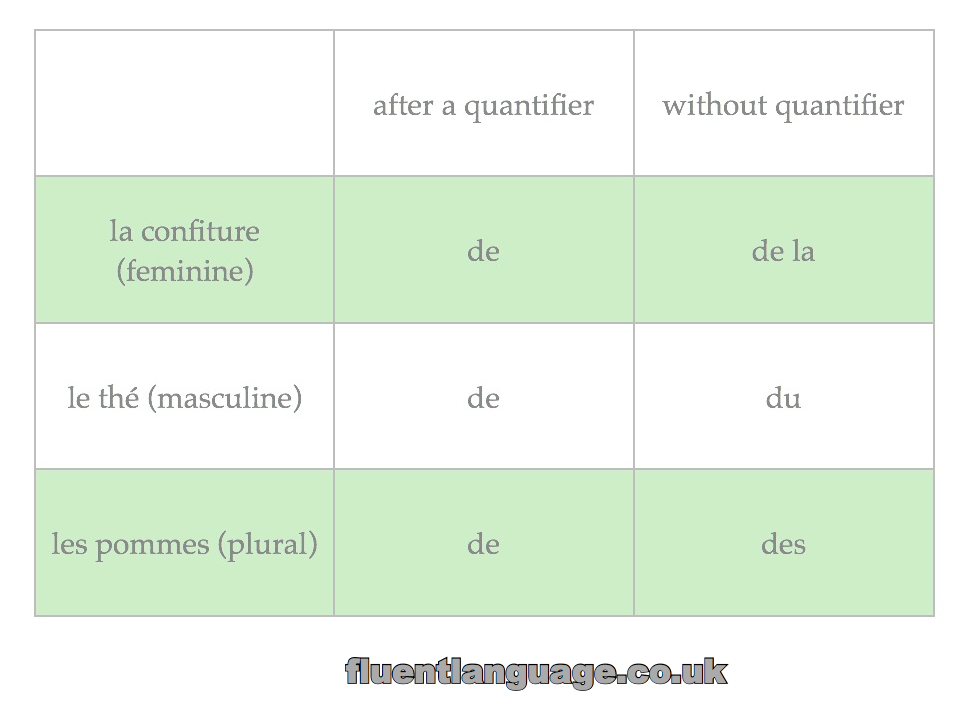
There are two types of uses of "de".
- After a quantifier - then it's just "de"
Examples of Quantifiers can be: un kilo, deux pots, 100 grammes, assez, beaucoup, peu...anything that gives you an indication of how much you have. - Without a quantifier - then it changes and becomes a contracted article
Use this Printable Sheet for your notes
Hope you enjoyed today's lesson again, and let me have your thoughts guys. I always look forward to hearing from you!



Struggling with listening? Discover realistic tips, challenge prompts, and the best tools for improving your listening skills as a self-guided language learner