

How to Learn a Language While Travelling the World
What is it really like to travel the world? What do you need to know about language learning so you can connect with people anywhere and make any trip a success?
Learn more in this podcast episode, where world traveller Lindsay shares her 5 top takeaways from visiting over 20 countries in one year.
Language learners dream of travel, meeting new people, and learning more about other cultures. But we only rarely get the chance to take life by the collar and say "I will DO this!".

For my podcast co-host Lindsay Williams, the dream of travelling the world became a reality last year as she set off to visit over 15 countries on a huge trip with her new husband. They called it the übermoon, and in today's podcast, Lindsay is going to reveal what one year of travel and language was really like.
Listen to the full show:
Lindsay's Top 5 Takeaways About Travel and Language Learning
1. Immersion Is Not The Quick Fix You Need
You have to be actively doing something else, like Lindsay's husband Ashley who started off strong learning Spanish and ordering food every day in Cuba...and then trailed off when conversation became less essential in Mexico. And remember, just because there are people walking around speaking your target language, they are not your teachers.
2. You Can Get By With Next To No Language Anywhere
The young modern traveller du jour is connected to technology and knows where she is going, booking, translating, and checking directions apps. So even in places where you don't know the language and English is limited with the locals, you can actually navigate better than ever before. Plus, people are always happy to communicate and so much can be said with hands, feet, and a smile.
As a result, you can get involved and travel with confidence, especially if you're an English speaker.
3. But It's Better With Even Just a Few Words And Phrases
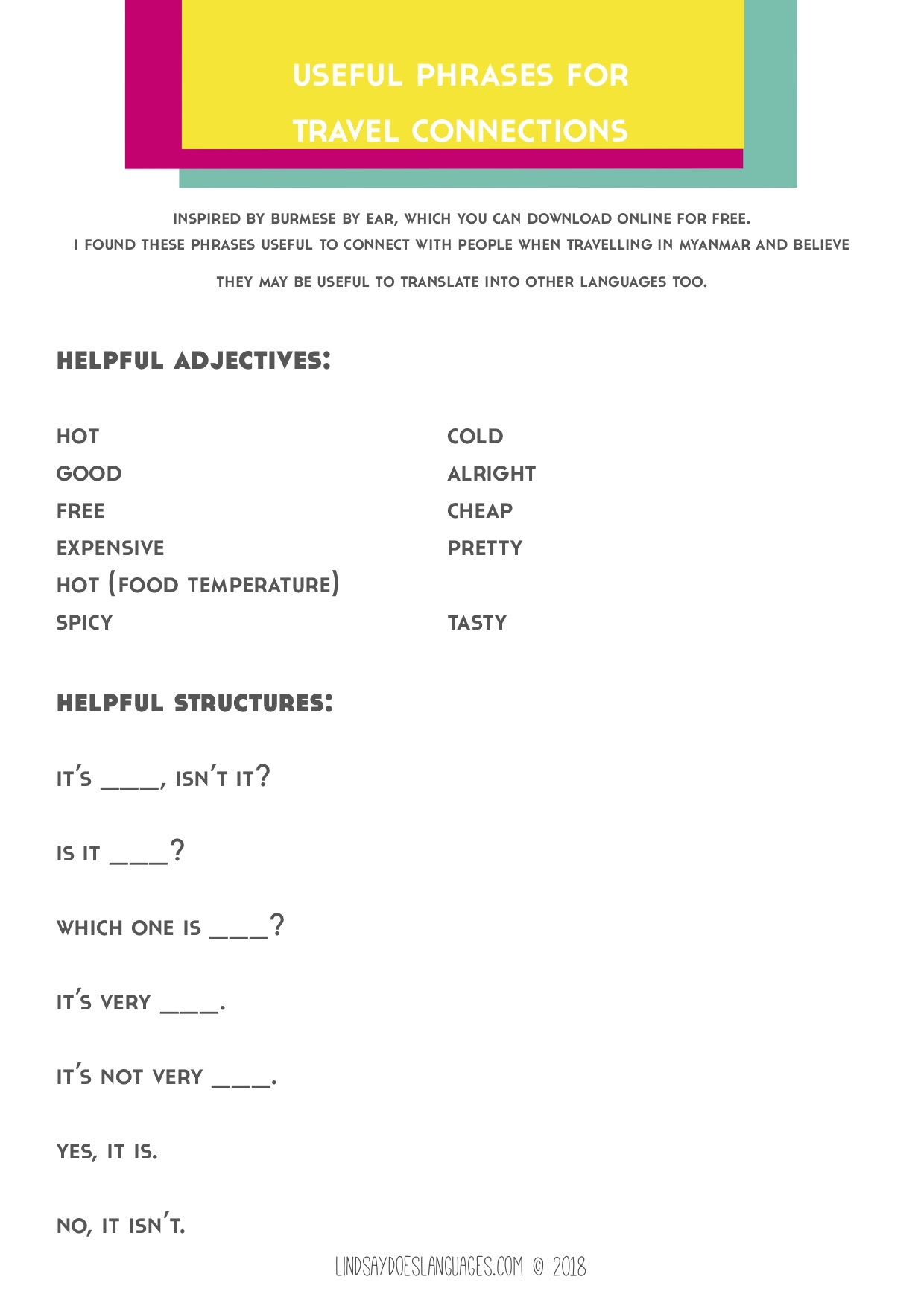
We're not just talking "hello" and "thank you", but a handful of extra phrases. In Myanmar, Lindsay experienced the world-changing results of remarking "it's hot, isn't it?" and "it's really cold!" during the water festival. Who wouldn't point that out when it's 35 degrees outside and someone's pouring cold water on you!
4. Language is Warm
People open up to you and are beyond friendly if you are learning their language, especially when it is a smaller language and they don't expect that effort from a visitor. For example, in Paraguay Lindsay found that "I'm learning Guarani" was such a magical phrase that it led to whole families inviting her to stay at theirs for the weekend.
5. Don't Forget Culture!
A successful travel experience is not just about the language and the perfect phrase, because it matters to be in tune with local customs and culture. For example, in East Asia where saving face and staying calm and "demure" in public is extremely important, it is impossible to get annoyed when the bus is late or someone gave you wrong directiongs. Even in perfect Vietnamese your actions may still stick out and break your connections to other people.
Conclusion: It is helpful and polite to read up on etiquette in your target country.
Want more tips for learning languages the fun way?
Join the Fluent Language newsletter today for the best language learning tips and offers in your inbox. (and SO many great freebies too!)

#clearthelist August 2018: The German Retreat!!
Welcome to my monthly language goals round-up - including a review of my studies during HOT July 2018, and the first ever Fluent German Retreat. Retreats are incredible, like a secret weapon for speaking another language. Read all about it in this article.

Welcome to my latest language learning update through #clearthelist, which is a language learning round-up sharing monthly language learning goals, support, and accountability.
I’m writing this a few days into August after a week fully focused on the first German language retreat - more about that later!
What Happened In July?
As ever, lots of stuff happened! July is a long month packed with travel and events that took me out of my routine as a learner, but gave me new growth and motivation as a professional.
Earlier in the month I attended Shout Out Live, a podcast festival in London. I met a wonderful community of supportive and unique people who are killing it with their podcasts, and picked up some tips for the Fluent Show. After that it was time to prep for 2 weeks spent in Germany, some of it with my family and the second half on the first Fluent German Retreat.
The German Retreat
The German Retreat was a very small, all-inclusive language trip to Munich.We welcomed three motivated learners around B1/B2, and for 5 days the motto was to learn, live, and speak only German.
I taught a custom German class focused around speaking German independently, and each participant was challenged every day. One attendee told me she’d been worried her language level was not good enough for speaking German only for so many days, but she certainly surprised herself. At the end, she told me “I have grown in confidence so much over the last week, I didn’t think I can do this and now I know I can. I am so motivated to continue and speak German.” As a teacher, the retreat experience was second to none, and I cannot wait to repeat it.
Every day of this trip offered something special, including a guided tour by a retired American history professor, a visit to the (non air conditioned 🚒) Deutsches Museum, and of course a huge giant pretzel and a beer in the beer garden. In other words, the perfect combination of a good week out and a language “level-up”.
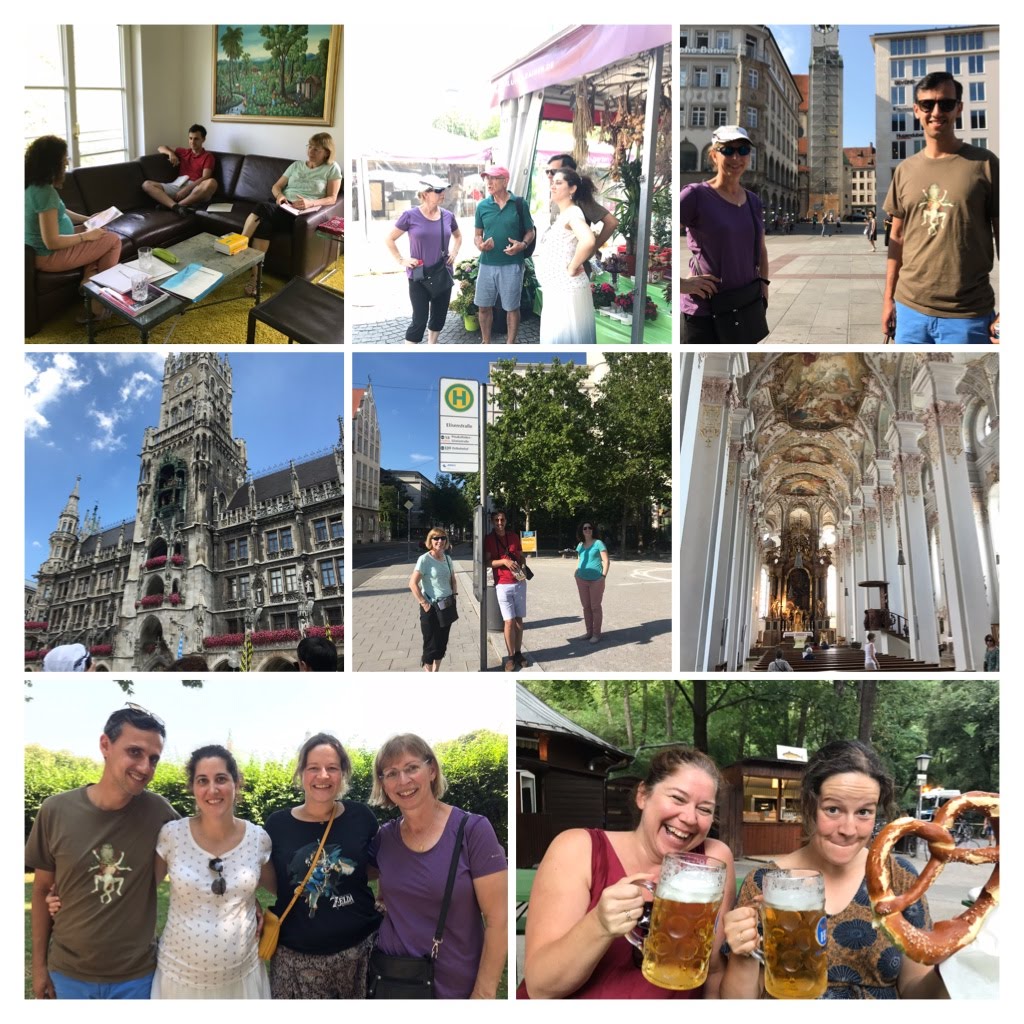
Oh, and because I am me….we also cooled ourselves off in a river.
Our next German retreats are already scheduled in the diary, so watch this space and register on my retreat list if you want to experience a trip like this.
The Fluent Show
My favourite episode this month was our discussion on language bias, and whether our hidden prejudice holds us back from learning certain languages. As Lindsay concluded at the end, we might not have answered the question but we had a great conversation about it.
In August, the show is hitting a milestone: We’re celebrating our 100th episode with a live broadcast full of games and special guests. Every language lover is invited! If you want to join us, click here for more information.
Language Goals and Progress
All right, all right. I bet you didn’t come here for a diary entry, so let’s get to the goods. How did I learn languages in July 2018?
¡Oye! ¡Español!
My moments with languages apart from my beloved Welsh continued. Checking out an upcoming Fluent Show sponsor’s wares, I decided to see what they’ve got to offer in the Spanish department…and found myself in an online lesson speaking Spanish for a full 60 minutes!
I learnt Spanish during my foreign language training in 2001-2003, and got to a level of B1/B2 for conversation and business letters. Thing is, after the end of the course I never had another formal lesson. And after 15 years, turns out I’m still good enough to function in Spanish!
Here’s my tutor’s assessment:
Moral of the story: Don’t worry if you do have an ex-language somewhere (see podcast episode 98). Your brain has way more skill stashed somewhere up there than you imagine possible.
Chinese
Still dabbling!! I spent an hour or two practicing what I already learnt and adding a few question words. At this pace, I’m on track to be “officially learning” by 2020 and fluent by the year 3000. I like it!
Learning Welsh
Yes, I’m still learning Welsh. In fact, I’m volunteering for a few days at the National Eisteddfod Cymru next week. If you’re coming and spot me speaking Welsh in a high-viz, dyweduch s’mae os gwelwch chi’n dad! Having said that, I didn’t reach all July goals. Let’s take a look.
Listening
I wanted to listen to Welsh for 90 minutes every week. This started off well with radio and television, but while I was in Germany it dropped to zero.
Reading
I wanted to try and finish the book Sgwp!…and then I didn’t touch it all month. My Welsh reading really took a dip and I’m not too proud to tell this to the internet. Luckily, there’s always another month to improve.
Speaking
The goal was to have 1 long lesson and 3 conversations, and I did have a fab lesson with my tutor. It helped me lots with that yes/no issue in the grammar. Conversationally, things were quiet though I did chat in Welsh on social media. Good job I have a trip coming up!
Writing
The goal was “write one poem, any kind”. That one got done, one sleepy morning when I put my thoughts down on the Notes app in my phone.
You might not think this is much, but sometimes it’s necessary to set the goal at “more than zero” and then move from there. After all, a small goal achieved feels better than a big goal missed.
Monthly Contact Goal
Every month, I log my “daily contact” with the Welsh language. In July, I logged 12 days of contact. I know there was more but being in Germany meant my tracking habit was off. Still, it shows that when the daily contact drops, everything drops.
Goals For August 2018
Cannot wait for this month - it’s going to be very Welsh!
Listening and Speaking
These two areas are grouped together for the National Eisteddfod, where I’m going to be from 8-11 August. Although I’m getting organised very late (my airbnb fell through), my plan is to stay on the Maes Camping and hear and say everything in Welsh while I’m there.
I also plan to volunteer for a bunch of hours. This is all organised in Welsh, so I’ll get plenty of input.
Reading
Guess what….I’m gonna whip out Sgwp once again! I’m also due a new issue of Lingo Newydd. Let’s say I’ll get halfway in this book!
Writing
I’m not entirely sure what to do for writing practice this month! I might sacrifice that writing time, not set a goal, and instead spend a little extra time on Chinese. That sounds good to me!
So there we have it, my new goals for August 2018 are set and I’m ready to go visit my target language country.
How Was Your Month?
Have you ever visited a language retreat? Do you write bad poetry in Welsh? Are you setting goals?
Leave a comment below to tell me all about it!
I would love to read about what you’re up to in the comments below!
If you want to write your own goals and join the #clearthelist linkup and share your own goals for the month, hop on to Clear The List hosted by Lindsay Williams and Shannon Kennedy.

#clearthelist July 2018: French, Welsh, And Why I Am Not Learning Chinese Yet
Clear The List is a monthly language goal report. This month, I’ve got news about three languages as a learner and one more as a teacher. I’m getting into a silly stumble with the Welsh language, and speaking lots of Welsh on podcast and travel.
Plus: Why am I not learning Chinese yet? Read on to find out.

Welcome to my latest language learning update through #clearthelist. Clear the List is a support and accountability blog group sharing monthly language learning goals.
The Fluent Show
Fantastic month for the Fluent Show as we reached 270,000 downloads in under a year. YAY!! Thank you so much.
I loved the conversation Lindsay and I had in the episode “What is Fluency, What Is Mastery…And How Do You Get There?”, my top pick for the month. Every ambitious learner should hear discussion, so do check it out.
What Happened in June
June was always going to be a busy one, because it was the first launch of my brand new course German Uncovered. This is a story-based German course going from zero all the way to B1. There was much to do, and it meant a few early mornings and evening shifts. If you’re on the course, give me a shout. I’m so excited to finally share it with you.

Working on German Uncovered. Look at those lights!
In June, I also attended my first Canterbury Pride celebration and took a lovely week off travelling to Marseille. I also attended the People's Vote March in London.
Learning Welsh
Welsh is still my main language, though it came up a little short this month.
Cymraeg Gogledd neu Cymraeg De?
One thing that slowed me down was my belief that I should switch from the Northern Welsh accent (which I’d studied for 2+ years) to the Southern Welsh accent. Why? Because I moved from North to South in England.
This turns out to be a silly idea. When people tell me “everyone will understand you no matter what accent”, they are right. When they say “only a few words are different”, they aren’t right. Even though it’s possible to understand both types of Welsh, learning to speak them both is harder than I thought. Just look at these two sentences:
1. North Welsh: Dw i eisiau gorffen cyn yfory.
2. South Welsh: Dw i’n moyn cwpla cyn yfory.
As far as I know, these are supposed to mean the same thing, but all native Welsh speakers will understand both.
My tutor at the Welsh class I attended told me “no mixing your accents”, which has made the idea of switching what I’ve studied next to impossible. My italki tutor is a lot more chilled, saying it doesn’t really matter as long as I’m not taking formal tests.
Conclusion: Welsh accents are confusing. I think I’ll declare Project Southern Welsh something I don’t want to continue. I stopped making progress because I felt trapped in this whole accent confusion, when it’s not that relevant. For now, I’ll speak how I speak and let life go on.
Let’s look at the goals from last month.
Listening
I had hoped to continue watching the series Ffit Cymru. But the show’s focus on weight loss as a measure of all good in the world started getting on my nerves. So I watched perhaps one more episode, and my listening in Welsh came up a little short.
Reading
I had hoped to finish the book Sgwp (there should be a ^ on the w but my keyboard can’t cope), and I’m getting behind on this one. But I did take my edition of the magazine Lingo Newydd with me and read it on the beach in France. Result!
One cool new resource I’m using in Welsh now is parallel.cymru, a website featuring parallel articles in Welsh and English. I’m loving the fact that I can read more on screen now, and I even submitted an article myself.
Click here to read my article on parallel.cymru in English or Welsh
Speaking
My goal was to fit in two 30 minute sessions with my tutor Gwyneth, and I did succeed. Scheduling these in advance was a huge help. I was a worse speaker than usual due to the accent kerfuffle, and due to speaking French for 10 days this month. But overall, mission accomplished.
Writing
I wanted to stick with poetry and write a haiku in Welsh, but I didn’t get it done. I didn’t even write much else. WARGH.
Daily Contact Goal
In May, I logged 14 days of contact with the Welsh language. Pretty good considering I was very busy with the German course, and also spent 10 days in France. My most used resources were Lingo Newydd, Ap Geiriaduron, and italki.
Speaking French In France

My second language of June was French, as I recorded my first bilingual podcast in French and English and then took some time off in Marseille. I had a great time, and noticed the difference a week in the country makes.
I was able to speak French pretty well anyway, as it’s a language I’ve studied on and off for 22 years. The week in France worked wonders for my comprehension and my speaking confidence. I refreshed all those everyday phrases like “you’re welcome”, “that was awesome”, or “for takeaway, please”.
I also learnt I enjoy being not-perfect at French. Here in England, I speak a foreign language almost every minute of every day. It doesn’t feel all that foreign anymore. But in French, I am still a learner. There’s a challenge, and that felt great because challenge means progress.
We didn’t stay in the main tourist quarter, and so a lot of people were amused and curious about this German and English couple where only one half speaks French. My husband relied on my French skills and I could tell that speaking the language was an advantage almost everywhere.
Good to Remember: People Switch To English For THEIR Reasons
In a busy restaurant, the host told me how to get to my table in French. It was noisy, and I didn’t understand what he was saying. I said Pardon? and he switched to English. I told him that I do speak French and he can speak to me in French.
His answer? “It is very busy here and I can speak English. In other words: He was too busy to slow down. He didn’t care if I speak French well, and he wasn’t judging my language skills. This was about getting something done.
If you’ve ever been in a similar situation, remember that people switch languages because it’s best for them. When someone switches to English, it’s often because they have other things on their mind than your language progress. Click to read more about this and get tips for dealing with the situation.
Goals For July 2018
Now that I’m in the intermediate haze with Welsh, I find it more important than ever to keep going forward. Happy to put French to one side and focus on Welsh again this month, especially because at the start of August I want to go to the National Eisteddfod again!
Listening
So disappointed I can’t watch the World Cup with Welsh commentary! I need to get ready for the Eisteddfod so it’s time to hear a lot of Welsh. I will Listen to Welsh For 90 Minutes Every Week Doesn’t matter if it’s the Pigion podcast or a show on S4C, the most important thing is that I hear a lot of Welsh right now.
Reading
Try and Finish The Book Sgwp Same as last month!
Speaking
Have 1 Long Lesson and 3 Conversations Loved having shorter classes in June (I scheduled 30 minutes at lunch times) and I’ll keep going with that, but as we know I struggle with yes/no in Welsh so I’ll also book a long lesson to drill these specifically.
And it’s time to catch up with my exchange partner!
Writing
Every month, I read about poetry and I read some poetry. But I’ve not written any. Goal: Write 1 Poem, Any Kind
Maybe asking myself to even to a Haiku was too much, a hurdle in front of getting started. So I will dial down the ambition one more. Easy.
Finally there is one more language I am playing around with, but here’s why I’m not learning Chinese right now.
Chinese
I’m still not learning Chinese. I’m going at the pace of two words a week. There’s so much in this language: words, tones, characters, all of it unknown to me. I can best describe this as a Prep phase, way before “learning the language”. I don’t want to put pressure on myself at this stage at all, and all I’m doing is driven by curiosity.
I had a similar phase in Russian and Welsh, where I’m currently at A1 and B1. Prep phases feel so valuable to me, especially when the other language is different from the ones I already know.
The Prep Phase And My Languages
Here’s an overview of the languages I know:
- I speak German and English at native levels. (C2)
- I’m fluent in French (C1?).
- I’m conversational in Welsh, if the conversation partner helps me. (B1)
- I’m somewhat conversational in Spanish, if the conversation partner helps me loads. (A1-A2)
- I can read Spanish, Italian, some Latin. (A1)
- I can read Cyrillic and exchange basic pleasantries in Russian. (A1)
I’ve never done much with Asian languages.
If I started to learn Romanian or Swedish I probably wouldn’t need a Prep phase. But with a new unfamiliar system, I find this extremely useful. If I decide to take this further, dabbling with tones and apps could turn into learning Chinese for real. But for now, I’m just learning about the language.
How Was YOUR Month?
Do you have a Prep phase too? Are you struggling with accents in your target language?
I would love to read about what you’re up to in the comments below!
If you want to join the linkup and share your own goals for the month, hop on to Clear The List with Lindsay Williams and Shannon Kennedy.
What To Do When You're Overwhelmed In Language Lessons
In this week’s episode, I have a **fascinating** Q&A question. Blog reader Andy is learning Russian, and finding the amount of word changes overwhelming.
On digging in, we discovered that there’s more at play than just grammar. Listen in and check out my tips to get a better experience when your lessons leave you feeling overwhelmed and exhausted.

What do you feel when you're in a conversation practice and find that you struggle to say a single sentence without interruption?
Have you ever experienced the OVERWHELM of being corrected too much?
If your answer is yes, the I've got some great tips and answers to help you get over that feeling and create effective progress in language learning.
In this podcast episode, you'll hear an insight into how I work in "coaching mode". Language coaching is a process where you can learn from an experienced polyglot or tutor, and focus on how to learn best.
I was contacted by listener Andy who was felt overwhelmed in his Russian lessons. He contacted me with a question about grammar - how to memorize and master all those grammatical changes and words in Russian, so that his tutors can focus on having a real conversation.
But as we dug in more, a few things emerged. We were looking at two completely separate issues:
- The technical issue of memorising grammar, which isn’t the problem Andy feels strongly about
- The OVERWHELM of being corrected too much
The Unseen Problem In Language Lessons
Any well-meaning teacher is likely to correct you at times.
This is great on the one hand - you get feedback, information on your errors, and lots of info. But when correction becomes too frequent, it starts to get in the way.
Overcorrection can
- Knock your confidence
- Give you too much to focus on in the moment
- Distract you from understanding the other person
- Stop you from knowing your target language!
What can you do when you feel overcorrected?
Know what you are there for! Is it speaking practice, exam preparation, business language, something else?
As Andy and I dug into more detail about what his aims and techniques are, he :
My goal in learning grammar is to learn enough grammar to express my thoughts, which tend to be complex. (..) Of course, I want to understand what the other person says, too.
This shows that Andy is not aiming for perfection and will be happy enough to express himself. He’s not at a C1 mastery stage, and as such, it’s possible to let things go. What matters is that he’s understood, and as a tutor it’s possible to compensate for this.
4 Steps To Success With Language Tutors
If you feel that heavy corrections are holding you back in your own learning experience, these 4 steps to success will help you get back on track.
- Be culturally aware. Some teachers have a full-on teacher mode (drill sergeant) and their goal is that you use the language as correctly as possible.
- Careful not to stereotype.This does not just vary between cultures, but also individuals.
- With Andy, I believe that this did play a role in his experience. He mentioned being corrected a lot less in fact-to-face meet ups (one indicator), and as a white American guy your tutors from the Far East may have been a lot less willing to correct you than a Russian tutor
- Be self aware: Maybe you really are trying to do things that are too difficult for you at this point. There’s no shame in that, and it’s a sign that something in your study plan isn’t delivering.
- When you make a mistake, native speakers will notice. That’s inevitable.
- Be goal aware: Do you aim for perfection, correct usage, being understood? This matters for the next step.
- Most importantly: Direct your tutors. Tell them what you’re there for. Make it clear that conversation is what you want, if that is the case. Be confident and clear at the start, as it will pay off. But also do your homework.
Listen to Episode 90 to learn more about how to prepare for language lessons on Skype.
What Tutor Strategy Helps?
As a tutor, it is difficult to resist correcting a student but resisting can be extremely helpful because this tells you what exactly they’re getting wrong.
When a student cannot even say one sentence to you without interruption, their goal is not being achieved. What is going on there? Here's how to find out:
- Stop correcting and start listening
- Start looking out for a pattern
- Model correct usage — try and reply with a demo of the correct usage instead of picking the student up on theirs, with stronger emphasis on what it should be
- Switch to a grammar explanation and drill, plugging the gap of what is missing in your student's toolbox
- If you know they’re in over their head, but they have grammar knowledge and confidence, prompt the use of specific concepts
How Do You Deal With Overwhelm?
What about you? Do you ever feel overwhelmed by corrections in your language lessons?
How do you deal with this problem? Leave me a comment below to share your own experiences.

Living And Speaking French Just Like In France + 11 Everyday French Expressions
Learn French with a bilingual podcast interview! In this article, you’ll learn what it takes to learn French so you can speak to any local in the language - plus there is an interview on the Fluent Show which is half in French and half in English. C’est trop bon! 🇫🇷
Let's be honest: We all dream of speaking perfect French. To communicate in melodic sentences, move along the boulevards and feel right at home, and essentially turn into Amélie for a day.
But if you've been learning the French language for a while, maybe you've found that it's hard to feel at home with this language. You know all the vocabulary, you have practiced the grammar...but something feels like it's missing.
In today's episode of the Fluent Show, I've got a special guest who is going to help us find that missing piece, in a bilingual episode dedicated to France and French culture. My guest is Géraldine Lepere, an online French teacher at Comme Une Française.
Her French lessons are for anyone who values the French language and culture, and her online courses help learners at any level go beyond grammar and "double their Frenchness."
Start listening here:
Bilingual? How does that work?
It's simple. Throughout this episode of the podcast, Géraldine and I will switch between speaking English and speaking French.
You will hear me make mistakes, forget words, and be right there in the truth of making mistakes. I am a French speaker and have studied French for 20+ years, but my French is NOT perfect.
In this episode you will learn
- how to swear and how to say "that's awesome" in French
- what you need to know about French food
- why understanding French culture makes the difference when you practice your language
- what real French people think about studying French grammar
- where to find the best restaurants and the best music in France
- how Géraldine's website can help you speak French comme une française
Here are a few things to listen out for:
Cross-Languaging

As soon as I started speaking French to Géraldine, I threw in all sorts of other languages! On the recording, you can hear me say things in Welsh, then German, and then finally in the language I was looking for. When you are out of practice speaking any language, this type of "interference" is actually pretty normal.
Everyday Expressions In French
I learnt French in the 1990s from an experienced (though perhaps middle-aged) French school teacher, so I used this opportunity to refresh my Français familier: the colloquial language that was neglected when my education focused on professional environments.
Here are a few of the expressions I learnt in this episode:
- Greetings and Goodbyes - Coucou, À plus
- "quite a while ago" - il y a longtemps
- Swearing (hehe!): mince!, or putain/merde (but those are not suitable for foreigners)
- awesome! - trop bien, génial, chouette
- cute - mignon
- great, but also awful...depending on the context! - terrible
- funny - rigolo
- to confuse - confondre
- around here - dans le coin
Living in Three Languages
Géraldine is more than your average French woman: she grew up conversing with her parents in French and in Spanish, and now runs a business helping English speakers too. For her, every language comes with a slightly different outlook: French for love and life, English for business and strategy, and Spanish for speaking to family.
Setting Good Goals
For learning French, it pays to be structured and organised about learning other languages. Géraldine and I discussed how a clear Vision Goal and Path Goal can serve you as you're sitting down to learn. When you set yourself the goal "I want to speak French", you run a risk of big failure because things are so vague.
Make sure that you capture the vision and document what motivates you to learn French - le désir, but then get specific and create les buts de chemin, goals that guide you on the path to everyday fluency.
The Language Habit Toolkit is my structured product giving guidance and worksheets so you can create your own goals and study plan, step by step.
Speaking a Language Means Having Respect
French people often get a reputation for "rudeness", but is that really true or are they simply acting in a way you're not familiar with? For example, small talk is less common and a French speaker's silence is often meant to communicate respect for you. When you're learning French, knowing these important things about the norms of communication in a country are a lot more important than knowing the gender of every single noun.
Understanding France
Learning French as a language is one thing. Learning real-life French with all the little things that help you sound like a real human instead of a 1950s textbook, that's another. Géraldine mentioned how many times her students struggle trying to get that natural touch in the French language, and how many times they get frustrated because the French keep replying to them in English.
Once you start working on your cultural competence, you'll find that this changes. You'll be able to hook in to that extra layer of fluency that makes everyone around you relax. And voilà, they start answering in French too.
Want To Lean French Language and French Culture? 🇫🇷
If you have been putting in the hours on French duolingo and feel nearly ready to speak the language to real people, here is something that will get you exactly where you want to be.
Géraldine has got a programme fantastique, a brilliant course designed to speak real French. It's perfect for intermediates who want to start speaking French for real.
Oh and best of all, she's included a 15% discount for listeners of the Fluent Show!
Click Here To Discover How To Speak French Like In France (15% Discount)
Loved The Show?
I look forward to hearing your feedback. Did you enjoy this bilingual podcast episode? Did you understand anything...and how did you feel if you did not?



Struggling with listening? Discover realistic tips, challenge prompts, and the best tools for improving your listening skills as a self-guided language learner