
The Special Needs Child and the Foreign Language (by Sally Holmwood)
Sally Holmwood, tutor at Indigo Languages is establishing herself as a regular and always very welcome guest here on the Fluent Language blog. Her experiences working with young people of all ages, both inside and outside the UK school system make her views so profound, and Sally has a real passion for her languages to share with you. Today she is discussing a special group of people, often forgotten in the language learning world: Special needs children.
One Tongue, Two Languages
As well as working with languages, I support individuals with special needs in a wide range of settings. There is a wealth of information, on the internet and beyond, about teaching languages to children with special needs – and plenty of resistance from parents and school staff alike!

“My Child Struggles to Communicate in English - Why Teach Them a Foreign Language?”
Many parents I know of children with severe learning difficulties would argue against teaching a foreign language to a child that experiences considerable difficulty in speaking their own. I know two mothers of non-verbal autistic boys, for example. For the mothers, English is not their native tongue. They live in England and so speak to their sons in English. They believe that, as their children hear English all day, wherever they go, it might confuse them to hear a different language spoken at home. Such apprehension about introducing a child with a learning difficulty to a foreign language is not uncommon. Some parents and staff believing pupils’ time might be better spent focussing on building independence skills.
Using Language-Learning as a Stepping Stone
At Languages Without Limits, the rationale that we are all different is reason enough to introduce pupils with special needs to a foreign language. Seeing the variation between people from different cultures showed pupils that it is acceptable to be ‘different’. There is scope for revisiting useful basic language concepts when learning a foreign language too. The teaching of social and other core skills can be integrated into foreign language lessons, shifting the focus just slightly. (Read this twice because it applies to all learners, not just special needs ones. -ed.)
“But This Child Can’t Speak!”
We may believe the non-verbal child does not benefit from learning a foreign language - but can we really be sure? If you haven’t heard of Carly Fleischmann, the Canadian teenager with non-verbal autism, now’s the time to look her up! Watch her video below to see for yourself the stark contrast between her father’s assumptions about her understanding and what she herself wants to communicate! Carly, like many other non-verbal youngsters, now has an electronic communication aid – many of these can even be furnished with foreign language software!
David R. Wilson has compiled a list of resources that include guidelines on making foreign languages accessible to pupils with a number of special needs, who may need to learn in a different way to their peers.
A Time and Place for Everything – Including Traditional Teaching Methods!
Rudyard Kipling once said
The first condition of understanding a foreign country is to smell it!
We know that there are three learning styles – visual, auditory and kinesthetic (tactile) – and certainly some pupils with special needs learn better if they can ‘get stuck in’. Videos, games and songs and plenty of opportunity to get up out of their seat to act things out will enhance their learning experience – the more tactile, the better!
Take fruit. Teach the names – and even the signs – not just by showing a simple photograph or cartoon image as a visual aid. Embrace the wonder that is ICT. Even better still, bring actual pieces of fruit in for pupils to try and allow them to feel, smell and taste it. Make the most of stories like Eric Carle's "The Very Hungry Caterpillar" – just think how this could be used to combine simple vocabulary with a brilliantly multi-sensory experience for children with special needs!
The Higher Functioning Special Needs Child
Let’s not forget the high functioning autistic learner either, who, like any of us, is highly motivated by things they really like. It may be the rigidity of maths or science that appeals. To others, like one young man I know, it is foreign languages. Excelling in school at French and German, he taught himself Russian at home. Foreign languages come complete with strict, non-negotiable grammar rules and a clear right or wrong answer for many questions. This can play to the high-functioning autistic pupil’s thirst for rigidity of routine. They may find such things easier to grasp than confusing abstract concepts found in other subjects.
Is the Special Needs Child the Better Language Learner?
We know that the pupil with special needs learns in a very different way to one without. We may have concerns that a child with special needs may not understand a foreign language, particularly if they are non-verbal, but that shouldn’t mean we exclude them altogether from the opportunity to learn. After all, Carly Fleischmann showed the world just how wrong people could be about the level of understanding of a non-verbal child.
The question of whether the special needs child makes the better language learner is a tricky one that brings me back to the diversity of all pupils, so much so that I am inclined to sit on the fence and say simply that we are all motivated by the things that interest us! We all deserve to be offered the same experiences and to receive support, where necessary, to make the most of them.
Learn One, Learn All!
The language learner with special needs may need to approach language learning in a completely different manner. Yet amongst the vast technologies that exist today, there are certainly many ways in which to offer them an experience of learning a foreign language that is meaningful to them. Perhaps the question we should be asking ourselves from now on is not simply whether individuals with special needs should learn a foreign language, but rather how they should be doing so?
About Sally Holmwood
Sally lives and works in West Sussex, England. She splits her working week between individuals of all ages with special needs, and languages (specifically German and French). Sally loves to make time to travel the world when she's not working - sometimes Europe, sometimes even further afield! Furthermore, she is a big fan of great television: Sherlock, Bones, The Big Bang Theory and Doctor Who. Stay in touch with Sally on Twitter or Facebook.
**Note from Kerstin : Like Sally, I also believe very strongly that language learning should be open to everyone who wishes to do so. This is not an easy path for anyone, and her ideas of the learner with autism finding comfort in rigid grammar rules, or the tactile learning styles, should be an inspiration to us all. How do you bring more adventure into your learning styles?**
How you can make your progess visible with a tracking routine
Here on the Fluent Language blog, we have previously covered the idea of invisible progress and how it affects your motivation. No language learner will find it easy to maintain high motivation and dedication when they feel like they are going along without much direction. So how do we make the progress a little more visible?
This is a look behind the scenes of a language tutor's work - all the prep and track work that students might not see, but that will be an important part of the service. My aim is not just to help my students learn, but to keep them going and keep an eye on what's already been covered and I do track every lesson.
The Eureka moment doesn't come without Eureka work
Think Outliers and practice hours and remember that you are working systematically towards the moment when it all falls into place. Not as beautiful a story, but achievable.
Here are a few steps that you as the language learner can take in order to keep track and stay motivated.

©dmachiavello on Flickr
Step 1: Decide where and how you will keep track
You will need a consistent place to do this, and one that is easy to use and very accessible. Basically, what we are looking for is a template which can be as low-key as a desk calendar or as high-powered as Evernote.
The important things are as follows:
- Make sure it's accessible enough for you to use all the time. If you travel, a paper notebook might be better than an app that needs to be online all the time.
- Make it consistent, so that once the template works for you, you'll only need to fill it in. Predicability is key here.
For me, formatting and printability were more important than universal access so I settled on creating a template that works for me, in MS Word.
Step 2: Write desired objectives
Self-taught learners in particular should have an idea of where they want to get to. The key to planning is to mke sure your objectives actually make sense. So write down a 1 month goal, a 3 month goal and a 12 month goal. This can be as poetic as you like, so "Have a conversation with a real German market trader" can go up there.
Step 3: Break it down into smaller tasks
I insist that you cannot actually have that market chat without taking lots of individual steps, and here's how I may break them down:
- Learn all the numbers and currencies
- Cover question making strategies in German grammar
- Select items I would like to buy
- Learn words for products
- Learn market-relevant verbs and phrases
- Arrange for travel to the German market
You should be looking at the long-term goal and breaking it down into smaller steps, then list the smaller steps as SMART goals.
Smaller steps for arranging travel to the German market?
- Research German market towns
- Choose trip destination
- Ensure trip dates match market opening times
- Choose travel companion
- Book flights
- Book accommodation
- Exchange money
- Sort out visas
- Leave space in my suitcase for purchases from German market
If it looks so simple that it's all obvious now, remember your original goal was to talk to a German market trader. How did you think that was going to happen?
Step 4: Check in regularly
The check in dates are the ones you chose in your objectives, and you are looking for an idea of how much closer you have come to the overall goal. These check ins are a great contribution to knowing whether your language learning project is running on time or behind, and they will also give you a chance to fix anything that's going very wrong.
Should you be checking in and realising you've been way too ambitious, you only need to stay calm and work out what you actually got done. That's your realistic working pace. Apply it to future goals, without judgement. You will now know if you can achieve the end goal in a year or not, and will be able to add 2 months on at the end if required.
Plan, Track and Optimise With The Language Habit Toolkit
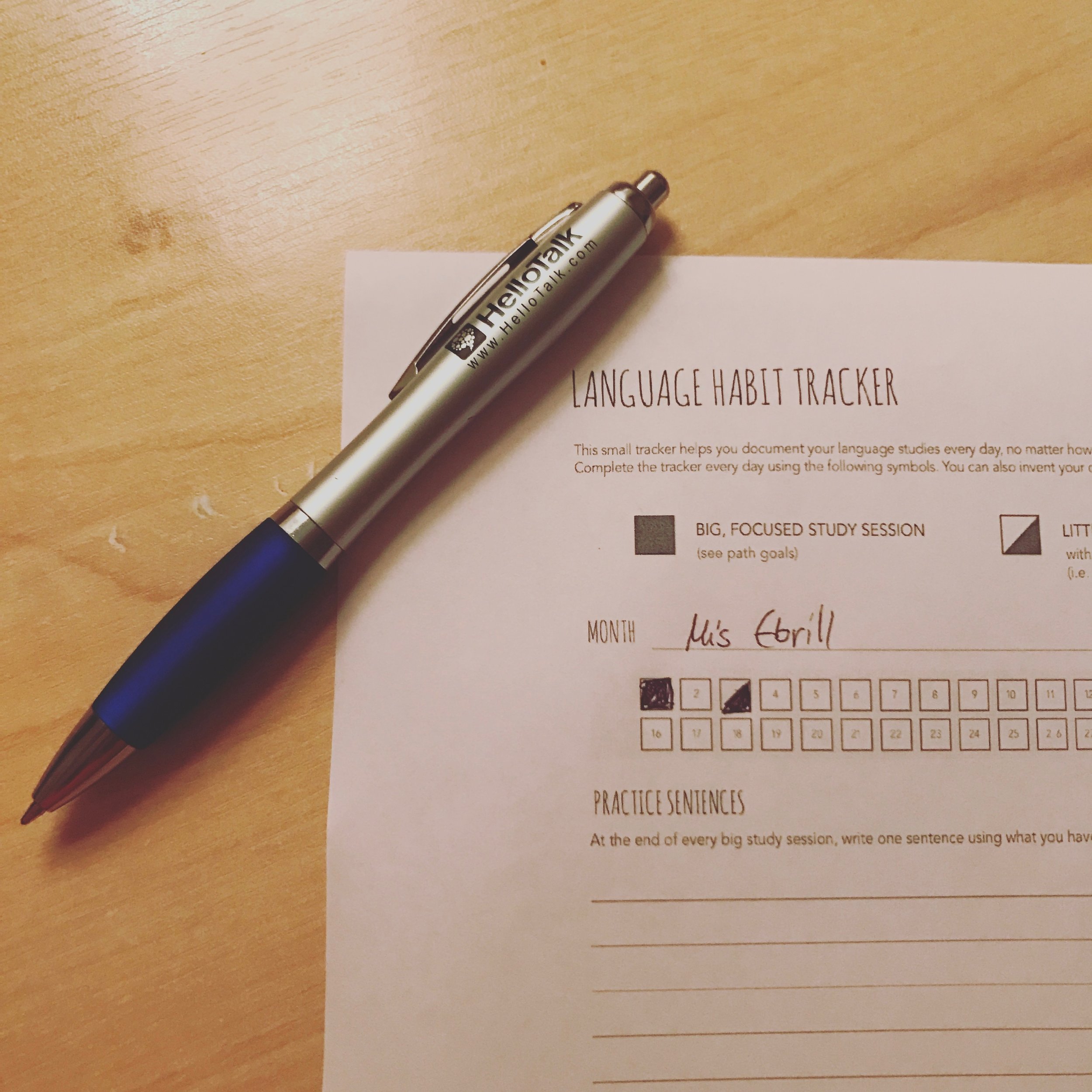
If you want a step-by-step guide to creating your personal language learning system, check out the Language Habit Toolkit, featuring language trackers, goal-setting guides and a review sheet to help you cut out the unnecessary and speed up your progress to fluently communicating in any language.
Thanks for reading this article on Fluent - The Language Learning Blog. Don't forget - if you sign up to our newsletter, you will receive a free Guide to the Best Language Learning Resources!
Why I'm quitting my job to become a full-time tutor
So you guys, I've got a personal announcement to make. You've just seen it in the heading - my office days are done, I'm going to dedicate myself fully to Fluent Language Tuition.
I have never done anything like this before. It's scary and exciting, and it's a credit to all my lovely students and friends that I feel ready for this. Let's make sure we take this opportunity and turn Fluent Language Tuition into a success!
In practical terms, this means I will have booking slots available every day of the week.
Things I love about being a tutor
- Creating my own materials
- Discovering online resources and techniques
- When "grammar face" turns into "aha!!!!! face"
- Learning with my students and from my students
- Inspiring those who thought they weren't "natural language learners"
- Meeting new people in the US, China, Switzerland, London, Lancaster...everywhere!
Things I want to add to Fluent Language Tuition
As an ideas person, there's always a lot bouncing around in my head. One day I want to write the ultimate German learning ebook, the next I want to take you all on a holiday, and I always want to inspire businesses to get into the international markets out there!
You guys are invited - join me on the adventure of edupreneurship.
Inspiration is everywhere and I'm really excited that I will be able to work on more projects. But I want some guidance. What IS it that the world is missing? If you have suggestions, ideas or thoughts then please do comment. My blog is important to me and I love hearing from the community!
Why you must train 4 skills to achieve fluency
Ask most language learners what they are hoping to achieve, and you will come across a recurring ambition: fluency. The word fluent comes from the Latin language and indicates a sense of flow, because that's what conversations often do: they flow. So what you're hoping to achieve is a point where using another language becomes so easy that you won't have to hesitate, you won't look for words all the time and won't feel stuck.
If you are an independent learner, have you ever found yourself off balance? For example, you find yourself becoming a real expert in understanding spoken language, but a wall comes up in your brain as soon as you try to say the simplest of things. Or sometimes you have picked up a lot of spoken language and you'd be ok at the shop, but you can't read a single label!
Four Core Skills
As a language tutor, I make my students aware that there are four core skills to language learning: Speaking, Reading, Listening and Writing. You have got to become good at all of them and keep your levels balanced to prepare for true fluency in a language.
One example: Audio-based systems, such as CDs or podcasts, will put a lot of emphasis on
speaking and listening. This is excellent for basic travelling or conversation. But it is enough if you
really want to find that elusive fluency in your new language? Personally, I don't think so. Neglecting two of the four skills can really affect your confidence!

Since these core skills are ever so important, why don't we get to know them a little better:
Writing doesn't just refer to how good you are at composing a letter, note or blog post. It also includes your sound recognition. For example, how good are you at making notes based on what you're hearing, spelling them correctly and writing something legible in your target language.
Speaking, now that sounds hard doesn't it? It's not all about producing free-hand sentences and word order. Speaking starts when you meet the sounds of your target language. Pronunciation and accent work breed confidence, and putting that speaking practice in right from the start is key to helping you feel like communication is possible.
Listening is the skill of piecing together all the foreign sounds, analysing them in your mind and making sense of them as words and phrases. Listening helps you get the idea of what's going on, but more importantly it teaches you important pronunciation skills. All language production depends on what you hear, so don't underestimate this one.
Reading looks like a simple task after all those others. In any target language, the essence of this skill is in training you to spot patterns. Reading a lot will bring you in tune with the way sentences are built in a different language, and exercises engaging with a text are among the most useful you can work on for becoming fluent.
On top of learning those, you should engage with the culture, civics and geography of your target language. It really is a tall order, but trust me, it's worth it. You'll finally get over those "errrrr" moments.
How to test yourself

Ommm...find your balance, young deshi.
Here is an exercise I work on together with a lot of my learners. It's perfect for exposing a training rut or giving you inspiration for a new challenge. Draw yourself a diagram of all the skills you're hoping to train. Think about them and rate yourself out of 10 in each one. Then consult someone like a teacher or language buddy - what do they think? The outside perspective of another learner or a native speaker adds real value to the assessment.
Write your numbers on the diagram - are they balanced? Do you have a particular weakness or strength? Then think about how you have learnt your language so far, and what kind of exercises you've done most, and perhaps what you've been missing. For more exercises getting you ready to target your core skills, please check out my forthcoming ebook.
Thanks for reading this article!
Please have a look around other extremely useful articles on the blog by visiting the blog topics page or skipping straight to the Must Read content. Popular posts include:
3 Noteworthy Techniques for remembering vocabulary once and for all
4 techniques for switching your brain into language mode
How to sell your language skill to any employer
French for Beginners: Regular Verbs
This post contains the video and reference materials for French on a Windowsill Ep. 05: The one about regular verbs. All standard conjugations are covered. Enjoy!
Hello everybody, after a bit of a break for learning to talk a bit in 25 languages, French on a Windowsill returns! And this time, I bring you regular verbs. Along with some useful grammar hints about verbs, conjugation and stem + ending, you will get to know the 3 groups of regular verbs in French.
Here are your reference materials:
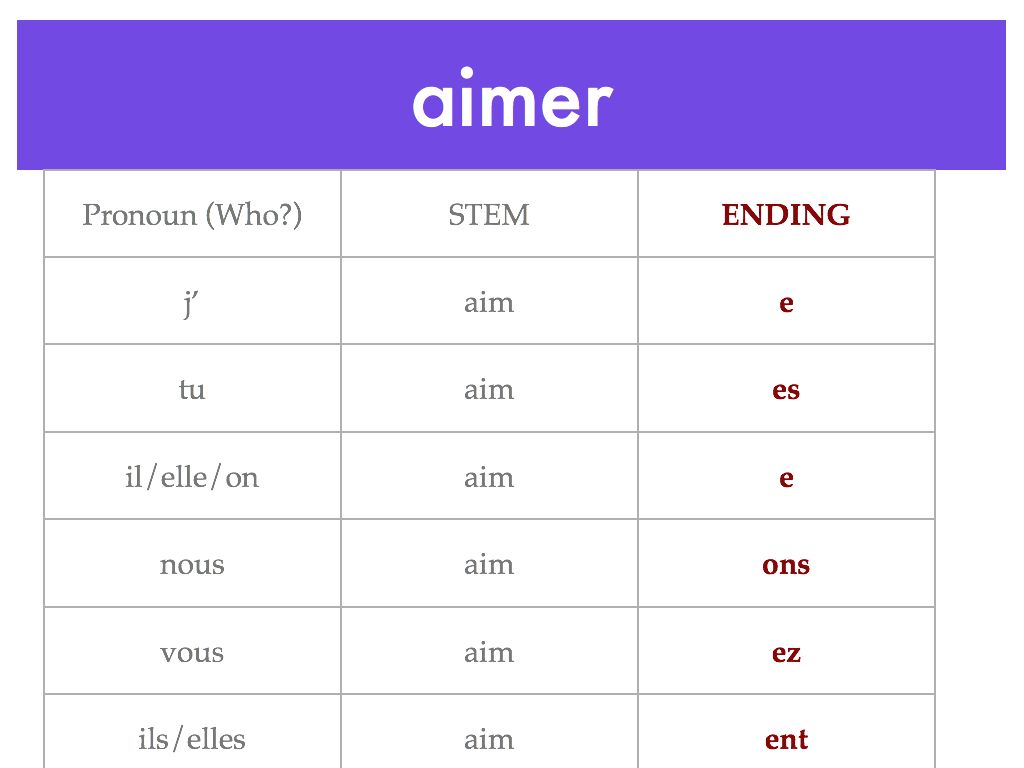
Regular verbs that end in -er
These are pretty common, and the conjugation is fairly conistent as well with a few small exceptions for pronunciation. You follow this ending pattern:
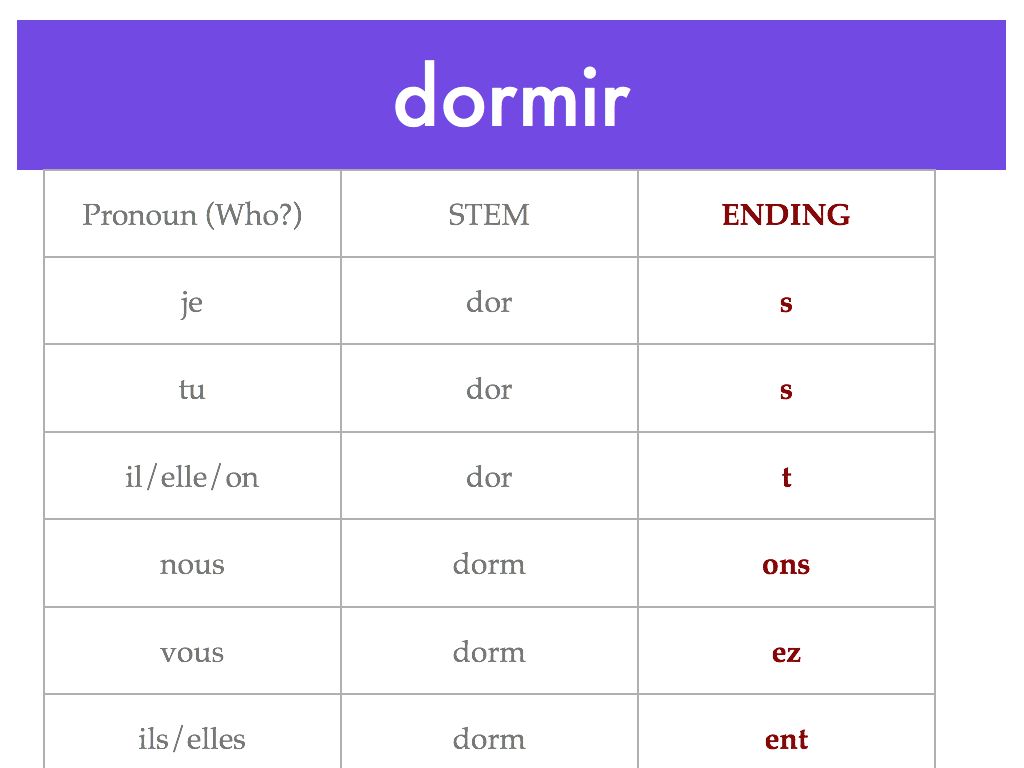
Regular verbs that end in -ir
What's interesting here is that in the first three conjugations you actually chop a letter off the stem, but then it comes back. If your stem ends in a vowel then you add a double s in the last three conjugations (for example with the verb finir). Here is the pattern:
Regular verbs that end in -re
The third group does have a regular conjugation, but do spend some time hugging the dictionary or Bescherelle* because a lot of verbs that end in -re are irregular. Need I say être or faire? But don't be disheartened, because knowing the regular conjugation means you couldn't go too wrong even if you tried:

Some of the vocab featured in this episode:
chanter (to sing)
aimer (to love)
manger (to eat)
commencer (to start)
tutoyer (to be on "tu" terms)
dormir (to sleep)
finir (to finish)
attendre (to wait)
déscendre (to descend, to come down)
Let me know what you think of the episode, as always I hope that this is useful stuff and I'm really looking forward to any feedback you guys might have.
*You may have noticed the link to the Bescherelle leads you to Book Depository. This is an online bookstore fit to rival the big A in many ways, often their prices are in fact lower, and international delivery is largely free. Click on the little link above if you want to support French on a Windowsill as an Affiliate.



Struggling with listening? Discover realistic tips, challenge prompts, and the best tools for improving your listening skills as a self-guided language learner