
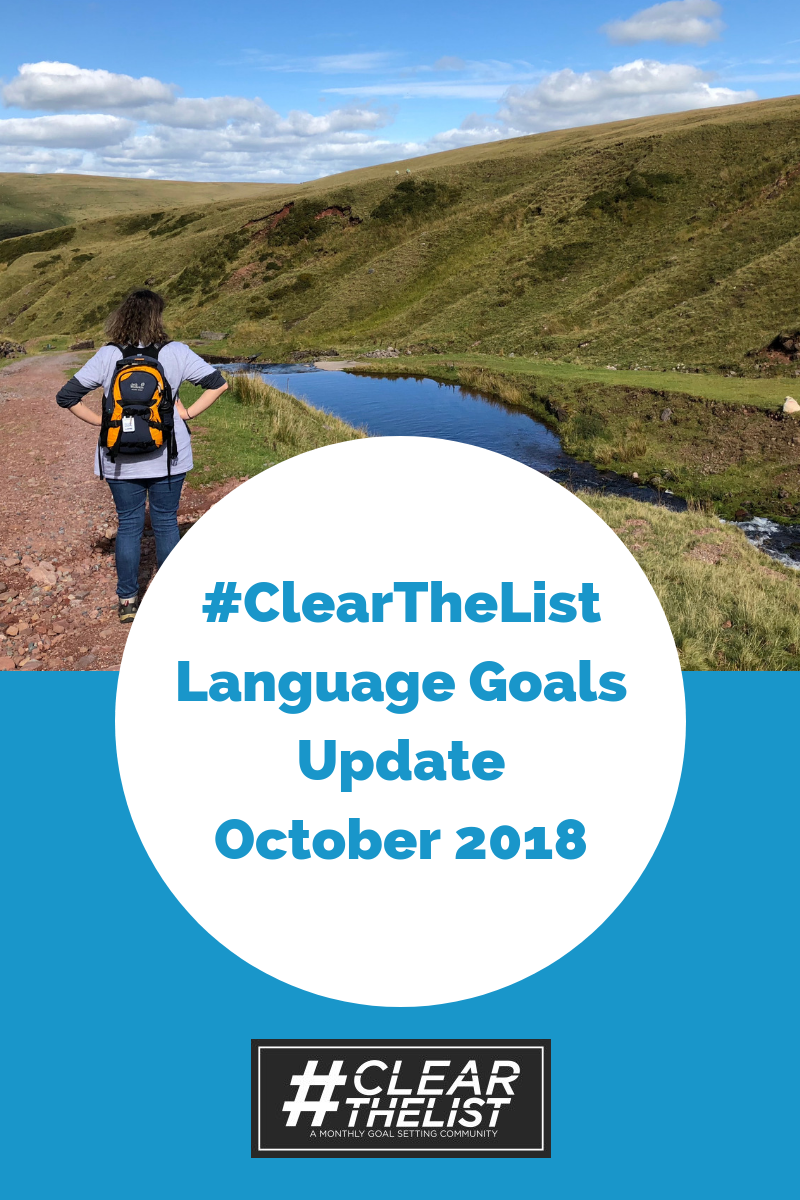
#clearthelist October 2018: Language Hunt In The Brecon Beacons
Catch up with my monthly language learning progress for intermediate Welsh and a few other languages and projects, plus September’s top Fluent Show episode

It’s time again for my language learning update with #clearthelist, the monthly language learning round-up sharing language learning goals, support, and accountability.
What Happened In September?
After all the summer’s travels, it was nice to spend a consistent bunch of weeks at home. I got back into my usual language routine — only to the extent that that routine actually exists! I’m not a “1 hour at this time every day” kind of person. In fact that kind of schedule would drive me crazy, so instead I focused on the goals for the month and making sure I maintain that daily contact level.
All in all, a good month for language! Plus, I’ve now started meeting on a weekly basis with Lindsay and Shannon again because we’re putting on a Women in Language sister event in November. Make sure you’re on the Women in Language list to stay up to date!
In other activities, the month was full up with promo, planning and bookings for the next Fluent German Retreat, which will be Christmas themed in December. I. Cannot. WAIT!!!
Travel in Wales: Is Welsh Useless After All?
At the end of the month, my husband and I spend a week travelling in Wales. It was lovely, we visited the Brecon Beacons, I swam in a lake, we walked in stupendous landscapes. By all measures, this trip was a success.
Except…I hardly spoke the language! You may have read how much I spoke in just 3 days at my last Welsh visit, the Eisteddfod in Cardiff., and wonder how come I didn’t get as much practice in this time?
In truth, I couldn’t find anyone who spoke Welsh. You may have heard before how the Welsh language was pushed out by English over the last 100-200 years. In the Brecon Beacons, this is super evident. Lots of people told me about parents and grandparents who “got beaten up in school for speaking Welsh, so they stopped”.
Make of that what you will. I think it’s not funny.
Where I grew up in Germany-near-Luxembourg, it was common to head to another country and for the border region folks to be bilingual. Yes, even in a tiny language like Luxembourgish. No one EVER would call Luxembourgish useless. Yet here in the UK, people do it to the Welsh (and probably the other UK languages) all of the damn time. Why would you have this presumption that a language is “useless”?
Anyway!! Do you have thoughts about this? Share them in the comments below, or come to the Polyglot Conference, buy me a drink and let’s put the world to rights.
The Fluent Show
The Fluent Show celebrated European Day of Languages (26 September) in style this year, with a HUGE 20 language quiz edition hosted by me and Lindsay. We quizzed each other and you lot. I’ve yet to find anyone who recognised all 20 languages. Could it be you?
Listen Here To Take Our 20 European Languages Quiz
Language Goals and Progress
Let’s have a look how September went in terms of language goals. I’ve got a feeling about this one!
Listening
The goal was to switch the radio on in Welsh 2-3 times per week. I managed this in week 1 (starter’s enthusiasm) and in week 4 (the car radio had Radio Cymru). In between, I did watch a few shows on S4C including coverage of Ironman Wales. I’d say 8 out of 10 for this goal.
Reading
Sgwp, Sgwp, Sgwp. It’s the book that keeps on giving. I’ve not set up a pretty good routine of reading the chapter, highlighting vocab, looking it up and putting it into my notebook, and reviewing previous words while I’m there.
I got through more chapters in September, but feel like more reading in Welsh is necessary.
Speaking
Speaking was pretty great! I had two meetings with Nicky and arranged to meet my friends Dafydd and Gavin while I was in Cardiff on the Wales trip.
I also set the goal to get through Say Something in Welsh 2 up to level 18, and in fact I’ve just finished level 19. Da iawn!
Writing

Well…I did download the exam papers. But then I didn’t look at them in detail. In fact, I totally forgot about this goal so it’s time I got back to it.
Through instant messaging in Welsh, I’m noticing that slowly I’m better able to translate “what I want to say in my head” into Welsh language without hesitation. Writing is always a slower skill for me, because speaking comes naturally with my extrovert/gregarious personality.
But as my tax advisor said…”you can’t hand wave through everything”.
Monthly Contact Goal
September looks pretty good, with 22 days out of 30 checked on the “daily contact with Welsh log”. Even when I didn’t speak Welsh to people on my trip, it was contact every day through bilingual signage and Radio Cymru in the rental car.
Other Languages
There’s always a chance for other languages to sneak in, and I did a tiny bit of playtime on the [Drops app] in Chinese and watched some Netflix with French subtitles.
Goals For October 2018
In October, I’m planning a trip to Croatia and a talk at the Polyglot Conference in Ljubljana, so it’s a busy one. Are you coming?
In October, I want to keep up the current Welsh level and play with a few other languages such as Chinese. I’m hoping to spend a good amount of time with Lindsay and Shannon, so maybe I can annoy them with my practice of tones.
Listening
At this stage, I feel it’s important for me to get lots more realistic spoken Welsh input so it’s definitely key to keep that TV or radio habit up. The goal’s 2-3 times a week, as before.
Reading

It’s not a particularly inspired goal, but I will continue to make progress with Sgwp and have a book of short stories lined up for afterwards. Reading is such a great way for me to grow my vocabulary. At this stage it’s more helpful for new words than online lessons!
Taking into account the big amount of travel I’ve got coming up, my goal is 5 chapters of Sgwp.
I want to dedicate the rest of the time to picking up the good old Chinese in 10 Minutes a Day again. Perhaps I should actually spend 10 minutes a day on it and then I’ll learn way more Chinese!!
Speaking
I will continue to book in an hour or so every week for a virtual paned a sgwrs (cuppa and a chat) in Welsh when my friends can spare the time. I am also craving contact with more speakers, so am considering putting together a Meet-Up Cymraeg here in Canterbury in the next month.
I'm also very pleased to be back on the Ceffyl (horse) with Say Something in Welsh, so my aim is to complete challenges 20-22 in level 2.
If you want to start learning Welsh yourself, download my free Teach Yourself Welsh toolkit here.
Writing
Tricky! I do want to work on that exam paper, but this month I don’t feel ready. I’ll set a different goal and park this one. My goal is to post a Welsh language caption on Instagram at least once a week.
How Was Your Month?
So that’s it for this month’s goals! Be sure to check out the linkup for #clearthelist, hosted by Lindsay Williams and Shannon Kennedy.
By the way, if you want to hear more about what you can do when you’ve failed to meet a goal, check out September’s Fluent Show episode about goals with tips from me and Lindsay.
Are you setting goals, too? How do you feel about your target language and its usefulness?
Leave a comment below to tell me all about it!
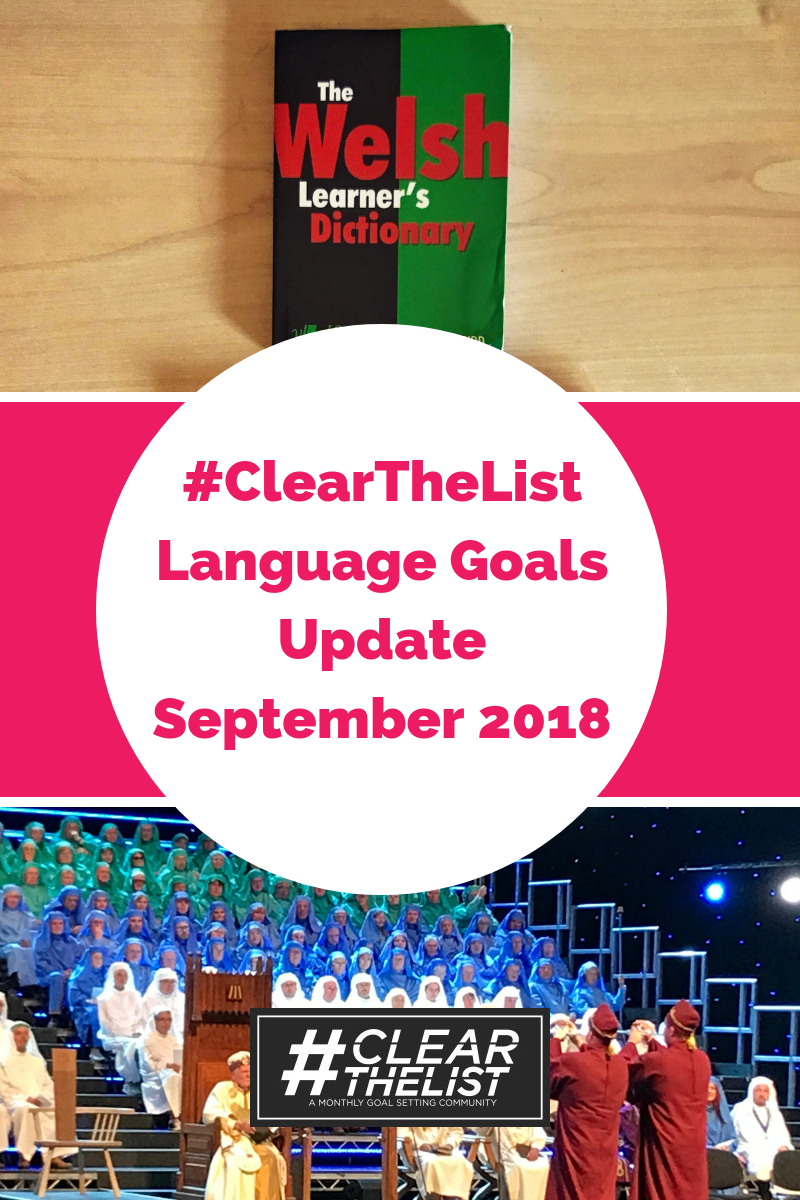
#clearthelist September 2018: Immersion, Eisteddfod, Druid, Video!
Welcome to my monthly language goals round-up, this time reporting on my language learning progress and new goals for September 2018. I have news about immersion, where I’m travelling next, and how I’m going to get to the next level in Welsh.
OMG it’s clear the list time again, and WHAT A MONTH IT HAS BEEN!!! 🛎 #clearthelist is a monthly language learning round-up sharing monthly language learning goals, support, and accountability.

What Happened In August?
So back in the last blog update, I already shared all about the amazing Fluent German Retreat in Munich. This technically happened into the first days of August, so it’s fair enough mentioning it here again. ☺️
Eisteddfod!
Barely home from the Retreat, I was back on the road, this time for my own immersion experience at the Eisteddfod Genedlaethol in Cardiff. If you’ve never experienced an Eisteddfod before, they’re hard to describe. Imagine EVERYTHING WELSH CULTURE in one place, colourful and happy and ancient and new, packed into a week-long festival. In other words, it’s amazing!
The Eisteddfod takes festival volunteers, so I signed myself up as a steward. Volunteering at the festival is a great way to ensure I speak as much Welsh as possible, experience things from a different angle, and attend events I may not have considered otherwise. Plus, it teaches me great phrases like these:
- Dyn ni’n hollol llawn fan hyn. (We are completely full here)
- Ddeffniddiwch y drws arall, os gwelwch chi’n dda. (Use the other door, please.)
- Paid ag eistedd yn y seddi wedi cadw. (Don’t sit in the reserved seats.)
In addition to all that, I also got free entry to one of the most popular events of the whole Eisteddfod week: the chairing of the bard! Here, you can see the Welsh archdderwydd (archdruid) in action:

The Fluent Show
All that August travel didn’t stop us from celebrating a major Fluent Show milestone as we recorded our 100th Podcast Episode this month.
We celebrated with a quiz and a live show including FIVE awesome guests: Shannon Kennedy, Gabriel Wyner, Richard Simcott, Kylie Sturgess, and Benny Lewis. So much fun! Catch up with us here.
Language Goals and Progress
Time to review August’s goals and get set up for what’s in store in September 2018. As expected, August was not a month for my dabble languages Spanish and Chinese. Instead, I taught lots of German and learnt lots of Welsh, so let’s focus on Welsh.
Listening and Speaking
I had grouped these skills together for August because of the trip, and would say I delivered on both!
My room in Cardiff was rented from Cymdeithas yr Iaith Cymraeg, meaning I had plenty of Welsh-speaking flatmates. I even ran into Robin, who I’d chatted to before on HelloTalk! In addition to that and the volunteering, I met up with friends and Welsh speakers I met online and spent over half of my days speaking the language.
At first, speaking Welsh was tricky and my head was working extra hard on day 2. You know that “I’m an idiot who understands nothing” feeling? Yep, I had it too! But by day 3, it felt like a lightbulb was coming on and Welsh became much easier. Here is a video filmed by Nicky Roberts, showing the way I was able to speak on my final day in Cardiff.
I’ll be honest, I’m actually pretty proud! This is approaching free conversation in Welsh, what better feeling could I have. And shout out to all the Welsh people I spoke to - turns out almaenes sy’n siarad Cymraeg (a German woman who speaks Welsh) has some novelty value and everyone was extra lovely.
Progress After A Few Days Of Immersion
One little note here on immersion, and you’ll see this as I write about the German Retreat on the blog too. This visit to Wales definitely felt like the most effective, productive, and encouraging immersion experience I’ve had so far. Last time I visited the Eisteddfod, my level was “high beginner” (late A1 ish) and I found it motivating and enjoyable, but I wasn’t ready to speak Welsh freely yet.
This time, with my level at a firm “intermediate” (B1 ish), it was WAY different and I enjoyed the experience because I was able to get truly involved.
Often, we think of “immersion” as a learning strategy that is beneficial to complete beginners. But in fact, it’s more helpful when you’re at the intermediate level and you DO have some knowledge to build on. This is when your mind is ready to join up the puzzle pieces and take you to the next level.
More About This And My “Language Waffle” Theory Here
Reading
I got about 7 chapters further into Sgwp!, but still not finished. My goal was to get halfway into it, and I would say I’m at 45%.
However, I also read through the whole issue of Lingo Newydd, including the red bits for advanced learners! Plus lots of incidental reading of programmes and tickets during the Eisteddfod.
Writing
As expected, I didn’t put any longer pieces of writing together in Welsh. I regularly direct message with friends and I posted on Instagram a few times with captions in Welsh, but I’m beginning to feel that it’s time to take my writing one step further.
More about that in the goals section…
Monthly Contact Goal
Every month, I log my “daily contact” with the Welsh language. And August was great, with 23 days out of 31 logged. As always, this also depends on me remembering to tick a box, so it’s not a 100% accurate number.
Best strategies: Visit where your target language is spoken, text friends in the language, and put the magazine where you’ll actually read it.
Tiny Note on Duolingo
I’m now at a level where I can test out of every new level Duolingo gives me and I never remember any of the new vocab it shows me. Duolingo, at my current level, feels like it has become inefficient for Welsh learning. Have you experienced anything similar?
Goals For September 2018
Listening
I have noticed that my podcast Pigion has become boring, but I’ve started listening to Radio Cymru live through the TuneIn app. There’s more music and I understand more than on the podcast, even though the podcast is supposed to be for learners! Radio also makes me feel more connected to the community of Welsh speakers.
The goal here is to switch the radio on in Welsh 2-3 times per week.
Reading
I’m feeling keen to try something different after a year of subscribing to Lingo Newydd, so for this month I’ll stick with Sgwp! and keep an eye out for a new printed publication I can try out.
As usual, the goal is to progress with Sgwp! It’s not a bad novel, and the short chapters are helping lots.
Speaking
It’s SO difficult to come away from an intense “Welsh every day” experience and drop back into normal life where I don’t have all these handy Welsh speakers around me. So my goal for September is definitely
In August, I picked up Say Something in Welsh (SSiW) again and got over my hesitations between the Northern and Southern dialect versions. I now just make my sentences in either dialect and go with the flow, so I feel ready to progress.
I’m on challenge 16 of level 2 and my goal this month is to move through challenge 18.
And lucky me…I’m going to Wales again! No details planned yet, but I’ll be sure to head North and speak more of the language.
Writing
Time to get real: I should put down a page of writing and get it corrected. For writing practice, it can be hard to know where to look as a solo learner. I’ll try the Welsh exam council and see what they ask for at the intermediate level, and work on writing an exam paper and getting it corrected.
If I don’t get this done this month, no harm done as I know September’s a busy one and I will make sure I still DM friends in Welsh every week.
How Was Your Month?
So that’s it for this month’s goals! Be sure to check out the linkup for #clearthelist, hosted by Lindsay Williams and Shannon Kennedy.
Are you a language waffle or a language pancake when you travel? Do you feel the same as me about Duolingo once you’re above the B levels? Are you setting goals?
Leave a comment below to tell me all about it!

Living And Speaking French Just Like In France + 11 Everyday French Expressions
Learn French with a bilingual podcast interview! In this article, you’ll learn what it takes to learn French so you can speak to any local in the language - plus there is an interview on the Fluent Show which is half in French and half in English. C’est trop bon! 🇫🇷
Let's be honest: We all dream of speaking perfect French. To communicate in melodic sentences, move along the boulevards and feel right at home, and essentially turn into Amélie for a day.
But if you've been learning the French language for a while, maybe you've found that it's hard to feel at home with this language. You know all the vocabulary, you have practiced the grammar...but something feels like it's missing.
In today's episode of the Fluent Show, I've got a special guest who is going to help us find that missing piece, in a bilingual episode dedicated to France and French culture. My guest is Géraldine Lepere, an online French teacher at Comme Une Française.
Her French lessons are for anyone who values the French language and culture, and her online courses help learners at any level go beyond grammar and "double their Frenchness."
Start listening here:
Bilingual? How does that work?
It's simple. Throughout this episode of the podcast, Géraldine and I will switch between speaking English and speaking French.
You will hear me make mistakes, forget words, and be right there in the truth of making mistakes. I am a French speaker and have studied French for 20+ years, but my French is NOT perfect.
In this episode you will learn
- how to swear and how to say "that's awesome" in French
- what you need to know about French food
- why understanding French culture makes the difference when you practice your language
- what real French people think about studying French grammar
- where to find the best restaurants and the best music in France
- how Géraldine's website can help you speak French comme une française
Here are a few things to listen out for:
Cross-Languaging

As soon as I started speaking French to Géraldine, I threw in all sorts of other languages! On the recording, you can hear me say things in Welsh, then German, and then finally in the language I was looking for. When you are out of practice speaking any language, this type of "interference" is actually pretty normal.
Everyday Expressions In French
I learnt French in the 1990s from an experienced (though perhaps middle-aged) French school teacher, so I used this opportunity to refresh my Français familier: the colloquial language that was neglected when my education focused on professional environments.
Here are a few of the expressions I learnt in this episode:
- Greetings and Goodbyes - Coucou, À plus
- "quite a while ago" - il y a longtemps
- Swearing (hehe!): mince!, or putain/merde (but those are not suitable for foreigners)
- awesome! - trop bien, génial, chouette
- cute - mignon
- great, but also awful...depending on the context! - terrible
- funny - rigolo
- to confuse - confondre
- around here - dans le coin
Living in Three Languages
Géraldine is more than your average French woman: she grew up conversing with her parents in French and in Spanish, and now runs a business helping English speakers too. For her, every language comes with a slightly different outlook: French for love and life, English for business and strategy, and Spanish for speaking to family.
Setting Good Goals
For learning French, it pays to be structured and organised about learning other languages. Géraldine and I discussed how a clear Vision Goal and Path Goal can serve you as you're sitting down to learn. When you set yourself the goal "I want to speak French", you run a risk of big failure because things are so vague.
Make sure that you capture the vision and document what motivates you to learn French - le désir, but then get specific and create les buts de chemin, goals that guide you on the path to everyday fluency.
The Language Habit Toolkit is my structured product giving guidance and worksheets so you can create your own goals and study plan, step by step.
Speaking a Language Means Having Respect
French people often get a reputation for "rudeness", but is that really true or are they simply acting in a way you're not familiar with? For example, small talk is less common and a French speaker's silence is often meant to communicate respect for you. When you're learning French, knowing these important things about the norms of communication in a country are a lot more important than knowing the gender of every single noun.
Understanding France
Learning French as a language is one thing. Learning real-life French with all the little things that help you sound like a real human instead of a 1950s textbook, that's another. Géraldine mentioned how many times her students struggle trying to get that natural touch in the French language, and how many times they get frustrated because the French keep replying to them in English.
Once you start working on your cultural competence, you'll find that this changes. You'll be able to hook in to that extra layer of fluency that makes everyone around you relax. And voilà, they start answering in French too.
Want To Lean French Language and French Culture? 🇫🇷
If you have been putting in the hours on French duolingo and feel nearly ready to speak the language to real people, here is something that will get you exactly where you want to be.
Géraldine has got a programme fantastique, a brilliant course designed to speak real French. It's perfect for intermediates who want to start speaking French for real.
Oh and best of all, she's included a 15% discount for listeners of the Fluent Show!
Click Here To Discover How To Speak French Like In France (15% Discount)
Loved The Show?
I look forward to hearing your feedback. Did you enjoy this bilingual podcast episode? Did you understand anything...and how did you feel if you did not?
What Is Fluency, What Is Mastery...And How Do You Get There?
This week on the Fluent Show, Lindsay and I went deep into what fluency is, adding in a few other words that often feel awkward to use. It's a great conversation, and will provide you with a new sense of clarity and inspiration, so you can confidently go out there and do what you need to do: learn languages and feel great about it!
If there is one question that haunts language learners, it must be this one:
"How many languages do you speak fluently?"
Often asked innocently by people who are interested, it can strike terror in your mind. Will they test you on your languages? Are you allowed to say you're fluent if you still make mistakes?

Oof! Those are heavy questions, and none of them are difficult to answer. Even for those of us who have studied for decades, the question of fluency still causes confusion.
This week on the Fluent Show, Lindsay and I went deep on those questions.
It's a great conversation, and will provide you with a new sense of clarity and inspiration, so you can confidently go out there and do what you need to do: learn languages and feel great about it!
Press play now, and don't forget to leave us a comment below to share what you thought of the show.
Podcast Notes
Our warm-up discussion revolved around the labels we see in our space, and whether they apply to you.
If You Travel And Work On A Laptop, Are You a Digital Nomad?
A digital nomad is a person who travels and works online, right? But for some reason, the term can feel icky to us. In this week's episode, we discussed how some words walk that line between being descriptive and defining.
When being a digital nomad (or "polyglot", y'know..?) becomes a label that you like to put on yourself, it's worth taking a second to consider who that YOU really is underneath. After all, at some point everyone might want to stop travelling and settle up with a nice cat, just two target languages instead of 12, and a garden and a veg patch. And that is super cool, because that's you.
If you thought that this discussion of who YOU are was deep, wait until you hear what we moved on to!
How Will You Get Fluent? How Can You Achieve Mastery?
I have received several messages from listeners recently, asking the Fluent Show to weigh in on how we can achieve goals such as fluency and mastery. And interestingly, each one of them asked another question:
"How do I know when I have achieved it?"
What Is Fluency In A Language?
Our first question came from Evan, and he wondered when one can consider oneself fluent in a language. In the question, Evan considered quite a range of definitions from "making no mistakes" to "dreaming in your target language".
Our discussion starts off with this fluency mindmap I drew:
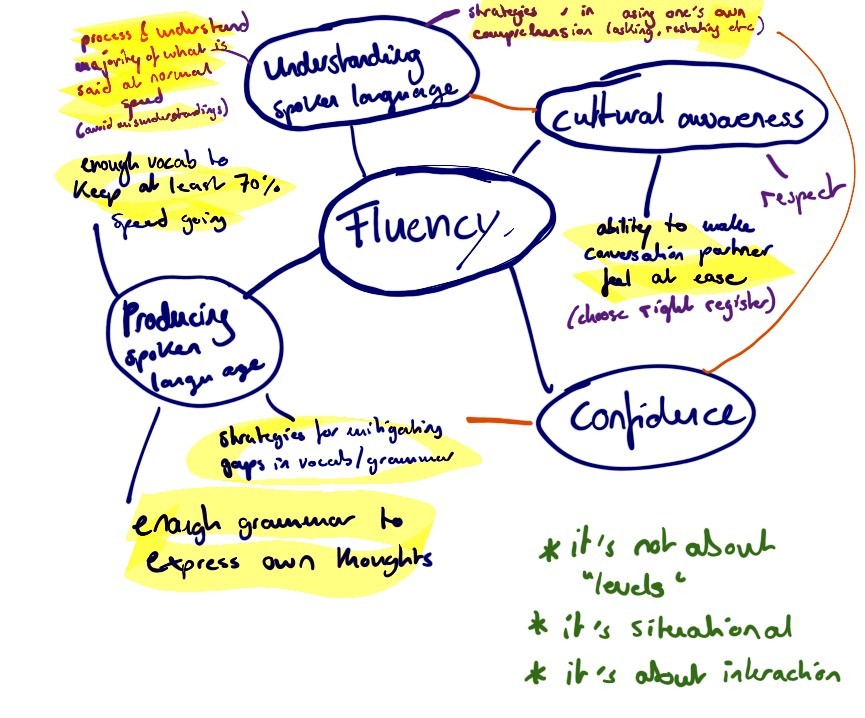
Bet you love my handwriting. Here's more about our take on fluency..
- "Fluency" implies speed and ease when using a language, which comes out most strongly when you're interacting with someone in person
- Usually interacting with someone in person means speaking
- The concept includes intercultural awareness that helps you put your conversation partner at ease and how to interact in a way that is appropriate for their style
- It implies confidence, meaning you have strategies to keep a conversation going
Fluency In A Language Is A Moving Target
Ultimately, your own definition of what fluency means to you is personal and unique. We believe that there are different points of fluency. These can relate to your goals and the purpose of your language learning. They can relate to what you are aiming for next, or what you're finding around you right now.
Just as life is forever changing, you may constantly evaluate your requirements for being "fluent".
What Is Mastery Of A Language?
Moving on from the fuzzy concept of fluency, we turned our minds to "Mastery" and how it is different from the former.
Madeline wrote in and asked:
What counts as mastery? Does every native speaker even possess it?
Our Thoughts on Mastery
This one was even trickier to nail down, believe it or not!
- Mastery is a point of pride and confidence for many, something we actively aim for and
- The word implies comfortable command, being able to use a skill (i.e. a language) with ease
- Mastery includes understanding beyond the literal meaning of the words in a target language
- But it can also imply superiority, like being the best out of everyone who uses that target language. Which isn't quite right in this context.
- For me, mastery is about more than just conversation and personal interaction. It encompasses the four core skills: listening, speaking, reading and writing
Our Conclusion
Both fluency and mastery are wonderful concepts to consider, but as Lindsay says, she is happy to not be fluent or masterful in every language. There is so much to discover and learn, and we can take a lot of joy out of appreciating the way that's ahead of us.
Yes, you can always get better. But there's no point in stressing about whether you are a fluent master - walk your own path, keep moving forward, and allow yourself to feel fluent on your own terms.
#clearthelist April 2018: Now I Know My Welsh Language Level
Catch up with my language learning goals and strategies with #clearthelist

Welcome to my latest language learning update through #clearthelist. Clear the List is a support and accountability blog group sharing monthly language learning goals. I have got LOTS OF GOALS this months, so let's get going.
What Happened in April 2018?
First of all: I went to Wales!
My big April goal was Book a day in Wales: SMASH SUCCESS PARTY, I went and attended a 2 day Easter Course in Wales in early April. You may have heard about it on the podcast I recorded there, which I was so happy with. The course I attended was awesome, so great to spend 2 days in the classroom with others who are also at my level in the language.
Talking of level, I have more good news. I chose to sign up for the course at intermediate level (“Canolradd” or roughly B1). I was not convinced, thinking I’m actually a little lower. But having taken a short self-assessment test, I figured I might as well be ambitious and downgrade if necessary. Turns out, I didn’t have to downgrade.
After 2.5 years of self-study I now know B1 level Welsh! This is so exciting, because I’ve never 100% self-studied a language to this level before. I still enjoy learning the Welsh language so much, and have a long way to go.
If you’re also a self-studier, see if there’s a top-up course like this available in your target language. They are great fun, and the tutor knew exactly which parts learners at our level are struggling with the most.

German Course Creation
I am currently working on a new German course. A lot of my working time was spent working with this story and creating resources for our students. German Uncovered in collaboration with Olly Richards from I Will Teach You a Language, and we're coming close to opening the course for the first time.
The Fluent Show

On the podcast, there were some great episodes during April, but the most exciting one has to be the episode Welsh is Not English.
I had never tried this “radio documentary” style of editing and was so proud of the result. Give the show a listen and subscribe for more episodes if you like it. The Fluent Show is now available on even more platforms including Spotify and TuneIn Radio.
Most “Fun Fact” of The Month
Welsh has 50 ways of saying yes or no. I can correctly use about 1.5 of them. Sigh.
How Did It Go With My April Goals?
In addition to the 2 day course, I also had some other goals:
Have 3 natural conversations with my tutor/exchange partner and listen carefully: Ohh gosh, oh my, I missed the one session I’d booked and never even rescheduled. So that’s 0 out of 3.
However, I had conversations in Welsh while travelling there. I actually tried to use Welsh in 3 or 4 shops and restaurants, and couldn’t find any server who actually knew the language. So my conversations were with enthusiasts, i.e. all the people you heard on the podcast. Thank you so much to Gavin and Steffan, Morfydd and Janet, for speaking Welsh to me.
Practice Welsh listening by playing with no-subtitle TV, and reviewing the Pigion podcast vocab before I listen: I didn’t watch any good TV, I need to stop even setting this goal as it’s just not what I get up to right now. But I listened to 2 Pigions and made good use of the vocab supplied with the show.
Write a longer Welsh poem and continue playing around with different poetry formats: I managed one longer poem, but it was supremely nonsensical. Well, better than nothing, right?
Finish my easy reader novel and read all of the latest Lingo Newydd magazine Yep! I finished Bywyd Blodwen Jones, my first ever book in Welsh! Also did well with the magazine, which continues to be such a joy in my house. Great to add a bit of Welsh over breakfast.
Daily Contact Goal
In April, I logged 19 days of contact with the Welsh language. My most used language apps were ApGeiriaduron, Duolingo, SmartCards+, and Clozemaster. Followed by Instagram and Twitter.
Goals For May 2018
Sometimes there’s nothing special or grand to be aiming for, and those are the hardest times to keep going. It feels like “another month of the same”, without that fizzy excitement of a fixed goal.
I find that my goals get more exciting when I share them with others, and when I join a group. So it’s time to search for accomplices.
They’re also more exciting when they are a challenge, so I made sure to include challenging things in the Speaking and Writing sections for May.
Listening
Complete at least 2 intensive listens to the Pigion podcast This podcast publishes a vocab list for each show, so intensive means I’ll read through the vocab, add some words to my lists, and then listen until I feel like I’ve understood 75%. This is natural, full speed, native content. No shame in not understanding it all.
Reading
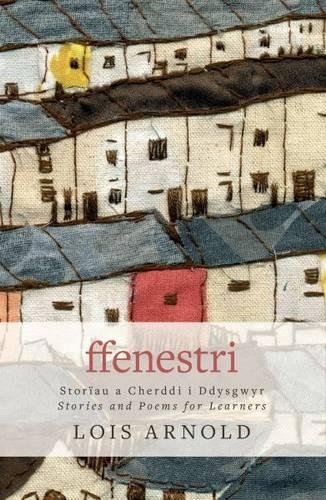
Start reading Ffenestri or Sgwp I bought two books for learners when I was in Wales, and then I got stuck because I can’t decide which one to start with. Goal: Pick one and just bloody start.
Read poetry in Welsh! Great job writing wonky poems on Instagram, Kerstin. But it’s time that I expanded my education here and learnt to appreciate what the language is like when used by a true expert. I love poetry more and more each day, and will
Speaking
Have at least 6 (!) short conversations in Welsh only This month I’m aiming to increase the frequency, not the length of my exchanges. I’ll take any opportunity from tutor sessions, friends, exchanges, and group chats using the Say Something in Welsh Slack group. By short, I mean 15 minutes (but you may make your own definition of “short”).
Look for a book club I mentioned new books above, and I am going to hit the forums at Saysomethingin and social media to see if anyone would like to have a book club meeting to chat about what we’re reading.
Writing
Write 2 language poems, and more considered ones. I have proven that I can write wacky, slightly nonsensical poetry in the Welsh language.
Anything Else?
Note to self: I need to start getting organised and booking my accommodation for the National Eisteddfod in Cardiff nice and early. I'm planning to volunteer again this year, which means a chance to speak and hear lots of Welsh.
I don’t have any goals in a language other than Welsh, but I do have something special and linguistic. to work on. I am reading several books that will help me with my general understanding and appreciation of language, and the English language in particular.
The first one is Getting Through by Roger Kreuz and Richard Roberts, a sequel to their book Becoming Fluent, which I LOVED and reviewed here on the blog (read the review).
There are two poetry books, too: Lifesaving Poems by Anthony Wilson,Collected Poems by Carol Ann Duffy. I’m also interested in finding more great French, German, and Spanish poetry. Great way to discover new worlds in my existing languages!
How was your month?
Is there anything you’re curious about? What did you learn in April? Leave a comment below or join #clearthelist to share your own language learning journey.
If you want to join the linkup for the month, hop on to Clear The List, hosted by my friends and language inspirations Lindsay Williams and Shannon Kennedy.



Struggling with listening? Discover realistic tips, challenge prompts, and the best tools for improving your listening skills as a self-guided language learner