
Accelerate Your Speaking Skills with Speechling: In-Depth 100% Honest Review
Speaking in other languages is harder than it looks at first. You can read books and study flashcards, and still choke when you speak to a real person.

It can be difficult to practice pronunciation and have conversations on a regular basis. Tutors are awesome, but your lesson time is limited. And many apps and bots make us feel detached.
Speechling claims to have cracked that problem. This new app offers speaking skill training, attractive design, and the most convenient access to a real person tutor that I have ever seen. No scheduling, no exchange of Skype names.
Sounds good, but does it work? In this review, let's take a deep dive and find out.
How does Speechling Work?
Speechling's courses use sentence repetition, a premise that you may know from fellow Fluent favourite Glossika. But there is a twist: Speechling includes feedback on everything you record, from an actual human.
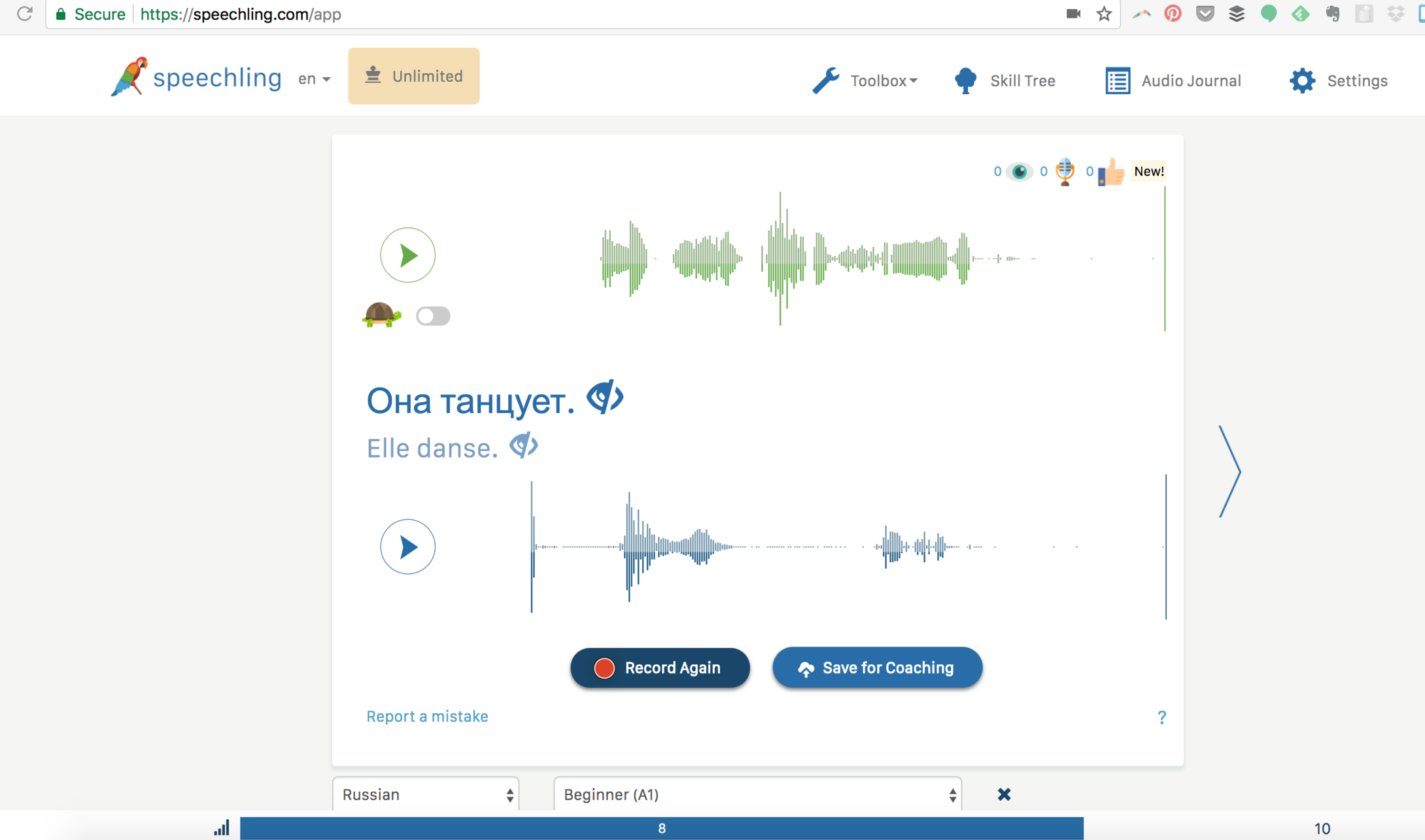
After repeating the sentence you see and hear on the screen, you have the choice of listening back to your pronunciation, or to save it for coaching. After you save your recording, you will receive feedback and tips from a Speechling coach.
How I Tested The App
Speechling's six language options gave me the chance to test ot for at different levels:
- Advanced (French),
- Confident Beginner(Russian)
- Absolute Beginner (Chinese).
The Advanced Learner Test: French
In French, my language level is around B2-C1 on the CEFR. I can navigate most conversations without hiccups, and I know for a fact that speaking French is what I need the most.
So for my level, saying a few sentences every day at my own convenience was perfect.
The live feedback here was eye-opening. I have an optimistic blind spot to my own weaknesses in pronunciation and word choice. I always learnt French in academic environments, so I produce great grammar. But in reality, my spoken French sounds textbook and a little uncomfortable. The coach feedback made me more aware of my little mistakes without discouraging me completely. I felt encouraged to try again, to fix what I was saying and carry on.

Describing a picture using Speechling's Freestyle mode
With the freestyle mode, I got to practice free speech instead of repeating pre-written sentences. In the dictation feature, I added listening comprehension at natural speeds.
The Confident Beginner Test: Russian
Russian is a language I studied about two years ago and I was able to have very basic exchanges (“what did you have for breakfast?” - “I had porridge”, that kind of stuff). I pronounce words correctly, and can read Cyrillic. So with this language, I wanted to see
- if Speechling can teach me something new and
- if my pronunciation is accurate.
The module I chose was “Beginner (A1)”, which was a great entry point after a few years off. With each repetition, I felt like I was learning. The examples were well pronounced, came at a speed that felt like a suitable challenge, and soon I was improving.
I also felt that pronouncing each new word immediately helped me remember it, especially when I added a recording. The accountability of recording and coaching (“someone will actually hear this”) helped me link the phrase with a strong emotion. For more about how emotions amplify memory, check out my interview with Gabriel Wyner from Fluent Forever.
With a language like Russian, you need regular exposure to stay comfortable with the alphabet and pronunciation. Speechling surprised me here because it felt like the perfect tool. There were so many sentences I had never said before, and so many opportunities for me to improve.
Best of all, I was speaking Russian right there and then without any hesitation.
Of course, exposure to lots of sentences won't teach me more than lots of sentences. If I wanted to get back into Russian and start making steady progress, I would definitely use Speechling and I would add a textbook, dictionary, grammar explanations, and lots of input resources.
The Absolute Beginner Test: Chinese
Chinese is the only language out of Speechling’s range that I have never studied, so I decided to go for the “simplified” version. Does that mean easy Chinese? No idea, but it's worth a try. The module I chose was “Beginner (A1)”, as there was no way of picking anything even easier.
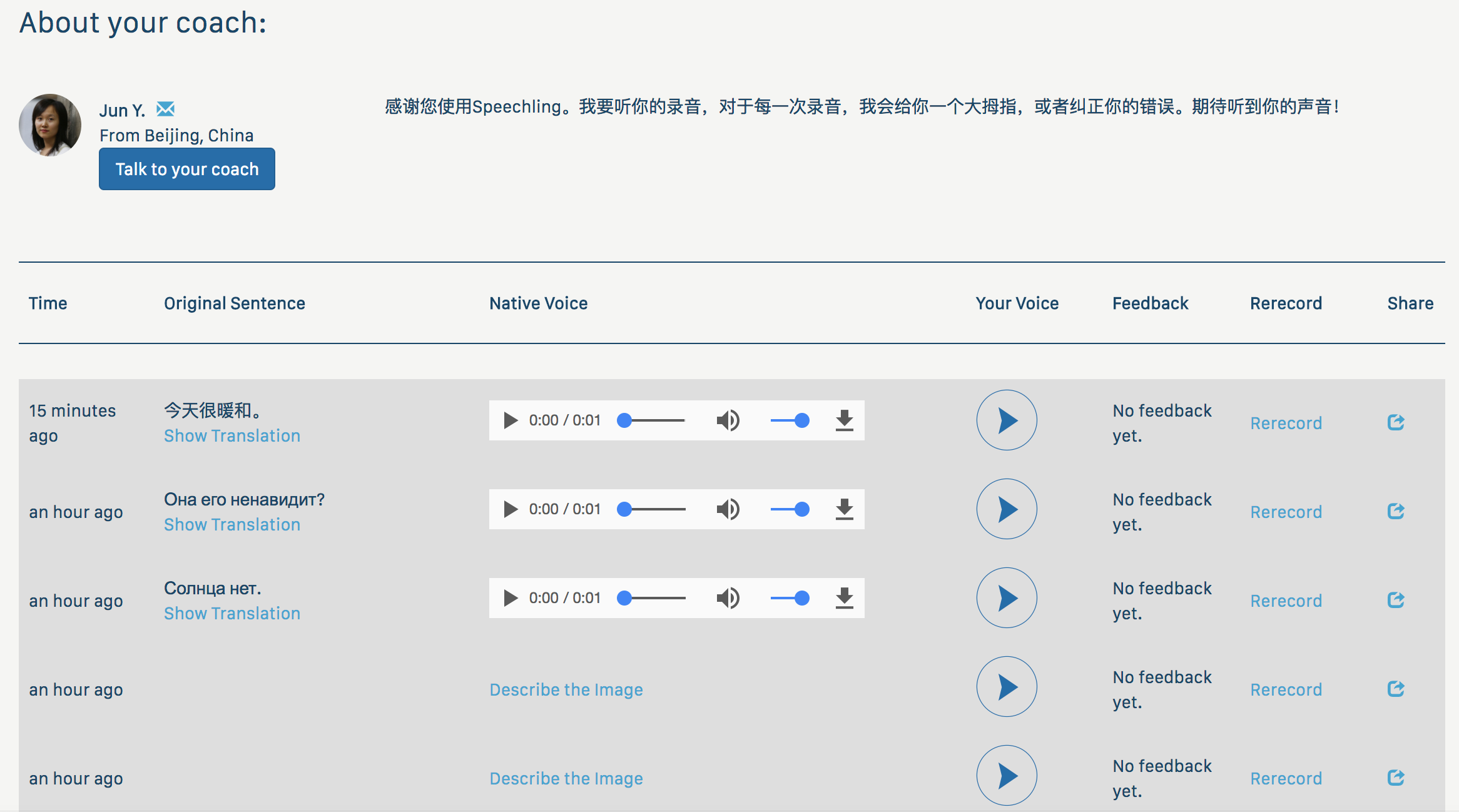
My Speechling Audio Diary
With Chinese, Speechling shows the sentences in Hanzi (Chinese characters). There is also the option of viewing the sentence in pinyin. Good job - it was the only way I could even start to guess at repeating the sounds I was hearing.
For a complete beginner like me, the sentences were interesting. I had to repeat the audio input 4-5 times before I dared to repeat the sounds. Surely, any Chinese speaker would be impressed?
Speaking Chinese to a Chinese Native After 5 Minutes
Well, I do know a Chinese speaker so I was ready to shine. Having newly acquired the sentence 今天很温暖 (“it’s warm today”), I asked my co-working buddy to listen to my Chinese and tell me if it’s correct. And he did understand what I was saying, although “impressed” would be stretching the truth a bit.
I also sent my recorded sentence to the Chinese coach, who drew my attention to the specific parts I got wrong.
Learning mass sentences as a complete beginner isn’t ideal. It leaves you without a sense of what each word means (which one out of jin tian hen nuan huo is “warm”, which one is “today”....and what do any of those symbols mean?). Learners don't get to understand what any of the rules of speaking are. But that’s okay, as Speechling not designed for that. This tool is a great confidence builder and accent sharpener. I could imagine it as a fantastic basis for tutoring, sending students away with homework on a topic.
Multilingual Usage

If you have studied more than one of Speechling’s range of languages, you can view translations in any of the six languages. This means you get to practice two languages at once, and it’s one of easiest ways to train your polyglot muscles.
Downsides of Speechling
On several occasions, my recordings were too long to be saved for feedback. This is understandable, but it was frustrating particularly in the freestyle mode. It’s disappointing when you say a complex sentence to send to your coach, and then get a message saying “file too large - cannot save”. It would be great if Speechling could include a guide on how long I can record for.
For languages where I knew nothing at all, I’d also like to see a primer module so I understand what I'm doing. But this is a tiny point, especially since Speechling is not aimed at complete beginners.
In Conclusion: Speechling is Great
All in all, I found Speechling a great addition to my studies. It was challenging and helped me improve my pronunciation and speaking skills in three languages. I was most excited about what Speechling could do for my Russian language skills. I improved both my vocabulary and accent, and the process was efficient and fast.
Speechling is free from robot voices and works with male and female voices (native speakers, of course). Its interface looks great and it gets you into the action immediately.
I love the record-feedback cycle, because it prompts you to re-record a better version of what you said. You get feedback, and you improve pronunciation, confidence, and speed.
The coaches were great for all the languages I tried. They recorded speedy corrections. At the very early levels, feedback is not rich, because they are native speakers and they use their native languages. But even so, it was clear where exactly I was supposed to change something. The more you learn, the more you will get out of these coaches.
If you work with a tutor that you don’t see every day, definitely try adding Speechling to your language routine. You will be speaking your target language more, you'll build a better accent. And best of all, pronouncing all the new words will help you remember them faster.
How to Get Started (+ Speechling Discount)
Create a free account and start speaking at Speechling.com, or by download the app from the App Store or Google Play Store.
Speechling is currently available in six languages: French, German, Spanish, English, Russian, and two types of Chinese.
It’s a freemium app, and you get 15-20 minutes of feedback for free every month. I would recommend checking out the paid plan (see below for 10% off) if you want to
- get a speaking boost, especially when there’s a deadline
- learn more than one language at once
- keep track of your progress with the audio journal.
The unlimited plan is open to Fluent readers at a 10% Lifetime discount: Make sure you use the code FLUENT when you sign up.
Good to know: Speechling is a non-profit company and also has a classroom version called Speechling for Education. I have an existing relationship with Speechling as they are a sponsor of my podcast. This only influenced the amount of attention the product received, not the verdict. It is a cool app.
Have You Tried Speechling?
Are you a pronunciation master now? How did you like the coach feedback? Leave a comment below and share your story.
***hello from the future!!***
Since my original review of Speechling in February 2018, these folks have been hard at work and have just emailed me to share the following new developments.
1. A new module called "Speechling Foundations", which will teach newbies from the very beginning. This start from zero module covers teaches the most essential words in context.
2. New listening options: Speechling now offers listening comprehension, multiple choice, fill in the blank, and flashcards. It's all available for free without login. All of this works on mobile too.
3. More language! They've more than tripled our content collection.
4. Offline mode!! Premium users can download a huge chunk of Speechling’s sentence collection (~10k sentences) and even audio books and Anki decks .
And added in March 2020
1. Speechling now includes Italian, Japanese, Korean, and Portuguese.
2. The recording time has been upgraded to 15s as Standard! It’s quadrupled to 30s for paid users.
3. There are now over 10k recordings (male + female combined) for each language, from words to complex sentences.
4. Speechling now includes word hints where you can mouse over words and get pronunciation tips and definitions.
I love it when an app listens to its users, this alone makes it worth checking out!
Language Learning Advice From a Polyglot Veteran (Bilingual Interview with Judith Meyer)
In this interview with passionate polyglot Judith Meyer, she shares how she learnt over 14 languages, how you can get over the intermediate plateau, and why learning any other language than English takes a little passion.
We talked about
- what excites Judith about leaving the textbook behind
- how to get over the intermediate plateau
- why using your language is the key to making progress
- what language learners can get out of events like the Polyglot Gathering
Oh...and we did it in two languages! Listen in to find out more.
Judith Meyer is well-known in the language learning world for co-founding the Polyglot Gathering event and writing several language books and courses. She's consulted by many and freely shares her own tips and experiences from learning over 14 languages.
Listen to my interview with her on the Creative Language Learning Podcast:

Happy places
We covered a lot of ground in this interview, and as a language learner you will be delighted to hear her excellent advice.
One Thing You Need to Know About This Episode
This is a bilingual podcast.
If you are not an experienced German learner, there will be some parts of the podcast that you don’t understand. But like all language learners, you’re not alone in that feeling. Try to stay with us, trust that we will come back to English again and again, and challenge yourself to become comfortable with not understanding everything.
German Learners: Click this link to view a full transcript (bilingual) of our conversation, so you can listen and read along at the same time.
The Learning is The Goal
Some people learn for practical reasons like travel or employment. to me is how both Judith and I come from monolingual households. There was no focus on languages, we both started at age 10, and yet this "late start" did not mean that it was impossible to do.
She says she used to try and invent her own writing system as a child because she found Chinese so fascinating.
Use Your Language Early
Judith says that it's important to do something that is NOT studying all the time. She says
I get easily demotivated if it's just studying a textbook
Judith books early lessons with tutors and uses her language in all kinds of ways so she can stay interested.
The Importance of Goals and Tracking
Even though Judith doesn't struggle with the general motivation to learn a language, she does keep track of her progress.
She's kept a spreadsheet on her computer for many years, and maintains a goal of doing a little more each year.
I absolutely agree with her on this, and found myself doing more with my language in the same amount of time when I started tracking. If you're interested in how learning languages works with my system, check out the Language Habit Toolkit.
How to Get Over an Intermediate Plateau

As someone who can hold a confident conversation in over five languages, Judith knows what it takes to go from a plateau to a much higher language level.
The trick is this: Your language level adapts to what you're doing in that language - in other words, you will grow with your challenges. You have to start trying to do something you cannot do.
The hard part is to start before you are ready. Judith describes how new Chinese challenges like presenting and debating tasks helped her get off the intermediate plateau.
But as Judith puts it:
If your lifestyle is such that you don't use C1 German, then good luck learning it.
You might get there for a short while, but to truly stay there you have to keep using your language.
Why Your Reason to Learn a Language Won't Be Enough
Finally, we chatted about the big reasons for learning languages. As a card-carrying member of "the tribe of those who learn a language because it's awesome", Judith has remarkable thoughts on why learning languages is important.
I don't need a reason to learn a language. I need an excuse.
By this she means that if you're looking for a reason, unless you're learning English there's often not a deep seated REASON that will keep you going for long enough to become fluent. Instead, make use of the good excuses out there, like learning for travel or for work.
But if you're just starting a language because you're fascinated, that is perfect.
After all, why would anyone learn so many languages if not for the love of them?
Understanding Germany
As the German part of a German-American couple, Judith knows that understanding other languages is a key part of learning other cultures.
She writes the blog "Understanding Germany", where she offers insights into what the Germans are like, how they think, and what's shaping the German mindset right now.
Click here to access all links and resources mentioned in this podcast
I look forward to hearing your feedback. Did you enjoy this bilingual podcast episode? Did you understand anything...and how did you feel if you did not?
Your Intuition is Wrong about Learning Languages
Do you have a vague feeling that you're too old to learn a language?
Are you still looking for the best way to do this?
Or do you just....feel like you're never quite doing enough?
Then we have the show for you!! Hit play now and check out episode 69 of the Creative Language Learning Podcast
Do you have a vague feeling that you're too old to learn a language?
Are you still looking for the best way to do this?
Or do you just....feel like you're never quite doing enough?
Then we have the show for you!! Hit play now and check out episode 69 of the Creative Language Learning Podcast
(Beware listeners: This episode contains a discussion of a few English swearwords, so if you want to avoid them please skip the first 20 minutes.)
Here's wbat's on the show this week:

Language Stories: Lindsay has a new podcast, reporting back from her adventures around the language landscapes of cities like Montréal, New York, and more.
Even after 20 years of English, I still don't know all the words. We discuss an English slang word that was news to me.
The Psychology of Rewards
We discussed why and how you can reward yourself when you reach those study goals.
Here are a few ideas from the super cool Fluent Language Learners community on Facebook:
Treat Yourself as a Reward
- Enjoy a coffee and take some time out in a café, watch the people, and take in the atmosphere
- Read a good book...maybe in your target language, maybe a bilingual text
- Treat yourself to some new stationery
- Go out and explore where speakers of your language hang out, for example if your city has an area where you can find ethnic food and goods
- Go to a concert or have a kitchen dance party
Enjoy the Rewards of Successful Language Learning
- Enjoy the happy glow of passing a certificate or good grade (Carlos), or the good feeling of completing a project
- Allow yourself a moment to recognise how much you have achieved
Some group members said that they never feel like they reach their goals. If this is you, check out our podcast for tips and thoughts on how you can reframe rewards and make them work for you.
Language Learning Misconceptions
What are the most common misconceptions, and which one is your (and my) top one?
There is even a Wikipedia article about this.
Some of them are intuitive and easy to accept, and some of them are so widespread that they have even made it into marketing.
Here's the list we discussed on the show:
- Children learn their first language effortlessly
- Younger learners learn languages more easily than older learners
- Intelligent people are better at learning languages
- Immersion is the best way to learn a language
- Grammar study is detrimental to second-language acquisition
- Learning a second language hinders the development of the first language
- Once a child can speak a language, the language-learning process is complete
Consider: All these ideas and beliefs are widespread, but none of them are true when taken at face value!
Double-click to edit...
Interlinear Books Review: a Powerful Language Learning Tool
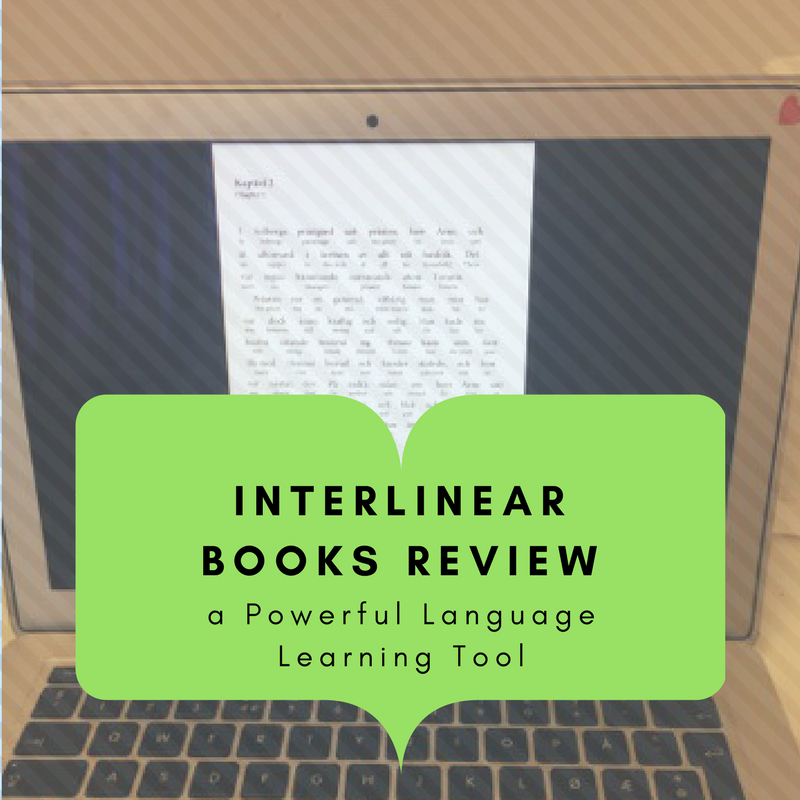
Interlinear are bilingual books that include the original and an English translation below. The English is in a smaller font, so that it doesn’t distract too much from the original language. Each word or phrase is translated below the original one, and the books are classic literature from the language it is teaching. In Interlinear Books’ own words: it’s like subtitles for books.
But do these live up to their promise? Read on to find out if Interlinear can really help you learn a language through books
Remember the recent podcast about reading in other languages? We talked a lot about how difficult it can be to find original literature in your target language that is actually comprehensible too.
In today's post, I've asked Fluent contributor Victoria to take a look at an intriguing offer...Interlinear books - they're like original subtitled literature. Say what! Victoria is both Norwegian and book-obsessed - no better candidate to review the books we examined in this post.
Read on to find out if the promise of Interlinear books delivers:
When I was asked to review Interlinear Books, a language learning literature tool, I was intrigued - I'm always looking for new reading experiences, and this certainly was unlike anything I have read before!

Short version of verdict: Interlinear Books are a great supporting language learning tool for intermediate learners to infuse some foreign language literature into their lives.
This review is based on no previous knowledge about Interlinear products, and all comments are based on my first-hand experience of trialing the Swedish Interlinear book.
What are Interlinear Books?
Interlinear are bilingual books that include the original and an English translation below. The English is in a smaller font, so that it doesn’t distract too much from the original language. Each word or phrase is translated below the original one, and the books are classic literature from the language it is teaching. In Interlinear Books’ own words: it’s like subtitles for books.
Click here to view all Interlinear books
Does it work?
Initially I was intrigued by the idea of learning language by reading quality literature – as a literature graduate and a book lover at large there could hardly be anything more fitting! I chose the Swedish title, Skatten: Herr Arnes Penningar (The Treasure: Sir Arne’s Money) and dived into it.
As a native Norwegian speaker, I was already fairly acquainted with Swedish as a language and feel that I was already somewhere between advanced and fluent level. However, I find that reading books in the language you are learning is always useful to broaden vocabulary, regardless of your fluency level. I wanted to feel more confident reading Swedish and thought this would be the perfect tool to do so with some guidance.
The story is not the most compelling and the language is fairly poetic for a novel, which I thought was a slightly strange choice. However, Interlinear does ensure that this poetic language carries through into the English translation, which I appreciated.
Not Your Usual Translation
Since each word is translated in the word order of the original text, I found that the English text could sometimes be strange to read. As a consequence of the word-for-word translation, the English sentence structure is sometimes quite unusual. However, this appears to be an effect of Interlinear’s aim to make you read sentences, rather than single words; the intention is for you to be able to grasp the meaning of the sentence without looking up every single word, just the ones you don’t already know. The text is translated and proofread by humans, which sets it apart from other translation language learning services.
Personally, I found the layout of the pages slightly hard to follow; the translation may be in a smaller font, but it is nonetheless very existent on the page and can be distracting at times. The result of the text appearing twice on one page is often that there is very little white space. You do get used to this as you read, however it may throw you off slightly at first.

I did, however, very much enjoy reading the text, and found that my reading skills improved throughout reading the text, as well as adding new words to my vocabulary. I also enjoyed the fact that Interlinear Books allow you to explore the literature of the country whose language you are learning and consequently get an insight into the cultural specifics.
Intermediate Learner? Look to Explore Interlinear
Interlinear really works best if you're an intermediate learner, as the concept of understanding the meaning of a sentence from understanding a few key words is unlikely to be effective at a beginner level. For this same reason I would also suggest that the Interlinear Books are a great tool for bridging the gap between beginner and intermediate; it allows you to put your language skills to the test with the translation to fall back on when necessary.
The key question you're all probably wondering about right now – can the Interlinear Books support your language learning experience? The answer is: absolutely.
So Should You Give Interlinear Books a Go?
If you're an intermediate learner, the short answer is: yes – but be aware that it cannot replace more conventional language courses or classes. It works best as a learning supplement.
The whole concept of Interlinear Books is to provide a tool that helps support your language learning, and the books should therefore not be the sole language learning you implement in your everyday life. Instead, you should use the books to replace some of your other English-language reading – read a chapter during lunch or during your commute, for example. The books are relatively short, so they are likely to feel easier to get through than a massive brick.
Interlinear Books currently have 10 books on offer, in 10 different languages. They're also continuously developing new books and languages, and you can sign up for their newsletter to be the first to hear about any new titles they produce.
View the Interlinear catalogue in full by clicking here
So, if you're looking to take that next step into reading books in the language you are reading, Interlinear Books is a brilliant place to start.
No More Hoarding! How to Organize All Your Language Learning Resources
Ever heard of resource overload? Most language lovers I know can't get enough of new books, courses, and blogs to inspire them...but there's a dark side!
Language resources can be overwhelming. You might wonder which ones are worth your time, or what you really need to get started in a language.
Over the years, I've amassed a huge pile of language learning resources, and in today's post I want to introduce you to a few of my favourites and explain four categories of resources that you should have when you're teaching yourself a language.
For instant organisation, you can find a Resource Organiser worksheet in the Language Habit Toolkit, available in the Fluent Online School.
1) Guiding Resources: Language Textbooks and Language Courses
The first resource I believe you should have is what I call a guiding resource. This can be a book, a CD set, a video course, or even a night class. For any resource to be considered a guiding resource in my mind, it must fulfil the following criteria:
Great Structure
Never compromise on structure. Look out for units, chapters, steps. There is none that is best for everyone, so ensure that your guiding resource follows a path that you will find interesting. You don't want something that just throws a lot of information at you, and you don’t want to be yawning by chapter 3.
The resource should have lessons that move you from one level to the next level. For example, in Benny Lewis' Teach Yourself book, there are different units and they tell you what it is you are going to learn - units such as talking about yourself, asking about other people, talking about family, and describing things.
Having a structure to follow is very important for independent language learners, so be sure to check out the curriculum before you buy.
Designed for Your Situation
When you buy a textbook, make sure you check if your choice might be designed for group classes (for example, Façon de Parler). This doesn't make such textbooks bad resources, but the way they are written, a lot of the exercises are usually not designed for you to do by yourself. The text will say something like: "Find a partner in your group and then practice these sentences with them," or "In the group, have a discussion of this image." The textbooks just assume that you're in a group class. If you're teaching yourself, this is not always helpful.
Multimedia
Third, there should be a multimedia component. This means that you want more than just a book or audio. You want the book unit to be accompanied by audio, worksheets, or video. Online courses in languages are getting better and better, but check that there’s offline access if you need it.
My preferred structure for a guiding resource is this:
Start with a story or dialogue, then an explanation of what was new, and finish with a chance for you as the learner to practice what you’ve learnt.
Good examples of guiding resources are
- Teach Yourself series, in particular the Language Hacking books
- Assimil (on Amazon UK)
- Duolingo if used in line with these recommendations
2) Input Resources: Enjoyable and Comprehensible Input
Input resources are very easy to find…the internet is a total treasure trove of them! I also call them supplementary resources, as they supplement all other learning.
You can have as many as you want. You never have too many input resources. With these resources, you can follow any story or video for some time, drop it, and then get back to it weeks later. Most YouTube videos in the language that you're learning are going to fall into this category. Music and TV shows also fall into this category.
Your input resources must be understandable, but not too easy and not too hard. You need to be able to sense that you're learning as you're following it; so, there should be a little bit of a challenge. But at the same time, you don't want them to be so easy that you know exactly what's coming.
If it’s fun, it works
Input resources also must be enjoyable. They must be fun, so feel very free to toss out what doesn’t interest you. If you don't enjoy them, you aren't going to engage with them. At Langfest in Montreal, I met the famous applied linguist Dr Stephen Krashen, whose belief in comprehensible input is all about these resources. This is where the magic happens. You need input, it needs to be fun, you need to understand it, and you need lots of it.
Good examples of input resources include
- Easy Languages on Youtube
- Olly Richards’ Short Stories for Language Learning (Amazon UK | amazon.com)
3) Reference Resources: Dictionaries, Grammar Guides, Phrasebooks
In a journey as epic as learning a new language, you’re going to get lost and waste lots of time without a map, and that’s what the reference resource can be for you.
Accessible Language Materials
First, the resource must be accessible. Obviously, they should be there for you to touch or open, but more importantly, they must be easy to understand. Second, the resource must be accessible in the sense that you should have it around. It should be there when you want it because the whole idea of a reference resource is you don't follow it as a course.
Dip in and out
Nobody ever learned a language by reading a dictionary. Instead of following reference resources as a course, you just have them around for when you have a question. At the start of language learning, I think reference resources are good to help you answer the question for yourself: Where am I going to look this up?
Many video courses fit right into the reference category. For example, the Fluent courses on German pronunciation and on grammar cross over between guiding and reference resources. My dream for my German courses is that somebody follows it, gains a lot from it the first time, but knows that they can dip in and watch every video individually.
Good examples of reference resources include
The three core reference resources you need are
- a good online or offline dictionary (read my in-depth dictionary tips)
- a good grammar resource (read more tips on effective grammar study)
- and a good pronunciation guide.
So those are the three key categories of resources you should have somewhere in your personal language library. To re-cap:
- Guiding Resources give your studies shape and help you know your progress. You want these to be structured.
- Input Resources make language learning effective and enjoyable. You want these to be fun and right for your level.
- Reference Resources are on hand when you have specific questions and need a quick answer. You want these to be easy to access and understand.
If you don't have these three areas covered on your (virtual or IRL) bookshelf, it's easy to feel lost when learning a new language, to miss things, and even to lose yourself and think you're better than you are or worse than you are.
4. Self-Teacher's Resources
Are you learning a language by yourself? You need one more: the self-teacher's resources, which are all about how to organise yourself. This category contains language learning blogs, podcasts, books to help you master the learning process.
The self-teacher's resources are awesome because they
- keep you motivated and accountable
- help you adopt great study techniques.
For a practical, action-focused take on this resource that will set you up for inevitable success, check out the Language Habit Toolkit, your language coach in a box.
What are your favourite resources? Want recommendations for a resource in your target language or feel you're lacking something?
No problem! Leave me a comment below or say hi in the Fluent Language Learners Facebook group.



Struggling with listening? Discover realistic tips, challenge prompts, and the best tools for improving your listening skills as a self-guided language learner