
De-Brief From An Organiser: Women in Language 2018

A few weeks ago, I was proud to co-organise and witness the first ever Women in Language conference, a unique online event designed to champion, celebrate, and amplify the voices of women in language learning. It was not my first online conference about language learning, but certainly the first I partly created and the first one ever to feature an all-female line-up of speakers.
In today’s article, I am going to lift the curtain and share my official de-brief as one of the three members of our organising team.
What I Felt at Women in Language
Let me start with the most important thing: I enjoyed every single presentation that I saw. And as I was often online making sure everything went smoothly, those were almost all of them. The quality of our many speakers at Women in Language was excellent, and the range of topics kept things interesting and inspiring.
Women in Language delivered on a few extra levels too. It felt as inspiring and intense as every offline conference could feel, with the added bonus of allowing me to sleep in my own bed. I adored seeing #womeninlanguage posts on social media, and to hear from our attendees in the live chat and Facebook group. And most importantly, I got SO inspired and motivated to learn languages in a brand new way!
What I Learnt About Language Learning
A lot of the impact of four days of language love cannot be put into words. It’s a boost in motivation, a renewed commitment, a burst of energy. And at Women in Language, I got all of those out of it and more. I got to know more of our conference attendees and boosted my own desire to learn and teach languages in new ways.
Here are the most important lessons from Women in Language that will be essential for all language learners:
1) Dabbling Is Legit
At Women in Language, we celebrated the huge diversity of how people learn languages. You can choose whatever language you want to learn, and you can learn it for 2 weeks or 20 years, and you can dabble in a handful of languages at once if you want to. This is all “allowed”, and won’t make you any less of a language lover or polyglot.
Sometimes it’s easy to feel self-critical as a language learner, and to tell yourself that you’re doing this wrong if you don’t use Anki or speak from day 1 or spend many hours on your project. But dabbling is perfectly legit, and you are allowed to feel proud of it.
2) Compassion Matters
Leading on from the previous point, compassion was a regular theme of the conference. When you’re faced with so many blog articles and Instagram posts and YouTube videos and language books telling you what to do, it’s sometimes hard to remember that everyone has a bad day.
You can’t always be happy and you can’t always be 100% gold in Duolingo. Compassion means allowing understanding and empathy for yourself when times are tough, but also for other language learners. No one method is the right one. Allow other people to feel good about themselves, and extend that same kindness to yourself.
3) Everyone Loves Transcribed Audio
Finding something interesting to watch or listen to, at the right level, and then with a transcription…that’s difficult. But it’s also what a lot of our conference attendees wanted, and you certainly CAN find it online. If you want to get a few ideas, check out Speechling, Glossika, Rhinospike, and Movieclips on YouTube.
And by the way: Just listening is NOT enough. If it’s just a wall of sound, you’re not doing much good. You’ll need to know what you’re hearing. Find input that you can engage with, and check against your own skills. For more about this, listen to my podcast episode about listening skills.
4) There’s So Much to Talk About
It’s never enough to practice speaking by doing the “Hello how are you where do you live” dance over and over again. Speaking practice is best when you’ve prepared something interesting to talk about. And lucky for us, there are tutors and learners who already discovered this too, and they’ve even put together lists (like this one) of questions and conversation prompts.
5) When Your Brain Is Having Fun, You Learn
All too often we think of language learning as a STUDY activity, in all caps. But it’s just not necessary to do things this way. Language can be learnt through story, through fun activities, through play. The most important things are exposure and repetition, not how hard you study or how much your language experience feels like work.
Though some of these lessons may read as happy-clappy positivity notes, I found that they often helped to ease a learner’s mind and allow them to take a break and come back to language learning with new energy and enthusiasm. After all, we want to get fluent while having fun, right?
What Do You Think?
Whether you attended Women in Language 2018 or not, what do you think about those lessons above? Are you a dabbler, or a hardcore study nut? Leave me a comment below to join the conversation.
In part 2 of this blog article, I will put on my co-organiser hat (a very stylish hat, for sure) to tell you more about how Women in Language was organised, what we learnt in the process, and what you should consider if you want to run or contribute to an event like this in future.
Organising A Successful Online Conference
I’ll start with what we looked for in our speakers and talks.
For this first ever conference, we used our own network of interesting women to ask if they wanted to speak at Women in Language. Their social media accounts, blogs, youtube channels, relationships with us were what put them on the radar. So if you’re dreaming of speaking out yourselves, making yourself very visible is good advice.
Before contacting our speakers, we considered some guidelines about the types of talks we would be looking for. In addition to practical topics featuring tips and techniques for language learners at “Beginner” and “Advanced” levels, we also chose the tracks “Living with Language” and “Working with Language”. Each speaker we contacted let us know which of the four themes they would like to address in their presentation, and was allocated one. This way, we ensured that no topics would be repeated and we could offer a varied programme on every single conference day.
Here are just three of the 25 talks we saw at Women in Language:


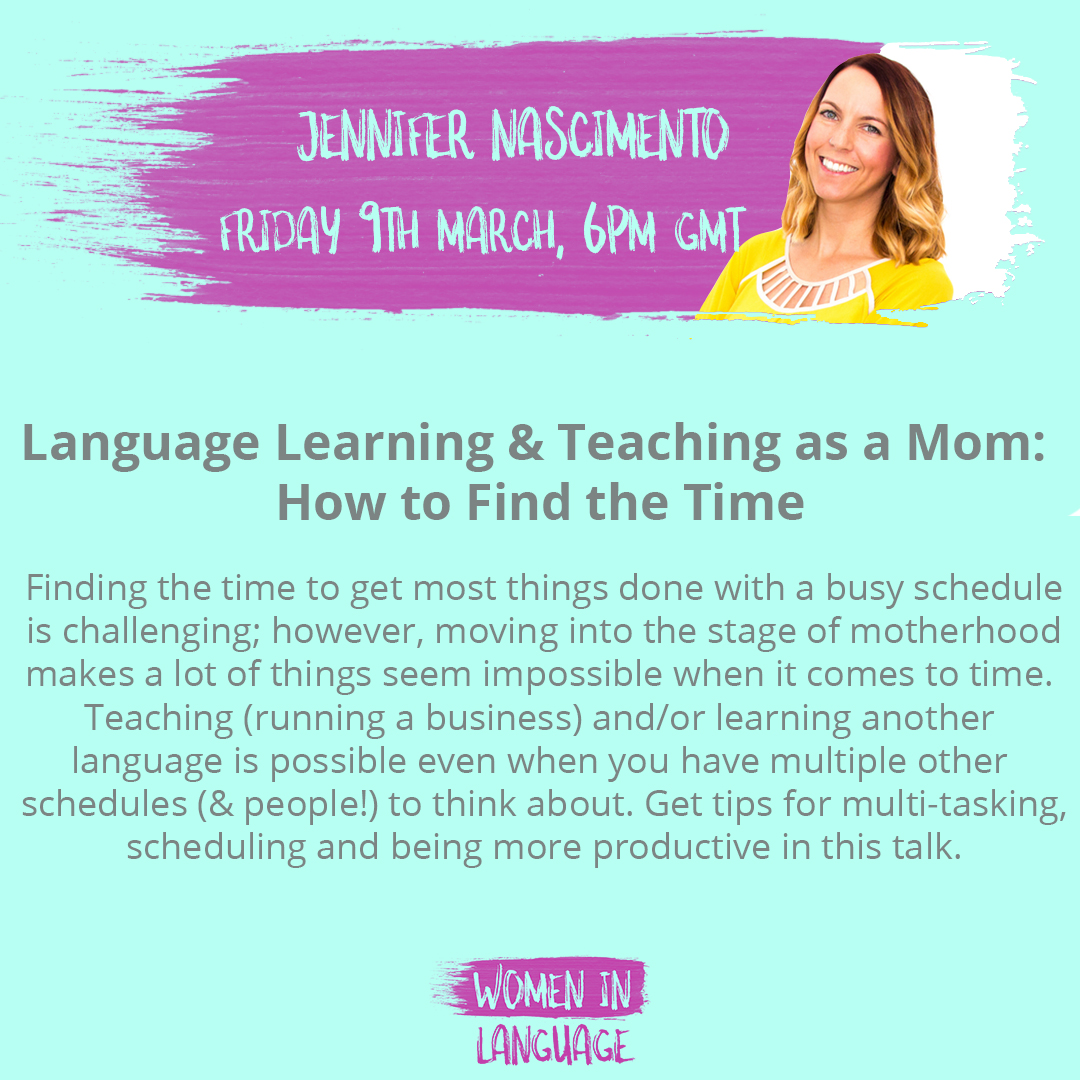
Some of our speakers came to us with a firm idea of the talk they wanted to present, while others found themselves unsure at the start. As our programme officer, I found myself receiving several messages saying “I don’t know, maybe I have nothing to say after all.” If you have ever hesitated to put yourself forward for an opportunity, here is the thought process that does stop them in their tracks: “Maybe I don’t have anything to say here.” Meaning “Maybe my experience, my voice, my passion are not valid. Others will have more to say.”
I extended offers of a little “talk surgery” to those who needed an idea boost, and without exception it was the speakers themselves who came to me with fantastic topic ideas, and who delivered on them 100%. In fact, I found that the most intriguing topics came from a place of passion and excitement in each speaker’s mind. Topics like “Learning With Crime Novels” and “Managing Motherhood and Language Learnings” are not a language learner’s most burning question, but that’s exactly why they make incredible conference topics: They are real, and invite us to think differently.
Some People Voiced Different Opinions
I won’t lie to you, at times it felt hard to be out there putting together this positive, kinda feminist event. Some commenters felt that it was a wrong move towards equality, unnecessarily excluding male voices. To those guys, I want to remind you that we welcomed and celebrated male voices throughout the event - it’s just that this time only women got to speak “on stage”, and every single one of them brought expertise, commitment, quality, enthusiasm, and outstanding topics. We set out to show the language learning world from a different angle, and I was so encouraged to hear from several male attendees who were enjoying the conference just as much as everyone else.
If You Want To Be a Conference Speaker
If you are considering applying to speak at a language conference, please don’t hesitate. Even if you were to hear a no, don’t worry and keep putting yourself forward - maybe the programme is full already or the conference can recommend a future event for you to try.
Don’t be shy about suggesting a topic outside the memory-boosting-fluency-fast-track-performance mainstream. Don’t wait until you’re fluent in 16 languages. You’re good enough right now, as long as you have a cool topic. And what’s a cool topic? Your own experience!
You are so cool when you are yourself.
I want to give kudos here to all those women who agreed to speak and trusted Shannon, Lindsay, and me with Women in Language. You absolutely killed it, and we appreciate all the hard work you put into giving a great online talk at an event you’d never heard of before.
Many of our speakers were new to presenting online. From my perspective as a blogger and podcaster, I’m used to speaking to an empty room and waiting until later to see if anyone connects with my words. But these guys were new to the whole environment, and they handled it brilliantly.
Tickets
When we put together our event, we knew that it was a risk to ask for payment from attendees of an online event. Many other online events are open to attendees for free, but we wanted to create an atmosphere where the sales pressure is off, and where our audience members were just as invested in having a great time as we were.

We found that the ticket sales achieved this goal, and allowed over 250 audience members to join us from all over the world. This reassurance also helped us relax and increase our commitment to Women in Language. So on the ticket selling front, we are happy to note that all went well and we are now able to give a donation of over $400 to our chosen charity, Kiva. The charity supports entrepreneurs who do cool things to alleviate poverty around the world.
Here I want to say thank you to our audience members, who went ahead and trusted us organisers with a brand new conference idea. Some purchased a ticket and even took time off work, others were unable to attend but joined the conference to support celebrating and amplifying women’s voices in language learning. We appreciated your trust and support.
About The Technology We Used
In terms of technology, we used a setup of Google Hangouts on Air for our live broadcasts and embedded them in individual Teachable lectures via YouTube. We also added individual Chatango chat boxes in each lecture.
At the end of any session, the viewers could click “Complete and Continue” at the top and move on to the next session in our packed programme. Credit here goes to Shannon for leading us on the setup of a gorgeous page and ensuring the information was up to date.

Inside Women in Language
Combining technologies to create the conference experience
This format added to the feel of hosting a real conference, where you would often walk into the next room for another talk. But in addition, it made us into the Netflix of language learning, where any previous talk could be streamed from the beginning right after it was published.
All talks were offered on a single track (no two at the same time), which kept the conversation focused and helped create a live chatroom community. We also added an “after hours” experience through a dedicated Facebook group for Women in Language attendees.
Marketing Women in Language
Our marketing campaign, headed up by Lindsay, made it easy for Women in Language to get seen. We obviously talked about Women in Language in our own blog, podcasts, social media, newsletters, youtube, and wherever you see us.
Lindsay also prepared some beautiful pictures and tweets for the speakers and the attendees, so that everyone could easily spread the word about our event. We are so grateful that you guys supported us and shared your excitement before the event. It helped us so much.
Shout out to our friends How To Get Fluent, Language Learning Summit and Langfest for inviting us to present our new event, and to Mezzofanti Guild for hosting a guest post written by Shannon. Check those guys out - they are doing amazing work.
The Organising Team
Between three organisers, we found that we were able to play to our strengths and largely handle the large workload of running a conference like this one. We stayed in contact with each other through direct messages, but also weekly meetings, and the project management software Asana. When your organising team is living on three different continents, it’s helpful to ensure online communications are as good as they can be.
Our track record of collaborations was a key to our success. Lindsay, Shannon, and I were no strangers to each other’s work. We knew already that we appreciate each other’s work and that each of us knows how to use all parts of the technology and marketing setup. We had also met in person before and solidified our friendship. Throughout the organising process, we were able to stay supportive and open to suggestions from each other.
Sometimes, it can take courage and grace to reach out to a colleague and trust that they’re on board with your idea. From the minute Lindsay first mentioned the idea of Women in Language and Shannon hopped on the first Skype call to join us, that was something we committed to.
I am grateful that I had the opportunity to run such a cool project with two colleagues and friends that I respect so much.
What We’ll Do Even Better Next Time
So we were excited, we were buzzing, we enjoyed four days of a successful conference full of tips. But that doesn’t mean that there weren’t any mistakes to learn from.
On the technology front, a few hiccups taught us the following lessons. Maybe you’ll find them useful one day, so I’m sharing them here:
- When you want to embed your YouTube events in another page, it pays to set up a dry run so that you’re double sure the embed will show up the way you want it to.
- When you are planning to invite someone to a Google Hangout, you cannot send them a “join link” in advance because the software will discard that link the minute you close the video window in your browser. And then your speaker’s link will be useless and they’ll be confused.
- Don’t click “eject” when you want to reset your Hangouts partner’s setup as they joined your Google Hangout. They won’t be able to join again, and you’ll have to create a new event.
- Power Point going full screen in Google Hangouts is a bit of a gamble, so stay calm, have a dry run, and prepare trouble shooting notes to make sure all goes smoothly.
In terms of the programme, we tried a new format of round table discussions which was successful at large. The two-hour time slot did discourage some audience members from watching it though, and that’s something I had not expected and we will look into providing shorter round table discussions next time.
Finally: I feel fired up to expand our commitment to diversity and ensure we include more global voices. Our line-up was international but still looked largely like us: white women who speak English a lot. Even if each of them is different in nationality or language line-up, this still gives our attendees an unintentional impression of what the “norm” is. We can add to that during future events, and I’m excited that we now have 27 speakers who can help us grow our network and look for polyglots and language experts from more diverse backgrounds.
What About You?
Did you enjoy the online conference?
Have you ever thought about becoming a conference speaker?
I’d love to hear from you in the comments below.

My 5 Simple Steps to French Fluency in 2017
I've been a French learner for 20 years, and recently the language had been in decline for me. But this year, things changed.
Check out this article to find out how and why French came back into my life, and which 5 steps helped me boost my fluency in less than 15 minutes a day.
I started learning French over 20 years ago and persisted with it diligently, but for a long time learning French felt like the harder version of learning my other languages, like English and Italian. It’s just that little bit trickier: a little harder to pronounce, a little less seductive.

I never quite connected to that relatively formal French culture, saying Madame and reserving the jokes for a little later. My language level slid down a little from C1…but this year something changed. In 2017...
French came back into my life!
After my first visit to Montréal, I discovered the joys of Quebecois and the relaxed French-Canadian mannerisms that were so on my wavelength. And since moving to Canterbury in South East England, I suddenly started hearing a lot more of the language, bumping into French people, and visiting the French bakeries here.
French is spoken by 80 million people on every continent of the world, and I’m part of a huge community of French learners. In other words, I was able to re-connect to French and focus on how much fun it is to learn a language when we love the places where it’s spoken.
If you also feel a desire to improve your French, either build on old foundations or to start from scratch, check out the following resources to see how I added more French language into my life.
1) Adding French to My Podcast List
My go-to podcast in French is News in Slow French, a short show that takes up no more than 7 or 8 minutes. I also had a root around the French iTunes Store to find more interesting shows.
My usual podcast joys are true crime, languages, politics, and TV reviews so I added Whisperos, a French review show all about Game of Thrones. The great thing about podcasts is that they’ll teach me a bit more colloquial French, my total weakness after years and years of academic and secretarial studies in the language.

Such a small button, such great results
2) Reading in French for 10-15 Minutes a Day
People don’t read anymore? Nonsense! I believe that the text-based nature of the internet means that most people who own a screen read more than ever. My French education had always focused on reading formal language like business letters and Le Monde, so I went out of my way to look for texts with street cred on this one.
Street Cred:
First, I added a subscription to the MademoiZelle feed to my list of blogs. Second, I went out and purchased magazines like Marie-Claire in French. So that was lots of casual, women’s mag style topics, perfect for keeping me interested.
…and Edu Cred
Third, a trip to the library sorted me out with the book 50 Ways to Improve Your French. Sometimes it’s nice to revisit language instruction and focus back on little linguistics points to improve and exercises that go with them. The book is split into different sections so that I only had to pick what was new to me (vocabulary and a review of irregular verbs, job done).
Adding to that, I regularly read articles from French Crazy and French Together to get new words and interesting points into my system.
3) Working through Glossika
I actively sought out educational materials for French learners. I worked on Glossika 123 French to speak more - the majority of sentences were a little below my level, which allowed me to think on my feet and whiz through them.
4) Setting Goals and Making Them Public
As a busy person who is already tackling one main language (Welsh), it was important for me to make sure I actually commit to the time I was going to spend studying the French language.
I’m not someone who learns for over an hour every day, and I do not believe that daily hours of study are necessary for fluency. But having said that, the German saying von nix kommt nix (from nothing comes nothing) is also true. If I was going to get better at French, I had to spend a little more time and effort on it.
So in addition to looking for a few new resources that I was interested in, I also made the decision to be very public about my renewed French efforts. I set up my goals in the Language Habit Toolkit, printed them out and pasted them in my notebook.
The best thing about planning in this way was that I got to eliminate my background worries about how learning French would make it impossible to progress in Welsh, and instead I always had clarity on how much I was going to add in each language.
Posting the photo on Instagram may not be much of a public commitment for some, but for me this was really important. When I tell you guys I’ll do something, it’s just one more reason to keep going.
5) The Easiest Way My French Improved: Speaking to More People!
French is spoken all over the world, so you can look forward to connecting with people in this language anywhere from Canada to Sénégal, from France to Shanghai. Sometimes the French speakers do seem to hide a little bit though, so my trips to Canada and my move to Canterbury really made a difference.
Now, I hear French spoken in the street, at my office, and on the television. But that didn’t solve my conversations issue entirely, so I went one further and found regular text partners. I’ve not started video calling in French yet, but have high hopes for adding in a few conversation classes soon.
If you’re looking for an online tutor or partner, the best online directories to use are italki (for qualified, independent, fair priced live tutors), and HelloTalk (for texting new people).
Keeping My Commitment
Before I started, a small part of me was grappling with the lack of excitement I was feeling. French wasn’t as hot as Welsh somehow, it felt like more of a chore. Adding interesting content and keeping the commitment to “little and often” helped me pull through and improve quickly.
I never aimed to read or listen to French for more than a quarter of an hour every day, but found that this made it a lot easier to get started. If you’re finding it particularly hard to get going, try my “ok then” trick and set a timer for just 10 minutes. It’s a lot better than ignoring French altogether and letting that guilt mount up in your head.
In conclusion, language should never feel like a chore…even if it does require some hard discipline now and then!
How Good is your French?
Are you a French learner, too? Have you been trying to master the language for 20+ years like me, or do you feel like you’re just starting to fly?
I’d love to hear your favourite resources and tips, so go ahead and leave a comment below.
By the way: If you're keen to improve your French grammar, check out Finally Get It in French Grammar, a course I'm teaching in the Fluent online school.

"For The Love of Humanity": Using Languages for Good
Often, we think about learning languages for reasons that benefit our lives in lots of ways. Learning a language makes you healthier, sexier, and smarter. But what can it do for others? In this post and podcast episode, I'm presenting two interviews with women who are working to change people's lives through the power of language.
Welcome to episode 66 of the Creative Language Learning Podcast.
In this episode, I'm presenting two interviews with women who are working to change people's lives through the power of language.
Madeline, Interpreter for Survivors of Torture and Trauma
Community Interpreter Madeline Vadkerty gives me an overview of what it is like to interpret for survivors of torture and trauma. This interview was an incredible chance to learn more about interpreting from her, and to hear why helping refugees and toture survivors get their stories heard matters so much.
The people Madeline works with were caught in situations that we take for granted in many other countries: running for political office, being a homosexual, or expressing different opinions to the mainstream.
She says got into her field "for the love of humanity", and shares what you need to know if interpreting intrigues you.
Marianne Manz, Religious education teacher...turned teacher for refugees

When Germany accepted a large number of refugees back in 2015, Marianne Manz sprang into action. She's a school teacher who has always loved teaching and languages, and thought to herself "we can do something here." Marianne pulled together a group of volunteers and started AG Reliwerk, a tiny local group of Germans who offer language courses.
In this interview, Marianne shared the joys and pains of teaching German to refugees, and what it's like when you have untrained teachers from 16 to 70 teaching refugees without regular internet access.
As a bonus, I also asked her if German is really so difficult to learn. A fascinating interview!
Go Further With Languages
1) You don't have to make this your full-time career
Marianne's interview shows that even a few hours a week can make a huge difference to the lives of other people, and give you so much joy.
2) Other skills really matter
In addition to their language skills, both of the women I interviewed stood out to me for their strengths in their field. Interpreting and teaching are skills in themselves and your new position will stretch them and help you grow in incredible ways.
3) Getting together with other is key
If you're reading these words right now, chances are that you're looking at a screen by yourself. Supporting others with your language takes you out of that state, and puts you deeply and intensively in touch with others. When you contribute to the world, you give to others but you also benefit in so many ways.
Check out the links for this episode to find inspiration of where to volunteer in the UK or USA.
Interpreting Links
- The Community Interpreter
- Advocates for Survivors of Torture and Trauma · Causes
- Advocates for Survivors of Torture and Trauma PSA - YouTube
Teaching Refugees and Migrants Links
- Arbeitsgemeinschaft Deutsch | Deutschunterricht für Flüchtlinge entwickeln
- Tips for teaching English to migrants and refugees in the UK | British Council
- Hominum International e.V. - Home
- Wycliffe Associates | Accelerating Bible Translation
Volunteering Links
- Home | Do-it.org volunteering made easy
- A Few Simple Ideas for New Language Learners — Greg Thomson's approach to self-directed language learning.
- Public Service and Volunteer Opportunities | USAGov
- Creative Language Learning Podcast Episode 43: Wikitongues — Language documentation and preservation charity Wikitongues, interviewed by Lindsay for our show
Do you want to use your languages for good?
I'd love to hear what you think! Have you ever been able to help someone else thanks to your own language skills? Do you feel inspired to start teaching, translating, interpreting, or writing for others?
Leave a comment below or share on Facebook or Twitter - and finally, of course don't forget to check out our sponsors at Clozemaster.
Learning Languages at Intermediate Level: My Language Goals, Routine, and Progress in Detail
Feeling stuck on that plateau of "invisible progress"? Here's how to keep going! Here's a snapshot of how I make progress in my target language step-by-step, even after 18 months of study. You’ll learn about my goals for April 2017, and how I fit in learning 2 languages at the same time.
I use the Language Habit Toolkit, a study system I created for learners like me who are self-guided and want to track flexibly.
Unlike some learners who love to schedule a set routine, my study approach is a little more flexible. I have a variety of resources on the go and work with them all on a regular basis, but my routine currently doesn't contain large daily sessions or check-ins at a specific time.
In today’s article, I am going to show you how I make progress in my target language even without committing to daily routines. You’ll learn about my goals for April 2017, and how I fit in learning 2 languages at the same time.
I use the Language Habit Toolkit, a study system I created for learners like me who are self-guided and want to track flexibly.
Planning My Goals (But Not My Schedule)
I'm not the best with schedules and don't stick to them unless I must. This flexibility is a part of my habits personality, so it really shows up in almost anything I do. For example, I struggle take medicines at a set time each day and often forget the time once I am immersed in a task. Don’t get me wrong…I do schedule things a lot. I just don’t always keep my own appointments.
But even so, I don't want that to stop me from finding focus and progress in language learning. In the Toolkit, my focus is on the content of what I'm learning rather than how regular I am or how many sessions I complete each week.
If I know what I want to get done, I find that I automatically start finding the time to work on it. So rather than thinking "I will complete 4 hours of study this week", I focus on my goals and set myself many very small goals that I want to get done throughout the month.
The daily check-ins in the Language Habit Toolkit are very small. I have seen some learners create their own tracking systems like colour codes and legends, but personally I keep to noting "big session" or "small session. Since I started using the Language Habit Toolkit myself, I definitely have been better about checking in with languages every day and I've finally managed to organise myself enough to learn two languages: Welsh and French.
Example: My Welsh Learning Goals for April 2017
In my routine, I use the Language Habit Toolkit worksheet for setting path goals and getting a quick overview of what I want to achieve in the next month. Here’s what I wrote at the start of April:
“Right Now, I’m Working On…”
- Finishing Level 1 of Say Something in Welsh
- Regular language exchanges on Skype with Gareth from How to Get Fluent, which are increasing the length of time I feel comfortable holding a Welsh conversation
- Getting better at using pronouns and speaking/writing in the past tense
In 30 Days, I want to…
- Be done with Say Something in Welsh Level 1 (I actually wrote challenge 26 - turns out there are only 25! Bonus!)
- Be able to watch 5-10 minutes of TV in Welsh without subtitles
- Grow my vocabulary
- Understand how the one word past tense works
My theme for the month was to become more comfortable listening to Welsh even when I don’t understand everything. These were my larger goals, which I broke down into the four core skills.
My Language Learning Goals and Progress in Listening, Speaking, Reading and Writing
Since we’re already through the month of April, I’ll tell you what the goals were and how it went:

Listening
- Listen to the Pigion podcast when it comes out (I’d been avoiding this one because it is still a little difficult for me, and as of April 30th I’ve listened to 3 out of 5)
- Watch 4 shows on S4C (I was procrastinating on this until my moment of joy…the show Ffasiwn Mecanic is back and I love it and today I’ll watch 3 and 4)
I even switched the subtitles off on Ffasiwn Mecanic and set a timer for 5 minutes, and I was able to understand 40% of what was said.
Reading
- Do a reading prep session from BBC Bitesize (this was a red herring - there aren’t any!)
- Review the hand-written vocabulary in my notebook and add more words (done! I did this in 2 sessions and added 20-30 new words for my vocabulary routine)
I actually read more outside of these goals, mostly Lingo Newydd magazine and news articles on the BBC Wales website, so for next month’s goals I can be more ambitious here.
Speaking
- Have 3 meetings with language exchange partners (not. a. single. one…we were both very busy, but next month we’re back to it)
- Record myself reading a poem (done)
Even though I didn’t meet any exchange partners, I started sending more voice messages in Tandem so I wasn’t entirely quiet.
Writing
- Put up a larger piece of writing on Reddit or Lang-8 (Reddit has writing prompts every week, and still I didn’t reply to them. Time to kick into gear.)
- Email my tutor and ask her to give me writing feedback (again, I neglected this over the month)
I did actually write in Welsh in April through text messages in Tandem, but I’ve been shy about sharing longer pieces. Another way to write more was to transcribe Say Something in Welsh’s levels, which really helps!
In terms of grammar, I did look up those confusing past tenses and found explanations that really helped in Wikibooks.
My Secondary Language: French
In French, my level is a passive B2/C1 and my main aim is to reactivate all those tired brain cells and speak French with less hesitation. I didn’t set myself any specific goals but scheduled in every Thursday as jour français. I read the French edition of Flow magazine, chatted to a new colleague in French, and followed Glossika Fluency 123 French. While I love the Glossika, I find its level a little low so I’m looking forward to more challenging Glossika content in the future.
It helps me to know that French is currently my “secondary” language, so I don’t scold myself for allocating less time to it. Perhaps in half a year, the languages I focus on are going to change as my Welsh skills become more solid, and I still have a lot of time for focusing on other languages in the future.
Overall, How am I Feeling After 18 Months of Welsh?
I’ve not really checked in in detail with my Welsh language skills for 6 months, but overall it’s feeling pretty great. I’m nearly starting Level 2 of Say Something in Welsh, and my conversation skills are improving a lot! Being at this more advanced level seems to mean that the structured resources are becoming more scarce.
Funnily, I worked so hard on creating the Language Habit Toolkit’s Review worksheet that I had not actually been able to use it myself yet! I’m really looking forward to working through all review questions and getting the next set of goals onto the road.
I’m looking forward to the next awesome events that are coming up, all of which are great chances to speak more in Welsh and French at the Polyglot Gathering in Bratislava, at Langfest in Montréal, and of course at the National Eisteddfod in Wales this year!
How Was Your Language Month?
What about you? What were your language goals in April? Are you tracking with the Language Habit Toolkit, or with your own systems? I’d love to hear from you in the comments.
Five Tips For Beating Embarrassment When Speaking Another Language

We've all been there: You're up for half an hour of speaking practice in your target language, and right after you say hello, you notice the first mistake tumble out. Not good. Now they think you're an idiot, and you've forgotten the word for "bread" and while you're racking your brain that pause becomes longer and your cheeks are glowing red. Time for the ground to open up!
If all that sounds familiar to you, you are not alone. Millions of language learners experience embarrassment when it comes to speaking practice. Especially when you're trying out your language in another country, it's almost impossible to feel prepared.
My personal threshold for embarrassment seems to be pretty high in most social situations, I have also experienced that crippling sense of looking truly foolish.
I won't get into that one time on a Russian airplane where the air hostess shouted incomprehensible things at me, I smiled throughout with lots of "da, da"...and later found out that they had been debating whether I could safely fly considering they thought I was pregnant. The shame!
But fear not, I've got some good advice to share with you today.
If you're ready to start saying no to embarrassment when speaking another language, here are four tips to help you feel better:
1) Prepare Your Speaking Partner
Chances are you are already pushing the boundaries of your comfort zone by speaking in another language. There is no need to add further discomfort to your challenge by talking to someone who is unlikely to support you. Strangers at the ticket counter, crazy air hostesses and even strict teachers are not the right people to choose for conversation practice when you are suffering from social anxiety or embarrassment.
Instead, try and hold on to what makes you feel comfortable right now. It helps to share your worries with your speaking partner before you start having to speak your target language. If it's a tutor, this will prompt them to be more patient and hold back on the corrections. If it's a friend, it can remind them to slow down and let you build your sentences slowly.
This technique of preparing your partner will help both of you feel more at ease, and ready to tackle this challenge together.
2) Focus On Your Breath
When anxious sensations take hold, your body responds by tensing up, raising your heartbeat and even causing you to sweat and blush. That's the last thing you need when you are already worried about the many ways in which you're about to lose face.
Instead of freaking out about all the words you remember or forget, the best course of action is a simple calming exercise.
Focus on something that is real and constant, for example your own breath. Breathe in slowly for 4 seconds, retain your breath for 2 seconds if you can, and enjoy a long and restorative out breath for 8 seconds. Breathing exercises may not feel like the right tool for a foreign language panic, but you'll be surprised at how much language skill returns once that mental stormcloud is allowed to pass.
For more tips and techniques that help with overcoming stress and anxiety, try the SAM app on your smartphone. It's a little toolkit of instant self-help.
3) Build Up Your Filler Vocabulary
Filler sentences are a wonderful tool when you are getting ready for speaking practice. They're usually uncomplicated, short, easy to remember and very effective. Think of filler sentences as the extra cushioning that is built into conversations so each speaker gets some time to relax. In English, these are lines like "hold on", "let me think for a second" or "let me think".
As a little treat for the German learners among you, I've collected a bunch of fillers and stock sentences in the "Make Your German Sound Amazing" booklet, which you can download for free.
But what should you do if you haven't understood half of what your speaking partner just said?
You can buy yourself a little time by repeating the last words of their sentence, stretched out with some "Hm" sounds. This may tide you over until you can remember how to proceed, for example by asking them to repeat what they just said. It's perfectly acceptable for you to control some aspects of the conversation even if you don't know your target language very well yet.
4) Practice
Even if you follow every single one of the tips above, that feeling of embarrassment is unlikely to just dissolve into thin air. You may still feel discomfort in new situations, and it's still embarrassing to make mistakes. There's no way around this one: At some point, your only way is forward and right through the bad feelings.
Luckily, there is plenty of reward waiting for you on the other side, as you realize that your mistakes and awkward pauses did not cause the ground to open up and swallow you whole.
If you want to push your boundaries and go for speaking practice in a brand new situation, why not take advantage of your next trip abroad? We've got plenty of travel language tips on Episode 41 of the podcast.
Even better, put yourself into an immersion experience with other learners, for example in the Fluent German Retreat led by yours truly. These retreats aim to create a speaking environment that pushes your boundaries without embarrassment, helping you to realize how good you actually are.
It's Not Easy, But It's Worth It
These tips are just a few examples of the many small steps you can take to keep yourself from suffering crippling embarrassment in speaking practice. Keep yourself reminded that this is not easy, and the fact that you are even trying is a testament to your bravery.
And I promise you: The rewards of speaking a foreign language are just as great as you've imagined.
Have You Dealt With Embarrassment and Anxiety About Speaking?
If you've got a story you would like to share, go ahead and share it in the comments section for this post. I'd love to hear your own tips and experiences.



Struggling with listening? Discover realistic tips, challenge prompts, and the best tools for improving your listening skills as a self-guided language learner