
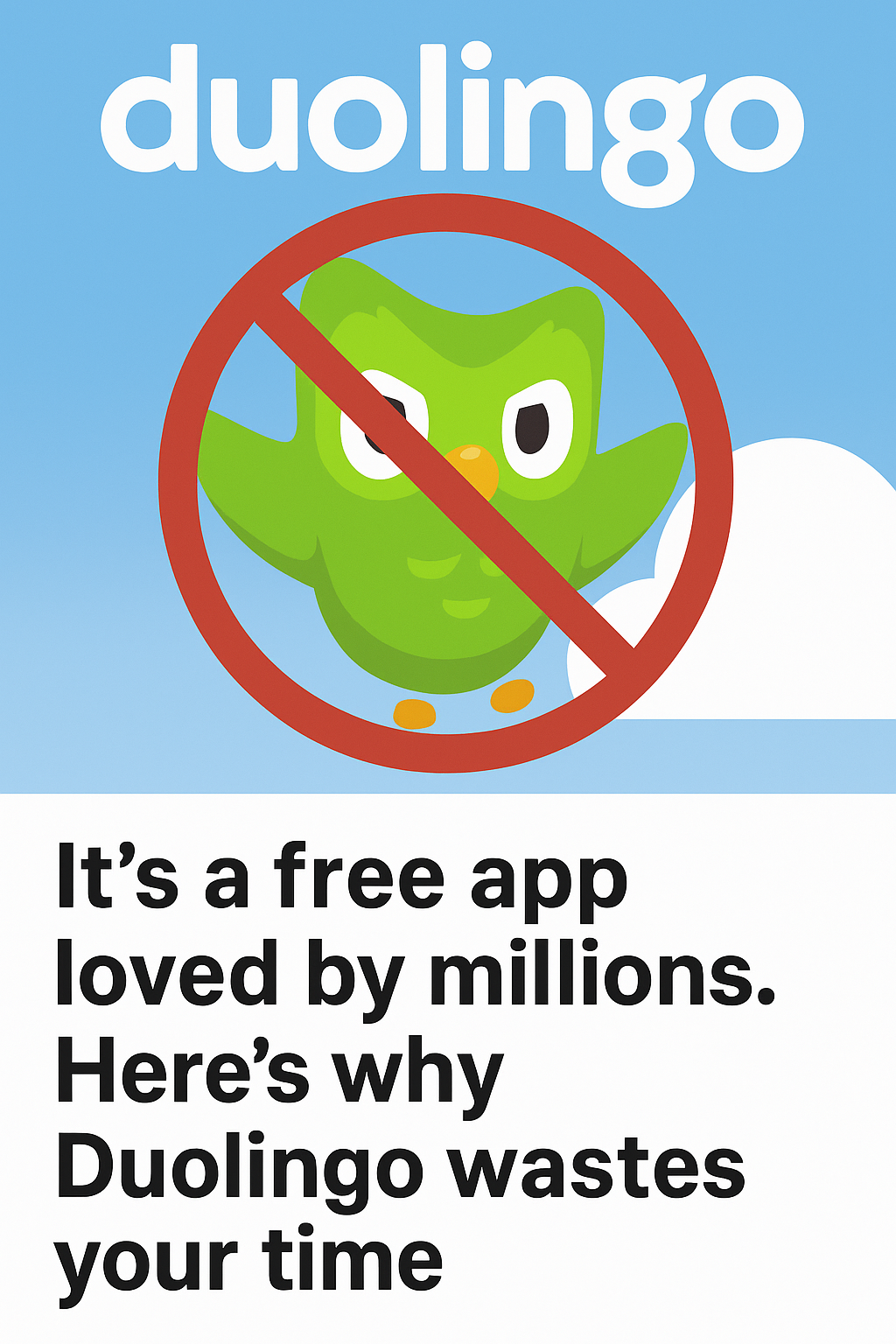
It's a free app loved by millions. Is Duolingo wasting your time?
Whenever I hear that someone new is starting language learning, I get excited.
But then, they mention Duolingo and I know how this is going to go.
I’ve spent years teaching, learning, and experimenting with language tools, and the little app with the Duolingo owl has always felt like a toy version of what language learners really need.
Using the app feels like language learning. You’ll pick up a few phrases. Cartoons cheer you on.
But deep down, it’s cosplay. Why?
What’s Good About Duolingo
This app felt like a revolution when it first came out. Here’s why:
Free-ish, easy access to language learning from your smartphone. Nice.
Lovely design with lots of fun illustrations
Gamified learning keeps you coming back!
It gets you from zero to somewhere in language learning, and officially works for getting people to do well on tests. (research sponsored by Duolingo itself though 👀)
The Downsides of Duolingo
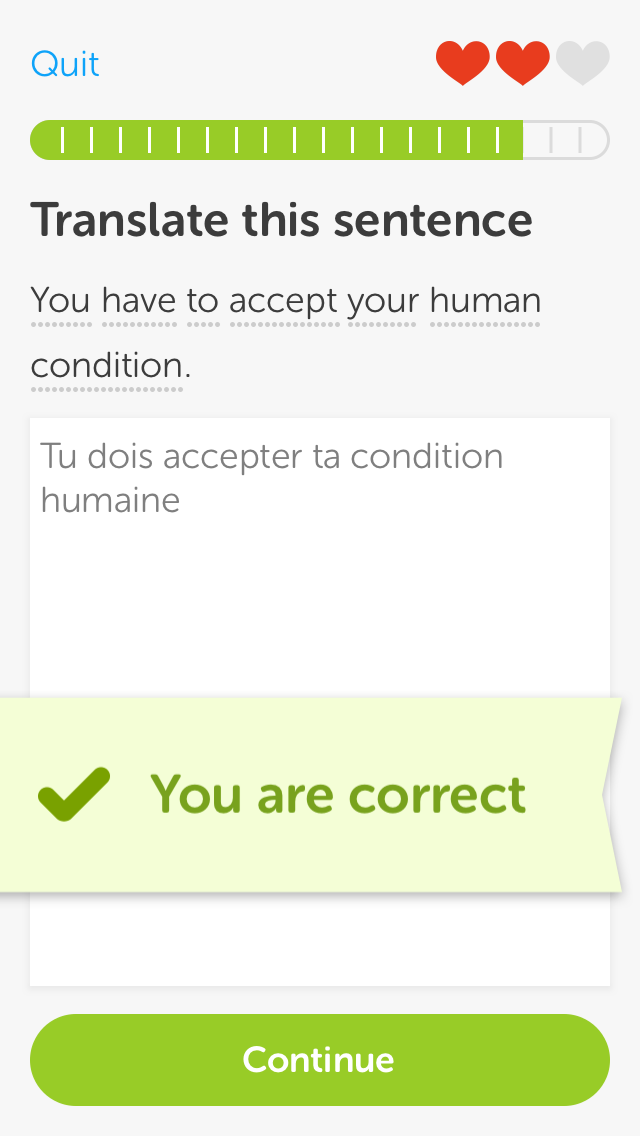
Duolingo telling me what my problem is.
You probably know about a lot of these issues by now, but let’s recap:
You have to learn endless nonsense sentences.
No flexibility about how you express yourself in your new language, so you’re not learning how to communicate.
The feedback is too easy to ignore.
Of course it’s not really free. Duolingo is now an ad-packed freemium app, and their business model has always cost teachers and learners. (Want the back story? Listen to this podcast about the hidden cost of cheap & easy language learning.)
Zero nuance, extremely limited explanations, no culture context.
Language learning should make people curious, but Duolingo doesn’t do that.
You don’t become a communicator. You become a really good Duolingo user.
What I Wanted to See Instead (So I Built it)
As a language teacher, AI has blown my mind. This endless resource of natural languages is easy to access, like a rich practice playground.
From the start, I wanted to build a community-driven, AI-powered space that actually helps people make progress:
Fresh, exciting ideas developed for real learners
Tools that help you learn with freedom, explore and have fun
Real-time personalised feedback, not just error messages
Content rooted in culture, context, and actual conversation
And most importantly: a support system. Other humans. (Plus AI that doesn’t sound like it’s dying inside.)

So I opened AI Language Club, where we create and experiment with fresh, interesting language learning ideas in ChatGPT, Gemini, and other AI tools.
If you are just getting started with a new language, don’t sleep on the big possibilities of AI, because it can do so much more than Duolingo!
What to Read Next
3 Tutor-Approved Ideas for Improving Your Duolingo Experience
Finding the Button That Makes AI Easier for Language Learners
If you are ready for fun, exciting language learning with fast results, come and join our club!

How To Learn A New Language With Smart And Useful Goals
For a long time, I had a difficult relationship with goal-setting. As a fully-fledged questioner, I find it hard to take anything at face value, let alone the idea that I must have a goal to achieve anything.
When I was learning languages in full-time education environments like school and university, the goals weren't on my mind. My school sorted that out for me: turn up to classes, write essays, take exams. But since I've started working with independent language learners (and since I became one), goals have taken an entirely different role.
As an independent language learner, you need to know what to do. It's easy to think that you're already doing the work by stating what you want to achieve. But let me have an honest moment with you here:
Those goals don't help you do things.
In this article, you'll learn about the two types of goals you need for language learning.
Goal Type 1: Vision Goals

Let's have a look at those language learning goals I see online again and again.
- "I want to become fluent in Spanish"
- "I want to have a 15-minute conversation in German" Or here is one that I set for myself last year:
- "I want to speak Welsh at the Eisteddfod festival in August"
I am sure you have often heard about SMART goals. In many areas of life, our goals will only serve us if we make them specific, measurable, achievable, relevant and time-bound.
In my mind, these fail the SMART list on a bunch of counts:
They're not specific and realistic enough because they are your inspiration
They aren't measurable, because concepts like "fluency" or "fluent conversation" just aren't
They aren't time-specific either, unless you want to make yourself sad by setting a painfully ambitious deadline
None of this is a bad thing in itself. If you are motivated and driven by a vision of your future self speaking a foreign language without hesitating, then that is an amazing image to hold on to. It should be one of the many vague and inspiring concepts you hold dear, and in fact I would even advise you start visualizing your success.
But those visions aren't useful goals, because they just won't help you when it gets down to doing the language learning work. You need that vision.
And for times when you've carved out that half hour to get to business and really learn a language, you need goals.
The Little-Known System for Success in Language Learning
Goal Type 2: Path Goals
In my Welsh studies, I've been completely independent from the start. I don't have that external structure of tutor, group class, exams, and it took a while before I found a way to use my time for language learning. At first, I tried ideas like "I want fluency" and even "I want to speak Welsh at the Eisteddfod in August". They worked as a motivator, but failed to give me a clear idea of the steps I wanted to take to learn a language.

My current path goals in Welsh
I needed something that would help me know what to do when my study time comes. These goals are what I call path goals. They guide you when you're in study mode and mark the milestones on your path.
Here's what you need for making good path goals:
Structure
Structure is the thing that stops you from starting every study session wondering what you'll work on today. It's absolute gold for independent language learners, because you simply don't have the time to faff every single time. Decision fatigue is real, and it's going to paralyze you if you allow it.
Learn more about how this works when you study more than one language.
- Schedule the days when you're going to study your language, so you can treat them like any other appointment.
- Use your path goals as simple "next steps" so you spend zero time deciding what matters.
- Get some external structure. Follow an established course, work with a tutor, or use a textbook or online course. Even without that, you can be just as successful. Set your goals up to match the four core skills, and this should provide you with the sense of variety and progress you need.
Core Skills
The four core skills are the essential set of everything that makes language learning a success for you. You will want to focus on some more than others, but ultimately you need to put work into all four for becoming that inspiring future self.
The four core skills are listening, speaking, reading and writing. (I wrote a book about this!) Structure your goals around improving in each one, and you're guaranteed to succeed.
There might be other areas you want to focus on too, such as improving your pronunciation and vocabulary. But if you've got the four core skills covered in your goals, I would advise you not to worry too much about any others. They will come naturally as you improve and respond to your needs in every situation.
Variety
Variety is a key component of the path goals you set for yourself. It's realistic to acknowledge that moods, motivation and focus can vary from day to day. So on one day you might be excited to crack open the textbook and work your phrases, but on another day all you want is speaking practice with a tutor.
Having varied goals (I recommend at least 4 to cover each core skill) allows you to pick from a short, focused list of tasks and make progress in every single study session.
Recap: The 2 Goal Types You Need for Learning a Language
So there you have it. Goal setting isn't the holy grail of productivity. But when you do it right and know your goal types, each step can give you the right support you need to progress today.
1. Set Vision Goals
You can call this an intention, a vision, a goal. This is the imagined, vivid image of your future self that will keep you going.
2. Set Path Goals
Path goals are not big visions, they are the structured next steps that will help you when it's time to work on studying
Frequently Asked Questions
How to Set a Smart Goal for Learning a Language?
Start by creating your big and inspiring vision goal. This is about where you see yourself once you have mastered your language. This grand vision will help you get excited and keep you motivated throughout your language learning journey.
Next, break down this vision into SMART path goals. SMART stands for Specific, Measurable, Achievable, Relevant, and Time-bound. These smaller, well-defined goals act as stepping stones towards your ultimate vision, making the learning process manageable and less overwhelming.
What is an Example of a SMART Language Learning Goal?
Let’s create a SMART goal example: suppose you have a language learning podcast you enjoy. Instead of a vague goal like “listen to a language learning podcast,” make it specific and actionable.
Instead of saying “listen to language learning podcast”, you could try and say: “Listen to episode 4 of the [Podcast Name] and write down 5 new words by Friday.”
This goal is specific (listen to a particular episode), measurable (5 new words), achievable (within a week), relevant (improves vocabulary), and time-bound (by Friday).
Such SMART goals keep you focused and make your progress trackable. For more detailed guidance, consider exploring the full Language Habit System® I created specifically for language learners.
What is the Best Way to Learn a Language?
The best part about learning a language is that everything will work a little bit. Rule one should be to do what you enjoy the most. You are NOT doing it wrong. The beauty of language learning lies in its flexibility, and almost any method can contribute to your progress.
It will help you massively when you set yourself goals that help you along the way. Think about why you are learning the language, and where you want to be in the future. For the day-to-day process, add in SMART “Path Goals” that make it easy to take action.
How to Structure Your Language Learning Routine
Do you want to follow the system I explained in this article and start to discover your ideal language learning routine? Then I recommend you check out the Language Habit System, my hands-on course to help you learn any language with personalized milestones.
--> Click here to learn more about the Language Habit System® <--

How to Learn a Language with Spotify, The App for Learning Languages with Music
If you’ve ever had trouble finding more songs and artists to listen to or if you’ve wondered whether it was worth it to try a popular music app like Spotify, here are some tips that can help you make the most of learning with all that Spotify has to offer.
How would you like to learn a language with the help of a famous musician?
Sounds awesome, right? Truthfully, the idea isn’t so far-fetched.
Learning a new language isn’t all about studying grammar and memorizing vocabulary. In fact, many of us have listened to music in another language and even learned a few things from our favourite songs.
For example, who knew the name of Seoul’s cool kid district before "Gangnam Style" became a sensation?

As you can see, it’s always a good idea to explore music in your target language.
Using music to learn a language can help you feel more connected and invested in a language as well as add a bit of creativity to your usual routine.

Photo by Vidar Nordli-Mathisen on Unsplash
The tough news is that can be hard to find music you enjoy listening to in your target language(s). How do you find the top artists in German or French? What if you don’t care for the top hits and want to search for songs in a particular genre?
That’s where music apps like Spotify turn into amazing resources for language learners.
If you’ve ever had trouble finding more songs and artists to listen to or if you’ve wondered whether it was worth it to try a popular music app like Spotify, here are some tips that can help you make the most of learning with all that Spotify has to offer.
Spotify Basics
What is Spotify?
Spotify is a streaming service that lets you listen to music and podcasts on your mobile device or computer. Using the app, you’ll discover music from artists all over the world, which makes it a fantastic resource for language learners.
It’s available for you to use on multiple devices, including your laptop, your phone, your tablet, or your gaming system.
There’s a free version as well as a paid premium version. Both allow you to search for music and podcasts, get recommendations for new music based on your preferences, and create your own playlists.
How To Learn a Language With Music
Spotify is simple enough to use, but how should language learners start using it to actually learn something?
Can you really learn with music?
Yes! Think of music as just another resource. For example, you could..
Look up the lyrics, translate them, and try to sing along
Song lyrics can be simple or complex - some talk about love, others just ask you to put your hands up. Either way, it’s a joy to discover what’s actually being said in the song that you’ve had playing in the background. And once you read along and start speaking or singing the lyrics to yourself, you’ll feel a boost in confidence...like a fluency rock star.
You can even find out about the stories behind your favourite lyrics using apps like Genius. Check out this podcast to learn how it works.

Genius user comments in Spanish
Check out the websites of your favourite artists or follow them on social media
Most artists will post on social media using the language that they sing in, and there’s a wealth of studio pics, in-jokes and fan responses to discover too. Who knows, the next time they announce a gig you might even find the courage to go and see them live? Going to gigs in my target language is one of my top activities!
Discuss your favourite songs or lyrics you don’t understand with a tutor or language exchange partner
Translating lyrics can be tougher than it looks at first, but that’s what you can work on with your tutor. Plus, if you’re working with a local native speaker living in the target country (such as most [italki][0] tutors), they’re likely to tell you about even more groups and artists in the target language.
Songs are natural input, a great way to become familiar with the way native speakers use a language to express themselves. Listening to lyrics is also helpful for training your ear and your pronunciation. I also find that I have a much easier time remembering new vocabulary that I’ve learned from songs because I’ve formed a personal, specific connection with the words and I’ve paired them with music.
Ways to Learn Languages with Spotify
Let it Play
Do you already know at least one song you like in your target language? How about an artist?
Head to the ‘Search’ bar and type in the song or artist you already know. Use that as your starting point and simply let it play. You’ll be able to shuffle through all of the songs under that artist or Spotify will start to play songs similar to what you’ve chosen.
It’s a great way to build up a playlist of songs in your target language, especially if you’re not sure what to listen to. Plus, this option works for both free and premium versions of Spotify.
Find a Playlist
If you’ve already started searching and listening, you’ll soon find that Spotify has some recommendations. You can try shuffling through the recommended artists and albums or try one of the Daily Mix playlists.
You also have the option of listening to other peoples playlists. If a user (or fellow language learner) has made a playlist public, you can choose to listen to the collection of music they’ve put together. In other words, you don’t have to go through the trouble of finding songs to create your own playlist if you don’t want to.
Need Support On Your Language Learning Journey?
Don’t miss out on the Fluent Language newsletter! Sign up today and get weekly language learning advice from me.
Learn with Podcasts
Spotify Search by Language
Music is wonderful, but sometimes you’re up for a bit more learning. Spotify can still help by providing access to hundreds of podcasts.
The easiest way to search is simply by typing your target language into the ‘Search’ bar. You can look up French or français, Spanish or español, Italian or italiano, etc. Either way, you’ll end up with a long list of language related podcasts.
If you already have a favorite podcast in mind, you can search by the podcast name, such as Coffee Break to find all of the Coffee Break language podcasts.
Listen to News Radio
While searching for language learning podcasts, you might come across SBS Radio in your target language. In fact, this is just one of many great options for listening to short news stories. in other languages.
If you search for SBS Radio, you’ll see options in dozens of languages. You can also find popular podcasts like News in Slow German or similar slow news podcasts.
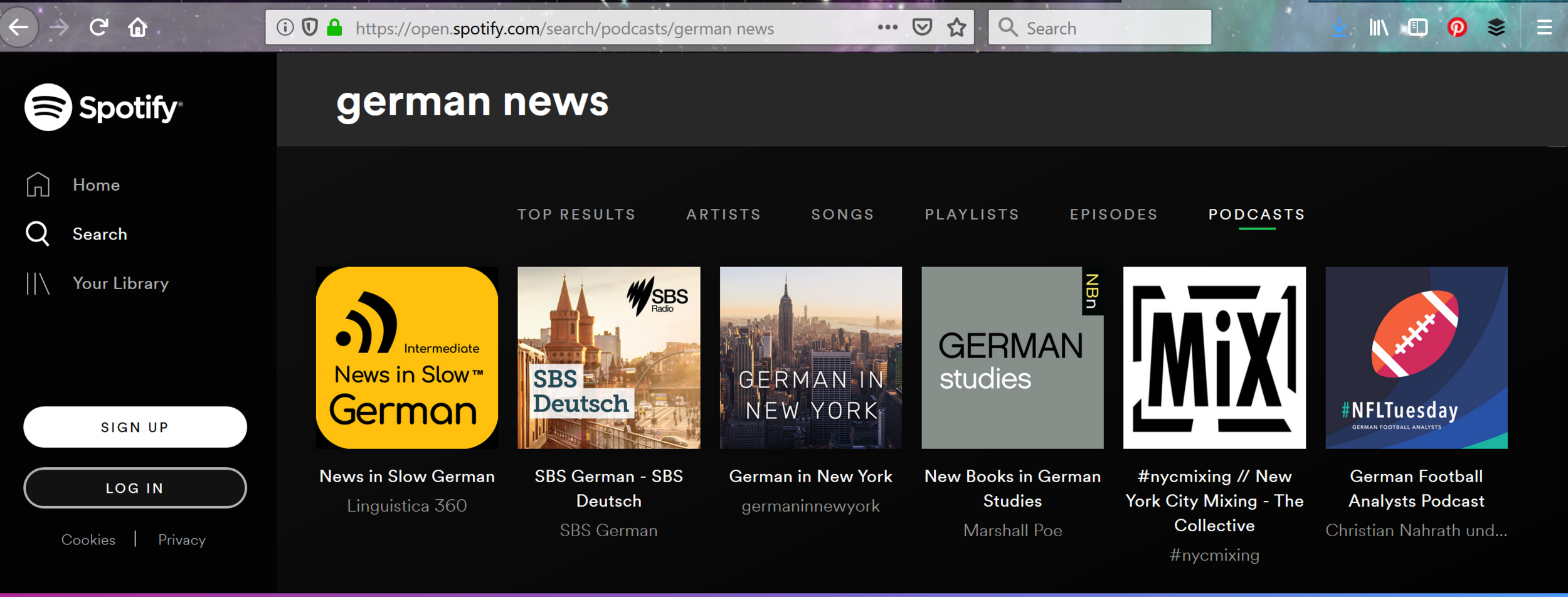
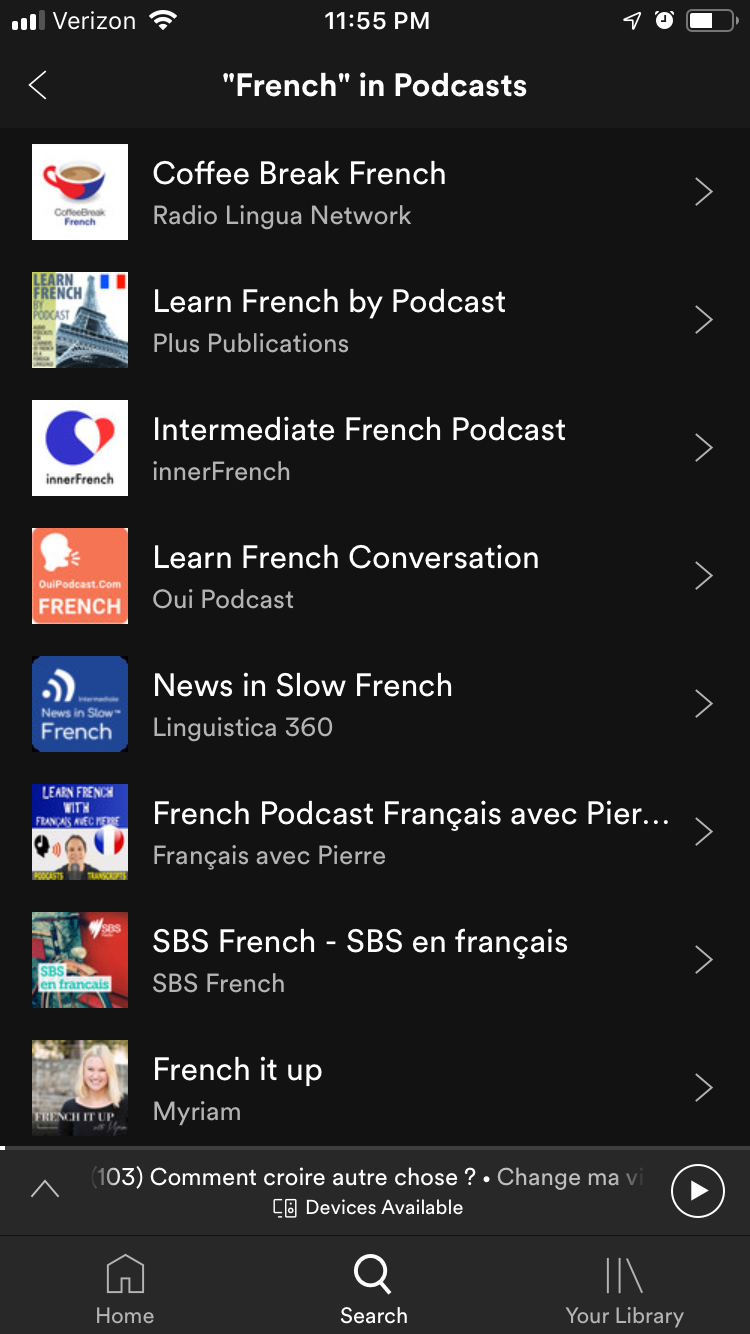
And of course, don’t forget that you can find the Fluent Show (your favourite podcast, right?) on Spotify too. Simply type "Fluent Show" in the search and hit play.
Find Native Language Podcasts
You can easily find podcasts geared towards native speakers as well. If you don’t have a specific topic in mind, type your target language into the Search bar and continue scrolling through until you find a title written out in the target language. In fact, I found one of my favourite French podcasts about personal development with this method, using "français" in the search bar.
If you do have a topic idea in mind, you can also type a related word in the target language into the search bar. Then, be sure to select ‘Podcasts’ or scroll down and select ‘See all podcasts’ (if you’re using the mobile app). This will bring up all the podcasts that have your search term in the name as well as related podcasts in the same language.
Make It A Habit
Adding music to your language learning can make things easier, but your efforts will only pay off if you take the time to learn and use the vocabulary your favourite song can teach you. Most of all, you need to do it consistently.
Listening and learning from music can be both fun and useful when you make it a regular habit.
Frequently Asked Questions
How can Music Help you Learn a Language?
Music can be an effective tool for learning a new language, here is why:
Memory Boost: Music's catchy nature makes it easier to remember words and phrases.
Better Pronunciation: Listening to music lets you hear natural pronunciation and accents that textbooks might miss. Singing along helps you practice these sounds.
Effortless Vocabulary Learning: Songs are filled with new vocabulary. By listening to and analyzing lyrics, you learn new words and see how they're used in context.
You can check out my series on using music for language learning. Where to look for inspiration, and some musical hacks
Can you Learn a Language Using Spotify?
Yes! Spotify is an excellent tool for language learning. In today's blog post, we explored how to fully leverage Spotify for this purpose.
If you've been struggling to find new songs and artists or have been curious about using a popular music app like Spotify for language learning, we've got some tips to help you make the most of what Spotify has to offer.

What Music is Best for Studying a Language?
For concentrating during your studies, choose gentle music without lyrics, attention-grabbing riffs or loud percussion. Try searching for “focus playlists” on Spotify, as there are many available. For learning a specific language, use the tips in this article to get the most out of the lyrics and learn more about which artists are popular in each country.
Try These Ideas!
What now? Pick one of the following ideas, open up your Spotify app, and let’s try it out!
Search for a playlist in your target language
Find a song you like? Search for the artist on social media or check out their website
Search for podcasts in the language so you can hear it spoken!
If you’re an independent language learner, forming successful habits and doing more with the songs you love in your target language isn’t always easy. For those who struggle to create an ideal language learning routine, check out The Language Habit System. It’s meant to help you create habits that work for you, which includes adding the music you love to your language learning.
Want podcast inspo? Check out our Best Podcasts series!

How Much Will You Pay for a Helpful Language Tutor?
A language tutor can teach you the ins and outs of your target language, and help you achieve your learning goals faster and easier. But the pricing confuses many students. Some tutors cost $50+ per hour, others are available for less money? What’s the difference? Read on to learn more about different backgrounds, levels, and prices.
A language tutor can teach you the ins and outs of your target language, and help you achieve your learning goals faster and easier. But how much should you pay for a language tutor? There are different online teaching platforms where you can choose from a wide range of tutors with different backgrounds, levels, and prices.
For example, on italki*, one of the most popular online language learning platforms, you can find tutors who charge as low as $5 per hour or as high as $50 per hour. You can even find great language exchanges for free!.
So what’s the difference? Read this article to discover which options will be right for you.
Do I need a language tutor?
Experienced language learners agree on one thing: Learning a language with a tutor is a true game changer.

Need Support On Your Language Learning Journey?
Don’t miss out on the Fluent Language newsletter! Sign up today and get weekly language learning advice from me.
It’s impossible to progress as much if you don’t start speaking your language at some point. And for an early stage learner, picking a tutor means working with someone who can help you bridge the gaps with ease.
Language tutor or language exchange?
I would recommend all learners to try at least one tutor, and to be clear about what you’d like from your lessons. A great tutor will ask you about your goals and tailor their service to you.
I wouldn’t recommend tackling a language exchange before you have learnt at least the essential structures and phrases of your target language (use this checklist to help you work out what to study).
Starting an exchange too early might leave you feeling frustrated, and there is a risk that you and your partner rely on the stronger language exclusively.
You do not get top quality at bottom prices
For the purpose of this article, I want to assume that you have made up your mind and you are looking for a tutor.
Now here is the part I want to talk to you about. I disagree with many other articles are telling you. Let's talk about price. Most other articles include a sentence that goes a little like this:
"Language lessons online are very cheap, you can get them for just $5 an hour."
US$5 an hour? That’s less than you pay for a drink at Starbucks. Now I know that wages and currencies vary around the world and I’m not stupid, so please don’t come commenting with the “$5 is lots of money in xyz!” argument. Your online teacher's costs are not just measured in time-per-hour. They also have a family to support, an internet connection and webcam to buy, personal development to cover. These are all part of the job, and that’s the case even if they live in the cheapest country in the world.
Self-employed language teachers will price themselves as low as they can because they really love working with you. But when they are taking on 50 students a week because the price per lesson is very low, they become mediocre teachers. If you are able to approach the exchange with a mindset that considers both payment and benefits, you will not be ripped off.
Read on to find out how to find exactly the right partner for your needs and your budget.
How To Find A Price That Works For You
In order to help you select the right language learning partnership, it is helpful to approach sites like italki* with a clear image of what you are truly looking for.
It's a good idea look beyond italki, because many of the greatest and most experienced teachers I know have their own blogs and websites. You can also try other platforms such as LanguaTalk.*
Option Number 1: The Freebie
Look for a language exchange partner and simply swap time helping them practice your native language for time practicing your target language.
Pros:
- You don’t even have to look online because many foreign students or residents in your town might be looking for language exchanges too.
- Sharing the language learning experience is very motivating and you’ll see the partner’s success just as much as yours.
Cons:
- There is a learning curve and this exchange may be frustrating at first. You have to be comfortable setting boundaries and working with rules, otherwise you become someone else’s free teacher.
- Your partner will speak the language but may not be able to explain it
- You give as much as you get, so prepare to work hard
Got a partner whose language you want to learn? Get our tips about learning a language from your partner.
And if you’re the one who wants to help your partner learn your language, here’s what I’ve learnt from having an English speaker partner (spoiler: I didn’t become his tutor!).
Option Number 2: The Super Bargain
Look for lessons under $10/hour and take advantage of the low living costs in other countries. Bear in mind these types of prices are below minimum wage in most countries, and probably this includes yours.
Pros:
- Maybe you will find a great tutor for peanuts
Cons:
- This is a trial and error technique, it often takes longer to find someone you click with, whose expectations match yours, and who is familiar with students from your cultural background
- The cheaper language teachers tend to be those supporting themselves temporarily, so you don’t get ongoing support as most cheap teachers decide to move on to another job within a few months
- This isn’t really a con from my perspective, but hopefully the tutor will soon raise their rates!
My personal verdict on this option? It’s better than nothing, but the worst of both worlds.
Option Number 3: The Professional
Hire an experienced language tutor for a minimum of $20/hour. Look for someone who is showing their expertise and commitment by having their own website, blogging about their work and knowledge and giving you a clear idea of what lessons will be like.
I’m biased, and here are my Pros:
- You’ll get a free consultation from most experienced language teachers and they will clearly tell you which goals you are working towards, and keep you committed
- The lessons tend to be tailored, long-term and built for you
- You’re doing a great thing because this is the way to support an experienced professional
- Professional teachers strive towards working full-time for you, so they can offer a flexible schedule and will fit the lesson times around you
For more details on how you can find that tutor that's worth your time, here is a list of questions you should ask them.
Cons? Well, we'd all love to get more free things in life.
A Tip for Ethical Teachers
For language teachers who are reading this article and excited about stepping up their business, here’s some important advice:
- Be serious and trustworthy: I would not charge a student until I know for sure that I connect with them. I don't take on each one, only students that understand my style. I don't want people to spend money on me unless I feel like I really understand what they need.
- Commit to your business: If you don’t want to be seen as some kind of fly-by-night operation, you have to show your worth to your potential student. Be worth their investment, be around and be reliable. You can’t do this without a brand and website, but it’s not as difficult as you may think.
For more information, have a look at the “Teach Languages” section here on Fluent, and in particular you should investigate the Live Lessons Course. This step-by-step course is written for language teachers who are excited to start standing out as one of the best out there.

Frequently Asked Questions
How Many Sessions With My Tutor Should I Have per Month?
There is no right or wrong answer to this question. The more sessions you have with your tutor, the more you can benefit from your tutor’s expertise and feedback.
Deciding on the number of tutoring sessions will depend on your personal situation and preferences. Here are some questions to help with your decision:
• What is your language learning goal?
• How many hours do you dedicate to learning your target language?
• How frequently do you have difficulties and need your language tutor's help?
For more detailed questions. Check my blog post 9 questions to ask your language tutor. And if you want deeper guidance to help you answer the questions above and find the right language strategy for yourself, I recommend checking out the Language Habit System or talking to a language learning coach.
Should I Hire A Native Speaker As My Language Tutor?
You don't actually need a native speaker to practice with. This is so important to understand. You just need someone who's good enough or a little better than you. Sometimes it even helps not to have the native speaker, because a non-native speaker has learnt your target language too and can explain grammar and other problems more easily.
You can check my blog post where I dive into why having a native speaker as your tutor might not be necessary.
Are Tutor Lessons A Good Way To Learn A Language?
Yes, they should be part of your system along with helpful resources and input, self-motivation is important so you don't become too reliant on one thing, learn how to build your routine here.

How to Speak More Fluently by Building Good Conversation Habits
Ever hit a wall in conversation when trying to speak another language? Discover the different ways that you can handle that wall. Knowing how to handle a conversation breaker means knowing how to keep things flowing, and it’s the only way for you to approach fluency.
No matter if you are new to language learning or you're a certified multilingualist, I bet you know the conversational wall. It's that feeling where you just don’t know how to say something. It could be a missing word, and sometimes you can’t find words for what you’re even trying to say.
The wall creates that awkward moment with your conversation partner, where you just stall the whole thing. You’re running on empty, grasping around for words, and in fact you’re feeling like an idiot. How frustrating it is for an articulate adult to fail when it comes to saying stupid basic things like “I don’t like boiled potatoes” or whatever. How far you have to go!

In today’s blog article, I want to introduce you to the different ways that you can handle that wall. Knowing how to handle a conversation breaker means knowing how to keep things flowing, and it’s the only way for you to approach fluency.
What You Have Tried Before to Get Fluent in a Language
The following three options might all feel pretty familiar and perhaps even helpful to you if you run into one of those walls. But are they really the best way of dealing with the problem?
You’ve Hit More Language Books
Many people who are new to language learning feel like their only way of dealing with the wall is to give up trying to have the conversation and return to the books. The logic is that if you don’t know how to say everything, you obviously haven’t studied enough yet. But in reality, this is a sign that your learning mindset needs a breath of fresh air.
A student once told me “I’ve always been used to excelling at the things I put my mind to. Law exams, university grades, that all didn’t feel so hard to me. So why can’t I ace this language!?”. As his language coach, it’s my duty to remind him of several trap doors that he’s opening up with that kind of thinking.
Firstly, believing that first time mastery is the only way to be a good language learner is a way of closing a door to true growth in your own mind. And moreover, it’s important to recognise that language learning is not only graded by what you remember and express correctly. Creativity, flexibility and conversational confidence play a huge part in fluency and form part of the learning experience.
The key is to understand that you’re not failing when you run into a wall. You are actually succeeding at discovering your skills. Keep on exploring.
You’ve Tried to Change the Topic
Changing the topic may help you save face, hide that panic and manoeuvre your conversation back onto safer ground. Overall, it’s a pretty solid option and one you can try if you are feeling particularly embarrassed. Remember that everyone loves to talk about themselves, so your sneaky way back from the conversation wall is to put the focus back on the person you are talking to. With a little bit of luck, they may even say exactly what you were thinking - and they’ll show you how to express it in your target language.
If this is a good option, why isn’t it the best one? The answer is simple. How many times are you going to change topic before you realize you still haven’t said what you need to say?
You’ve Tried to Look Up Words in Google Translate
The part of you that considers herself a solid and obedient learner will want to do this. The part of you that wants to demonstrate that you are truly accomplished will want to do this. The easy way out of not knowing something is to look it up. Of course! And yet I urge you to consider the negative effects of looking up words every single time.
First of all, your smartphone battery isn’t going to last forever. Secondly, it’s not actually all that polite to keep your conversation partner waiting while you whip out a phone and start googling for an answer. They’re right there! They might just be dying to help you. And thirdly, you’re training your brain to know where to look, but not to remember anything that you are learning. Neither your brain nor your mind will thank you for relying on a lazier way of thinking.
So with all those kind-of-okay options ruled out, what could be the way a truly fluent learner approaches the conversation wall? From my observations in lessons and in my own language learning experiences, it comes down to a few significant shifts in attitude. Remember that Growth Mindset I’m so very fond of? Here is where you use it. Here is where you show your head who’s boss!
Here's How to Be More Fluent in Conversation
Step 1: Walk through the Awkwardness

If you’re a perfectionist or someone who holds themselves to high standards you’re not going to like this option at all. A way through? You mean I’m telling you that you should admit when you don’t know something and sit there all awkwardly looking like an idiot? Yes. That is exactly what I am telling you to do. There are so many learning benefits from finding your way through that awkwardness. First of all, you’ll quickly realise that missing a word in foreign language conversation is a pretty common thing.
My friend Lindsay recently told me about British nursery rhyme We’re Going on a Bear Hunt. In the story, the brave bear hunters encounter all kinds of obstacles. Mud, snowstorms, rivers, everything is in the way. There’s no way under it. There’s no way over it. So they decide to go the only way that they can: through it!
When you are facing your own linguistic obstacles, remember that you can’t go over or under. You’ve got to get through it. That awkward moment when you feel restricted and stupid because you don’t know how to say what’s on your mind? That’s normal. Just notice it’s happening, take a breath and continue to Step 2.
Ideal Step 2: Accept the Challenge
The idea of accepting a challenge sounds like this is a big thing, but I assure you that this is an attitude shift that will become your best new habit within a matter of hours. So you don’t know a word. So someone’s looking at you and waiting for you to say something and you don’t know how. So WHAT! What can you do next? How are you going to go from awkward to outspoken?
Ideal Step 3: Describe What You Want to Say
Okay, here is where you flex your real fluency muscles. A confident foreign language speaker is not intimidated by gaps in her vocabulary. Instead, she will embrace the learning opportunity and look for a way around the gap. The first step to take is to prepare a set of useful fillers in your target language. These filler lines should become as comfortable to you as hello and thank you. You will need them for ever and ever - trust me, I’m so fluent in English and words still fail me on a regular basis.
Good filler expressions include the following:
“I don’t know how to say, but I mean a thing that…"
“Help me out here…how do you say…?"
“You know, it is a little like…"
The key component in a good filler line is that they all allow you to describe the thing you are trying to express. No matter if it’s a noun, verb or expression you are searching for, the key to fluency is in opening yourself up to learning the word from your conversation partner.
It’s absolutely essential to remember that these moments of hitting the wall are where you really show your skills in language learning. Not because you are measured by how many times you encounter the wall, but by how many times you get through it, over it or under it. This is the way that you will have confident conversations in weeks, not years.
So are you ready to start having truly fluent conversations?
Thanks for reading this article on Fluent, the Language Learning Blog. Please share this post on Twitter, Insta, or Facebook using the Share buttons. If you are feeling stuck right now, why not subscribe to Fluent.




Struggling with listening? Discover realistic tips, challenge prompts, and the best tools for improving your listening skills as a self-guided language learner