

The Two Sides of Foreign Language Learning
What does it take to start learning a language and stick with it...even through the difficult parts?
Today I have a guest post from linguist and blogger tutor Julia Gracheva. In this article, Julia is all about balance and will give you actionable tips on marrying the two important sides of learning: Joy and Discipline...or Yin and Yang!
What does it take to start learning a language and stick with it...even through the difficult parts?
Today I have a guest post from linguist and blogger tutor Julia Gracheva. In this article, Julia is all about balance and will give you actionable tips on marrying the two important sides of learning: Joy and Discipline...or Yin and Yang!
Over to Julia..
How To Create Balance In Language Learning

Learning a foreign language is fun! Learning a foreign language is rewarding and uplifting! Learning a foreign language is a pure joy you could only otherwise get from eating chocolate (insert “cheese” instead of “chocolate” if you are a savoury person not a sweet one)!
Now, let me tell you: it’s not all peaches and cream (and, yes, I am writing this hungry). It’s oftentimes hard, brain wrecking work that doesn’t give you immediate results to motivate you to keep going. But this hard work has to be done, so that your language learning could also be fun, rewarding, uplifting and a pure joy (have just tucked into a cheese sandwich, so no more food mentions, I promise!).
What is the Yin and Yang of Language Learning?
I will be referring to the hard part and the pure joy one as the yin and yang of language learning. These parts are very different and still cannot exist without each other.
Yang is that hard bit, the grammar you need to understand, the words you have to memorise and the peculiar sounds that you teach your mouth to articulate.
Yin is the fun bit, the melody of the language, its humour, flavour and culture. It’s all the stuff that makes a combination of sounds, words and grammar rules a unique, rich and fascinating phenomenon which is a language of the people who speak it, reflecting their unique ways, views, lifestyle, history and what not.
I have seen many adults lured into studying a foreign language by its yin side only to discover the yang one is not so easy and far too long winded to crack in a couple of months of even intense study. They would learn some frequently used or touristy words and phrases, some easy dialogues, may be read an easy book or two in this language or even complete a beginner course at a language school or with some app. The novelty would wear out, they would discover they are still far away from fluency, their busy adult life would take over and au revoir the big sweet language dream!

Where there used to be pleasant exotic sounds flowing about of hoş geldiniz’s being trained, doors, windows and dinner table carefully labelled with sticky notes with die Tür, das Fenster and der Tisch written on them or where there used to be a poster of the Eiffel tower overlooking the desk with a neat stack of French for beginners books on top with pretty bookmarks showing between the pages, now there is just a whiff of foreign language sadness and a pile of unused publications gathering dust.
Not Forgetting the Yang
So, how do you save yourself from this heart breaking scene of your foreign language that died young? Of a big language dream that crashed down having barely taken off the ground? Of having to repair the wall in your study after the blooming Eiffel tower poster came off with half the wall when you tried to take it down?
Firstly, you shouldn’t forget the yang of foreign language learning. And, secondly, you need to marry the two of them, the yin and the yang.
You need to be ready for the long term game, to realise that there is not only yin but there is yang as well and you cannot get the one without the other. The better you get at the language, the better you get tuned to the culture and understand the ways of the people who speak it. And the more you are able to take part in all this language/cultural awesomeness yourself!
When the novelty of a new language wears out and you have learnt all the shiny touristy stuff about the culture, you can get too lazy to keep dealing with the yang. If you give up on the yang, you won’t be able to appreciate and enjoy the yin deeper, to really understand and fall in love with the culture. And you won’t carry on with learning the language!
So, to make a success out of your language study, to get really fluent in the language you are learning, you need to marry yin and yang.
Finding the Yin
The yin and yang of my first foreign language were separate for quite a while. As I started learning it at school as a kid (I studied English as a foreign language at a Russian school), I didn’t go through this phase typical for many adult language learners that I talked about earlier.
Instead, I just followed the rules as any diligent student would, without too much of a passion and excitement over yin injected into my study. Then at some point in my early twenties I got overtaken by the yin and had to really sort out the yang. So, here is the story of how I married the yin and yang of my language learning.
Marrying the Yin and Yang
So, it starts at school. Do you remember how you studied your foreign language at school? To me personally it all seemed to be about new grammar and vocabulary topics. We drilled them by doing all sorts of exercises and were assessed by doing more (marked and timed) exercises. Of course, after graduating from high school, I didn’t speak a word in the language I had been studying. None of us did. And I would have been surprised if anybody did. And that was fine as apparently learning a foreign language at school doesn’t imply that pupils will be able to speak it.
On the other hand, was I myself trying hard to learn the language? Was I driven by the yin? In other words, was I interested in the culture of the people who spoke it? Nah, not really. I was barely aware of my own at that time. So, the yang of the language was underdeveloped and the yin was just totally lost on me.
You see, kids and teens are very practical about languages: if there is no point in using it, they won’t. Period. Unless, of course, they are bilinguals. Or constantly pushed by parents, tutors or teachers to speak it in artificial settings. None of these two was my case. So, for me there was no point in using it. Indeed, if I don’t need to use a foreign language living in a country where it’s not really spoken, if I am not really fascinated by the yin, why would I want to be able to read, listen, write or speak in it? Especially, if there is more than enough interesting (and easier) information for me to digest in my own language?
But then I got older. And the Internet happened. Websites in the language. Language exchange. Wow. The yin was right there at the end of a long monotonous sound of a modem connecting my PC to the big big world out there. The yin with its people, their habits, foods, houses, their beliefs, dreams and values: all of them not quite like my own hence super exciting. The oops moment - they spoke a different language which I myself could barely speak. On top of it, I was painfully slow with instant messaging and who cares to write lengthy emails in their early twenties? So, I had to sort out the yang for real, grab the books, learn words and drill the grammar. The more I progressed with the yang, the more I enjoyed the yin.
So, the two were finally married and have been living happily ever after. Years passed but I still try to keep up and improve the yang, so as to get a better grip of the yin and enjoy it more. It’s no longer chats with peers and reading love stories like in my youth. It’s mostly collectively expressed yin in the form of the media, non-fiction books and Netflix. The yin that keeps me going with my yang, which in its turn helps me understand the yin deeper. The unity of the two that makes me really fluent.
There is another story of my second foreign language. It is less of a success but the yin and yang idea helps me to keep going. I hope that someday I will be able to mark it as a success story, too.
So, if you feel like giving up your language study, may be all you need to do is marry the yang and yin?
Yin & Yang In Action: How To Learn Languages In Balance
Here are the yin and yang tasks I marry to make my language learning “happy ever after”.
Yin: I watch comedies and TV series. These are a lot of fun!
Yang: While watching I make sure I record the new words I loved. The more words I learn, the better I understand while watching!
Yin: I listen to songs. And even sing them along when no one is listening!
Yang: I listen to and sing along the same songs again and again so that I can sing along with the same speed as the original. It’s not easy but worth it as helps me improve my pronunciation. The better I can articulate, the more I enjoy singing along!
Yin: I talk to my language partner regularly. Luckily he’s an interesting person who makes me laugh and tells interesting stories.
Yang: I make sure I discuss with him the stuff I have recently read about in the language I learn. Thus, I use in the conversation the specific vocabulary and even certain grammar I picked up while reading. The better I express myself, the more I enjoy the conversation.
What helps you to keep going with your language study?
Have you noticed your own sense of yin and yang in language learning? Are you drawn to one of them: the yin that motivates you or the grammar and efficiency of the yang? Tell us in the comments below!

Thanks to Julia Gracheva for sharing this article. You can find more of Julia's writing on the vocBlocks blog. Her target languages are German and French.

How Can I Inject Fun Into Language Learning? (Special Guest: Olly Richards)
Having fun is a key to success when it comes to most big endeavours. Surely language learning is one of those, too. But how can you best have fun when you’re learning a language? In this podcast episode, Olly Richards from I Will Teach You A Language joined me to discuss how you can love learning languages and have fun with it.

Learning a language is the challenge of your life.
It requires motivation, discipline, empathy, and some serious grey cells. It's an art because you learn to express yourself freely, beautifully, and you paint pictures with new words. It's also a science because you need to experiment with what works and what doesn't work.
But How Much Fun Can Language Learning Be?
In today's podcast episode, my guest is Olly Richards from I Will Teach You A Language. Olly says he used to learn languages for fun, going out with friends, and enjoying a great social life.
We had an incredible discussion - click play below to listen to it in full.
Now he's still learning them, but his motivations have shifted to intellectual gratification. He still gets fulfilment and a sense of achievement out of learning a language but in today's show he joined me to ask
"How Can I Inject FUN Into Language Learning ?"
Olly cites a few reasons in this youtube video, for example:
- He is busier than he used to be, mostly because he works a lot.
- He considers himself a social learner, but he doesn't have access the fun part of social interaction.
- He pursues the intellectual achievement, which means books and rules rather than pints and parties.
In January I sent out a tweet that caught Olly's eye and opened up the question about fun. Here it is:
Golden Rules of Daily Language Learning
Make contact with your target language on a daily basis
Find a convenient way of making that contact - the more convenient it is, the better
Prioritise fun and find something you enjoy in your target language
Olly saw that I talked about fun, and it was on his mind already...so we got together to have an in-depth discussion about having fun while learning languages.
The Discussion

Debate Team
Fun or No Fun, That Is The Question
Enjoying something does not mean that you are not learning anything. In fact, it is often a huge motivator for learning a new language - but both Olly and I agreed that fun and motivation are NOT the same thing. Fun and enjoyment also matter in language learning, because they add motivation. But can the fun ever be in the learning, or is it always part of the result?
Olly says:
"I care much more about speaking a language than the learning process. For me, the real fun is speaking the language."
Language Choices
We have to acknowledge that a language that's easier to learn can be more fun, because you can use all you learn just that little bit quicker. But does that mean your motivation to learn it will fade just because a language is "difficult"? Not necessarily! Deciding which language to learn is about much more than just thinking whether you'll enjoy it.
Conquering A Challenge
Adding to that, it's also fun to discover that you have achieved something you found difficult. But is that fun? I argued yes, but Olly wasn't sure - he thinks it's more about the results. We both found that conquering a challenge is a big motivation and so are the results. But the challenge itself may not always be the fun part. It can be the opposite of fun when something is way too difficult.
It Has To Be Interesting
The #1 fun killer? Boredom!
If you're all about the results and you work through those verb drills...but you're falling asleep over them...that's definitely not fun. It might still be productive though!
Olly thinks it's impossible to have 100% fun in language learning. There has to be a disciplined aspect, there has to be some routine...but if you were to focus on that exclusively, you'd lose sight of why you even started in the first place. This is especially important for those of us stuck somewhere in intermediate levels, when the honeymoon period is over and new words feel like "ugh, another one" instead of "wow, a new one".
7 Tips: How To Enjoy Language Learning More
So what can be done? How to plan for fun? Here are a few tips emerging from our conversation:
- If you have been feeling frustrated or under stress, take the pressure off and focus away from the results for a little bit. Try doing the opposite for a while and see what happens.
- Adjust your expectations of what "learning" looks like. and
- Be sillier, and try to use art, music, poetry to expand your mind and explore language. This isn't always easy to do, so consider reaching out to a coach or tutor to help you find a new way of looking at language.
- Embrace your own personality and work with who you are. If you enjoy play and your hobbies include juggling and clown skills, it's a safe bet that you may enjoy reading and telling jokes in another language. I also see this with analytical-minded engineers I work with, who love focusing on creating the most effective flashcards and routines based on data and hard facts.
- Curate your social life! Put the books down and spend lots of time with speakers of your target language, and make sure you end up in situations where your target language will actually be spoken.
- Change it up. It could be that you're bored because you've done the same thing too long. Olly finds that the ideal time to switch to a new activity is after a period of 3 weeks, and changing things more regularly is beneficial.
- Choose the easy language! This tip is a little tongue-in-cheek, but it boils down to the fact that you have to ensure you're making progress in order to keep enjoying what you're doing.
What About You?
Do you have fun when you're learning a language?
Do you think it's possible to have 100% fun in language learning?
Do you enjoy the language learning process? Or do you only really love speaking to people?
Join our discussion and share your answers in the comments below! I'm looking forward to reading how you treat "fun" in language learning!
Episode Links
Da Costa a Costa — Italian podcast recommended by Olly
The Fluent Show: Learning and Speaking 20+ Languages in New York City — Interview with "Language Learning Hedonist" Ellen Jovin
EPISODE SPONSOR
A Free Skype Class For Everyone! Claim It From Live Lingua Today

#clearthelist September 2018: Immersion, Eisteddfod, Druid, Video!
Welcome to my monthly language goals round-up, this time reporting on my language learning progress and new goals for September 2018. I have news about immersion, where I’m travelling next, and how I’m going to get to the next level in Welsh.
OMG it’s clear the list time again, and WHAT A MONTH IT HAS BEEN!!! 🛎 #clearthelist is a monthly language learning round-up sharing monthly language learning goals, support, and accountability.

What Happened In August?
So back in the last blog update, I already shared all about the amazing Fluent German Retreat in Munich. This technically happened into the first days of August, so it’s fair enough mentioning it here again. ☺️
Eisteddfod!
Barely home from the Retreat, I was back on the road, this time for my own immersion experience at the Eisteddfod Genedlaethol in Cardiff. If you’ve never experienced an Eisteddfod before, they’re hard to describe. Imagine EVERYTHING WELSH CULTURE in one place, colourful and happy and ancient and new, packed into a week-long festival. In other words, it’s amazing!
The Eisteddfod takes festival volunteers, so I signed myself up as a steward. Volunteering at the festival is a great way to ensure I speak as much Welsh as possible, experience things from a different angle, and attend events I may not have considered otherwise. Plus, it teaches me great phrases like these:
- Dyn ni’n hollol llawn fan hyn. (We are completely full here)
- Ddeffniddiwch y drws arall, os gwelwch chi’n dda. (Use the other door, please.)
- Paid ag eistedd yn y seddi wedi cadw. (Don’t sit in the reserved seats.)
In addition to all that, I also got free entry to one of the most popular events of the whole Eisteddfod week: the chairing of the bard! Here, you can see the Welsh archdderwydd (archdruid) in action:

The Fluent Show
All that August travel didn’t stop us from celebrating a major Fluent Show milestone as we recorded our 100th Podcast Episode this month.
We celebrated with a quiz and a live show including FIVE awesome guests: Shannon Kennedy, Gabriel Wyner, Richard Simcott, Kylie Sturgess, and Benny Lewis. So much fun! Catch up with us here.
Language Goals and Progress
Time to review August’s goals and get set up for what’s in store in September 2018. As expected, August was not a month for my dabble languages Spanish and Chinese. Instead, I taught lots of German and learnt lots of Welsh, so let’s focus on Welsh.
Listening and Speaking
I had grouped these skills together for August because of the trip, and would say I delivered on both!
My room in Cardiff was rented from Cymdeithas yr Iaith Cymraeg, meaning I had plenty of Welsh-speaking flatmates. I even ran into Robin, who I’d chatted to before on HelloTalk! In addition to that and the volunteering, I met up with friends and Welsh speakers I met online and spent over half of my days speaking the language.
At first, speaking Welsh was tricky and my head was working extra hard on day 2. You know that “I’m an idiot who understands nothing” feeling? Yep, I had it too! But by day 3, it felt like a lightbulb was coming on and Welsh became much easier. Here is a video filmed by Nicky Roberts, showing the way I was able to speak on my final day in Cardiff.
I’ll be honest, I’m actually pretty proud! This is approaching free conversation in Welsh, what better feeling could I have. And shout out to all the Welsh people I spoke to - turns out almaenes sy’n siarad Cymraeg (a German woman who speaks Welsh) has some novelty value and everyone was extra lovely.
Progress After A Few Days Of Immersion
One little note here on immersion, and you’ll see this as I write about the German Retreat on the blog too. This visit to Wales definitely felt like the most effective, productive, and encouraging immersion experience I’ve had so far. Last time I visited the Eisteddfod, my level was “high beginner” (late A1 ish) and I found it motivating and enjoyable, but I wasn’t ready to speak Welsh freely yet.
This time, with my level at a firm “intermediate” (B1 ish), it was WAY different and I enjoyed the experience because I was able to get truly involved.
Often, we think of “immersion” as a learning strategy that is beneficial to complete beginners. But in fact, it’s more helpful when you’re at the intermediate level and you DO have some knowledge to build on. This is when your mind is ready to join up the puzzle pieces and take you to the next level.
More About This And My “Language Waffle” Theory Here
Reading
I got about 7 chapters further into Sgwp!, but still not finished. My goal was to get halfway into it, and I would say I’m at 45%.
However, I also read through the whole issue of Lingo Newydd, including the red bits for advanced learners! Plus lots of incidental reading of programmes and tickets during the Eisteddfod.
Writing
As expected, I didn’t put any longer pieces of writing together in Welsh. I regularly direct message with friends and I posted on Instagram a few times with captions in Welsh, but I’m beginning to feel that it’s time to take my writing one step further.
More about that in the goals section…
Monthly Contact Goal
Every month, I log my “daily contact” with the Welsh language. And August was great, with 23 days out of 31 logged. As always, this also depends on me remembering to tick a box, so it’s not a 100% accurate number.
Best strategies: Visit where your target language is spoken, text friends in the language, and put the magazine where you’ll actually read it.
Tiny Note on Duolingo
I’m now at a level where I can test out of every new level Duolingo gives me and I never remember any of the new vocab it shows me. Duolingo, at my current level, feels like it has become inefficient for Welsh learning. Have you experienced anything similar?
Goals For September 2018
Listening
I have noticed that my podcast Pigion has become boring, but I’ve started listening to Radio Cymru live through the TuneIn app. There’s more music and I understand more than on the podcast, even though the podcast is supposed to be for learners! Radio also makes me feel more connected to the community of Welsh speakers.
The goal here is to switch the radio on in Welsh 2-3 times per week.
Reading
I’m feeling keen to try something different after a year of subscribing to Lingo Newydd, so for this month I’ll stick with Sgwp! and keep an eye out for a new printed publication I can try out.
As usual, the goal is to progress with Sgwp! It’s not a bad novel, and the short chapters are helping lots.
Speaking
It’s SO difficult to come away from an intense “Welsh every day” experience and drop back into normal life where I don’t have all these handy Welsh speakers around me. So my goal for September is definitely
In August, I picked up Say Something in Welsh (SSiW) again and got over my hesitations between the Northern and Southern dialect versions. I now just make my sentences in either dialect and go with the flow, so I feel ready to progress.
I’m on challenge 16 of level 2 and my goal this month is to move through challenge 18.
And lucky me…I’m going to Wales again! No details planned yet, but I’ll be sure to head North and speak more of the language.
Writing
Time to get real: I should put down a page of writing and get it corrected. For writing practice, it can be hard to know where to look as a solo learner. I’ll try the Welsh exam council and see what they ask for at the intermediate level, and work on writing an exam paper and getting it corrected.
If I don’t get this done this month, no harm done as I know September’s a busy one and I will make sure I still DM friends in Welsh every week.
How Was Your Month?
So that’s it for this month’s goals! Be sure to check out the linkup for #clearthelist, hosted by Lindsay Williams and Shannon Kennedy.
Are you a language waffle or a language pancake when you travel? Do you feel the same as me about Duolingo once you’re above the B levels? Are you setting goals?
Leave a comment below to tell me all about it!

How to Learn a Language While Travelling the World
What is it really like to travel the world? What do you need to know about language learning so you can connect with people anywhere and make any trip a success?
Learn more in this podcast episode, where world traveller Lindsay shares her 5 top takeaways from visiting over 20 countries in one year.
Language learners dream of travel, meeting new people, and learning more about other cultures. But we only rarely get the chance to take life by the collar and say "I will DO this!".

For my podcast co-host Lindsay Williams, the dream of travelling the world became a reality last year as she set off to visit over 15 countries on a huge trip with her new husband. They called it the übermoon, and in today's podcast, Lindsay is going to reveal what one year of travel and language was really like.
Listen to the full show:
Lindsay's Top 5 Takeaways About Travel and Language Learning
1. Immersion Is Not The Quick Fix You Need
You have to be actively doing something else, like Lindsay's husband Ashley who started off strong learning Spanish and ordering food every day in Cuba...and then trailed off when conversation became less essential in Mexico. And remember, just because there are people walking around speaking your target language, they are not your teachers.
2. You Can Get By With Next To No Language Anywhere
The young modern traveller du jour is connected to technology and knows where she is going, booking, translating, and checking directions apps. So even in places where you don't know the language and English is limited with the locals, you can actually navigate better than ever before. Plus, people are always happy to communicate and so much can be said with hands, feet, and a smile.
As a result, you can get involved and travel with confidence, especially if you're an English speaker.
3. But It's Better With Even Just a Few Words And Phrases
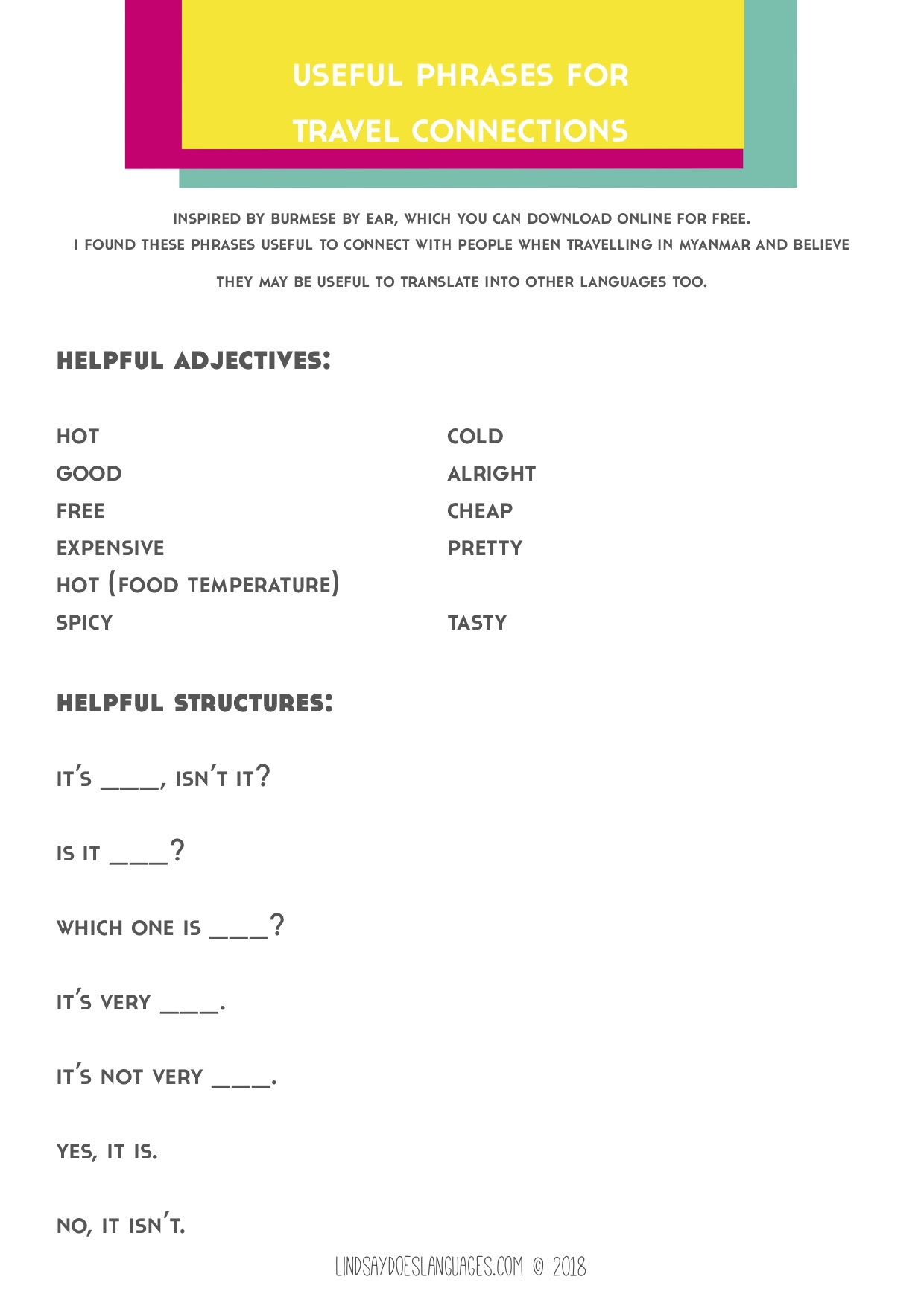
We're not just talking "hello" and "thank you", but a handful of extra phrases. In Myanmar, Lindsay experienced the world-changing results of remarking "it's hot, isn't it?" and "it's really cold!" during the water festival. Who wouldn't point that out when it's 35 degrees outside and someone's pouring cold water on you!
4. Language is Warm
People open up to you and are beyond friendly if you are learning their language, especially when it is a smaller language and they don't expect that effort from a visitor. For example, in Paraguay Lindsay found that "I'm learning Guarani" was such a magical phrase that it led to whole families inviting her to stay at theirs for the weekend.
5. Don't Forget Culture!
A successful travel experience is not just about the language and the perfect phrase, because it matters to be in tune with local customs and culture. For example, in East Asia where saving face and staying calm and "demure" in public is extremely important, it is impossible to get annoyed when the bus is late or someone gave you wrong directiongs. Even in perfect Vietnamese your actions may still stick out and break your connections to other people.
Conclusion: It is helpful and polite to read up on etiquette in your target country.
Want more tips for learning languages the fun way?
Join the Fluent Language newsletter today for the best language learning tips and offers in your inbox. (and SO many great freebies too!)

#clearthelist August 2018: The German Retreat!!
Welcome to my monthly language goals round-up - including a review of my studies during HOT July 2018, and the first ever Fluent German Retreat. Retreats are incredible, like a secret weapon for speaking another language. Read all about it in this article.
Welcome to my latest language learning update through #clearthelist, which is a language learning round-up sharing monthly language learning goals, support, and accountability.
I’m writing this a few days into August after a week fully focused on the first German language retreat - more about that later!
What Happened In July?
As ever, lots of stuff happened! July is a long month packed with travel and events that took me out of my routine as a learner, but gave me new growth and motivation as a professional.
Earlier in the month I attended Shout Out Live, a podcast festival in London. I met a wonderful community of supportive and unique people who are killing it with their podcasts, and picked up some tips for the Fluent Show. After that it was time to prep for 2 weeks spent in Germany, some of it with my family and the second half on the first Fluent German Retreat.
The German Retreat
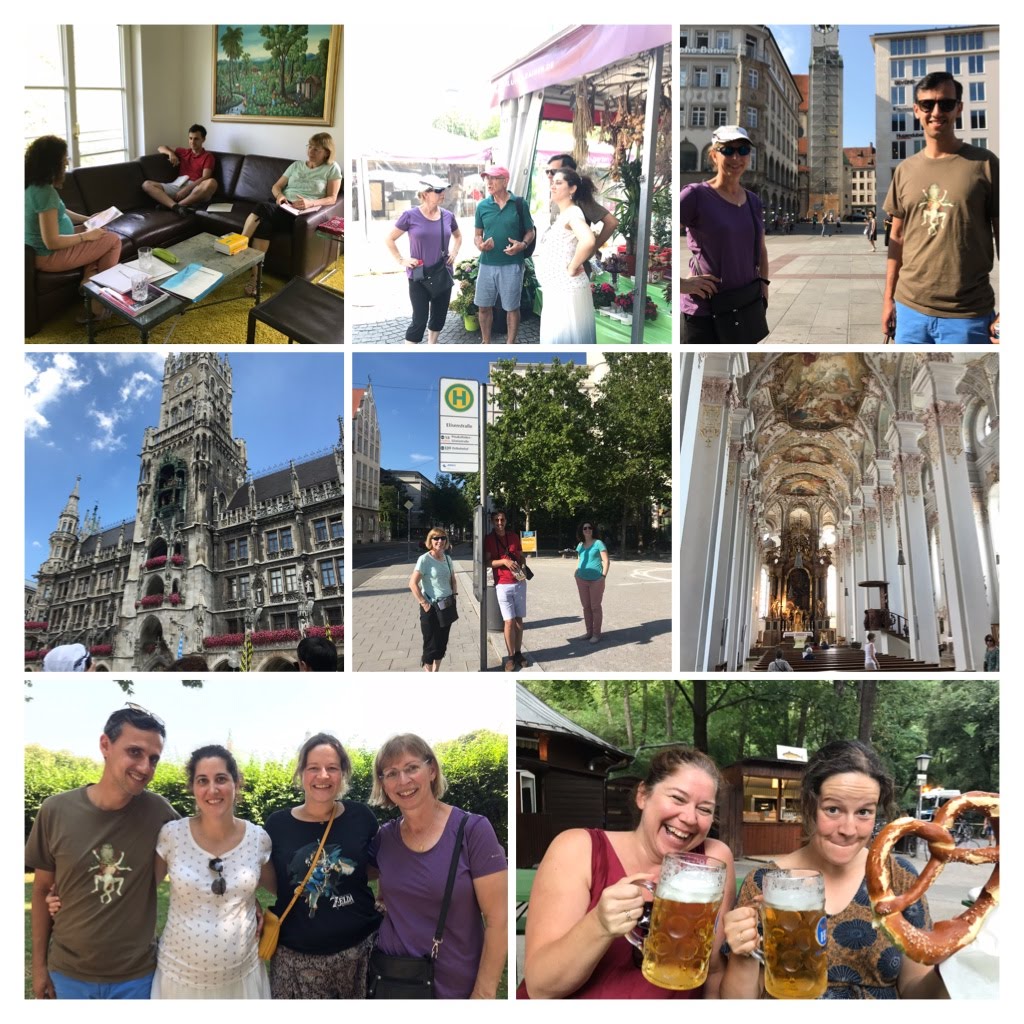
The German Retreat was a very small, all-inclusive language trip to Munich.We welcomed three motivated learners around B1/B2, and for 5 days the motto was to learn, live, and speak only German.
I taught a custom German class focused around speaking German independently, and each participant was challenged every day. One attendee told me she’d been worried her language level was not good enough for speaking German only for so many days, but she certainly surprised herself. At the end, she told me “I have grown in confidence so much over the last week, I didn’t think I can do this and now I know I can. I am so motivated to continue and speak German.” As a teacher, the retreat experience was second to none, and I cannot wait to repeat it.
Every day of this trip offered something special, including a guided tour by a retired American history professor, a visit to the (non air conditioned 🚒) Deutsches Museum, and of course a huge giant pretzel and a beer in the beer garden. In other words, the perfect combination of a good week out and a language “level-up”.
Oh, and because I am me….we also cooled ourselves off in a river.
Our next German retreats are already scheduled in the diary, so watch this space and register on my retreat list if you want to experience a trip like this.
The Fluent Show
My favourite episode this month was our discussion on language bias, and whether our hidden prejudice holds us back from learning certain languages. As Lindsay concluded at the end, we might not have answered the question but we had a great conversation about it.
In August, the show is hitting a milestone: We’re celebrating our 100th episode with a live broadcast full of games and special guests. Every language lover is invited! If you want to join us, click here for more information.
Language Goals and Progress
All right, all right. I bet you didn’t come here for a diary entry, so let’s get to the goods. How did I learn languages in July 2018?
¡Oye! ¡Español!
My moments with languages apart from my beloved Welsh continued. Checking out an upcoming Fluent Show sponsor’s wares, I decided to see what they’ve got to offer in the Spanish department…and found myself in an online lesson speaking Spanish for a full 60 minutes!
I learnt Spanish during my foreign language training in 2001-2003, and got to a level of B1/B2 for conversation and business letters. Thing is, after the end of the course I never had another formal lesson. And after 15 years, turns out I’m still good enough to function in Spanish!
Here’s my tutor’s assessment:
Moral of the story: Don’t worry if you do have an ex-language somewhere (see podcast episode 98). Your brain has way more skill stashed somewhere up there than you imagine possible.
Chinese
Still dabbling!! I spent an hour or two practicing what I already learnt and adding a few question words. At this pace, I’m on track to be “officially learning” by 2020 and fluent by the year 3000. I like it!
Learning Welsh
Yes, I’m still learning Welsh. In fact, I’m volunteering for a few days at the National Eisteddfod Cymru next week. If you’re coming and spot me speaking Welsh in a high-viz, dyweduch s’mae os gwelwch chi’n dad! Having said that, I didn’t reach all July goals. Let’s take a look.
Listening
I wanted to listen to Welsh for 90 minutes every week. This started off well with radio and television, but while I was in Germany it dropped to zero.
Reading
I wanted to try and finish the book Sgwp!…and then I didn’t touch it all month. My Welsh reading really took a dip and I’m not too proud to tell this to the internet. Luckily, there’s always another month to improve.
Speaking
The goal was to have 1 long lesson and 3 conversations, and I did have a fab lesson with my tutor. It helped me lots with that yes/no issue in the grammar. Conversationally, things were quiet though I did chat in Welsh on social media. Good job I have a trip coming up!
Writing
The goal was “write one poem, any kind”. That one got done, one sleepy morning when I put my thoughts down on the Notes app in my phone.
You might not think this is much, but sometimes it’s necessary to set the goal at “more than zero” and then move from there. After all, a small goal achieved feels better than a big goal missed.
Monthly Contact Goal
Every month, I log my “daily contact” with the Welsh language. In July, I logged 12 days of contact. I know there was more but being in Germany meant my tracking habit was off. Still, it shows that when the daily contact drops, everything drops.
Goals For August 2018
Cannot wait for this month - it’s going to be very Welsh!
Listening and Speaking
These two areas are grouped together for the National Eisteddfod, where I’m going to be from 8-11 August. Although I’m getting organised very late (my airbnb fell through), my plan is to stay on the Maes Camping and hear and say everything in Welsh while I’m there.
I also plan to volunteer for a bunch of hours. This is all organised in Welsh, so I’ll get plenty of input.
Reading
Guess what….I’m gonna whip out Sgwp once again! I’m also due a new issue of Lingo Newydd. Let’s say I’ll get halfway in this book!
Writing
I’m not entirely sure what to do for writing practice this month! I might sacrifice that writing time, not set a goal, and instead spend a little extra time on Chinese. That sounds good to me!
So there we have it, my new goals for August 2018 are set and I’m ready to go visit my target language country.
How Was Your Month?
Have you ever visited a language retreat? Do you write bad poetry in Welsh? Are you setting goals?
Leave a comment below to tell me all about it!
I would love to read about what you’re up to in the comments below!
If you want to write your own goals and join the #clearthelist linkup and share your own goals for the month, hop on to Clear The List hosted by Lindsay Williams and Shannon Kennedy.



Struggling with listening? Discover realistic tips, challenge prompts, and the best tools for improving your listening skills as a self-guided language learner