
De-Brief From An Organiser: Women in Language 2018

A few weeks ago, I was proud to co-organise and witness the first ever Women in Language conference, a unique online event designed to champion, celebrate, and amplify the voices of women in language learning. It was not my first online conference about language learning, but certainly the first I partly created and the first one ever to feature an all-female line-up of speakers.
In today’s article, I am going to lift the curtain and share my official de-brief as one of the three members of our organising team.
What I Felt at Women in Language
Let me start with the most important thing: I enjoyed every single presentation that I saw. And as I was often online making sure everything went smoothly, those were almost all of them. The quality of our many speakers at Women in Language was excellent, and the range of topics kept things interesting and inspiring.
Women in Language delivered on a few extra levels too. It felt as inspiring and intense as every offline conference could feel, with the added bonus of allowing me to sleep in my own bed. I adored seeing #womeninlanguage posts on social media, and to hear from our attendees in the live chat and Facebook group. And most importantly, I got SO inspired and motivated to learn languages in a brand new way!
What I Learnt About Language Learning
A lot of the impact of four days of language love cannot be put into words. It’s a boost in motivation, a renewed commitment, a burst of energy. And at Women in Language, I got all of those out of it and more. I got to know more of our conference attendees and boosted my own desire to learn and teach languages in new ways.
Here are the most important lessons from Women in Language that will be essential for all language learners:
1) Dabbling Is Legit
At Women in Language, we celebrated the huge diversity of how people learn languages. You can choose whatever language you want to learn, and you can learn it for 2 weeks or 20 years, and you can dabble in a handful of languages at once if you want to. This is all “allowed”, and won’t make you any less of a language lover or polyglot.
Sometimes it’s easy to feel self-critical as a language learner, and to tell yourself that you’re doing this wrong if you don’t use Anki or speak from day 1 or spend many hours on your project. But dabbling is perfectly legit, and you are allowed to feel proud of it.
2) Compassion Matters
Leading on from the previous point, compassion was a regular theme of the conference. When you’re faced with so many blog articles and Instagram posts and YouTube videos and language books telling you what to do, it’s sometimes hard to remember that everyone has a bad day.
You can’t always be happy and you can’t always be 100% gold in Duolingo. Compassion means allowing understanding and empathy for yourself when times are tough, but also for other language learners. No one method is the right one. Allow other people to feel good about themselves, and extend that same kindness to yourself.
3) Everyone Loves Transcribed Audio
Finding something interesting to watch or listen to, at the right level, and then with a transcription…that’s difficult. But it’s also what a lot of our conference attendees wanted, and you certainly CAN find it online. If you want to get a few ideas, check out Speechling, Glossika, Rhinospike, and Movieclips on YouTube.
And by the way: Just listening is NOT enough. If it’s just a wall of sound, you’re not doing much good. You’ll need to know what you’re hearing. Find input that you can engage with, and check against your own skills. For more about this, listen to my podcast episode about listening skills.
4) There’s So Much to Talk About
It’s never enough to practice speaking by doing the “Hello how are you where do you live” dance over and over again. Speaking practice is best when you’ve prepared something interesting to talk about. And lucky for us, there are tutors and learners who already discovered this too, and they’ve even put together lists (like this one) of questions and conversation prompts.
5) When Your Brain Is Having Fun, You Learn
All too often we think of language learning as a STUDY activity, in all caps. But it’s just not necessary to do things this way. Language can be learnt through story, through fun activities, through play. The most important things are exposure and repetition, not how hard you study or how much your language experience feels like work.
Though some of these lessons may read as happy-clappy positivity notes, I found that they often helped to ease a learner’s mind and allow them to take a break and come back to language learning with new energy and enthusiasm. After all, we want to get fluent while having fun, right?
What Do You Think?
Whether you attended Women in Language 2018 or not, what do you think about those lessons above? Are you a dabbler, or a hardcore study nut? Leave me a comment below to join the conversation.
In part 2 of this blog article, I will put on my co-organiser hat (a very stylish hat, for sure) to tell you more about how Women in Language was organised, what we learnt in the process, and what you should consider if you want to run or contribute to an event like this in future.
Organising A Successful Online Conference
I’ll start with what we looked for in our speakers and talks.
For this first ever conference, we used our own network of interesting women to ask if they wanted to speak at Women in Language. Their social media accounts, blogs, youtube channels, relationships with us were what put them on the radar. So if you’re dreaming of speaking out yourselves, making yourself very visible is good advice.
Before contacting our speakers, we considered some guidelines about the types of talks we would be looking for. In addition to practical topics featuring tips and techniques for language learners at “Beginner” and “Advanced” levels, we also chose the tracks “Living with Language” and “Working with Language”. Each speaker we contacted let us know which of the four themes they would like to address in their presentation, and was allocated one. This way, we ensured that no topics would be repeated and we could offer a varied programme on every single conference day.
Here are just three of the 25 talks we saw at Women in Language:
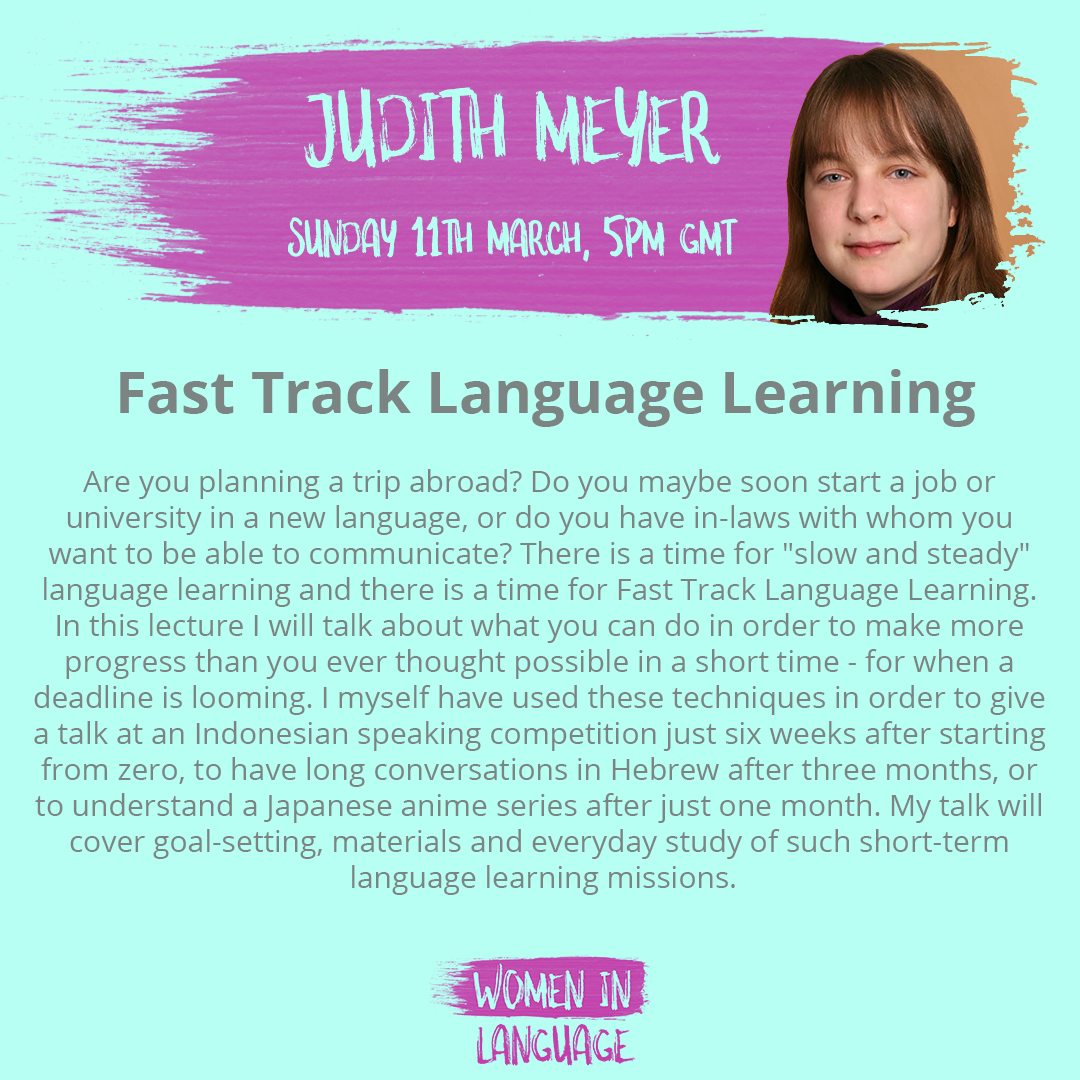

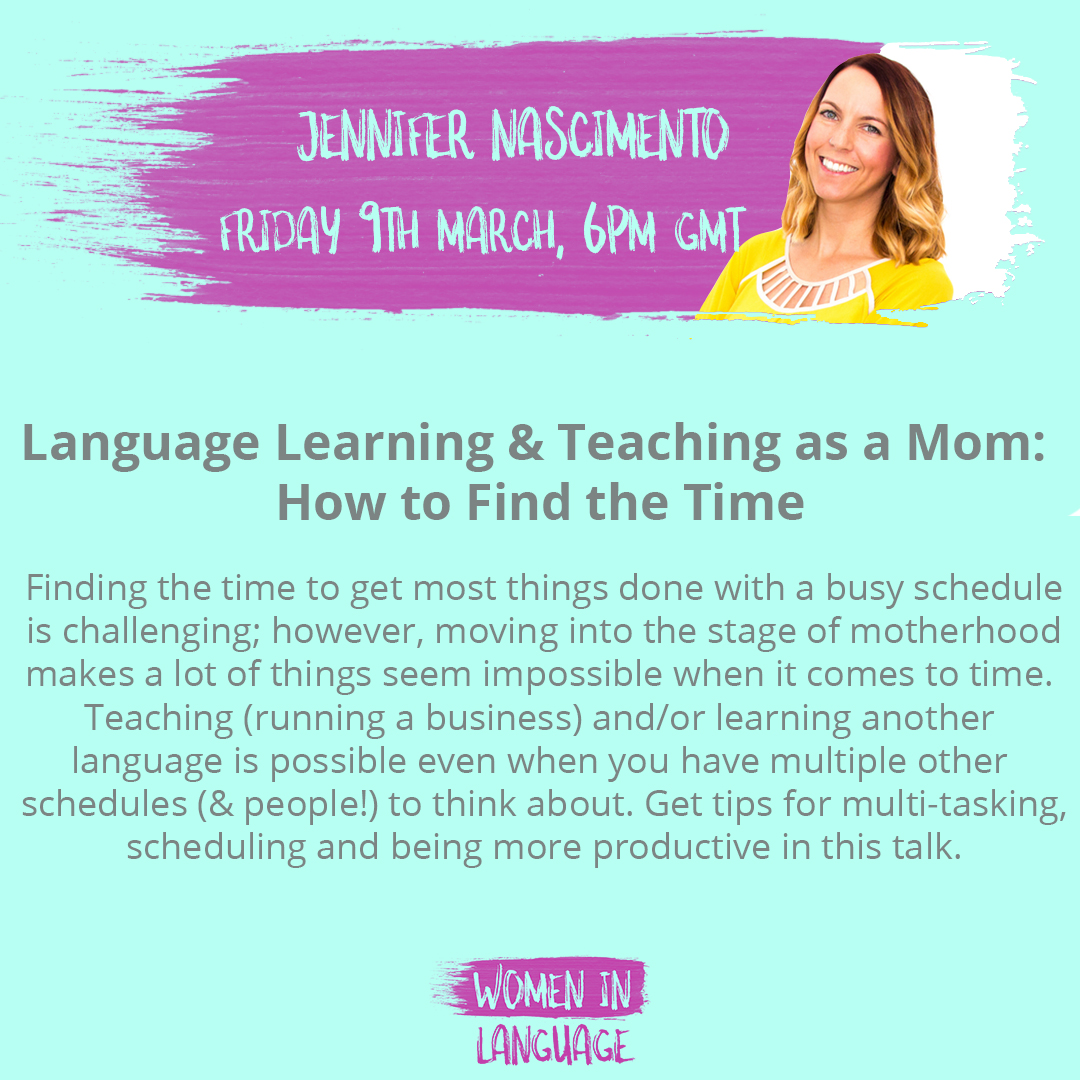
Some of our speakers came to us with a firm idea of the talk they wanted to present, while others found themselves unsure at the start. As our programme officer, I found myself receiving several messages saying “I don’t know, maybe I have nothing to say after all.” If you have ever hesitated to put yourself forward for an opportunity, here is the thought process that does stop them in their tracks: “Maybe I don’t have anything to say here.” Meaning “Maybe my experience, my voice, my passion are not valid. Others will have more to say.”
I extended offers of a little “talk surgery” to those who needed an idea boost, and without exception it was the speakers themselves who came to me with fantastic topic ideas, and who delivered on them 100%. In fact, I found that the most intriguing topics came from a place of passion and excitement in each speaker’s mind. Topics like “Learning With Crime Novels” and “Managing Motherhood and Language Learnings” are not a language learner’s most burning question, but that’s exactly why they make incredible conference topics: They are real, and invite us to think differently.
Some People Voiced Different Opinions
I won’t lie to you, at times it felt hard to be out there putting together this positive, kinda feminist event. Some commenters felt that it was a wrong move towards equality, unnecessarily excluding male voices. To those guys, I want to remind you that we welcomed and celebrated male voices throughout the event - it’s just that this time only women got to speak “on stage”, and every single one of them brought expertise, commitment, quality, enthusiasm, and outstanding topics. We set out to show the language learning world from a different angle, and I was so encouraged to hear from several male attendees who were enjoying the conference just as much as everyone else.
If You Want To Be a Conference Speaker
If you are considering applying to speak at a language conference, please don’t hesitate. Even if you were to hear a no, don’t worry and keep putting yourself forward - maybe the programme is full already or the conference can recommend a future event for you to try.
Don’t be shy about suggesting a topic outside the memory-boosting-fluency-fast-track-performance mainstream. Don’t wait until you’re fluent in 16 languages. You’re good enough right now, as long as you have a cool topic. And what’s a cool topic? Your own experience!
You are so cool when you are yourself.
I want to give kudos here to all those women who agreed to speak and trusted Shannon, Lindsay, and me with Women in Language. You absolutely killed it, and we appreciate all the hard work you put into giving a great online talk at an event you’d never heard of before.
Many of our speakers were new to presenting online. From my perspective as a blogger and podcaster, I’m used to speaking to an empty room and waiting until later to see if anyone connects with my words. But these guys were new to the whole environment, and they handled it brilliantly.
Tickets
When we put together our event, we knew that it was a risk to ask for payment from attendees of an online event. Many other online events are open to attendees for free, but we wanted to create an atmosphere where the sales pressure is off, and where our audience members were just as invested in having a great time as we were.

We found that the ticket sales achieved this goal, and allowed over 250 audience members to join us from all over the world. This reassurance also helped us relax and increase our commitment to Women in Language. So on the ticket selling front, we are happy to note that all went well and we are now able to give a donation of over $400 to our chosen charity, Kiva. The charity supports entrepreneurs who do cool things to alleviate poverty around the world.
Here I want to say thank you to our audience members, who went ahead and trusted us organisers with a brand new conference idea. Some purchased a ticket and even took time off work, others were unable to attend but joined the conference to support celebrating and amplifying women’s voices in language learning. We appreciated your trust and support.
About The Technology We Used
In terms of technology, we used a setup of Google Hangouts on Air for our live broadcasts and embedded them in individual Teachable lectures via YouTube. We also added individual Chatango chat boxes in each lecture.
At the end of any session, the viewers could click “Complete and Continue” at the top and move on to the next session in our packed programme. Credit here goes to Shannon for leading us on the setup of a gorgeous page and ensuring the information was up to date.

Inside Women in Language
Combining technologies to create the conference experience
This format added to the feel of hosting a real conference, where you would often walk into the next room for another talk. But in addition, it made us into the Netflix of language learning, where any previous talk could be streamed from the beginning right after it was published.
All talks were offered on a single track (no two at the same time), which kept the conversation focused and helped create a live chatroom community. We also added an “after hours” experience through a dedicated Facebook group for Women in Language attendees.
Marketing Women in Language
Our marketing campaign, headed up by Lindsay, made it easy for Women in Language to get seen. We obviously talked about Women in Language in our own blog, podcasts, social media, newsletters, youtube, and wherever you see us.
Lindsay also prepared some beautiful pictures and tweets for the speakers and the attendees, so that everyone could easily spread the word about our event. We are so grateful that you guys supported us and shared your excitement before the event. It helped us so much.
Shout out to our friends How To Get Fluent, Language Learning Summit and Langfest for inviting us to present our new event, and to Mezzofanti Guild for hosting a guest post written by Shannon. Check those guys out - they are doing amazing work.
The Organising Team
Between three organisers, we found that we were able to play to our strengths and largely handle the large workload of running a conference like this one. We stayed in contact with each other through direct messages, but also weekly meetings, and the project management software Asana. When your organising team is living on three different continents, it’s helpful to ensure online communications are as good as they can be.
Our track record of collaborations was a key to our success. Lindsay, Shannon, and I were no strangers to each other’s work. We knew already that we appreciate each other’s work and that each of us knows how to use all parts of the technology and marketing setup. We had also met in person before and solidified our friendship. Throughout the organising process, we were able to stay supportive and open to suggestions from each other.
Sometimes, it can take courage and grace to reach out to a colleague and trust that they’re on board with your idea. From the minute Lindsay first mentioned the idea of Women in Language and Shannon hopped on the first Skype call to join us, that was something we committed to.
I am grateful that I had the opportunity to run such a cool project with two colleagues and friends that I respect so much.
What We’ll Do Even Better Next Time
So we were excited, we were buzzing, we enjoyed four days of a successful conference full of tips. But that doesn’t mean that there weren’t any mistakes to learn from.
On the technology front, a few hiccups taught us the following lessons. Maybe you’ll find them useful one day, so I’m sharing them here:
- When you want to embed your YouTube events in another page, it pays to set up a dry run so that you’re double sure the embed will show up the way you want it to.
- When you are planning to invite someone to a Google Hangout, you cannot send them a “join link” in advance because the software will discard that link the minute you close the video window in your browser. And then your speaker’s link will be useless and they’ll be confused.
- Don’t click “eject” when you want to reset your Hangouts partner’s setup as they joined your Google Hangout. They won’t be able to join again, and you’ll have to create a new event.
- Power Point going full screen in Google Hangouts is a bit of a gamble, so stay calm, have a dry run, and prepare trouble shooting notes to make sure all goes smoothly.
In terms of the programme, we tried a new format of round table discussions which was successful at large. The two-hour time slot did discourage some audience members from watching it though, and that’s something I had not expected and we will look into providing shorter round table discussions next time.
Finally: I feel fired up to expand our commitment to diversity and ensure we include more global voices. Our line-up was international but still looked largely like us: white women who speak English a lot. Even if each of them is different in nationality or language line-up, this still gives our attendees an unintentional impression of what the “norm” is. We can add to that during future events, and I’m excited that we now have 27 speakers who can help us grow our network and look for polyglots and language experts from more diverse backgrounds.
What About You?
Did you enjoy the online conference?
Have you ever thought about becoming a conference speaker?
I’d love to hear from you in the comments below.

In Language Learning, Are Apps All Amazing? Are All Apps Amazing?
In this episode, we caught up, talked about a new directive on language use in a very special setting: Childbirth!
We also discussed language learning apps and how to make the most out of them, so if you're enjoying Duolingo but you're STILL not fluent, this is the episode for you.
Welcome to Fluent Show episode 79, where co-host Lindsay joins me to catch up, talk about language, and discuss the hot topic of language learning apps.
If you've ever downloaded and used a language learning app, and then wondered "Am I doing this well? Could I learn more from this?", then our discussion will help you swipe and tap your way to fluency.
The Language You Use When She's Giving Birth
The British Medical Journal recently published a blog article sharing guidelines on how to speak respectfully to women during childbirth. Is this "political correctness gone mad", or does it matter how we refer to people in these settings? Would you expect that less dramatic and violent language can help mothers stay calm in labour?
Also, as ever: The important theme of "use her name", and how we'd expected to be addressed in different language environments.
If I got to the stage where I'm having a baby, I would expect to be called signora..not the equivalent of 'girl'
Tune in to our discussion to find out, and leave a comment below to share your own views.
How To Make Good Use of Language Apps

In this episode, we talked about language learning apps and how to use them.
Practical Tips
- Use different apps on different devices if you have them, for example you could make your iPad your reading resource while you use the phone to text language exchange partners
- Take most of the promises that come from language learning apps with a grain of salt - using an app without effort does not mean learning a language without effort
- Customize your experience: Apps are not all you need to learn a language, but it can help you create a language learning environment that is unique to you. We find that when an app is not the only way you're learning a language, your experience and results gets be better.
- Don't ever feel ashamed or embarrassed about your app choices and what works for you!
The Essential Language Apps To Try On Your Device
Apps can be roughly sorted into a few categories, and it's worth trying a few to find your personal preference
- A good dictionary app like WordReference, LEO, or even Google Translate
- A flashcard system like Memrise, Anki, or Smartcards+
- A language course app (often gamified) like Speechling or Duolingo 4. Our sponsors Clozemaster of course!
- A non-language related app that can help you stay productive like 30/30, Timeglass, Pomodoro, or Streaks
Which language learning apps do you use regularly? Can you manage without them?
Leave us a comment below or tweet @thefluentshow.
EPISODE SPONSORS
EPISODE LINKS
- Code-switching - Wikipedia
- italki - where people can find online language tutors
- Humanising birth: Does the language we use matter? – The BMJ
- 12 Ideas For Making the Perfect Language Learning App by Fluent Language
- After Duolingo? : Esperanto
- The Welsh-Dictionary App: Language Technologies Unit, Canolfan Bedwyr
- The Fluent Show: Gabriel Wyner is NOT a Robot (with Fluent Forever author Gabriel Wyner) — Interview with Gabe Wyner, the creator of the Fluent Forever app
- Gboard - the Google Keyboard - Android Apps on Google Play
- STREAKS. The to-do list that helps you form good habits. For iPhone.
- 30/30 | You have never experienced a task manager like this!
- Gretchen Rubin: The Four Tendencies — Cool personality quiz that can tell you more about your habits. See also Fluent Show 32
- clear the list Archives - Eurolinguiste
- Language Learning Goals: Clear The List - March 2018 - Lindsay Does Languages

Introducing Women in Language: An Online Conference For Language Lovers
Women in Language is a unique online event designed to champion, celebrate, and amplify the voices of women in language learning. It's happening 8-11 March 2018, for the first time ever!
I am one of the organisers and in this blog article I am sharing the story of what inspired me to get involved.

Women in Language
8-11 March. 25+ Speakers. 4 Days of Language Passion.
Around 2010, I worked a job which involved a lot of travel. I visited countries around the world to promote UK education, and one of my core markets was Russia and its capital city of Moscow.
As I was walking in Moscow, there was one thing that kept standing out to me. The Russians seemed to love flowers. There were lots of цветы stands all over the city. In the freezing winter and busy city, I wondered what occasions there were for all that floral appreciation. So I asked my Russian colleague Mariyam when the flowers change hands.
She said "The biggest is the International Women's Day".
I responded with wonder: "International what? Women's Day? What is this? When is this?"
"It is 8 March", she explained. "This is the day when men give women flowers."
I was charmed. I'd already noticed Russian chivalry as men held doors open for me and allowed me to enter the Metro before them. Russia, who knew! "Wow, I never knew that this place was so supportive of women!", I said.
But I was wrong. Mariyam explained: "On this day, men give flowers and say "You are doing a good job, woman". Maybe the woman can spend more on a haircut. And the next day, they she goes back in the kitchen."
She laughed, but right there and then I knew that she had a point.
My own upbringing taught me that a woman's voice is not her main asset. Growing up in rural Germany, Hausfrau was the norm as a job for women. You may have read about this as "Kinder, Küche, Kirche" - children, kitchen, and church.
Women are not expected to speak up, to lead, to be the boss of anything let alone men, to even speak other languages.
We are living in a society where women have been long valued for "quietly getting on with it".
The voices of boys in the classroom are louder, more often heard, more praised, and as a result we see that females hold back in conversation. Even successful women fear that there is limited space at the top and it can happen that they "pull up the drawbridge" behind them.
That is not the world I want to live in.
I always knew that I love languages and that I want to make a lot of noise about it. My dream is to do things that inspire and motivate everyone, no matter if they're a man or a woman. And I have always been aware of the strength of male voices in our space.
For a while now, I'd wanted to build on the energy and inspiration created at the best polyglot events. So last year, when my friends Lindsay Williams (Fluent Show co-host and Lindsay Does Languages) and Shannon Kennedy (Eurolinguiste) mentioned that they both had been thinking along the same lines, the three of us decided to take action.
The Idea: A Conference With a Difference
You may have noticed that the majority of "famous polyglots" online are male, and that expert panels and line-ups can be dominated by these voices. The media in particular pays more attention to male experts, even though statistically our field is full of females too.
We decided to create of a new event full of fresh voices and perspectives. To create a movement where female experts are part of the norm. We decided to list and contact the many female speakers we know, and to create a platform that is open for all of them to showcase their unique talents and views.
We created..

Women in Language 2018
Women in Language is a unique online event designed to champion, celebrate, and amplify the voices of women in language learning.
It starts on 8 March - International Women's Day 💐 - and runs online for 4 days. So that's 8-11 March 2018.
If you want to join us, click here get your ticket today from www.womeninlanguage.com.
You can attend from the comfort of your sofa, and with your ticket you gain access to every single live talk and recording with famous polyglots, world travellers, teachers, translators, interpreters, and linguists counting over 15 years in the business.
The price of $29 comes in at just over $1 per session, and with your tickets we included a few special extras.
- You do not have to be glued to the screen for 4 days straight, as your ticket price already includes access to all conference recordings.
- As well as the live speaker presentations, there’s also a private Facebook community where you can connect with other language learners and speakers, up to 6 weeks after the event.
- If you're a note-taker like me, we've got you covered with the digital Women in Language notebook where you can capture the inspiration you will gain at the conference.
- One last thing before I go today: 10% of all profits of our event will go to the charity Kiva, a charity creating opportunities for entrepreneurs across the globe.
I can't wait to meet you at this online celebration of female voices in language learning.
Of course, you may still have a few open questions. Here's some of our FAQ, and feel free to comment below to find out more.
How Does An Online Conference Work?
All of our sessions will be broadcast live. Click here to check out the schedule (on the left). After you purchase your ticket, you will gain access to each talk and chatroom which goes live at the time advertised.
But we understand you're busy and that your timezone may not match the speaker's, so we also give you access to every session recording to watch at your leisure.
You do not need to dress smart casual and can attend from anywhere in the world.
Is This Event Open to Women Only?
Absolutely not. Men are not just welcome, they are needed to show that equality and (dare I say it) feminism benefit all of us.
No matter who you are, this line up of world-class experts will inspire you and share their best tips and secrets for becoming fluent in a language, creating language careers, and living as a polyglot. I can't wait to welcome you.
Is This an Event About Language Learning Or About Being Women?
This is an event where women talk about language learning. You care about learning a language and want to hear from experts who share the best techniques and experiences, so that's what we found for you.
Creating a space for reflection on life as a female has given us a few interesting extra spaces - from a talk about motherhood to Round Table discussions reflecting on whether women do anything differently in language learning. Join us to find out the answers!
If you're excited about the event, it's worth getting your ticket early so you can join our discussions before the conference on Facebook and elsewhere (#womeninlanguage). Click here to get your ticket right away.
I'm looking forward to hearing your comments on the #womeninlanguage hashtag, and of course right here on the blog.

"It's Hard Work But It's So Worth It": Everything You Need To Know For Raising Bilingual Children
Have you ever wondered how bilingual parents do it and what the life of a bilingual family looks like? Are you excited about passing on language skills to your kids, but not sure how?
In this episode of the Fluent Show, you'll get an incredible amount of support.
Marianna du Bosq, bilingual mother in a bilingual family and host of the Bilingual Avenue podcast, talks about how to raise bilingual children. And she knows her stuff.
For a while now, I have wanted to bring you an expert on bilingual parenting on the Fluent Show, and here she is: Marianna du Bosq, host of the awesome Bilingual Avenue podcast, a show for parents who are raising bilingual children.
As a German native speaker who speaks English all day long, I find the prospect of bilingual parenting both daunting and fascinating.
Marianna's incredible energy shines through and she's got SO many tips. I came away with so much more knowledge about what bilingual parenting is really like, and I'm convinced you will too.

In the interview, we'll talk about:
- How much work do you have to put in as the "one language" parent of a bilingual kid
- What agreements parents should set up with each other when they decide to do this
- How to create a more immersive environment for children learning languages
- Whether you have to hire nannies and tutors and do all the expensive things to make this work
- How to overcome negative attitudes, and how to help a parent who feels left out when they don't understand their child
- How to learn a language along with your child
- What the school experience is like for Marianna's daughter who is in an English-speaking school
- What the most popular and effective bilingual parenting models are..and which ones are not the best ones to try
- Which episodes of Bilingual Avenue you should check out next (see below)
And most importantly, why raising a bilingual child is so worth the extra work and planning - Marianna makes a passionate case towards the end of our show so don't miss that.
Step By Step To a Bilingual Family Household
"It's hard work but it's so worth it."
Marianna has worked with many families to support their language plans, and she explains it comes down to six steps.

What I found interesting here is how useful and great these are for adults just as much as children - exposure and need at the heart, and really combing through our routines in detail can uncover new opportunities for speaking another language in the busiest schedules.
1) Start with a vision - how much of a language do you want the child to know, and how do you want family life to look in your family?
2) Assess your surroundings - Where will you and your child be able to get exposure to both languages?
3) Consider what your child's day is like and make notes on where the exposure in each language is coming from
4) Make your kid's interactions with the less dominant language partner fun, interactive, and engaging. They should find themselves entertained and wanting to communicate in that target language.
5) Implement a period of "language time" in the day, when you and your child have fun together and only speak the language you determine. Sometimes you may have to negotiate with them, but around language exposure you're the boss.
6) Stay encouraging and praise your child for speaking the target language, even if they aren't perfect at first. Focus on modelling correct usage rather than pointing out flaws.
I really loved how Marianna emphasized the two most important principles for bilingual life as need and exposure. Just like in adult learning, we won't be able to go far without those two. Need and exposure are the key to a productive language experience, and no matter how old you are you'll benefit from planning those in your life.
"Every time I switch to English, that's a lost opportunity for a word I could have shown, taught and modelled in Spanish."
The Top 3 Models for Bilingual Parenting
Wondering how to get started? Here are the three most popular models of bilingual parenting, and according to Marianna these are the most successful.
"One Person, One Language", a scenario in which each parent (or other person in the child's life, like grandparent or nanny) will choose a language and make that the core of all interactions with the child.
"Minority Language at Home", a scenario in which you make your home language the language that the child isn't exposed to in the wider world. For example, a Korean-speaking family living in Germany would focus on Korean at home but German outside the home.
"Language Time", which means you select pre-determined time periods and switch languages throughout your child's life. For example, as a parent you may want to speak Spanish for 3 weeks followed by 3 weeks in French.
EPISODE SPONSORS
CODE: FLUENT
EPISODE LINKS
- Vocabulary and grammar tips for non-native speakers | Bilingual Avenue — My visit to Bilingual Avenue
- I am Germany on Twitter: "So, as I've been here for a while, and as I have children here, one of my issues is how to raise them bilingual/ teach them German." — Interesting twitter thread on this topic
- ‘We’re told we’re anti-Welsh bigots and fascists’ – the storm over Welsh-first schooling | Education | The Guardian
- Candyland Game — I did not know what this is.
- Bilingual 077: Managing the presence of multiple languages in a single mind with Dr. Giuli Dussias | Listen via Stitcher Radio On Demand
- Bilingual Avenue 093: 15 helpful tools to help you and your child learn a language with Lindsay Dow | Listen via Stitcher Radio On Demand
- Bilingual Avenue 101: Money saving tips for your next language trip with Lauren Lyons Cole | Listen via Stitcher Radio On Demand
- Bilingual Avenue 147: Parenting Abroad with Jennifer Langkjaer | Listen via Stitcher Radio On Demand
- Bilingual Avenue 017: Actionable Tips & Strategies to Enhance Language Development with Susanne Dopke | Listen via Stitcher Radio On Demand — This episode includes tips for play with bilingual kids
- Bilingual Avenue 004: Bilingual Benefits, Myths & Developmental Milestones with Dr. Brenda Gorman | Listen via Stitcher Radio On Demand — Can bilingualism cause speech delay?
- International education - International Baccalaureate®
- LangFest17: Bella and Yulia Devyatkina - Raising Bella in 8 languages - YouTube
Are You Planning a Bilingual Family? Got a Bilingual Family Already?
I'd love to hear more about your own experiences of parenting in another language. Leave a comment below or find me on Twitter

How To Get Off The Intermediate Plateau in Language Learning
Welcome to Fluent Show episode 76, where I tackle the question:
**"How Can I Get Off The Intermediate Plateau?"**
If you're stuck somewhere in the language weeds, this show will help you untangle them and get those wheels turning again.
Welcome to Fluent Show episode 76, where I tackle the question:
"How Can I Get Off The Intermediate Plateau?"
If you're stuck somewhere in the language weeds, this podcast episode will help you untangle them and get those wheels turning again.
Just like any big goal that leads us to a happier life, language learning for the long haul works best as a habit. It’s possible to reach miraculous short-term results, but if we’re looking for mastery and SUSTAINABLE mastery then there’s no point putting your 6 week boot camp crash challenge attack plan into place.

Note On Progress and Your Sense Of Progress
- You’re in this for the long haul. After reaching a level that shows you’ve been studying this language for a long time, your motivation is likely more than fast progress. It doesn’t help to count the time you have spent learning.
- It doesn’t help to assume that going to A2 from zero is the same as going to C2 from B1 — it really isn’t like that.
Rewards
The problem with the plateau is how frustrating it feels. You don’t feel the rewards anymore. So let’s talk about rewards and how you can bring back the feeling that your work is paying off.
Strategy 1: Get Fresher Rewards
6 months ago, you got a real kick out of being able to watch the news in your target language without subtitles. 3 months ago, you were still watching the news but it started feeling like a chore. Today, you still understand everything but you’re frustrated in a new arena. Rewards are most rewarding when they come after some really hard work towards a desire, and right now your frustration is rooted in your shortfall.
Ask yourself honestly where you are most frustrated right now. What is missing? What do you feel scared to attempt? Whatever it is, it’s likely not something you can do on your current plateau.
(Example of reading a book in Welsh)
Strategy 2: Intrinsic Rewards
This is about your identity, who you are as a language learner, and what you love the most.
Strategy 3: Extrinsic Rewards
These incluce
- Validation from friends
- Passing exams
- Career advancement
Strategy 4: Change the conversation
Reward yourself for effort, not result. No point in burning yourself out.
So now I’ve convinced you to keep going, there is one question remaining. How do you actually get better? How do you study the right topics?
Do Difficult Things
Yes, I mean working hard. Your learning curve is slowing because you are not doing the difficult things anymore, so this is a good problem to have.
Getting to the C levels without the four core skills, without grammar, is not possible.You will not automatically get to the highest language learning levels by just keeping going. Things do need to develop, and if there’s a corner of grammar or a core skill that you have been neglecting, now is when it catches up with you.
Put That Yardstick In Place
If you feel like you’re not making progress, it’s likely because you have lost something that helps you measure your progress. It's time to get the yardstick back. Yardstick options:
- Set consistent path goals and share them with people, then check in every week. Join a learning club or mastermind.
- Write down your goals and be accountable to yourself — keep them in front of you
- Sign up for a language exam and get yourself tested
- Use a guiding resource, something you can really measure
- Work with rewards and treats - there is nothing wrong with celebrating where you are right now. You’ve come a long way
Become REALLY Clear On Your Aims
People often remark on the high quality of my English, and this level of English is impossible to reach without an incredible amount of exposure. But this level is NOT C2 - it is in fact higher.
Find a person who will mentor you.
This doesn’t have to be a paid tutor, but could be a patient and dedicated friend or group of friends. They might not even know they're your mentor. This is why people often report success when they travel - they put themselves in a world where language mentors are easily accessible. But just because something is not quite as straightforward, doesn’t mean it’s impossible.
In Conclusion
It’s easy to give up at this stage…but just because it’s difficult, doesn’t mean we give up. Right? Right!
You never have to finish the language. You never will. It will just speak to your soul in new ways.
EPISODE SPONSORS
CODE: FLUENT
EPISODE LINKS
Mastery and Advanced Level Language Learning (Podcast Episode 46) by Fluent Language
3 Reasons why you're still an intermediate level language learner - The Polyglot Dream
Common European Framework of Reference for Languages - Wikipedia
How To Learn A New Language With Smart And Useful Goals by Fluent Language



Struggling with listening? Discover realistic tips, challenge prompts, and the best tools for improving your listening skills as a self-guided language learner