

Accelerate Your Speaking Skills with Speechling: In-Depth 100% Honest Review
Speaking in other languages is harder than it looks at first. You can read books and study flashcards, and still choke when you speak to a real person.

It can be difficult to practice pronunciation and have conversations on a regular basis. Tutors are awesome, but your lesson time is limited. And many apps and bots make us feel detached.
Speechling claims to have cracked that problem. This new app offers speaking skill training, attractive design, and the most convenient access to a real person tutor that I have ever seen. No scheduling, no exchange of Skype names.
Sounds good, but does it work? In this review, let's take a deep dive and find out.
How does Speechling Work?
Speechling's courses use sentence repetition, a premise that you may know from fellow Fluent favourite Glossika. But there is a twist: Speechling includes feedback on everything you record, from an actual human.
After repeating the sentence you see and hear on the screen, you have the choice of listening back to your pronunciation, or to save it for coaching. After you save your recording, you will receive feedback and tips from a Speechling coach.
How I Tested The App
Speechling's six language options gave me the chance to test ot for at different levels:
- Advanced (French),
- Confident Beginner(Russian)
- Absolute Beginner (Chinese).
The Advanced Learner Test: French
In French, my language level is around B2-C1 on the CEFR. I can navigate most conversations without hiccups, and I know for a fact that speaking French is what I need the most.
So for my level, saying a few sentences every day at my own convenience was perfect.
The live feedback here was eye-opening. I have an optimistic blind spot to my own weaknesses in pronunciation and word choice. I always learnt French in academic environments, so I produce great grammar. But in reality, my spoken French sounds textbook and a little uncomfortable. The coach feedback made me more aware of my little mistakes without discouraging me completely. I felt encouraged to try again, to fix what I was saying and carry on.

Describing a picture using Speechling's Freestyle mode
With the freestyle mode, I got to practice free speech instead of repeating pre-written sentences. In the dictation feature, I added listening comprehension at natural speeds.
The Confident Beginner Test: Russian
Russian is a language I studied about two years ago and I was able to have very basic exchanges (“what did you have for breakfast?” - “I had porridge”, that kind of stuff). I pronounce words correctly, and can read Cyrillic. So with this language, I wanted to see
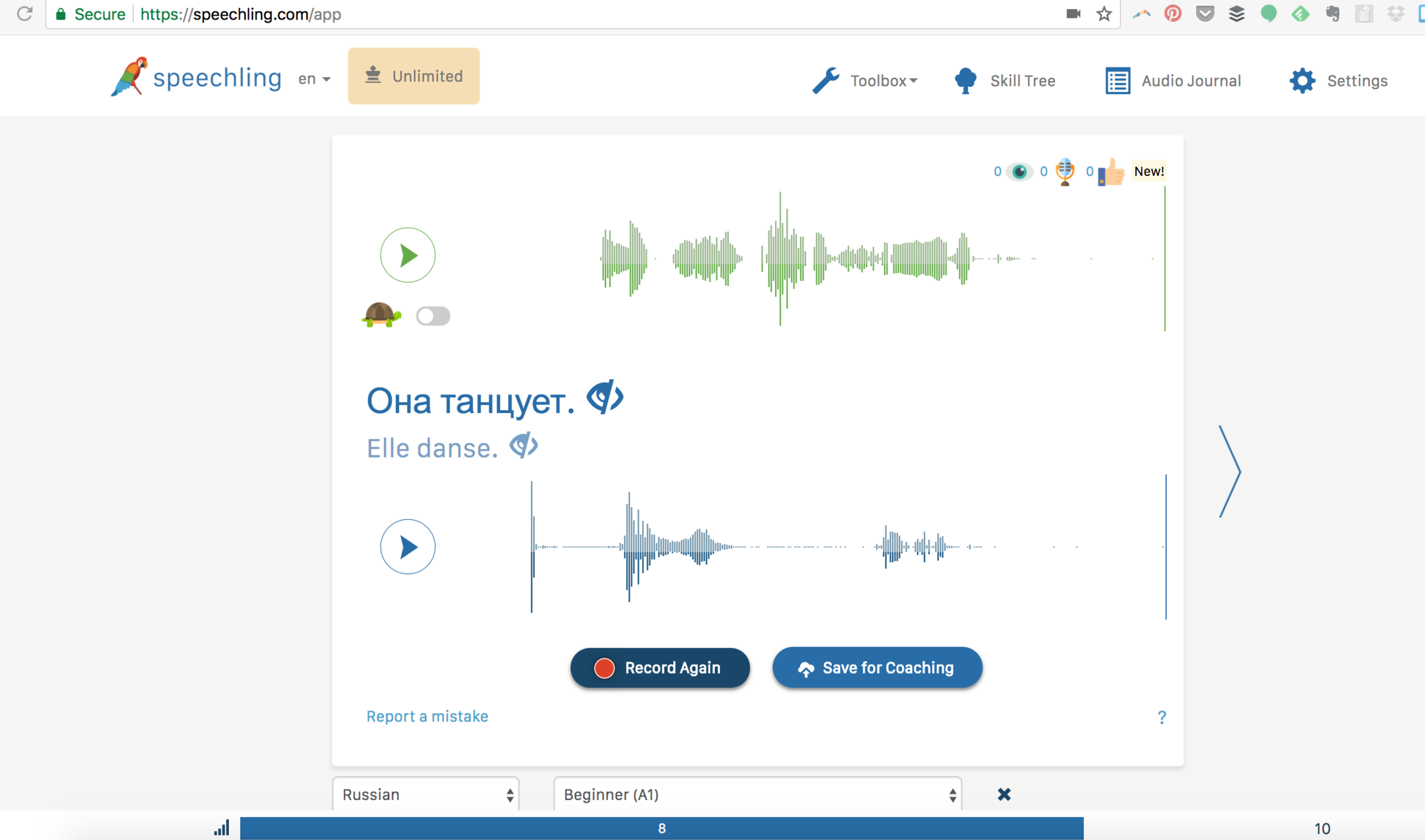
- if Speechling can teach me something new and
- if my pronunciation is accurate.
The module I chose was “Beginner (A1)”, which was a great entry point after a few years off. With each repetition, I felt like I was learning. The examples were well pronounced, came at a speed that felt like a suitable challenge, and soon I was improving.
I also felt that pronouncing each new word immediately helped me remember it, especially when I added a recording. The accountability of recording and coaching (“someone will actually hear this”) helped me link the phrase with a strong emotion. For more about how emotions amplify memory, check out my interview with Gabriel Wyner from Fluent Forever.
With a language like Russian, you need regular exposure to stay comfortable with the alphabet and pronunciation. Speechling surprised me here because it felt like the perfect tool. There were so many sentences I had never said before, and so many opportunities for me to improve.
Best of all, I was speaking Russian right there and then without any hesitation.
Of course, exposure to lots of sentences won't teach me more than lots of sentences. If I wanted to get back into Russian and start making steady progress, I would definitely use Speechling and I would add a textbook, dictionary, grammar explanations, and lots of input resources.
The Absolute Beginner Test: Chinese
Chinese is the only language out of Speechling’s range that I have never studied, so I decided to go for the “simplified” version. Does that mean easy Chinese? No idea, but it's worth a try. The module I chose was “Beginner (A1)”, as there was no way of picking anything even easier.
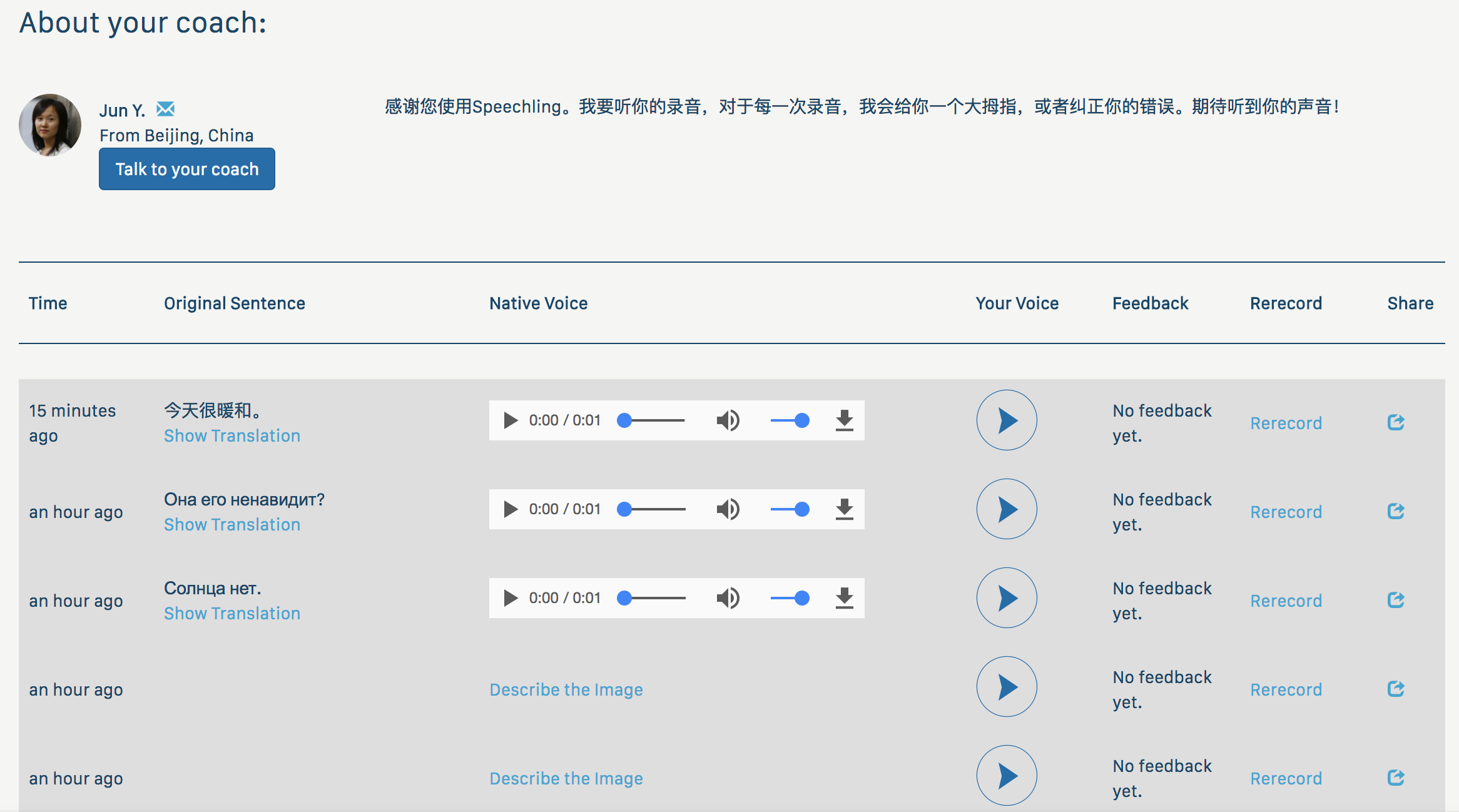
My Speechling Audio Diary
With Chinese, Speechling shows the sentences in Hanzi (Chinese characters). There is also the option of viewing the sentence in pinyin. Good job - it was the only way I could even start to guess at repeating the sounds I was hearing.
For a complete beginner like me, the sentences were interesting. I had to repeat the audio input 4-5 times before I dared to repeat the sounds. Surely, any Chinese speaker would be impressed?
Speaking Chinese to a Chinese Native After 5 Minutes
Well, I do know a Chinese speaker so I was ready to shine. Having newly acquired the sentence 今天很温暖 (“it’s warm today”), I asked my co-working buddy to listen to my Chinese and tell me if it’s correct. And he did understand what I was saying, although “impressed” would be stretching the truth a bit.
I also sent my recorded sentence to the Chinese coach, who drew my attention to the specific parts I got wrong.
Learning mass sentences as a complete beginner isn’t ideal. It leaves you without a sense of what each word means (which one out of jin tian hen nuan huo is “warm”, which one is “today”....and what do any of those symbols mean?). Learners don't get to understand what any of the rules of speaking are. But that’s okay, as Speechling not designed for that. This tool is a great confidence builder and accent sharpener. I could imagine it as a fantastic basis for tutoring, sending students away with homework on a topic.
Multilingual Usage

If you have studied more than one of Speechling’s range of languages, you can view translations in any of the six languages. This means you get to practice two languages at once, and it’s one of easiest ways to train your polyglot muscles.
Downsides of Speechling
On several occasions, my recordings were too long to be saved for feedback. This is understandable, but it was frustrating particularly in the freestyle mode. It’s disappointing when you say a complex sentence to send to your coach, and then get a message saying “file too large - cannot save”. It would be great if Speechling could include a guide on how long I can record for.
For languages where I knew nothing at all, I’d also like to see a primer module so I understand what I'm doing. But this is a tiny point, especially since Speechling is not aimed at complete beginners.
In Conclusion: Speechling is Great
All in all, I found Speechling a great addition to my studies. It was challenging and helped me improve my pronunciation and speaking skills in three languages. I was most excited about what Speechling could do for my Russian language skills. I improved both my vocabulary and accent, and the process was efficient and fast.
Speechling is free from robot voices and works with male and female voices (native speakers, of course). Its interface looks great and it gets you into the action immediately.
I love the record-feedback cycle, because it prompts you to re-record a better version of what you said. You get feedback, and you improve pronunciation, confidence, and speed.
The coaches were great for all the languages I tried. They recorded speedy corrections. At the very early levels, feedback is not rich, because they are native speakers and they use their native languages. But even so, it was clear where exactly I was supposed to change something. The more you learn, the more you will get out of these coaches.
If you work with a tutor that you don’t see every day, definitely try adding Speechling to your language routine. You will be speaking your target language more, you'll build a better accent. And best of all, pronouncing all the new words will help you remember them faster.
How to Get Started (+ Speechling Discount)
Create a free account and start speaking at Speechling.com, or by download the app from the App Store or Google Play Store.
Speechling is currently available in six languages: French, German, Spanish, English, Russian, and two types of Chinese.
It’s a freemium app, and you get 15-20 minutes of feedback for free every month. I would recommend checking out the paid plan (see below for 10% off) if you want to
- get a speaking boost, especially when there’s a deadline
- learn more than one language at once
- keep track of your progress with the audio journal.
The unlimited plan is open to Fluent readers at a 10% Lifetime discount: Make sure you use the code FLUENT when you sign up.
Good to know: Speechling is a non-profit company and also has a classroom version called Speechling for Education. I have an existing relationship with Speechling as they are a sponsor of my podcast. This only influenced the amount of attention the product received, not the verdict. It is a cool app.
Have You Tried Speechling?
Are you a pronunciation master now? How did you like the coach feedback? Leave a comment below and share your story.
***hello from the future!!***
Since my original review of Speechling in February 2018, these folks have been hard at work and have just emailed me to share the following new developments.
1. A new module called "Speechling Foundations", which will teach newbies from the very beginning. This start from zero module covers teaches the most essential words in context.
2. New listening options: Speechling now offers listening comprehension, multiple choice, fill in the blank, and flashcards. It's all available for free without login. All of this works on mobile too.
3. More language! They've more than tripled our content collection.
4. Offline mode!! Premium users can download a huge chunk of Speechling’s sentence collection (~10k sentences) and even audio books and Anki decks .
And added in March 2020
1. Speechling now includes Italian, Japanese, Korean, and Portuguese.
2. The recording time has been upgraded to 15s as Standard! It’s quadrupled to 30s for paid users.
3. There are now over 10k recordings (male + female combined) for each language, from words to complex sentences.
4. Speechling now includes word hints where you can mouse over words and get pronunciation tips and definitions.
I love it when an app listens to its users, this alone makes it worth checking out!
Robo-Tutors and Translating Megaphones: It's the Future of Language Learning
What does the future hold for language learners?
When a device translates what you say directly into another language, is there even a need to learn languages anymore?
In this podcast, we've got everything you need to know about
- Gadgets and stuff that translates our language into other languages
- How AI has made language learning apps a lot more useful
- Virtual Reality and Augmented Reality as learning aids
Welcome, weary language learner. Your brain might be tired after reviewing vocab lists for hours. Your voice is straining to pronounce strange foreign sounds. Your mind longs for a miracle.
Behold, we have uncovered the future of language learning. In today's podcast, it's all about technology, brain power, and everything that you need to know to stay ahead of the curve.
Listen in and don't forget to leave us a rating and a review on your iTunes-enabled futurephone.
The Future of Language Learning
When a device translates what you say directly into another language, is there even a need to learn languages anymore?
We discuss
- Gadgets and stuff that translates our language into other languages
- How AI has made language learning apps a lot more useful
- Virtual Reality and Augmented Reality as learning aids
Gadgets That Translate
Think the dream of the universal translator, like in Star Trek.
Some gadgets still look like very early things in the making (the megaphone and the pixel buds) - will they ever be able to get over the hurdles of being in the way of human interaction and spoken nuances?
Question for you, listener: Would you want Siri to dub all your movies? Would you want it to dub your world?
Virtual Reality and Augmented Reality
This is where it gets interesting!
Artificial Intelligence (AI):
Things like the new Glossika bring reactive learning to what used to be a book, adapt to how quickly you say you learn something. SRS is an old system that also aided our learning on paper, but assisted beautifully by technology
Our verdict on AI is that it's useful, here to stay, and more utility than fun.
Augmented Reality (AR):
AR can add interest and fun, can enhance your learning experience and do what we often dream of: make the language more RELEVANT
- You can have a lot of fun with the Flashsticks & Memrise apps
- Wearables are coming, though they’re not quite here yet.
- My paranoid self is worried that I’m 3 years away from having a chip implanted into my brain.
Virtual Reality (VR):
This is where you wear a headset (often a curiously named "Oculus Rift") that can give you immersive experiences in a digital world. Language company Mondly is working on a VR app for language learners. We weren't 100% convinced.
A few more points to think about..
Communities
How does the online world influence us when it comes to learning languages? Are people boasting on YouTube motivating, is online community a new type of community?
People have always met and connected based on their interests, but isolation has been reduced by the internet.
How will social media look in the future?
Many Questions Remain..
On the show we concluded by answering the most important one...will it ever be possible to learn a language in 3 weeks?
Are you a futurist? What do you think the future of language learning looks like? Give us a shout in the comments below and share your vision.

Language Learning Advice From a Polyglot Veteran (Bilingual Interview with Judith Meyer)
In this interview with passionate polyglot Judith Meyer, she shares how she learnt over 14 languages, how you can get over the intermediate plateau, and why learning any other language than English takes a little passion.
We talked about
- what excites Judith about leaving the textbook behind
- how to get over the intermediate plateau
- why using your language is the key to making progress
- what language learners can get out of events like the Polyglot Gathering
Oh...and we did it in two languages! Listen in to find out more.
Judith Meyer is well-known in the language learning world for co-founding the Polyglot Gathering event and writing several language books and courses. She's consulted by many and freely shares her own tips and experiences from learning over 14 languages.
Listen to my interview with her on the Creative Language Learning Podcast:

Happy places
We covered a lot of ground in this interview, and as a language learner you will be delighted to hear her excellent advice.
One Thing You Need to Know About This Episode
This is a bilingual podcast.
If you are not an experienced German learner, there will be some parts of the podcast that you don’t understand. But like all language learners, you’re not alone in that feeling. Try to stay with us, trust that we will come back to English again and again, and challenge yourself to become comfortable with not understanding everything.
German Learners: Click this link to view a full transcript (bilingual) of our conversation, so you can listen and read along at the same time.
The Learning is The Goal
Some people learn for practical reasons like travel or employment. to me is how both Judith and I come from monolingual households. There was no focus on languages, we both started at age 10, and yet this "late start" did not mean that it was impossible to do.
She says she used to try and invent her own writing system as a child because she found Chinese so fascinating.
Use Your Language Early
Judith says that it's important to do something that is NOT studying all the time. She says
I get easily demotivated if it's just studying a textbook
Judith books early lessons with tutors and uses her language in all kinds of ways so she can stay interested.
The Importance of Goals and Tracking
Even though Judith doesn't struggle with the general motivation to learn a language, she does keep track of her progress.
She's kept a spreadsheet on her computer for many years, and maintains a goal of doing a little more each year.
I absolutely agree with her on this, and found myself doing more with my language in the same amount of time when I started tracking. If you're interested in how learning languages works with my system, check out the Language Habit Toolkit.
How to Get Over an Intermediate Plateau

As someone who can hold a confident conversation in over five languages, Judith knows what it takes to go from a plateau to a much higher language level.
The trick is this: Your language level adapts to what you're doing in that language - in other words, you will grow with your challenges. You have to start trying to do something you cannot do.
The hard part is to start before you are ready. Judith describes how new Chinese challenges like presenting and debating tasks helped her get off the intermediate plateau.
But as Judith puts it:
If your lifestyle is such that you don't use C1 German, then good luck learning it.
You might get there for a short while, but to truly stay there you have to keep using your language.
Why Your Reason to Learn a Language Won't Be Enough
Finally, we chatted about the big reasons for learning languages. As a card-carrying member of "the tribe of those who learn a language because it's awesome", Judith has remarkable thoughts on why learning languages is important.
I don't need a reason to learn a language. I need an excuse.
By this she means that if you're looking for a reason, unless you're learning English there's often not a deep seated REASON that will keep you going for long enough to become fluent. Instead, make use of the good excuses out there, like learning for travel or for work.
But if you're just starting a language because you're fascinated, that is perfect.
After all, why would anyone learn so many languages if not for the love of them?
Understanding Germany
As the German part of a German-American couple, Judith knows that understanding other languages is a key part of learning other cultures.
She writes the blog "Understanding Germany", where she offers insights into what the Germans are like, how they think, and what's shaping the German mindset right now.
Click here to access all links and resources mentioned in this podcast
I look forward to hearing your feedback. Did you enjoy this bilingual podcast episode? Did you understand anything...and how did you feel if you did not?
9 of the Best Podcasts for Learning German
German is a great language for learning by podcast. There is a big selection, so I've gone and selected 9 of the best shows for you to discover.
In this article, you'll find
- German Podcast Courses from Deutsche Welle
- Podcasts in Slow German
- German Video Shows
- Story-Based and German Culture Podcasts
- A tip on how to find podcasts produced by native German speakers
What would you do if you could easily understand spoken German? Perhaps you'd finally travel to the places you've dreamed of, watch the original version of your favourite film, or try ordering that fabled Club Mate to go full on German hipster.
If you want to prepare yourself for real conversations with German natives, there's great value in developing those listening skills.

Why Practice German Listening Skills?
German is a language with consistent pronunciation and spelling, so you will find that the more you listen, the more you can work out. And for any level of language, podcasts have come onto the scene.
And what easier way to do this than with a German podcast.
Podcasts are a great way to add a little German listening practice into your day-to-day life. They are free, and can accompany any part of your day: driving a car, washing your dishes, doing laundry, working out, reading, and more.
Quick Primer: How Do Podcasts Work?
If you're curious about podcasts, but not quite sure how they work, here's what you need to know:
You can subscribe for free to podcasts on your phone, tablet, or computer.
If you use an iPhone or iPad, go to the Podcasts app. If you're on a Mac, use the iTunes directory.
On a PC or Android device, try the Pocketcasts app for a quick and easy start.
Subscribing means you'll always have the latest episode ready and waiting for you as soon as it's published.
German is a great language for learning by podcast. There is a big selection, so I've gone and selected 9 of the best shows for you to discover.
Listen To The Fluent Show
In addition to the German podcasts you'll find in this article, check out the my own podcast The Fluent Show where we share languages, learning methods, and how to live a multilingual life.
As a German learner, you will love this recent bilingual episode in German and English with polyglot Judith Meyer.
The 9 Best German Podcasts for Learners
In this article, you'll find
German Podcast Courses from Deutsche Welle
Podcasts in Slow German
German Video Shows
Story-Based and German Culture Podcasts
A tip on how to find podcasts produced by native German speakers
German Podcast Courses from Deutsche Welle

- Deutsch - Warum Nicht? (Deutsche Welle - A1-B1)
Deutsch - Warum Nicht? is a 4-part podcast series for complete beginners and early German learners. Parts 1 and 2 focus on the A1 and A2 (beginner) stages while Parts 3 and 4 focus on the B1 (intermediate) stages. It tells the story of Andreas Schäfer, a journalism student and hotel doorman. Each of the four series contains 26 lessons all with PDF dialogues, exercises, and downloadable audio clips. These series are for beginners, intermediate learners, and advanced learners.

- Deutsch - Wieso Nicht? (Deutsche Welle - B1)
Deutsch - Wieso Nicht? is the sequel to Deutsch - Warum Nicht. It focuses on intermediate level German (roughly B1). Everything is in German and like its predecessor, downloadable PDFs and audio files are available. The podcast focuses on topics related to daily life in Germany and Austria on fun and interesting topics and situations. It is very clear and easy to understand and follow. I wholeheartedly recommend it to intermediate German learners.
Podcasts in Slower German
These podcasts present slow or slightly simplified German language content, while keeping you attuned to real German voices. Make sure you keep yourself attuned to faster spoken German too, otherwise you might flounder in conversation.

News in Slow German is an intermediate level podcast. This podcast covers world news, grammar, and expressions and slows down all the dialogue to make it easier to process what you hear. Every episode breaks down a point on grammar and vocabulary.
The audio is very clear and easy to follow. On the website there are transcripts for each episode available with grammar, expressions, pronunciation, and quizzes.

Annik Rubens from Munich produces German learning podcasts for two levels:
- For absolute beginners, there is a podcast in English which introduces basic German words.
- For intermediate learners, she covers interesting aspects and stories about Germans, German culture, and German places.
The podcast offers a paid premium version with great extras such as slowed down lessons, PDF guides, grammar and vocabulary tutorials, fairy tales, and quizzes.
German Video Shows

- Learn German With Videos (Yabla)
Yabla is a video-based learning platform with bilingual subtitles and integrated dictionaries. The subtitles are interactive, which is a really cool concept! Check out how Yabla works in detail by reading my full review.
Yabla is great for all levels from basic to advanced. There is a free German podcast available with plenty of videos to watch.
Story-Based and German Culture Podcasts

This podcast comes on the back of the successful Authentic German Learning website and YouTube channel! It promises to be an exciting one, as the host, Marco Rösler, is an enthusiastic and energetic host with a zest for life. This podcast is focused on learning German through personal development and the TPRS (Teaching Proficiency through Reading and Storytelling) method. The concept invites you to read and listen to the dialogue at the same time.

The LingQ German podcast was recommended to me by German learner Alex Gentry as one of his favorites. Steve Kaufmann, the founder of LingQ, emphasises learning German through extensive listening to audio and reading of texts. This is called the comprehensible input method.
The LingQ podcast is excellent for beginner and intermediate learners. There is no English, the tone is relaxed and conversational, and steve gets right in there talking to German native speakers. All exercises are available to download via iTunes, and you can sign into LingQ to get the podcast notes, transcripts, and exercises.

Coffee Break German, a podcast from Radio Lingua Network, combines German language lessons with a lot of useful information about German food, culture, German-speaking countries, and so on.
My favorite part of the podcast is the chemistry between relaxed and charismatic host Mark from Scotland and native speaker Thomas from Bavaria. Cultural Correspondant Julia from Potsdam has great cultural advice, and Grammar Guru Kirsten from Scotland discusses grammar in a clear, easy to understand way.

GermanPod101 from InnovativeLanguage covers any level you can think of from basic to advanced German. With enticing titles and interesting themes for each episode, you'll never get bored.
The dialogues are presented by engaging presenters and the hosts Judith (a native speaker) and Chuck (a fluent speaker) cover both cultural and grammatical aspects clearly and concisely. On the website you can sign up for the premium content to access spaced repetition flashcards, PDF lesson notes, and a community forum for a subscription fee.
Advanced Learner Tip: Native German Podcasts
The German podcast world has come a long way in recent times, and these days you'll be able to find a big array of native level content to listen to when you want to get German language immersion. You can choose from a full catalogue of shows on topics from politics to film reviews. The easiest way to access native German language podcasts is to go to iTunes and switch your country setting to "Germany" or "Austria".

There's no restriction on your switch, and you'll be able to access all podcasts in the same way that listeners from Germany can. One of my favorites is Serienjunkies, covering TV reviews from Game of Thrones to new netflix arrival Dark.
Free German Guide for YOU
My mini-guide to speaking German is out now! It’s called Make Your German Sound Amazing and will give you the best tips and 26 key phrases to make you ready for any conversation. Get it today by subscribing to the Fluent Language Newsletter.
Your Intuition is Wrong about Learning Languages
Do you have a vague feeling that you're too old to learn a language?
Are you still looking for the best way to do this?
Or do you just....feel like you're never quite doing enough?
Then we have the show for you!! Hit play now and check out episode 69 of the Creative Language Learning Podcast
Do you have a vague feeling that you're too old to learn a language?
Are you still looking for the best way to do this?
Or do you just....feel like you're never quite doing enough?
Then we have the show for you!! Hit play now and check out episode 69 of the Creative Language Learning Podcast
(Beware listeners: This episode contains a discussion of a few English swearwords, so if you want to avoid them please skip the first 20 minutes.)
Here's wbat's on the show this week:

Language Stories: Lindsay has a new podcast, reporting back from her adventures around the language landscapes of cities like Montréal, New York, and more.
Even after 20 years of English, I still don't know all the words. We discuss an English slang word that was news to me.
The Psychology of Rewards
We discussed why and how you can reward yourself when you reach those study goals.
Here are a few ideas from the super cool Fluent Language Learners community on Facebook:
Treat Yourself as a Reward
- Enjoy a coffee and take some time out in a café, watch the people, and take in the atmosphere
- Read a good book...maybe in your target language, maybe a bilingual text
- Treat yourself to some new stationery
- Go out and explore where speakers of your language hang out, for example if your city has an area where you can find ethnic food and goods
- Go to a concert or have a kitchen dance party
Enjoy the Rewards of Successful Language Learning
- Enjoy the happy glow of passing a certificate or good grade (Carlos), or the good feeling of completing a project
- Allow yourself a moment to recognise how much you have achieved
Some group members said that they never feel like they reach their goals. If this is you, check out our podcast for tips and thoughts on how you can reframe rewards and make them work for you.
Language Learning Misconceptions
What are the most common misconceptions, and which one is your (and my) top one?
There is even a Wikipedia article about this.
Some of them are intuitive and easy to accept, and some of them are so widespread that they have even made it into marketing.
Here's the list we discussed on the show:
- Children learn their first language effortlessly
- Younger learners learn languages more easily than older learners
- Intelligent people are better at learning languages
- Immersion is the best way to learn a language
- Grammar study is detrimental to second-language acquisition
- Learning a second language hinders the development of the first language
- Once a child can speak a language, the language-learning process is complete
Consider: All these ideas and beliefs are widespread, but none of them are true when taken at face value!
Double-click to edit...



Struggling with listening? Discover realistic tips, challenge prompts, and the best tools for improving your listening skills as a self-guided language learner