

4 Techniques for Switching Your Brain into Language Mode
Have you ever heard of a phenomenon called "Priming"? Priming is what psychologists call it when your brain adapts to the environment around it without you realising. For example, you might automatically walk slower in a nursing home than you do in a gym. The brain helps your body to adjust, and this also affects your memory and even your confidence and the whole way you interpret situations.
How Priming Helps You Turn on Your Brain
Priming is largely unconscious, but now that you’re aware of it you can also use it to your advantage when learning languages. The idea is to switch your brain into “language mode” and use cues from your environment to help you get into the right zone.
Want to learn more about how to be a productive language learner?

©morethanmaths on Flickr
How Subtle Prompts Help You Stay in The “Language Learning Zone”
When I was a German tutor, I’d teach many people in their lunch hour. They would stay in the office at their English-speaking workplace, close the door and open up Skype to start chatting German with me.
In those situations, I’d commonly noticed that it took them a lot of time to warm up, relax, and start chatting away. Having thought about the learning environment and what it means for your performance, I came to the conclusion that these students need to make a brain switch from work mode to learning mode.
In this article on Wired, the author describes how a mere glance at the native speaker will prompt them to blurt out native words.
The different role you need to play as a language learner.
And there’s more at play than just the language you’re speaking.
Many people who work in management or office-based roles are in an environment that looks a bit like school, but demands a completely different behaviour. “Professionals” don't just go out and try things. They are expected to control their creativity and maintain a professional image at all times.
When you think about the good mindset for language learners, it's a contrast: You'll do well if you can combine curiosity, discipline and a complete disregard for embarrassment!
How to Start Switching Your Brain Into a Different Mode
Switching up a part of your environment can help you become a better learner, with simple prompts that take seconds to implement.
Try out some ideas that learners and teachers can use to make priming work in the right way:
1. Listen to Target Language Songs and Watch Movies
I will not promise you that watching an awful lot of films in a foreign language will magically beam fluency into your mind.
The real benefit of surrounding yourself with the target language is that you stay engaged with it and develop knowledge of the country. In terms of the priming benefit, it will work magic. Plus, you get to do it while putting your feet up or driving.
2. Find a Suitable Slot in Your Schedule
Schedule your learning sessions for the right times. For example, I like doing my chatting in Spanish on the drive back from Zumba - partly because the Spanish lady is captive in my car, partly because we've just spent an hour having fun and dancing around. Others also swear by having a nice glass of wine to relax or using breathing exercises.
Another great tip is to create a learning corner in your home - somewhere quiet, free from distractions and full of positive associations.

3. Visualise Your Life as a Successful Language Learner
School classroom teachers have known for a long time that putting up posters and displays around the classroom can get pupils in the right state of mind for learning. They don't have to be written in the foreign language, but just reminders of what's great about the country you're learning about.
Take a tip from this and create your own language learning displays full of things that interest you about your language. They could be recipes, tickets from old trips, tourist brochures or printouts from the internet. I particularly love vintage posters.
You can find more inspiration on my Pinterest boards for German, French and Russian.
4. Warm Up in Your Target Language
In my teaching role, I try to start my lessons off easily with some smaller warm-up activities like asking students how they are or offering them a drink.
Recently, I received the great tip that using the same warm-up activity every time for regular students is actually helpful - here I was worrying people would get bored, but the learner's perspective was that knowing "what's coming" allowed them to prepare and feel confident at the start of the lesson. That puts every learner in the right state of mind for success.
A Festive Take on Using Your Environment as a Study Aid
Click here for my article on learning a language at Christmas (even if you don’t celebrate it)
First published July 2013. Last updated December 2021.

9 Great Websites For German Beginners
Looking for inspiration and great courses to help you learn the German language? Here are 9 great websites that will help you learn German
Pop quiz - Which one of these is your favourite reason to learn German?

You fell in love with a German speaker
You fell in love with the atmosphere of a beer fest or a Christmas market
You have not yet tasted the greatest bread on this Earth, but you’d really like to, and you’ve heard the bakery only offers it to German speakers
Your company works with German clients and their English is so good it’s embarrassing all you know is jawohl ein Bier bitte
You want to visit Germany and get a taste of the wonderful nature, forests, skiing, castles, Roman history, medieval town centres, comfortable trains, inviting restaurants, fairy tale rivers
There are no wrong answers here. ALL of the above are fantastic reasons to get started learning the German language. I have been teaching and sharing German language and culture for five years, and today I’m sharing some of my favourite resources for beginners.
Make Your German Sound Amazing
My free mini-guide to speaking German is out now. It's called Make Your German Sound Amazing and will give you the best tips and 26 key phrases to make you ready for any conversation. Pop your details into the form below to join my email list and get the guide immediately!*
Check out 2 or 3 of these resources and make sure you bookmark them to visit again and again!
Great German Learning Websites
Beautiful German castles and Germany.travel
Sometimes it's necessary to check out of verb tables and remember why you chose to learn this language in the first place. What better way than to dream of hiking up beautiful hills and discovering romantic castles? Castles beat cases, after all.

Mein Weg nach Deutschland
This is a great project from the Goethe institute. Where would we be without them! Follow the story of Nevin, a newbie in Germany (who excitedly photographs pretty much anything on her mobile phone). The videos are available with and without subtitles and each episode has practice exercises too!
Deutsch Plus and Jojo sucht das Glück
There are some truly great telenovelas out there, designed especially for German learners. Lovers of retro Germany will like Deutsch Plus, the story of shy TV intern Nico from Romania - it's vintage 1996 work. Even better - it's suitable for starters from day 1. For improvers, Brazilian student Jojo will be a fun resource.
Listening: Radio D
Another suitable resource for beginners right from day 1 - Radio D is an audio course. Nice plot and a very well supported website with grammar hints and word lists make this resource a go-to page for German learners of any age.
Dictionary: LEO
No German learner can do without LEO - it must be one of the best online dictionaries around! Language searches available in both directions, 7 supported language pairs with German, audio pronunciation and a well-attended forum finding even the most obscure expressions make this a bookmark no-brainer.
TIP: Read more on how to use a dictionary like the most successful language learners
German Uncovered
Learn German the natural way without complex grammar explanations and boring lessons. This course is based on a story, so you’ll be reading and having fun as you progress to level A2 at high speed.
Speak German Like a Native
If you find spoken German hard to understand, you need this course. This is my 5* masterclass course for all levels. No other course digs into the sounds of the German language, giving you the confidence to even say Eichhörnchen and Wechselstrom like a native.
Got More To Add?
The German learning community out there is always growing, and I’d love to hear what you’ve uncovered online.
Leave a comment if you know where to go for grammar that makes sense, or the best Swiss expressions.

Before You Set Your 2019 Goals, Here's What You Can Do To Get Ready
Don’t leave good lessons on the table - listen to this podcast episode to learn about the most important language lessons from 2018 with special guest Shannon.
Plus: More resources you can try right now!
Happy New Year, hurrah, welcome to 2019!

I bet you've been itching for January to kick off so you can go full steam ahead in lots of new language projects! But before that, let's not forget the year that's just gone by.
That's right, there are some goodies and lessons in the old year that can make a huge difference in how successful you'll be in 2019.
We'll find them with an annual review! For this purpose, I hung out with my friend and 10-language polyglot Shannon Kennedy to talk through her experiences of language in 2018, and how to set the best possible goals so your year goes better than ever.
Hit play to listen to our podcast:
In our conversation, Shannon shared her stories of how 2018 went as a language study year.
A New Language Learning Routine
Shannon's language learning routine changed away from setting specific task goals like "learn 30 new words". It is now more free and focuses on time spent with the language, which allows space for inspiration and still means a lot of productivity.
Shannon also had to deal with big routine changes like the loss of her 2-hour commute which used to provide lots of focused language time. She quickly learnt how to make up for that loss and now pairs her activities with more intention, for example using household chores as a great opportunity to put on an audio course or a podcast.
The Value of Discipline Over Motivation
Shannon also talks about how motivation can be a bad friend for language learners. It's just not as reliable as you would want it to be. She discovered just how valuable discipline is instead, and the difference it can make when you make discipline a value in your study routine.
How To Set Great Language Learning Goals
Finally, we discussed the way Shannon sets herself goals and works with the structure of Vision Goals and Path Goals. She shares a few of her own Vision Goals and I promise you, they're among the best I have EVER heard from a language learner. These goals are your "why", your source of all the mental energy you may need to focus on your language and keep moving forward.
TIP: If you can anchor your goal in real life and make it about a real situation you'd like to experience, it will be a more powerful and helpful Vision Goal.
Here Are The Year Review Questions
You can use them to conduct your own review of 2018 and set goals for the next year.
- How would you sum up the year in your languages?
- What changed in your life and in your languages in 2018?
- What lessons do you think you learnt from the year 2018?
- What surprised you?
- What will you change going forward?
- Looking forward, what are your language learning goals for 2019?
Shannon's top 3 books of 2018
- Grit by Angela Duckworth
- The Organised Mind by Daniel J. Levitin
- Courses from the Assimil series
Shannon's top 3 apps of 2018
Shannon's top 3 courses
- The Add1 Challenge
- Yoyo Chinese
- 90 Day Korean
What Were Your Top Books, Apps, and Courses?
And do you set yourself regular vision goals?
Share them in the comments below!

What Is Fluency, What Is Mastery...And How Do You Get There?
This week on the Fluent Show, Lindsay and I went deep into what fluency is, adding in a few other words that often feel awkward to use. It's a great conversation, and will provide you with a new sense of clarity and inspiration, so you can confidently go out there and do what you need to do: learn languages and feel great about it!
If there is one question that haunts language learners, it must be this one:
"How many languages do you speak fluently?"
Often asked innocently by people who are interested, it can strike terror in your mind. Will they test you on your languages? Are you allowed to say you're fluent if you still make mistakes?

Oof! Those are heavy questions, and none of them are difficult to answer. Even for those of us who have studied for decades, the question of fluency still causes confusion.
This week on the Fluent Show, Lindsay and I went deep on those questions.
It's a great conversation, and will provide you with a new sense of clarity and inspiration, so you can confidently go out there and do what you need to do: learn languages and feel great about it!
Press play now, and don't forget to leave us a comment below to share what you thought of the show.
Podcast Notes
Our warm-up discussion revolved around the labels we see in our space, and whether they apply to you.
If You Travel And Work On A Laptop, Are You a Digital Nomad?
A digital nomad is a person who travels and works online, right? But for some reason, the term can feel icky to us. In this week's episode, we discussed how some words walk that line between being descriptive and defining.
When being a digital nomad (or "polyglot", y'know..?) becomes a label that you like to put on yourself, it's worth taking a second to consider who that YOU really is underneath. After all, at some point everyone might want to stop travelling and settle up with a nice cat, just two target languages instead of 12, and a garden and a veg patch. And that is super cool, because that's you.
If you thought that this discussion of who YOU are was deep, wait until you hear what we moved on to!
How Will You Get Fluent? How Can You Achieve Mastery?
I have received several messages from listeners recently, asking the Fluent Show to weigh in on how we can achieve goals such as fluency and mastery. And interestingly, each one of them asked another question:
"How do I know when I have achieved it?"
What Is Fluency In A Language?
Our first question came from Evan, and he wondered when one can consider oneself fluent in a language. In the question, Evan considered quite a range of definitions from "making no mistakes" to "dreaming in your target language".
Our discussion starts off with this fluency mindmap I drew:
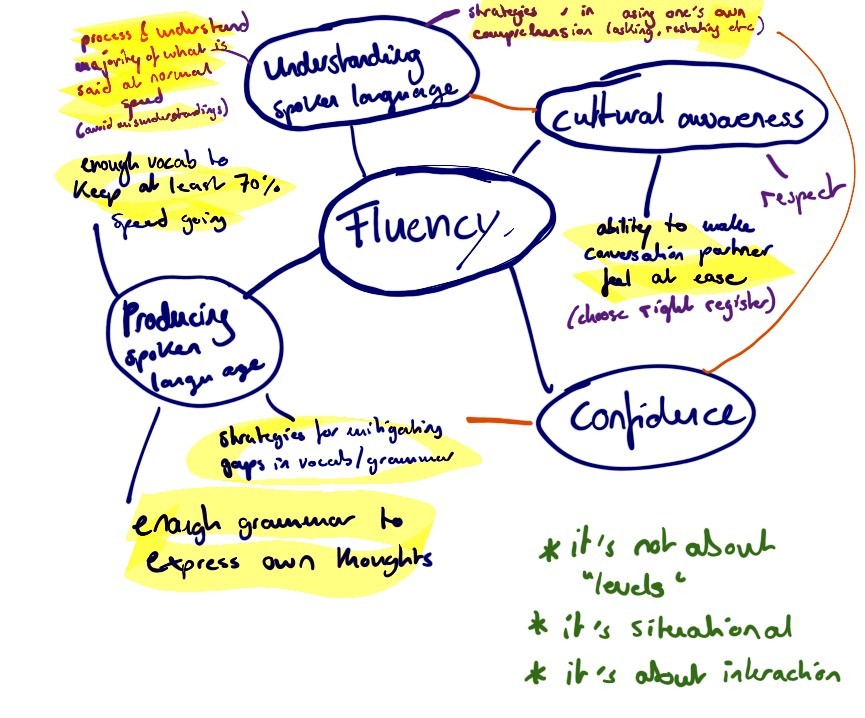
Bet you love my handwriting. Here's more about our take on fluency..
- "Fluency" implies speed and ease when using a language, which comes out most strongly when you're interacting with someone in person
- Usually interacting with someone in person means speaking
- The concept includes intercultural awareness that helps you put your conversation partner at ease and how to interact in a way that is appropriate for their style
- It implies confidence, meaning you have strategies to keep a conversation going
Fluency In A Language Is A Moving Target
Ultimately, your own definition of what fluency means to you is personal and unique. We believe that there are different points of fluency. These can relate to your goals and the purpose of your language learning. They can relate to what you are aiming for next, or what you're finding around you right now.
Just as life is forever changing, you may constantly evaluate your requirements for being "fluent".
What Is Mastery Of A Language?
Moving on from the fuzzy concept of fluency, we turned our minds to "Mastery" and how it is different from the former.
Madeline wrote in and asked:
What counts as mastery? Does every native speaker even possess it?
Our Thoughts on Mastery
This one was even trickier to nail down, believe it or not!
- Mastery is a point of pride and confidence for many, something we actively aim for and
- The word implies comfortable command, being able to use a skill (i.e. a language) with ease
- Mastery includes understanding beyond the literal meaning of the words in a target language
- But it can also imply superiority, like being the best out of everyone who uses that target language. Which isn't quite right in this context.
- For me, mastery is about more than just conversation and personal interaction. It encompasses the four core skills: listening, speaking, reading and writing
Our Conclusion
Both fluency and mastery are wonderful concepts to consider, but as Lindsay says, she is happy to not be fluent or masterful in every language. There is so much to discover and learn, and we can take a lot of joy out of appreciating the way that's ahead of us.
Yes, you can always get better. But there's no point in stressing about whether you are a fluent master - walk your own path, keep moving forward, and allow yourself to feel fluent on your own terms.

Welsh Is Not English: How The Welsh Language Fought Back
When I first moved to the UK 15 years ago, I thought Welsh was dying out.
But did you know that people went on protest marches and even got ARRESTED to keep this language alive?
In this podcast episode, I bring you interviews with Welsh learners and teachers, sharing their own passions for this ancient language.
What do you know about the Welsh language?
When I first moved to the UK 15 years ago, I thought Welsh was dying out. I moved to England and never considered that people in the UK speak more than English. To me, the Welsh language was a relic from the past.
But did you know that people went on protest marches and even got ARRESTED to keep this language alive?
In this podcast episode, I bring you interviews with Welsh learners and teachers, sharing their own passions for this ancient language.
Where is Wales?
Wales is one of the four nations that make up the United Kingdom. It's a small part of the UK, located on the western border of England.
It covers just over 8,000 square miles (20,722 km²) - that's about the same size as Massachusetts in the USA or half the size of Switzerland. In other words, Wales is not big.
But it's certainly old. The Welsh history begins with the Celts, and just like the bigger British island, it has a whole history of invasions and territorial fighting on its record. Here is a great timeline guiding you through the last few millennia of Welsh history.
What Is Welsh Like? A Quick Introduction
In terms of the language, Welsh is what was here first. The Celts spoke a dialect that would later evolve into Welsh, so this language is now considered a treasured part of Welsh identity.
Welsh is a Celtic language in the same family as Irish Gaelic, Scottish Gaelic, Cornish, and Manx. It's spoken in two dialects these days: Northern and Southern Welsh.
The Welsh alphabet is quite similar to the English one, with a few quirks:
- The vowels of Welsh are a, e, i, o, u, w, and y
- There are no letters j, k, q, v, w, x, and z
- There are extra consonants, namely ff, ll, rh, and ph
The Welsh letters also mutate when you start putting words together, which means that the first letter can change in all kinds of fun ways. Apart from that though, it's quite easy to pronounce because Welsh is phonetic, meaning what you see is what you get.
Find out more about how the language works and looks on Omniglot
But let's get back to our story.
How Welsh Came Under Attack
Welsh was spoken im Wales for thousands of years. But as the nation entered a turbulent period of history in the 19th century, the MPs and lawmakers in London started to wonder "why are these Welsh folks so much trouble?"
They decided that the existence of Welsh must have something to do with it, and introduced harsh measures to start eliminating Welsh from public and school life. On the podcast, you will hear from Morfydd who remembers her mother avoiding Welsh like the plague...for a pretty good reason!
Fighting For Welsh Language Rights

"I want to live in Welsh" - a campaign poster from the Welsh Language Society
So between the 1800s and the 1950s, the use of Welsh decreased and English became seen as the standard language for any part of the UK.
In the 1960s, the activist language group Cymdeithas Yr Iaith was founded. This group campaigned for many of the things that are now bilingual standards in Wales, such as road signs and official council letters, television, and customer service in Welsh.
Many members were arrested, asserting their willingness to go to court for language rights. And over time, this fight for language rights has led to significant changes in law and society. The Welsh language hasn't died out.
In the podcast, you'll hear from Steffan Webb who shares how Cymdeithas yr Iaith started and what they got up to. Until today, the Welsh Language Society remains an active protest movement and Steffan explained that they see a long way to go.

Bilingual Driving Directions
in Wales
What's Next For Welsh?
The Welsh government is a devolved government, meaning they have the power to determine some of what happens in their area. But officially, Wales is still a part of the United Kingdom and they don't get to determine which languages are spoken.
The Welsh language became an official language in Wales in 2011, with the government act stating:
This means it must be treated no less favourably than English.
Fighting For Welsh Language Rights
Welsh is now on Duolingo, and there is a hugely popular online course called Say Something in Welsh, focusing on enabling learners to speak everyday Welsh.
This means that there are independent Welsh learners everywhere in the world now, learning online just like me (read about my own langauge progress).
Do You Want To Give Welsh A Try?
Every Welsh learner becomes a part of this bigger story. If you're interested in trying the language for yourself, you can download my Welsh Starter Kit here and kick off with the resources that I used to start my own journey.
Before you listened to this podcast, what did you think about Wales? Did you already know this story of protesting in the streets for language rights?
Share your thoughts in the comments - I'm excited to hear from you.
And if you want to support the Fluent Show podcast, make sure you subscribe so you always get the latest episodes and share the story with a friend who loves languages too!



Struggling with listening? Discover realistic tips, challenge prompts, and the best tools for improving your listening skills as a self-guided language learner