
New Podcast: Chris Broholm on Challenges, Information Overload and Book Club (and the Owl!)
In Episode 12 of the Creative Language Learning Podcast, I interviewed a fellow podcaster! Chris Broholm is a language learner with a big mission: 10 Languages in 10 Years!
Listen to our interview to find out more about
Who everybody's favourite owl is!
How Chris built up his own support community of inspiring language learners through the Actual Fluency Podcast
Whether there is a best way to approach language learning methods
What to think about when you set yourself an ambitious goal like Chris Broholm's 10 Languages in 10 Years
The importance of bewaring information overload
The language learning method that you absolutely must try out
And why trying it out is all that we can tell you to do!
“As long as you’re doing something, you’re doing it right.”

And most importantly...
We talk about Language Book Club and how much we're looking forward to it!
Article of the Week
Duolingo is Getting More Serious by Kay Alexander on Fair Languages
Tips of the Week
Chris chose Tip 1 as his favourite, because goal setting is still WAY undervalued in learning a new language.
Tip 1: set your chosen Fluency level (travel fluent, job fluent?)
Tip 2: Be a historical linguist
Word origins and vocab divergence can help with remembering words
Look up "etymology"
Tip 3: Sprint with the Language Challenge
Tips and Links from this Podcast
Support the Creative Language Learning Podcast through Patreon - from just $1!
Actual Fluency Indiegogo Campaign
The italki New Year Challenge: Study 20 Lessons and Win
Actual Fluency Episode 32 with me talking about how to be an independent online teacher
Russian in 10 Minutes a Day by Kristine Kershul
Thanks for reading this article on Fluent, the Language Learning Blog. If you are feeling stuck right now, why not subscribe to Fluent and check out our language book shop.
New Podcast: Putting the World to Rights with Olly Richards
“I never woke up and decided that I want to be a polyglot.”
You wanna learn a language? Then I've got the guy for you! In today's podcast episode, I'm speaking with Olly Richards, the man behind I Will Teach You a Language. Olly is an expat Brit with a lot of travel experience under his belt, and his considered and smart answers really put me to shame.
You Will Learn More About:

- Our Dreams of how Education can Make the Language Learning World so much Better
- Why "Speaking" Can Become a Huge Obsession and Actually Damage your Motivation
- What to Look Out for When Taking a Teaching Qualification
- The Problem with the WHOLE Education System
- How to Make Motivation Work
- What Beginners should Read - and why reading Children's Books is not a good idea
- Why Olly Advises that you DON'T Track Your Progress
Articles of the Week
Most Language Students unable to do more than understand Basic Phrases on the UK Guardian
The Best Way to Learn a Language is the Opposite of the Usual Way on Forbes
Tips of the Week
Out of the following fabulous three tips, Olly chose number 2 as his favourite tip - not without a lot of careful consideration though!
1) Use online self-tests as check-ins, not tutorials
2) "Makers Classroom", like at Raw Learning - follow foreign recipes, sewing patterns, directions?
3) Join Parleremo, a virtual town that teaches languages
Tips and Links from this Podcast
What is Content and Language Integrated Learning? (CLIL)
The 60 Second Fluency Test by Olly Richards
My Article that Sparked some Polyglot Debate
Der Weg zum Lesen, simple German short stories
Le Petit Nicolas et Les Copains, fun story in simple French
French Comic Books for Language Learners
Thanks for reading this article on Fluent, the Language Learning Blog. Please head over to Patreon and become a supporter!
Do your Mistakes Matter in Language Learning? A "Written Homework" Perspective
You know, language learners, how we bloggers always bang on about “things don’t have to be perfect” and “start speaking even if you will make mistakes”? You’ve heard all this, right? You’ve heard it and nodded and seen how it makes sense. You believe that you will be able to get over yourself.
But here’s the thing:
When it comes to really putting your skills on the line and “showing your workings” to another person, are you still holding back?

Take this example from one of my German students. We had spent a little time reading a news article and discussing the themes in it. In terms of core skills, this guy is a red hot reader! He is not only happy and confident about picking up any book from Harry Potter to Dune in German, but will also approach it with the positive mindset of someone who enjoys understanding every single word. We’ve also worked so much on speaking skills over the year and made excellent progress. But there’s one thing on my list, one left to cover: The Writing skill needs a push.
Why Do I Prompt My Students to Write?
You can tell me that pushing ahead on writing skill is just not what an adult learner needs in 2014, but I’d just direct you to what I wrote in Fluency Made Achievable: There are four key components to building up expertise and confidence in the language you’re trying to acquire: listening, reading, speaking and writing. You can't skip out on one of those four without feeling the consequences at some point. Even if you are not planning to enter into a German story competition any time soon, pushing your writing skill has a million advantages for your language learning journey. For example, your composition and structuring skills transfer straight to the spoken word. An experienced writer doesn’t need language exchanges, their confidence will come naturally when they open their mouth. For introverted learners, getting into writing also has huge advantages since you’ll become comfortable AND GOOD at using your target language correctly, before ever entering that “risk period” where someone else sees you. And believe it or not, being a great speller means being a great reader and speaker of your target language.
To speak a language well, it helps to understand how spelling and pronunciation work together. (Tweet this here)
If a tree falls in the forest…
Writing can be very introverted, it’s an exercise you do at home, typing away on your computer or scribbling into a notebook. No one else needs to see what you write. And there's why this is so difficult: Because your writing isn't for others to see, it becomes pretty easy to just not do it. What you need is accountability.
You know what it’s like with New Year’s resolutions: No one will ever know you’re doing it unless you actually tell them. Your foreign language writing is the same thing. If you don’t find someone that actually expects you to write, it becomes too easy to avoid doing this work altogether. You start realizing that mistakes are really, really visible when you write. On the one hand, language learners subscribe to the philosophy that making mistakes is part of learning. But on the other hand, showing those mistakes to people as a “written fact” is the hardest thing in the world.
Which leads me back to my wonderful student. I set him an exercise two weeks ago: Summarize each paragraph of our text in simple words, just one sentence picking up the key points. Yesterday I got an email saying:
I must admit that I am just not getting it done right now. I have tried to work on it a couple of times this week, but have only a few sentences to show for it. I feel like I’m still learning, but just not making progress on this part.
Those are the words of somebody who’s judging himself pretty harshly. My reaction? “A few sentences? That’s AWESOME!! All credit to you for trying, and we totally have something to work with now for the lesson.” Do I care if he’s sending me a perfect summary of the text? No! Do I treat this like a school exam, grading him on a scale of A to F for “failure”? No! From the point of view of your language tutor, let me tell you that all I want you to do is try your best. Or even your semi-best. Just sit down and do the thing, open up, be vulnerable and let’s work on this together.
No matter if you do work with a tutor or not, here are a few tips on embracing mistakes in your writing:
- Stop apologising to anyone about how “little” work you do, and start embracing that any exercise done means you become vulnerable. Most likely you're not perfect. You will spell things wrong and (if I'm your teacher) I will still LOVE it, because that's how I can know which bits you spell wrong. We tutors are largely a kind bunch. We appreciate the fact that you have made a commitment to study a foreign language.
- Converseley, if you ever hear a person in a "teaching position" tell you that you're never going to get it, consider FIRING THEM.
- Go somewhere specific to do your writing: not in the office, not at the computer, not where you usually type all your Facebook posts. Here are a few more tips on why that is going to help.
- Work with word order formulas. Here are a few German ones you can use, but if you are studying other languages please ensure that the word order you’re working with is actually correct:
1) Subject + verb + object
2) time + verb + subject + object
3) Subject + verb to say "says" or "expresses", subject + verb (indirect speech) + object
- Use a little bit of lesson time or email time to type in your foreign language. This can be done right from day 1, and it's one of the easiest way to bridge the gap when you don't have a native speaker to practice with.
The Language Writing Challenge
In conclusion, writing is difficult. It may well be the core skill that takes the most time, makes your mistakes super visible and has the most potential to embarrass you. And now we've put that out into the open, it's time to get over it! Try one of the steps above, or even start by copying textbook language into your notebook, but it's a fact of language learning that writing will always be there. It's part of a healthy language habit!
I've tried my best to address all of the reasons why you would avoid writing in your language practice above. Got any others? Write me a comment and see if you can change my mind!
Thanks for reading this article on Fluent, the Language Learning Blog. If you are feeling stuck right now, why not subscribe to Fluent and check out our language book shop.
New Podcast! The Full Online Learning Guide with Breanne Dyck

Welcome to episode 10, a little milestone for the Creative Language Learning Podcast! Thank you guys so much for tuning in, sharing the podcast and responding to it so often.
Do you have any dream guests you'd like to hear from? Special topics, questions or discussions? Leave them in the comments below.
This time, I am talking to an expert in the area of course design and online education. Breanne Dyck knows how to make people learn, she's got lots of information about neuroscience and learnt quite a few languages herself.
“It’s not abstract motivation that keeps us going. It’s all about checking in along the way.”
In this Interview you'll be finding out about
- Why languages are the daddy of self-teaching
- The big mistake all self-learners tend to make
- Where the MOOC concept comes from
- What you should consider before you start even looking for an online course
- The difference between a MOOC, an online course and Duolingo
How to avoid wasting money on unsuitable courses
- What motivation is really about
Click here to Listen on Stitcher and Here to Listen in itunes
Article of the Week
What is a foreign language worth?
Tips of the Week
Out of the following fabulous three tips, Breanne chose number 1 as her Tip of the Week! Keep immersing yourself in the target language through Facebook and practice switching from and to the target language without translating everything in your head.
1) Language Immersion by Facebook on Language Surfer
2) Beat the Leaderboard on Memrise like Leszek Trybala
3) Translate to Beat the Plateau, a tip from Dr Rebecca Braun at the Guardian Live Q&A
Tips and Links from this Podcast
Breanne is holding three major webinars, the Elevate series from 3-6 December 2014. If you're curious about making your own online course, this is THE place to be.
Google, in case you have not heard of it
Rozuku, an easy course creation website
Udemy, an online course marketplace with reviews and thousands of courses
French Grammar for Beginners, my awesome online French course for grammar reference and simple explanations
Lynda.com, online course marketplace
Breanne Dyck's Blog at MNIB, about the science of learning and teaching online
Reddit, where you can find communities about anything and any language
New Podcast: Episode 8 -- Lindsay and Kerstin Do Languages
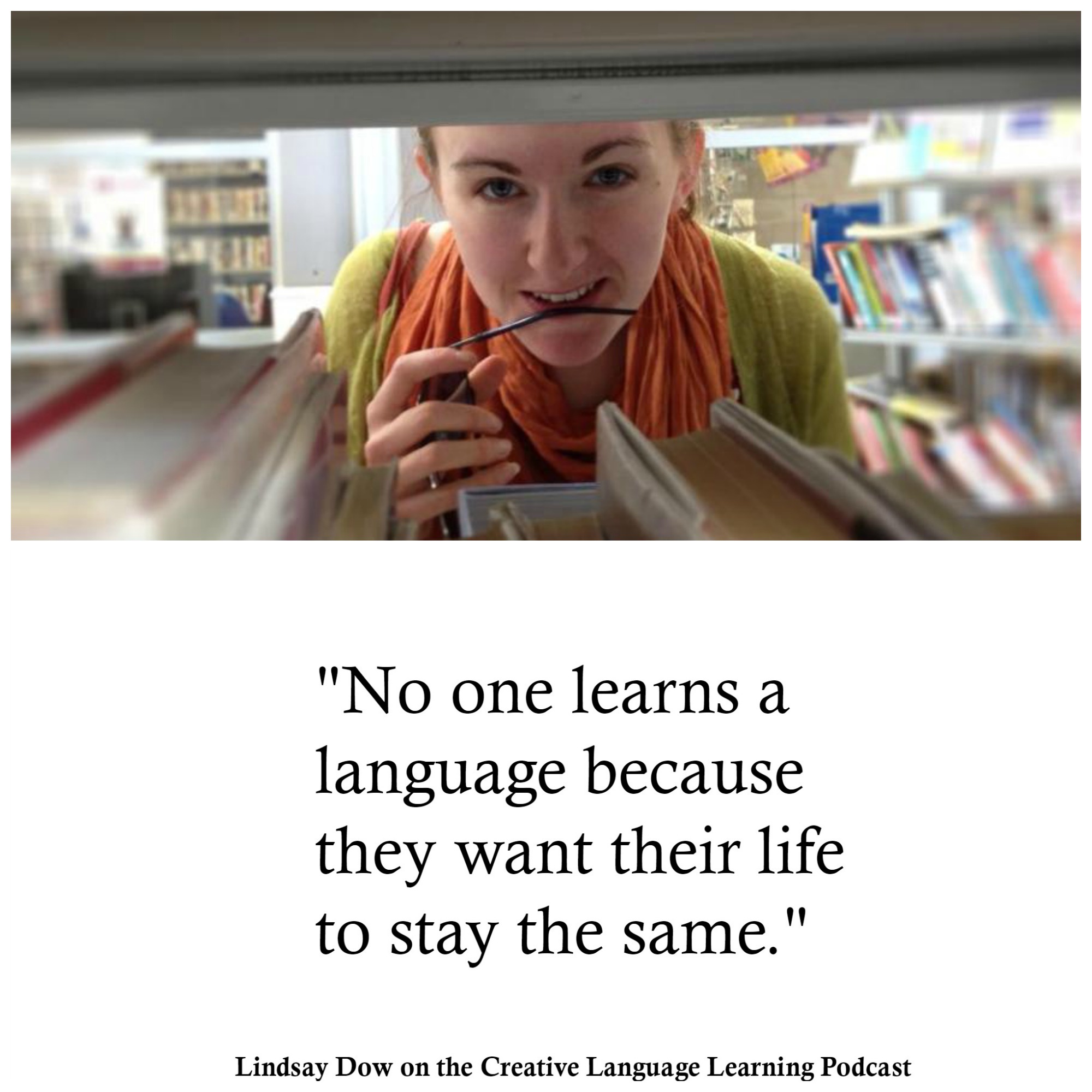
In Episode 8, my guest is Lindsay Dow, a really enthusiastic and cool independent language teacher from the UK. Lindsay is well-known for her great Youtube videos about all aspects of language learning, and she was also a winner in the Sensational Fluent Giveaway.
“No one learns a language because they want their life to stay the same.”
The show doesn't follow the usual interview format, instead Lindsay came on as a co-host and talked about her favourite blogs and articles, as well as her own story of language learning. She also helped me select the Tip of the Week.
Some of the highlights:
- How music and lyrics from Sheffield can teach you great English
- Which Asian language was a total eye-opener for Lindsay
- Why travelling is the greatest motivation for language learning
- How to stop getting bored by the language you’re learning (hint: Celebrity crushes help!)
- Our exclusive permission to you: Learn AS MANY LANGUAGES AS YOU LIKE
Language Learning Tip of The Week
Set yourself some goals and challenges, write them down and try your best to achieve them. For example, making a language video, writing a blog article in another language or reviewing 50 items on Memrise could be a goal.
It's important to make sure that you do go easy on yourself if you don't hit the goal. It doesn't make you a failure, so make sure you know how to do better next time and move on!
Our Tool and Blog Recommendations for the Week
- Wordreference and Linguee, two great online dictionaries
- Language Surfer
- Koko the Polyglot
- A Frog's Life - un blog BD français
- Omniglot
- Oh My God My Wife is German
- Itchyfeet
Language Book Recommendations
- The Meaning of Tingo: and Other Extraordinary Words from Around the World
- Through the Language Glass by Guy Deutscher
And Here are the Other Sites and Tools we Mentioned
- Feedly and Bloglovin for following all the blogs your heart desires
- The Sapir-Whorf Hypothesis
- The Next Tango in Paris by Ta-Nehisi Coates on the Atlantic
- 12 Mind Blowing Number Systems from Other Languages
As always, you can check out the podcast on Stitcher, or head over to itunes.



Struggling with listening? Discover realistic tips, challenge prompts, and the best tools for improving your listening skills as a self-guided language learner