
Language Practice: Why You Don't Need A Native Speaker

The native speaker is often considered an absolute holy grail of language learning: They naturally know how language is used, they speak it perfectly and of course you will be immersed in your target language if you speak to one. But today, I'm writing to make you re-think your dependence!
Have you ever found one of the following problems when practicing with a native speaker:
- It's difficult to understand regional accents
- You ask them a question, and they respond with "it just is like this"
- They always want to practice your language with you
- You run out of topics after a few hours of discussing family, hobbies and weather
What if you have NO native speaker to talk to? Does that mean you will stop learning a language?
Why You Do Not Need A Native Speaker For Practice
In this blog, I'm not advocating that you avoid native level input and natural sources of your target language. They are what makes it come alive! By all means, make full use of Italki, social media and your own network to find a good language buddy, but please note the following:
You don't actually need a native speaker to practice with. This is so important to understand. You just need someone who's good enough or a little better than you. Sometimes it even helps not to have the native speaker, because a non-native speaker has learnt your target language too and can explain grammar and other problems more easily. Natives often don't even know which bits are hard for non-native speakers.
Why Practicing Online Isn't For Everyone
In addition to this point, some people just don't connect so well with the Skype or phone communication method. As an online language tutor, I work on Skype all the time, and it's a different to meeting in person - some of my students love it, some find it odd at the start. For some, I can just tell that it's not the right medium. So if you're In fact, the teenager who will practice his school French with you might actually be a better option than the French native speaker that you meet online.
Moral of the story: Make your own rules for what works for you.
What To Do About It
My advice would be to try a tutor, and that's just because:
- They work hard to make sure you understand, by reducing their own dialects and breaking sentences down to where you need them
- They will stick with you when you run out of the first 3 conversation topics with a language partner and research topics you need to talk about
- They won't expect you to spend any time teaching them your own language
Personally I learnt English before the internet was everywhere and still got from "pretty good" to "pretty fluent", through being taught by German natives and spending a lot of spare time listening to Pulp all the time and talking to myself. But I cannot imagine having done it without teachers. When your target language is German,
I think it's even more important that you find native speakers who understand your needs. German is that much easier to learn when you can make sense of the rules - and our spoken language is different from the grammar books. Trust yourself most of all, but if you have no native speaker around you please remember: It's not going to stop you.
How To Bring In Native-Like Practice
Of course, working without a native person to learn a language does not mean it would be wise to cut out all native-language content. When learning a language, it's important to know how it's spoken and to get a sense of the place where it's spoken.
You want to hear the sounds, the idioms, you want to know that there is a point to what you're doing here. In all learning, it's boring when it's just theory.
To get native-level practice into your studies before you go hunting for speakers all over town, try bringing in audio resources or even TV. It's easy to watch television in other languages or use cool software like Yabla.
And if you have regular access to native speakers, don't avoid them. Go out of your way to say even small things like good morning, and ask them "How do I say this in your language?" You'll soon find that every one of them is a small ambassador for their own language, just like you are for your own. And what's better than sharing?
How Soon Do You Work With Native Speakers?
Has it ever held you back that you can't find the native speaker? Or has shyness stopped you from talking to natives?
Leave your comment below to tell me more!
Do You Need a Native Speaker To Practice a Language? (Podcast Episode 48)
Hello and welcome to Episode 48 of the Creative Language Learning Podcast!
We started off our episode with some insights into what's going on with our language learning - in a new format! It's called the good, the bad and the struggling. Listen in and tell us what you think!
What's your Good, Bad and Struggling?
We'd love to hear from you guys on this one. If you want to share what's good, bad and difficult in your languages right now, send your feedback to us. We read every one and your language news could make it to a show intro in the future.
Simply do one of the following:
- go on Skype and leave a voice message for fluentlanguage
- email us at podcast@fluentlanguage.co.uk - include a voice memo from your phone if you can, so we can feature your voice on the show
Topic: You Do Not Need a Native Speaker For Practice
This one had a controversial statement at the heart of it, and Lindsay and I debated the merits of hunting, finding, selecting, working with and learning with native speakers.
So, do you need a native speaker to learn a language?
Or can you learn a language just as well if you don't have a native speaker to practice with?
One of us argued that native speakers are almost "fetishized" in the world of language learning -- listen in to find out which one and see where our debate ended up.
Some Of The Arguments We Made
1. A Tutor Can Be Better
Tutors tend to know what learning is like, and they see people learn all the time. They know the grammar structures, the vocabulary you're looking for, and they're ready to help you out and set you up for success. So for a language beginner, working with the tutor could be way more successful than working with any native speaker.
The native language of your tutor doesn't matter - it's all about what they can teach you, and that their personality allows you to blossom.
2. Don't Procrastinate Through Searching
If you're always looking for a native tutor to practice with, could it be that you'd hold back when practicing with non-natives? Before you start setting irrelevant standards in your language learning, it may be time to consider what is most relevant.
Waiting to find the perfect native speaker to practice with can become its own form of procrastination.
3. Find The Native At The Perfect Time
When you're feeling shaky about your speaking speed, accuracy and fluency, the native conversation can become a struggle. There's no point in getting yourself frustrated. Instead, consider working towards that natural conversation and a feeling of it being "effortless" - the native speaker can become a goal you set yourself, not something you put in your way as a hurdle.
4. It's Too Vague To Have A Vague Goal
A "15 minute conversation with a native speaker" is a goal that you may find inspiring, but it's a tough one to put into reality. Try and go about this goal more specifically by putting in milestones, things that will happen on the way to that conversation, and will pull it into sharper focus.
I can't count the amount of times I've found an advanced speaker of my target language, and then we ran out of things to say within a few hours. You need to find someone who wants to help you on the path, but also someone you have a rapport with. And once you've got that covered, it's a milestone.
Links and Further Reading
- Episode 22 of the Podcast: Tutor Hunting Tips
- 9 Questions To Discuss With Your Language Tutor
- Language Practice: Why You Don't Need A Native Speaker
- The book Becoming Fluent
Five Tips For Beating Embarrassment When Speaking Another Language

We've all been there: You're up for half an hour of speaking practice in your target language, and right after you say hello, you notice the first mistake tumble out. Not good. Now they think you're an idiot, and you've forgotten the word for "bread" and while you're racking your brain that pause becomes longer and your cheeks are glowing red. Time for the ground to open up!
If all that sounds familiar to you, you are not alone. Millions of language learners experience embarrassment when it comes to speaking practice. Especially when you're trying out your language in another country, it's almost impossible to feel prepared.
My personal threshold for embarrassment seems to be pretty high in most social situations, I have also experienced that crippling sense of looking truly foolish.
I won't get into that one time on a Russian airplane where the air hostess shouted incomprehensible things at me, I smiled throughout with lots of "da, da"...and later found out that they had been debating whether I could safely fly considering they thought I was pregnant. The shame!
But fear not, I've got some good advice to share with you today.
If you're ready to start saying no to embarrassment when speaking another language, here are four tips to help you feel better:
1) Prepare Your Speaking Partner
Chances are you are already pushing the boundaries of your comfort zone by speaking in another language. There is no need to add further discomfort to your challenge by talking to someone who is unlikely to support you. Strangers at the ticket counter, crazy air hostesses and even strict teachers are not the right people to choose for conversation practice when you are suffering from social anxiety or embarrassment.
Instead, try and hold on to what makes you feel comfortable right now. It helps to share your worries with your speaking partner before you start having to speak your target language. If it's a tutor, this will prompt them to be more patient and hold back on the corrections. If it's a friend, it can remind them to slow down and let you build your sentences slowly.
This technique of preparing your partner will help both of you feel more at ease, and ready to tackle this challenge together.
2) Focus On Your Breath
When anxious sensations take hold, your body responds by tensing up, raising your heartbeat and even causing you to sweat and blush. That's the last thing you need when you are already worried about the many ways in which you're about to lose face.
Instead of freaking out about all the words you remember or forget, the best course of action is a simple calming exercise.
Focus on something that is real and constant, for example your own breath. Breathe in slowly for 4 seconds, retain your breath for 2 seconds if you can, and enjoy a long and restorative out breath for 8 seconds. Breathing exercises may not feel like the right tool for a foreign language panic, but you'll be surprised at how much language skill returns once that mental stormcloud is allowed to pass.
For more tips and techniques that help with overcoming stress and anxiety, try the SAM app on your smartphone. It's a little toolkit of instant self-help.
3) Build Up Your Filler Vocabulary
Filler sentences are a wonderful tool when you are getting ready for speaking practice. They're usually uncomplicated, short, easy to remember and very effective. Think of filler sentences as the extra cushioning that is built into conversations so each speaker gets some time to relax. In English, these are lines like "hold on", "let me think for a second" or "let me think".
As a little treat for the German learners among you, I've collected a bunch of fillers and stock sentences in the "Make Your German Sound Amazing" booklet, which you can download for free.
But what should you do if you haven't understood half of what your speaking partner just said?
You can buy yourself a little time by repeating the last words of their sentence, stretched out with some "Hm" sounds. This may tide you over until you can remember how to proceed, for example by asking them to repeat what they just said. It's perfectly acceptable for you to control some aspects of the conversation even if you don't know your target language very well yet.
4) Practice
Even if you follow every single one of the tips above, that feeling of embarrassment is unlikely to just dissolve into thin air. You may still feel discomfort in new situations, and it's still embarrassing to make mistakes. There's no way around this one: At some point, your only way is forward and right through the bad feelings.
Luckily, there is plenty of reward waiting for you on the other side, as you realize that your mistakes and awkward pauses did not cause the ground to open up and swallow you whole.
If you want to push your boundaries and go for speaking practice in a brand new situation, why not take advantage of your next trip abroad? We've got plenty of travel language tips on Episode 41 of the podcast.
Even better, put yourself into an immersion experience with other learners, for example in the Fluent German Retreat led by yours truly. These retreats aim to create a speaking environment that pushes your boundaries without embarrassment, helping you to realize how good you actually are.
It's Not Easy, But It's Worth It
These tips are just a few examples of the many small steps you can take to keep yourself from suffering crippling embarrassment in speaking practice. Keep yourself reminded that this is not easy, and the fact that you are even trying is a testament to your bravery.
And I promise you: The rewards of speaking a foreign language are just as great as you've imagined.
Have You Dealt With Embarrassment and Anxiety About Speaking?
If you've got a story you would like to share, go ahead and share it in the comments section for this post. I'd love to hear your own tips and experiences.

Lindsay Dow's "Successful Self-Study" Course - A Full Review

Hi everyone, and strap yourselves in for today's review post all about a new course released by Lindsay from Lindsay does Languages. The course is called Successful Self Study, and it's all about every single step you need to follow for teaching yourself a language.
If you're a solo language learner hoping to meet an ambitious goal this year, read on to discover how Successful Self Study makes language learning easier.
Is This Instructor Worth Your Time?
You'll already know that Lindsay is my co-host on the Creative Language Learning Podcast. Lindsay is British, but she's one of the language-craziest people I know. She has studied over 8 foreign languages,.
Last year, she completed a self-directed university degree at the Open University. This means the end of 6 years doing a distance-learning course - the pinnacle of self study! And at the end of those 6 years, Lindsay has mastered a skill that so many of us struggle with: how to focus on your language studies and make real progress.
So before I go any further, let's go full disclosure: I have a lot of time for this person, and I believe she's totally trustworthy when it comes to language learning.
Lindsay has created the new course Successful Self Study, and allowed me a Sneak Preview so I can review it for you today.
The TL;DR Version: 7 Things You Need to Know
This course is perfect if you're trying to learn a language by yourself and you struggle with
- Having no time to study
- Getting distracted all the time
- Loneliness
- Lacking the commitment to your studies
- Feeling like you're stuck
- Over-researching and reading too many "guides to language mastery"
- It's great value when you add up 60 items, consisting of videos + guides + the most incredible workbook I've ever seen + a private online community + downloadable bonuses
- The thing is this: If you're learning a language by yourself, this is going to save you so much money and time in the long run that it would be ridiculous to mess around on Facebook's "Polyglot Procrastination" forums any longer
- I liked the course structure and found that the approach throughout is totally about the practice - this is designed to make you do stuff!
- It contains 3 amazing webinars, including my excellent goal-setting class with Lindsay that we held right at the start of the new year
- That workbook really is the BEST language learning book I've ever seen, and I wish I could go into a book shop and buy a printed version. Do yourself a favour and download it today
- Overall rating: 4.5/5
If you're ready to find out more and see the full curriculum, head over to Lindsay's site and watch the first video.
If you want to know more about what's inside Successful Self Study, let's have a look together.
The Look and Experience
This course is a combination of videos, workbooks, audio, and some extra downloads. It's hosted on the Teachable platform, which I can only applaud as this is what I chose as your best experience for the Fluent courses, too. The video selection is 50% Lindsay's friendly vlogging style and 50% screencast videos which demonstrate how different apps work.
The audio sections are going to be downloadable so you can listen and learn on the go (I haven't heard these yet, but they are announced for the release date.)
What's Inside The Course?
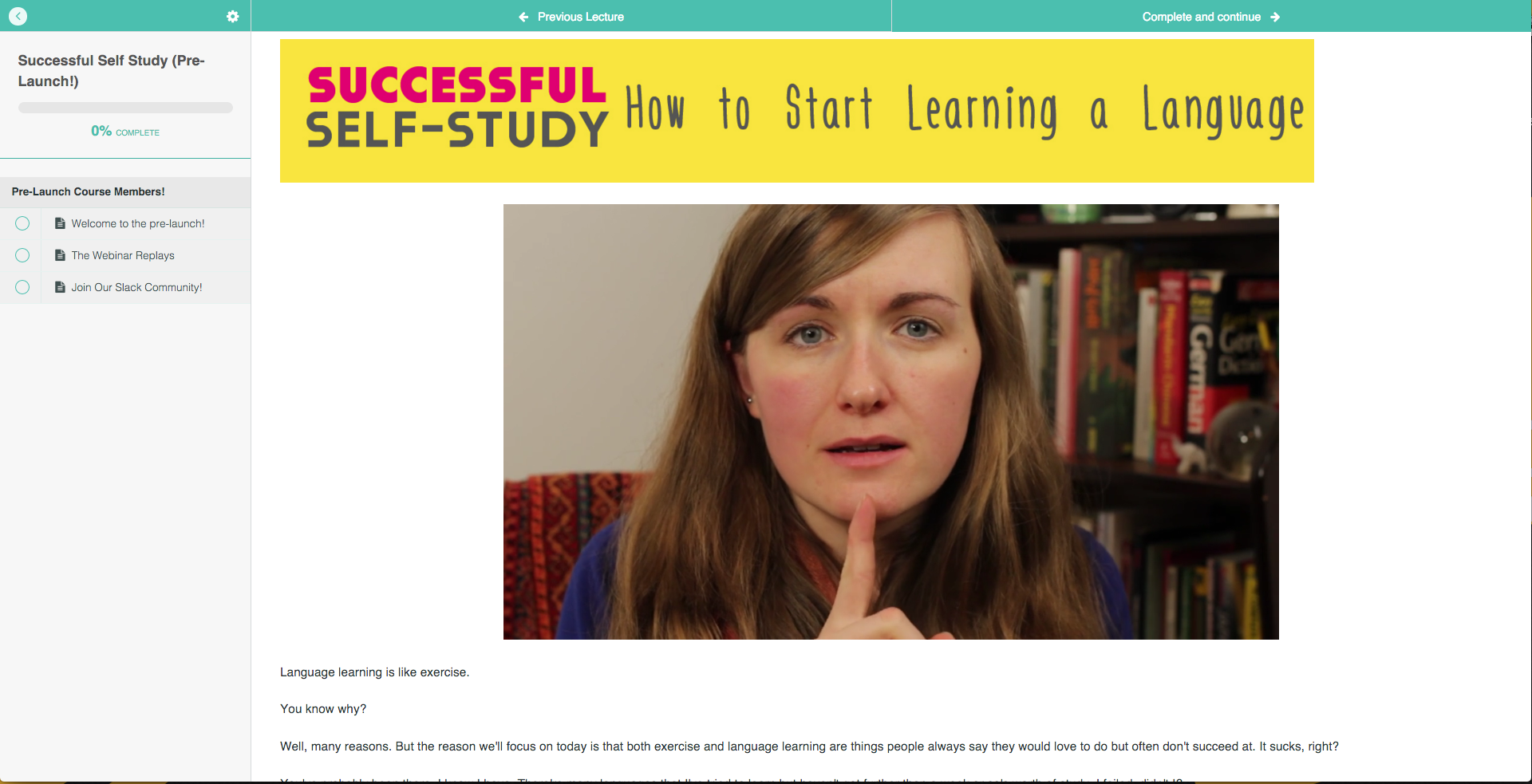
This course is divided into three main section, prefaced by a cute little introduction featuring Lindsay's own story as your instructor.
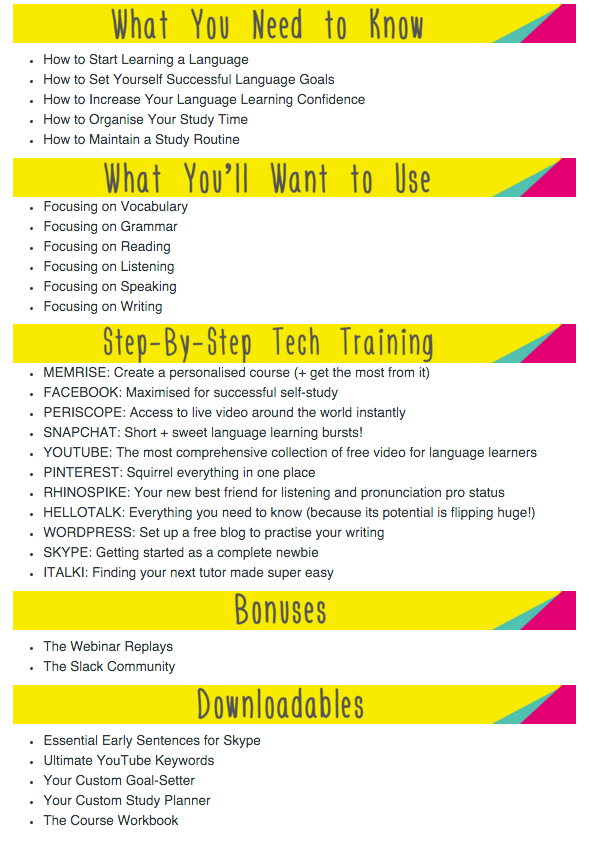
Section 1: Study Skills
The first section of the course is a short tour of the best practice in studying a foreign language by yourself.
The topic breaks down into aspects like motivation, productivity and how to build a language learning habit for the long haul. This section is what you think you already know, until you find yourself googling "how to speak a language tips" because you actually don't. Nice and useful to have it all in one place, and Lindsay definitely speaks from experience.
There's a definite focus on developing a routine, and it's just perfect for you if you're someone who needs to make every minute count. She's thought of every possible question: motivation, time management, confidence, productivity. It's like a secret library of self study shortcuts.
The course section can be kind of intense if you apply it all in one go, so remember that you have lifetime access and take it step by step. But you know...if we all wanted an easy hobby, we'd be Netflixing and not learning languages.
Section 2: Language Skills
Okay, this is a strange one for me but I bet you're going to like it lots. The second part of Successful Self Study is all about getting into learning a language (not just anything). It's structured perfectly featuring the 4 core skills (listening, reading, speaking and writing) together with vocabulary and grammar. Exactly how I would do it!
Lindsay is super practical She doesn't waste too much time telling you why each aspect matters, instead the approach here is this:
If we know we gotta do this thing, how can be make it the easiest thing ever?
As a result, it's motivating and very actionable. Within just a few minutes of watching these videos, I promise you're going to be excited to try out new tools and jump deeply into your new language.
She recommends the best possible tools for every aspect, so that you can come away with a roadmap for learning vocabulary, grammar, and every important language skill you need for fluency.
Section 2 is my favourite because it's the most "language-nerdy". I like background and research about what works for us from a scientific or social perspective. This isn't covered in the videos, but easily accessible with links to Lindsay's best articles around the web.
Section 3: Tech Training
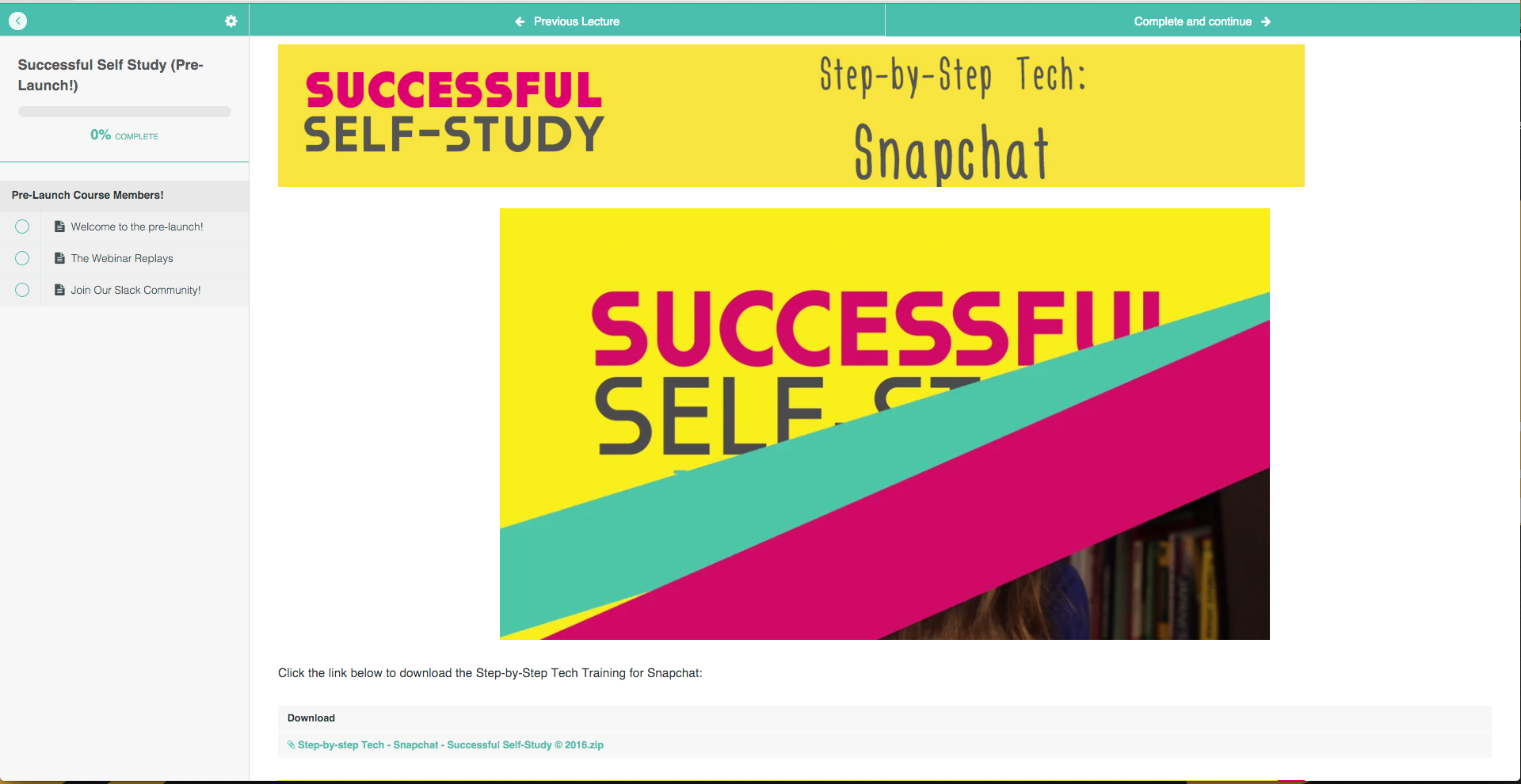
The list of tech training resources is excellent - overall she's demonstrating 11 different websites, apps and tools. None of them costs any money at all, so this is like the ticket to the biggest free online playground you've ever seen. You're guaranteed to find something new to try - my favourites were Periscope and italki.
Some of these videos felt pretty basic and could be a little shorter. Things like joining Facebook groups seem obvious, and many of you have done this already. Having said that, remember that I'm pretty tech-savvy, I write a blog and it's my job to know this stuff.
I don't think as a learner you need to become hung up on the two videos about the tool you already knew. Use this section in line with your own priorities, and you'll have saved yourself a likely 300 hours of googling over the next year.
The key is that you don't just find it, but you do something with it. And the way Lindsay builds in this accountability is absolutely fantastic - let me tell you more!
Now THIS Is Going To Double Your Productivity
The absolute key to a course with so much content is to avoid becoming overwhelmed. Lindsay doesn't tell you when, how, or for how long you should work on this.
But this doesn't mean that you're left alone. Quite the contrary!
The course structure and delivery are solid, and Lindsay concludes every single lecture with an actionable exercise - you don't get to be passive. As a fellow online teacher, I rate this a very good thing.
The one thing you have GOT to do right after sitting down and clicking the purchase button (if you choose to) is download that amazing workbook.
It's an editable PDF. But that description does it no justice. Let me try and say it differently.
I Love This Self Study Workbook!!!!
This workbook is the single most awesome self study language learning resource I've ever seen. If you are one of the people who liked the 3-Week Planner in Fluency Made Achievable, you are going to faint with excitement at the sight of this thing.
I would really hate for super-keen learners to discover it halfway through the course. So do yourself a favour and listen to me here: You want to download this and have it by your side as the course companion, as it contains every planning worksheet, printout, notes section, EVERYTHING.
The one thing it was missing at the time I tested it was a table of contents to help you navigate through the book, but Lindsay has promised to add this in the next edition.

You can choose to have the workbook with you and make your notes on the computer, or to print it out. In fact, send the PDF to my local printer and have it bound. The workbook is just really, really good.
Bonuses
The bonus section contains starter credit for italki and HelloTalk plus four webinars with a bunch of experienced and knowledgeable guests (spot me and my super-cool hoodie) on topics like goal-setting and maintaining motivation.
Conclusion
Yep, we've got to a conclusion stage at the end of this super-detailed review.
Successful Self Study ratings:
- For structure and engagement (workbook!), it's 5/5.
- For video quality, it's 5/5.
- The tech training is a 3/5 in my book, because I would skip a lot of it.
For the results you can expect from taking this course, it's 5/5 because if you do the work, it is guaranteed to
- help you learn a language quickly
- teach you that discipline so you don't feel overwhelmed and busy
- boost your confidence so you actually start speaking within a few weeks
- save you money - with all the tools, a new langauge can be studied very cheaply.
Overall rating: 4.5/5 - highly recommended for anyone new to studying by themselves or struggling because life is busy. So that's all of us then.
How to Get Started
You can join Lindsay's Course Successful Self Study today.
It's easy peasy:
- Follow this link to get to the course page and select the yellow course
- Click "Enroll in Course"
2017 Update: Lindsay has recently updated this course and added a huge amount of bonus content, including training for grammar, better reading, speaking, listening, and lots more. It's priced at $120 which currently represents ENORMOUS value. Go forth and try it - well done, Lindsay!
Here's that sign-up link again: http://www.fluentlanguage.co.uk/selfstudycourse
So you're getting
- the world's most awesome workbook
- tech training
- 6 language study videos
- membership in a private online community of language learnears
- bonus webinars
- PDF guides to help you master language exchanges, YouTube & more
- practical self study tutorials
- my audiobook.
Compare that to $500 spent on Rosetta Stone, or at your local Goethe institute. WHOAH. Go for it.
Tell Me More!
Have you joined Successful Self Study? How did you find it? I'd love to hear what you thought in the comments below.
*This offer's good throughout 2017.
Taming the Dragon: My 3-Month Welsh Language Learning Update
Welcome to my first progress report on my own language study. It's pretty comprehensive and longer than my usual blog articles, so I figured we'll just jump in!
First of all, let me give you a quick impression of how the past 3 months have gone:
- I've been spending 1-3 hours per week on my Welsh studies, sometimes a little more and sometimes a little less
- I've been combining a good bunch of resources and several people who talked to me in Welsh
- I'm feeling really positive about my progress and where I'm headed
3 Month Progress
One of the best ways of tracking my language learning progress is blogging about it, which is probably the only way that I know how long I've been at this.
So here's where I'm at: I didn't seriously start learning Welsh until I returned from honeymoon in September. So that makes it about 3 months of study, the often-cited time it takes to build a habit. And I'm shocked at how much progress I have made.
Here is an in-depth update of exactly what has been going on, and how I'm feeling about my 4 core skills.
Understanding Welsh
Understanding groups listening and reading, and I feel significant progress particularly in understanding spoken Welsh. Don't get me wrong. I've still got absolutely no clue what is going on when people talk at normal speed, or when I'm watching TV in Welsh.
But I've been repeating my input and training myself to pick out the words that I do know, and it's made a big difference.
For example:
- I am beginning to anticipate Welsh words based on the English subtitles in TV shows or on Youtube (if you want to know which shows I like, listen to podcast episode 31)
- Understanding and spotting patterns that occur regularly in Welsh is becoming easier as well, which means I'm now able to know where sentences start and end, and if they're in future, past, or present tense
In the coming months, I would love to be able to understand more social media posts in Welsh. Lucky for me, most Welsh speakers are bilingual (Welsh/English) and post in both languages.
The progress goal here will be to recognise and know more nouns and patterns, which I can study just by tracking what I look up in the dictionary.
Speaking Welsh
I've called this section "speaking", but I actually mean producing language in both speaking and writing. Here again, I feel like my progress has been awesome.
I'm absolutely ready to speak Welsh at any time. Sure, it will be terrible Welsh. It will be full of mistakes, and I'll last about 20 seconds without an English word.
But none of that matters. It isn't about the quality of my speaking. It's about doing it over and over again, little and often.
2 weeks ago, we went out for drinks with some new people. One of them turns out to be Welsh and we started talking. I wasn't Shakespeare, but I managed to ask her if she wants a drink, talk about my studies and a little bit about where I'm from. Respectable progress for 3 months of slow burn study!
In the coming months, my next goal is that I'd like to speak Welsh on the phone. Calling up a B&B or a language school with an enquiry is a simple enough task, but it has instant feedback in case I can't get my words out.
Here's How I've Been Studying My Language
- Community Class
I went to a class called Clwb Siârad in Preston, where I met a great mix of native speakers and language learners. The most amazing thing about Welsh Club is the fact that they're "offline polyglots" - a large group of language lovers in my county that I never knew about. The Welsh learners were speaking and learning more than just Welsh, so that our lesson ended up featuring 6 languages altogether.
- 1-to-1 Tuition
Working with a 1-to-1 tutor is a huge benefit to my speaking skills! I've not been able to commit to weekly lessons, but decided not to let that stop me. Instead, I book a session with Mererid around once a month to top up and consolidate what I've been working on.
I learn something new in every tutoring session, and always come away feeling inspired and positive.
- Say Something in Welsh podcast
This podcast is currently my main speaking resource, and prompts the listener to speak continuously and right from the start. I worked with this concept before when I tried Michel Thomas, but this system of focusing entirely on patterns is easier to follow and more effective in my mind.
Main downside: I've got to find vocabulary resources for words somewhere else, meaning it trains patterns and structure way before it adds many words.
Believe it or not, Instagram is a regular place for me to get just a little bit of Welsh language and practice what I'm doing. I've started giving every post a level of "added" Welsh by talking about the photo in both English and Welsh. The kind community of Instagram users out there (especially #iglc folks) has been great at helping me with corrections.
In the coming months, I also want to add the Cwrs Mynediad book
A Problem I Need to Solve: No Study Corner
When I'm at my laptop, my mind switches into work mode and language learning is more difficult (priming affects how we learn languages). I can tell I'm more engaged and make better progress when I am studying differently, on the couch or the stairs.
This explains why building my Memrise course and watching the BBC videos has fallen behind - both of those only work on a desktop AFAIK.
In the next month, I want to find a study corner in my house. It won't be easy, because my house is pretty tiny, but with some creativity I think the Welsh corner is going to be a great resource.
All in All: A Feeling of Ease
Welsh is the first language that I am truly teaching myself, without attending any regular group classes. It's also the most modern self-taught process I've ever used, because most of my first languages were studied in school in the 90s when mobile phones looked like this:

I'm wondering what exactly is different between this language and Russian, my previous experiment. Russian had the added difficulty of Cyrillic, so it was slightly less accessible. I also didn't feel the same level of curiosity in the end - Wales and Welsh are more exciting to me right now, and that is an entirely personal thing.
And ultimately, the materials and speakers I've worked with are just so supportive and welcoming. They are what's made my studies feel easy, and I think a feeling of ease is the key to keeping going.
Overall, I feel like things are going well. I have regular success moments, even tiny things like completing an episode of my study podcast. Those are the key to keeping going, because I never feel like I'm stuck.
Saying I'm feeling ease does not mean I'm actually "good at Welsh" yet. It just means that I'm feeling progress without frustration. But ultimately, my goals and results belong to me and this is exactly the result I am happy with.
Book to Try: Fluency Made Achievable
If you're learning a language and you haven't read my book Fluency Made Achievable yet, check it out today. Fluency Made Achievable is my guide to what it takes to learn a language and do what's necessary for achieving that feeling of ease and fluency.
It goes into depth about those 4 core skills and helps you understand why they matter and how you can create easy routines for yourself in language learning.
And now that I'm learning a new language again, I can tell even more just how useful it is to get your practice right and I want you to benefit from the same insights.
If you do own the book already, let me know how you used it in your own learning routine in the comments below!
And of course, please share your thoughts and updates on YOUR language learning routines. In other words, I invite you to comment on this post and tell me more about your own studies. I love hearing what you're up to!



Struggling with listening? Discover realistic tips, challenge prompts, and the best tools for improving your listening skills as a self-guided language learner