

How To Get Native Speakers To Speak Your Target Language
Practice is important, but what if people keep switching back to your own language? Will you ever be able to speak to anyone if they don't even want to speak back to you?
This week on the podcast, I have got a packed episode full of tips to help you stay in control.
You may know this feeling: You've spent hours on your own pronouncing words into your phone, studying vocabulary, and when you want to practice your language with friends...they just keep switching back to English!
"Hey, möchtest du vielleicht heute Abend Tatort gucken?" - "Yes, that sounds great. I will bring beer." - "Ähhh, danke."
If you find it frustrating that your friends keep switching back to English, you are not alone. This week on the podcast, I have got a packed episode full of tips to help you stay in control when native speakers don't want to speak their language with you.

The most common issue here is for English speakers. You’re likely to meet the largest number of people who are learning English (because everyone is) and you’re one in a dozen as a learner looking for practice time.
Why Do They Do This?
- They don’t want to be rude. Most commonly, people will want to include you in their conversations and make this as easy as possible.
- They are prioritising their own learning - again, it’s unusual that you want to learn their language and they’ve been wanting to practice their English for ages, so you’re just the person they’ve been looking for.
- They’re busy. You may have chosen a person who just wants to get things done right now. You are speaking slowly and taking 3 seconds between words. You’re hard to understand. You’re looking up words in the dictionary. Ain’t nobody got time for that.
- They think this is a struggle for you and want to make your life easier. Language learning is effort, and if they see you looking up every other word they may just want to save you the work especially if you drop into English now and then.
What You Must Accept
- You can’t win them all - even if you had the perfect accent, chances are that you're still over 6 months away from having those fluent, easy, flawless interactions that you're dreaming of in your Vision Goals. That's okay. Remember that rejection is only for the moment, and only relevant to the current situation.
- You may need to be persistent. This issue will not be resolved even when you get to the higher levels in your language, because it is not just a reflection of you. It’s always about the other speaker and where they are at, so prepare to try several times and start looking for the compromise.
- You may need to hunt down a person who is the right partner for you. Especially in the early stages of your language learning journey, this may well be a tutor who can support you until you're fast and confident enough to stick with the target language.
What You Can Try
- Seek out a group - when they have a common language of interaction with each other, they are more likely to slip in and out. You can eavesdrop, join a meeting, or simply go out for drinks and let them know that you’ll try and stay in their language.
- Set up a clear language exchange or ask them for temporary support such as being 100% in their native language for just 20 minutes.
- Improve your local flair - this one is great for service and shorter interactions, for travel, and for talking to in-laws. If you are regularly frustrated because you can’t even manage to small talk for 2 minutes before there is a switch, then you’ll get a lot out of improving your language skill so you can fake it til you make it. 2 ways to do this: Pronunciation perfection, and stock phrases (fillers, standard constructions).
- Wait until you’re more confident and a little faster. You are going to get there. Until then, the person who keeps switching away from your target language just won’t be the right person to talk to.
- Go with it. Think bilingual conversation, not “battle lost”. Make it fluid, and even if they switch into English you can stay in your own target language and send a signal.
As you've seen there are different ways of dealing with situations like these. Remember to employ empathy when you are speaking to any native speaker of your target language. Consider their own perspective and the situation they are in. Often, it goes a long way just to mention that you are a learner and to say "I could use some practice, can we speak your language?".
Have You Had Good Luck Practicing Your Target Language?
Leave me a comment or say hi on Twitter to share your own experiences of speaking with native speakers. Who switches to English? How have you dealt with it? I'm looking forward to hearing from you guys.
EPISODE SPONSORS
EPISODE LINKS
- How To Get Germans to Speak German To You by Fluent Language
- What's The Secret To The Greatest Language Exchange Ever? by Fluent Language
- To Sell Is Human: The Surprising Truth About Moving Others
- "Make Your German Sound Amazing" Mini Guide with 26 Key Phrases
- The Secret to Getting Natives to Speak Spanish with You | NachoTime Spanish
#clearthelist March2018: Update On My Welsh Language Progress
Learn how I am studying languages in this monthly goals update. This month marks the first time you're hearing about my Welsh progress since like 2016.

Welcome to a new kind of blog post here on Fluent - I’ve long been aware that my last personal language update was about a year ago and this blog should include more of that good stuff. So this month, I am joining Clear The List, a monthly language strategies update.
You may have heard me talk to Lindsay about it on the Fluent Show - Clear The List is open to everyone and gives us support and accountability by sharing regular language learning goals and stories.
Every month, I set my goals using the Language Habit Toolkit worksheets and I put them up behind my computer screen to keep them in mind. And this month, I had a LOT of them in Welsh. The mindset was not to expect too much from myself, but to remember the direction I was aiming for.
What Happened in March 2018?
Up to the 11th of March, my working life was dominated by sharing and co-running the absolutely wonderful Women in Language conference. If you were there, you’ll know that we had a great time.
Click here to read my full debrief of Women in Language, which includes
- the 5 most important lessons I learnt at the conference
- some behind the scenes details
- tips for you on what to do if you also want to be a speaker
- lessons learnt on what we’ll do differently next time.
Special Guests
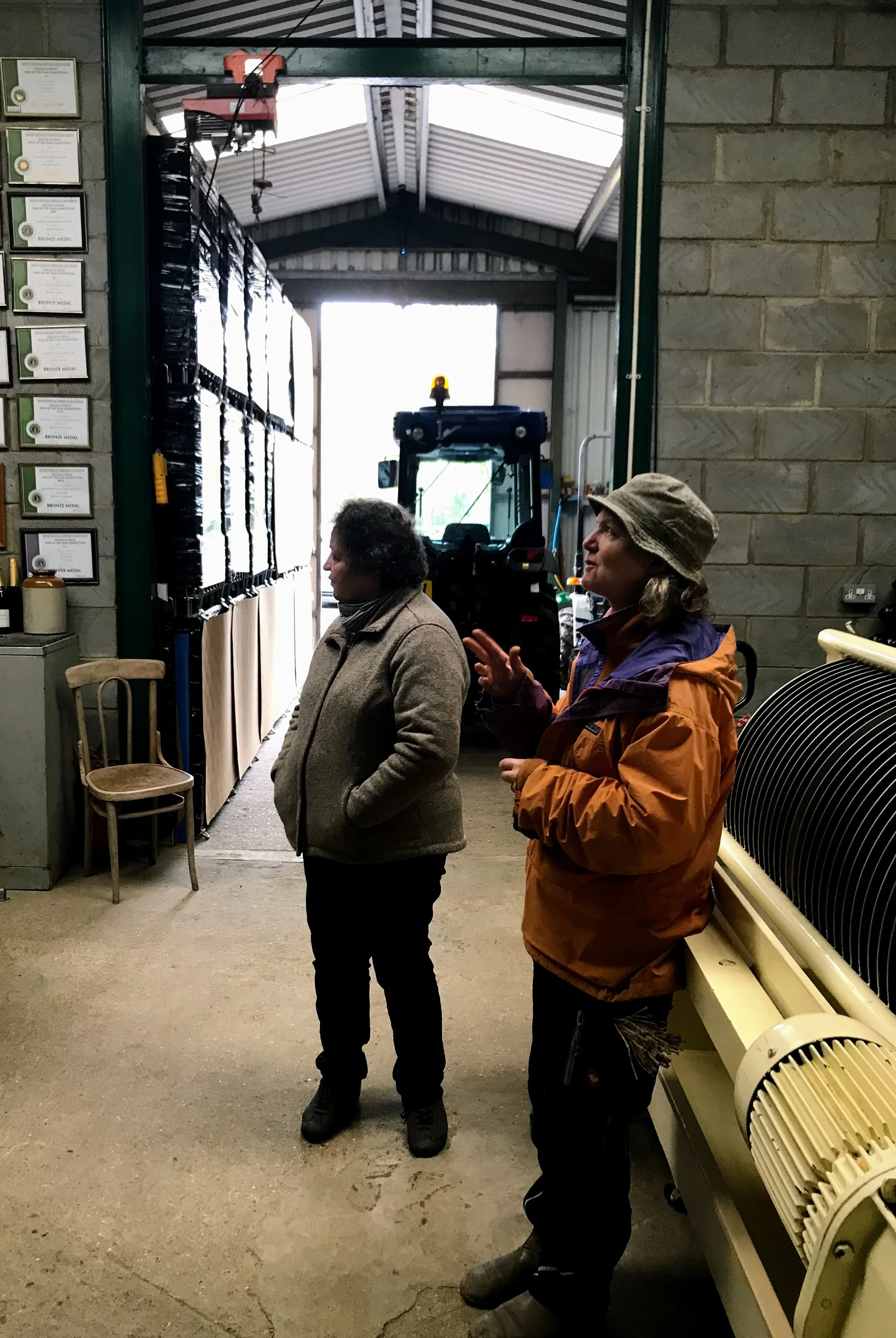
English Vineyard Visit
Right after the conference I experienced another unusual week with lots of spoken German as my parents came to visit me in Canterbury. We had a great time pottering around and I did my usual interpreting job and listened to my husband’s German.
If you are visiting Canterbury and want to practice your German on a city tour, do give me a shout through the contact page.
Highlight: A visit to an English winery, showing me that I know more winemaking vocab than I expected. My parents are winemakers, so this always seems to happen when they’re around.
One more unusual event was the news that my favourite ever English teacher had passed away. He was one of a few English teachers who influenced and inspired me as a teenager, spoke lots of English in class, and shared the literature he loved. What a reminder to appreciate those who inspire us.
The Fluent Show

March marked one month since the Creative Language Learning Podcast became the Fluent Show. Thank you so much for listening!
Here’s my favourite episode from this month: In Language, Are Apps All Amazing? Are All Apps Amazing?
My Welsh Goals For March 2018
With so much going on, did I even get ANY language study done?
Contact Goal
On an everyday basis, I have one important goal: Have contact with my target language. So I have a lot of mini-sessions on Duolingo, Clozemaster, with flashcards, with vocab lists. I read tweets in Welsh, look out for books, anything. All these different strategies add up to consistent slow progress, but they are the basis for all other goals.
I track my contact with Welsh using the Streaks app on my iPhone. In March, I logged 22 days of contact.
Here are the Path Goals I set, and how it went:
Listening
Watch S4C every other day for 10 minutes: Did this about three times. I’m not sure my devices have S4C set up to be accessible as easily as possible. Also, 10 minutes is an awkward length for a TV show. I did watch some YouTube clips, so I’ll take that into account as a goal format.
Listen more when I’m having real conversations Listening is the conversation habit I always need to bear in mind. I had one tutor conversation in Welsh this month, and I did shut up and listen to her a little more than usual. A good job with room for improvement.
Transcribe 1 Song from Listening What was I thinking? Not really a goal I’ll go back to.
This month, I resubscribed to the Pigion podcast and listened to the weekly episodes. I discovered that they provide a vocab list with each episode and reviewed the vocab before I start the episode.
Speaking
I wanted to work through the Sylfaen (Foundation Level) exam questions to practice speaking at a higher level, but found the exam paper so boring that I never went back to it. But on the positive side, I feel confident that I could tackle all of the questions on it, so I’m now definitely on that level or even further ahead.
My other goal was to get to 30 minutes all-Welsh conversation, so my tutor session was a 60 minute time slot, and we had nearly a full hour of Welsh conversation. Very exciting! ✅ I also got to the halfway point on Say Something in Welsh level 2.
Reading
Read articles or 1/2 book page in Welsh every 2 days. The goal here was to acquire new vocabulary, and build up my reading capacity to “more than a tweet”. I don’t think I read enough, partly because I don’t know where to find easy Welsh articles online.
Writing
My goal was to write 1/2 a page and share it with my tutor 3 times. This is where the MAGIC happened. Inspired by one of the talks at Women in Language, my writing practice evolved to include poetry in my target language. It’s really fun - one of the best ways I’ve found to use Welsh creatively.
I haven’t shared with my tutor yet, but I did post the poetry on Instagram with #languagpoems and I’ll keep going.
My other goal was to complete Chapters 7-9 in my Grammar exercise book - I’m halfway through chapter 8, so that one’s trucking along.
Goals For April 2018
In Welsh: My listening skills are a little behind and I don’t understand as much as I would like to, so the focus will again be on this core skill so I can get into a routine.
My goals in Welsh are:
Have 3 natural conversations with my tutor/exchange partner and listen carefully: My next tutor session is already booked so I reckon I can smash this one and I’ll continue aiming for 45-60
Practice Welsh listening by playing with no-subtitle TV, and reviewing the Pigion podcast vocab before I listen: These are about listening comprehension, the area I need to improve right now.
Write a longer Welsh poem and continue playing around with different poetry formats: Last month I tried a Haiku. Maybe this month I’ll attempt poetry that rhymes. I’m loving my poetry focus this month and am also reading more of it in English and German.
Finish my easy reader novel and read all of the latest Lingo Newdyy magazine - these are all offline, can anyone recommend easy Welsh websites?
Book a day in Wales: I keep looking at this list of courses and not booking, even though they’re so cheap. Time to dive in!
One Last Thing: Other Languages
This month, I also dabbled in Swedish and spoke a lot of French. I’m still on the hunt for my new language to play with.
Swedish was the first language in which I've tried an official Memrise course and I'm so impressed. WAY better than the usual.
So now we’re caught up, let me assure you that future Clear The List articles will be a little shorter. I will continue setting goals using the framework of 4 core skills, and I always use the Language Habit Toolkit to set and track quality goals that will challenge me without driving me crazy.
Is there anything you’re curious about?
How was your month?
 \
\
If you want to join the linkup and share your own goals for the month, hop on to Clear The List with Lindsay Williams and Shannon Kennedy. Would love to see what you’re up to!

In Language Learning, Are Apps All Amazing? Are All Apps Amazing?
In this episode, we caught up, talked about a new directive on language use in a very special setting: Childbirth!
We also discussed language learning apps and how to make the most out of them, so if you're enjoying Duolingo but you're STILL not fluent, this is the episode for you.
Welcome to Fluent Show episode 79, where co-host Lindsay joins me to catch up, talk about language, and discuss the hot topic of language learning apps.
If you've ever downloaded and used a language learning app, and then wondered "Am I doing this well? Could I learn more from this?", then our discussion will help you swipe and tap your way to fluency.
The Language You Use When She's Giving Birth
The British Medical Journal recently published a blog article sharing guidelines on how to speak respectfully to women during childbirth. Is this "political correctness gone mad", or does it matter how we refer to people in these settings? Would you expect that less dramatic and violent language can help mothers stay calm in labour?
Also, as ever: The important theme of "use her name", and how we'd expected to be addressed in different language environments.
If I got to the stage where I'm having a baby, I would expect to be called signora..not the equivalent of 'girl'
Tune in to our discussion to find out, and leave a comment below to share your own views.
How To Make Good Use of Language Apps

In this episode, we talked about language learning apps and how to use them.
Practical Tips
- Use different apps on different devices if you have them, for example you could make your iPad your reading resource while you use the phone to text language exchange partners
- Take most of the promises that come from language learning apps with a grain of salt - using an app without effort does not mean learning a language without effort
- Customize your experience: Apps are not all you need to learn a language, but it can help you create a language learning environment that is unique to you. We find that when an app is not the only way you're learning a language, your experience and results gets be better.
- Don't ever feel ashamed or embarrassed about your app choices and what works for you!
The Essential Language Apps To Try On Your Device
Apps can be roughly sorted into a few categories, and it's worth trying a few to find your personal preference
- A good dictionary app like WordReference, LEO, or even Google Translate
- A flashcard system like Memrise, Anki, or Smartcards+
- A language course app (often gamified) like Speechling or Duolingo 4. Our sponsors Clozemaster of course!
- A non-language related app that can help you stay productive like 30/30, Timeglass, Pomodoro, or Streaks
Which language learning apps do you use regularly? Can you manage without them?
Leave us a comment below or tweet @thefluentshow.
EPISODE SPONSORS
EPISODE LINKS
- Code-switching - Wikipedia
- italki - where people can find online language tutors
- Humanising birth: Does the language we use matter? – The BMJ
- 12 Ideas For Making the Perfect Language Learning App by Fluent Language
- After Duolingo? : Esperanto
- The Welsh-Dictionary App: Language Technologies Unit, Canolfan Bedwyr
- The Fluent Show: Gabriel Wyner is NOT a Robot (with Fluent Forever author Gabriel Wyner) — Interview with Gabe Wyner, the creator of the Fluent Forever app
- Gboard - the Google Keyboard - Android Apps on Google Play
- STREAKS. The to-do list that helps you form good habits. For iPhone.
- 30/30 | You have never experienced a task manager like this!
- Gretchen Rubin: The Four Tendencies — Cool personality quiz that can tell you more about your habits. See also Fluent Show 32
- clear the list Archives - Eurolinguiste
- Language Learning Goals: Clear The List - March 2018 - Lindsay Does Languages

How To Get Off The Intermediate Plateau in Language Learning
Welcome to Fluent Show episode 76, where I tackle the question:
**"How Can I Get Off The Intermediate Plateau?"**
If you're stuck somewhere in the language weeds, this show will help you untangle them and get those wheels turning again.
Welcome to Fluent Show episode 76, where I tackle the question:
"How Can I Get Off The Intermediate Plateau?"
If you're stuck somewhere in the language weeds, this podcast episode will help you untangle them and get those wheels turning again.
Just like any big goal that leads us to a happier life, language learning for the long haul works best as a habit. It’s possible to reach miraculous short-term results, but if we’re looking for mastery and SUSTAINABLE mastery then there’s no point putting your 6 week boot camp crash challenge attack plan into place.

Note On Progress and Your Sense Of Progress
- You’re in this for the long haul. After reaching a level that shows you’ve been studying this language for a long time, your motivation is likely more than fast progress. It doesn’t help to count the time you have spent learning.
- It doesn’t help to assume that going to A2 from zero is the same as going to C2 from B1 — it really isn’t like that.
Rewards
The problem with the plateau is how frustrating it feels. You don’t feel the rewards anymore. So let’s talk about rewards and how you can bring back the feeling that your work is paying off.
Strategy 1: Get Fresher Rewards
6 months ago, you got a real kick out of being able to watch the news in your target language without subtitles. 3 months ago, you were still watching the news but it started feeling like a chore. Today, you still understand everything but you’re frustrated in a new arena. Rewards are most rewarding when they come after some really hard work towards a desire, and right now your frustration is rooted in your shortfall.
Ask yourself honestly where you are most frustrated right now. What is missing? What do you feel scared to attempt? Whatever it is, it’s likely not something you can do on your current plateau.
(Example of reading a book in Welsh)
Strategy 2: Intrinsic Rewards
This is about your identity, who you are as a language learner, and what you love the most.
Strategy 3: Extrinsic Rewards
These incluce
- Validation from friends
- Passing exams
- Career advancement
Strategy 4: Change the conversation
Reward yourself for effort, not result. No point in burning yourself out.
So now I’ve convinced you to keep going, there is one question remaining. How do you actually get better? How do you study the right topics?
Do Difficult Things
Yes, I mean working hard. Your learning curve is slowing because you are not doing the difficult things anymore, so this is a good problem to have.
Getting to the C levels without the four core skills, without grammar, is not possible.You will not automatically get to the highest language learning levels by just keeping going. Things do need to develop, and if there’s a corner of grammar or a core skill that you have been neglecting, now is when it catches up with you.
Put That Yardstick In Place
If you feel like you’re not making progress, it’s likely because you have lost something that helps you measure your progress. It's time to get the yardstick back. Yardstick options:
- Set consistent path goals and share them with people, then check in every week. Join a learning club or mastermind.
- Write down your goals and be accountable to yourself — keep them in front of you
- Sign up for a language exam and get yourself tested
- Use a guiding resource, something you can really measure
- Work with rewards and treats - there is nothing wrong with celebrating where you are right now. You’ve come a long way
Become REALLY Clear On Your Aims
People often remark on the high quality of my English, and this level of English is impossible to reach without an incredible amount of exposure. But this level is NOT C2 - it is in fact higher.
Find a person who will mentor you.
This doesn’t have to be a paid tutor, but could be a patient and dedicated friend or group of friends. They might not even know they're your mentor. This is why people often report success when they travel - they put themselves in a world where language mentors are easily accessible. But just because something is not quite as straightforward, doesn’t mean it’s impossible.
In Conclusion
It’s easy to give up at this stage…but just because it’s difficult, doesn’t mean we give up. Right? Right!
You never have to finish the language. You never will. It will just speak to your soul in new ways.
EPISODE SPONSORS
CODE: FLUENT
EPISODE LINKS
Mastery and Advanced Level Language Learning (Podcast Episode 46) by Fluent Language
3 Reasons why you're still an intermediate level language learner - The Polyglot Dream
Common European Framework of Reference for Languages - Wikipedia
How To Learn A New Language With Smart And Useful Goals by Fluent Language
Accelerate Your Speaking Skills with Speechling: In-Depth 100% Honest Review
Speaking in other languages is harder than it looks at first. You can read books and study flashcards, and still choke when you speak to a real person.

It can be difficult to practice pronunciation and have conversations on a regular basis. Tutors are awesome, but your lesson time is limited. And many apps and bots make us feel detached.
Speechling claims to have cracked that problem. This new app offers speaking skill training, attractive design, and the most convenient access to a real person tutor that I have ever seen. No scheduling, no exchange of Skype names.
Sounds good, but does it work? In this review, let's take a deep dive and find out.
How does Speechling Work?
Speechling's courses use sentence repetition, a premise that you may know from fellow Fluent favourite Glossika. But there is a twist: Speechling includes feedback on everything you record, from an actual human.
After repeating the sentence you see and hear on the screen, you have the choice of listening back to your pronunciation, or to save it for coaching. After you save your recording, you will receive feedback and tips from a Speechling coach.
How I Tested The App
Speechling's six language options gave me the chance to test ot for at different levels:
- Advanced (French),
- Confident Beginner(Russian)
- Absolute Beginner (Chinese).
The Advanced Learner Test: French
In French, my language level is around B2-C1 on the CEFR. I can navigate most conversations without hiccups, and I know for a fact that speaking French is what I need the most.
So for my level, saying a few sentences every day at my own convenience was perfect.
The live feedback here was eye-opening. I have an optimistic blind spot to my own weaknesses in pronunciation and word choice. I always learnt French in academic environments, so I produce great grammar. But in reality, my spoken French sounds textbook and a little uncomfortable. The coach feedback made me more aware of my little mistakes without discouraging me completely. I felt encouraged to try again, to fix what I was saying and carry on.

Describing a picture using Speechling's Freestyle mode
With the freestyle mode, I got to practice free speech instead of repeating pre-written sentences. In the dictation feature, I added listening comprehension at natural speeds.
The Confident Beginner Test: Russian
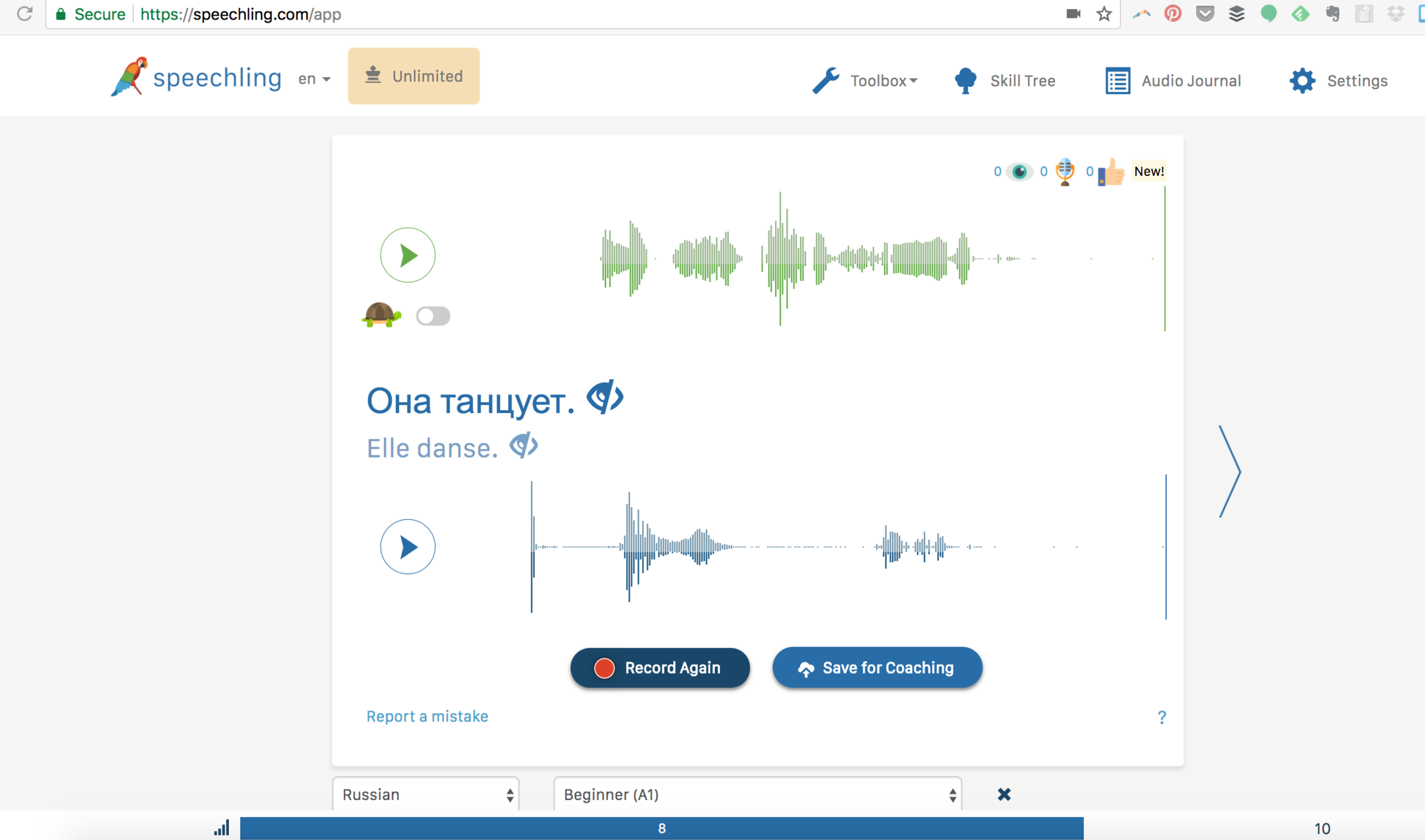
Russian is a language I studied about two years ago and I was able to have very basic exchanges (“what did you have for breakfast?” - “I had porridge”, that kind of stuff). I pronounce words correctly, and can read Cyrillic. So with this language, I wanted to see
- if Speechling can teach me something new and
- if my pronunciation is accurate.
The module I chose was “Beginner (A1)”, which was a great entry point after a few years off. With each repetition, I felt like I was learning. The examples were well pronounced, came at a speed that felt like a suitable challenge, and soon I was improving.
I also felt that pronouncing each new word immediately helped me remember it, especially when I added a recording. The accountability of recording and coaching (“someone will actually hear this”) helped me link the phrase with a strong emotion. For more about how emotions amplify memory, check out my interview with Gabriel Wyner from Fluent Forever.
With a language like Russian, you need regular exposure to stay comfortable with the alphabet and pronunciation. Speechling surprised me here because it felt like the perfect tool. There were so many sentences I had never said before, and so many opportunities for me to improve.
Best of all, I was speaking Russian right there and then without any hesitation.
Of course, exposure to lots of sentences won't teach me more than lots of sentences. If I wanted to get back into Russian and start making steady progress, I would definitely use Speechling and I would add a textbook, dictionary, grammar explanations, and lots of input resources.
The Absolute Beginner Test: Chinese
Chinese is the only language out of Speechling’s range that I have never studied, so I decided to go for the “simplified” version. Does that mean easy Chinese? No idea, but it's worth a try. The module I chose was “Beginner (A1)”, as there was no way of picking anything even easier.
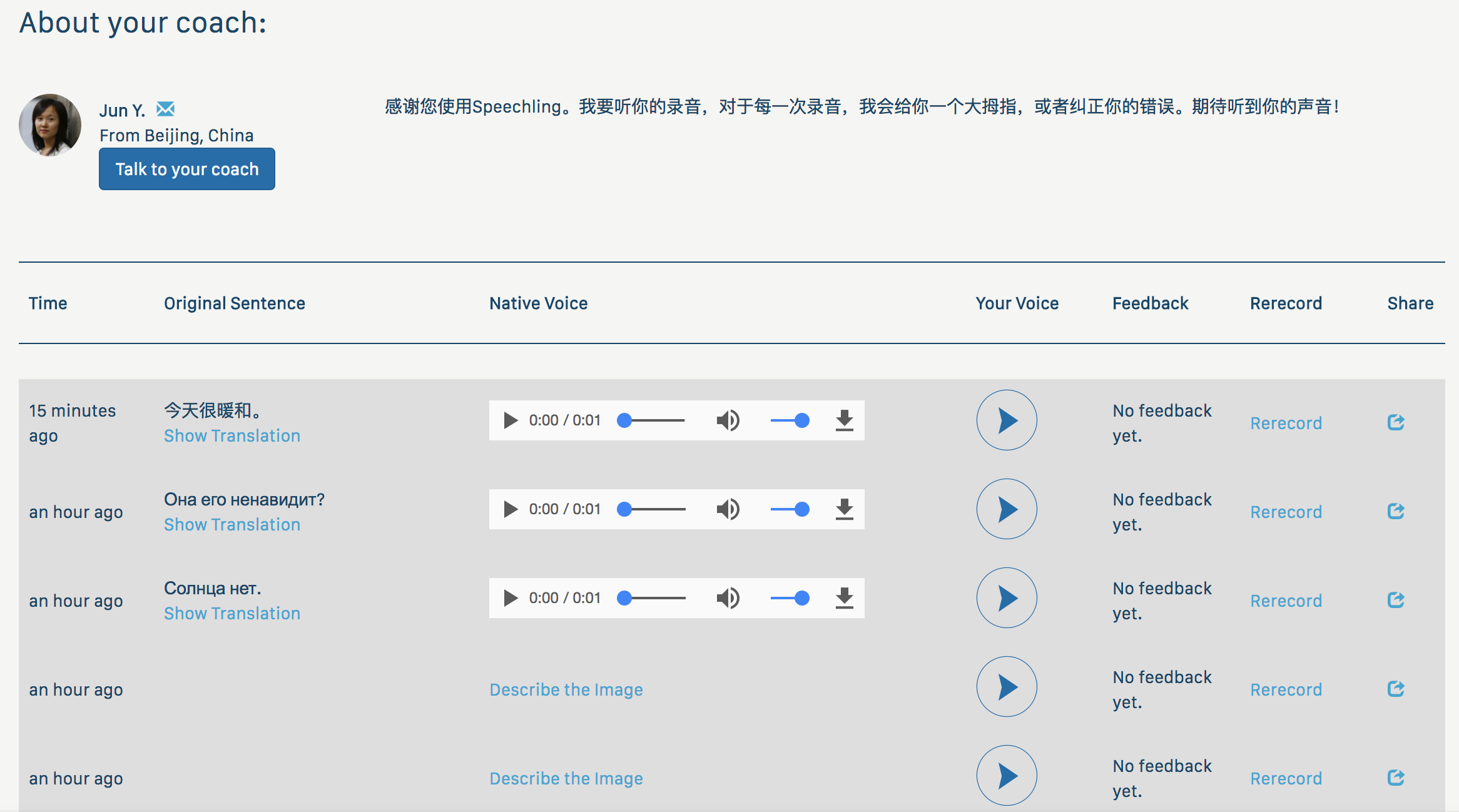
My Speechling Audio Diary
With Chinese, Speechling shows the sentences in Hanzi (Chinese characters). There is also the option of viewing the sentence in pinyin. Good job - it was the only way I could even start to guess at repeating the sounds I was hearing.
For a complete beginner like me, the sentences were interesting. I had to repeat the audio input 4-5 times before I dared to repeat the sounds. Surely, any Chinese speaker would be impressed?
Speaking Chinese to a Chinese Native After 5 Minutes
Well, I do know a Chinese speaker so I was ready to shine. Having newly acquired the sentence 今天很温暖 (“it’s warm today”), I asked my co-working buddy to listen to my Chinese and tell me if it’s correct. And he did understand what I was saying, although “impressed” would be stretching the truth a bit.
I also sent my recorded sentence to the Chinese coach, who drew my attention to the specific parts I got wrong.
Learning mass sentences as a complete beginner isn’t ideal. It leaves you without a sense of what each word means (which one out of jin tian hen nuan huo is “warm”, which one is “today”....and what do any of those symbols mean?). Learners don't get to understand what any of the rules of speaking are. But that’s okay, as Speechling not designed for that. This tool is a great confidence builder and accent sharpener. I could imagine it as a fantastic basis for tutoring, sending students away with homework on a topic.
Multilingual Usage

If you have studied more than one of Speechling’s range of languages, you can view translations in any of the six languages. This means you get to practice two languages at once, and it’s one of easiest ways to train your polyglot muscles.
Downsides of Speechling
On several occasions, my recordings were too long to be saved for feedback. This is understandable, but it was frustrating particularly in the freestyle mode. It’s disappointing when you say a complex sentence to send to your coach, and then get a message saying “file too large - cannot save”. It would be great if Speechling could include a guide on how long I can record for.
For languages where I knew nothing at all, I’d also like to see a primer module so I understand what I'm doing. But this is a tiny point, especially since Speechling is not aimed at complete beginners.
In Conclusion: Speechling is Great
All in all, I found Speechling a great addition to my studies. It was challenging and helped me improve my pronunciation and speaking skills in three languages. I was most excited about what Speechling could do for my Russian language skills. I improved both my vocabulary and accent, and the process was efficient and fast.
Speechling is free from robot voices and works with male and female voices (native speakers, of course). Its interface looks great and it gets you into the action immediately.
I love the record-feedback cycle, because it prompts you to re-record a better version of what you said. You get feedback, and you improve pronunciation, confidence, and speed.
The coaches were great for all the languages I tried. They recorded speedy corrections. At the very early levels, feedback is not rich, because they are native speakers and they use their native languages. But even so, it was clear where exactly I was supposed to change something. The more you learn, the more you will get out of these coaches.
If you work with a tutor that you don’t see every day, definitely try adding Speechling to your language routine. You will be speaking your target language more, you'll build a better accent. And best of all, pronouncing all the new words will help you remember them faster.
How to Get Started (+ Speechling Discount)
Create a free account and start speaking at Speechling.com, or by download the app from the App Store or Google Play Store.
Speechling is currently available in six languages: French, German, Spanish, English, Russian, and two types of Chinese.
It’s a freemium app, and you get 15-20 minutes of feedback for free every month. I would recommend checking out the paid plan (see below for 10% off) if you want to
- get a speaking boost, especially when there’s a deadline
- learn more than one language at once
- keep track of your progress with the audio journal.
The unlimited plan is open to Fluent readers at a 10% Lifetime discount: Make sure you use the code FLUENT when you sign up.
Good to know: Speechling is a non-profit company and also has a classroom version called Speechling for Education. I have an existing relationship with Speechling as they are a sponsor of my podcast. This only influenced the amount of attention the product received, not the verdict. It is a cool app.
Have You Tried Speechling?
Are you a pronunciation master now? How did you like the coach feedback? Leave a comment below and share your story.
***hello from the future!!***
Since my original review of Speechling in February 2018, these folks have been hard at work and have just emailed me to share the following new developments.
1. A new module called "Speechling Foundations", which will teach newbies from the very beginning. This start from zero module covers teaches the most essential words in context.
2. New listening options: Speechling now offers listening comprehension, multiple choice, fill in the blank, and flashcards. It's all available for free without login. All of this works on mobile too.
3. More language! They've more than tripled our content collection.
4. Offline mode!! Premium users can download a huge chunk of Speechling’s sentence collection (~10k sentences) and even audio books and Anki decks .
And added in March 2020
1. Speechling now includes Italian, Japanese, Korean, and Portuguese.
2. The recording time has been upgraded to 15s as Standard! It’s quadrupled to 30s for paid users.
3. There are now over 10k recordings (male + female combined) for each language, from words to complex sentences.
4. Speechling now includes word hints where you can mouse over words and get pronunciation tips and definitions.
I love it when an app listens to its users, this alone makes it worth checking out!




Struggling with listening? Discover realistic tips, challenge prompts, and the best tools for improving your listening skills as a self-guided language learner