

Clear the List November 2019: No-English Lessons as a Beginner?!
Welcome to my latest check-in on language learning goals. In October, I studied three languages: Mandarin Chinese, Welsh, and a wildcard language that you can read about in this article. Join me in setting new goals for the month!

Clear the List November 2019: No-English Lessons at My Level?!
Hello and welcome to another blog post in the Clear The List series, the monthly language learning round-up about language learning goals and progress.
That’s right - NOVEMBER goals! October was a very interesting month for my language learning as I tried out something I had never tried before. Exciting stuff!
This check-in is part of the #clearthelist round-up hosted by Shannon Kennedy and Lindsay Williams.
What Happened in October?
I was busy signing up participants for the next Fluent German Retreat, and then I travelled to the USA again! This time, my time was spent at a retreat in Colorado and it took up about half of the month. So that means I had half of the month for studying languages.
I don’t usually allow a lot of my weekend to become language study time as I want to spend it with my husband and my inner lazybones, but this month I challenged myself and took several lessons on Saturday afternoons. It was actually great fun, and definitely a time of the week that now feels open for languages.
The Fluent Show in October
I travelled to London to record my first ever interview in person! The interview was with David Peterson, the remarkable creator of languages for TV shows like Game of Thrones, The 100, and Defiance. The resulting show is out on 11 November so look out for it in your usual podcast locations.
Recording in person was a new adventure for me and I travelled up to London with brand new microphones, cables, and mic stands! It’s worth it for a special recording atmosphere, I can’t wait to record in person again soon. If you listen to just one episode from October 2019, I recommend this deep dive into finding a perfect language teacher with my co-host Lindsay Williams.
Reminder: The Fluent Show has opened a Patreon page. This allows all listeners to become involved in making the show with a small monthly pledge. If you want to become a part of the community, please visit our Patreon page.
Language Goals and Progress
During the month of October, I pushed myself to take as many italki lessons as possible in the italki language challenge.
If you’ve never heard of italki, click here to find out more and get $10 credit - it is a platform for finding online language teachers, and it’s excellent.
Now before the big reveal, lemme tell you a thing: italki sets the challenge goals in lesson hours. But for me, language lessons are rarely an hour long when I’m crouching around somewhere at an early level. With the approach I took in Chinese, an hour would have felt very exhausting for me and the tutor so I chose to take lots of lessons but many of them were half an hour long.
And on that note, I totally didn’t meet the goal of 12 study hours. But I hadn’t expected to.
Instead, I took 6.25 hours of study time split over 9 lessons. The results were surprisingly positive, I felt reinvigorated and reminded how much I love languages! Here are the specifics.
Mandarin Chinese
Wow! Considering I was tutor-less a month ago, the italki challenge absolutely pushed me to find a new style and tutor that worked for me. And in Chinese, I tried a whole new approach this time.
Instead of choosing an experienced and formally qualified tutor, I decided to go with what italki calls a “community tutor”, i.e. someone who is ready to help and teach but who hasn’t formally studied the language as much.
This was 100% the right decision for someone like me who is
- an experienced language learner
- already working with 1 or 2 guiding resources
- pretty confident about knowing what to do.
Going for a tutor who approaches teaching less formally suits my own informal style perfectly, especially since I tend to follow up after class and do my own homework without prompting.
By the way, you can learn more about the differences and what they mean in this month’s podcast episode about language teachers.
No-English Lessons at My Level?!
I took inspiration from Scott Young’s interview on the Actual Fluency podcast (episode 164). In this interview, Scott mentioned that he used to hire tutors and tell them beforehand that he doesn’t know a lot but he wants to eliminate English during the class, so he will heavily use google translate.
I had previously taken lessons that involved a tutor working through a textbook with me, and I did not enjoy them so much. So I figured “what the heck” and decided to throw myself in at the deep end and speak terrible internet Chinese to a few people. They get paid, after all!
And the result was totally positive! I enjoyed each class, had lots of fun, experimented, and understood almost nothing my partners said to me. But it didn’t matter! We came away after 30 minutes feeling like there had been some level of conversation.
I am NOT speaking well yet, but or the first time since I started, I was having fun in Chinese.
If you want to try this out for yourself, go for it! The key is having good follow-up.
Each tutor was very diligent about typing what they said for me, so that after the lesson I took time to copy it into my notebook and I reviewed it for myself. This added about 30 minutes of follow-up time to the lessons, but it’s how I was able to remember things, and it’s also writing practice. Worth it!
App and Book Update
I’m enjoying Lingodeer and Assimil’s “Chinese False Beginners” workbook.
LingQ has fallen by the wayside because I’ve now finished the beginner’s material and there is a big gap between beginner and intermediate. No one wants to review 50 expressions after every page.
Welsh
I also took online lessons with a new Welsh teacher, who was lovely! After my US trip I noticed that I was particularly rusty, so getting right back into an hour of conversation was crucial. Looking forward to more!
In other goals, I have finally booked my next trip to Wales! I’m going to Cardiff/Pontypridd for a Sadwrn Siarad on 23 November and I cannot wait. Love Cardiff, and it’s been too long.
Wildcard Language!
My wildcard language for the italki challenge was BSL (British Sign Language), and I loved each of my 2 classes so much that it left me very eager to learn more and more. In reality, this would come at the cost of either Welsh or Chinese…what to do? Maybe I end up being a learner of all my local languages?
Language Goals for November 2019
Let’s get into detail then! November is a month without international travel, and I’m grateful for it.
Listening
When I’m a beginner in any language, listening without the visuals makes me feel more lost than supported. So this is all about my intermediate/advanced language, Welsh. I regularly listen to the radio and watch TV in Welsh, so my goal is to continue the good work with radio 2-3 times a week and TV for at least 2 hours without subtitles.
When I’m in Cardiff, I’ll also see if I can’t make it to a gig in Welsh.
In Chinese I’ll take a bit of Yabla practice but it’s not my main focus.
Reading
In Chinese, I read a lot as it’s my main source of information. My goal is to complete 2 more chapters in the Assimil workbook and to review the handwritten lesson notes I make.
In Welsh, once again I will finish Ffenestri. I WILL!!! It’s an important goal because then I can take it to Cardiff, give it away to another learner, and get a new supply.
Speaking
I want to build on the good work from October and take another 4 italki lessons in Chinese.
In Welsh, I’m obviously going to a whole day about siarad (speaking), and will also try to hang out with local friends when I’m in Cardiff. I am so excited.
Writing
This is one for Chinese study, where I want to continue my discipline in terms of following up on each lesson with hand-written notes that I can review easily.
What About You?
How do you work with online tutors? How was your October? Leave a comment below or if you’re an Instagram fan, click on the post below to share your own goals in your stories with my template.

italki Review: Find Your Online Language Teacher
Finding a good language teacher isn’t necessarily an easy task. For those who don’t have a lot of local tutoring options or for those learning a less popular language, it can sometimes feel impossible.
Maybe you’ve had no luck finding teachers or language exchange partners in the past and you’re wondering if online teaching sites are a good idea. Maybe you’ve thought about trying one before, but didn’t know which option to choose.
In this review, let’s take a look at what italki is all about, what it has to offer, and how to make the most of its features to help you connect with others.
What is italki?
In short, italki is an online platform that connects language learners with both professional teachers and community tutors.
Currently, there are over a hundred languages for learners to choose from, including German, Chinese, Catalan, Armenian, and Esperanto. Since all lessons are done online, there’s also greater chance you’ll be able to find someone who teaches a language you’d like to learn.
How Do You Use It?
Like lots of language learning resources, it sounds great, but how easy is it to use?
Setting up an account only takes a few minutes and it’s free. After that, you can simply select a language from search bar to start looking for a teacher.
Finding a Teacher on italki
One thing I liked about this process was the fact that I could review all the available teachers before commiting to a decision. Each teacher on italki has a profile with a video introduction, a short description, a list of their teaching strengths, a list of the type of lessons they offer, and different costs. Professional teachers will also have a list of education and experience.
Once you find a teacher you’d like to schedule a lesson with, you’ll have to purchase italki credits, which can be done at any time from one of the options in the top menu. It doesn’t take long and there are a few different payment options, but keep in mind that each option has a different processing fee. After you’ve added enough credits, you can schedule a lesson.
Booking a Language Lesson
The booking process is simple and straightforward. Clicking ‘Schedule Lesson’ opens a window that lets you pick the language, lesson time, and lesson duration. New italki accounts have the option to select a 30 minute trial lesson, which is meant to help you get used to scheduling lessons and using the platform. It’s also great if you’re feeling nervous about your first lesson. You can use the shorter time period to test your connection, see how things work, and ask the teacher any questions you might have.
Once you pick a date and time for your lesson based on the teacher’s availability, you can also select an alternate way to connect for your session, like via Skype. I’d recommend entering in this information since the italki classroom is currently still in beta and can experience glitches.
After your lesson is completed, italki will ask you to verify that the lesson took place. If you did experience any issues, you’ll want to let them know. Then, you can leave a review for your teacher to share your thoughts on how the lesson went.
How Can I Get the Most out of Italki?
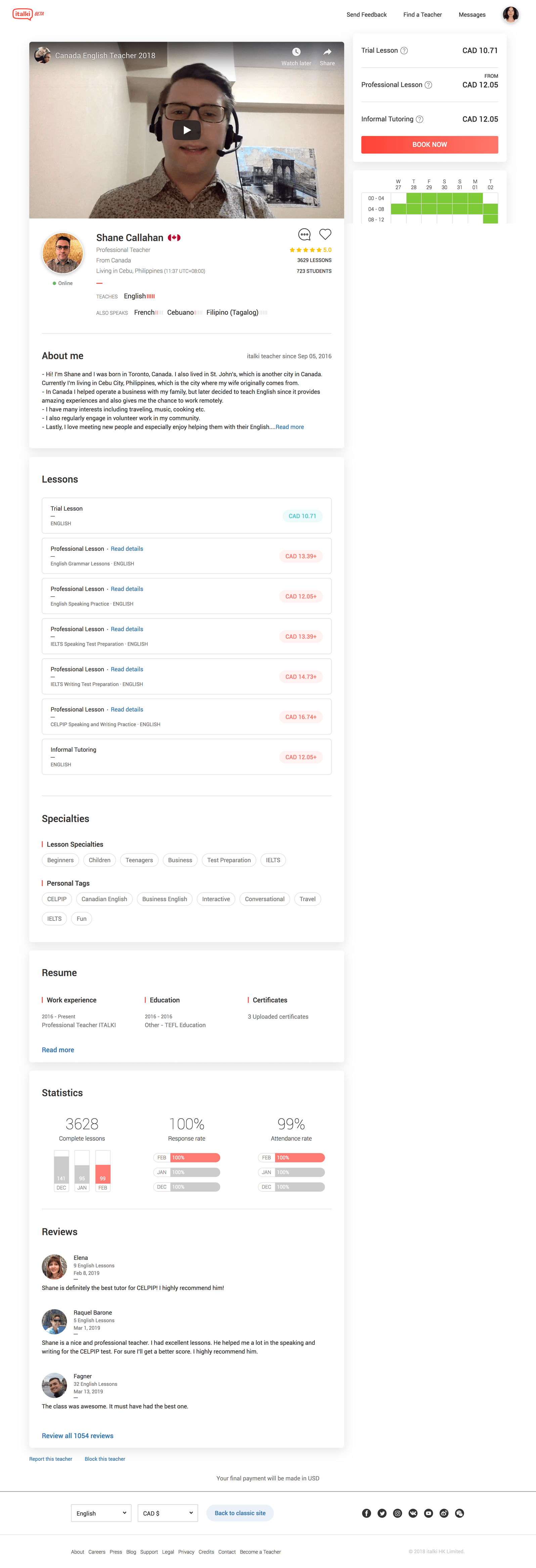
italki teacher: A sample profile
Since italki is focused on connecting language learners and teachers, it’s important to remember that your experience will depend on how you use it to interact with others. If you want to make the most of it, there are a few things you should keep in mind:
Think about Your Own Language Learning Goals
Do you want to learn a language in order to travel? Are you trying to pass a test?
There are a lot of teachers on italki and they all charge a different rate. I found that knowing my own language goals was one of the best factors in finding a good teacher, not price.
For instance, one of my reasons for learning Spanish is to have conversations with my Spanish-speaking, Latin American side of the family. So, when searching for a Spanish teacher on italki, I’m a bit more particular about finding someone who speaks Latin American Spanish and seems like someone I could easily talk to.
However, someone who wants to learn Spanish to travel to Spain or needs to pass the DELE Spanish Exam will have a better learning experience with a different teacher.
Once you’re a bit more clear on your own goals, you can use that information to help you pick a teacher. Pay special attention to:
Introduction videos
Teacher specialties
Lesson types
Reviews
To learn more about what you get for your money, read How Much Will You Pay For a Language Tutor?.
To Get The Best Italki Results: Be Patient and Prepared
Even if you think you’ve found a good teacher, you never know what a lesson might be like. You could find it hard to talk to each other or you might not care for their style of teaching.
Just remember that you won’t connect well with everyone. Don’t take it as a sign to give up. There’s nothing wrong with trying several teachers.
Starting a Brand New Language on italki
One thing that helped me was to be prepared ahead of time. My most recent italki lesson was for Arabic, a language I knew almost nothing about. Before the lesson started, I wrote down a few initial questions and made sure I had a notebook and pen nearby. I think even this small preparation helped me focus a bit more during the lesson, even though I didn’t feel confident.
Be conscious of any practical steps to need to take ahead of time as well, including finding a quiet room and making sure you have a fast, stable internet connection. It can go a long way in making sure your session goes smoothly.
Don’t Ignore the Other Italki Features
One-on-one lessons aren’t the only thing italki has to offer, but a lot of people either forget about or don’t bother with some of the other cool resources.
Improve Your Writing Skills With Feedback
Unter the Community tab of the main menu, you’ll find articles, a notebook to write things down in a language you’re learning, a place for questions and discussions, and a way to find conversation exchange partners.
If you’re interested in improving your writing skills, you’ll definitely want to try the notebook feature. You’ll be able to post an entry in your target language and native speakers have the option to give you feedback and corrections.
Similarly, you can check the Answers or Discussions pages if you have small questions or simply want to start a conversation. Any of these options is also a great opportunity to connect with others on the platform and find language exchange partners.
So, Should You Give Italki a Go?
Hopefully, this review has given you a bit more insight into how italki works and how you can make the most of its features to help you learn a language.
My honest advice is to start by making an account and simply searching for teachers. Take a look at the costs and click the small heart symbol to bookmark any teachers that you think might be a good fit. I’ll admit that I nervously did that for a bit before I finally took the chance and scheduled my first lesson.
The nice thing about italki is that you can just add a few italki credits and try it out. It’s not a big commitment, but it has a lot of potential to be extremely helpful.
italki: Better Than Your Local Class
Overall, I found the site incredibly easy to work with and much better than trying to find a class or a private tutor to connect with locally. So, if you think it might be a good resource for you, try at least one lesson. I think you’ll like your experience.
This review is part of a sponsorship from italki. It was written by Cassie Wright. To learn more about italki and get $10 of free lesson credit, go to www.fluentlanguage.co.uk/italki.



Struggling with listening? Discover realistic tips, challenge prompts, and the best tools for improving your listening skills as a self-guided language learner