
Who can I communicate with using Portuguese?
Portuguese Podcasts For Beginners and Intermediates
Top Recommendation: PortuguesePod101
Portuguese Language Podcasts For Advanced Learners
Portuguese Videos for Beginners and Intermediate Learners
Interested in other language podcasts?
Language Learning FAQ: Your Top Questions Answered

Oi, tudo bom?! Imagine the rich life you could live if you knew Portuguese.
You could interact with Portuguese speakers while…
- sunbathing on Rio’s praia de Ipanema and listening to samba.
- drinking port wine in Oporto on Friday.
- savoring bacalhau à portuguesa in Lisbon on Sunday.
- having fun at your neighborhood pub’s weekly language meetup.
Think these are just pipe dreams? Well, I’ve got good news for you. Just by listening to podcast episodes, you could learn enough Portuguese to converse with native speakers in a very short time.
Podcasts are super convenient to listen to on your daily commute or walk through the park. There are helpful and free podcasts for learners of all language skills. So, pop in those earbuds and open your favorite podcast app. Let’s get into our curated list of the 10 Best Podcasts for Learning Portuguese.
Extra Podcast Gem: The Fluent Show
In addition to the Portuguese podcasts you’ll find in this article, check out the Fluent Show. That’s my own podcast where we discuss languages, learning methods, and how to live a multilingual life. Click here to listen and subscribe.
Need Support On Your Portuguese Learning Journey?
Then make sure you join the Fluent Language newsletter right here! Subscribe now, and every week, I'll send you handpicked language learning tips right in your inbox.
Subscribe to Your Favorite Pod from the List
Listen on your favorite app like the Apple Podcasts app or Spotify.
Subscribe and listen to any of the podcasts recommended below so you don’t miss new episodes.
Some podcasts also post the episodes to YouTube if you are more comfortable with that app.
Leave a comment on a particular episode to interact with the host and other listeners (great extra practice for your Portuguese!).
Who can I communicate with using Portuguese?
Portuguese is spoken by over 250 million people in almost every continent. You could make friends online or travel to any of the following countries whose official language is Portuguese:
Brazil
Portugal
Cape Verde (Cabo Verde)
Angola
Mozambique
Equatorial Guinea (co-official with French and Spanish)
Guinea-Bissau
Sāo Tomé and Príncipe
East Timor (Timor-Leste) [co-official with Tetum]
Macau, China [co-official with Chinese and Macanese]
So what are you waiting for? Get in on the fun right away so you can start communicating with people all over the world. Vamo’ lá!
Portuguese Podcasts For Beginners and Intermediates
Top Recommendation: PortuguesePod101

PortuguesePod101.com (InnovativeLanguage)
This pod is a lot more than just a weekly updated audio lesson. It’s an online course, a YouTube channel, and a video podcast all under the same name. To get the most out of the site, I clicked the yellow “Join for Free” button and signed up using my email.

After signing up, you immediately gain access to hundreds of free lessons and resources.
Look forward to interesting lessons like:
“Shopping in Brazil: How Much is This?” An audio lesson that teaches you how to ask how much something is and understand different prices and numbers.
“Making an Appointment in Portuguese: Making Plans” Your friendly native speaker Paloma shows how to set up an appointment, and then breaks it down for the intermediate learners.
“Video Culture Class: Brazil Holiday: Ano Novo” You’ll see Paloma talk about the traditions of New Year’s Day. The food, the clothing, and the candomblé origin of making offerings to Iemanjá, the goddess of the seas. And don’t forget about jumping over 7 waves for good luck and love in the new year!
“Brazilian Beauty: Waterfalls” You’ll fall into a flowing dialogue broken down line by line, a vocab review, and cultural insights about the state of Paraná.
The beginner modules have over 75 lessons. Intermediate has over 100 lessons. Advanced has 50 lessons. There’s truly a ton of free material you can pick and choose from. Diagnostics interspersed throughout all levels will help give you good information on where your skill levels are.

Prefer structure? Go in order according to your level and complete one lesson a day to maintain your momentum.
Want to choose your own adventure with PortuguesePod101?
Pick any topic or dialogue that draws your attention–even if it’s more basic or challenging than you’re used to. See what sticks. See what you can handle. Have fun with the ole’ grab bag approach. Complete one a day to keep up with your good language learning habits.
CoffeeBreak Portuguese (Brazilian and European accent)

This series is so positive, effective, and welcoming that it wins my award for the PPP (Perfect Portuguese Podcast)! Twelve-year teacher Rafael, from São Paulo, and Scottish learner Ava start in straight away on real-life dialogues. As the listener, you accompany Ava on her year plus journey of saying basic intros like “Hi, how are you?” (“Oi, tudo bem?”) to describing her favorite aspects of Lisbon.
Each episode, you hear a conversation between 2 or more people (in accents from Brazil and Portugal), then Rafael and Ava break down and translate to English what you just heard, sentence by sentence. Here is where you get a lot of grammar and vocab questions answered.
The structure and invitational vibe of these episodes make it an obvious choice for beginners or any learner wanting a laid back review.
Brazilianing (Brazilian accent)

Dani is your personal and personable tutor who has created a fun mix of episodes ranging from grammar explanations about the subjunctive using song lyrics to talking about the culture of futebol. Sometimes she tells little 5 to 10-minute stories. In one episode she discusses the age-old debate on what it means to be “fluent.”
She speaks clearly and at a slightly slower than natural pace–perfect for beginners with a little bit of base. She’s super approachable (kind of like that high school Spanish teacher whose class you adored).
She even has a conversation club you can join with two different skill levels.
Fala, Gringo! (Brazilian accent)

Literally “Speak, Gringo!” it’s more like “What’s up, Gringo!” And don’t think this is a bad term for a foreigner. In this context it’s like a term of endearment.
Leni, your host, is a super affable dude. He speaks clearly with the beginner to intermediate learner in mind. His topics run the gamut and will keep your brain stimulated.
Here are just a few things his episodes cover:
Sex Education
Politics: Bolsonaro vs. Lula
Big Brother reality show
Is it safe to travel in Brazil?
The “Jeitinho Brasileiro” (the Brazilian Way), a very particular cultural concept
The literature of Clarice Lispector, a very important author
Each episode comes with complete transcripts.
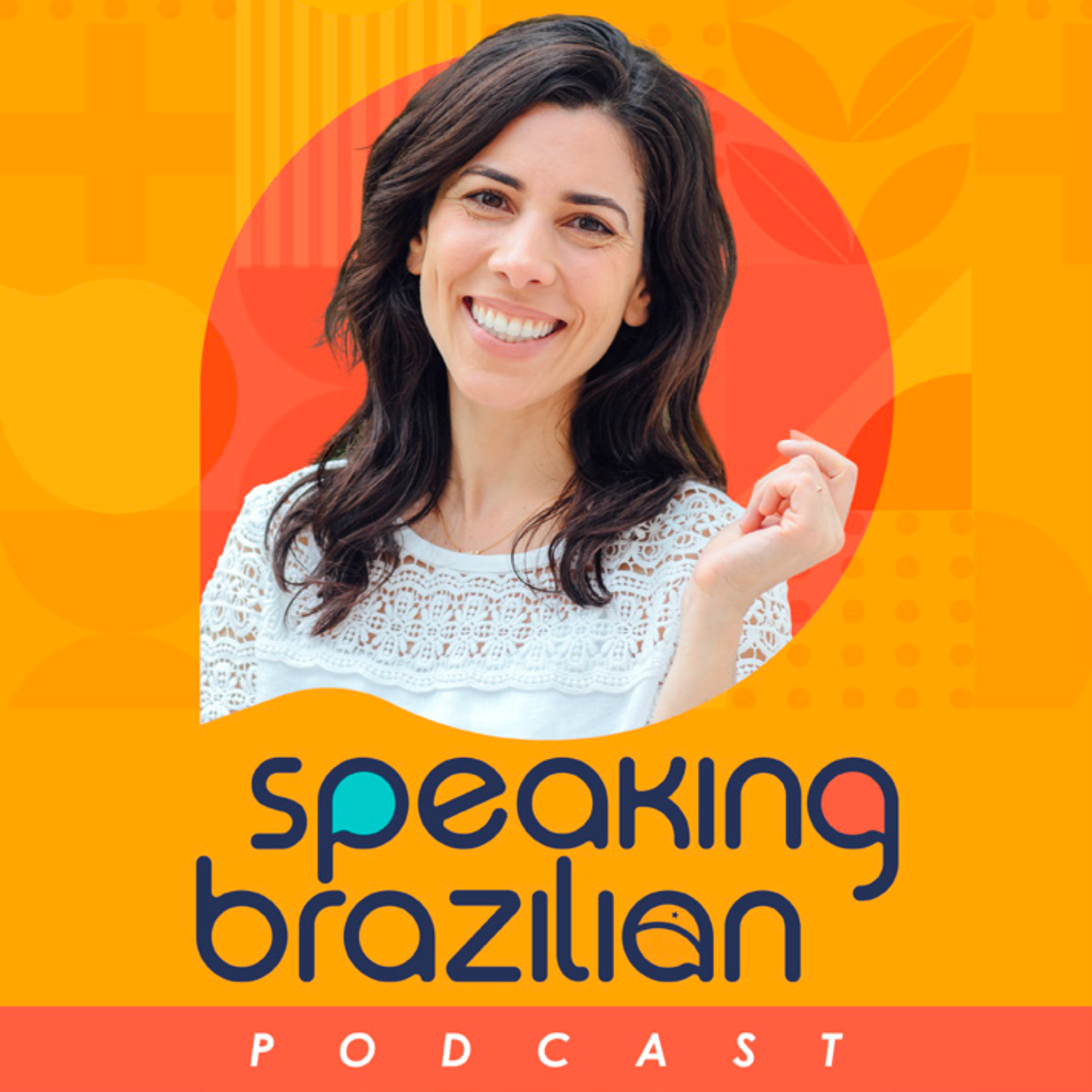
Impressively, Virginia Langhammer releases a new lesson every Wednesday. She also creates free lesson PDF’s for every episode. A particularly unique approach she takes on the first audio of 2025 is a shadowing technique where she has you repeat after her, focusing on imitating her accent.
She encourages her students (you!) to slow down the speed if you need to. In “Conversation Practice” she is your conversation partner and leaves gaps for you to answer her questions and ask her back. It’s great practice for beginners.
Virginia packs a big punch with what she offers, as her freebie page is full of resources for you to up your language level.

This might be a personal favorite. What I love about this podcast is that she speaks with guests that include non-native speakers who have successfully learned to communicate. Sílvia creates a friendly vibe that invites you to listen in on authentic conversations.
She keeps things optimistic, speaking about culture, language, and even mindset. In one episode we are invited to think about our reason for learning European Portuguese. That sort of coaching and self-reflection goes a long way to keep us students motivated. We are all busy, but Sílvia helps her students remember their why to give them language-learning wings.
Because I’m used to speaking with Brazilians, I usually have trouble understanding the Euro accent. But Sílvia speaks slowly and kindly enough that I am picking a ton! It’s making me much less anxious about my upcoming trip to Lisbon.
Portuguese Lab Podcast (European accent)

With 150 episodes, this series is excellent for beginners that love step-by-step structure. You can find full transcripts, vocabulary lists, and translation breakdowns on their website. Using the listen-and-repeat method, the 10-ish minute episodes resemble traditional curriculum topics like:
At the airport
At the supermarket
At the doctor
The difference between para and por
The difference between bem and bom
The difference between saber and conhecer
Whether you plan on taking a trip to Oporto or just want to have some structured learning, this podcast might be a good option for you.
Portuguese Language Podcasts For Advanced Learners

Sometimes learners who hit an intermediate plateau feel they are lacking authentic material to lift them out of the B2-C1 rut. Café da Manhā is created for native speakers so it presents an interesting challenge. A partnership between the daily newspaper Folha de São Paulo and Spotify (which you will need in order to access this rich series). This pod was the top recommendation from our Portuguese teacher as a way to train our listening skills.
If you want a good challenge and want to keep your ear trained, while keeping up with current events, this is a great choice. They provide hot takes on pop culture, social issues, and political news.
On March 10, 2025 the topic was “Ser mulher no Brasil de hoje” (“Being a woman in Brazil today”). It tells the story of Ms. Santos, an afro-Brazilian, 30-something mother and journalism student. She speaks about her dreams and life with her daughter, while the narrator chimes in to give context to the reality for other women in Brazil.
Não Inviabilize (Brazilian accent)

“A Laboratory of True Stories,” this podcast–with the most fabulous color scheme–is taking Brazilians by storm! According to their website, they have over 1 million listeners per month, over 900 stories published, and more than 370 million plays.
They have different “channels” like Pícole de Limāo (Lemon Popsicle), “o refresco ácido do seu dia” (the sour refreshment for your day), where they highlight funny, weird, every day tales like “Parque” about Carmen, a retired teacher, who would do exercise in the park. One day while on her outdoor stroll, she saw her brother-in-law’s car where she saw him in the back seat, but he wasn’t alone…

The important staff member at Não Inviabilize
These stories are real and cause real intrigue. There’s a ton of different genres such as their terror channel called “Luz Acesa” (“Light On”) or their love channel called “Amor Nas Redes” (“Love on the Socials”).
Their team is made up of fierce women as well as a gato named Coentro-Nenê who has a doctorate in “miados” (“meows”) and “ronronados” (“purrs”). 🐈⬛
Portuguese Videos for Beginners and Intermediate Learners
Easy Portuguese (Brazilian and European accents)
Easy Portuguese is much more effective as a listening and viewing experience. So, while not technically a traditional podcast you can still get a lot out of it even if you can only listen.

Easy Portuguese brings you a variety of fun street interviews with native (and some successful non-native) Lusophones.
You can choose from the following playlists:
Portuguese from Brazil (with 140 videos 🙂)
Portuguese from Portugal (unfortunately there’s only 7 videos 🙁)
Start Here for Absolute Beginners (37 videos)
Videos range from “What to Bring to a Carnival Block” to “Are You a Typical Portuguese?” There are subtitles in Portuguese and English. Plus, fun Instagram posts!
Interested in other language podcasts?
Interested in podcasts for other languages? We've got you covered! Explore our series of the 9 best podcasts:
9 Of The Best Podcasts For Learning Italian
9 Of The Best Podcasts For Learning French
Language Learning FAQ: Your Top Questions Answered
Can I Learn Basic Portuguese in 3 Months?
Yes, you can learn basic Portuguese skills in 3 months with consistent effort and the right approach.
Here are some tips to help you:
Set Clear Useful Goals: Define what “basic Portuguese” means for you. Choose an accent (Euro or Brazilian) and consider common phrases, basic grammar, and conversational skills.
Daily Practice: Dedicate a specific amount of time each day to study. Even 30 minutes can make a significant difference.
Spice it Up With New Tools: If you’re usually an app user, shake things up with videos and books. If you like to listen to podcasts, add some notebooks.
Set up a Language Learning Notebook: It’s the best, cheapest tool. Score extra points with this $9 course full of shortcuts and pro tips.
How To Learn A Language By Yourself
If you want to boost your motivation and stay on track as you study the Italian language, I recommend the Language Habit System®. This course gives you all the tools you need to plan your studies, track your progress and take stock of where you need to go next.
Click here to learn more about the Language Habit System®
Thank you to Joe Bommarito for writing this awesome guest post.
Joe is a language teacher and freelance content and copywriter. He’s taught students in the USA, Korea, Spain, and on iTalki. Two of his favorite activities are walking in the sun and listening to podcasts. If your paths cross, he’d love to get you a tasty cuppa coffee. Click here to get in touch with him.

