

italki Review: Find Your Online Language Teacher
Finding a good language teacher isn’t necessarily an easy task. For those who don’t have a lot of local tutoring options or for those learning a less popular language, it can sometimes feel impossible.
Maybe you’ve had no luck finding teachers or language exchange partners in the past and you’re wondering if online teaching sites are a good idea. Maybe you’ve thought about trying one before, but didn’t know which option to choose.
In this review, let’s take a look at what italki is all about, what it has to offer, and how to make the most of its features to help you connect with others.
What is italki?
In short, italki is an online platform that connects language learners with both professional teachers and community tutors.
Currently, there are over a hundred languages for learners to choose from, including German, Chinese, Catalan, Armenian, and Esperanto. Since all lessons are done online, there’s also greater chance you’ll be able to find someone who teaches a language you’d like to learn.
How Do You Use It?
Like lots of language learning resources, it sounds great, but how easy is it to use?
Setting up an account only takes a few minutes and it’s free. After that, you can simply select a language from search bar to start looking for a teacher.
Finding a Teacher on italki
One thing I liked about this process was the fact that I could review all the available teachers before commiting to a decision. Each teacher on italki has a profile with a video introduction, a short description, a list of their teaching strengths, a list of the type of lessons they offer, and different costs. Professional teachers will also have a list of education and experience.
Once you find a teacher you’d like to schedule a lesson with, you’ll have to purchase italki credits, which can be done at any time from one of the options in the top menu. It doesn’t take long and there are a few different payment options, but keep in mind that each option has a different processing fee. After you’ve added enough credits, you can schedule a lesson.
Booking a Language Lesson
The booking process is simple and straightforward. Clicking ‘Schedule Lesson’ opens a window that lets you pick the language, lesson time, and lesson duration. New italki accounts have the option to select a 30 minute trial lesson, which is meant to help you get used to scheduling lessons and using the platform. It’s also great if you’re feeling nervous about your first lesson. You can use the shorter time period to test your connection, see how things work, and ask the teacher any questions you might have.
Once you pick a date and time for your lesson based on the teacher’s availability, you can also select an alternate way to connect for your session, like via Skype. I’d recommend entering in this information since the italki classroom is currently still in beta and can experience glitches.
After your lesson is completed, italki will ask you to verify that the lesson took place. If you did experience any issues, you’ll want to let them know. Then, you can leave a review for your teacher to share your thoughts on how the lesson went.
How Can I Get the Most out of Italki?
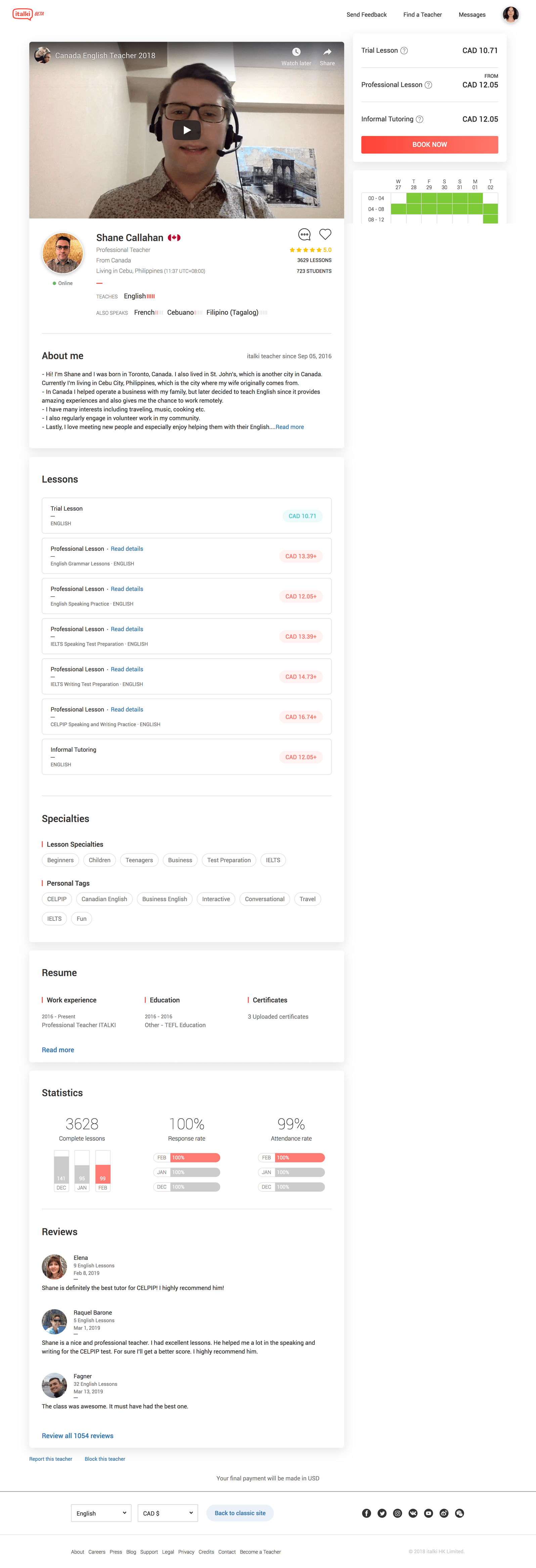
italki teacher: A sample profile
Since italki is focused on connecting language learners and teachers, it’s important to remember that your experience will depend on how you use it to interact with others. If you want to make the most of it, there are a few things you should keep in mind:
Think about Your Own Language Learning Goals
Do you want to learn a language in order to travel? Are you trying to pass a test?
There are a lot of teachers on italki and they all charge a different rate. I found that knowing my own language goals was one of the best factors in finding a good teacher, not price.
For instance, one of my reasons for learning Spanish is to have conversations with my Spanish-speaking, Latin American side of the family. So, when searching for a Spanish teacher on italki, I’m a bit more particular about finding someone who speaks Latin American Spanish and seems like someone I could easily talk to.
However, someone who wants to learn Spanish to travel to Spain or needs to pass the DELE Spanish Exam will have a better learning experience with a different teacher.
Once you’re a bit more clear on your own goals, you can use that information to help you pick a teacher. Pay special attention to:
Introduction videos
Teacher specialties
Lesson types
Reviews
To learn more about what you get for your money, read How Much Will You Pay For a Language Tutor?.
To Get The Best Italki Results: Be Patient and Prepared
Even if you think you’ve found a good teacher, you never know what a lesson might be like. You could find it hard to talk to each other or you might not care for their style of teaching.
Just remember that you won’t connect well with everyone. Don’t take it as a sign to give up. There’s nothing wrong with trying several teachers.
Starting a Brand New Language on italki
One thing that helped me was to be prepared ahead of time. My most recent italki lesson was for Arabic, a language I knew almost nothing about. Before the lesson started, I wrote down a few initial questions and made sure I had a notebook and pen nearby. I think even this small preparation helped me focus a bit more during the lesson, even though I didn’t feel confident.
Be conscious of any practical steps to need to take ahead of time as well, including finding a quiet room and making sure you have a fast, stable internet connection. It can go a long way in making sure your session goes smoothly.
Don’t Ignore the Other Italki Features
One-on-one lessons aren’t the only thing italki has to offer, but a lot of people either forget about or don’t bother with some of the other cool resources.
Improve Your Writing Skills With Feedback
Unter the Community tab of the main menu, you’ll find articles, a notebook to write things down in a language you’re learning, a place for questions and discussions, and a way to find conversation exchange partners.
If you’re interested in improving your writing skills, you’ll definitely want to try the notebook feature. You’ll be able to post an entry in your target language and native speakers have the option to give you feedback and corrections.
Similarly, you can check the Answers or Discussions pages if you have small questions or simply want to start a conversation. Any of these options is also a great opportunity to connect with others on the platform and find language exchange partners.
So, Should You Give Italki a Go?
Hopefully, this review has given you a bit more insight into how italki works and how you can make the most of its features to help you learn a language.
My honest advice is to start by making an account and simply searching for teachers. Take a look at the costs and click the small heart symbol to bookmark any teachers that you think might be a good fit. I’ll admit that I nervously did that for a bit before I finally took the chance and scheduled my first lesson.
The nice thing about italki is that you can just add a few italki credits and try it out. It’s not a big commitment, but it has a lot of potential to be extremely helpful.
italki: Better Than Your Local Class
Overall, I found the site incredibly easy to work with and much better than trying to find a class or a private tutor to connect with locally. So, if you think it might be a good resource for you, try at least one lesson. I think you’ll like your experience.
This review is part of a sponsorship from italki. It was written by Cassie Wright. To learn more about italki and get $10 of free lesson credit, go to www.fluentlanguage.co.uk/italki.

#clearthelist April 2019: Structured Chinese Goals

Hello and welcome to Clear The List, “that was the busiest month” edition. This monthly language learning round-up brings together my progress from last month and my goals for the next month.
What Happened in March 2019?
I feel like the correct answer to this one is “everything happened”. First of all, the month of March kicked off with the best possible start as I co-hosted Women in Language with Shannon Kennedy and Lindsay Williams.
The event was a big success, and we’re super proud to share that our online language conference brought in over 500 people from over 50 countries. Thank you so much if you were one of them. We cannot wait for the next Women in Language event!

After those 4 days of fun, it was time for me to start the engines for my new online course launch. It’s actually happening this week. My new German course German Uncovered is out on Thursday, and you can peek inside the course by joining a free mini-course too.
So that was a lot of course building and promo writing, talking about the German language and all round getting busy.

The month was not over yet, as there was important work to do. Say what you want about the Brexit: it certainly takes up a lot of mental space. I went on the People’s Vote March in London along with a peaceful million others and Gareth from How to Get Fluent.
Here’s a video showing our experience on the day:
So that’s a glimpse into March - a busy month!
The Fluent Show
With all that was going on, we didn’t miss a single episode of the Fluent Show.
One of my favourites was my interview with calm and centred language learner Nicole Miles, who shared rich insights into the deep motivations for learning a language…the kind that will fuel your progress long after the first weeks of excitement are over.
And talking of being in for the long run, let’s see whether I squeezed in a lot of language practice.
Language Goals and Progress
I’ve got to admit one thing right from the start: This month, tracking and lessons fell by the wayside and this makes today’s review a little harder. If I don’t keep track of what I do, I get to the end of the month with a vague sense of progress.
Did I study? Didn’t I? Did you? No one knows unless we write this down.
(Or maybe your mind is less of a sieve when you’re busy..)
As you know, my current beginner language is Mandarin Chinese.
Chinese Progress

A local café - perfect study space
My Chinese studies are progressing at a leisurely pace. After failing to find any Chinese self-study materials in the library, I decided to give the old 10 Minutes a Day another try and it’s been going fine in combination with the Drops app.
This month I learnt numbers 1-20, consolidated the basics, and got a little more to grips with classifiers like 张 and basics like rooms in a house. I have a Chinese speaking acquaintance in my Coworking space and am rather proud that I was able to say “Excuse me, where is the house?” and they understood me.
TRIUMPH.
I’m very close to booking my first Chinese lesson on italki, but haven’t quite got the courage together yet.
Welsh Progress
In the first two weeks of the month, Welsh took a step back as I worked on Chinese and Women in Language. But I started to miss it, so I feel like especially part two of the month was when I stepped it up.
I was not able to meet my goal of having more conversations on a grand scale, though I did
- chat to Gareth in Welsh on the protest in London,
- wear a Welsh flag at that protest and chat to a fellow flag wearer in Welsh,
- bump into my local conversation partner by coincidence.

YES!!!
This Welsh element of surprise made me a much worse speaker - it’s so much harder to speak another language without warning. But I got there and this kept me practicing.
I also said I’d finish Level 2 of Say Something in Welsh. And I did! I am very proud of this achievement.
Finally, I continued to listen to the Mynd am Beint Gyda podcast, started watching the TV show “Fferm Ffactor” (a farm-based games show, what could be more Welsh!), and got a habit of reading The BBC Cymru or parallel.cymru articles.
Welsh = going well!
Daily Contact Goal
Every month, I log my “daily contact” with the Welsh language. In total, March had 17 contact days out of 31 (and 12 of them in the last 2 weeks). I don’t track the length of each “contact”.
In Chinese, I track a goal of “10 minutes” with the language, rather than daily contact. This is because I’m such a beginner that I feel a 2-minute Chinese session wouldn’t teach me enough. All in all, I tracked 80 minutes of Chinese during March.
Since I use an app for this tracking method, it’s not 100% accurate. If you’re interested in a tracking template for your own language routine, check out the Language Habit Toolkit which contains two templates you can print or copy.
Goals for April 2019
I love April, it’s springtime and my birthday month!
Welsh Language Goals
My habit of learning/speaking Welsh is now well established, as you saw in March where I actually started missing my language practice. Wonderful!
I’ll trust myself to keep up the reading and listening by myself and will focus my goals on speaking practice. I must speak every week! Time to book more italki lessons and meet-ups with my local buddy.
Chinese Language Goals
In Chinese, I’m slowly building up to my usual structure of listening, speaking, reading and writing as a goal structure. Let’s try it!
Listening
I dabbled with Coffee Break Chinese for a little bit, but didn’t really fall in love with it. But with Chinese being a tonal language, it’s probably very important for me to listen to it lots. So here, my goal is to find and try some more materials starting with the Easy Mandarin series on Youtube.
Speaking
I can’t say much yet. My goal is to book an italki lesson but I’m not putting pressure on myself to do this at any cost. I’ll see if I feel like there would be any benefit.
Reading
Most of my materials are written and that’s the core of my practice at the moment, so all’s well here. I just aim to learn more, really.
Writing
My goal in Chinese is not about the characters at the moment, but I do find that I enjoy practicing a few of them here and there. The notebook is very helpful here, so my goal is to just spend a little more time practicing and playing here.
How Was Your Month?
As you can see, it’s possible to keep your goals light even if you do use the structure of listening, speaking, reading and writing. Have you ever tried it before?
Be sure to check out the Clear the List linkup for #clearthelist, hosted by Lindsay Williams and Shannon Kennedy.
So that’s it for this month. Leave a comment below to tell me all about how you’re getting on.

On The Need For Fun And Creativity In Languages

What do you think of when you see the word “creativity”?
For me, creativity used to mean being particularly gifted in visual arts. Painters and sculptors were creative. In school, it was clear that being creative was how you got good grades in art classes.
I was a pretty terrible artist, and so I always assumed that I’m not creative at all.
But then I got a job and started noticing things. In work meetings, ideas for alternative solutions to problems would bubble out of me. When I started teaching and learning languages on my own, I felt constrained by the ideas of learning with a textbook and classroom structure.
Instead of putting off my ideas as delusions, I started to listen to them and put a few into action. And slowly I realised…I’m creative after all!
You Have The Tools to Be a Creative Language Learner
My own discovery encouraged me to start looking differently at language learning. I quickly discovered that adults learn best when creativity and fun come along for the ride. So I started to seek out creative ideas of learning.
If you are a first-time solo language learner who’s busy in her life and wants to know how to become fluent without sacrificing all your leisure time, creativity is what will get you to your goals.
I know lots of people who start off and and think “learning is the books and the app”, and when you box your language learning in like that, your motivation suffers as a result.
Creative Ideas For Language Learning
In this episode of the Fluent Show, Lindsay and I discussed the easiest ways to start building a fun and creative language routine.
Listen to the show here to get our full discussion:
Warning: These may not feel like study, but you’ll learn a lot anyway.
Language Learning With Music
Research and discover songs in your target language and music from the target country. Learn new words and expressions by understanding the lyrics of the songs you listen to.
Playing Games
It’s a common theme on this blog: We learn best when we’re having fun. Playing word games like Taboo, or even classic board games in your target language gives you a subtle way of creating a space where you learn a few new words free from pressure.
When you’re on your own, video games create another interesting option for language learning, and some of them are even [developed with language learners in mind.]
Games are especially handy when you want to share your language with kids.
Poetry and Literature
You might think you have to be an advanced level language wizard before you can even touch a book of poems in your target language, but that is not true! Enjoy a story with tools like [Interlinear books], try your first ever haiku, or lose yourself in a rhyming dictionary.
The key here is to express yourself freely and have fun in the process, getting out of your head and into the feeling that you want to have.
Technology
It’s the 21st century, which means you’re more likely to be reading this on a phone than on a desktop computer right now. And that means it’s time to get creative with tech in your new language.
Lindsay recommends creating a language space in social media that’s dedicated to learning your target language, for example a “Norwegian only Instagram”. I’ve tried this too through Twitter lists. The result is fabulous: it’s instant mini lessons, whenever and wherever you want them.
Exercise
Movement boosts memory! Have you ever thought about combining a language workout with a body workout? We had lots of ideas in the podcast, like example looking for exercise videos in your target language, and taking a language podcast out on a jog.
This one’s great for teachers of any age group, too, as you can create a whole new lesson plan when you think about different ways of moving around your classroom (or outside!).
Bricolage / Crafts
For thousands of people, getting creative means creating cool craft projects like woodwork, scrapbooks, or small art. With craft projects, you have so many options of incorporating language.
Of course you can search online for videos and instructions in another language.
Or you could take printed items from the target country and use them to decorate your home. Or make special art pieces celebrating the words you love the most. Or create a photo essay based on inspiring expressions.
Listen to the podcast to hear more about the special things I created as a teenager (Lindsay calls them ransom notes!).
Cooking
Everybody’s got to eat, and most people have to cook. So what could be more practical than cooking yourself a meal in your target language? From seaweed scones to the secret cuisines of Paraguay, we’ve tried this out and recommend it whole-heartedly.
It’s SO Easy To Get Creative in Language
When it comes down to it, we found that it’s almost impossible to be anything BUT creative in language learning. Yet…many learners avoid getting involved.
Or when we do play and enjoy in our target language, we feel guilty as if this isn’t “proper learning”.
So this made Lindsay and me wonder: why the heck did school teach us that language learning has to look like classroom-exam-teacher-class-snoozefest?
STUDY and LEARNING are concepts that feel like they should look a certain way, when in reality they are not.
Creativity is about permission!
In the podcast, Lindsay and I looked deeper into this idea of permission and allowing ourselves to let go of language learning guilt. Guilt does not do us any favours at all so we should learn to let it go.
Whenever you feel like your activity is not “real learning”, it might be time to reconsider and remind yourself to:
- Accept our mistakes (both in language and process and habits and study)
- Be kinder to ourselves (does it really matter if we break a streak?)
- Impress NOBODY but ourselves
How do YOU get Creative in Language Learning?
Do you cook, craft, run, or rhyme with your target language? Or are you worried that these activities mean you won't learn anything?
Leave a comment below and hare your thoughts!

#clearthelist March 2019: Surprising Gigs, Welsh Friends, Big Things to Come
Clear the List is a monthly round-up of my language goals and progress. This month, read about
how I ended up at a political rally without noticing
how having friends is my language constant in Welsh
how to start learning Chinese (if you’re me, haha)

Welcome to the March edition of my #clearthelist goal tracking post. Clear The List is a support and accountability blog group sharing monthly language learning goals, hosted by my friends Lindsay and Shannon.
Anyone can join and you're welcome in the blog round-up. Lindsay has more information on how it works on her website.
What Happened in February 2019?
February is a short month and full of joy for me as one of the co-organisers of the Women in Language conference. I spent a big chunk of the month emailing speakers, creating a schedule and booking everyone in for their individual speaking slots. And then of course there’s marketing - I hope you spotted us on the blog or on a podcast you listen to.
As I write this, we’re just 2 days away from starting the conference. I’m feeling nervous and excited, and ready to enjoy 4 days of straight-up fun. All the information you need is at Womeninlanguage.com.
During this month, I also put together everything I need so I can open my new course German Uncovered in March. I am excited to be taking the first Fluent students and made a free mini course for all of you to enjoy. Sign up at www.german2019.com site to find out more about that one.
Surprising Gig Experience
February wasn’t all work. I took a fun trip to Cardiff (the Welsh capital) with my friend Gareth and saw a fab selection of bands for the Yes is More! gig. I attended for the bands…didn’t quite realise the gig’s political dimension as it was a Welsh independence campaign rally too!
Ending up dancing at a concert that supports an “independent, socialist Wales” is EXACTLY why I learn languages. It’s the kind of thing I would never ever get to do if I didn’t speak the language and let that pull me deeper under the surface of a country.
What language-based adventures have you had in your life?
And finally, I was excited to be commenting on Britain’s less impressive language news on BBC Radio 5 Live. Here’s a glimpse of their high tech local studio!
The Fluent Show
February’s episodes were fabulous - I shared the results of the big audience survey in episode 123 and got to bring you a brand new bilingual podcast. This time, I spoke French and English with Khady Ndoye who can teach us a lot about the many languages of Africa.
Listen to the bilingual episode about African languages here
Language Goals and Progress
As I mentioned above, the Women in Language conference is just 2 days away. So this time I’ll breeze through the goals and give you a very short summary.
extremely short summary: Chinese learning not terrible, Welsh learning mostly speaking practice.
Let’s take a quick look at my…
Welsh Language Progress
I’m only one lesson away from finishing level 2 of Say Something in Welsh. This level is 25 lessons long so once I get that done I’ll be at a GREAT milestone.
As I mentioned above, I visited Wales in February. That’s always a treat. Cardiff is mostly English speaking but there are always a few opportunities for Welsh practice too. Hanging out with Gareth from How to get fluent is great for me - not just because he’s another Welsh speaker but also because he’s a good friend.
I stayed at the YHA, where the staff wear badges to show their language skills, and one of the staff members had all her exchanges with me in Welsh. Which was awesome and confirmed that I’m fully functional in this language.
I also popped up to visit my friend Dafydd who patiently spoke Welsh with me even when I lazily switched to English. Diolch!
And finally, I also met with my local language exchange partner I found on Facebook, and texted and messaged several friends.
Now that I have built a network of Welsh speakers around me, it feels almost impossible to spend a month not using this language. This is such a positive development!
In terms of listening, I also listened to a full episodes of the Mynd am beint gyda.. show with Nicky Roberts. I can now listen while doing other stuff and still understand everything. Result!
Chinese Language Progress
Well, isn’t Chinese at a different level! This month I did meet my goals of
- starting a Chinese notebook
- going to the library to see what they have.
Sadly the library didn’t have anything useful in terms of traditional courses, so I continued to explore online and use apps. I listened to a few episodes of Coffee Break Chinese which I enjoyed lots.
Best new word of the month is definitely the Chinese for English: yīng gé lán 英格兰…because it sounds like the “In-ger-land” shout in New Order’s song ‘World in Motion’ which I love. 😅
Language Goals for March 2019
March looks like it’s going to be a month all about German with the new German course opening, but here are the goals I’m going to set myself.
Welsh Language Goals
- I’m keen to have more real conversations to develop my Welsh listening skills, so I hope to chat to friends every week on Skype or locally.
- I am 100% going to finish Level 2 of Say Something in Welsh!
- Listening needs more attention! Once again, Nicky’s podcast to the rescue. It’s great for my level, conversational with a good amount of English thrown in.
I miss reading in Welsh so I’m also going to start my next book, which is Ffenestri by Lois Arnold.
Chinese
I get the feeling it’s now time that I move on from the basics of “good, thank you, I am, you are, excuse me..” and towards some way of expressing myself in my target language.
I’ve also decided to focus less on the characters, as my first vision goal has been established: I want to understand what people say!
So my main work here will have to be on pronunciation and on lots of listening.
Here are a few things I hope to do:
- Purchase an audio-based course
- Make my first sentences in my notebook
- If there’s time, book my first Chinese lesson to try those sentences with a tutor
- Keep up with the apps I’m liking: Drops, Memrise, Lingodeer if there’s time.
So that’s it, my Clear the List report for the two languages I’m now learning at two very different levels.
By the way, if you’re interested in learning more about learning two languages at once, check out Abigail from Polyglot Process who is presenting at Women in Language. Her talk is going to be popular!
What Are Your Language Goals?
Have you studied two languages at very different levels? For me it’s not the first time, but it is the first time as a solo learner!
If you have ambitions in German, don’t forget to visit www.german2019.com where my free course is launching next month.
How was your February? Leave a comment below and share how you got on.

How to Fluently Switch From One Language To Another Language
Imagine you're on a train in Belgium. A woman on the train is speaking French on the phone when the ticket conductor comes in. She asks him a question in fluent Flemish. No one bats an eyelid.
Switching effortlessly between languages is a dream for many language learners. But how do you achieve it? Is it a realistic goal? In this article, read and hear my best tips for switching languages.
Imagine you're on a train in Belgium. A woman on the train is speaking French on the phone when the ticket conductor comes in. She asks him a question in fluent Flemish. No one bats an eyelid.
Or a guy at a party is chatting to his friends in Spanish, and suddenly an American friend comes in and he enthusiastically greets her in fluent English.

We've all seen it on TV or even in real life, but have you ever wondered how these super-quick switches between languages work?
Alessia, 17 from Verona has! She sent me this question to answer on the Fluent Show this week.
How to switch quickly from a language to another? Is it just a question of practice?
In answer to Alessia's question, I dove into a bunch of studies and came up with my best tips for anyone who wants to step up their switching.
Looking Into Switching Between Languages
Speedy switches like those I described above are a hallmark of bilingual people. Linguistically, doing this is is called “code switching”. It is very common and has been studied for decades.
Bilinguals do it naturally, for example in environments where there is more than one dominant language or native language. It happens all over the world and millions of people are able to speak bilingually.
Here are three ways you may experience code switching:
Switching a word might look like this: “Dw i’n teimlo yn rili rili wedi blino.“ (I am feeling really, really tired.)
Switching a phrase could be something like this: “Oui, ils offrent des part-time jobs dans leur société." (Yes, they offer part-time jobs at their company.)
Switching between languages after a few sentences, or even saying half a sentence in one and another half in the other.
When you switch into another word, phrase, or sentence, the switch is absolute and your brain is able to do this very quickly.
This has attracted the attention of phsychologists and neurologists too, studying and trying to measure what happens in our brain during such a switch.
Studies show: There are “neurocognitive costs”, for example slower response times. Your brain has to activate the second language (L2) and suppress your dominant main language (L1), and that means it has to concentrate and work hard.
The research also shows that these costs are lower when switching into L2 than when switching into L1. The brain patterns change as your expertise in L2 changes. It also changes depending on whether you’re able to predict that the switch is coming, and whether you’re switching individual words or full phrases.
To get started reading about all the fascinating research, check out the links at the bottom of this article.
How Can You Get Better at Language Switching?
As a learner, your goal might be to use your target language just as easily as you use your first language. But being able to switch like a bilingual person is NOT a good goal for your early language learning stages.
Use it as a vision goal, your inspiration and motivation source. But be honest with yourself and clear about the fact that it’s not going to happen in just a few months.
There’s a huge element of practice involved in switching languages quickly. Sorry, no one likes to hear that there isn’t a secret shortcut!
4 Ways To Practice For Switching
Tip 1: Practice phrases not words so that you build good muscle memory and you can ’think faster’ in your target language.
Tip 2: Listen to input in lots of languages and find bilingual materials too so you can process the language more quickly, for example parallel texts or bilingual podcasts.
Tip 3: Stick to one subject area and one type of conversation at first so you can direct your studies towards the goal of code switching
Here are my 3 Steps for Learning Topical Vocabulary
Tip 4: Practice in comfortable environments.
For example you could create an exercise with a trusted tutor that involves switching.
Or set up a language exchange. This involves switching by offering your skills to someone else and it's usually free. Often, exchanges switch languages after about half an hour, but to spice it up you could switch every 5 minutes.
The ‘price’ of Code Switching As a Bilingual
I’m bilingual in German and English, but make no mistake, my language quality suffers unless I practice.
Here are some of the annoying things that happen.
- My vocabulary in German becomes heavily influenced by my thinking in English and English sometimes shows through. I will use words that I know as dictionary translations of what I want to say in English, but they don’t feel casual enough for how I want to speak in German.
- My German isn’t up to date and I might mix in a word I used as a teenager or an expression that feels a bit 90s.
- English words that I say without thinking, like “actually”, find their way into my German sentences and just bubble up.
- My dialect is heavily reduced and I produce the German language as Hochdeutsch, which is not how I would speak in my home environment.
In other words, I speak an odd “international German”. I was recently called out for having an “englischen Akzent” by a former schoolmate who had not seen me for over a decade. That’s fairly embarrassing.
Episode Links
Study Shows How Bilinguals Switch Between Languages – Association for Psychological Science
Multidisciplinary Approaches to Code Switching - Google Books
Going in and out of languages: Article by François Grosjean and Joanne L. Miller, 1994
The Language Habit Toolkit — The All-in-One System For Meeting Your Goals in Language Learning
Conclusion: Language Shows Who You Are
It’s impossible not to be a product of your environment when it comes to how you speak.
To stay more active in German, I’m subscribing to a German magazine and watching more YouTube so that I hear German on a regular basis. But without living there, I lose a part of my authenticity in German.
Have you ever practiced switching from one language of another? Do you think there's a price to being bilingual?
Leave a comment below to share your thoughts!



Struggling with listening? Discover realistic tips, challenge prompts, and the best tools for improving your listening skills as a self-guided language learner