
French for Beginners: Regular Verbs
This post contains the video and reference materials for French on a Windowsill Ep. 05: The one about regular verbs. All standard conjugations are covered. Enjoy!
Hello everybody, after a bit of a break for learning to talk a bit in 25 languages, French on a Windowsill returns! And this time, I bring you regular verbs. Along with some useful grammar hints about verbs, conjugation and stem + ending, you will get to know the 3 groups of regular verbs in French.
Here are your reference materials:
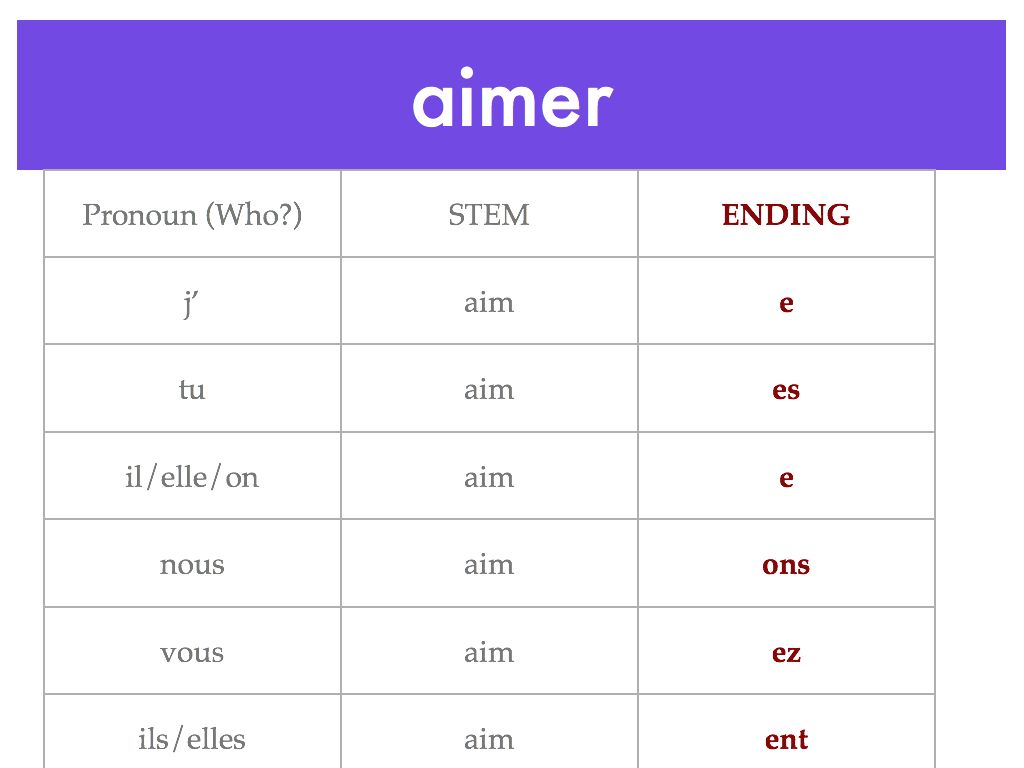
Regular verbs that end in -er
These are pretty common, and the conjugation is fairly conistent as well with a few small exceptions for pronunciation. You follow this ending pattern:
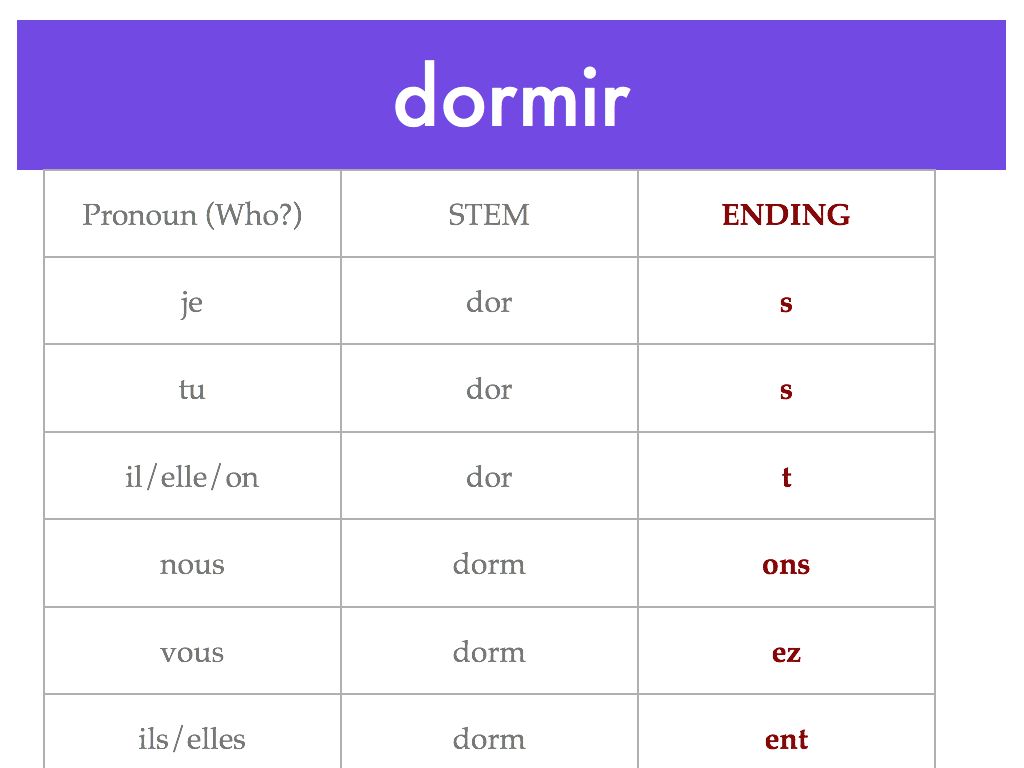
Regular verbs that end in -ir
What's interesting here is that in the first three conjugations you actually chop a letter off the stem, but then it comes back. If your stem ends in a vowel then you add a double s in the last three conjugations (for example with the verb finir). Here is the pattern:
Regular verbs that end in -re
The third group does have a regular conjugation, but do spend some time hugging the dictionary or Bescherelle* because a lot of verbs that end in -re are irregular. Need I say être or faire? But don't be disheartened, because knowing the regular conjugation means you couldn't go too wrong even if you tried:

Some of the vocab featured in this episode:
chanter (to sing)
aimer (to love)
manger (to eat)
commencer (to start)
tutoyer (to be on "tu" terms)
dormir (to sleep)
finir (to finish)
attendre (to wait)
déscendre (to descend, to come down)
Let me know what you think of the episode, as always I hope that this is useful stuff and I'm really looking forward to any feedback you guys might have.
*You may have noticed the link to the Bescherelle leads you to Book Depository. This is an online bookstore fit to rival the big A in many ways, often their prices are in fact lower, and international delivery is largely free. Click on the little link above if you want to support French on a Windowsill as an Affiliate.
Language Learning Motivation: What Drives You?

Image source: Morguefile
There's been an awful lot of research into language learning motivation, with scholarly articles, curriculum changes and millions of research funding spent on working out what makes us learners tick. Motivation is one of the most significant factors for successful language learning, so there is a lot of value in sitting down and having about yourself and what makes you tick. Here are my ideas about the motivation groups - which camp are you in?
2 camps of learners
To me, there are two key camps, let's call them Camp Requirement and Camp Acquisition. Those who learn for a practical application and out of necessity. They may not feel the joy of learning a language from the word Go, but keep going anyway because they are working towards a clear goal. They have the motivation of requirement.
And those who learn because they are curious about a language and simply learning because they want to get good at this. These guys often love the process of learning just as much as applying their new knowledge and will feel happy with the "lifelong learner" label. They have the motivation of acquisition.
None of these types of motivation is any more valid than the other, and I don't believe that either one will make you a better, more skilled learner. It's simply important to understand your driving forces. Be clear about why you are in this learning process. Make sure your motivation is clear to you, and you'll find it will help you kick through those dips and keep going even in the boring drills. If you have a tutor or teacher, why not try and catch them for a conversation about what motivates you and gets you going. That way, they may be able to support you better - even a busy school teacher is likely to jump at that chance of understanding how to get more out of a student.
No Success without Motivation
You have GOT to stay motivated, you have got to stay excited or keen about learning your target language. This is the only way that you will actually look for chances to speak, you'll listen to things you only half understand and in effect the only way that you can keep going once the lesson is over and you have a whole week to forget all you've just been told.
For me as a language tutor, this brings in an extra responsibility. It's my job to understand, as well as I can, the motivations of my students and help them work towards goals that are important to them. Teachers may sometimes make assumptions about language learners which don't match up with their own inner drivers, and that results in both steering in different directions. I want to make sure that I understand where my students stand, so I'll be my best at supporting them reach their goals, and at facilitating a real sense of achievement.
My Allegiances
I have drawn you a little graph to show just how much variation I find in my own language learning motivations:
You can see how far I was in Camp Acquisition at some points, for example when I took Italian. That was my third language, it was an optional offer, afternoon lessons at school doing something new and fun, with friends - I was in it for social reasons. Later when I took Spanish, the main motivation was more about where it was in my curriculum and my career. I wasn't desperate for another new language, but there was a clearer requirement. These days, my lifelong learner is very keen and I'd say it's nearly all that drives my Russian learning.
This was actually a bit tougher to work out than I thought. It's a great exercise to have a little think about the question "Why is it that I'm putting the effort into this language?" Be clear with your answer about this question and review it on a regular basis. What is your personal language learning driver?
French for Beginners: Pronouns and Verbs
I do use a lot of grammar nerd words, please don't let that scare you off. I want to explain them all in simple terms to make it easy for you to understand these!
Exciting new French on a Windowsill - enjoy, and as ever please do share and comment as I love hearing what people think.
Five Myths about Language Learning: Myth 5
What do you mean, there aren't any jobs out there? In this post, Fluent demolishes the fifth language myths and compiles some great tips for getting the edge in your job search.
A foreign language won't get me into a job
Yes, we've arrived at the final myth about language learning. With all the talk of A-Levels and employability after college and university at the moment, it's more than time we dispersed with this one as well. I can see how, with English being considered the worldwide lingua franca of business, it would seem far from necessary to learn any foreign language in order to get a job. And I think that's not wrong, it's just missing the point. The mastery of a language alone is never enough for an employer who wants a creative, open-minded, dedicated candidate in front of them.

These guys use languages in their career.
In job applications, you do well to mention your intercultural awareness, advanced communication skills and analytical mind as key characteristics. If someone asked me to evidence those, the first thing I'd say would be that I speak three languages fluently and I've picked up the basics of at least five others in under 2 hours. It almost goes without saying that you're likely to excel in teamwork too if you've spent a lot of time practising how to express yourself and listen to others.
The UK economy is full of businesses that want to take advantage of international markets, and all you need to do is launch yourself into it. One of the consequences of globalisation is that more and more jobs will involve you dealing with people in other countries, bidding for projects somewhere abroad and having to travel. Employers will want to know that you are adaptable to different people and environments, and what better evidence than time spent abroad, or hosting an exchange student from a different country?
Finally, what interviewer won't love a candidate who can illustrate his or her dedication through pointing out how they've studied their other language for 7 years now?
The secret is this: Think about what language learning teaches you beyond just a language, then think about your passion and whether your dream employer works internationally. No matter if you are into fashion or fishing, you're likely to think of a use for your multilingual mastery straight away.
Five myths about language learning: Myth 4
Why bother when everyone speaks English anyway?
Okay, so before I sit down and watch the highlights of last night's opening of the London Olympics, I had better get this blog post covered. Not lastly, the topic of our Myth 4 is rendered pretty current by such an international event, because now we're looking at one of Britain's absolute favourite reasons to avoid language learning: the belief that "everyone speaks English". Some of the parties that like to promote this myth are tabloid papers, right-wing politicians (often guising it as "holy crap! people dare enter our country and bring their own languages!") and, scarily enough, some of the learners themselves.
Language learning is about connecting with people, making your own life easier and understanding more about how people express themselves and what for. It should go way beyond parroting "Where is the supermarket?" and "I have a brother and two sisters", and be seen as a way of reflectively engaging with how people communicate. If you're only ever going to view another language as a means of obtaining basic necessities during a brief stay abroad as a tourist, then you're losing 90% of the benefit. Take, for example, the intricate system of Japanese honorifics or the special German terms referring to 20th century history (Ossi, Wessi, Ostalgie etc). Language evolves with society, and that's what's amazing about it: You'll get to know another place's history, values, food, traditions and so much more. And you don't even have to travel there.


Or you would love to cycle through Spain, haggle 40% off a cashmere scarf from your local Indian market stall, get in touch with your Gaelic roots? It certainly worked for me, studying my way through the lyrics of Pulp's whole musical oevre with a dictionary by my side.
One final point: Yes, a very large part of the world now learns English as a second language. It's an also-ran official language in countries like India, Nigeria and Cyprus. Having said that, this doesn't mean that it is the international community's preferred language. Even the British Foreign Office seem to have recognised that you miss out if you're the monolingual guest at the world's multilingual party. The amount of literature, film, theatre and music from another country that doesn't even make it into an English-speaking country is staggering. It's like looking at a painting and only seeing one colour.
Luckily, the many other positive reasons for picking up a foreign language are only a google away. No one says that this is something you have to do, but just think how fun and enriching it would be to start seeing in colour.




Struggling with listening? Discover realistic tips, challenge prompts, and the best tools for improving your listening skills as a self-guided language learner