
De-Brief From An Organiser: Women in Language 2018

A few weeks ago, I was proud to co-organise and witness the first ever Women in Language conference, a unique online event designed to champion, celebrate, and amplify the voices of women in language learning. It was not my first online conference about language learning, but certainly the first I partly created and the first one ever to feature an all-female line-up of speakers.
In today’s article, I am going to lift the curtain and share my official de-brief as one of the three members of our organising team.
What I Felt at Women in Language
Let me start with the most important thing: I enjoyed every single presentation that I saw. And as I was often online making sure everything went smoothly, those were almost all of them. The quality of our many speakers at Women in Language was excellent, and the range of topics kept things interesting and inspiring.
Women in Language delivered on a few extra levels too. It felt as inspiring and intense as every offline conference could feel, with the added bonus of allowing me to sleep in my own bed. I adored seeing #womeninlanguage posts on social media, and to hear from our attendees in the live chat and Facebook group. And most importantly, I got SO inspired and motivated to learn languages in a brand new way!
What I Learnt About Language Learning
A lot of the impact of four days of language love cannot be put into words. It’s a boost in motivation, a renewed commitment, a burst of energy. And at Women in Language, I got all of those out of it and more. I got to know more of our conference attendees and boosted my own desire to learn and teach languages in new ways.
Here are the most important lessons from Women in Language that will be essential for all language learners:
1) Dabbling Is Legit
At Women in Language, we celebrated the huge diversity of how people learn languages. You can choose whatever language you want to learn, and you can learn it for 2 weeks or 20 years, and you can dabble in a handful of languages at once if you want to. This is all “allowed”, and won’t make you any less of a language lover or polyglot.
Sometimes it’s easy to feel self-critical as a language learner, and to tell yourself that you’re doing this wrong if you don’t use Anki or speak from day 1 or spend many hours on your project. But dabbling is perfectly legit, and you are allowed to feel proud of it.
2) Compassion Matters
Leading on from the previous point, compassion was a regular theme of the conference. When you’re faced with so many blog articles and Instagram posts and YouTube videos and language books telling you what to do, it’s sometimes hard to remember that everyone has a bad day.
You can’t always be happy and you can’t always be 100% gold in Duolingo. Compassion means allowing understanding and empathy for yourself when times are tough, but also for other language learners. No one method is the right one. Allow other people to feel good about themselves, and extend that same kindness to yourself.
3) Everyone Loves Transcribed Audio
Finding something interesting to watch or listen to, at the right level, and then with a transcription…that’s difficult. But it’s also what a lot of our conference attendees wanted, and you certainly CAN find it online. If you want to get a few ideas, check out Speechling, Glossika, Rhinospike, and Movieclips on YouTube.
And by the way: Just listening is NOT enough. If it’s just a wall of sound, you’re not doing much good. You’ll need to know what you’re hearing. Find input that you can engage with, and check against your own skills. For more about this, listen to my podcast episode about listening skills.
4) There’s So Much to Talk About
It’s never enough to practice speaking by doing the “Hello how are you where do you live” dance over and over again. Speaking practice is best when you’ve prepared something interesting to talk about. And lucky for us, there are tutors and learners who already discovered this too, and they’ve even put together lists (like this one) of questions and conversation prompts.
5) When Your Brain Is Having Fun, You Learn
All too often we think of language learning as a STUDY activity, in all caps. But it’s just not necessary to do things this way. Language can be learnt through story, through fun activities, through play. The most important things are exposure and repetition, not how hard you study or how much your language experience feels like work.
Though some of these lessons may read as happy-clappy positivity notes, I found that they often helped to ease a learner’s mind and allow them to take a break and come back to language learning with new energy and enthusiasm. After all, we want to get fluent while having fun, right?
What Do You Think?
Whether you attended Women in Language 2018 or not, what do you think about those lessons above? Are you a dabbler, or a hardcore study nut? Leave me a comment below to join the conversation.
In part 2 of this blog article, I will put on my co-organiser hat (a very stylish hat, for sure) to tell you more about how Women in Language was organised, what we learnt in the process, and what you should consider if you want to run or contribute to an event like this in future.
Organising A Successful Online Conference
I’ll start with what we looked for in our speakers and talks.
For this first ever conference, we used our own network of interesting women to ask if they wanted to speak at Women in Language. Their social media accounts, blogs, youtube channels, relationships with us were what put them on the radar. So if you’re dreaming of speaking out yourselves, making yourself very visible is good advice.
Before contacting our speakers, we considered some guidelines about the types of talks we would be looking for. In addition to practical topics featuring tips and techniques for language learners at “Beginner” and “Advanced” levels, we also chose the tracks “Living with Language” and “Working with Language”. Each speaker we contacted let us know which of the four themes they would like to address in their presentation, and was allocated one. This way, we ensured that no topics would be repeated and we could offer a varied programme on every single conference day.
Here are just three of the 25 talks we saw at Women in Language:


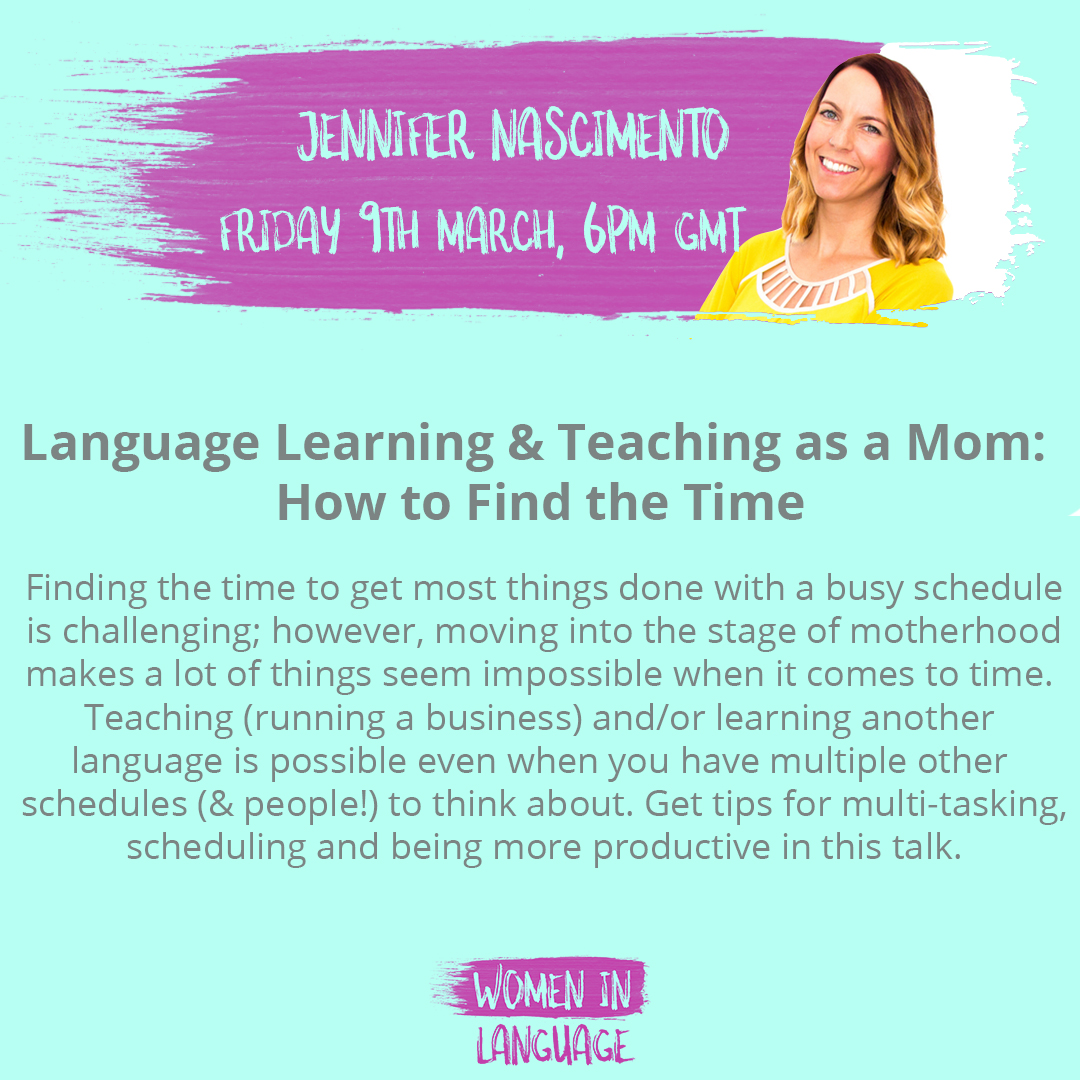
Some of our speakers came to us with a firm idea of the talk they wanted to present, while others found themselves unsure at the start. As our programme officer, I found myself receiving several messages saying “I don’t know, maybe I have nothing to say after all.” If you have ever hesitated to put yourself forward for an opportunity, here is the thought process that does stop them in their tracks: “Maybe I don’t have anything to say here.” Meaning “Maybe my experience, my voice, my passion are not valid. Others will have more to say.”
I extended offers of a little “talk surgery” to those who needed an idea boost, and without exception it was the speakers themselves who came to me with fantastic topic ideas, and who delivered on them 100%. In fact, I found that the most intriguing topics came from a place of passion and excitement in each speaker’s mind. Topics like “Learning With Crime Novels” and “Managing Motherhood and Language Learnings” are not a language learner’s most burning question, but that’s exactly why they make incredible conference topics: They are real, and invite us to think differently.
Some People Voiced Different Opinions
I won’t lie to you, at times it felt hard to be out there putting together this positive, kinda feminist event. Some commenters felt that it was a wrong move towards equality, unnecessarily excluding male voices. To those guys, I want to remind you that we welcomed and celebrated male voices throughout the event - it’s just that this time only women got to speak “on stage”, and every single one of them brought expertise, commitment, quality, enthusiasm, and outstanding topics. We set out to show the language learning world from a different angle, and I was so encouraged to hear from several male attendees who were enjoying the conference just as much as everyone else.
If You Want To Be a Conference Speaker
If you are considering applying to speak at a language conference, please don’t hesitate. Even if you were to hear a no, don’t worry and keep putting yourself forward - maybe the programme is full already or the conference can recommend a future event for you to try.
Don’t be shy about suggesting a topic outside the memory-boosting-fluency-fast-track-performance mainstream. Don’t wait until you’re fluent in 16 languages. You’re good enough right now, as long as you have a cool topic. And what’s a cool topic? Your own experience!
You are so cool when you are yourself.
I want to give kudos here to all those women who agreed to speak and trusted Shannon, Lindsay, and me with Women in Language. You absolutely killed it, and we appreciate all the hard work you put into giving a great online talk at an event you’d never heard of before.
Many of our speakers were new to presenting online. From my perspective as a blogger and podcaster, I’m used to speaking to an empty room and waiting until later to see if anyone connects with my words. But these guys were new to the whole environment, and they handled it brilliantly.
Tickets
When we put together our event, we knew that it was a risk to ask for payment from attendees of an online event. Many other online events are open to attendees for free, but we wanted to create an atmosphere where the sales pressure is off, and where our audience members were just as invested in having a great time as we were.

We found that the ticket sales achieved this goal, and allowed over 250 audience members to join us from all over the world. This reassurance also helped us relax and increase our commitment to Women in Language. So on the ticket selling front, we are happy to note that all went well and we are now able to give a donation of over $400 to our chosen charity, Kiva. The charity supports entrepreneurs who do cool things to alleviate poverty around the world.
Here I want to say thank you to our audience members, who went ahead and trusted us organisers with a brand new conference idea. Some purchased a ticket and even took time off work, others were unable to attend but joined the conference to support celebrating and amplifying women’s voices in language learning. We appreciated your trust and support.
About The Technology We Used
In terms of technology, we used a setup of Google Hangouts on Air for our live broadcasts and embedded them in individual Teachable lectures via YouTube. We also added individual Chatango chat boxes in each lecture.
At the end of any session, the viewers could click “Complete and Continue” at the top and move on to the next session in our packed programme. Credit here goes to Shannon for leading us on the setup of a gorgeous page and ensuring the information was up to date.

Inside Women in Language
Combining technologies to create the conference experience
This format added to the feel of hosting a real conference, where you would often walk into the next room for another talk. But in addition, it made us into the Netflix of language learning, where any previous talk could be streamed from the beginning right after it was published.
All talks were offered on a single track (no two at the same time), which kept the conversation focused and helped create a live chatroom community. We also added an “after hours” experience through a dedicated Facebook group for Women in Language attendees.
Marketing Women in Language
Our marketing campaign, headed up by Lindsay, made it easy for Women in Language to get seen. We obviously talked about Women in Language in our own blog, podcasts, social media, newsletters, youtube, and wherever you see us.
Lindsay also prepared some beautiful pictures and tweets for the speakers and the attendees, so that everyone could easily spread the word about our event. We are so grateful that you guys supported us and shared your excitement before the event. It helped us so much.
Shout out to our friends How To Get Fluent, Language Learning Summit and Langfest for inviting us to present our new event, and to Mezzofanti Guild for hosting a guest post written by Shannon. Check those guys out - they are doing amazing work.
The Organising Team
Between three organisers, we found that we were able to play to our strengths and largely handle the large workload of running a conference like this one. We stayed in contact with each other through direct messages, but also weekly meetings, and the project management software Asana. When your organising team is living on three different continents, it’s helpful to ensure online communications are as good as they can be.
Our track record of collaborations was a key to our success. Lindsay, Shannon, and I were no strangers to each other’s work. We knew already that we appreciate each other’s work and that each of us knows how to use all parts of the technology and marketing setup. We had also met in person before and solidified our friendship. Throughout the organising process, we were able to stay supportive and open to suggestions from each other.
Sometimes, it can take courage and grace to reach out to a colleague and trust that they’re on board with your idea. From the minute Lindsay first mentioned the idea of Women in Language and Shannon hopped on the first Skype call to join us, that was something we committed to.
I am grateful that I had the opportunity to run such a cool project with two colleagues and friends that I respect so much.
What We’ll Do Even Better Next Time
So we were excited, we were buzzing, we enjoyed four days of a successful conference full of tips. But that doesn’t mean that there weren’t any mistakes to learn from.
On the technology front, a few hiccups taught us the following lessons. Maybe you’ll find them useful one day, so I’m sharing them here:
- When you want to embed your YouTube events in another page, it pays to set up a dry run so that you’re double sure the embed will show up the way you want it to.
- When you are planning to invite someone to a Google Hangout, you cannot send them a “join link” in advance because the software will discard that link the minute you close the video window in your browser. And then your speaker’s link will be useless and they’ll be confused.
- Don’t click “eject” when you want to reset your Hangouts partner’s setup as they joined your Google Hangout. They won’t be able to join again, and you’ll have to create a new event.
- Power Point going full screen in Google Hangouts is a bit of a gamble, so stay calm, have a dry run, and prepare trouble shooting notes to make sure all goes smoothly.
In terms of the programme, we tried a new format of round table discussions which was successful at large. The two-hour time slot did discourage some audience members from watching it though, and that’s something I had not expected and we will look into providing shorter round table discussions next time.
Finally: I feel fired up to expand our commitment to diversity and ensure we include more global voices. Our line-up was international but still looked largely like us: white women who speak English a lot. Even if each of them is different in nationality or language line-up, this still gives our attendees an unintentional impression of what the “norm” is. We can add to that during future events, and I’m excited that we now have 27 speakers who can help us grow our network and look for polyglots and language experts from more diverse backgrounds.
What About You?
Did you enjoy the online conference?
Have you ever thought about becoming a conference speaker?
I’d love to hear from you in the comments below.
Robo-Tutors and Translating Megaphones: It's the Future of Language Learning
What does the future hold for language learners?
When a device translates what you say directly into another language, is there even a need to learn languages anymore?
In this podcast, we've got everything you need to know about
- Gadgets and stuff that translates our language into other languages
- How AI has made language learning apps a lot more useful
- Virtual Reality and Augmented Reality as learning aids

Welcome, weary language learner. Your brain might be tired after reviewing vocab lists for hours. Your voice is straining to pronounce strange foreign sounds. Your mind longs for a miracle.
Behold, we have uncovered the future of language learning. In today's podcast, it's all about technology, brain power, and everything that you need to know to stay ahead of the curve.
Listen in and don't forget to leave us a rating and a review on your iTunes-enabled futurephone.
The Future of Language Learning
When a device translates what you say directly into another language, is there even a need to learn languages anymore?
We discuss
- Gadgets and stuff that translates our language into other languages
- How AI has made language learning apps a lot more useful
- Virtual Reality and Augmented Reality as learning aids
Gadgets That Translate
Think the dream of the universal translator, like in Star Trek.
Some gadgets still look like very early things in the making (the megaphone and the pixel buds) - will they ever be able to get over the hurdles of being in the way of human interaction and spoken nuances?
Question for you, listener: Would you want Siri to dub all your movies? Would you want it to dub your world?
Virtual Reality and Augmented Reality
This is where it gets interesting!
Artificial Intelligence (AI):
Things like the new Glossika bring reactive learning to what used to be a book, adapt to how quickly you say you learn something. SRS is an old system that also aided our learning on paper, but assisted beautifully by technology
Our verdict on AI is that it's useful, here to stay, and more utility than fun.
Augmented Reality (AR):
AR can add interest and fun, can enhance your learning experience and do what we often dream of: make the language more RELEVANT
- You can have a lot of fun with the Flashsticks & Memrise apps
- Wearables are coming, though they’re not quite here yet.
- My paranoid self is worried that I’m 3 years away from having a chip implanted into my brain.
Virtual Reality (VR):
This is where you wear a headset (often a curiously named "Oculus Rift") that can give you immersive experiences in a digital world. Language company Mondly is working on a VR app for language learners. We weren't 100% convinced.
A few more points to think about..
Communities
How does the online world influence us when it comes to learning languages? Are people boasting on YouTube motivating, is online community a new type of community?
People have always met and connected based on their interests, but isolation has been reduced by the internet.
How will social media look in the future?
Many Questions Remain..
On the show we concluded by answering the most important one...will it ever be possible to learn a language in 3 weeks?
Are you a futurist? What do you think the future of language learning looks like? Give us a shout in the comments below and share your vision.
Your Intuition is Wrong about Learning Languages
Do you have a vague feeling that you're too old to learn a language?
Are you still looking for the best way to do this?
Or do you just....feel like you're never quite doing enough?
Then we have the show for you!! Hit play now and check out episode 69 of the Creative Language Learning Podcast
Do you have a vague feeling that you're too old to learn a language?
Are you still looking for the best way to do this?
Or do you just....feel like you're never quite doing enough?
Then we have the show for you!! Hit play now and check out episode 69 of the Creative Language Learning Podcast
(Beware listeners: This episode contains a discussion of a few English swearwords, so if you want to avoid them please skip the first 20 minutes.)
Here's wbat's on the show this week:

Language Stories: Lindsay has a new podcast, reporting back from her adventures around the language landscapes of cities like Montréal, New York, and more.
Even after 20 years of English, I still don't know all the words. We discuss an English slang word that was news to me.
The Psychology of Rewards
We discussed why and how you can reward yourself when you reach those study goals.
Here are a few ideas from the super cool Fluent Language Learners community on Facebook:
Treat Yourself as a Reward
- Enjoy a coffee and take some time out in a café, watch the people, and take in the atmosphere
- Read a good book...maybe in your target language, maybe a bilingual text
- Treat yourself to some new stationery
- Go out and explore where speakers of your language hang out, for example if your city has an area where you can find ethnic food and goods
- Go to a concert or have a kitchen dance party
Enjoy the Rewards of Successful Language Learning
- Enjoy the happy glow of passing a certificate or good grade (Carlos), or the good feeling of completing a project
- Allow yourself a moment to recognise how much you have achieved
Some group members said that they never feel like they reach their goals. If this is you, check out our podcast for tips and thoughts on how you can reframe rewards and make them work for you.
Language Learning Misconceptions
What are the most common misconceptions, and which one is your (and my) top one?
There is even a Wikipedia article about this.
Some of them are intuitive and easy to accept, and some of them are so widespread that they have even made it into marketing.
Here's the list we discussed on the show:
- Children learn their first language effortlessly
- Younger learners learn languages more easily than older learners
- Intelligent people are better at learning languages
- Immersion is the best way to learn a language
- Grammar study is detrimental to second-language acquisition
- Learning a second language hinders the development of the first language
- Once a child can speak a language, the language-learning process is complete
Consider: All these ideas and beliefs are widespread, but none of them are true when taken at face value!

My Partner Speaks English - How Can I Help Them Learn My Language?
Are you ready to learn a language for love? Are you with a partner who can't say much in your native language?
It’s easy to fall in love, even without words. But sadly, learning a language doesn’t become easier even if you’re in love. Here are the things you can try for keeping your sweetheart motivated without putting too much pressure on them.
It’s easy to fall in love, even without words. But sadly, learning a language doesn’t become easier even if you’re in love. Just like good relationships, learning a language is a long-term game. It takes compromise, commitment, and a bit of hard work.

The easiest way to communicate as a couple is to stay in the language you were using when you met. Most couples settle on a common “official language”. For me and my partner, it’s English. English is my everyday language, and I don’t have the habit of switching into German with my partner. As for him, he didn’t come out of school with remarkable knowledge or confidence when it comes to foreign languages.
Most of the time, our life together works just fine. But I do wonder:
- “Do we have to move to Germany before my husband has the opportunity to become a German speaker?”
- “How can I walk the line between forcing him to pick up my language, and encouraging him to discover the culture of my home country?”
- “How can I help him learn German without becoming his teacher?”
We are facing that classic native English dilemma: If everyone else speaks English already, where’s the urgency and pressure to learn another language?
Love is a Deep Motivator
No matter where your partner is from, you’re likely to spend a lifetime trying to figure out what exactly goes on in their head. As Carol Madfouh puts it in this lovely article on language learning for love:
“For us and any other couple from a mixed marriage you are having to work that wee bit harder the whole time to understand the mentality (…) I’m never quite certain whether I am pissed off with him because he’s Tunisian, because he’s French, because he’s a man… or whether just because he’s old!”
If you are the partner who is learning a new language for love, I want to thank you and congratulate you. I know it’s not easy, but you’re doing something amazing. Your desire for a deeper connection has a lot of value. It serves as your Vision Goal, the consistent motivation that keeps you committed to the problem.
Tips for Sharing Your Language With Your Partner
If you are the partner who wishes you could share more of your own language and culture in your relationship, I’m with you. It can be tough to walk the line between sharing your language and nagging someone to learn it.
Here are the things you can try for keeping your sweetheart motivated without putting too much pressure on them.
1) Talk to Third Parties
Every language learner knows that it feels bad to understand nothing, especially when you care about the person who is speaking to you. Introducing your native language into the household becomes a lot easier when there’s a third party around. Adding bilingualism to the home is common when you have a child (try Bilingual Avenue for more tips). But even if you don’t have kids, it helps to have your partner hear simple dialogues in another language.
If you are an expat yourself, your sweetheart likely won’t hear a lot of your native language outside the home. But what about your own circle of friends? Try and see if you can invite a fellow native speaker around the home, giving you more occasion to throw in a few words of vocabulary now and then.
At the Polyglot Gathering in Bratislava, one fellow expat wife told me she switched to talking to her pet in another language. What a great idea! This way you can keep your native language active in the home without putting the pressure on way high.
2) Let Them Know What To Expect
One of the trickiest parts of switching into your native language with your partner is that you can never be sure what mood they are in. They may respond with curiosity and enthusiasm one day, only to roll their eyes and ask to be left alone the next. So it’s helpful to make your non-English moments a little more predictable.
- Try setting up an English-free zone in your house, where your partner knows they will be able to practice. I can’t decide if I would suggest the bedroom for this, or tell you to avoid that at all costs..
- Have a regular date night with your native language where you spend time experiencing something new like a restaurant, dance lesson, or language meet up
- Set language times or days, so you know that both of you have agreed to switch languages once a week
3) Treat Language as an In-Joke
In an animated discussion on language learning, Idahosa Ness from the Mimic Method shared that a past girlfriend and he would speak her native language to each other as a sign of closeness. Learning the language came more easily to him as he felt he was in on a private joke with his sweetheart.
Just like nicknames, sharing a second language can make any couple feel more deeply connected. If you want to build your own private language together, try starting with a few loving phrases, or learning the words related to something you love to do together.
4) Share Your Background Without The Language Barrier
If your partner lacks confidence when it comes to learning your native language, you can still offer many fun ways of engaging with your background. Bring in foods or music from home, or discuss the politics of your home country. As long as the topic is interesting to your partner, it will serve as an inspiration for both of you to connect to each other’s cultures.
Sharing traditions of your home country is what makes you special as a couple. It can also create memories that last for life. At my wedding in Germany, my husband asked for us to act out the German tradition of sawing a log together as the couple. My parents happily obliged…with a pretty blunt saw! The experience of my neighbour running in to “rescue the couple” with his chainsaw won’t be forgotten any time soon.

What's more romantic than a bit of mansplanation about sawing logs?!
5) Learn a third language together
The biggest problem with teaching your native language to your sweetheart is that it can create a power imbalance. You don’t want them to feel like the stupid one, right? Some couples have reported that learning a third language together became a great leveller and hobby. Go for something that you both consider relatively neutral and easy, such as Esperanto. This way, it’s their chance to flex those study muscles without feeling any pressure.
Respect Your Partner’s Learning Style
Allow your partner to determine the pace and learning style that they prefer. Even if you are a polyglot who swears by using Anki cards, their own preference might be for starting out in an adult class at the local college. Keep them accountable to their own goals, but never to demand unreasonable efforts. It may help to discuss their language learning goals together and to keep easy accountability through something like the Language Habit Toolkit. Like a good tutor, your job is to inspire motivation and excitement and to refrain from judgement.
Have you ever been in a relationship with someone from a different country? How did you go about language learning? Tell me more in the comments below. I’m excited to hear those stories.

Motivated by Vladimir Putin's Russian (with Kris Broholm)
In episode 55, friend of the show Kris Broholm from Actual Fluency joined me to discuss mindset and accountability in language learning that come from a place of reality and gentle confidence.
In episode 55, friend of the show Kris Broholm from Actual Fluency joined me to discuss mindset and accountability in language learning that come from a place of reality and gentle confidence.
Tune in to hear us chat and share:

- Great advice for English speakers who want to have early success in a new language
- Language learning is such a complicated jigsaw puzzle, so how can we really track what we have actually learnt?
- Is it presumptuous, are you lacking humility if you set yourself a big, impressive goal?
- How the reason you are learning a language is DIRECTLY connnected to the success that you are going to have a week, 3 months, and perhaps 12 months down the line
- The one thing you MUST have in order to get language learning motivated - a sense of "this is who I am"
Four Tendencies in Language Learning
We revisit perspectives on the 4 tendencies framework Lindsay and I discussed in episode 32. Kris is on record as an Obliger, saying:
"It would be Embarrassing to tell people that I gave up."
You can take a test to determine your own tendency here.
Links From This Episode
- Vladimiar Putin interviewed by Oliver Stone (sadly, no bear or horse)
- The Language Habit Toolkit
- Gretchen Rubin
- Kris's Course Language Routine Mastery
- Clear the List on Kris's Actual Fluency blog
- The James Altucher Podcast
Leave us an iTunes Review
Your feedback is extremely important to the show. It gives us inspiration, topics, ideas, and it makes us happy. Find us on Twitter and Instagram using hashtag #cllp
You can help our show by going on itunes and leaving us a review yourself - we are invisible without your help!




Struggling with listening? Discover realistic tips, challenge prompts, and the best tools for improving your listening skills as a self-guided language learner