
3 noteworthy techniques for remembering vocabulary once and for all
Welcome back, Fluent readers, hope you are enjoying a spectacular day. Today, let me share three tricks with you that can boost your memory - without brain surgery!
The following three techniques might seem counter-intuitive - there's talk of switching off or going back to school! But there is a lot to be said for considering your own productivity levels and best hacks before you set off learning something.
In this article, I'm sharing three ways that were very successful for me for learning languages in the past 20 years. Which one is your favourite? Let me know in the comments!
1. Be accountable and smart with your lists
This one is for the times when you feel like putting in the graft of language learning - and so you should!
Vocabulary lists are crammy and annoying and remind you way too much of high school, but you know what? That part of your teacher's methods wasn't all bad. Surprise pop quizzes and learning words by rote have their place, because the method establishes important routines and reminds you that language learning requires accountability. It also has an even more important use: applying your words.The reason no one ever managed to learn a language from someone who points at stuff and names it is that this taught them zero about making sentences.
So when you are writing a vocabulary list and doing your own revision, here's what you need to do:
- Commit yourself to knowing at least 90% of all the words in your list before you move on to another
- Ask someone else to quiz you on this so you don't cheat
- Keep lists in a file for repetition after a set a mount of tim after a few weeks
- Write down the prepositions and other connections that go with a particular verb. For example, don't just study the German word "auf" but connect this knowledge with the cases it corresponds to.
2. Build strong associations
This technique is as old as the hills and still completely under-appreciated because it just feels contrary to instinct. So let me surprise you by saying: yes, it works to remember a word through a really complicated picture or idea. The trick is to make it something that makes you smile.
For example, a student and I once tried to find a good way of relating to the French word for cloud, which is "nuage". We decided that, since the word sounds a little like "new age" in English, we could think of hippies...in a cloud.....of smoke! Since then, I have been completely unable to forget the word.
3. Relax already!
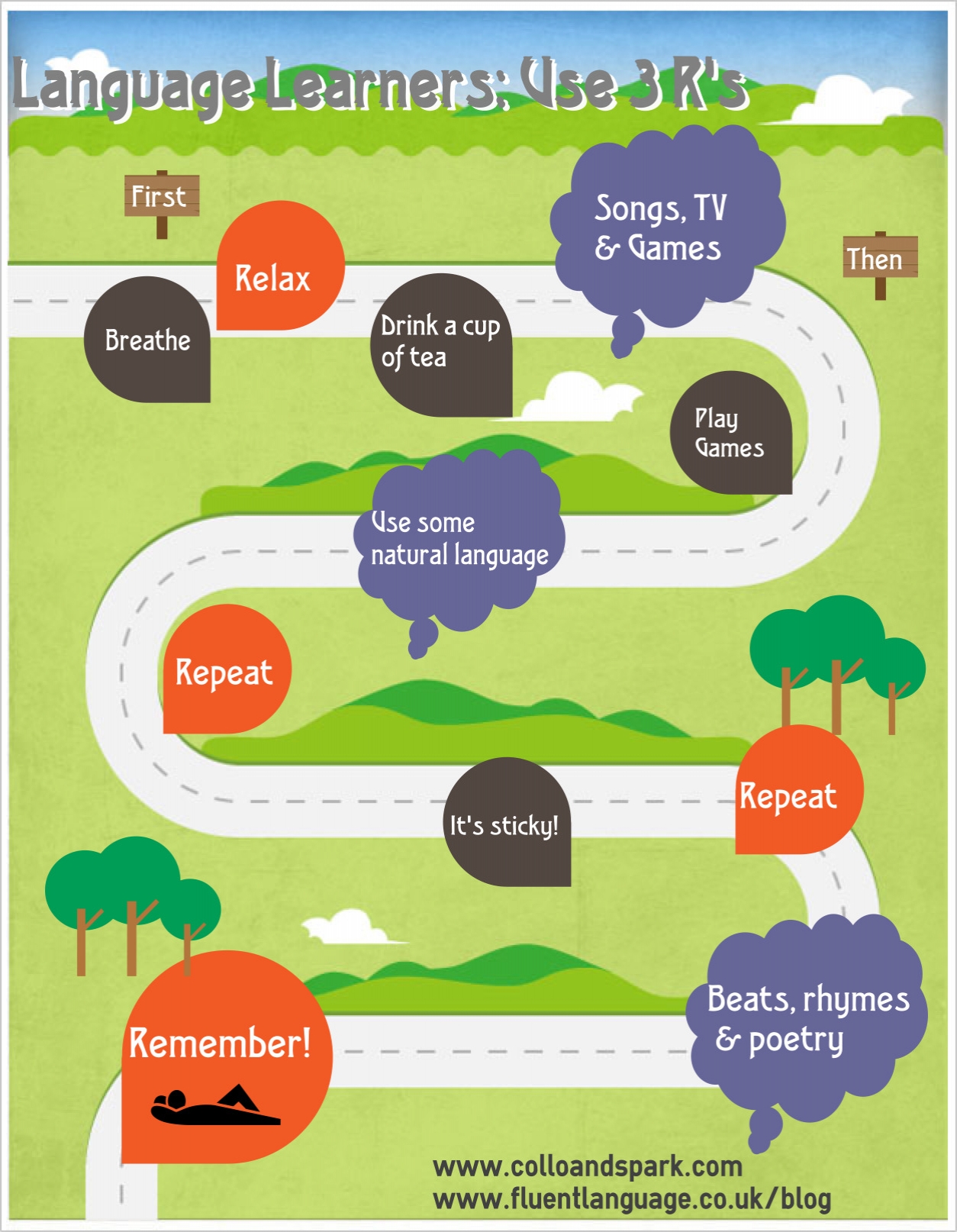
The best way of remembering is when something's fun or relaxing. We have seen this in students successfully using music, poetry, art and stories for their vocab. Want an example? What do you think of when I write #thicke? Gotcha. Think of Fluency MC - relax, repeat, remember. It works. But the key to making things stick with this technique is that you must follow the most important rule to get the best results:
Know your limits!
Repeating what you learn is great, but it's based on not trying hard. As a result, you have got to take the "relax" part very seriously. Make sure you don't try to push towards ambitious goals - one word per song will be fine, after all you weren't really trying anyway. Repeat a few things that you really love, not 1000 things that you feel indifferent about.
I hope you found at least one tip above that will rock your world, and if you did you might enjoy my upcoming book: The Ultimate Guide to Language Skills.
Got any better ones? Leave me a comment here or say hi on Twitter or Facebook. Can't wait to meet you (in pixels).
Fun and Motivation: Meet Mickey Mangan, host of the Lernen to Talk show
This week, I'm very pleased to share the story and successes of Mickey Mangan.
Mickey is best known on the internet as the host of the Lernen to Talk show. He has done all of us language learners a big favour by charting his progress as a native English speaker learning German during a year of living in Germany and taking his language skills from very basic to very comfortable.
If you have never seen or heard of the LTTS, I recommend you watch Mickey's own short introduction to the show.
I had the pleasure of speaking to him last week, highlights of which will be available to watch on Wednesday. (Note this interview is written as paraphrases, not word for word transcripts of Mickey's answers.)
Hey Mickey, thanks for chatting to me! I am definitely a fan of LTTS and I get a lot out of the episodes both as a teacher and as an expat getting to see her home country in real life snapshots. You mention right at the start that your goal is to show others how much improvement attacking a language like a fun, passionate project can bring. Are you a linguist by trade?
No, I actually went to university and took Mechanical Engineering. My first foreign language was Spanish, and I would say that yes, I liked it at school but after all those hours leading me to high school graduation I still didn't feel as though I could actually speak any of it. Think about it - that's approximately 1000 hours spent on a language and the result didn't feel like anything resembling fluency. I was left with a sense of wasted time.
“I made the most of every day and I had such fun using the language in real life.”
When I went on to university, the desire to make all those hours count stuck with me, and so I enrolled on a Study Abroad semester in Chile. That was my first experience of living in a country and going from these low-level speaking skills to full confidence (what many people would consider fluent). I made the most of every day and I had such fun using the language in real life.
Did you take Spanish in the partner university in Chile?
I took Engineering modules, but the experience of my own subject paled in comparison to the energy and stimulation I felt from focusing on understanding it all in Spanish. I found myself doing better at my own subject because it was taught in another language. That extra challenge just kick-started my interest.
On my return from Chile, I was filled such excitement and appreciation for taking the learning experience into real life that I just wanted to go abroad again and learn another language.
Was that the motivation behind LTTS as well?
Yes and no. My semester in Chile gave me a clear appreciation of how much and how fast progress in language learning can be made. But the real idea for LTTS came at summer camp!
I had a job as a counsellor at Concordia LV, a camp which provides this immersive foreign language experience for children. When I was there, I could see that those students who really signed on to making the most out of camp were the ones that improved the most. I wanted to show them what can be achieved in language learning by talking to people, and eventually the idea of the videos was born.
Fast forward to your trip to Germany. How and why Germany?
The programme was CBYX. It had a lot of attractive aspects for me in particular, being an engineer interested in sustainable energy sources for example.
“The point of the Lernen to Talk show is having fun and instilling motivation.”
And in the LTTS videos, you have managed to document a full year of language improvements. Did you ever feel that you might not achieve your goal?

Actually, I must say I knew with 100% certainty that I would be fluent in German within a year. In fact, as I was filming the LTTS I always had the final time lapse in mind - I couldn't wait to cut the videos together and just show all this progress. I felt that having this as a project and attacking it with a sense of fun really kept my motivation going. The point of LTTS is having fun and instilling motivation.
And from the comments that you receive on your videos, I can tell that it has worked!
Finally, I noticed how confident you are right from the start. How aware were you of your own progress?
I didn't feel it very strongly in the first two months, but after those two I moved to a different place and suddenly made contact with so many new people who all met me for the first time. They were so impressed with how much German I had learnt in just two months that it really boosted my confidence. Progress can be so microscopically incremental for a language learner that I would really say the best way to stay encouraged is to change your environment completely. Find a new person to practice with or join a new group, so that you can get the positive feedback.
“Progress can be so incremental for a language learner that the best way to stay encouraged is to change your environment completely.”
So, now that your CBYX year has come to an end, would you say you're "done", a finished product now fluent in German?
Well. I would confidently write "fluent" next to my German and Spanish on my CV - but fluent is a meaningless word by most measures - but really I wouldn't say I'm fluent until I can fully enjoy a novel in the language. With progress comes more interest and motivation, so now I want to discover Goethe.
What language fluency looks like
On my adventures around Pinterest, I recently came across this image which is filled with thoughts of "language fluency". It addresses a question every learner asks him- or herself lots of times - What exactly IS fluency? So many of you quote fluency as the ultimate learning ambition, so have you defined what it means to you?

Giant beret is not a symbol of fluency
A word about SMART goals
If you have taken on challenges in the past, you may have come across this very corporate acronym before. SMART stands for specific - measurable - achievable - relevant - time constrained. Generally speaking, this is considered to be the best possible way that you can formulate a goal. "Fluency" therefore needs to be made measurable, and it's really important that you try and spell out to yourself what exactly it means to be fluent.
For example, a vague and not very effective goal would be "I want to be able to have a conversation with a French person soon."
Now compare that to this goal, which can be considered worthwhile and functional: "I want to be able to have general small talk about the weather and travel methods (specific and achievable ) with my French aunt (relevant ) when I go and see them in a month (time constrained )." And even with that, the question of how you measure it is not too clearly answered. Measuring fluency is up to you. Like a self-fulfilling prophecy, fluency happens when you believe it's happening.
Checklist - what makes you fluent?
In the image shown above, you can see a few good indicators that you could take as measurements of fluency. For me, these are the most important ones:

- You are able to communicate without hesitation and without long gaps, and feel confident to compensate for words you don't know
- You are secure enough in your understanding of grammar and word order that you can produce sentences without wondering where the words go or what tense the sentence is supposed to be in
- You feel that you connect, share information and understand your partner's responses in a conversation
- You find that using your language brings you a sense of achievement and confidence, which increases your core skills
If you are a language learner or educator, what would you add to this list? Or would you take something out?
Remember it's attitude and skill combined
Finally, there are two parts to becoming that fluent speaker you dream of being. It's in your attitude, trying and going for it without worries of whether your verb endings are spot on or not. But there is also an aspect of practice and expertise, so don't think that with the right attitude you could completely neglect the study part. Once you get both of those up to the right level, you will just know that it's working. Until then....invisible progress.
6 odd Moselle slang expressions they teach in no German class
Hello language lovers, yes it's a late blog post today. I'm writing this in Germany after a weekend full of family goodness: a wedding, a lot of time with a small child, and then a long-awaited new life came into this world. All is well then. And on the linguistic front, I have noticed that, once I return all of my good grammar goes out of the window. Wanna know why?
German dialects are strong
The German language plays host to a range of dialects as varied as the country they are from. This place used to be so scattered in different kingdoms and duchies that even across a few miles the language would have varied strongly.
Are strong dialects cool?
To this question, I would vote quite an emphatic yes. I love being able to understand Mosel German, and in the UK I like hearing the differences between a Scouse (someone from Liverpool), a Geordie (someone from Newcastle) and a Londoner. Dialects, just like language choices, are all about identity.
In celebration of all that dialect goodness, here are your essential Mosel phrases - if you ever want to sound local around Trier, make sure you say one.
- Bei dich
This is used where high German would say "zu dir". Note how we use the dative case after the word "bei", so that indicates that the usually stationary "bei" (at) is being used as a "zu" (to).
Example: Ja, ich komm morgen bei dich. (yes, I'll come to yours tomorrow)
- Was ist das denn für Zahnpasta?
Hmm, this one is quite odd indeed. Jumbly word order meets omission of indefinite article and mixes in nicely with a "für" thrown in. The correct German version of asking this would be "Was für eine xx ist das?", meaning "What type of xx is this?"
- dem Leon sein
The Genitive case, who needs it around here!? Why not just cut it and randomly use dative + possessive? Really, this will make you sound so local. Practice now, then keep it quiet from your German teacher.
Example: Ich will das T-Shirt anziehen, aber das ist dem Ludwig seins. (I want to wear the T-Shirt but it's Ludwig's).
- langsam
You know this one, it means slow. But when you talk to little kids around here, we also want them to be quiet. I guess it's the Mosel musicality, basically telling a child to go "Adagio".
- die Kerstin
This slang phenomenon is common all over Germany - basically we put a "the" in front of the first name of whoever we're referring to. It's quite informal and very common among children and friends.
- ich hab 20 kilo abgeholt
We really prefer "holen" to "nehmen" around here, and even use it where no other German would think that holen is a thing that you do...you lose weight, that's abholen (yep, abnehmen in your dictionary), you take medication, that's einholen. Read up about it here (in German language, but it's high German!).
That's it for today guys, I hope you enjoyed the short insight into how Germans really speak. Use these liberally if you want to tear up the rulebook, but never with "Sie", because slang and the polite form of address don't mix.
If you enjoyed this article and want to learn more tips and fun stories about Germany and the German language, hop on the newsletter below. I'm looking forward to meeting you!
Fluency Masterclass, Part 2: Writing
Hey all, welcome to the second instalment in my series of articles looking at practical techniques for mastering each of the four core skills in language acquisition. Let's have a closer look at..
Writing
Yes, writing skills. That's that thing people did with pen and paper before screens and keyboards. Ideas for simple exercises to get started with might be writing your shopping list, packing list, postcards or recipes.

Using colours to mark word types, and to annotate my notes.
A word about writing and typing
In this article I do recommend you focus on old-school pen and paper. For the language learner, this provides a really important benefit: kinaesthetic (tactile) learning. This means that the movements of putting letter-shaped lines on paper in new combinations will help you remember.
There are also psychological benefits. I'm currently studying Russian - a new challenge with new letters! Putting them onto paper in my own handwriting and with my own hands gives the whole undertaking a stronger sense of achievement. It really is me mastering letters like л, Ф, and я!
If you do feel that you want to get typing, there are advantages to doing it online. Websites like Italki have journaling functions that invite native speakers to answer your questions or correct your entries, which can be excellent practice. Make sure you re-write everything after it's been corrected.
Steps to improve your writing skills
Play with colour, shape and paper
Now that you are hopefully signed up to pen and paper, or at least stylus and paper app, you should use them to their full potential. Use different coloured pens, highlighters and crayons. Doodle. Mark up your sentences in a way that makes sense to you. Here are some tips to get you started:
- Colour each word differently depending on its gender
- Underline every verb, then shade in every object, then use another colour for different cases
- Write out the sentence in one tense, then re-write it in another
- Draw tables, boxes, diagrams, or whatever you need to illustrate your thoughts
Sound out the letters, syllables and words
While breaks and gaps in a conversation are so obvious they're bound to make you nervous, writing is something you can do in your own time. Languages have a script in order to document the sounds you make when speaking out loud, so make sure you engage fully when you are writing things down: Sound out each letter, add the sounds to make a word and really get to know them. Yes, it sounds silly. That probably means you are doing it correctly.
Listen and Write
Combining your language skills is the key to fluency. When it comes to writing, this means your integration should go both ways. Remember dictation tests from school? Find a simple audio example. Listen first and write down what you hear - this will work on your comprehension, spelling and most importantly teach you the connections between spelling and sound. Then compare your notes to the transcript to see what you got right. This exercise should be a weekly drill, because its benefits are bound to build up your skills significantly.
Writing was part two of the Fluency Masterclass. Catch up on Part 1 (Reading), and if you enjoyed this article why not subscribe to my monthly newsletter here:
Fluent Language Learning Newsletter
Other great articles about reading in language learning
- Omniglot: Want to speak a foreign language better? Learn to write first!
- The Everyday Language Learner: Five reasons you should write as part of your language learning



Struggling with listening? Discover realistic tips, challenge prompts, and the best tools for improving your listening skills as a self-guided language learner