
CHECKLIST: How to Get the Most Out of Women in Language 2020
Are you ready for 4 days of language learning fun, expertise and inspiration? It’s Women in Language time! This article will give you the tips you need to get the most out of your time at our conference.
Every blog article is great if it can start with a quote from an 80s rock banger..so let’s go:
🎶 It’s the Final Countdown…🎸🤘
In just one week, hundreds of language lovers around the world are going to settle in and click PLAY for the Opening Ceremony of Women in Language 2020.
What’s Women in Language?
Women in Language is an online conference featuring over 30 expert speakers who share their stories, careers, and lessons on the world of learning languages.
Do you love languages and want to hear from these amazing people?
Then it’s time to get your ticket now from www.womeninlanguage.com
Women in Language is live from 17-20 September. Tickets are $29 and the price includes all conference recordings too.
In this year’s Women in Language conference, you’ll discover new perspectives on learning languages. Here’s a sneak peek of our schedule:

Is Women in Language a Polyglot Event?
Kinda! We’re well aware that the word “polyglot” can strike fear into some language learner’s hearts, and we don’t mind which languages you’re learning or how good you are.
We are made by women, for EVERYONE including men, non-binary folks, and monolinguals. It doesn’t matter. All you need to do is bring an interest in hearing from very cool people.
Is Women in Language an Online Event?
Yes! We have been an online event from day 1, even before covid19 made it cool. This conference is fully live, meaning every single speaker will be talking to you right there and then.
There is a live chatroom and many speakers even join the Women in Language Facebook group so you can network with them.
Get The Most Out of Your Online Conference
Chances are you’ve already had a thousand Zoom meetings this year, so the technology probably won’t throw you too much. You need fast internet to watch the event, and if you want to join in our language exchanges you’ll also need a microphone and webcam.
Here are a few more tips for getting the most out of your Women in Language experience:
Plan Your Schedule
With an online event you won’t need to travel, so it can be easy to think you won’t need to plan ahead. If you can take some time off or cancel other obligations, do consider it! There’s a real buzz about attending the talks live, and our Women in Language chatroom has become a conference legend over the years.
This year, we are bringing you 25 speaker presentations, 2 expert panel discussions, and 2 opportunities to join a language exchange. Your first stop is the conference schedule, where you can get to know the speakers and find out more about what they are sharing.

Time it Right
Our schedule contains timings in London time, so if you live in a different timezone it’s important that you check your local timings with an online converter like www.timeanddate.com.
The “master times” at our event are in British Summer Time, so make sure that you have checked what the start and end times are in your own timezone.
Yes, with this 4-day event you’re guaranteed to find a few talks you do NOT want to miss and it’s a good idea to put them on your digital calendar and schedule a reminder on your phone.
Play People Bingo
This one’s a Women in Language special and it’s one of my favourite things! We have prepared a bingo game card for you with 9 types of attendee. Ask around in the chatroom, post in the Facebook group and bring your list of names to the closing ceremony on Sunday 20th to celebrate the many new connections you’ve made at Women in Language.
Can you win anything? EVERYONE can win something, because there’s a super valuable prize draw for all ticket holders too!
Get Ready to Take Notes
I'm one of those people who attend every training session and whip out a notebook before anyone even says “good morning”. If you’re like me, I strongly recommend you get your notebook and pens ready. Think about moving your computer away from its usual place as well so you can enjoy the talks without getting distracted by social media or the latest headlines.
We have created a fantastic PDF programme that you can print at home and use for all your planning and scheduling. There is also a full page for every single session, so you can jot down your questions and ideas. It’s instantly available after you buy your ticket.
Prepare the Snacks
Our Women in Language schedule features a new talk on the hour, every hour. Of course you can take as many breaks as you like because you’ll be joining us from the comfort of your own home. For the most enjoyable experience, make sure you’ve got a few of your favourite nibbles nearby just in case.
We’ve also heard from several attendees who are stocking up on coffee to catch the super late and early talks in their timezone. It’s going to be lots of fun to bond over Women in Language in the chatroom!
Join a Speak Easy Session
Do you want to take a break from learning about all these languages and join a fun networking session? Ready to practice that language you’re learning? Then join one of our Speak Easy Sessions on Friday and Sunday.
These sessions are open, friendly language exchanges with no pressure to perform. You show up and tell us which language you’d like to practice and we’ll split you into small groups where you can speak your language in a group of other learners.
The Speak Easy sessions are held on Zoom, so make sure you’re able to participate in a Zoom call and have a microphone that works. We’re not going to record these, so you are safe knowing you can practice and make as many mistakes as we do ;)
It’s a Language Learning Festival!
The Women in Language is a great experience and we’d love to have you join us. The tickets are just $29, and that price includes all conference recordings.
And just in case you’re wondering: YES men can come too! Of course!!
Tickets for Women In Language 2020 are available right here.
And, one final thing to share, 10% of profits go to a charity or non-profit organisation each year. This year, it’s Girl Up, a movement to advance girls’ skills, rights, and opportunities to be leaders.
There’s just no reason to miss this one. See you there!

Women in Language TICKETS ARE HERE For 7-10 March 2019
Women in Language is a special online conference for all language lovers, organised by Shannon Kennedy, Lindsay Williams, and me. In this article, you’ll discover more about how it all started and what it feels like to be at the conference.
Just over 16 months ago, Lindsay Williams (my podcast co-host) and I were chatting on Skype. It was October or November. I remember the day turning into night at what felt like 4 in the afternoon on my side of the world, while Lindsay was getting ready for her day.
We were chatting about a few ideas for the future, when she mentioned this one thing that made my heart explode with excitement.
“So I’m thinking of maybe doing a one day event on International Women's’ Day with loads of female language people speaking...wouldn’t that be cool?! I can’t do it this year though because I’ll still be away but…”
I didn’t need to hear any more. I was like STOP IT RIGHT THERE I AM IN!!
Lindsay had just spoken an idea that had been growing in my brain, too. And I’m not a patient kinda girl so I wasn’t going to let Lindsay’s round-the-world trip stand in the way of an amazing idea. We contacted Shannon Kennedy and asked “would you maybe be interested…”.
Shannon was a yes. The organising team was ready, and few months down the line we shared the news with the world that we’d be hosting Women in Language in March 2018.
The event was a massive success! (Read my full debrief if you want to know what I learnt and how we pulled it off.)
Over the last year, we continued to work on our list of speakers and our background preparations. And now, we’re ready to bring you WOMEN IN LANGUAGE 2019!
If you were at last year’s event, you’ll know what to expect.
But if not, I know you’re curious. I asked writer Cassie Wright who was at Women in Language to share what it was like for her. Here’s Cassie’s story:
Conference Experience: What Cassie Thought Of The Language Conference
Once, when I was 9 years old, I tried to tell everyone I knew that in Finnish, you could make whole sentences into one super long word.
How awesome, right?
Unfortunately, my school friends were a lot less enthusiastic about my latest language tip. In fact, I was surprised to find that they didn’t really care at all.
Even at that age, I had two binders dedicated to languages, each full of vocabulary: one labeled ‘Finnish’ and another labeled ‘Japanese’. I was fascinated by languages and it stood out just as much as my mop of curly hair in a classroom full of long, straight locks. I was a language nerd at heart, though no one else seemed to have the same sort of passion.
Despite the fact that my friends didn’t care about my Finnish facts, I was proud of my attempts and motivation to learn. I never got very far, but I was always confident in my abilities.
"Japanese?" People would ask, “Isn’t that hard?”
I would just nod and grin.

But eventually, going it alone became too much of a challenge and the things other people told me were more important took over.
Still, languages followed me through both high school and college. Without fail, each time I tried to start again, I couldn’t find the drive to keep going.
Then, years later when I tried once more, I found an entire blog dedicated to learning languages. It was a lot different from the sites I’d seen before that featured big name polyglots and sold all kinds of "easy tricks".
That’s when I came across an announcement on my Twitter feed for Women in Language.
It caught my attention immediately, not only because there were so many women prepared to talk about their language experiences, but because it was all online. The only thing I needed to attend was a ticket for the event, which meant the cost of plane rides and hotels wasn’t an issue.
When I bought my ticket to Women in Language that day, I didn’t realize how much it would change my approach to language learning.
It’s not just about languages. It’s about representation.
Learning a language is the goal, but how do you do it with a busy schedule? Kids? How do you find the courage to pick up and move to another country? How do you immerse yourself when that’s not possible?
How amazing would it be to learn about those things from someone in your place: women of all different races and backgrounds with a variety of experiences.
This is what I really gained from Women in Language and it gave me a sense of validation.
Here were a number of talented women who gladly shared their knowledge and ideas. I saw in them my own language learning dreams, only this time, it wasn’t some unrealistic goal.
In this community of multilingual women, I felt I could proudly hold onto my vocabulary-filled binders with my mess of curly hair and say, "Hey! I’m one of you, too. I see myself here."
Women in Language brings that community of learners forward and inspires them to keep going.
More than anything, it’s a breath of fresh air for those who need a place to share a common interest and belong.
GET YOUR TICKET TO WOMEN IN LANGUAGE!
This year, we are proud to announce that there are EVEN MORE presentations at Women in Language. There’s so much more happening – including 2 Panel Discussions and a chance for YOU to present, a prize draw worth over $1000, and daily fun activities for everyone.
Ready for it?
Women in Language is happening live and online over 4 days from Thursday 7th March to Sunday 10th March 2019.
If you can’t make it on those dates, you can catch up at any time since your ticket purchase gets you access to all recordings for as long as you like.
Everyone is welcome (the ‘women’ in Women in Language only refers to the line-up of speakers!) and we’d love to have you join us for the live event. Click below to get your ticket now for Women in Language 2019.
To join us, click here to purchase your ticket.
Are you coming to Women in Language? Leave a comment below and let me know!
De-Brief From An Organiser: Women in Language 2018

A few weeks ago, I was proud to co-organise and witness the first ever Women in Language conference, a unique online event designed to champion, celebrate, and amplify the voices of women in language learning. It was not my first online conference about language learning, but certainly the first I partly created and the first one ever to feature an all-female line-up of speakers.
In today’s article, I am going to lift the curtain and share my official de-brief as one of the three members of our organising team.
What I Felt at Women in Language
Let me start with the most important thing: I enjoyed every single presentation that I saw. And as I was often online making sure everything went smoothly, those were almost all of them. The quality of our many speakers at Women in Language was excellent, and the range of topics kept things interesting and inspiring.
Women in Language delivered on a few extra levels too. It felt as inspiring and intense as every offline conference could feel, with the added bonus of allowing me to sleep in my own bed. I adored seeing #womeninlanguage posts on social media, and to hear from our attendees in the live chat and Facebook group. And most importantly, I got SO inspired and motivated to learn languages in a brand new way!
What I Learnt About Language Learning
A lot of the impact of four days of language love cannot be put into words. It’s a boost in motivation, a renewed commitment, a burst of energy. And at Women in Language, I got all of those out of it and more. I got to know more of our conference attendees and boosted my own desire to learn and teach languages in new ways.
Here are the most important lessons from Women in Language that will be essential for all language learners:
1) Dabbling Is Legit
At Women in Language, we celebrated the huge diversity of how people learn languages. You can choose whatever language you want to learn, and you can learn it for 2 weeks or 20 years, and you can dabble in a handful of languages at once if you want to. This is all “allowed”, and won’t make you any less of a language lover or polyglot.
Sometimes it’s easy to feel self-critical as a language learner, and to tell yourself that you’re doing this wrong if you don’t use Anki or speak from day 1 or spend many hours on your project. But dabbling is perfectly legit, and you are allowed to feel proud of it.
2) Compassion Matters
Leading on from the previous point, compassion was a regular theme of the conference. When you’re faced with so many blog articles and Instagram posts and YouTube videos and language books telling you what to do, it’s sometimes hard to remember that everyone has a bad day.
You can’t always be happy and you can’t always be 100% gold in Duolingo. Compassion means allowing understanding and empathy for yourself when times are tough, but also for other language learners. No one method is the right one. Allow other people to feel good about themselves, and extend that same kindness to yourself.
3) Everyone Loves Transcribed Audio
Finding something interesting to watch or listen to, at the right level, and then with a transcription…that’s difficult. But it’s also what a lot of our conference attendees wanted, and you certainly CAN find it online. If you want to get a few ideas, check out Speechling, Glossika, Rhinospike, and Movieclips on YouTube.
And by the way: Just listening is NOT enough. If it’s just a wall of sound, you’re not doing much good. You’ll need to know what you’re hearing. Find input that you can engage with, and check against your own skills. For more about this, listen to my podcast episode about listening skills.
4) There’s So Much to Talk About
It’s never enough to practice speaking by doing the “Hello how are you where do you live” dance over and over again. Speaking practice is best when you’ve prepared something interesting to talk about. And lucky for us, there are tutors and learners who already discovered this too, and they’ve even put together lists (like this one) of questions and conversation prompts.
5) When Your Brain Is Having Fun, You Learn
All too often we think of language learning as a STUDY activity, in all caps. But it’s just not necessary to do things this way. Language can be learnt through story, through fun activities, through play. The most important things are exposure and repetition, not how hard you study or how much your language experience feels like work.
Though some of these lessons may read as happy-clappy positivity notes, I found that they often helped to ease a learner’s mind and allow them to take a break and come back to language learning with new energy and enthusiasm. After all, we want to get fluent while having fun, right?
What Do You Think?
Whether you attended Women in Language 2018 or not, what do you think about those lessons above? Are you a dabbler, or a hardcore study nut? Leave me a comment below to join the conversation.
In part 2 of this blog article, I will put on my co-organiser hat (a very stylish hat, for sure) to tell you more about how Women in Language was organised, what we learnt in the process, and what you should consider if you want to run or contribute to an event like this in future.
Organising A Successful Online Conference
I’ll start with what we looked for in our speakers and talks.
For this first ever conference, we used our own network of interesting women to ask if they wanted to speak at Women in Language. Their social media accounts, blogs, youtube channels, relationships with us were what put them on the radar. So if you’re dreaming of speaking out yourselves, making yourself very visible is good advice.
Before contacting our speakers, we considered some guidelines about the types of talks we would be looking for. In addition to practical topics featuring tips and techniques for language learners at “Beginner” and “Advanced” levels, we also chose the tracks “Living with Language” and “Working with Language”. Each speaker we contacted let us know which of the four themes they would like to address in their presentation, and was allocated one. This way, we ensured that no topics would be repeated and we could offer a varied programme on every single conference day.
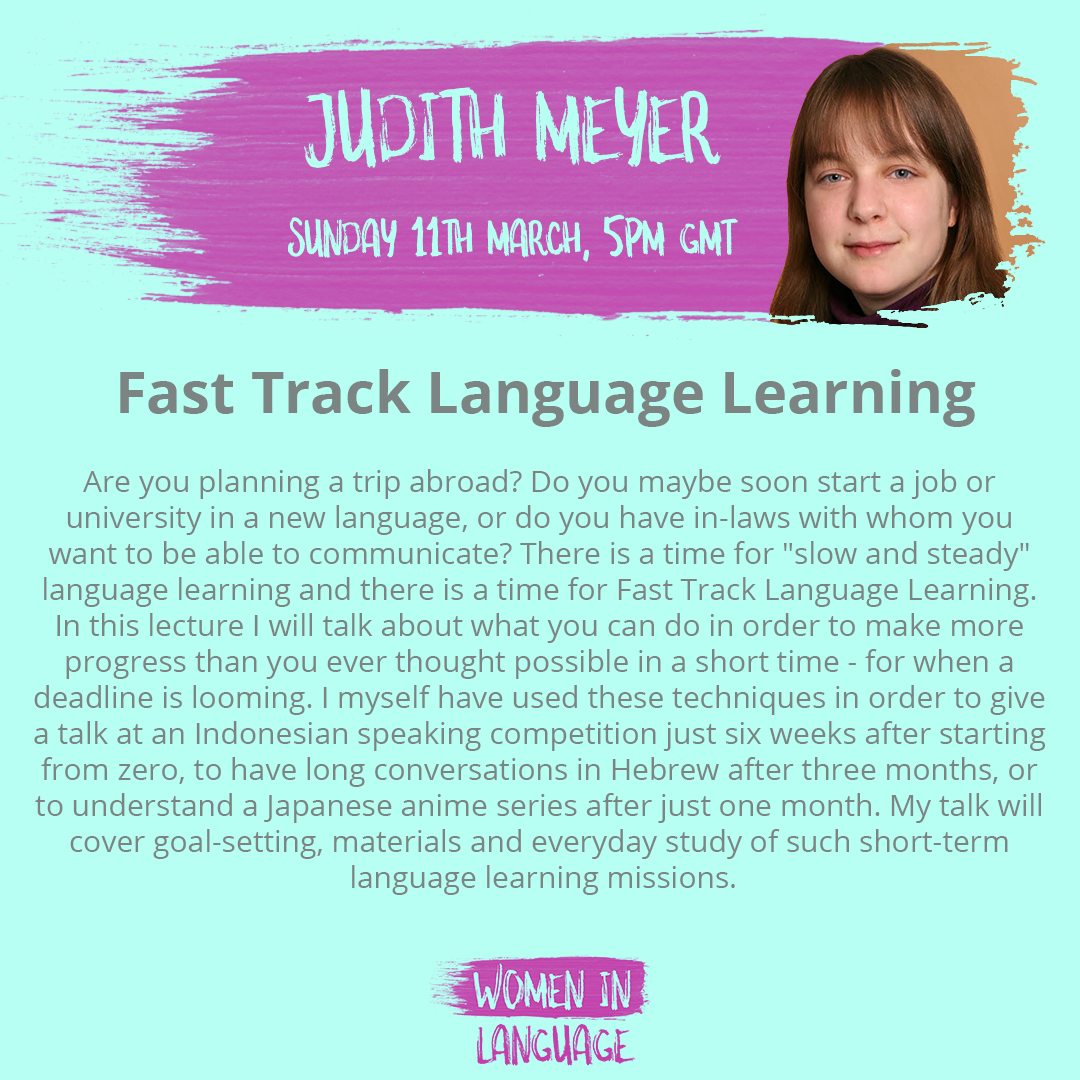
Here are just three of the 25 talks we saw at Women in Language:

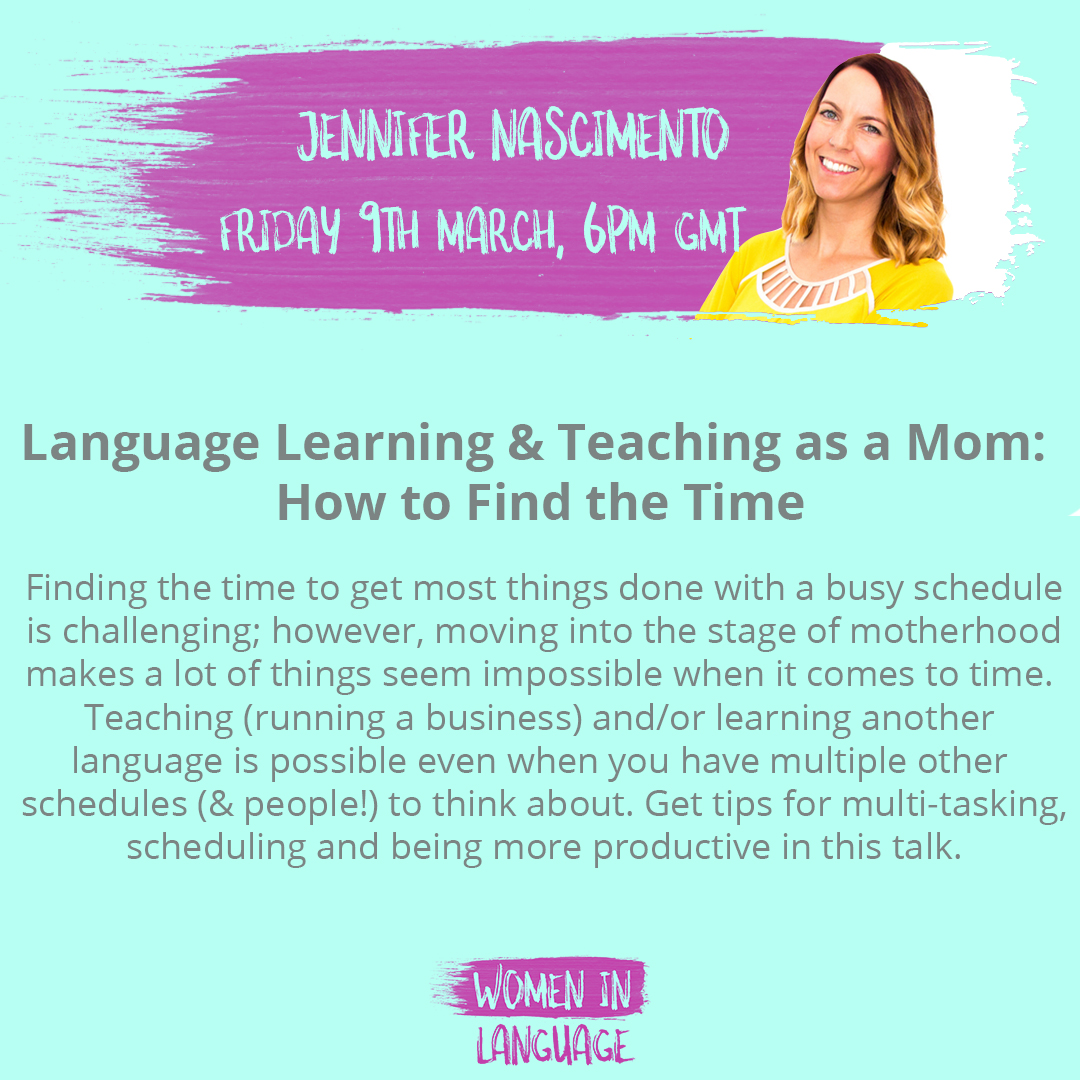
Some of our speakers came to us with a firm idea of the talk they wanted to present, while others found themselves unsure at the start. As our programme officer, I found myself receiving several messages saying “I don’t know, maybe I have nothing to say after all.” If you have ever hesitated to put yourself forward for an opportunity, here is the thought process that does stop them in their tracks: “Maybe I don’t have anything to say here.” Meaning “Maybe my experience, my voice, my passion are not valid. Others will have more to say.”
I extended offers of a little “talk surgery” to those who needed an idea boost, and without exception it was the speakers themselves who came to me with fantastic topic ideas, and who delivered on them 100%. In fact, I found that the most intriguing topics came from a place of passion and excitement in each speaker’s mind. Topics like “Learning With Crime Novels” and “Managing Motherhood and Language Learnings” are not a language learner’s most burning question, but that’s exactly why they make incredible conference topics: They are real, and invite us to think differently.
Some People Voiced Different Opinions
I won’t lie to you, at times it felt hard to be out there putting together this positive, kinda feminist event. Some commenters felt that it was a wrong move towards equality, unnecessarily excluding male voices. To those guys, I want to remind you that we welcomed and celebrated male voices throughout the event - it’s just that this time only women got to speak “on stage”, and every single one of them brought expertise, commitment, quality, enthusiasm, and outstanding topics. We set out to show the language learning world from a different angle, and I was so encouraged to hear from several male attendees who were enjoying the conference just as much as everyone else.
If You Want To Be a Conference Speaker
If you are considering applying to speak at a language conference, please don’t hesitate. Even if you were to hear a no, don’t worry and keep putting yourself forward - maybe the programme is full already or the conference can recommend a future event for you to try.
Don’t be shy about suggesting a topic outside the memory-boosting-fluency-fast-track-performance mainstream. Don’t wait until you’re fluent in 16 languages. You’re good enough right now, as long as you have a cool topic. And what’s a cool topic? Your own experience!
You are so cool when you are yourself.
I want to give kudos here to all those women who agreed to speak and trusted Shannon, Lindsay, and me with Women in Language. You absolutely killed it, and we appreciate all the hard work you put into giving a great online talk at an event you’d never heard of before.
Many of our speakers were new to presenting online. From my perspective as a blogger and podcaster, I’m used to speaking to an empty room and waiting until later to see if anyone connects with my words. But these guys were new to the whole environment, and they handled it brilliantly.
Tickets
When we put together our event, we knew that it was a risk to ask for payment from attendees of an online event. Many other online events are open to attendees for free, but we wanted to create an atmosphere where the sales pressure is off, and where our audience members were just as invested in having a great time as we were.

We found that the ticket sales achieved this goal, and allowed over 250 audience members to join us from all over the world. This reassurance also helped us relax and increase our commitment to Women in Language. So on the ticket selling front, we are happy to note that all went well and we are now able to give a donation of over $400 to our chosen charity, Kiva. The charity supports entrepreneurs who do cool things to alleviate poverty around the world.
Here I want to say thank you to our audience members, who went ahead and trusted us organisers with a brand new conference idea. Some purchased a ticket and even took time off work, others were unable to attend but joined the conference to support celebrating and amplifying women’s voices in language learning. We appreciated your trust and support.
About The Technology We Used
In terms of technology, we used a setup of Google Hangouts on Air for our live broadcasts and embedded them in individual Teachable lectures via YouTube. We also added individual Chatango chat boxes in each lecture.
At the end of any session, the viewers could click “Complete and Continue” at the top and move on to the next session in our packed programme. Credit here goes to Shannon for leading us on the setup of a gorgeous page and ensuring the information was up to date.

Inside Women in Language
Combining technologies to create the conference experience
This format added to the feel of hosting a real conference, where you would often walk into the next room for another talk. But in addition, it made us into the Netflix of language learning, where any previous talk could be streamed from the beginning right after it was published.
All talks were offered on a single track (no two at the same time), which kept the conversation focused and helped create a live chatroom community. We also added an “after hours” experience through a dedicated Facebook group for Women in Language attendees.
Marketing Women in Language
Our marketing campaign, headed up by Lindsay, made it easy for Women in Language to get seen. We obviously talked about Women in Language in our own blog, podcasts, social media, newsletters, youtube, and wherever you see us.
Lindsay also prepared some beautiful pictures and tweets for the speakers and the attendees, so that everyone could easily spread the word about our event. We are so grateful that you guys supported us and shared your excitement before the event. It helped us so much.
Shout out to our friends How To Get Fluent, Language Learning Summit and Langfest for inviting us to present our new event, and to Mezzofanti Guild for hosting a guest post written by Shannon. Check those guys out - they are doing amazing work.
The Organising Team
Between three organisers, we found that we were able to play to our strengths and largely handle the large workload of running a conference like this one. We stayed in contact with each other through direct messages, but also weekly meetings, and the project management software Asana. When your organising team is living on three different continents, it’s helpful to ensure online communications are as good as they can be.
Our track record of collaborations was a key to our success. Lindsay, Shannon, and I were no strangers to each other’s work. We knew already that we appreciate each other’s work and that each of us knows how to use all parts of the technology and marketing setup. We had also met in person before and solidified our friendship. Throughout the organising process, we were able to stay supportive and open to suggestions from each other.
Sometimes, it can take courage and grace to reach out to a colleague and trust that they’re on board with your idea. From the minute Lindsay first mentioned the idea of Women in Language and Shannon hopped on the first Skype call to join us, that was something we committed to.
I am grateful that I had the opportunity to run such a cool project with two colleagues and friends that I respect so much.
What We’ll Do Even Better Next Time
So we were excited, we were buzzing, we enjoyed four days of a successful conference full of tips. But that doesn’t mean that there weren’t any mistakes to learn from.
On the technology front, a few hiccups taught us the following lessons. Maybe you’ll find them useful one day, so I’m sharing them here:
- When you want to embed your YouTube events in another page, it pays to set up a dry run so that you’re double sure the embed will show up the way you want it to.
- When you are planning to invite someone to a Google Hangout, you cannot send them a “join link” in advance because the software will discard that link the minute you close the video window in your browser. And then your speaker’s link will be useless and they’ll be confused.
- Don’t click “eject” when you want to reset your Hangouts partner’s setup as they joined your Google Hangout. They won’t be able to join again, and you’ll have to create a new event.
- Power Point going full screen in Google Hangouts is a bit of a gamble, so stay calm, have a dry run, and prepare trouble shooting notes to make sure all goes smoothly.
In terms of the programme, we tried a new format of round table discussions which was successful at large. The two-hour time slot did discourage some audience members from watching it though, and that’s something I had not expected and we will look into providing shorter round table discussions next time.
Finally: I feel fired up to expand our commitment to diversity and ensure we include more global voices. Our line-up was international but still looked largely like us: white women who speak English a lot. Even if each of them is different in nationality or language line-up, this still gives our attendees an unintentional impression of what the “norm” is. We can add to that during future events, and I’m excited that we now have 27 speakers who can help us grow our network and look for polyglots and language experts from more diverse backgrounds.
What About You?
Did you enjoy the online conference?
Have you ever thought about becoming a conference speaker?
I’d love to hear from you in the comments below.




Struggling with listening? Discover realistic tips, challenge prompts, and the best tools for improving your listening skills as a self-guided language learner