

Master Language Learning: The Benefits of Keeping a Language Learning Journal
Discover how a language learning journal can enhance your self-teaching methods and boost your fluency goals. Featuring a gallery of language notebook examples and podcast with expert language learners.

Are you an electric language fiend, armed with Flashcard apps and podcasts? Or going it old-school with pen and paper?
What if you had a language learning tool that costs you hardly anything, adapts to your own preferences, boosts your memory and helps concentration?
Turns out you do, and it's probably in your bag right now: Your notebook!
In today’s article, I want to introduce you to some of the tricks I use to get the most out of my language learning routine without adding to my screen time.
On the podcast I'm joined by language lovers Kathryn and Sam who are passionate about taking fantastic language notes. Listen to discover their experiences, language learning tips and strategies for effective note taking.
My absolute language learning essential is a notebook. Flashcards are great for vocabulary lists, but notebooks are for everything. The first thing I do with a new word is write it down in a notebook, maybe with an example and pronunciation note.
Get Step-by-Step Journal Tips with Write Your Way to Fluency: only $9!
Dive into a world where motivation meets organization, and discover how a simple journal can become your most powerful tool for mastering a new language. Click the image to find out more!

Like this article?
Then you’re going to LOVE Write Your Way to Fluency, my new guide to creating your language learning journal.
Why Keep a Language Learning Notebook?
Working with a paper notebook can bring many excellent benefits to your language learning routine. It provides a refreshing break if you spend most of your time chained to a computer screen or mobile phone. Here are a few reasons that writing on paper can help you add vocabulary, improve your memory and create a better learning experience:
Personalised Learning
Language learning notebooks are a completely blank canvas where you can design the textbook of your dreams. You control the layout and the content, and get to create what makes sense to you.
As you add notes, you are filling pages of paper with clear signs of your work. It is unmistakably yours as it’s written in your personal style and handwriting. No matter if you are 5 or 50 pages into the adventure, there is nothing like the proud feeling of looking back over what you have already done.
You are in charge of your learning experience. Writing allows you to start from zero and design your page in the way that aligns best with how your mind works.
Clearer Thinking

Writing in a notebook means expressing concepts and sentences in a way that makes sense to you personally. It automatically helps organise what you are learning. In the podcast episode, Sam mentions that he selects what he finds most helpful and important from podcasts, YouTube videos and online lessons so he can curate his own version of a personal textbook.
Your thoughts become clearer in your own mind. The UK Handwriting Association features this great quote from a 17-year-old student on its website, illustrating the way in which a screen can actually make it harder to focus on what you are learning. He says:
“The process of handwriting promotes clear thought and natural structure. Being so close to the page means that translation of thought has less opportunity for deviation.
When typing I find I compulsively re-read my work on the screen and the ability to edit is sometimes paralysing, Although computer work can allow for more complex structure, it is often too complex and has many complications for timed conditions.”
Memory Boosts
When you write your notes by hand, you become better at remembering them. The act of writing, perhaps even colouring or illustrating your note is an in-depth repetition of what you’re learning. Add to that the personal connection as you write what is meaningful to you, and the increased repetitions as you look back over your notebook, and what you have created is a reliable system for remembering what you learn.
If you want more inspiration for creating effective study notes in your notebook, check out my short course Write Your Way to Fluency.
Language Learning Motivation
Filling a book is visible progress, a huge psychological benefit which is going to keep you motivated and coming back to your language time and time again.
If you have a creative side you’d like to unleash, your language learning notebook is a welcome new playground. Kathryn and Sam already loved drawing, design and papercrafts. The language notebook became a way of adding language to what they enjoy, and it has helped create time to combine two great hobbies.
Freedom from Screens
Learning online gives you access to infinite materials, but sometimes it’s hard to remember everything that you see. The notebook becomes your place to capture the coolest bits you find online, the new words you learn from an app, everything you find in your personal language learning world.
Need Inspiration? Welcome to our Language Learning Notebook and Language Journal Gallery
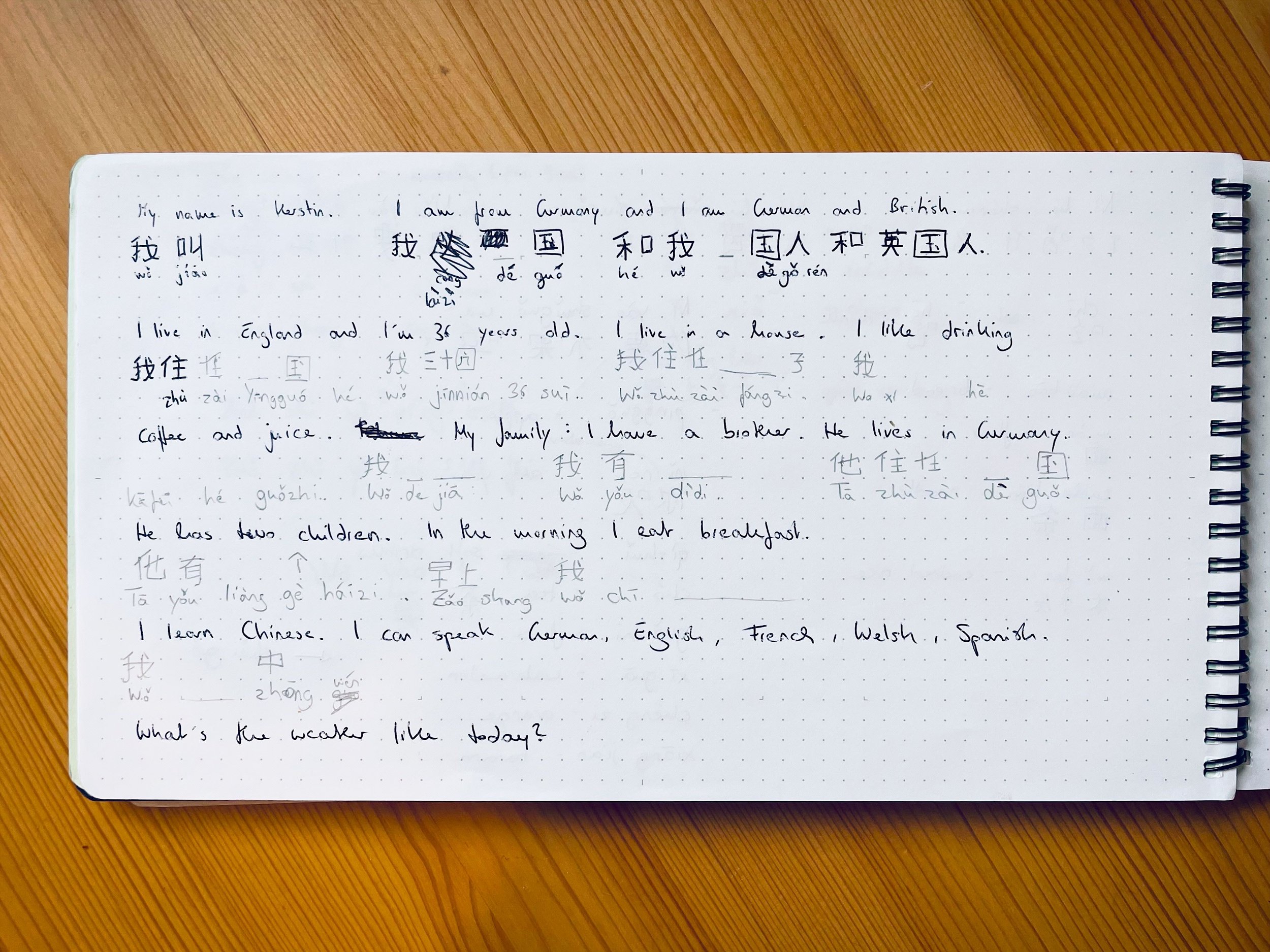

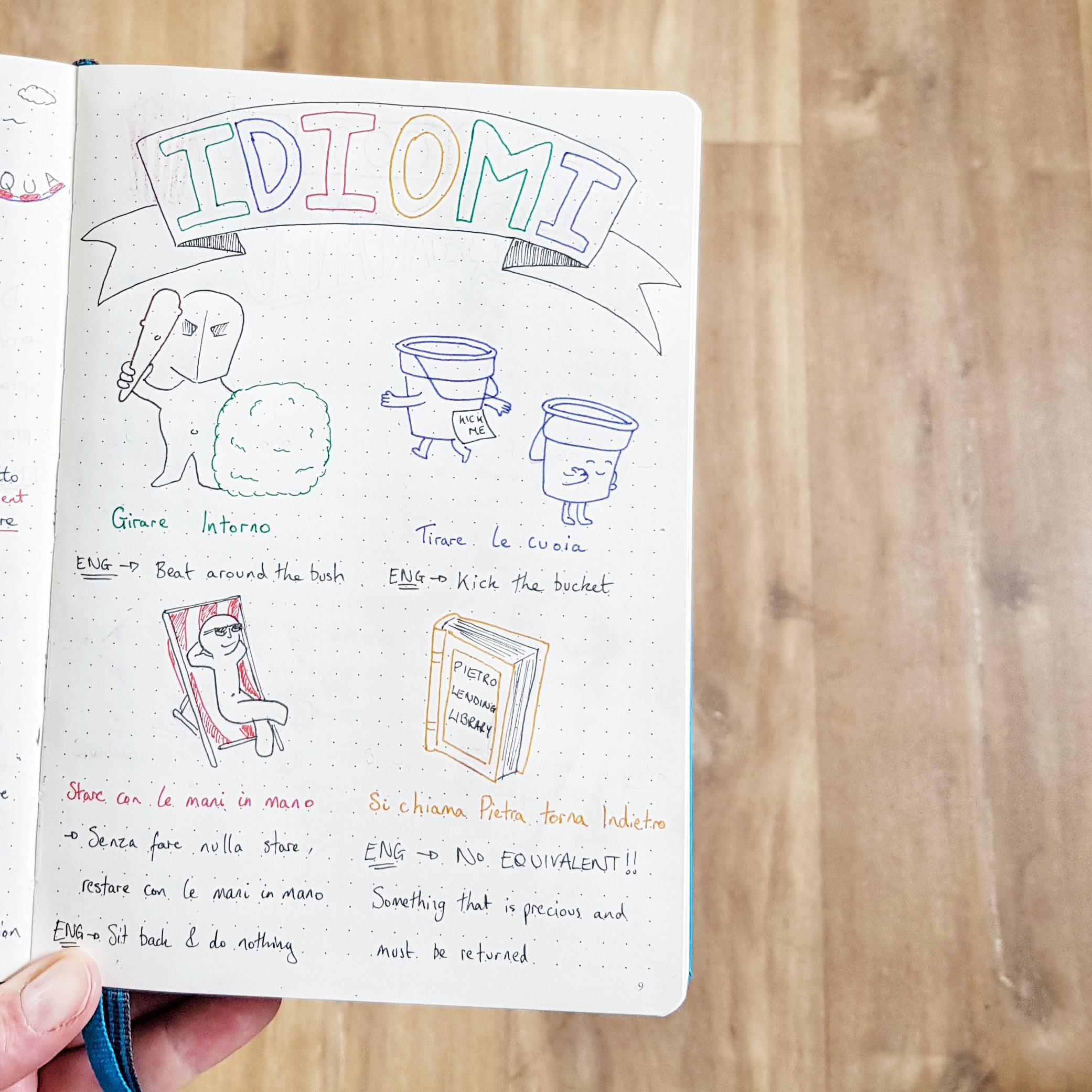


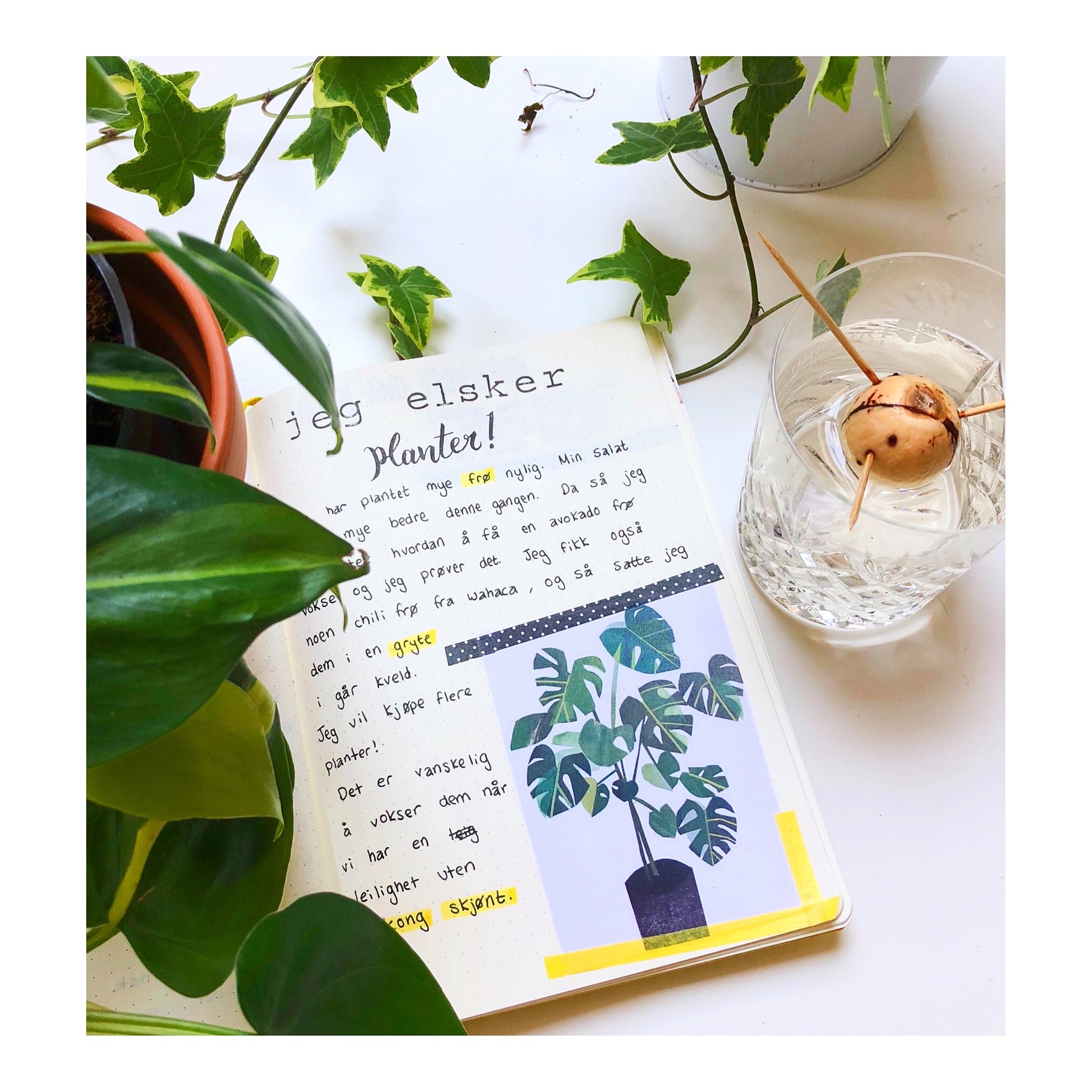
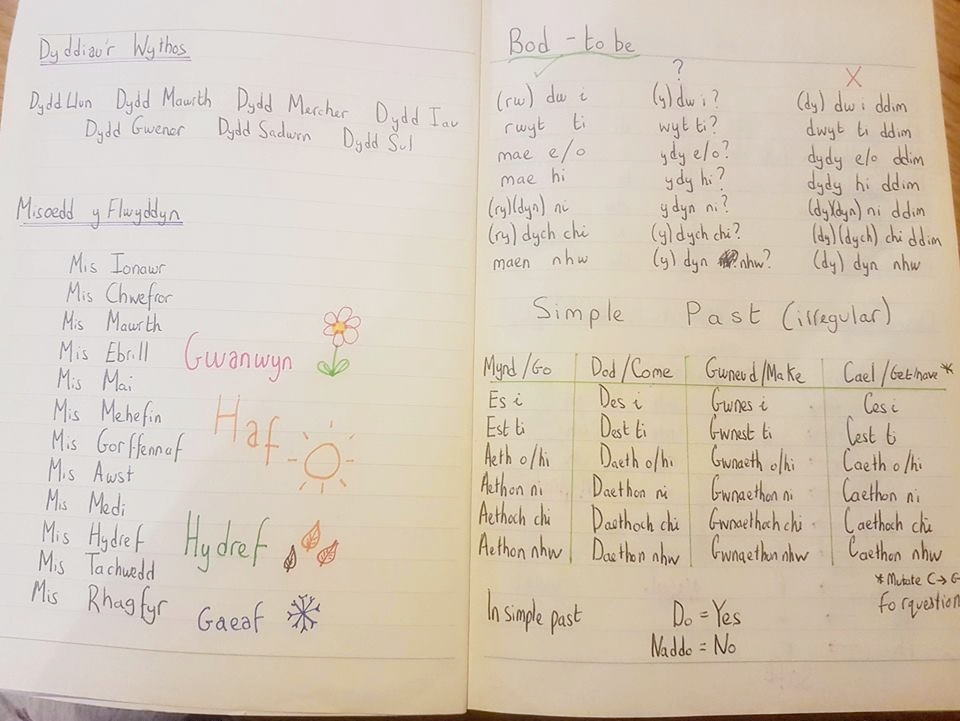
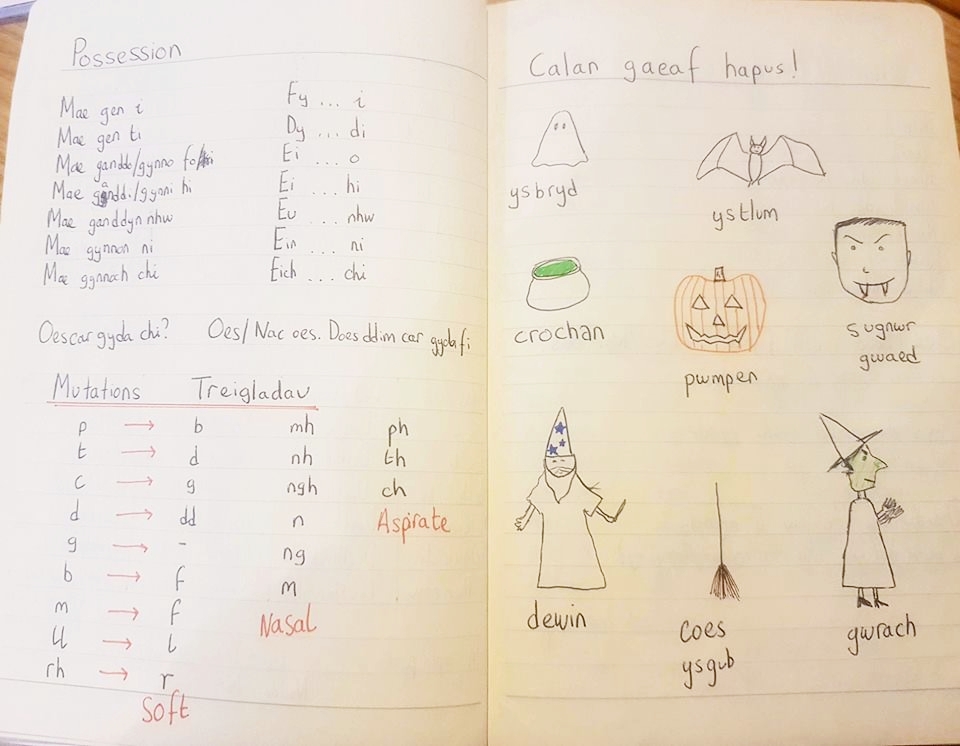
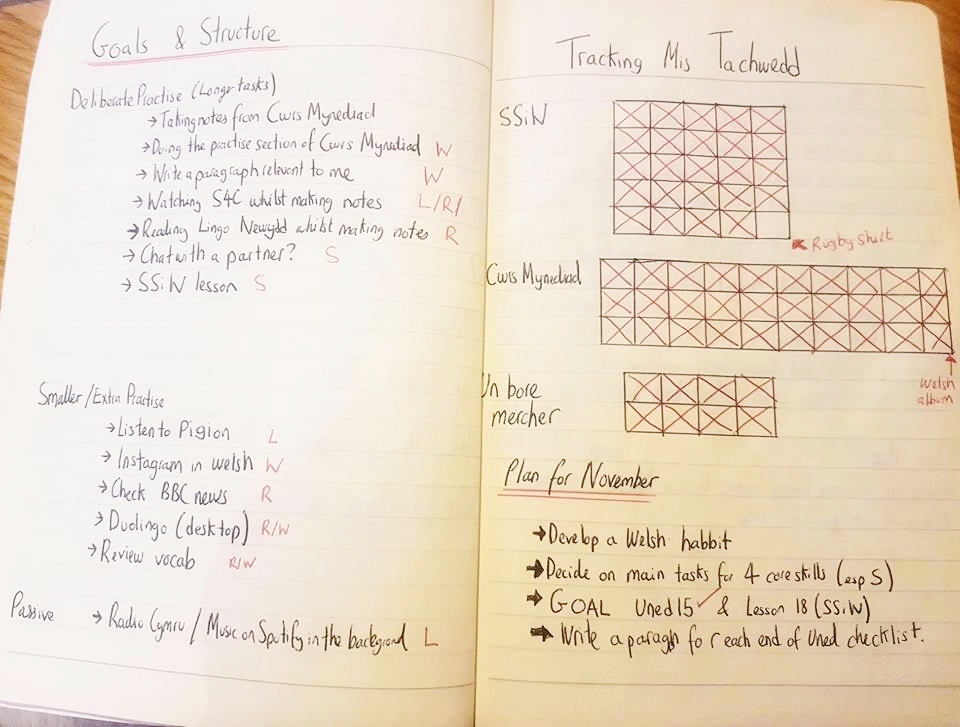
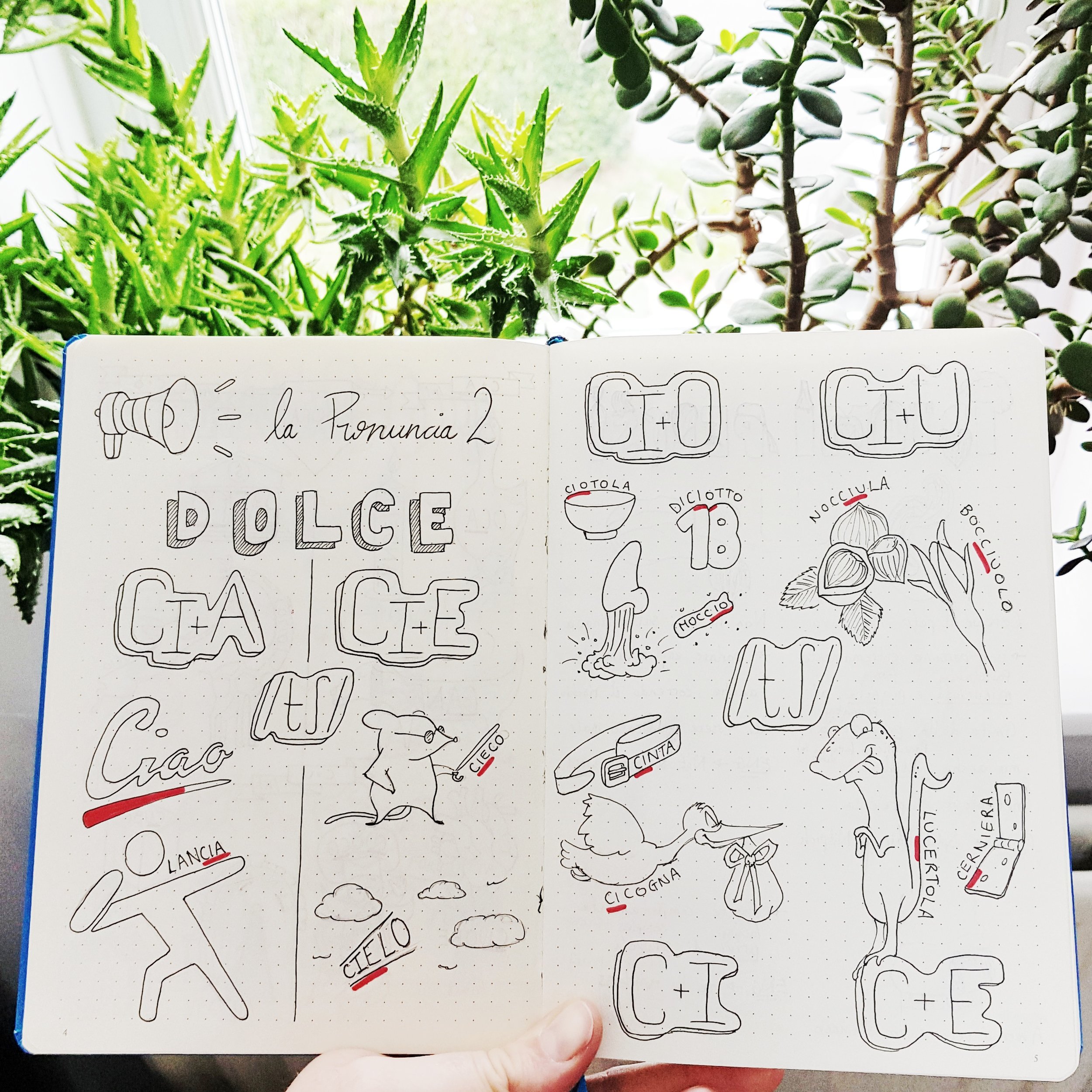
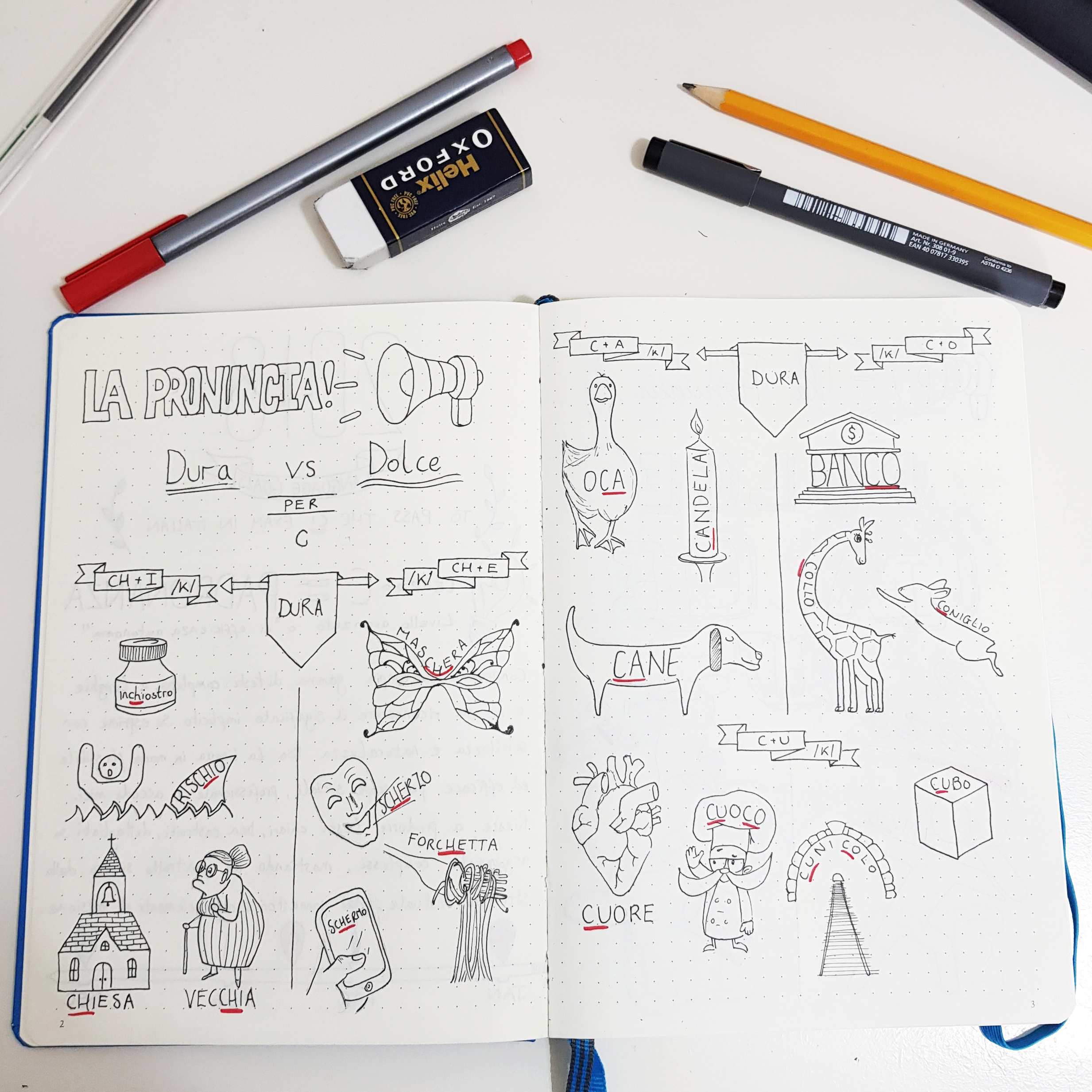
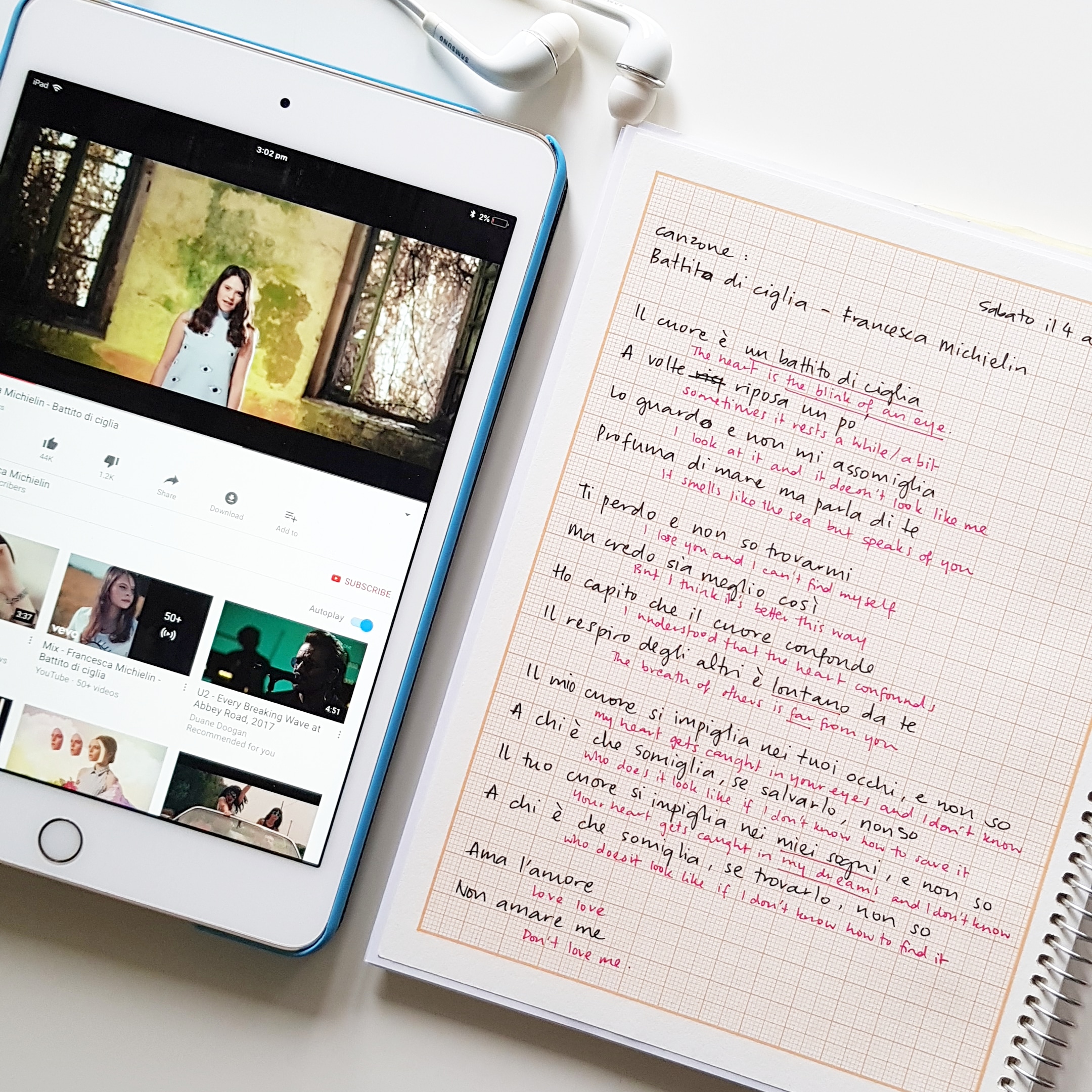
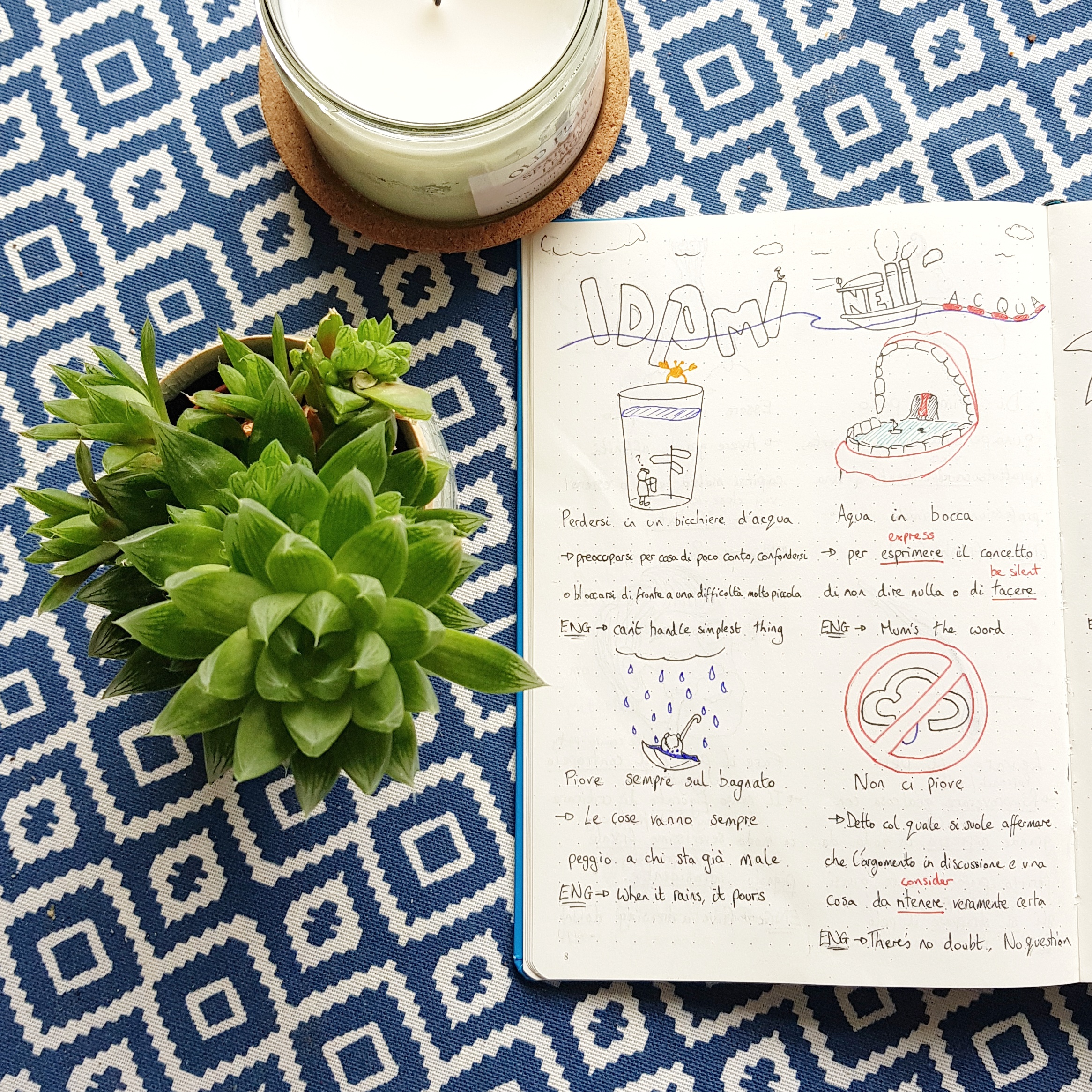
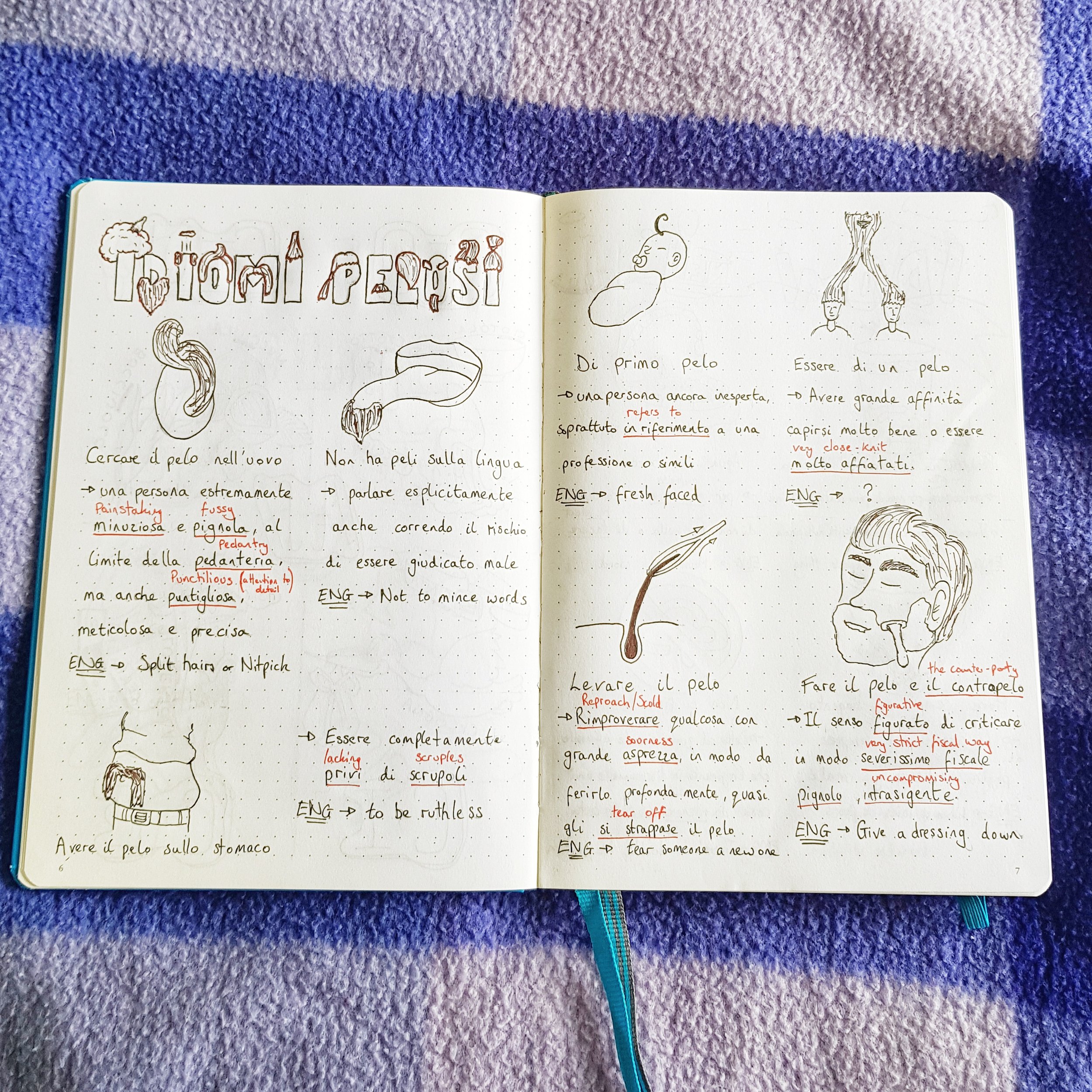

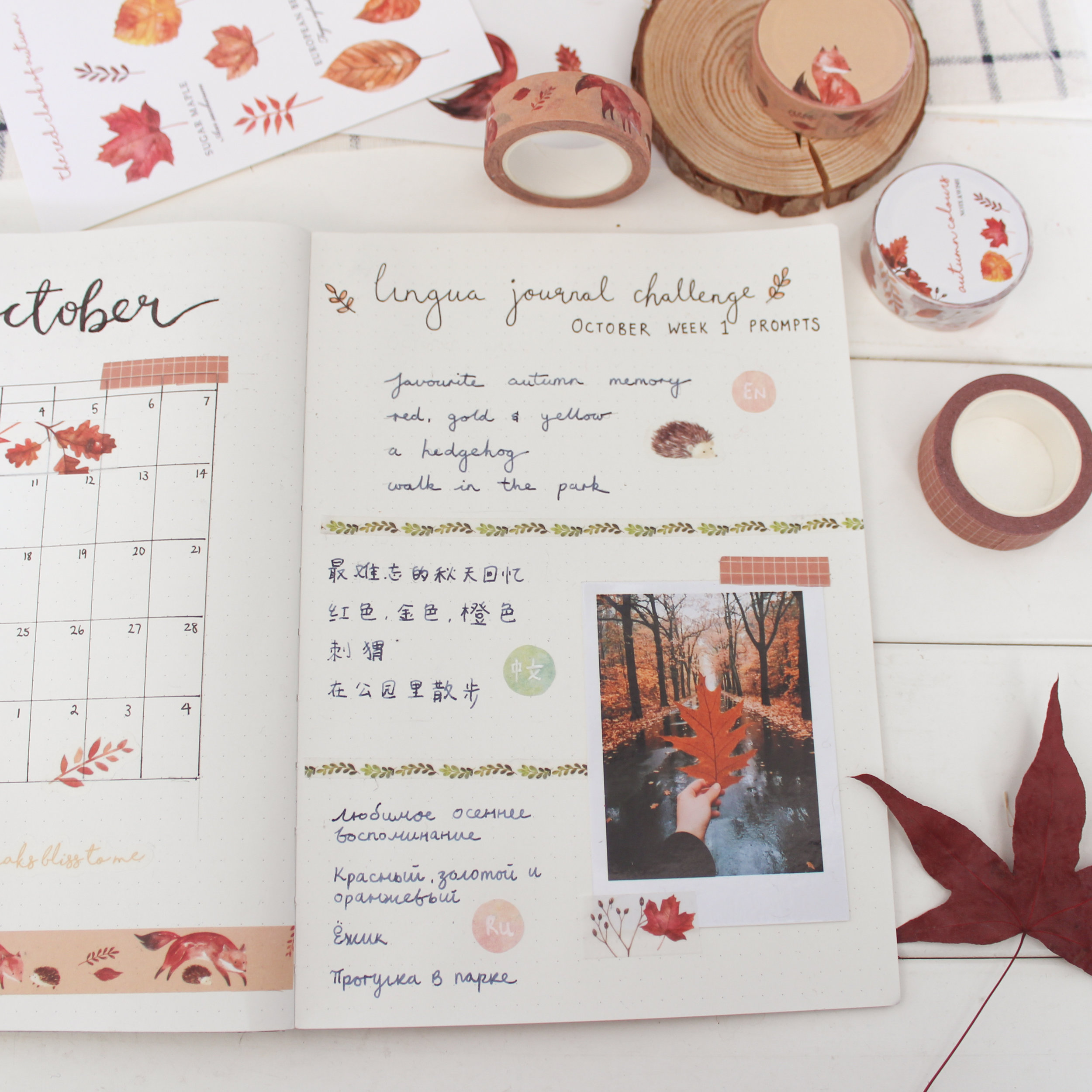


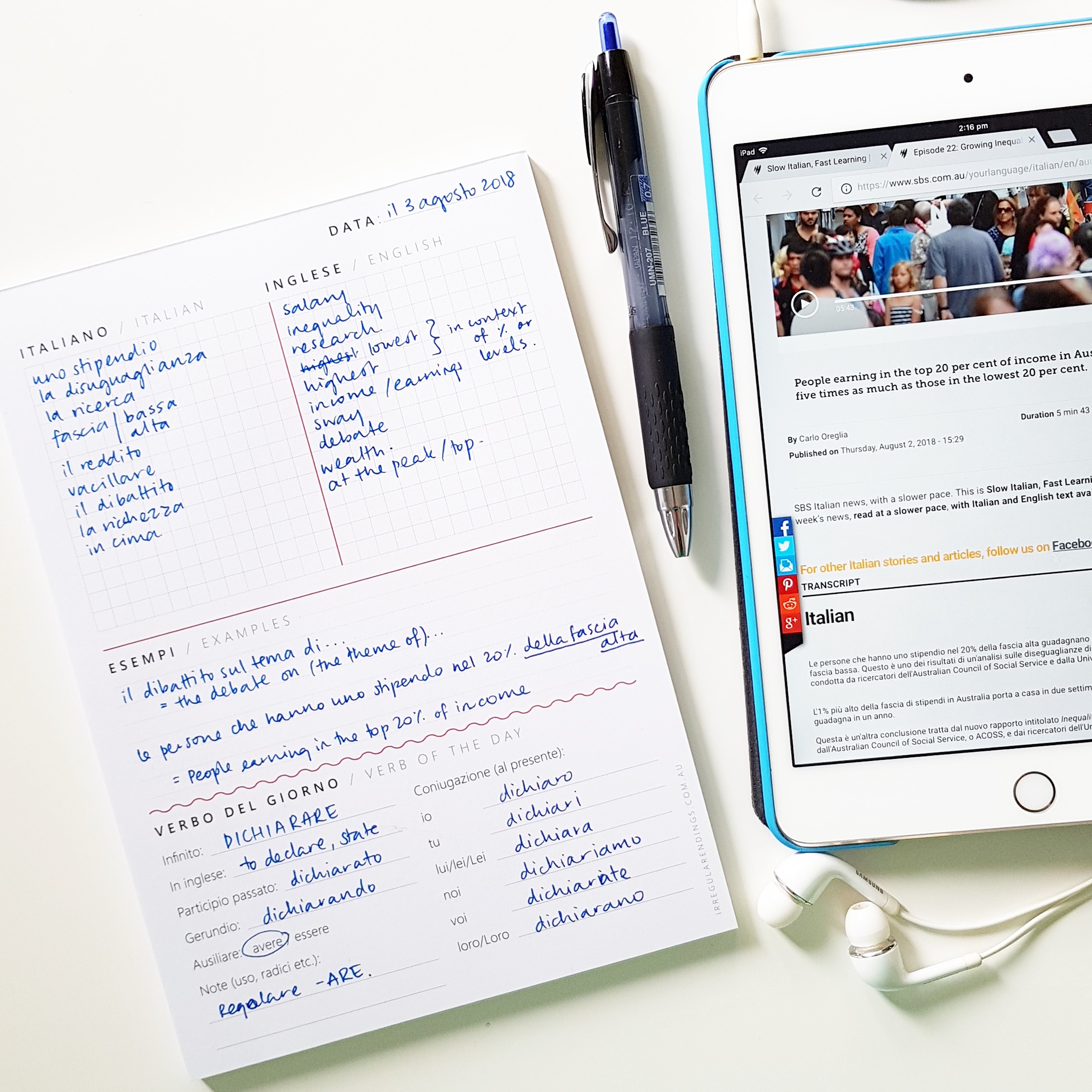
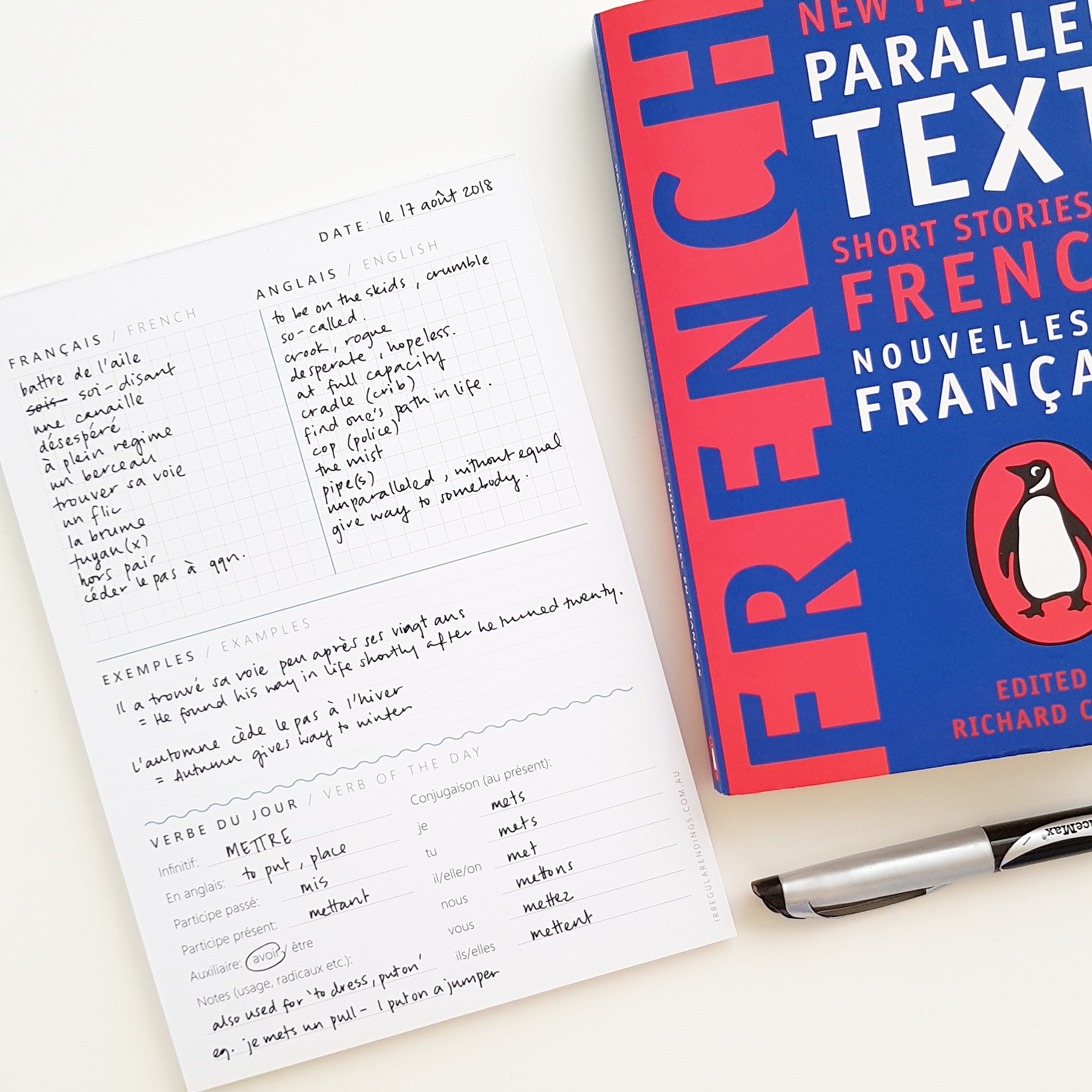
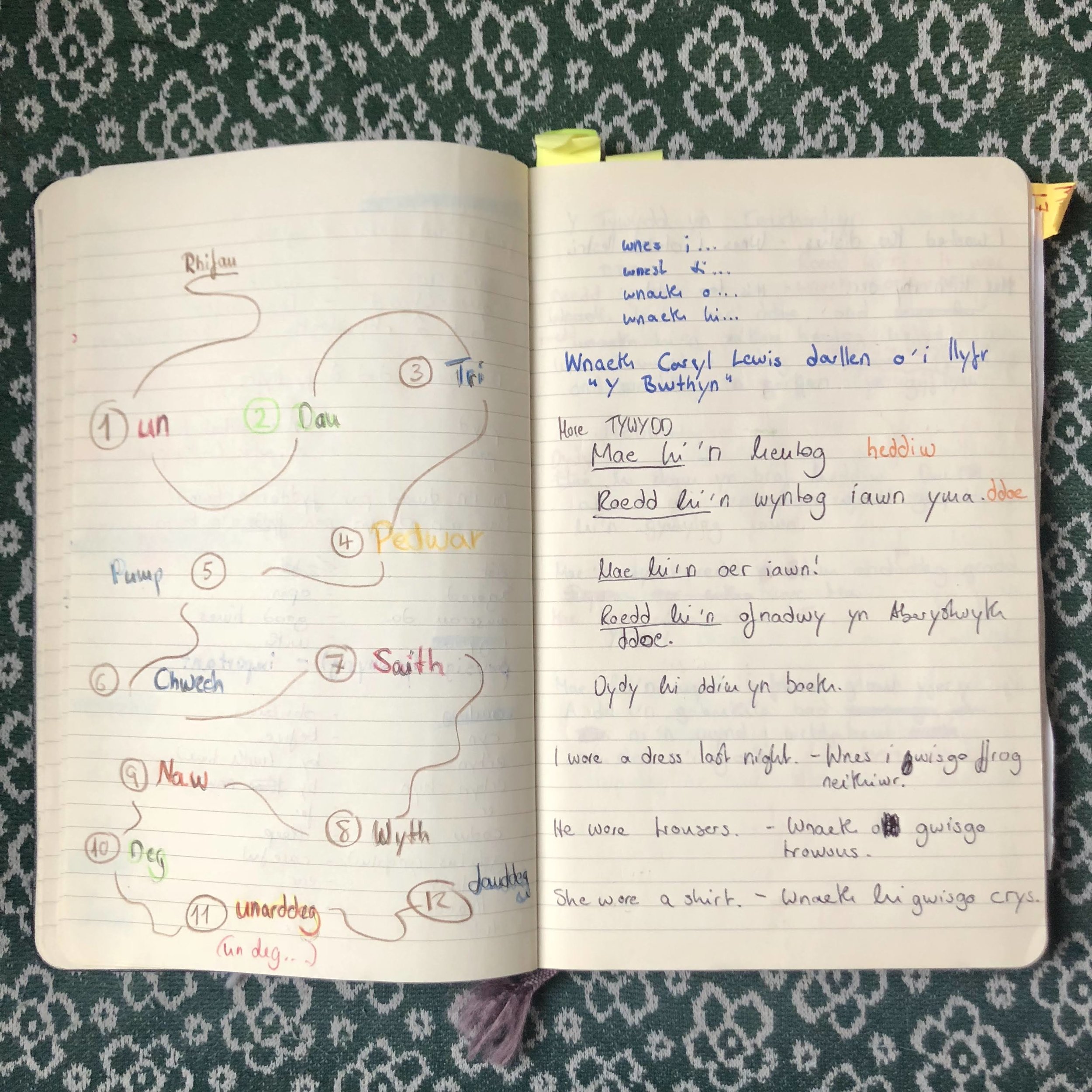
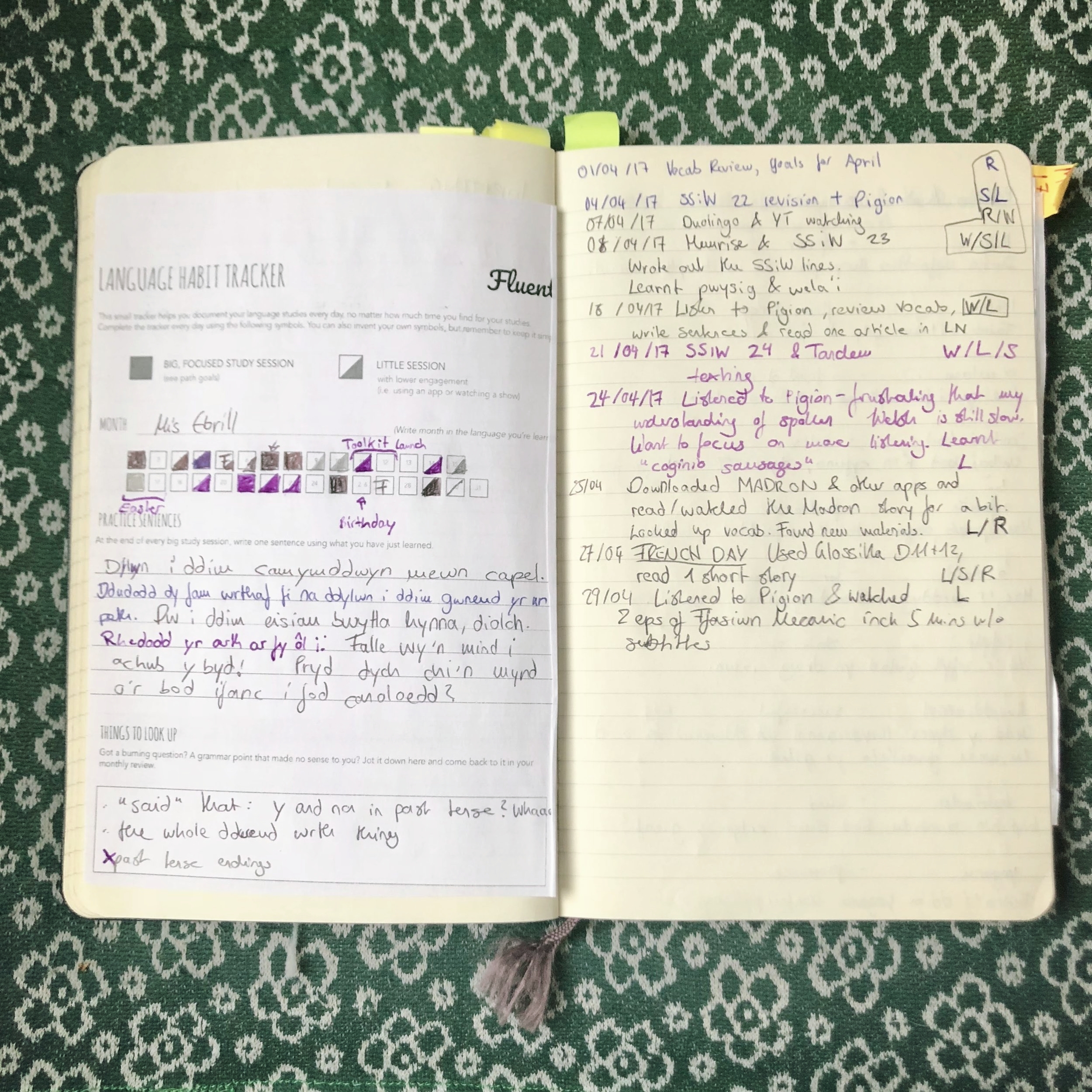
How To Work With The Language Notebook?
When you start learning languages, the notebook becomes more than just the place to note down the bare facts. You can use it for two core purposes:
1. Language Learning
Noting new vocabulary as and when you hear it, drawing memory aids, mapping out your memory palace even. Notebooks are also the right space to write down grammar rules and example sentences. On the pages of my own notebook, I see pronunciation notes and alphabet practice. Basically, anything.
For reviewing and testing yourself, there can be pages dedicated to vocabulary learning. My technique for such pages is to create special reference sections. This works in any book or journal, and you can learn it step by step in my $9 course, Write Your Way to Fluency. .
Here is an example of what this looks like in my current book:

It is easy to highlight words that I tend to forget, and even easier to add them to another list at a later stage so that my revision materials always stay fresh.
At the start of every new session, try looking through previous pages to review what you have learnt before. There is no need to memorize it word for word, but it will jog your memory and set up the ground today’s session can grow from.
2. Goal Setting and Productivity
Language learning is a big journey. For some learners it’s about growth and development, for others it’s a hobby or an aspiration. No matter what your goals and motivations are, you can gain a lot from creating a language learning journal..
Consider adding interesting facts about places, drawing maps or pasting in tickets and mementos from your trips.
Again, writing by hand and focusing on the book in front of you aids clarity and minimises distraction. In a busy world full of overachievers, this is more important than ever.
Here are some more ideas for what you can write in your language learning journal:
Vocab doodles or lists
Jokes & Cute Pictures
Repeat and review things you learnt from YouTube or a podcast
All types of language learning goals and motivations
Memories from cool things you’ve done
Tracking: Core skills balance, daily contact with an app
Your resource lists
Weekly learning plans
Ready to transform your language learning journey with just a pen and paper?
Join Write Your Way to Fluency for only $9! Dive into a world where motivation meets organization, and discover how a simple journal can become your most powerful tool for mastering a new language.
How Can You Navigate Your Language Learning Notebook?
One of the downsides of paper is that it doesn't have a search bar.
To aid yourself with a bookmark system, consider colour-coding areas like "grammar", "vocab" or "situations". Again, the beauty of your notebook is that this is your personal space. You’re no language learning robot, so work with what feels good to you.
The great thing about building your personal language learning system is that these categories can be unique to you and help you build the exact language course that you need (remember that this is one of the core principles in independent language learning).
My favourite bookmarks are sticky notes such as this cute set from Filofax, but this isn't the only way. You can experiment with a notebook in sections, with highlighter pens or beautiful bookmarks.
Good Notebook Options
You can get paper from anywhere of course, but the best language learning notebooks are durable and built to handle a bit of use.
Go for a notebook that is bound like a real book and lasts you all year. Next, discard any paper that is too thin or delicate to take scribbles, highlighters and different kinds of pen. You never know when you'll want to write something down and all you'll have to reach for is your auntie's fountain pen.
The style of paper does not matter - go for squared, lined or blank and pick a paper size that gives you a little space to work with. The language learning notebook works best it doesn't fill up too quickly. My favourite options are:
Frequently Asked Questions
How to Use A Bullet Journal for Language Learning
Having a bullet journal can be an incredibly effective tool for language learning, combining the flexibility of a notebook with the structure of a planner. Bullet Journaling not only improves productivity, it is also extremely flexible in terms of personalizing it for your own needs
Pinterest is excellent to see how other people are designing their bullet journals and to get inspiration for your own.
To keep simple, you set yourself a number of keys, which basically mean you choose which symbols have which meanings. Clarifying your keys is, pun intended, key to using bullet journaling successfully.
Once your keys are sorted, you need to decide on a format. This, however, doesn’t need to be strictly adhered to – indeed, I would actually encourage you to try out different things, since you will know when you’ve got a format that works for you. I like planning my whole year very briefly at the end or the beginning of my notebook. I use a Leuchtturm 1917 with dotted pages, having weekly spreads with the key events from each day, then doing daily pages with detailed to dos and agendas.
Why Do You Need a Language Learning Journal?
A language learning journal is an essential tool that helps you learn a new language more effectively and enjoyably.
Here's why a language learning journal is essential:
Progress Tracking: Helps you visually track your improvements and milestones.
Focused Improvement: Allows you to identify and concentrate on areas needing more work, like grammar or vocabulary.
Memory Aid: Writing down new information helps in better retention.
Customized Learning: Lets you tailor your notes with examples and visuals that make learning more fun and effective.
Self-reflection: Offers a space to ponder your learning methods and discover what techniques suit you best.
Share This Blog to Spread Language-Learning Inspiration With Your Friends!
Share this link on your Instagram stories or Facebook so your friends can create their own personalised language journal: https://www.fluentlanguage.co.uk/blog/language-notebooks.
Who knows, maybe you'll motivate someone to start learning. The more people you know who are learning a language, the more motivated you are!
Don't forget to tag @kerstin_fluent on Instagram or @fluentlanguage on X when you share it!
Further Links
Write Your Way to Fluency, your easy guide to creating the best language learning journa. (just $9)
How To: Bullet Journal for Effective Language Learning by Fluent Language
The Language Habit System | Fluent Language — Templates for building your language learning routine

How To: Bullet Journal for Effective Language Learning
Have you ever found yourself in a really good language learning flow, only to have a couple of days off and fall off the wagon? I know this has happened to me numerous times, whether when learning a language, trying to work out daily, or even trying to keep a housecleaning routine.
But now there's a perfect and beautiful answer: the Bullet Journal. Could this powerful paper-based organisation system help you get fluent in another language? Let's dive in and check it out!

Have you ever found yourself in a really good language learning flow, only to have a couple of days off and fall off the wagon? I know this has happened to me numerous times, whether when learning a language, trying to work out daily, or even trying to keep a housecleaning routine. You're doing great, you're feeling organised, and then you have a day off or a temptation and you just can't seem to get back on track.
So what if you had a system to organise your housecleaning routine or language learning that was proven to improve productivity? Bullet Journaling not only improves productivity, it is also extremely flexible in terms of personalizing it for your own needs. Personally, I’m never as efficient as when I’m using the bullet journal system.
So how does it work?
It’s fairly simple, really. You set yourself a number of keys, which basically mean you choose which symbols have which meanings. Clarifying your keys is, pun intended, key to using bullet journaling successfully.
These are the keys I personally use in my bullet journal, however a quick google search or Pinterest search will give many more options.

Once your keys are sorted, you need to decide on a format. This, however, doesn’t need to be strictly adhered to – indeed, I would actually encourage you to try out different things, since you will know when you’ve got a format that works for you. I like planning my whole year very briefly at the end or the beginning of my notebook. I use a Leuchtturm 1917 with dotted pages, having weekly spreads with the key events from each day, then doing daily pages with detailed to dos and agendas.
You can also incorporate spreads and pages for anything you want to track, such as:
- Food eaten
- Water consumption
- Budget and spending
- Daily gratitude
- Workouts
- Words written
- And – you guessed it – language learning.
Have you thougth about creating these spreads in your target language?
Since bullet journaling is almost sure to guarantee you to stay on track, the system is perfect for scheduling your everyday language learning habits.
How To Use It For Language Learning

Snapshot of my own goal setting spread from the Bullet Journal
My number one tip would be to use Pinterest for inspiration for this! Pinterest is excellent to see how other people are designing their bullet journals and to get inspiration for your own. Personally I have a folder just for bullet journal inspiration - it can become an addiction! - and whenever I am struggling for ideas I have a browse in there.
Abigail from Polyglot Progress has also made a really informative video on how to use bullet journaling for language learning, perfect to ease yourself into the system!
The Language Habit Toolkit
Another option, if you do like things to be ready made for you, is the Fluent Language Habit Toolkit. The toolkit combines the best parts of the bullet journal system and effective language learning into one cohesive package.
I started working on it in my own bullet journal, as I realised that there was no all-in-one system out there offering goals, tracking, and review.
The kit is designed to be printed out as either A4 or A5 and is perfect to glue into a notebook for easier overview of your progress. It provides you with a complete set of tools that you can use to make steady progress and start building towards fluency in any language, and is based on 20 years experience of teaching languages.

So what are you waiting for? The possibilities are limitless with this system, and I can't wait to see what you do with yours! Please feel free to tag @fluentlanguage on Twitter or @kerstin_fluent on Instagram to share your creations.




Struggling with listening? Discover realistic tips, challenge prompts, and the best tools for improving your listening skills as a self-guided language learner